
Who invests in RL environment startups?
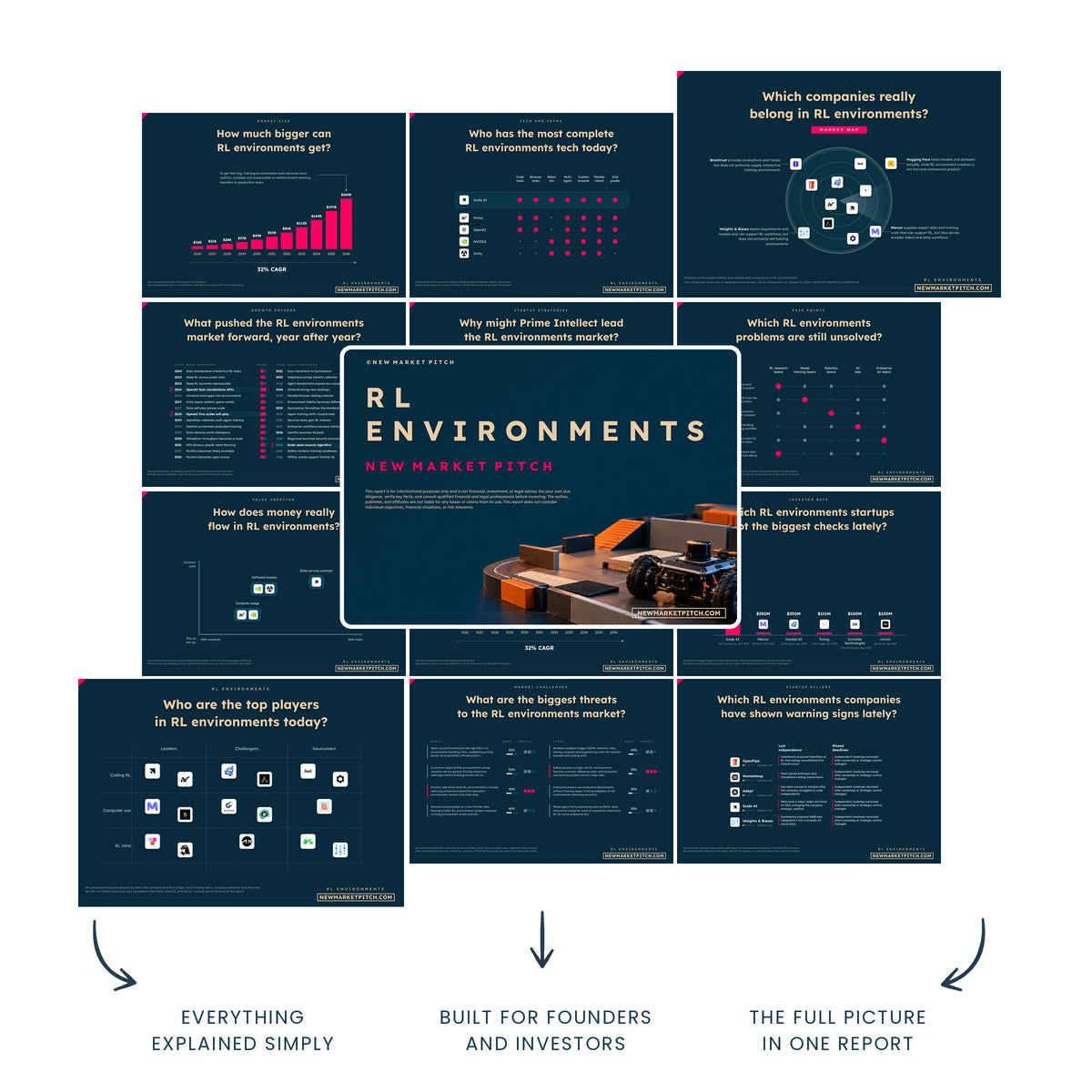
Whether you're building or investing in the RL environments market, our report covers everything you need to know: the players, the money, and what's coming next.
Summary
General Catalyst is the most active RL environments investor, with 5 rounds joined and 4 named leads. NVIDIA and Jeff Dean are tied behind it at 4 rounds each. They appear just as often as each other, though neither has a named lead in the rounds we counted.
That tells us more than a list of famous backers would. RL environments include expert-built tasks, simulated workplaces, coding practice and systems that check whether AI agents actually finish a job. Investors are backing different pieces of that process.
General Catalyst covers much of the field through Mercor, Proximal, Luel and Good Start Labs. Its investments reach from professional expertise to coding challenges and game environments.
NVIDIA has a different role. It participated in rounds for Scale AI, Mercor, Prime Intellect and SuperAnnotate, giving it exposure to the data and software that make AI training useful alongside its computing business.
Felicis made a concentrated bet on Mercor. Andreessen Horowitz backed Deeptune and Preference Model, while Oak HC/FT went after the harder-to-simulate work of finance and medicine. These are distinct bets, even when all the companies talk about improving agents.
Jeff Dean is unusually visible for an individual investor. All 4 of his recorded rounds were seed deals, putting him alongside the most active institutional names by participation.
Seed remains the most common stage: 24 of the 49 rounds that name an investor and have a known stage fall there. General Catalyst and Jeff Dean joined 4 seed rounds apiece. That is where investors are testing which kinds of environments are worth building.
Later rounds attract a different mix. NVIDIA joined 2 Series D and later rounds, though a round's headline amount says nothing about how much NVIDIA itself committed.
Activity has continued this year. General Catalyst joined 3 rounds, and 19 of the 20 most active investors took part in at least one. A prominent name from last year is no guarantee of an investment this year.
For now, leadership is clearer than any supposed investor alliance. General Catalyst has the strongest repeated record of leading deals, while corporate backers, angels and specialist funds play different roles. Individual check sizes and long-term partnerships are much harder to establish.

Written by the New Market Pitch teamWe track new markets so founders and investors can move faster. About us

In our report covering the RL environments market, you will always find fresh funding data, taken straight from our own verified funding database.
Which VCs invest the most in RL environments right now?
General Catalyst tops RL environments investing right now, having joined 5 rounds and been named lead in 4.
NVIDIA and Jeff Dean are tied behind it on 4 rounds each, with no named leads. Felicis has joined 3 rounds. Across the market, we identified 97 named investors in 50 rounds where at least one backer was disclosed. A firm's appearance in a large deal says that it participated; it does not say how much it invested or who negotiated the terms. General Catalyst stands out because it repeatedly appears in the lead role across different companies, including Proximal, Luel and Good Start Labs, and it also joined Mercor's latest round. NVIDIA's investments cover more of the infrastructure and data ecosystem, while Dean appears as an individual early backer.
The table below ranks the 20 most active RL environments investors by the number of equity rounds they joined, with the rounds they led, their main stages, the startups they backed and the biggest round they joined.
If you want to go more into detail and get more data to understand what investors are betting on now, please check our RL environments report.
| # | Investor | Rounds | Led | Main stages | RL environments startups backed | Biggest round joined | Latest round |
|---|---|---|---|---|---|---|---|
| 1 | General Catalyst ▲ | 5 | 4Named as lead in every round found (lead known for 4 of 5 rounds) |
Seed 4Series D+ 1 | Mercor, Proximal, Luel, Good Start Labs | $31MLuel · 2026 | Nov 2026 |
| 2 | NVIDIA | 4 | 0Never led (lead known for 3 of 4 rounds) |
Series D+ 2Series A 1 | Scale AI, Mercor, Prime Intellect, SuperAnnotate | $130MPrime Intellect · 2026 | Nov 2026 |
| 3 | Jeff Dean ▼ | 4 | 0Never led (lead known for 2 of 4 rounds) |
Seed 4 | Bespoke Labs, Phinity, BenchFlow, Hillclimb | $8.2MBespoke Labs · 2024 | Oct 2026 |
| 4 | Felicis ▼ | 3 | 2Named as lead in every round found (lead known for 2 of 3 rounds) |
Series B 1Series C 1 | Mercor | $350MMercor · 2025 | Nov 2026 |
| 5 | Oak HC/FT | 2 | 2Named as lead in every round found | Seed 1Series A 1 | Halluminate, Alterra Labs | $30MHalluminate · 2026 | Nov 2026 |
| 6 | Andreessen Horowitz | 2 | 2Named as lead in every round found | Seed 1Series A 1 | Deeptune, Preference Model | $43MDeeptune · 2026 | Oct 2026 |
| 7 | Benchmark | 2 | 1Named as lead in every round found (lead known for 1 of 2 rounds) |
Series A 1Series D+ 1 | Mercor | $30MMercor · 2024 | Nov 2026 |
| 8 | Gradient | 2 | 1Leads half its rounds | Seed 1Series A 1 | Plato | $16MPlato · 2026 | Oct 2026 |
| 9 | Chemistry | 2 | 1Leads half its rounds | Seed 1Series A 1 | Proximal, Datacurve | $15MProximal · 2026 | Sep 2026 |
| 10 | Dell Technologies Capital | 2 | 1Leads half its rounds | Series A 1Series B 1 | Prime Intellect, SuperAnnotate | $130MPrime Intellect · 2026 | Jul 2026 |
| 11 | Founders Fund | 2 | 1Named as lead in every round found (lead known for 1 of 2 rounds) |
Seed 2 | Prime Intellect, Symbal | $15MPrime Intellect · 2025 | Feb 2025 |
| 12 | SV Angel | 2 | 0Never led (lead known for 1 of 2 rounds) |
Seed 2 | Proximal, Fleet AI | $15MProximal · 2026 | Sep 2026 |
| 13 | Datadog Ventures | 2 | 0Never led | Series A 1Series B 1 | Patronus AI | $50MPatronus AI · 2026 | Jun 2026 |
| 14 | Y Combinator | 2 | 0Lead not published | Seed 2 | HUD, Polymath | $500KHUD · 2025 | 2026 |
| 15 | Team8 | 1 | 1Named as lead in its only round found | Seed 1 | Plurai | $13MPlurai · 2026 | Nov 2026 |
| 16 | Nava Ventures | 1 | 1Named as lead in its only round found | Series A 1 | Plato | $16MPlato · 2026 | Oct 2026 |
| 17 | Infinitum Partners | 1 | 1Named as lead in its only round found | Series D+ 1 | Labelbox | $93MLabelbox · 2026 | Oct 2026 |
| 18 | Uncork Capital | 1 | 1Named as lead in its only round found | Seed 1 | Phinity | $5.2MPhinity · 2026 | Oct 2026 |
| 19 | Dream Ventures | 1 | 1Named as lead in its only round found | Series B 1 | micro1 | $100Mmicro1 · 2026 | Sep 2026 |
| 20 | Insight Partners | 1 | 1Named as lead in its only round found | Series D+ 1 | Snorkel AI | $350MSnorkel AI · 2026 | Sep 2026 |
No investors match this search.
Data from January 2024 through 13 November 2026, which is enough to show who is active today and who has been for years. Rounds: equity rounds in which the investor is named. Led: rounds it led or co-led. ▲ more rounds in 2026 so far than its 2025 pace, ▼ fewer.

In our research about RL environments startups, we turn what is vague and complex into simple, useful visuals. Market maps like this one show you at a glance where every startup stands.
Is General Catalyst really leading RL environments deals?
Across several RL environments companies, General Catalyst has been named lead in 4 rounds.
We found its name beside Mercor, Proximal, Luel and Good Start Labs. Those companies give AI models different kinds of practice: expert-created work, hard coding problems, rights-cleared training material and game-based tasks. General Catalyst has spread its interest across several ways of making AI agents more reliable.
The announcements still need careful reading. Luel's own announcement names General Catalyst and Lightspeed as co-leads of its $31M seed, while Mercor's latest financing named General Catalyst as a participant without specifying a lead. We count leadership only when it is named. Even with that rule, General Catalyst's record is wider than a fund repeatedly joining rounds for one popular startup. A founder looking for an investor willing to back a new RL environment business has stronger evidence here than a brand name on a crowded financing announcement.
Does NVIDIA lead investments in RL environment startups?
NVIDIA is a major participant in RL environments financing, but none of its 4 recorded rounds identifies it as lead.
Its investments span Scale AI, Mercor, Prime Intellect and SuperAnnotate. Each supplies some part of the process that turns raw computing power into better-trained agents, whether that means expert feedback, executable tasks or running training jobs. That creates a clear connection with NVIDIA's larger business, but participation does not prove that the company set the financing terms.
Prime Intellect offers a concrete example. The company said Radical Ventures led its $130M Series A, while NVIDIA Ventures, Dell Technologies Capital and Intel Capital joined. NVIDIA also participated in Scale AI's large later-stage financing without a named lead role. So NVIDIA is tied near the top on activity, yet investors looking specifically for the firms that originate RL environment rounds should look elsewhere.

In our market report about RL environments startups, we always try to gather several sources and make estimates that make sense, so you can work with solid numbers.
Are Andreessen Horowitz and Sequoia investing in RL environments?
Andreessen Horowitz has led RL environments investments, while Sequoia does not appear among the most active named backers.
Andreessen Horowitz joined 2 qualifying rounds and was named lead in both. One was Deeptune's $43M Series A, which financed realistic copies of business software where agents could practice tasks. The other involved Preference Model, a company working on reward signals and environments designed to expose when models exploit scoring shortcuts. Both investments focus on whether an agent can finish a sequence of real work and be judged fairly.
Deeptune's later acquisition by Mercor made that thesis more concrete: a company that originally matched experts with AI labs wanted working software environments too. Sequoia's absence says less. It simply does not show up as a repeat backer in the rounds we counted, which does not rule out other investments. In this field, the recognizable VC logo matters less than the actual company and the role the investor took.
Who keeps backing Mercor as it expands into RL environments?
Felicis has made one of the clearest repeat bets on Mercor's RL environments expansion, leading 2 of its 3 recorded rounds.
Felicis led Mercor's Series B and its $350M Series C, then appeared again in Mercor's latest investor group. That is a concentrated choice. Other investors spread their activity among coding gyms, simulation tools and data businesses; Felicis repeatedly backed the same company as it moved beyond matching skilled professionals with AI labs.
Mercor now builds professional evaluations and has acquired Deeptune's simulated business software. Its recent Series D+ announcement described more investment in post-training and enterprise agents. Felicis now backs a platform that can buy or build several kinds of environments. That gives the fund a meaningful position in Mercor, even though it trails broader investors by deal count.
Can angel investors keep up with VCs in RL environments?
Jeff Dean shows that individual investors can match major funds in RL environments: he joined 4 seed rounds in his personal capacity.
The startups are Bespoke Labs, Phinity, BenchFlow and Hillclimb. Their work ranges from testing AI agents to engineering tasks that can be checked for correct results. Phinity's announcement, for example, named Dean alongside Uncork Capital and other supporters as it described agents that design chips and test their own output. These are technically demanding products whose early value may be clearer to researchers than to conventional software investors.
Dean was not identified as lead in the rounds we counted. Uncork Capital led Phinity's financing. That difference matters to a founder: a well-connected technical angel can help validate an idea, while a fund leading the round usually takes on the work of assembling its financing. Counting only institutional VC brands would miss Dean's visible role at the start of this market.
Which RL environments investors are still investing this year?
General Catalyst is the most active RL environments investor this year, with 3 joined rounds, compared with 1 last year.
Among the 20 most active investors, 19 have participated this year and 1 has not. General Catalyst's latest appearance was in Mercor's recent financing; other active names include early-stage funds, corporate investors and angels. We counted 23 rounds with at least one named investor this year against 18 last year, although those counts should never be mistaken for amounts invested by any one backer. A fund's pace can change with the timing of its portfolio companies' financings. What we can say now is that this market is still attracting named participants, with General Catalyst the busiest of them.
The table below shows, year by year, how many rounds 12 of the most active RL environments investors joined, so it is easy to see who is still investing and who has slowed down.
If you want to go more into detail and see which investors are still writing checks and which have slowed down, please check our RL environments report.
| Investor | 2024 | 2025 | 2026* | Total |
|---|---|---|---|---|
| General Catalyst | 1 | 1 | 3 | 5 |
| NVIDIA | 2 | 2 | 4 | |
| Oak HC/FT | 2 | 2 | ||
| Andreessen Horowitz | 2 | 2 | ||
| Jeff Dean | 1 | 2 | 1 | 4 |
| Felicis | 2 | 1 | 3 | |
| Benchmark | 1 | 1 | 2 | |
| Gradient | 1 | 1 | 2 | |
| Chemistry | 1 | 1 | 2 | |
| Dell Technologies Capital | 1 | 1 | 2 | |
| SV Angel | 1 | 1 | 2 | |
| Datadog Ventures | 1 | 1 | 2 |
* 2026: January to 13 November. Darker cells mean more rounds that year. Data from January 2024 through 13 November 2026.

Our document detailing everything you need to know about RL environments gets updated several times a month, so you always get the latest view of where things stand.
Are the early backers of RL environments still investing?
Some early RL environments investors are still making fresh bets, while others have no newly recorded deal this year.
General Catalyst is busier than last year. Jeff Dean and Felicis have each joined fewer rounds, while continuing to support companies they already know. Neither a slower pace nor a missing deal means a firm has abandoned the category: Dean participated in Phinity's seed, and Felicis remains invested in Mercor as it moves into workplace environments.
Founders Fund has no new qualifying round this year after backing Prime Intellect and Symbal in earlier seed financings. Meta no longer appears among the most active names: its June 2025 deal with Scale AI bought shares from existing holders, so it is not a funding round. For founders, recent participation matters more than an old press release. Early portfolios can keep growing commercially even when their investors do not show up in a new financing announcement.
Has Meta stopped putting money into RL environment startups?
Meta has no named RL environments investment round this year in our count, following its earlier participation in Scale AI.
Meta joined 1 qualifying round, Scale AI's Series D+ in May 2024. Its June 2025 investment in Scale AI paid existing shareholders for their stock, so we do not count it as a funding round. That relationship was unusual. Scale announced an equity investment and a deeper commercial partnership, while founder Alexandr Wang moved to Meta's AI efforts. Meta was securing a relationship with a major supplier of training data and evaluation work alongside its ownership stake.
NVIDIA, by contrast, joined 2 rounds this year. The records make that difference plain. It says nothing definite about Meta's current purchases from data vendors or its internal work on RL environments. Those activities are not private funding rounds. For an entrepreneur seeking a new outside investor, Meta's earlier strategic deal is weak evidence that it is actively leading new startup financings today.
Are corporate investors taking over RL environments funding?
Corporate investors have not taken over RL environments financing; independent venture firms still lead many of the disclosed rounds.
NVIDIA participated without a named lead. Dell Technologies Capital joined 2 rounds, covering Prime Intellect and SuperAnnotate, with 1 named lead. Datadog Ventures joined 2 rounds involving Patronus AI without leading either in our records. Meta's only counted round is Scale AI's 2024 Series D+. Together, these companies have good reasons to watch how agents are trained, tested and deployed.
General Catalyst has the strongest named lead record, while Andreessen Horowitz and Felicis also originated rounds. Prime Intellect's Series A is a useful example: Radical Ventures led the financing and several technology investors participated. Corporate money is visible because RL environments touch major AI platforms, chipmakers and enterprise software vendors. Founders still need to distinguish between a strategic participant and a VC willing to price and lead the deal.
Which RL environments investors back seed rounds, and which back growth rounds?
Seed is the most common stage in RL environments financing, with 24 of the 49 rounds that name an investor and have a known stage.
General Catalyst and Jeff Dean are tied at 4 seed rounds each. At the other end, we counted 9 rounds at Series C or later, and NVIDIA leads Series D and later participation with 2. Look at the companies, and the split makes sense. New coding and workflow gyms often start with a small group of technical backers, while mature data and evaluation businesses such as Scale AI and Mercor bring in large corporate investors and established funds. A large round belongs to the whole financing group; it cannot be assigned to the most famous participant.
The table below shows, for 12 of the most active RL environments investors, how many rounds they joined at each stage, from seed to growth.
If you want to go more into detail and see where each investor places its bets, from seed to growth, please check our RL environments report.
| Investor | Seed | Series A | Series B | Series C | Series D+ | Growth |
|---|---|---|---|---|---|---|
| General Catalyst | 4 | · | · | · | 1 | · |
| NVIDIA | · | 1 | 1 | · | 2 | · |
| Jeff Dean | 4 | · | · | · | · | · |
| Felicis | · | · | 1 | 1 | 1 | · |
| Oak HC/FT | 1 | 1 | · | · | · | · |
| Andreessen Horowitz | 1 | 1 | · | · | · | · |
| Benchmark | · | 1 | · | · | 1 | · |
| Gradient | 1 | 1 | · | · | · | · |
| Chemistry | 1 | 1 | · | · | · | · |
| Dell Technologies Capital | · | 1 | 1 | · | · | · |
| Founders Fund | 2 | · | · | · | · | · |
| SV Angel | 2 | · | · | · | · | · |
Most active at each stage, among all RL environments investors: Seed, General Catalyst and Jeff Dean · Series A, no investor joined more than one round · Series B, no investor joined more than one round · Series C, no investor joined more than one round · Series D+, NVIDIA · Growth, no investor joined more than one round. Bigger dots mean more rounds. Data from January 2024 through 13 November 2026.

In our report covering the RL environments market, we look at what the winners do differently, so you can learn from the best instead of guessing.
Who leads the first funding rounds for RL environment startups?
General Catalyst is a repeat seed lead for RL environments, while Jeff Dean matches its early activity as an individual participant.
Both joined 4 seed rounds. General Catalyst backed companies including Proximal and Good Start Labs, which design difficult coding tasks and game-based training worlds. Jeff Dean joined Phinity's seed financing, led by Uncork Capital, for agents that can try engineering solutions and verify their results. The job of a lead fund and the help of a respected technical angel can be quite different.
The choice is wider than those names. Team8 led Plurai's $13M seed to build agent simulations; Andreessen Horowitz led Preference Model; Oak HC/FT backed Alterra Labs' medical environments. Those investments ask a practical question: can the startup offer tasks that AI labs cannot easily reproduce and reliably score? The examples show there is room for a focused product. Individual investment amounts remain private.
Does NVIDIA lead the biggest RL environments rounds?
NVIDIA is the most frequent named participant at Series D and later in RL environments, with 2 rounds, but it is not the disclosed lead in those deals.
Scale AI and Mercor help explain why NVIDIA appears in mature financings. Both businesses support model training and evaluation on a far wider scale than a specialist gym selling one kind of simulated task. Meta is visible around Scale AI; Felicis has repeatedly backed Mercor. The wider syndicates reflect the companies' different roles in the AI supply chain.
Round size does not always follow the usual seed-to-growth sequence. Prime Intellect raised a $130M Series A led by Radical Ventures, with NVIDIA Ventures and Dell Technologies Capital joining. Training infrastructure can need serious capital even at an early lettered stage. We can identify who joined and who was named lead. Without disclosed individual check sizes, nobody can credibly award the title of biggest investor by dollars spent.
Are investors favoring workplace simulations over coding RL environments?
RL environments investors are backing both workplace and coding simulations, without enough evidence to call either the clear winner.
Andreessen Horowitz funded Deeptune's replicas of enterprise software. Oak HC/FT backed Halluminate's finance-focused simulations and Alterra Labs' medical environments. Nava Ventures invested in Plato, which creates resettable workplace tasks. These companies train agents on work where the steps and the final result can be checked.
Coding remains a serious target. Proximal builds demanding software engineering practice, Phinity works on chip-design loops, and Prime Intellect lets customers run a wide range of training environments. The categories increasingly overlap: an agent completing a business workflow might need to write code, use a browser and recover after a failed action. We see clear investors on both sides, but no reliable category-by-category funding comparison in these records that would justify declaring the workplace side ahead.

Learning from others' mistakes is the cheapest lesson there is. In our research about RL environments startups, we look at what broke startups before you, so you don't repeat it.
Are RL environments investors backing real simulations or AI data companies?
Investors in RL environments back both established expert-data suppliers and newer companies selling executable training worlds.
Mercor, Scale AI, Luel and SuperAnnotate sit closer to expert knowledge, evaluation and training-data delivery. Mercor's APEX work uses professional tasks to test models, while Luel organizes rights-cleared multimodal material. These companies help model developers get useful feedback from people with expertise. Their businesses can also extend into scored, interactive tasks.
Deeptune, Halluminate, Plato and Plurai focus more directly on places where an AI agent can act, fail and try again. Their investors are taking a bet on software fidelity and outcome checking rather than primarily on finding expert contributors. Mercor's acquisition of Deeptune shows how those approaches can meet inside one product. Investors should still distinguish a dataset from an environment: the latter lets a model do a task and produces feedback on what happened. A marketing reference to reinforcement learning alone is not enough.
Which RL environments investors most often invest together?
Our records show no two RL environments investors backing more than 1 round together, so no regular investing duo stands out yet.
We identified 97 named investors, and in our records no two of them show up together in more than one round. That is a floor: Mercor's own announcements list General Catalyst and Felicis in both its Series C and its Series D+, while our Series C record names fewer participants. Individual syndicates can still be substantial. Prime Intellect announced Radical Ventures as lead alongside NVIDIA Ventures, Dell Technologies Capital and Intel Capital. Mercor's latest financing likewise named a long list of corporate and VC participants. A list of backers for one deal does not show that the same firms regularly finance companies together. Founders should identify who is prepared to lead their specific round instead of treating a one-time syndicate as a standing group.
Can specialist investors beat big generalists in RL environments?
Specialist RL environments investors can lead important deals, but General Catalyst remains ahead on the number of rounds joined.
Oak HC/FT joined 2 rounds and was named lead in both, backing Halluminate's financial-workflow environments and Alterra Labs' medical training simulations. These are areas where mistakes have real consequences and a convincing environment needs expert judgment as well as working software. Team8's investment in Plurai takes another approach: uncover failures before an agent is trusted with a customer's workflow.
General Catalyst has backed a wider set of products, from coding practice to games and expert data. That wider range is one reason a generalist can rank above a narrowly focused fund. It does not make Oak HC/FT's finance and medical expertise irrelevant. Founders choosing investors should care whether a fund understands the task they are building, while readers asking who is most active should still get the clear answer: General Catalyst.
Is funding for RL environments becoming an AI infrastructure bet?
RL environments are increasingly sold alongside AI training infrastructure, but they still need meaningful tasks and trustworthy scoring.
Prime Intellect combines computing, model training, environments, evaluations and deployment. Its $130M Series A was led by Radical Ventures and included NVIDIA Ventures, Intel Capital and Dell Technologies Capital. Radical's investment argument was that businesses want to improve their models on their own work. That requires tasks they can run repeatedly and score reliably.
Plurai exposes agent failures through simulation; Halluminate builds financial tasks; Proximal makes coding practice. An ordinary server can execute a program, while a useful RL environment also defines a job, makes actions possible and checks the result. Investors are paying attention to the connection between model training and real work. Whether the specialist vendors keep their own customers or become features inside broader platforms remains open.

If you build or invest in the RL environments market, you need to know which business models pay off now and which ones are fading. That's why our report covering it has a whole section on it.
Can new RL environment startups still find investors willing to lead?
New RL environments companies are still finding named lead investors, especially when their tasks are hard to replicate.
Team8 led Plurai's $13M seed for simulations that expose where enterprise agents fail. Uncork Capital led Phinity's seed, which focuses on verifying AI-designed chips. Oak HC/FT led Halluminate's $30M Series A to build financial-workflow environments. These products are different, but each gives an agent something concrete to do and a way to judge whether it succeeded.
A founder cannot assume that adding a simulation screen to an agent product will attract funding. The best examples solve specific problems that labs or enterprise teams already face, such as testing complex workflows or checking engineering results. General Catalyst's new-company investments and Andreessen Horowitz's bets on Deeptune and Preference Model show that specialist products still have a route to institutional leads, even as larger platforms buy some of the technology.
So, who is actually backing RL environment startups today?
General Catalyst is still the most active investor in RL environment startups today.
NVIDIA and Jeff Dean are tied behind it, although neither was identified as a lead. Felicis keeps backing Mercor, Andreessen Horowitz has led specialized environment companies, and Oak HC/FT is active in finance and medical workflows. Seed is where most disclosed rounds happen. Later-stage deals bring corporate investors into the picture, often as participants rather than leads. There is no reliable way to infer which investor committed the most cash from the round amounts alone.
The table below shows what we found.
| Question | Answer |
|---|---|
| Does showing up mean controlling the deal? | General Catalyst has the clearest repeated leadership among RL environment investors. It joined 5 rounds and was named lead in 4. That record covers several companies with very different training products. |
| Are chipmakers now calling the financing shots? | NVIDIA is visible in RL environments without being a named lead. It joined 4 rounds and has no identified lead role. A strategic participant can matter without setting the financing terms. |
| Can a technical angel compete with VCs? | Jeff Dean has been unusually active at the earliest stage. He joined 4 seed rounds without a named lead role. Technical credibility helps, though an angel plays a different financing role. |
| Are specialist funds getting left far behind? | Some specialists lead deals in difficult professional AI training. Oak HC/FT joined 2 rounds and led both of them. Its finance and medical focus differs from a generalist portfolio. |
| Does repeating one big bet pay off? | Felicis has repeatedly supported Mercor as its product has expanded. It joined 3 rounds and led 2 of them. Concentration brings influence but does not win the activity count. |
| Can early-stage startups still find serious backers? | Seed remains the busiest known stage for RL environments financing. Seed accounts for 24 of the 49 rounds with named investors. Founders still attract leads before building a mature software business. |
| Do large rounds all go through traditional VCs? | Corporate investors are particularly visible around mature AI data businesses. NVIDIA joined 2 rounds at Series D and later. That does not tell us the size of its own checks. |
| Did the busiest fund slow down recently? | General Catalyst is still joining fresh RL environment rounds. It joined 3 this year after 1 last year. Its activity includes both new bets and established portfolio companies. |
| Have most active backers already gone quiet? | Most leading backers remain present in recent RL environments financing. Of the leading 20, 19 joined a round this year. Past visibility and current deal activity are different things. |
| Is the market controlled by repeat investment alliances? | No stable co-investment pair leads the recorded RL environments activity. In our records, no two of the 97 named investors share more than one round. Mercor's announcements suggest General Catalyst and Felicis may be the first repeat pair. |

In our document detailing everything you need to know about RL environments, we like to show you the big picture. We know your time is precious, so we make every page quick to read and packed with as much learning as possible per minute.
Our methodology
Our data runs through November 13, 2026. We systematically tracked private equity rounds in this market deal by deal from January 2024, a window long enough to show who is active today. RL environments are executable task worlds in which AI agents take actions and receive verifiable outcomes for reinforcement-learning training or evaluation. We include coding, browser, science, enterprise, security, multi-agent and domain-specific gyms, plus platforms and data companies with substantial environment offerings; borderline companies are included rather than dropped. Every company counted meets our startup definition: an independent, growth-oriented technology company founded in 2000 or later, never publicly listed or listed only recently, with recent acquisitions retained.
We count each qualifying equity round once for every named investor that joined it, then record separately whether that investor was named lead. We never count a financing round's full size as an individual investor's check. IPOs and offerings after listing are excluded because they are not private investment rounds joined by these investors. We reconcile names across company announcements and reputable reporting, merge duplicate round reports, and exclude vague references such as 'existing investors' or 'angel investors' when no name is available. The current-year activity column begins in March, once three months of data are available. Investor-table counts differ from deal counts because each round can name several investors and rounds without named investors are omitted from investor rankings.
Announcements name lead investors more reliably than smaller participants, so rounds that an investor joined without leading are undercounted and lead rates are an upper bound.
Rounds confirmed by a company announcement, a press article or a regulatory filing are counted in full. Where no article exists, a round is counted only when at least two recognised databases agree on its date (within one month) and amount (within 5%), and it is marked as low confidence; a round found in a single database stays in the company's history but is left out of totals. For companies that have raised more than $100M, every round counted is backed by an article.
We do not take investor rosters from commercial databases such as Crunchbase or PitchBook on their own: they can attach the wrong backers to a round or confuse equity financing with loans and grants. In our market, 50 of 57 rounds name at least one investor, leaving some activity unattributed. The 97 named investors and their respective round totals should therefore be read as documented floors, not a perfect account of every privately negotiated investment.
A well-known specialist may rank below a broad generalist because we rank verified rounds joined, not fund size, thematic marketing or the total dollars raised by its portfolio companies. A fund can lead an unusually influential deal without appearing frequently, and a corporation can join a very large round without setting its terms. That distinction is deliberate: it answers who repeatedly backs RL environment startups while leaving unsupported claims about the size of individual checks out of the analysis.
Key sources include Mercor's recent financing participants and expansion of post-training and evaluations., Felicis's role in Mercor's Series B and Series C., Reported Mercor Series C lead and investor syndicate., Prime Intellect Series A lead, participants and RL stack., Radical Ventures' thesis on enterprise training loops., Andreessen Horowitz's Deeptune investment rationale., Deeptune's Series A lead, amount and simulated software product., Andreessen Horowitz on RL environment design and reward hacking., Mercor's acquisition announcement and strategic rationale., Good Start Labs' named backers and games thesis., Luel financing lead and General Catalyst participation., Luel's May 2026 seed, co-led by General Catalyst and Lightspeed., Halluminate financing and financial workflow environments., Oak HC/FT's rationale for leading Halluminate., Alterra Labs financing and medical simulations., Phinity seed financing with Uncork Capital and Jeff Dean., Team8's Plurai investment thesis and named lead., Plurai product and financing announcement., Y Combinator's description of companies building RL environments., Founders Fund's lead role in Prime Intellect's earlier financing., Scale AI's announcement of Meta's investment and commercial relationship., and Oak HC/FT's portfolio description of Halluminate..

When you build or invest in the RL environments market, you need clarity, not confusion. In our report covering the RL environments market, we always try to put numbers on and quantify whatever is usually vague and confusing.
Written by the New Market Pitch teamWe track new markets so founders and investors can move faster. About us
