
What are the most valuable RL environment startups?
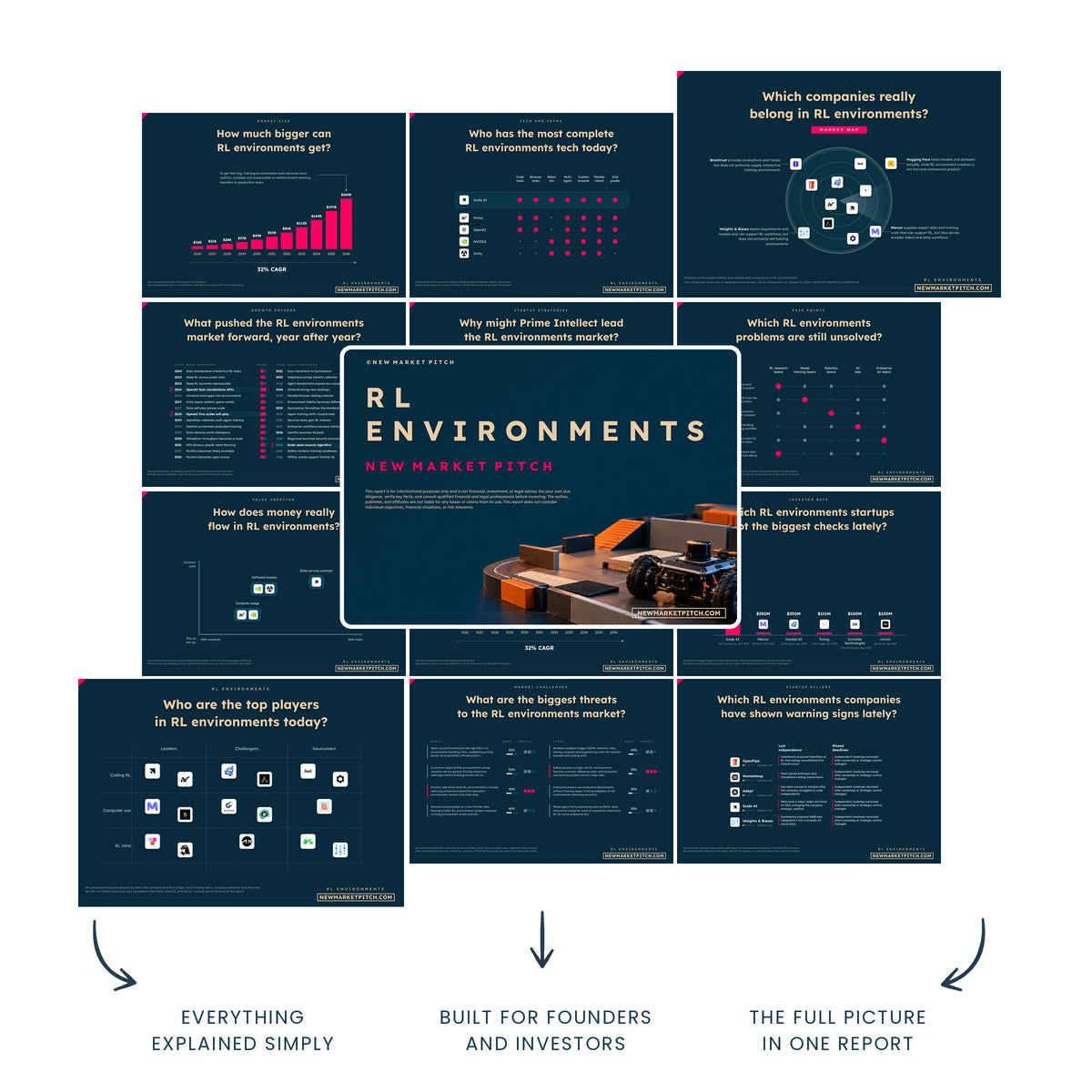
Whether you're building or investing in the RL environments market, our report covers everything you need to know: the players, the money, and what's coming next.
Summary
Scale AI is the most valuable RL environment startup, valued at $29.0B. Mercor follows at $20.0B. The biggest prices belong to companies that already sell expert data and AI evaluations.
Scale AI's lead is clear, but its Meta deal has made independence a real question. A supplier working closely with one major model developer may face harder conversations with its rivals.
Mercor is the closest challenger, helped by its move from recruiting experts to building evaluations and simulated workplaces. The two companies are now competing over how AI agents learn to do real work.
The next group is much smaller. micro1 is valued at $4.0B, while Handshake and Snorkel AI show that recruiting networks and data-development software can both turn into valuable AI training businesses.
Snorkel AI is selling finished training data and RL environments instead of stopping at dataset tools. Handshake has taken a different route, adding AI research capabilities through an acquisition.
We count 10 startups whose valuations fully clear the unicorn threshold. Many sell expert data and evaluations alongside environments; dedicated simulation software is still a smaller part of the top tier.
Prime Intellect offers a different way in, selling the tools needed to train and evaluate agents. Mechanize and Patronus AI build simulated work itself, though neither has the scale of the largest expert-data marketplaces.
Investors are paying for the possibility that these worlds become essential to training. For younger specialists, the harder test is whether customers keep paying for fresh tasks, realistic software behavior and reliable scores.
The United States is home to 32 of the 35 startups we track. Britain and the Netherlands have contenders, but the highest-value companies are heavily concentrated in America.
For now, expert-data suppliers are winning the valuation race. The next big winner may be a company that turns difficult work into simulations agents can practice over and over, without hiring an ever-larger army of experts.

Written by the New Market Pitch teamWe track new markets so founders and investors can move faster. About us

In our report covering the RL environments market, we turn what is vague and complex into simple, useful visuals. Market maps like this one show you at a glance where every startup stands.
Top startups in the RL environments market ranked by valuation
Here is the current ranking of the most valuable RL environments startups. For each one you will also find our confidence level and the valuation basis we used.
If you want to go deeper into the RL environments startup landscape, check our report covering the RL environments market.
| # | Startup | Valuation | Confidence | Valuation basis | Last round | Total funding |
|---|---|---|---|---|---|---|
| 1 | Scale AIAI data labeling and evaluation | $29.0Bas of Jun 2025 | Full | Announced private round valuation | UndisclosedSeries F · May 2024 | $602M+valued at 48.1× this |
| 2 | MercorExpert recruitment and AI training data | $20.0Bas of Nov 2026 | Full | Announced private round valuation | UndisclosedSeries D · Nov 2026 | $484M+valued at 41.4× this |
| 3 | micro1Expert-generated AI training and evaluation data | $4.0B | Full | Announced private round valuation | $100M+Series B · Sep 2026 | $135M+valued at 29.6× this |
| 4 | HandshakeExpert human data for AI | $3.5Bas of Jan 2022 | Full | Announced private round valuation | $200MSeries F · Jan 2022 | $434Mvalued at 8.1× this |
| 5 | Snorkel AIAutomated AI training data development | $3.5B | Full | Announced private round valuation | $350MSeries D+ · Sep 2026 | $583M+valued at 6.0× this |
| 6 | AfterQueryExpert data for AI model training | $3.2Bas of Sep 2026 | Strong | Reported private round valuation | $50MSeries B · Aug 2026 | $80Mvalued at 39.9× this |
| 7 | TuringExpert data for frontier AI | $2.2Bas of Mar 2025 | Full | Announced private round valuation | $111MSeries E · Jun 2025 | $244Mvalued at 9.0× this |
| 8 | Invisible TechnologiesEnterprise AI training and operations | $2.0Bas of Sep 2025 | Strong | Reported private round valuation | $100MGrowth equity · Sep 2025 | $100Mvalued at 20.0× this |
| 9 | LabelboxAI training data and evaluation | $1.25B+as of Oct 2026 | Full | Announced private round valuation | $93MSeries E · Oct 2026 | $283Mvalued at 4.4× this |
| 10 | Prime IntellectTraining and evaluation infrastructure for AI agents | $1.0B | Full | Announced private round valuation | $130MSeries A · Jul 2026 | $150M+valued at 6.6× this |
| 11 | TolokaExpert human feedback for AI | $480M–$900Mas of May 2025 | Low | Estimated from last round | $72MGrowth equity · May 2025 | $72Mvalued at 9.1× this |
| 12 | MechanizeSimulated environments for agent training | $500Mas of Apr 2026 | Full | Announced private round valuation | $9.1MVenture / stage undisclosed · Apr 2026 | $9.1M+valued at 54.9× this |
| 13 | Patronus AISimulation and evaluation environments for AI agents | $333M–$625Mas of Jun 2026 | Low | Estimated from last round | $50MSeries B · Jun 2026 | $70Mvalued at 6.5× this |
| 14 | ProximalReinforcement learning data and environments | $300Mas of Sep 2026 | Strong | Reported private round valuation | $15MSeed · Sep 2026 | $15Mvalued at 20.0× this |
| 15 | Bespoke LabsReinforcement learning environments for autonomous agents | $156M–$261Mas of Jul 2026 | Low | Estimated from last round | $31MSeries A · Jul 2026 | $40Mvalued at 5.1× this |
| 16 | HalluminateReinforcement learning environments for knowledge work | $150M–$250Mas of Oct 2026 | Low | Estimated from last round | $30MSeries A · Oct 2026 | $30Mvalued at 6.5× this |
| 17 | LatchBioBuilds biological AI benchmark environments and tasks | $140M–$233Mas of Jun 2022 | Low | Estimated from last round | $28MSeries A · Jun 2022 | $33Mvalued at 5.5× this |
| 18 | LuelMarketplace for multimodal human data | $125M–$208Mas of May 2026 | Low | Estimated from last round | $31MSeed · May 2026 | $31Mvalued at 5.2× this |
| 19 | SuperAnnotateEnterprise AI data annotation platform | $90M–$169Mas of Jun 2025 | Low | Estimated from last round | $14MSeries B · Jun 2025 | $67M+valued at 1.8× this |
| 20 | HUDReinforcement learning environment development platform | $80M–$133Mas of Jun 2026 | Low | Estimated from last round | $16MSeries A · Jun 2026 | $16M+valued at 6.3× this |
| 21 | PlatoCreates simulated digital workplaces and feedback environments used to train and improve AI agents. | $80M–$133Mas of Oct 2026 | Low | Estimated from last round | $16MSeries A · Oct 2026 | $16M+valued at 6.5× this |
| 22 | DatacurveExpert coding data for AI models | $75M–$125Mas of Oct 2025 | Low | Estimated from last round | $15MSeries A · Oct 2025 | $15Mvalued at 6.5× this |
| 23 | Taste LabsBuilds preference-driven creative design training environments | $74M–$123Mas of Jun 2026 | Low | Estimated from last round | $18MSeed · Jun 2026 | $18Mvalued at 5.2× this |
| 24 | Preference ModelReinforcement learning environments for AI | $64M–$107Mas of Oct 2026 | Low | Estimated from last round | $16MSeed · Oct 2026 | $16Mvalued at 5.2× this |
| 25 | PluraiBuilds stateful digital-twin simulations of agent tools, policies and workflows, with executable tasks and outcome-based evaluations. | $52M–$87Mas of Nov 2026 | Low | Estimated from last round | $13MSeed · Nov 2026 | $13Mvalued at 5.2× this |
| 26 | Alterra LabsCreates executable medical and health-system workflow environments with clinician-designed scoring and RL training feedback. | $50M–$83Mas of Nov 2026 | Low | Estimated from last round | $12MSeed · Nov 2026 | $12Mvalued at 5.2× this |
| 27 | General ReasoningDevelops open reward and RL environment tools | $44M–$73Mas of Jul 2025 | Low | Estimated from last round | $11MSeed · Jul 2025 | $11Mvalued at 5.2× this |
| 28 | IdlerRL environments for agentic AI | $36M–$60Mas of Aug 2026 | Low | Estimated from last round | $9MSeed · Aug 2026 | $9Mvalued at 5.2× this |
| 29 | WorldmodeldataVideo game data for AI training | $36M–$60Mas of Jul 2026 | Low | Estimated from last round | $9MSeed · Jul 2026 | $9M+valued at 5.2× this |
| 30 | Veris AISimulates enterprise systems and users for agents | $34M–$57Mas of Jun 2025 | Low | Estimated from last round | $8.5MSeed · Jun 2025 | $8.5Mvalued at 5.2× this |
| 31 | PhinityBuilds chip design training environments and verifiers | $21M–$35Mas of Oct 2026 | Low | Estimated from last round | $5.2MSeed · Oct 2026 | $5.2M+valued at 5.2× this |
| 32 | MatricesCreates browser-workflow environments for agent learning | $20M–$33Mas of Mar 2024 | Low | Estimated from last round | $5MSeed · Mar 2024 | $5Mvalued at 5.2× this |
| 33 | ParetoExpert human data and evaluations | $18M–$30Mas of Nov 2021 | Low | Estimated from last round | $4.5MSeed · Nov 2021 | $5.1Mvalued at 4.6× this |
| 34 | Good Start LabsGame-based AI training environments | $14M–$24Mas of Oct 2025 | Low | Estimated from last round | $3.6MSeed · Oct 2025 | $3.6Mvalued at 5.2× this |
| 35 | BenchFlowBuilds interactive agent benchmarks and test environments | $4M–$6.7Mas of Feb 2025 | Low | Estimated from last round | $1MPre-Seed · Feb 2025 | $1Mvalued at 5.2× this |
No startups match this search.

Our research about RL environments startups gets updated several times a month, so you always get the latest view of where things stand.
Why are AI companies paying so much for RL environments?
RL environment startups are getting pricier because AI labs need software worlds where agents can practice real tasks and get reliable scores.
Building a useful environment takes more than putting questions into a dataset. It must recreate the tools an agent uses, offer a task the agent can actually attempt, preserve the state of a workflow, and distinguish real success from a plausible-looking answer. Mercor described those components explicitly when announcing its plan to acquire Deeptune in July 2026. Patronus AI's June 2026 Digital World Model announcement likewise framed long-horizon simulation as a way to train agents on failures that static benchmarks do not expose.
Look at the highest valuations and a pattern appears. Many of these businesses started outside simulation. Scale AI became a major data and evaluation supplier; Mercor recruited expert workers; Snorkel AI first automated training-data development. Their customers and operating networks make the move into executable environments credible. Dedicated builders such as Prime Intellect and Mechanize address the same problem with different starting points: infrastructure or simulated work itself. Investors are paying for two things at once: existing data businesses and the chance that reusable practice worlds become essential to AI training.
Is Scale AI still the most valuable RL environment startup?
Scale AI still leads RL environment startups by valuation at $29.0B, even after its Meta deal raised questions about independence.
Its $29.0B is the value Scale announced with Meta's June 2025 investment. Scale stated that the transaction expanded its commercial relationship with Meta and that founder Alexandr Wang would join Meta's AI efforts while remaining on Scale's board. The deal tied a leading data supplier to a customer competing against the other frontier model developers that also need its services. Scale's earlier May 2024 Series D+ had already established its importance to companies building frontier models and government AI systems.
Working closely with Meta has a cost: other model developers may question Scale's independence. Reuters reported in June 2025 that Google planned to move work away from Scale after Meta's deal, while OpenAI's finance chief said OpenAI intended to continue working with multiple data vendors, including Scale. Those reactions point in different directions, and neither changes Scale's leading valuation. They do show why the price cannot be interpreted as a simple measure of customer loyalty. Scale leads on valuation today. Keeping rival AI labs as customers may prove harder.

In our market report about RL environments startups, we look at what the winners do differently, so you can learn from the best instead of guessing.
Can Mercor catch Scale AI in the valuation race?
Mercor is the closest company to Scale AI on RL environment valuation, but it trails at $20.0B with a 1.4x gap.
Mercor began by matching organizations with professionals, then used its expert network to supply AI training and evaluation. Its November 2026 Series D+ announcement shifted the emphasis further toward companies testing agents against their own workplace requirements. An agent may understand accounting and still fail to operate a spreadsheet or finish a complicated finance task.
Mercor's July 2026 decision to acquire Deeptune addresses that problem directly. Deeptune recreated enterprise applications as practice worlds, while Mercor supplied professionals able to write realistic tasks and judge outcomes. Customers can now buy expert task design and workplace simulation together. Still, Scale's established data operations and relationships cannot be displaced by valuation momentum alone. Mercor has a credible way to compete through its combination of expert work, testing and software simulations. Scale still has the valuation lead.
Has micro1 become a serious rival to the AI data giants?
micro1 has become a high-valued AI training supplier at $4.0B, but it remains behind the two biggest RL environment companies.
micro1 got here quickly. Forbes reported in September 2026 that micro1 had evolved from an AI recruiting business into a provider of specialized training data for leading model labs, with customers including Microsoft, Amazon and robotics developer 1X. This resembles the path taken by Mercor and Handshake: organizations that know how to recruit and manage experts can turn that capacity into reasoning tasks, evaluations and increasingly specialized agent-training material.
A high price does not tell us who can build the hardest simulations. An expert marketplace can scale by adding workers and delivery operations; a robust RL environment also needs software behavior, state, reliable grading and resistance to reward hacking. Snorkel AI and Labelbox have explicitly invested in those components, while Prime Intellect provides an infrastructure-oriented alternative. micro1's price shows how much investors value expert training data. It tells us less about how much environment software micro1 controls.
Is Snorkel AI now worth more than Handshake?
Snorkel AI and Handshake are tied on displayed valuation at $3.5B, despite selling very different kinds of AI training products. Handshake's price dates from its January 2022 round, Snorkel AI's from September 2026.
Snorkel AI's September 2026 Series D+ accompanied a move from software that helps customers build datasets toward selling finished training data and RL environments. The company described its new offering as combining automated and synthetic-data systems with human experts. Handshake, by contrast, grew from a recruiting network into an expert-data supplier, then acquired Cleanlab in January 2026 to strengthen its AI research, evaluation and environment capabilities.
The companies could make money in very different ways. Snorkel's challenge is to keep automation useful when each task requires domain-specific judgment and valid feedback. Handshake's challenge is to turn access to experts into products that clients cannot easily rebuild elsewhere. We cannot assume their margins, repeat sales or advantages over competitors are alike. Both companies have credible paths into the RL training budget, but neither's price alone proves which delivery model will prevail. For now, the displayed valuations tie. The businesses and their risks are different.

In our document detailing everything you need to know about RL environments, you will always find fresh funding data, taken straight from our own verified funding database.
Is Handshake still worth its old price after pivoting to AI?
Handshake's old valuation still tells us something about the RL environment race, but its business has changed since its January 2022 Series D+.
Handshake's original advantage was a network connecting students and graduates with employers. Its AI unit repurposed that reach to source qualified people who can evaluate model outputs and create specialized tasks. When the company announced its acquisition of Cleanlab in January 2026, it explained that the acquired research team would develop evaluation, safety and RL environment capabilities alongside its human data offering. The move changed the content of its business without automatically establishing a newly priced company value.
That history makes comparisons with Snorkel AI and micro1 tricky. Handshake has moved well beyond job listings. Its older valuation, however, is not a fresh offer to buy the company. Gross billings may include contractor payouts, so they should not be confused with software sales. Handshake competes in RL environments now, but its price comes from an earlier phase of the business.
Is AfterQuery really worth billions today?
AfterQuery is reportedly valued at $3.2B, a high price for an RL training supplier that still needs to prove its expert-data work can be repeated at scale.
TechCrunch reported in September 2026 that the YC-backed company had moved from its earlier funding milestone to a new reported valuation as it sold professional task data to frontier model developers. Frontier labs need more than generic answers when training models for legal, medical and financial work. They need to see how experts make decisions and check the result. That places AfterQuery close to Mercor, Handshake and micro1 in buyer demand.
Other suppliers can recruit skilled contractors. It is harder to copy a system that captures real workflows, checks outcomes and improves as customers use it. Mercor is buying simulation infrastructure; Snorkel AI mixes automated generation with expert review; Labelbox offers environments and agent products. AfterQuery must show that its own approach can deliver similarly durable value. Its 39.9x valuation-to-complete-funding multiple is the highest among the comparable figures we track, highlighting how much future success is already implicit in the price. The price leaves little room for a business that cannot keep winning difficult customer work.

Learning from others' mistakes is the cheapest lesson there is. In our report covering the RL environments market, we look at what broke startups before you, so you don't repeat it.
Can enterprise AI training suppliers still fetch billion-dollar valuations?
Turing and Invisible Technologies are still billion-dollar AI training suppliers, with customers and experience that newer RL simulators cannot easily copy.
Turing's June 2025 Series D+ placed its value at $2.2B. Its company announcement emphasized software engineers contributing to frontier AI model development and its expansion beyond traditional staffing into research and model-training services. Invisible Technologies was reportedly valued at $2.0B following its September 2025 Growth Equity financing. Its own announcement stressed a long history of combining human processes and AI to deliver outcomes for model labs and enterprises.
Their businesses work differently. Turing's technical talent network is particularly relevant when generating coding tasks and evaluating software-engineering agents. Invisible's enterprise operations experience is useful for simulating real business workflows and managing human review when agents fail. Both face competition from more narrowly focused environment companies that may be better able to standardize products. New simulator startups have to improve on work experienced suppliers already deliver to paying customers. Attractive benchmark scores alone will not be enough.
Is Labelbox still an RL environment unicorn?
Labelbox remains an RL environment unicorn, with a valuation of at least $1.25B following its October 2026 financing.
Labelbox began with tools for labeling and managing training data. Its October 2026 announcement described a different product direction: Horizon produces simulated software environments and expert-written grading tasks for frontier labs, while Recursion helps enterprises deploy agents and learn from completed work. The company also highlighted a substantial installed customer base and a push to connect post-training with actual business execution.
There is a practical reason investors still see value in Labelbox. If an enterprise can run a task, score the result and use the evidence to improve future runs, the supplier becomes part of a continual performance loop. Now Labelbox has to deliver. A company that sells tools to researchers and managed agents to enterprises must prove it can serve two demanding buyer groups without weakening its focus. Its valuation comes from a real financing. Whether Horizon and Recursion become products buyers use repeatedly is a separate test.
Can an RL training platform become a unicorn without a giant expert network?
Prime Intellect shows that an RL training platform can reach a $1B valuation without building an enormous marketplace of human experts.
Prime Intellect is valued at $1.0B and announced a $130M Series A in July 2026. In that announcement, it described a stack spanning model training, reinforcement learning, environments, sandboxes, evaluations, deployment and inference. Its thesis is that enterprises want to improve models for their own workflows rather than depend exclusively on frontier labs to do the training for them.
Prime Intellect started from a different place than Scale AI's data operation or Mercor's expert network. Prime Intellect wants infrastructure users to run their own optimization loop, including verifiable agent practice. HUD is another platform-oriented participant, while Preference Model focuses on secure environment construction and robust reward signals. A sandbox by itself is not enough. The software has to set real tasks and score them reliably so models can improve. Prime Intellect has shown that investors will pay for specialist training software. Winning customers away from data suppliers is another challenge.

In our research about RL environments startups, we always try to gather several sources and make estimates that make sense, so you can work with solid numbers.
How many RL environment startups are unicorns now?
We count 10 RL environment startups securely worth at least $1B among the 35 companies we track.
A company counts as a unicorn only when a reported or implied value clears the threshold, or its entire estimated range does. We also include broad AI data businesses only when they have a recognized role supplying interactive tasks and verifiable feedback for agents.
The unicorn group spans different business models. Scale AI and Mercor rely heavily on expert data and evaluations; Snorkel AI brings automated data development; Handshake and micro1 use talent networks; Prime Intellect represents open reinforcement-learning infrastructure. At smaller values, Patronus AI, Mechanize and other specialists show a separate investment thesis around simulated digital work. Several mature AI data companies are already unicorns. Most pure environment builders have yet to reach that size.
Are there any RL environment startups worth over $10B?
Only 2 RL environment startups are clearly valued above $10B, making giant prices rare even in this AI market.
Scale AI and Mercor do far more than build simulated environments. Scale AI built operations for training and evaluation data across several waves of AI. Mercor assembled a large expert network and is integrating software simulations through Deeptune. Their customers and large expert-data operations help explain why young specialists have not caught up.
The next group is much smaller, with different approaches: micro1 on specialized human intelligence, Snorkel AI on the data factory, Handshake on its network of qualified workers and Prime Intellect on an open training stack. We also count 8 startups in the middle unicorn bracket and 25 below the unicorn threshold. Huge valuations remain rare, especially for startups whose main product is simulated work.

If you build or invest in the RL environments market, you need to know which business models pay off now and which ones are fading. That's why our report covering it has a whole section on it.
Why are AI data giants worth more than specialist RL simulators?
Most dedicated RL simulators are still valued well below the biggest AI training-data suppliers.
Mechanize announced a $500M post-money valuation when it raised $9.1M in April 2026. Patronus AI is valued at $333M–$625M on our estimate from the size of its June 2026 Series B, dated to that round. Proximal has a reported $300M valuation, while Halluminate and Bespoke Labs represent narrower work-simulation approaches. A lower price says little about technical quality. These young companies have had less time to build recurring sales and customer networks.
Mechanize is attempting to model ordinary digital work. Patronus AI is building digital world models, while Halluminate focuses on tasks such as financial analysis and complex knowledge work. Plato simulates workplace applications and changing business constraints. All want customers to reuse their environments instead of commissioning a new task for every training cycle. If those products become standardized, the differences in operating model could become more important than today's differences in value. For now, the largest valuations still sit with companies that can sell training and evaluation services at scale.
The table below shows selected RL environment specialists and their valuations.
| Company | Valuation | Last round |
|---|---|---|
| Mechanize | $500M | April 2026 |
| Patronus AI | $333M–$625M | June 2026 |
| Proximal | $300M | September 2026 |
| Bespoke Labs | $156M–$261M | July 2026 |
| Halluminate | $150M–$250M | October 2026 |
| LatchBio | $140M–$233M | June 2022 |
| HUD | $80M–$133M | June 2026 |
| Plato | $80M–$133M | October 2026 |
Patronus AI, Bespoke Labs, Halluminate, LatchBio, HUD and Plato have ranges estimated from their last rounds, and HUD and Plato share the same range. Rows follow their positions in the overall valuation ranking rather than a comparison of overlapping ranges.
Can Mechanize really become a leader in RL simulation?
Mechanize is a high-valued RL environment specialist, but its reported price does not prove it has beaten competing simulators.
Its $500M valuation was announced by the company with a $9.1M raise in April 2026. Mechanize's founding announcement set out a plan to recreate the computer-based tasks that make up ordinary jobs, including long sequences of actions, interruptions and changing objectives. The emphasis is ambitious: useful reinforcement learning needs tasks that resemble actual work rather than a handful of deterministic game-like challenges.
Patronus AI has chosen a different route, modeling the dynamics of digital workflows so agents can encounter realistic failures. Prime Intellect addresses the underlying training stack rather than developing only a proprietary catalog of tasks. In contrast, Plato and Halluminate focus on specific work domains where success can be judged by expert-defined criteria. They serve different customers and solve different problems, so a higher price cannot settle which product is better. Mechanize is a high-priced specialist on a figure it announced itself. We cannot infer better technology from that number. Estimated ranges can overlap announced valuations: Toloka sits one place above Mechanize because its $480M–$900M estimate, drawn from its $72M round in May 2025, is ordered on its middle. The ordering should not be mistaken for a precise market consensus.
Can simulated digital work make Patronus AI more valuable?
Patronus AI is attracting interest because its simulated software worlds let agents practice difficult jobs across many steps.
In June 2026, Patronus AI announced a $50M Series B and introduced a Digital World Model designed to simulate the behavior of software environments. The company highlighted coding, research, dialogue and tool-use tasks as domains where model behavior can be tested repeatedly. Agents can get a short answer right and still fail a long job. Patronus is trying to capture that gap in training.
For valuation purposes, we estimate Patronus AI at $333M–$625M from the size of its last round, dated to June 2026; it is not a price announced by the company. Its estimate needs to be read differently from Proximal's reported value or Mechanize's announced price. Patronus AI is listed above Proximal's $300M because an estimated range is ordered on its middle, not on its low end. The best customers may be teams that need to test agents before deployment and then reuse those environments for training. Patronus still has to show that its worlds behave realistically and do not cost too much to run repeatedly. Customers will decide whether the simulations are useful enough to buy again as their tools change.

In our document detailing everything you need to know about RL environments, we like to show you the big picture. We know your time is precious, so we make every page quick to read and packed with as much learning as possible per minute.
Can investors put a high price on coding RL environments?
Proximal shows that investors will pay for specialized coding RL environments, even at the Seed stage.
Proximal has a reported $300M valuation from its September 2026 Seed financing. Patronus AI is listed just above it with an estimate drawn from its last round rather than a price paid in a round. The company's work is centered on the tasks and feedback needed to train coding agents that operate across real software projects. Unlike static code completions, these tasks involve dependencies, tools and checks that determine whether an implementation actually works. This brings Proximal into a field where Turing supplies specialist engineers and Prime Intellect builds the surrounding training infrastructure.
A narrow coding focus helps Proximal build hard tasks quickly, but ties the business to whichever problems model labs prioritize. If general model capabilities improve and easy coding benchmarks saturate, suppliers must continuously design harder tasks and more reliable grading. Preference Model, which builds environments meant to resist it, describes the danger of reward hacking: a model may exploit a grader instead of doing the intended job. Investors are backing the ability to design tough coding environments. Proximal will have to keep those tasks useful as models get better.
Are investors paying for healthcare and finance RL environments?
Investors now back RL environments built for finance and healthcare, although specialist valuations remain well below the biggest AI data firms.
Halluminate develops environments where agents attempt real knowledge-work tasks, including financial modeling and analysis. Its October 2026 announcement described working with frontier labs and designing benchmarks around professional work rather than general trivia. Alterra Labs takes a comparable idea into healthcare: an investor announcement in November 2026 described simulated electronic records, payer workflows and clinical decisions that models must complete under realistic constraints. LatchBio represents a biology-focused approach to evaluating technical work.
One sandbox will not cover every kind of professional work. A correct financial analysis requires consistent calculations and judgment; a medical workflow requires clinical safety and operational context; a biological task requires a defensible scientific answer. Building those verifiers is hard but may create customer trust. Investors see a business in specialized simulations, but it remains unclear how large each niche can grow. Whether they expand into adjacent domains or remain focused providers will decide how far their valuations can grow.

When you build or invest in the RL environments market, you need clarity, not confusion. In our report covering the RL environments market, we always try to put numbers on and quantify whatever is usually vague and confusing.
Does a high RL environment valuation mean lots of cash raised?
No, a high RL environment valuation does not mean a startup has raised a matching amount of cash.
A valuation sets the price investors are willing to pay for ownership today, taking future growth into account. Equity raised is the capital that investors have actually put into the business, subject to the distinction between primary funding and secondary share transactions. AfterQuery and Proximal illustrate the separation: a company can have a high implied or reported price after a relatively small number of rounds, while a mature supplier such as Handshake may have accumulated more funding without reaching the very top of the valuation list.
Our comparison uses only companies with a source-based valuation and complete reported equity total. AfterQuery has the highest displayed valuation-to-funding multiple, while Labelbox is at the bottom of that comparable group. These multiples are neither revenue multiples nor investor returns. They show how far company valuations sit above the equity investors have put in. A high price tag does not pay the next engineering bill.
The table below shows selected valuation-to-equity-funding multiples for companies with complete totals.
| Company | Value/funding | Valuation |
|---|---|---|
| AfterQuery | 39.9x | $3.2B |
| Invisible Technologies | 20.0x | $2.0B |
| Proximal | 20.0x | $300M |
| Turing | 9.0x | $2.2B |
| Handshake | 8.1x | $3.5B |
| Labelbox | 4.4x | $1.25B+ |
The comparison excludes companies whose funding total is only a minimum and companies valued only by our estimate. Equal displayed multiples are ties.
Are the most valuable RL environment startups mostly American?
Yes, the RL environment valuation market is overwhelmingly US-based, with 32 of the 35 tracked companies headquartered there.
Smaller companies show the same US concentration. Scale AI, Mercor, Snorkel AI and Prime Intellect are American, but so are younger task-design and simulator companies including Mechanize, Halluminate, HUD and Preference Model. The category benefits from proximity to frontier AI labs, venture funds and buyers that want human experts and production-grade evaluation delivered quickly. Mercor's expansion into enterprise agent training and Labelbox's push into repeatable agent work are concrete examples of this concentration in practice.
We also count 2 companies in the United Kingdom and 1 in the Netherlands. General Reasoning and Worldmodeldata represent different British approaches, while Toloka contributes a European expert-data model. Europe has a few participants, but nothing like the American cluster. These are headquarters figures: the people creating the data and the buyers can live elsewhere. The companies are largely US-based; the work itself crosses borders.
Why is Surge AI missing from lists of valuable RL environment startups?
Surge AI is a major training-data company, but its bootstrapped approach leaves it outside this comparison of priced RL environment startups.
Surge founder Edwin Chen has publicly emphasized that the company built its research and data operation without outside funding. Our comparison needs a priced round or similarly credible valuation evidence. An independent, founder-funded supplier can be commercially important without producing a priced venture round that fits the comparison. There is no defensible basis here for inventing a price for Surge.
Surge is a reminder that outside fundraising is a choice. Scale AI, Mercor and Handshake have accessed investors to support their operations, while Surge has emphasized control and expert research. Both paths may supply frontier AI labs, but their financing records support different kinds of quantitative comparison. A reader expecting every well-known data company to appear near the top should distinguish operating strength from a documented investment price. Surge still competes with venture-backed suppliers; it simply has no comparable equity price to rank.

A good product starts with a real problem. In our research about RL environments startups, we show you the ones customers still live with.
Could AI labs build their own RL environments and hurt startup valuations?
Yes, AI labs building RL training environments in-house could put pressure on specialist startups' valuations.
A supplier earns its place by continually designing harder tasks, keeping up with changing software, stopping reward hacking and scoring outcomes correctly. Mercor's Deeptune acquisition shows a buyer bringing environment engineering inside its own business. Prime Intellect offers the opposite route by providing external infrastructure to organizations that want to operate their own training loops. Preference Model is trying to make trustworthy environment construction itself a specialized product.
Building environments in-house will be easier in some fields than in others. A frontier lab may write its own coding tests; a regulated business may still need outside expertise to simulate clinical or financial work faithfully. The risk is particularly sharp for simple datasets and benchmarks that can be replicated once, less so for living environments tied to real applications and constantly changing tasks. Some of today's valuations will be hard to defend if customers can build similar worlds internally. The firms most likely to justify high prices are those whose customers improve models faster by continuing to use them.
So, which RL environment startups are worth the most today?
Scale AI is the most valuable RL environment startup, with Mercor next and dedicated simulator developers still valued far lower.
The leader is valued at $29.0B and its closest challenger remains well behind. The next group includes micro1, Handshake, Snorkel AI and AfterQuery, while Prime Intellect provides evidence that a dedicated training stack can earn a unicorn valuation. The biggest companies already know their buyers and have access to experts. Their prices also assume they can keep turning that knowledge into practice worlds that AI agents can use repeatedly.
The two leaders have different strengths. Scale's Meta relationship creates a formidable commercial position and a supplier-neutrality problem. Mercor's Deeptune acquisition connects expert judgment with simulated software. Specialist developers are younger and cheaper today, but their products address the training problems that the leaders are trying to solve.
The table below shows what we found.
| Question | Answer |
|---|---|
| Did Meta make Scale impossible to catch? | Scale AI still leads, though Meta's stake worries rival model labs. The gap to Mercor is currently 1.4x on valuation. That leaves room for competitors with more independent customer relationships. |
| Could Deeptune help Mercor close the gap? | Mercor is still the closest challenger to Scale AI. Its announced valuation is $20.0B after the recent financing. Deeptune gives Mercor software simulations alongside its network of experts. |
| Did micro1 catch the two AI data leaders? | micro1 has surged, but it still trails Scale AI and Mercor. Its announced valuation is $4.0B in our comparison. That shows how quickly an expert-data supplier can grow in value. |
| Are Snorkel AI and Handshake really tied? | They tie on displayed valuation despite selling very different products. Both carry announced valuations of $3.5B in our research. Automation and large expert networks create different costs and customer risks. |
| Is AfterQuery's huge price already justified? | AfterQuery's price assumes expert-data demand will keep growing quickly. Its valuation-to-equity multiple is 39.9x on complete funding totals. That leaves little room for weak customer retention or easy imitation. |
| Can dedicated RL software firms become unicorns? | Prime Intellect shows a specialist training platform can reach unicorn status. Its announced valuation is $1.0B following its Series A. That gives software-first companies another path beyond giant expert marketplaces. |
| Are most RL environment developers unicorns yet? | Most RL environment startups remain below the unicorn threshold. Only 10 of the 35 tracked companies are clearly above it. The biggest members are broader data businesses, not pure simulators. |
| Do many RL startups reach giant valuations? | The very highest prices still belong to a tiny group. Only 2 startups are clearly valued above $10B. Younger simulators have a long way to go before reaching those prices. |
| Are specialist simulations priced like expert data? | Dedicated simulators still trail expert-data businesses on valuation today. Bespoke Labs carries a $156M–$261M estimate from its last round. That rewards specialized work but remains far below the leaders. |
| Does a high valuation mean much cash? | Valuation and money raised can move separately in this market. Turing's valuation-to-equity multiple is 9.0x in our comparison. That reflects an ownership price, not the company's bank balance. |
| Are American firms winning the valuation race? | American startups dominate the current RL environment valuation group. We count 32 US companies among the 35 tracked. That describes headquarters, not where all the expertise lives. |

In our market report about RL environments startups, we try to remove everything that could confuse you, especially if you're investing or building in this market.
Our methodology
Our data runs through November 13, 2026. We define RL environments as commercial systems supplying interactive training tasks in which AI agents take executable actions and receive verifiable feedback, including coding, workplace, browser, scientific and security simulations and established suppliers of such environments. We include companies on the boundary of this definition rather than silently excluding them. Every company in the main ranking is an independent startup under our definition, founded in 2000 or later and backed by equity or founders; acquired and listed companies are displayed separately.
Every startup in this ranking has raised equity funding, and each valuation comes with a confidence level that shows how it was obtained. A Full rating means the company announced the valuation itself, or several independent sources report the same figure. A Strong rating means a credible press report gives the valuation, or it follows directly from the terms of a funding round, such as the amount raised and the stake sold.
When no valuation has been disclosed, it is estimated. A Partial rating means the startup was compared with similar companies at the same stage, using indicators such as revenue, deal terms or recent transactions in the sector. A Low rating means the only reliable data point is the last equity round: the valuation is then derived from the amount raised and the share of the company that startups usually give up at that stage, which is why it is shown as a range and dated to that round.
Several safeguards keep these figures honest. Valuations that appear only in commercial databases, with no article or company statement behind them, are not used, and neither are share sales between existing shareholders, which often take place at a discount or a premium. Rounds older than five years are not used to estimate a valuation, debt and grants never count as equity, and companies whose claims are disputed are left out of the ranking. Startups that have since been acquired or have gone public are listed separately, valued at their acquisition price or market capitalization rather than at a past private round.
We order companies with a valuation range by the geometric mean of its lower and upper endpoints, preventing an optimistic high end from dominating the order. Total capital raised counts equity since founding, excluding debt, grants and post-IPO offerings; a plus sign means the total is a documented minimum. We count a round when a company statement, filing or credible press report supports it, or when two recognized databases agree on its date and amount, with low confidence and never for companies above $100M raised. A round in only one database is excluded from totals. Valuations themselves always require company statements, filings or credible reporting, not a commercial database figure alone.
A last-round estimate can appear above a smaller announced valuation because we order the estimate by the geometric mean of its range, not its optimistic ceiling. Such a Low-confidence figure reflects typical ownership sold at that funding stage and is dated to the round; readers can weigh it against a Full- or Strong-confidence transaction price. A famous supplier may be absent when no qualifying equity valuation exists. These choices keep reported prices, implied prices and estimates visibly distinct without pretending every private company has a current, directly observed price.
Key sources include Scale's June 2025 Meta investment and leadership change, Scale's May 2024 financing and data-development business, Reuters on supplier neutrality after Meta's Scale deal, Mercor's November 2026 round and enterprise evaluation focus, Mercor's July 2026 acquisition and environments strategy, Forbes reporting on micro1 customers and AI data transition, Snorkel's shift into finished data and RL environments, Handshake's acquisition of Cleanlab and AI research expansion, TechCrunch report on AfterQuery's rapid expansion, Turing's financing announcement and technical data offering, Invisible Technologies' enterprise AI financing, Labelbox's RL environment and enterprise agent product direction, Prime Intellect's July 2026 funding and reinforcement-learning stack, Mechanize's mission to simulate workplace tasks, Patronus AI's simulated digital worlds and June 2026 Series B, Halluminate's financial-work environments and funding, Wing on Bespoke Labs and verification in agent training, HUD's environment-development platform and Series A, Preference Model on grading integrity and RL environments, Plato's simulated workplace training systems, Alterra Labs' medical environment design, and Surge AI founder on independent funding and research focus.
In our document detailing everything you need to know about RL environments, we turn what is vague and complex into simple, useful visuals. Market maps like this one show you at a glance where every startup stands.
Written by the New Market Pitch teamWe track new markets so founders and investors can move faster. About us
