
Which RL environment startups earn the most?
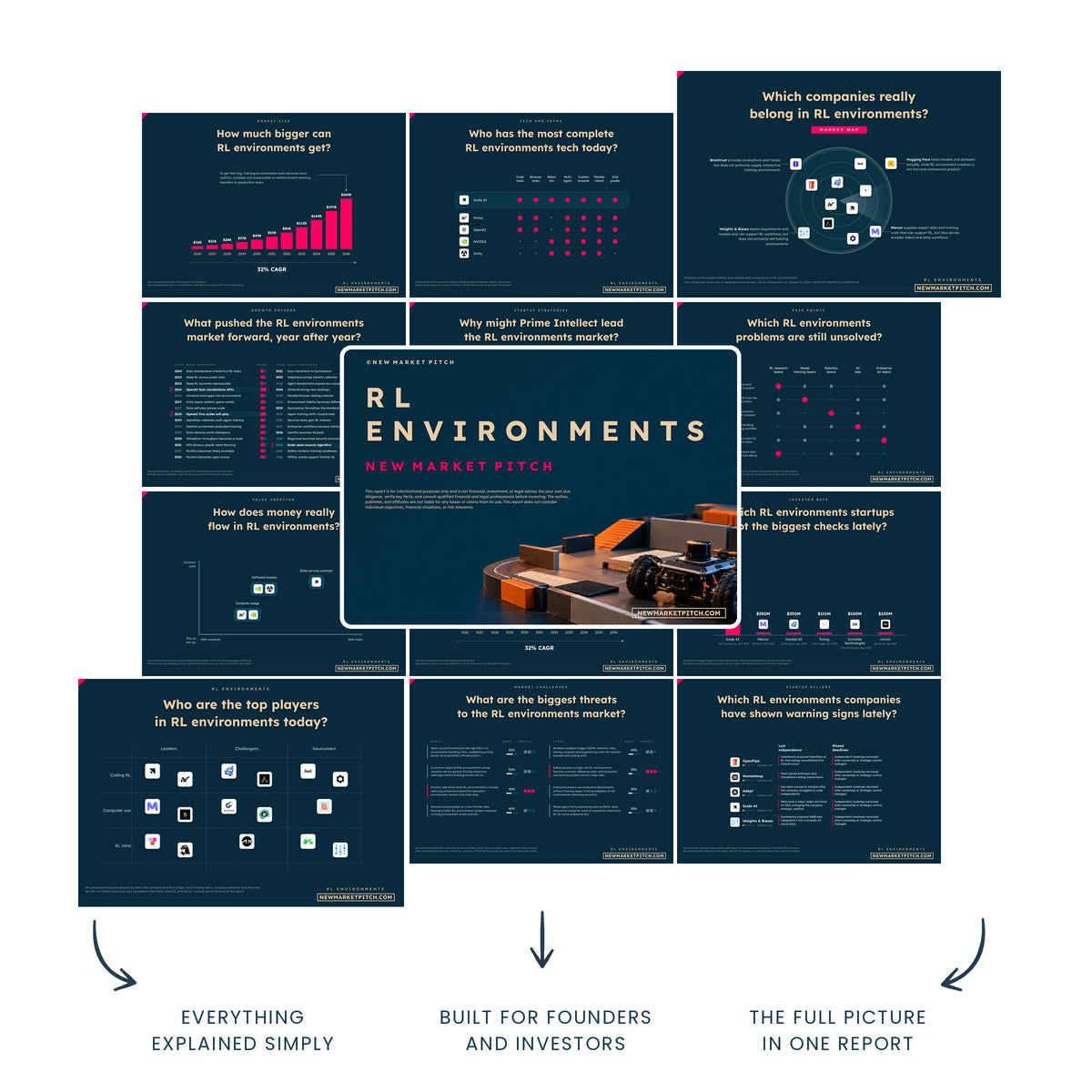
Whether you're building or investing in the RL environments market, our report covers everything you need to know: the players, the money, and what's coming next.
Summary
micro1 leads RL environment startups on reported revenue scale, with a >$1B revenue run-rate as of September 2026. Scale AI has ~$1B in annual revenue for 2025, while Mercor reports a $500M revenue run-rate. These are different measures, so the ranking shows reported commercial scale rather than identical accounting results.
The biggest sellers are often companies known for supplying experts and training data. They are now adding interactive tasks and evaluations because AI labs want models to practice real work and receive useful feedback.
Mercor shows how that shift works. It started by matching skilled professionals with AI companies, built evaluations for professional tasks and announced the acquisition of Deeptune, whose software lets agents practice inside simulated applications.
micro1 is building a similar bridge between expert work and RL environments through its Realm offering. Its latest sales threshold comes straight from the company, as does Mercor's smaller $500M figure.
Scale AI remains a big business after Meta's investment changed its ownership and customer relationships. Its completed-year sales figure is easier to interpret than a run-rate, though it describes an earlier period.
Snorkel AI has found another way to sell data-development software and expert services. Its $375M revenue run-rate shows that the opportunity extends beyond matching experts to individual jobs.
Older figures give useful context. Turing reported a $300M revenue run-rate, while Invisible Technologies reported $134M in annual revenue. Both demonstrate that expert-led AI training had real customers well before RL environments became a popular product label.
AfterQuery disclosed a >$100M revenue run-rate, and Prime Intellect reported more than $100M across a broader stack that includes computing and model training. Both figures are floors, so the order between them does not measure a gap. Buyers are paying for different parts of the learning process, often together.
The lower end needs more caution. Toloka's $6.4M is a historical partial-period segment result, while Patronus AI's ~$1M is an older run-rate. Handshake, Labelbox and SuperAnnotate remain unranked because each rests on a single outside estimate. Handshake's $1.1B run-rate estimate would sit near the top, but it comes from an analyst and covers a company that also sells outside RL environments.
For now, micro1 has the largest reported revenue figure. The open question is how much of the money earned by these broad AI training businesses comes from standalone RL environments, and whether specialized simulation software can eventually catch up.

Written by the New Market Pitch teamWe track new markets so founders and investors can move faster. About us

In our report covering the RL environments market, we turn what is vague and complex into simple, useful visuals. Market maps like this one show you at a glance where every startup stands.
The ranking of top startups in the RL environments market by revenue
Below is a table ranking the startups of this market by their current revenue scale. You can find our methodology at the end of this page.
If you want a deeper understanding of the market and its current dynamics, get our report on the RL environments market.
| Ranking | Company | Latest Metric | Metric Type | Freshness | Disclosed When | Source Quality | Confidence | Segment | Why This Ranking | Local Metric | Country |
|---|---|---|---|---|---|---|---|---|---|---|---|
| 1 | micro1 | >$1B | Revenue Run-Rate | Very Fresh · 2mo | Oct 12, 2026 | Company Disclosed | Medium | Human-data-led RL environments | Annualized revenue run-rate as of Sep 2026 disclosed by the company. ARR and run-rates annualize current sales; they are not recognized revenue. | us | |
| 2 | Scale AI | ~$1B | Annual Revenue | Fresh · 11mo | May 14, 2026 | Company Disclosed | High | Human-data-led RL environments | Annual revenue for the year to Dec 2025 disclosed by the company. Close to micro1, at ~$1B against >$1B. | us | |
| 3 | Mercor | $500M | Revenue Run-Rate | Period not stated · collected 4mo ago | Period not stated | Company Disclosed | Low | Human-data-led RL environments | Annualized revenue run-rate, period not stated (collected Jul 2026) disclosed by the company. ARR and run-rates annualize current sales; they are not recognized revenue. | us | |
| 4 | Snorkel AI | $375M | Revenue Run-Rate | Very Fresh · 2mo | Sep 22, 2026 | Company Disclosed | Medium | Human-data-led RL environments | Snorkel AI disclosed a $375M revenue run-rate in September 2026. It covers the company's broader data-development business, including expert services and software. | us | |
| 5 | Turing | $300M | Revenue Run-Rate | Aging · 23mo | Jan 28, 2025 | Company Disclosed | Medium | Human-data-led RL environments | Turing announced a $300M revenue run-rate for December 2024. That company figure is credible, although it predates the latest shift toward interactive environments. | us | |
| 6 | Invisible Technologies | $134M | Annual Revenue | Aging · 23mo | Jan 21, 2025 | Company Disclosed | Medium | Human-data-led RL environments | The Information reported $134M of completed-year revenue for 2024. The older period limits comparisons with newer annualized sales disclosures. | us | |
| 7 | AfterQuery | >$100M | Revenue Run-Rate | Fresh · 7mo | Apr 9, 2026 | Company Disclosed | Medium | Human-data-led RL environments | AfterQuery disclosed a >$100M revenue run-rate as of April 2026. The figure is an annualized minimum for expert data and AI training work. | us | |
| 8 | Prime Intellect | >$100M | Revenue Run-Rate | Very Fresh · 4mo | Jul 8, 2026 | Company Disclosed | Medium | RL environment platforms | Annualized revenue run-rate as of Jul 2026 disclosed by the company. ARR and run-rates annualize current sales; they are not recognized revenue. Close to AfterQuery, at >$100M against >$100M. | us | |
| 9 | Toloka | $6.4M | Half-Year Revenue | Fresh · 17mo | Aug 12, 2026 | Filed / Audited | Medium | Human-data-led RL environments | Nebius reported $6.4M in discontinued Toloka segment revenue for H1 2025. The regulatory filing covers only a historical slice of the operation. | nl | |
| 10 | Patronus AI | ~$1M | Revenue Run-Rate | Aging · 23mo | Apr 14, 2025 | Credible Reported | Medium | Enterprise & professional workflows | The Information reported a ~$1M revenue run-rate for December 2024. The aging annualized figure leaves current agent-evaluation sales unclear. | us | |
| NR | Handshake | $1.1B | Revenue Run-Rate | Fresh · 7mo | Apr 22, 2026 | Third-Party Estimate | Low | Human-data-led RL environments | Sacra estimated a $1.1B revenue run-rate for April 2026, an analyst figure rather than a company one. Handshake also sells outside RL environments and does not publish that share, so it stays unranked. | us | |
| NR | Labelbox | $50M | Annual Revenue | Aging · 23mo | Jul 3, 2026 | Third-Party Estimate | Low | Human-data-led RL environments | GetLatka estimates $50M in annual revenue for 2024, an automated figure with no second independent source. It stays unranked, below companies with better documented figures. | us | |
| NR | SuperAnnotate | $27.4M | ARR | Fresh · 14mo | Sep 18, 2025 | Third-Party Estimate | Low | Human-data-led RL environments | GetLatka estimated $27.4M of ARR in September 2025, with no independent confirmation. The figure remains unranked. | us |

Our research about RL environments startups gets updated several times a month, so you always get the latest view of where things stand.
Did Mercor really overtake Scale AI in RL environment revenue?
Mercor ranks behind Scale AI in reported RL environments revenue scale, with a $500M run-rate against Scale AI's ~$1B of annual revenue for 2025.
The comparison comes with an important difference. Mercor's number annualizes sales at a point in time; Scale AI's covers an entire completed year. Mercor disclosed its own run-rate, while Forbes described Scale's full-year sales after the Meta deal reshaped its business. We retain the published measures, so the order is clear without pretending both companies report revenue in the same way.
Mercor's product has changed too. Its APEX-Agents work uses professional tasks in law, finance and consulting to evaluate models. Mercor then acquired Deeptune's simulated enterprise software, giving agents places to practice. Scale still sells training data, evaluation and enterprise AI tools. We can say Scale AI has the larger reported revenue-scale figure. We cannot say how either company's standalone environment product performs, because neither company publishes a directly comparable figure for that slice of the business.
Is Mercor's AI training revenue as big as it sounds?
Mercor's reported AI training sales pace is enormous, but it remains a run-rate rather than completed-year revenue.
Mercor's company-disclosed figure is a $500M revenue run-rate, and the source does not state which period it covers. A run-rate assumes that sales at the observed pace continued for a full year. It does not tell us exactly what was recognized over a completed reporting period.
Mercor also pays the professionals who help create AI training material, so large sales figures do not reveal what the company keeps after those costs. Its recent Series D+ announcement pointed to evaluations, post-training and enterprise agent work. Deeptune's simulated software is part of that plan. The next useful test is whether Mercor can turn an expert network into products that clients keep using, with economics that work beyond a few large training contracts. That question remains open even with the current sales claim.

In our market report about RL environments startups, we look at what the winners do differently, so you can learn from the best instead of guessing.
Can micro1 catch Mercor in RL environment sales?
micro1 leads reported RL environments revenue scale, with a company-disclosed >$1B run-rate as of September 2026.
micro1 announced the threshold in its October business update and said it remained historically profitable. Its Realm offering includes expert-generated tasks, evaluations and reinforcement-learning environments. Like Mercor, it wants to help frontier AI labs teach models to work through complex problems rather than simply generate plausible answers. These companies compete for similar customers, though their contracts and services are not necessarily identical.
The reported threshold is a floor, not an exact total. Mercor's figure is a smaller company-disclosed run-rate whose period is not stated. We therefore cannot measure the precise distance between them today. What matters is that micro1 has publicly claimed a large commercial operation and is building more of the environment and evaluation tools that Mercor also sees as important. micro1 still leads the reported ranking, but the gap should never be described as an audited comparison of completed annual sales.
Is Scale AI still making serious money after Meta's investment?
Scale AI is still making serious money from AI training and RL environments, with ~$1B of reported annual revenue for 2025.
Forbes reported that completed-year figure after Meta's investment and wider commercial agreement changed Scale's position among AI developers. Scale's founder Alexandr Wang moved into Meta's AI efforts, while Scale kept building enterprise software, training data and evaluation products. Some rival model developers had reason to reconsider their relationships, but the revenue figure confirms a large business continued operating through that change.
Scale's annual revenue is a more conventional measure than the recent run-rates from Mercor and micro1. It is also older, and the company does not give a clean public split for interactive RL environments alone. A comparison with micro1 should therefore focus on what each figure says: Scale has demonstrated large completed-year revenue; micro1 has reported a current annualized pace above $1B. Both can be true without implying Scale's business disappeared after Meta became an investor.

In our document detailing everything you need to know about RL environments, you will always find fresh funding data, taken straight from our own verified funding database.
How much is Snorkel AI making from AI training today?
Snorkel AI disclosed a $375M revenue run-rate for September 2026, putting it among the biggest reported businesses supplying RL environments and training data.
Snorkel combines software, generated data and subject-matter experts. In its recent business update, the company described a data-as-a-service product that helps AI developers get complete training material and simulated environments. TechCrunch also reported on this shift. A company buying from Snorkel can get both the tooling to build data and the people who know whether a result is useful.
That is a different offer from a platform that mainly recruits specialists for projects. Snorkel says expert costs sit in cost of goods sold, which makes the amount retained after those costs worth watching. That figure is still an annualized run-rate for a broader data business. We do not know how much comes from standalone interactive environments or whether software accounts for most of the margin. Snorkel has reported substantial current sales from a business that goes beyond expert matching.
Has Turing been overtaken by newer RL environment startups?
Turing has been overtaken by larger published RL environments sales claims, although its $300M run-rate for December 2024 already showed a substantial AI training business.
Turing's announcement said its annualized sales had grown strongly and that the company had achieved profitability. Its work spans expert training data, coding, mathematics and reasoning tasks for AI labs. Those capabilities make it relevant to the development of RL environments even if the company is better known for connecting skilled engineers with customers.
The reporting date is the catch. Mercor, micro1 and Snorkel AI have more recent sales disclosures, and we cannot update Turing's number from customer announcements or hiring. It may have grown since the reported period, but no later revenue figure in our evidence establishes how much. The useful conclusion is that Turing reached commercial scale early. Its lower position today reflects the larger figures other companies have since reported, alongside the fact that its own public sales number has aged.
How big is Invisible Technologies' AI training business?
Invisible Technologies reported $134M of annual revenue for 2024, giving RL environments a documented example of an established expert-services business.
The Information described Invisible's work supplying human expertise for reasoning-model development. It runs managed operations and specialist workflows that help AI developers create and assess training material. That work generated an annual revenue figure covering a full reporting period, which is easier to understand than a sales pace extrapolated from a shorter stretch.
The company has since been operating in a market where buyers increasingly ask for interactive tasks, reward checks and agent evaluations. Mercor and Snorkel AI have expanded their offerings in that direction, too. We keep Invisible's completed-year number with its date because it remains meaningful evidence of commercial demand. It would be misleading to turn it into a current run-rate or claim that all of the money came from executable RL environments. Its present sales may be different; the older figure does not answer that question.

Learning from others' mistakes is the cheapest lesson there is. In our report covering the RL environments market, we look at what broke startups before you, so you don't repeat it.
Are newer AI training startups already making serious revenue?
AfterQuery shows that newer RL environments businesses can already make substantial sales: it disclosed a >$100M run-rate as of April 2026.
AfterQuery said leading labs use its datasets and environments for financial reasoning, software engineering and enterprise workflows. Its approach starts with professionals who understand complicated work and then turns that knowledge into tasks and feedback that models can learn from. The company announced the revenue threshold alongside its fundraising update, giving a concrete sales claim rather than only a list of technical ambitions.
The published notation is a minimum annualized pace, not a full year of revenue. Prime Intellect also reports a run-rate, but from a broader stack including compute and training. They sell different things, so a similar headline amount tells us little about margins or how much each earns from environments alone. Still, AfterQuery's disclosure is enough to show that newer expert-data businesses can move beyond experimentation into material customer spending.
Does Prime Intellect earn money from RL environments or mostly GPUs?
Prime Intellect's >$100M revenue run-rate for July 2026 includes RL environments, but the company has not disclosed how much comes from environments instead of compute and other services.
Prime Intellect's financing announcement described an integrated stack: computing, sandboxes, model training, environments, evaluations and deployment. It highlighted Ramp's work training a specialized model for spreadsheet search using the platform. That is a concrete example of a customer buying a learning process that includes real tasks and feedback, not simply rented hardware.
Its Series A was led by Radical Ventures and included NVIDIA Ventures and Dell Technologies Capital. The financing shows interest in this integrated model, while the revenue run-rate shows reported customer demand. Neither figure divides the business into GPU sales and environment software. Prime Intellect belongs among businesses supplying RL environments, while its published revenue covers the whole stack. The amount generated by environment software alone remains unknown.

In our research about RL environments startups, we always try to gather several sources and make estimates that make sense, so you can work with solid numbers.
Could Handshake become one of the biggest RL environments revenue companies?
Handshake could already be one of the biggest RL environments suppliers, with an estimated $1.1B run-rate for April 2026, but that analyst figure covers a company that also sells outside this market, so it gets no rank.
Sacra described Handshake's expansion from student recruiting into sourcing experts for AI labs. That creates a business that can move a great deal of money, though the amount kept after paying contributors may look quite different. The estimate comes from an analyst, not the company, and Handshake does not say how much of it comes from AI training work rather than its original recruiting business.
Handshake also acquired Cleanlab as it moved further into AI data quality and evaluation. The direction resembles other platforms that are joining expert recruitment with better ways to train and test models. That makes Handshake commercially relevant to this market. It still remains unranked: the $1.1B is a single third-party estimate for the whole company, with no company-confirmed figure and no published split for this market. That is why Handshake appears after the ranked companies, even though its estimate would sit among the largest figures in this market. We would rather leave that uncertainty visible than guess where it belongs.
Is Labelbox still one of the top-earning RL environments startups?
Labelbox sells AI data and evaluation tools, but its estimated $50M in annual revenue for 2024 cannot establish a reliable RL environments revenue rank.
The figure is an automated estimate from a company-data website, with no second independent source to confirm it. The period is also older than most of the leading sales disclosures. That is why Labelbox's $50M appears after Toloka's $6.4M and Patronus AI's ~$1M, which rest on a filing and a press report. A known product and customer base can demonstrate relevance, but neither proves a precise amount of recognized revenue.
Labelbox offers tools for developing training material and evaluating AI systems. Its wider platform can include many forms of annotation, data work and model testing, so company revenue should not automatically be read as money from interactive RL environments. We keep Labelbox visible without a rank rather than turn an imprecise estimate into a firm ordering. Investors and customers may find its products useful, but the published figure does not settle how big the relevant business is today.

If you build or invest in the RL environments market, you need to know which business models pay off now and which ones are fading. That's why our report covering it has a whole section on it.
How much revenue does SuperAnnotate make from AI training?
SuperAnnotate has no independently verified RL environments revenue figure in the available disclosures. Its $27.4M ARR estimate is not strong enough for a rank.
The amount comes from an automated company-data estimate dated September 2025, with no second independent confirmation. A named investor or a product launch cannot fix those weaknesses in the revenue evidence. We therefore display the figure without pretending it is a current company disclosure, after the ranked companies, even those with smaller but better documented figures.
SuperAnnotate's RL environments & Rewards product does fit this market: it covers executable agent actions, success checks and reward verification. NVIDIA and Dell Technologies Capital appear among the investors linked to its financing history. Those relationships help explain why the company matters to AI developers, but they tell us little about recognized sales. We cannot rank SuperAnnotate confidently until an independently supported, dated revenue measure becomes available.
Can RL environment startups' revenue claims really be compared?
RL environments revenue claims are comparable only with care because companies publish full-year sales, annualized run-rates and partial segment figures.
Mercor and micro1 report current annualized sales paces, while Scale AI and Invisible Technologies have completed-year revenue figures. Toloka's filing covers just part of a business and a historical period. We keep each measure attached to the amount so a reader can see what was actually reported. A company can have a large run-rate without having booked that much revenue in a full year, and an older completed-year figure can understate its current size.
These distinctions also affect how the companies compare commercially. Expert marketplaces pay contributors; infrastructure platforms may sell computing; specialized simulation tools have other costs. Published sales alone do not reveal margins or cash kept. The table below shows selected RL environments companies with their reported figures, measures and periods.
| Company | Figure | Metric | Period |
|---|---|---|---|
| Mercor | $500M | Revenue Run-Rate | Jun 2026 |
| micro1 | >$1B | Revenue Run-Rate | Sep 2026 |
| Scale AI | ~$1B | Annual Revenue | 2025 |
| Snorkel AI | $375M | Revenue Run-Rate | Sep 2026 |
| Turing | $300M | Revenue Run-Rate | Dec 2024 |
| Invisible Technologies | $134M | Annual Revenue | 2024 |
| Prime Intellect | >$100M | Revenue Run-Rate | Jul 2026 |
| Toloka | $6.4M | Half-Year Revenue | H1 2025 |

In our document detailing everything you need to know about RL environments, we like to show you the big picture. We know your time is precious, so we make every page quick to read and packed with as much learning as possible per minute.
How much revenue does AI training company Toloka actually report?
Toloka reports $6.4M for a historical, partial-period AI training segment, which leaves its current RL environments revenue unknown.
Nebius reported the amount for discontinued Toloka operations during the first half of 2025. Its filing described an ownership change that led it to deconsolidate Toloka in May 2025. So this figure reflects a limited accounting period inside the former parent's reports. It cannot be annualized safely into a current company-wide total.
Toloka works on human feedback and AI model training, which explains its relevance to RL environments. The filing is stronger evidence than an automated estimate, but its scope is narrow. Prime Intellect's newer annualized sales figure, for example, measures a different kind of business over a different time frame. We retain Toloka's verified historical number and label it precisely. Readers should not interpret the lower rank as proof that current demand for Toloka's services has collapsed.
Is Patronus AI making money from agent evaluation yet?
Patronus AI has reported commercial activity in agent evaluation, but its available ~$1M run-rate dates to December 2024.
The Information reported that figure while examining the gap between excitement about evaluation startups and their published sales. Patronus builds evaluation tools and simulations for checking how AI agents behave. Its newer GlobeBench work shows technical investment in testing realistic tasks, but a research release gives no current revenue figure.
Companies often try evaluations before they commit to long-term deployments. Patronus could have expanded its business since the older disclosure, yet we cannot establish a new sales number from the existence of a product or benchmark. We rank the documented run-rate with its reporting period and avoid presenting it as current annual revenue. An old sales figure says little about how good its technology is today.
Are RL environments startups making a profit yet?
Some RL environments startups say they are profitable, but the revenue figures do not establish profitability across the market.
Turing said it achieved profitability in 2024 while reporting a $300M revenue run-rate. micro1's update described the business as historically profitable alongside its >$1B sales pace. Those company statements are useful, but they do not tell us whether Mercor, Snorkel AI, Prime Intellect or specialist simulation vendors have comparable margins.
The costs differ. Expert-data providers pay skilled contributors, training platforms can spend heavily on compute, and environment developers must keep simulations accurate as software changes. We cannot infer operating profit from annualized sales. A big run-rate may show strong customer demand while still leaving substantial costs to cover. The evidence supports company-specific profitability claims, with no reliable basis for a market-wide verdict.

When you build or invest in the RL environments market, you need clarity, not confusion. In our report covering the RL environments market, we always try to put numbers on and quantify whatever is usually vague and confusing.
Are US RL environments startups making more money than European ones?
US startups have the largest published RL environments revenue-scale figures, but the disclosures cannot establish a total US-versus-Europe market comparison.
Mercor, micro1, Scale AI, Snorkel AI, Turing and Prime Intellect are US companies with large reported figures, although several are run-rates rather than completed annual results. Toloka is based in the Netherlands and reports a narrow historical segment result. Comparing that narrow filing with a current US sales pace would say little about the size of European customer demand.
The US clearly has more of the biggest publicly documented businesses in this ranking. That observation does not measure every private RL environment developer operating in either region. European suppliers may have contracts without releasing comparable sales information. We can identify where the companies with the largest reported figures are based; we cannot turn those mixed disclosures into precise regional revenue shares.
Can specialized RL gyms outsell the big AI data companies?
Standalone RL gyms have not yet shown published revenue on the scale of the leading expert-data suppliers in this market.
Mercor and micro1 both report very large sales paces while combining expert services with evaluation and environment work. Prime Intellect likewise sells environments as part of a broader training and computing platform. None of those disclosures gives a clean sales figure for standalone simulation software.
Companies such as Deeptune, Halluminate, Plato and Plurai build simulated work environments, finance tasks and tests that expose agent failures. Mercor's acquisition of Deeptune suggests that such products can be strategically valuable well before they publish major sales. It does not tell us what a specialist RL gym earns on its own. For now, the biggest documented commercial businesses bundle environments with expert data or other infrastructure. A pure environment vendor could still become large, but there is no published revenue result here that proves it has already caught up.

A good product starts with a real problem. In our research about RL environments startups, we show you the ones customers still live with.
Could a few AI labs account for most RL environment revenue?
A small group of frontier AI labs could account for a large share of RL environments sales, but the available company disclosures do not give a reliable percentage.
The Information has reported on Mercor's dependence on major AI customers. Forbes described how Meta's investment changed Scale AI's relationships with model developers. AfterQuery says frontier labs use its expert data and environments, while Snorkel AI sells to labs and other enterprise customers. A vendor can grow quickly if it wins a major model-training contract, and its sales can be exposed if that customer changes suppliers.
Customer risk differs by product. An expert marketplace may have to win new projects as model needs change. A simulation platform embedded in a customer's evaluation workflow may be harder to replace, although that is something customers and renewals have to prove. We should not invent a concentration ratio from customer logos or funding announcements. The concern is real; its exact size remains unproven for these companies.
So, which RL environment startups make the most money today?
micro1 is currently the top RL environment startup by reported revenue scale.
micro1 leads on annualized sales, while Scale AI follows with documented completed-year revenue. The two report different measures. Mercor, Snorkel AI, Turing and Invisible Technologies have substantial figures from different reporting periods, and AfterQuery and Prime Intellect show that other training businesses are selling at scale. The leaders are largely companies that combine expert data with environments and evaluations. We have far less evidence that standalone RL gym software generates sales on the same scale. Handshake, Labelbox and SuperAnnotate remain unranked because their available estimates are too uncertain for a firm ordering.
The table below shows what we found.
| Question | Answer |
|---|---|
| Has Scale AI kept the revenue crown? | Mercor ranks third on reported revenue scale. Its $500M run-rate is smaller than the available Scale AI figure of ~$1B. Scale's completed-year revenue is a different kind of measure. |
| Is Mercor's nearest challenger already a giant? | micro1 reports substantial annualized sales from expert AI training work. It disclosed a >$1B run-rate for September 2026. That minimum does not reveal its exact distance from Mercor. |
| Are completed annual sales still worth comparing? | Scale AI offers a more conventional full-year revenue reference. Its 2025 annual revenue was reported at ~$1B. The different period limits direct comparison with recent annualized rates. |
| Can software-led data businesses make real money? | Snorkel AI reported strong sales across its data-development offering. Its September 2026 revenue run-rate was reported at $375M. That figure includes more than standalone simulated environments. |
| Have older expert-data vendors already been overtaken? | Turing still has a meaningful historical commercial benchmark. Its December 2024 revenue run-rate was reported at $300M. A newer disclosure would be needed to assess today's position. |
| Can a full-year result remain useful today? | Invisible Technologies has documented annual AI training services sales. It reported $134M in completed-year revenue for 2024. That period predates much of the new environment-building activity. |
| Are newer startups already moving past pilot projects? | AfterQuery has disclosed material sales from expert training products. Its April 2026 revenue run-rate was reported at >$100M. The figure is annualized and reported as a minimum. |
| Can integrated training infrastructure attract paying customers? | Prime Intellect reports significant demand across its integrated platform. Its July 2026 revenue run-rate stood at >$100M. That includes compute and other services alongside RL environments. |
| Does Toloka's filing show its whole business? | Toloka has a verified but narrowly scoped historical revenue disclosure. The filing shows $6.4M for a discontinued partial-period segment. It cannot establish the company's current entire sales level. |
| Could Handshake be bigger than the ranked leaders? | Possibly, but no reliable figure settles it yet. Handshake's estimated $1.1B run-rate comes from a single analyst. That estimate also covers sales outside RL environments, so it gets no rank. |

In our market report about RL environments startups, we try to remove everything that could confuse you, especially if you're investing or building in this market.
Our methodology
Our data runs through November 13, 2026. We define RL environments as interactive task worlds in which AI agents execute actions and receive verifiable feedback for reinforcement-learning training or evaluation. This includes coding, browser, enterprise, science and security gyms; task and reward design; simulation and environment platforms; and major expert-data suppliers with substantial RL-environment offerings. We include borderline market participants rather than excluding them arbitrarily. Every ranked company meets our definition of a startup: an independent, growth-oriented technology company founded in 2000 or later, including recently acquired businesses, while established corporate groups are excluded.
We reviewed company and investor announcements, annual reports, regulatory filings and reputable media over roughly the past decade, keeping each figure tied to its stated period. Companies describe commercial scale in different ways. Annual revenue, ARR and revenue run-rates remain distinct, and we do not turn bookings, gross merchandise value, contracts, forecasts, users or pricing into revenue. If only a partial period or business segment is disclosed, it remains labeled as such rather than being presented as a full-year total.
We choose one revenue-scale figure per company, prioritizing a recent period of 18 months or less, then source quality and finally the most complete available measure: filed or company figures before reputable press, then analyst and automated estimates; full-year revenue before ARR or run-rates, then partial periods or segment results. We rank on the retained figure, using the proportionate middle of a range rather than an optimistic ceiling and the lower bound for a published minimum. Very old figures and amounts that are not revenue remain unranked. A first-tier press figure replaces an older company disclosure only when at least six months newer and at least 50% higher or lower.
Our freshness labels distinguish Very Fresh, Fresh, Aging and Historical disclosures according to time since the period ended. Confidence is High for an exact recent full-year figure from a filing or the company, Medium for annualized run-rates, partial figures, press disclosures, minima and moderately aged results, and Low for estimates, wide ranges and older figures. Original currencies are retained when relevant and converted to dollars using fixed exchange rates. An automated company-data estimate or a single analyst estimate without independent corroboration receives no rank. Those figures stay visible after the ranked companies, ordered by size, even when they are larger than some ranked figures.
A large expert-data company may sell environments alongside recruitment, evaluation, managed services or compute. We rank a published environment segment when available; when the relevant market share is not separately reported, a whole-company amount may be shown without a rank rather than presented as pure RL-environment sales. Estimates also remain estimates. Handshake, Labelbox and SuperAnnotate are visible without ranks because their available evidence cannot support an exact, comparable position.
The main objection is that this ranking places run-rates beside completed-year sales, and may put an estimate ahead of a more conservative filed amount. That is precisely why every figure retains its type, period and source strength. We do not claim the companies share accounting methods or gross margins. The ranking answers which startups have demonstrated the largest credible revenue-scale signals, while the dated disclosures and unranked group show where a precise current comparison is not established.
Key sources include The Information's reporting on Mercor's revenue run-rate and customer concentration., Mercor's business shift toward evaluations and post-training., Mercor's acquisition of an enterprise RL environment developer., Mercor's professional benchmark and post-training work., micro1's company-disclosed annualized revenue threshold., micro1's evaluations, expert data and RL environment offering., Scale AI's annual revenue and changes after the Meta agreement., Scale AI's description of Meta's investment and business relationship., Snorkel's run-rate and software-led data services strategy., Snorkel's business model, sales and gross-versus-net context., Turing's company-announced annualized revenue and profitability., Invisible Technologies' historical revenue report., AfterQuery's run-rate disclosure and RL environment customers., Prime Intellect's annualized revenue and integrated training stack., Nebius's historical discontinued Toloka segment revenue., Patronus AI's historical revenue context., Patronus's newer world-model and simulation research., Sacra's firsthand analyst estimates and gross-versus-net distinction for Handshake., Handshake's AI operations and Cleanlab acquisition media record., SuperAnnotate's executable environment and reward-verification product., Publisher of the third-party Labelbox revenue estimate., and Publisher of the third-party SuperAnnotate revenue estimate..
In our document detailing everything you need to know about RL environments, we turn what is vague and complex into simple, useful visuals. Market maps like this one show you at a glance where every startup stands.
Written by the New Market Pitch teamWe track new markets so founders and investors can move faster. About us
