Smart glasses: what’s funding like now?
Whether you're building or investing in the smart glasses market, our report covers everything you need to know: the players, the money, and what's coming next.
Summary
Smart glasses startups are raising more money, but the biggest checks still make the market look stronger than the average startup feels. We tracked 32 deals raising at least $530M in the last 12 months, and Even Realities led by capital raised, with $150M.
The preceding 12 months produced 16 deals and at least $198M. Both deal activity and money rose, though the earlier sample is too small for reliable growth percentages.
Smaller financings improved too. Removing rounds above $50M still leaves at least $180M in the latest period against at least $98M before it.
The giant checks still dominate the total. Three rounds of $100M or more accounted for $350M in disclosed funding, so investors are not spreading the money evenly.
The number of funded companies grew to 23 from 15. More companies got checks, and repeat fundraising became more common: 6 companies raised several times in the latest period.
Established names remain central. VITURE, XREAL and Rokid attracted capital while building different answers to the same question: should glasses replace a screen, supplement a phone or become an AI interface?
Binocular AR glasses led both deal activity and disclosed capital, with media display glasses close behind on money. A private gaming screen and glasses that place information in the real world are different bets.
China was the center of the startup funding activity. The country accounted for 24 deals and at least $398M, while American startups still drew substantial individual checks.
Early-stage financing continued, but follow-on rounds absorbed most money. We found 5 first financings and 23 follow-ons in the latest period, a sign that newcomers can enter while previously funded teams dominate the checks.
Funding is healthier on several measures, but it still depends heavily on a handful of well-financed manufacturers. The next question is whether smaller firms can keep raising and selling after the headline rounds fade.

Written by the New Market Pitch teamWe track new markets so founders and investors can move faster. About us

In our report covering the smart glasses market, you will always find fresh funding data, taken straight from our own verified funding database.
All funding deals in the smart glasses market over the last 24 months
Below is the table listing all the deals. You can find our methodology at the end of this page.
If you want a deeper understanding of the market and its current dynamics, get our smart glasses market report.
| Company | Category | Date | Stage | Deal size | What they do | Region | Lead investors | Country | Rank |
|---|---|---|---|---|---|---|---|---|---|
| AREX | Monocular HUD Glasses | November 2026 | Seed | $3M+ | AR diving masks with heads-up display | Asia-Pacific | Not disclosed | China | |
| Microlumin | Binocular AR Glasses | October 2026 | Series A | Undisclosed | Modular AI augmented reality eyewear | Asia-Pacific | Wuxi Liangxi Science and Technology City Innovation Investment | China | |
| Unseen Reality | Media Display Glasses | October 2026 | Unknown | $10M | Open-sided video-passthrough spatial display glasses | North America | Not disclosed | United States | |
| Chenbo Vision | Non-Display AI Glasses | October 2026 | Series A | Undisclosed | AI eyewear and vision technology | Asia-Pacific | Youbo Capital | China | |
| Bitmojo (NIMO) | Media Display Glasses | October 2026 | Seed | Undisclosed | Productivity smart glasses and spatial computer | Asia-Pacific | Gobi Partners | China | |
| Guangli Technology | Monocular HUD Glasses | September 2026 | Series B | Undisclosed | AR glasses and waveguide displays | Asia-Pacific | Not disclosed | China | |
| LLVision | Enterprise Assisted-Reality Glasses | September 2026 | Series C | $45M+ | Enterprise AR glasses and software | Asia-Pacific | Not disclosed | China | |
| The Subvocal Company | Non-Display AI Glasses | September 2026 | Unknown | $800K | Silent-speech sensing smart eyeglasses | North America | Not disclosed | United States | |
| INMO | Binocular AR Glasses | September 2026 | Series C | Undisclosed | Consumer all-in-one AR smart glasses | Asia-Pacific | Not disclosed | China | |
| RealWear | Enterprise Assisted-Reality Glasses | July 2026 | Unknown | $7.7M | Industrial hands-free wearable computers | North America | Not disclosed | United States | |
| ENGO Eyewear | Monocular HUD Glasses | July 2026 | Seed | $5.6M | Sport glasses displaying real time performance data | Europe | Ventech, Odyssée Venture, Bpifrance Amorçage Industriel | France | |
| Even Realities | Binocular AR Glasses | July 2026 | Series A | $150M | Minimalist AI display smart glasses | Asia-Pacific | Meituan, Tencent | China | |
| Tongxing Technology | Assistive Smart Glasses | June 2026 | Seed | Undisclosed | Smart glasses and augmented reality hardware | Asia-Pacific | Not disclosed | China | |
| MemoMind | Binocular AR Glasses | May 2026 | Seed | ~$8.8M | AI-powered memory smart glasses | Asia-Pacific | CICC Emerging Fund | China | |
| Rokid | Binocular AR Glasses | May 2026 | Unknown | Undisclosed | AI and AR smart glasses | Asia-Pacific | Not disclosed | China | |
| Future Fullscreen Intelligent Technology Group | Media Display Glasses | April 2026 | Series A | Undisclosed | Portable XR display and smart eyewear developer | Asia-Pacific | Not disclosed | China | |
| Rokid | Binocular AR Glasses | April 2026 | Growth Equity | ~$13M | AI and AR smart glasses | Asia-Pacific | Not disclosed | China | |
| Rokid | Binocular AR Glasses | April 2026 | Growth Equity | ~$5.8M | AI and AR smart glasses | Asia-Pacific | Not disclosed | China | |
| The Subvocal Company | Non-Display AI Glasses | April 2026 | Seed | $500K | Silent-speech sensing smart eyeglasses | North America | Afore Capital | United States | |
| Bitmojo (NIMO) | Media Display Glasses | April 2026 | Seed | ~$5.8M | Productivity smart glasses and spatial computer | Asia-Pacific | Not disclosed | China | |
| INAIR | Media Display Glasses | April 2026 | Series A | $2.8M | AI spatial computing and AR glasses | Asia-Pacific | Not disclosed | China | |
| Shoujing Technology | Enterprise Assisted-Reality Glasses | March 2026 | Series A | $4.2M | Enterprise AR hardware and solutions | Asia-Pacific | Daoming Optics & Chemical | China | |
| Rokid | Binocular AR Glasses | March 2026 | Growth Equity | $25M | AI and AR smart glasses | Asia-Pacific | Not disclosed | China | |
| Guangli Technology | Monocular HUD Glasses | March 2026 | Series A | Undisclosed | AR glasses and waveguide displays | Asia-Pacific | Hangzhou High-Tech Financial Investment Group | China | |
| BleeqUp | Camera Smart Glasses | February 2026 | Seed | $14M+ | AI camera glasses for athletes | Asia-Pacific | Skyworth Investment | China | |
| VITURE | Media Display Glasses | February 2026 | Unknown | $100M | XR entertainment and productivity glasses | North America | Legend Capital | United States | |
| INMO | Binocular AR Glasses | January 2026 | Series C | $14M+ | Consumer all-in-one AR smart glasses | Asia-Pacific | Chengdu Sci-Tech Innovation Investment Group | China | |
| XREAL | Media Display Glasses | January 2026 | Unknown | $100M | Consumer augmented reality display glasses | Asia-Pacific | Not disclosed | China | |
| Lighthouse Tech | Assistive Smart Glasses | December 2025 | Seed | Undisclosed | Assistive obstacle-detection smart eyewear | Europe | Not disclosed | Switzerland | |
| MemoMind | Binocular AR Glasses | December 2025 | Seed | $7M | AI-powered memory smart glasses | Asia-Pacific | Not disclosed | China | |
| Mira | Binocular AR Glasses | November 2025 | Seed | $6.6M | Always-on AI glasses with private display | North America | General Catalyst | United States | |
| Guangli Technology | Monocular HUD Glasses | November 2025 | Unknown | Undisclosed | AR glasses and waveguide displays | Asia-Pacific | Not disclosed | China | |
| Halliday | Monocular HUD Glasses | October 2025 | Seed | Undisclosed | AI wearables and near-eye displays | Asia-Pacific | Not disclosed | Singapore | |
| VITURE | Media Display Glasses | September 2025 | Series B | $100M | XR entertainment and productivity glasses | North America | Not disclosed | United States | |
| Mira | Binocular AR Glasses | August 2025 | Seed | $1M | Always-on AI glasses with private display | North America | Pillar VC | United States | |
| LLVision | Enterprise Assisted-Reality Glasses | August 2025 | Series D+ | $14M+ | Enterprise AR glasses and software | Asia-Pacific | Yizhuang Industrial Upgrading Fund | China | |
| BleeqUp | Camera Smart Glasses | August 2025 | Seed | Undisclosed | AI camera glasses for athletes | Asia-Pacific | Not disclosed | China | |
| RealWear | Enterprise Assisted-Reality Glasses | July 2025 | Unknown | $650K | Industrial hands-free wearable computers | North America | Not disclosed | United States | |
| INMO | Binocular AR Glasses | July 2025 | Series B | $21M+ | Consumer all-in-one AR smart glasses | Asia-Pacific | Not disclosed | China | |
| Mentra | Camera Smart Glasses | July 2025 | Seed | $8M | Open-source smart glasses operating system | North America | Not disclosed | United States | |
| Mtaitech | Media Display Glasses | July 2025 | Seed | Undisclosed | Smart glasses and augmented reality hardware | Asia-Pacific | Not disclosed | China | |
| XREAL | Media Display Glasses | May 2025 | Growth Equity | ~$28M | Consumer augmented reality display glasses | Asia-Pacific | Pudong Venture Capital Group | China | |
| Microlumin | Binocular AR Glasses | May 2025 | Seed | ~$6.9M | Modular AI augmented reality eyewear | Asia-Pacific | Dinghan Investment | China | |
| INAIR | Media Display Glasses | May 2025 | Series A | ~$2.8M | AI spatial computing and AR glasses | Asia-Pacific | Weihai Venture Capital | China | |
| LAWK | Binocular AR Glasses | April 2025 | Series B | Undisclosed | AI-powered AR eyewear | Asia-Pacific | Not disclosed | China | |
| RealWear | Enterprise Assisted-Reality Glasses | March 2025 | Unknown | $1.6M | Industrial hands-free wearable computers | North America | Not disclosed | United States | |
| dotLumen | Assistive Smart Glasses | January 2025 | Seed | $5.5M | Wearable navigation device for blind people | Europe | Catalyst Romania | Romania | |
| Even Realities | Binocular AR Glasses | December 2024 | Series A | $9M | Minimalist AI display smart glasses | Asia-Pacific | Not disclosed | China |

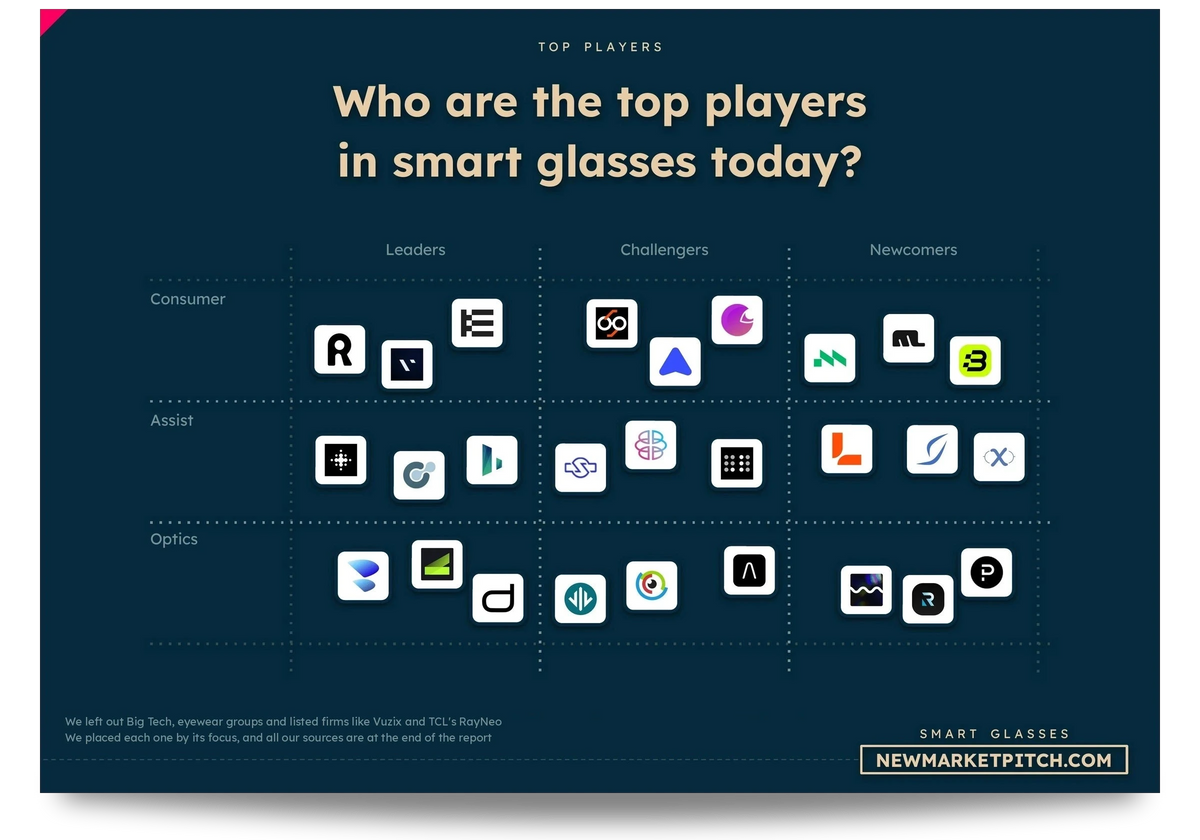
In our research about smart glasses, we turn what is vague and complex into simple, useful visuals. Market maps like this one show you at a glance where every startup stands.
Are smart glasses startups finding it easier to raise money?
Smart glasses startups are getting more financing now, although a lasting funding boom is still far from certain.
We tracked 32 deals worth at least $530M in the last 12 months, against 16 deals worth at least $198M in the 12 months before. Both figures moved up. With so few deals in the earlier period, percentage growth would exaggerate how certain that improvement is.
There is a reason smart glasses have investors looking again. EssilorLuxottica reported sales above 7 million AI-glasses units across Ray-Ban Meta and Oakley Meta during 2025, while Meta widened its eyewear range in September 2026. Those sales are from established brands, not startups. They show people will buy connected eyewear, but tell us little about which independent makers can compete.
Is Even Realities making smart glasses funding look better than it is?
Even Realities gives smart glasses funding a huge lift, but smaller startups have also been raising money.
The largest tracked financing was Even Realities' $150M pre-Series B round in July 2026, which our stage counts place with Series A. Even Realities' round helped make July 2026 the highest-capital month in the latest period, at $163M. VITURE's $100M round in February 2026 and XREAL's $100M round in January 2026, both of undisclosed stage, show why this is a market led by substantial individual commitments.
TechCrunch reported in July 2026 that Even Realities deliberately avoids outward-facing cameras in its G2 glasses and instead focuses on information projected into the wearer's view. The company said it had sold beyond its initial product target, but its customer base is different from that of a gaming-display maker such as VITURE. Investors are backing different kinds of glasses, each with different customers.
Take out the biggest deals and there is still money reaching smaller products. Even Realities dominates the headlines, but it is not the entire market.
Would smart glasses funding still look strong without giant rounds?
Yes, smart glasses startups still raised meaningful money after removing the giant rounds.
Excluding rounds above $50M, startups raised at least $180M in the last 12 months and at least $98M in the 12 months before. Excluding rounds above $100M leaves at least $380M against at least $198M. These are alternative cuts of the same market, not additional pools of money. We do not infer precise growth rates from a small earlier sample.
Those smaller rounds went to very different products. BleeqUp raised at least $14M in a Seed round in February 2026 to develop camera glasses aimed at athletes. The Subvocal Company raised a $500K Seed round in April 2026 for silent-speech sensing eyewear. INAIR completed a $2.8M Series A in April 2026 for spatial computing products. A sports camera, silent-input interface and spatial display serve different buyers.
Bpifrance described ENGO's July 2026 financing as supporting product development and miniaturization. That money helps improve a focused product, even if it never becomes a mass-market brand.

Your time is limited. In our market report about smart glasses, we put numbers on each part of the market, so you can see where it makes sense to focus.
Are more smart glasses startups getting funded, or just familiar names?
More smart glasses companies are getting funded, and existing companies are returning for checks more often.
We counted 23 funded companies over the last 12 months, compared with 15 companies in the 12 months before. The most recent period included 17 companies with a single tracked round, 4 companies with two rounds and 2 companies with three or more. The earlier period had 14 companies with a single round and 1 company with two. New names appeared, while some companies came back several times.
Look at the returning companies: Rokid, Bitmojo (NIMO) and MemoMind are making different products. Rokid is pursuing AR glasses and artificial-intelligence functions, Bitmojo positions eyewear as a productivity computer, and MemoMind is building memory-oriented glasses. Their different approaches require different types of product development. A repeat check could pay for growth or for another difficult round of product development. Financing announcements cannot tell us which.
Are investors writing bigger checks for smart glasses startups?
The typical disclosed smart glasses round is a little bigger, but the market still has a wide gap between ordinary checks and giant ones.
Among rounds with disclosed amounts, the median was $7.7M in the last 12 months and $7.5M in the 12 months before. At the company level, the median capital raised was $10M and $8M respectively. Company totals can include several rounds. The median deal tells a different story.
There are plenty of smaller rounds too. The latest period contained 5 disclosed deals under $5M, 11 deals from $5M to under $20M, and 2 deals from $20M to under $50M. A focused product can get funded, but developing optics, batteries and software together is expensive.
Meta's September 2025 launch of Ray-Ban Display illustrated the integration challenge: its device combines a display, cameras and interaction through an accompanying wristband. Smaller makers can offer less, provided buyers have a clear reason to pick their glasses.
Are $100M rounds becoming normal in smart glasses?
No, $100M smart glasses rounds remain rare even as investors write larger checks.
We tracked 3 rounds of $100M or more in the last 12 months, totaling $350M. The preceding period contained 1 such round, the $100M VITURE Series B in September 2025. In the latest period, the other major commitments went to Even Realities and XREAL, alongside VITURE's additional financing. Each company targets a distinct mix of everyday information, entertainment and spatial displays.
VITURE announced in February 2026 that it had secured another $100M after its September 2025 financing. The company linked the capital to products including its Luma and Beast lines. VITURE shows that an established manufacturer can return quickly for another major check. A new entrant should not expect that treatment.

In our document detailing everything you need to know about smart glasses, we always try to gather several sources and make estimates that make sense, so you can work with solid numbers.
Why are investors still backing VITURE’s smart glasses?
Investors are still putting major money into VITURE because portable display glasses have a clear use case beyond AI chat.
VITURE raised $100M in February 2026, in a round whose stage was not disclosed, after a separate $100M Series B in September 2025. The announcements fell in different comparison periods, so interest was not confined to one fundraising event. VITURE's company statement in February connected the later financing to its entertainment and productivity glasses lineup, including Luma Ultra and The Beast.
What VITURE sells differs from Meta's everyday camera and AI frames. Its product proposition centers on privately viewing games, videos and virtual screens. Gamers and laptop users can see the appeal of a private screen, but compatibility and display quality need to work every day.
Are investors choosing portable displays over full AR glasses?
No, full AR glasses now edge out portable display glasses on disclosed smart glasses money, and they get more separate rounds.
In the last 12 months, binocular AR glasses accounted for 11 deals and at least $231M, while media display glasses accounted for 7 deals and at least $219M. Investors are making different bets, and the funding totals do not show which technology is better. Media-focused devices often start with games and private screens. Binocular AR devices must make digital information useful while users see their surroundings.
Google and XREAL blurred that line when they launched AURA on Android XR in October 2026. The glasses use transparent lenses for spatial applications, showing how a company can move beyond an external screen into software that interacts with the user's environment. Even Realities goes in another direction, deliberately keeping its G2 eyewear camera-free.
The table below shows deal activity and disclosed capital by smart glasses product category over the last 12 months.
| Category | Deals | Capital | Capital share |
|---|---|---|---|
| Binocular AR Glasses | 11 | $231M+ | 44% |
| Media Display Glasses | 7 | $219M+ | 41% |
| Enterprise Assisted-Reality Glasses | 3 | $57M+ | 11% |
| Camera smart glasses | 1 | $14M+ | 3% |
| Monocular HUD Glasses | 5 | $8.6M+ | 2% |
| Non-Display AI Glasses | 3 | $1.3M+ | <1% |
| Assistive smart glasses | 2 | Undisclosed | 0% |
Capital shares refer only to rounds with a disclosed amount, and “+” means at least.

Our report covering the smart glasses market gets updated several times a month, so you always get the latest view of where things stand.
Why aren’t investors funding more camera smart glasses?
Camera smart glasses sell in large volumes, but independent camera-glasses startups attract surprisingly little disclosed funding.
Our latest-period sample contains 1 camera smart glasses deal, raising at least $14M. Non-display AI glasses received 3 deals worth at least $1.3M. By contrast, the large capital commitments in our sample mostly went to display-led products. The consumer bestseller is attracting far fewer startup checks than display-led glasses.
EssilorLuxottica reported more than 7 million AI-glasses unit sales in 2025 through its partnership with Meta. Counterpoint Research's September 2026 report found that display-less AI eyewear dominated global AI-glasses shipments in the first half of 2026. These are shipment figures, not venture dollars. Meta and EssilorLuxottica also hold the strongest position in that part of the market.
Is China pulling further ahead in smart glasses funding?
Yes, China is pulling further ahead in smart glasses startup funding, although Meta still leads a different contest: worldwide sales of display-less AI eyewear.
Chinese-headquartered startups completed 24 deals raising at least $398M in the last 12 months. American companies recorded 6 deals raising $126M. The Chinese activity spans display glasses, binocular AR, heads-up displays and specialized devices rather than a single fashionable product. The earlier period also contained Chinese funding, but with fewer funded companies and a smaller disclosed total.
China has a deep hardware manufacturing base, though our deal records cannot show how much that helped any particular startup. Building glasses involves optics, precision components, electronics assembly and rapid hardware iteration. The prominence of manufacturers such as Rokid, XREAL and INMO is consistent with the value of that ecosystem. Funding announcements simply don't measure that kind of advantage.
Counterpoint's September 2026 market report provides the counterweight: Meta dominates global display-less AI-glasses shipments, even though most of the startup money we track goes to China. China leads these startup deals while Meta remains the benchmark for mainstream display-less glasses sales.
Is Europe being left behind in smart glasses financing?
Europe is getting very few smart glasses startup checks compared with China and the United States.
The last 12 months included 2 European deals raising at least $5.6M, compared with 1 deal raising $5.5M in the 12 months before. The latest European examples include ENGO Eyewear's $5.6M Seed round in July 2026 and Lighthouse Tech's undisclosed Seed round in December 2025. That is a narrow funding market, even for a fast-developing device category.
ENGO provides a sharper view than the regional total. Bpifrance said in July 2026 that the Grenoble company was developing ultralight sports glasses to put cycling and running metrics in the wearer's vision, with its financing backing development and miniaturization. ENGO is targeting athletes, not trying to build an AI companion for everyone.

In our research about smart glasses, we look at what the winners do differently, so you can learn from the best instead of guessing.
Can a new smart glasses startup still raise its first round?
Yes, new smart glasses makers can still get a first check, though those rounds account for little of the disclosed money.
We identified 5 first financings in the last 12 months, representing at least $22M. The 12 months before contained 1 identified first financing, whose amount was undisclosed. Some startup histories are incomplete, so we treat this as an identified first financing, not every first check ever written. The latest examples include The Subvocal Company's $500K Seed round in April 2026 and ENGO Eyewear's $5.6M Seed round in July 2026.
Neither company is attempting to reproduce all of Meta's consumer features. The Subvocal Company is experimenting with silent speech input. ENGO focuses on exercise data for athletes. That kind of focus helps a new company explain what it can build first. A team can demonstrate a distinct problem, a plausible product and a testable route to customers without claiming to replace the smartphone immediately.
Are follow-on rounds swallowing smart glasses funding?
Pretty much: most disclosed smart glasses funding now goes to companies that have already raised money.
Over the last 12 months, 23 follow-on rounds raised at least $487M and 5 first financings raised at least $22M. Funding history was not classifiable for another 4 deals. In the earlier 12-month period, we identified 10 follow-ons worth at least $184M and 1 first financing with an undisclosed amount. The largest checks clearly favor companies investors have already seen.
Hardware makers often need follow-on rounds to pay for manufacturing, software updates, certification and retail distribution. VITURE was already selling advanced XR display glasses before raising again. Even Realities had launched G2 before its July financing. Investors may see more information after a product reaches buyers than they see in an initial prototype.
Do younger smart glasses startups have a real shot at funding?
Young smart glasses startups can raise money, especially when they ask for smaller checks and solve a narrow problem.
The median company age at funding was 4.5 years in the last 12 months, against 3.5 years in the preceding period. Among companies receiving under $5M, the median age was 1 year in the latest period. Most funded companies were founded recently: 74% of latest-period companies were founded in 2020 or later, and 57% in 2022 or later.
Investors will fund recent startups with modest checks. Manufacturers seeking much larger sums tend to be further along. New founders need not wait until they resemble an established consumer-electronics brand, but they are unlikely to convince investors through a rendering alone.

In our market report about smart glasses, we don't want to repeat what boring consulting reports say. Instead, we show you the real and latest market signals that matter.
Are smart glasses companies raising money faster than before?
Smart glasses startups that raise again are doing so sooner on the median measure, though quick returns can mean different things.
For repeated financing events with usable timing information, the median gap was 6 months in the last 12 months and 9 months in the 12 months before. Coverage was 72% of relevant gaps in the latest period and 69% previously. In the latest period, 65% of measured gaps were under 12 months, while 78% were under 18 months. We measured gaps between financings, not the percentage of companies that raised again.
VITURE's separately announced $100M rounds of September 2025 and February 2026 are a concrete example of a rapid return. Rokid also appeared across several financings in the latest period. But faster repeat funding is ambiguous: it can reflect strong investor demand, an unusually intensive development cycle or continued capital needs before a device pays for itself.
A faster return shows investors are willing to write another check. It says little about profit without sales, margins and cash-use figures.
Are early-stage smart glasses startups getting more of the money?
Yes, early-stage smart glasses deals now receive more disclosed money, partly because one unusually large round changes the picture.
Among deals with a named stage, early-stage transactions represented 72% in the last 12 months and 64% in the 12 months before. Early stages took 67% of the disclosed capital with a named stage in the latest period against 17% previously. One financing makes that share look especially strong: Even Realities' $150M pre-Series B round of July 2026 is counted with Series A, so a larger early-stage capital share should not be mistaken for generous funding for every seed-stage founder.
The stage breakdown shows how different the checks can be. Seed financing had 11 deals and at least $51M, while Series A had 7 deals and at least $157M. Rounds whose stage was not disclosed raised the most, at least $218M, because the $100M rounds of VITURE and XREAL did not name a stage. Later-stage companies can still raise sizeable sums, but the labels do not describe identical product maturity across manufacturers.
The table below shows capital and deals by announced funding stage over the last 12 months.
| Stage | Deals | Capital | Capital share |
|---|---|---|---|
| Unknown | 7 | $218M+ | 41% |
| Series A | 7 | $157M+ | 30% |
| Series C | 3 | $59M+ | 11% |
| Seed | 11 | $51M+ | 10% |
| Growth Equity | 3 | $44M | 8% |
| Series B | 1 | Undisclosed | 0% |
Capital shares are of disclosed capital, and “+” means at least.

Learning from others' mistakes is the cheapest lesson there is. In our document detailing everything you need to know about smart glasses, we look at what broke startups before you, so you don't repeat it.
Are more investors starting to back smart glasses startups?
More investors are funding smart glasses startups, but none of the disclosed lead investors led multiple rounds in the latest period.
We identified 39 unique investors in the last 12 months, compared with 16 in the 12 months before. A disclosed lead investor appeared on 41% of the latest deals, and there were 16 unique lead investors. No lead investor was recorded as leading multiple rounds in that period. The earlier period had 6 unique leads and likewise no repeat leader.
No single investor tops the lead list. Meituan and Tencent co-led the largest round, Even Realities' $150M financing, and that round size is not the amount either investor wrote personally. Legend Capital led VITURE's February 2026 financing, and Gobi Partners led Bitmojo's October 2026 round.
Does Meta's smart glasses success make startup fundraising easier?
Meta makes the smart glasses market easier for investors to understand, while making life harder for startups selling similar frames.
EssilorLuxottica's 2025 results demonstrated large-scale demand for its Ray-Ban Meta and Oakley Meta lines. Meta expanded into prescription-oriented frames in March 2026 and introduced more audio and AI eyewear choices in September. Those sales show people will buy electronic eyewear, but Meta and its retail partners already occupy the most obvious mainstream opportunity.
Our financing records show capital clustering in display-led and specialized devices instead. Some founders may be steering away from Meta, while display hardware may simply cost more to build. Funding amounts alone cannot tell us which explanation dominates.
Can smaller smart glasses brands compete with Meta and Google?
Smaller smart glasses brands can compete by making something specific that Meta or Google does not prioritize.
Meta now sells camera and AI glasses through established eyewear brands and its own expanded styles. Google said in May 2026 that Android XR would support audio-first eyewear and display glasses through partners such as Warby Parker and Gentle Monster. In October 2026, Google and XREAL launched AURA as an Android XR glasses product. Developers get a stronger platform and buyers get familiar brands.
A startup can still build something narrower and useful. Even Realities places private prompts into everyday lenses without a camera. ENGO shows sports performance metrics, and LLVision sells glasses for enterprise workflows and translation. None needs to win every customer looking for general-purpose AI glasses.

If you build or invest in the smart glasses market, you need to know which business models pay off now and which ones are fading. That's why our report covering it has a whole section on it.
Is enterprise smart eyewear being overlooked by investors?
Enterprise smart glasses are still getting funded, but consumer display glasses are drawing far more rounds.
Enterprise assisted-reality glasses accounted for 3 deals and at least $57M in the last 12 months. The preceding period also had 3 deals, though its disclosed capital was at least $16M. LLVision's Series C of at least $45M in September 2026 stands out in the latest group. Shoujing Technology raised a $4.2M Series A in March 2026, and RealWear raised $7.7M in July 2026, in a round of undisclosed stage.
Factory teams and technicians buy glasses for different reasons than gamers. RealWear's Navigator devices are built for frontline tasks, hands-free operation and industrial environments. LLVision describes remote collaboration and professional eyewear software. Those tools can earn repeat business without ever becoming fashion products.
Why aren’t more investors funding accessibility-focused smart glasses?
Accessibility-focused smart glasses receive very few identifiable venture checks, despite clear uses for navigation and obstacle detection.
The latest 12-month period included 2 assistive smart glasses deals with undisclosed amounts. The preceding period contained 1 deal, raising $5.5M. Lighthouse Tech's December 2025 Seed financing fits the latest period, while dotLumen's $5.5M Seed round in January 2025 appears in the earlier one. The amounts available to compare are too incomplete to support a conclusion that money has moved decisively in either direction.
These products also solve problems distinct from recording videos or gaming. Lighthouse Tech targets obstacle detection, and dotLumen develops wearable navigation for blind users. For customers who depend on these glasses to move safely, reliability matters far more than flashy features.
So, what does smart glasses funding look like right now?
Smart glasses funding is healthier than before, but a handful of huge checks still decide much of the picture.
The last 12 months brought more activity, a wider set of financed companies and credible smaller rounds. At the same time, a handful of large manufacturers and display-led projects received most of the disclosed capital. Even Realities raised the most over the last 12 months among the startups we tracked. No investor led more than one round, and Meituan and Tencent co-led the largest one.
The useful change is that investors are backing new teams, returning manufacturers and products for very different jobs: private contextual displays, entertainment screens, enterprise assistance, sports information and accessibility. That variety is genuine, but the short history still makes long-term claims risky.
The table below shows what we found.
| Question | Answer |
|---|---|
| Has startup funding become a genuinely broad boom? | Smart glasses financing clearly expanded across both money and activity. We counted 23 funded companies in the latest period. The earlier sample is too small for reliable growth percentages. |
| Are blockbuster checks the whole funding story? | The biggest rounds still dominate disclosed capital and attention. Smaller financings raised at least $180M without rounds above $50M. Smaller deals give the boom a base beyond its giants. |
| Can portable screens keep attracting serious backers? | Yes, VITURE is still raising for gaming and productivity glasses. Media display glasses secured at least $219M in the latest period. Big checks show commitment, though buyers still need convincing. |
| Do camera glasses attract the most venture dollars? | No, identifiable venture capital favors screen-based smart glasses instead. Binocular AR glasses secured at least $231M in the latest period. Mainstream camera-glasses demand is largely served by established brands. |
| Are new eyewear founders finding their first checks? | Some new smart glasses ventures are still securing first financings. We identified 5 such rounds in the latest period. Their smaller capital pool contrasts with already-funded manufacturers. |
| Are previous winners returning more often for capital? | Yes, smart glasses startups increasingly return to investors for checks. We identified 23 follow-on rounds in the latest period. That strengthens existing teams but raises questions about newcomer access. |
| Is China leading consumer demand as well? | China dominates this startup funding sample, not global unit sales. Chinese companies raised at least $398M in the latest period. Meta remains the commercial reference point for everyday AI eyewear. |
| Can focused European smart eyewear still succeed? | European startups can raise for specialized and useful products. The region recorded 2 deals in the latest period. Its financing scale remains distant from Asia-Pacific and North America. |
| Is industrial assisted reality being crowded out? | Enterprise eyewear is still securing capital for practical applications. That category drew at least $57M in the latest period. Customer need may matter more than consumer-fashion visibility. |
| Are repeat funding intervals consistently getting shorter? | Median intervals shortened for the repeat-round gaps we measured. The latest median was 6 months with 72% coverage. Individual gaps still differ, and fast financing does not prove profitability. |
| Can today's financing pace be called durable? | A lasting smart glasses boom remains an unproven claim. The prior period contained only 16 deals in our comparison. Another sustained run of broader financings would strengthen the verdict. |

In our research about smart glasses, we like to show you the big picture. We know your time is precious, so we make every page quick to read and packed with as much learning as possible per minute.
Our methodology
Our data runs through November 17, 2026. We then reviewed this article and updated its answers on November 18, 2026, the date shown under the title. We compare November 18, 2025 to November 17, 2026 with November 18, 2024 to November 17, 2025. The comparison uses 12 months against 12 months. The earlier period contains fewer than 20 deals, and 18 months against 18 months could not be used because the earlier period would start before our complete coverage began in January 2024. This market is too small for reliable percentage changes between these periods.
We count equity financings of private companies with deal sizes of at least $300K. We exclude debt, grants, loans, unconverted convertibles, SAFEs and public offerings. We include equity rounds of undisclosed size in deal counts when they otherwise qualify, but not in capital totals. We record each financing once and merge duplicate coverage of the same event.
We define smart glasses as eyewear containing digital functions for information, communication or interaction. We include AI and camera glasses, display and AR glasses, industrial assisted-reality devices and special-purpose visual, navigation and captioning eyewear. We exclude ordinary frames, component-only suppliers, software-only XR services, contact lenses and enclosed VR headsets. Borderline eyewear makers remain included when they primarily design or sell qualifying connected glasses.
Every company is a startup under our definition: an independent fast-growth technology business founded in 2000 or later, privately held or listed within the past five years, with recently acquired businesses retained for up to three years as part of their acquirer. We group financing by disclosed stage, treat unidentified stages as unknown and distinguish earlier financing from follow-ons when the available history allows. Regions follow headquarters country. Product categories reflect our own segmentation.
We prioritize company announcements, regulatory filings and reliable reporting. Undisclosed amounts still contribute to deal counts, which is why some reported capital totals are minimums rather than exact market-wide sums. For the same reason, the disclosed-capital shares in our category and stage comparisons describe only financings with published amounts.
Rounds confirmed by a company announcement, a press article or a regulatory filing are counted in full. Where no article exists, a round is counted only when at least two recognised databases agree on its date (within one month) and amount (within 5%), and it is marked as low confidence; a round found in a single database stays in the company's history but is left out of totals. For companies that have raised more than $100M, every round counted is backed by an article.
A reader may find a higher market total elsewhere because another publication may include acquisitions, subsidiaries, grants, component companies, enclosed headsets or earlier financing outside these dates. We keep those boundaries fixed and distinguish investor-backed startups from major public technology and eyewear companies. The result is a like-for-like view of this narrowly defined market rather than a claim to measure every dollar spent on wearable computing.
Key sources include EssilorLuxottica 2025 results and sales of AI eyewear with Meta, Meta's expanded AI and audio eyewear portfolio in September 2026, Meta Ray-Ban Display launch and wristband design, Meta's prescription-oriented AI eyewear in March 2026, Google's audio and display glasses roadmap in May 2026, Google's October 2026 XREAL AURA launch, Even Realities funding, product design and commercial context, VITURE's February 2026 financing and device lineup, Even G2 functions and design philosophy, ENGO Eyewear financing and athletic eyewear use case, RealWear's industrial assisted-reality product family, LLVision enterprise solutions and professional eyewear, and Independent shipment research on display-less and AR eyewear.

When you build or invest in the smart glasses market, you need clarity, not confusion. In our market report about smart glasses, we always try to put numbers on and quantify whatever is usually vague and confusing.
Written by the New Market Pitch teamWe track new markets so founders and investors can move faster. About us