What are the funding trends in smart glasses right now?
Whether you're building or investing in the smart glasses market, our report covers everything you need to know: the players, the money, and what's coming next.
Summary
Smart glasses startups are raising far more money this year, and more companies are getting checks. A few giant rounds still do much of the work. We tracked 28 deals raising at least $516M so far this year, led by Even Realities with $150M.
At the equivalent point in 2025, we had tracked 15 deals and at least $189M. The same point in 2024 also had 15 deals, with at least $211M. The current run is markedly busier.
The current partial year has already beaten both previous full-year totals. The full year 2025 recorded 19 deals and at least $203M, while the full year 2024 had 16 deals and at least $220M.
The largest rounds take a huge share of the money. Three deals of $100M or more account for $350M of the disclosed funding this year, led by large commitments to Even Realities, VITURE and XREAL.
Smaller startups are still finding investors. Excluding rounds above $50M leaves at least $166M so far this year, compared with at least $89M at the same point in 2025.
Funding still comes in waves rather than rising every quarter. Q1 2026 drew at least $257M, Q2 2026 brought more deals but less money, and Q3 2026 rose again on large financings.
Investors continue to support different product directions. Binocular AR glasses have the most deals, while media display glasses have raised slightly more disclosed money. Camera-focused independent startups are much less visible in the financing record.
China now dominates financing activity among qualifying startups, with 22 deals and at least $391M this year to date. That's a sharp contrast with consumer sales, where Meta's eyewear partnership ships the most glasses worldwide.
More companies are reaching Series A and returning for another check. We see additional Series A activity, repeated raises by companies already in the market and a broader pool of identifiable investors, but very large checks remain exceptional.
Funding has jumped, but it has not settled into a steady rhythm. The next test is whether more independent glasses makers can keep winning customers and follow-on checks.

Written by the New Market Pitch teamWe track new markets so founders and investors can move faster. About us

In our report covering the smart glasses market, you will always find fresh funding data, taken straight from our own verified funding database.
All funding deals in the smart glasses market over the last years
Below is the table listing all the deals. You can find our methodology at the end of this page.
If you want a deeper understanding of the market and its current dynamics, get our smart glasses market report.
| Company | Category | Date | Stage | Deal size | What they do | Region | Lead investors | Country | Rank |
|---|---|---|---|---|---|---|---|---|---|
| AREX | Monocular HUD Glasses | November 2026 | Seed | $3M+ | AR diving masks with heads-up display | Asia-Pacific | Not disclosed | China | |
| Microlumin | Binocular AR Glasses | October 2026 | Series A | Undisclosed | Modular AI augmented reality eyewear | Asia-Pacific | Wuxi Liangxi Science and Technology City Innovation Investment | China | |
| Unseen Reality | Media Display Glasses | October 2026 | Unknown | $10M | Open-sided video-passthrough spatial display glasses | North America | Not disclosed | United States | |
| Chenbo Vision | Non-Display AI Glasses | October 2026 | Series A | Undisclosed | AI eyewear and vision technology | Asia-Pacific | Youbo Capital | China | |
| Bitmojo (NIMO) | Media Display Glasses | October 2026 | Seed | Undisclosed | Productivity smart glasses and spatial computer | Asia-Pacific | Gobi Partners | China | |
| Guangli Technology | Monocular HUD Glasses | September 2026 | Series B | Undisclosed | AR glasses and waveguide displays | Asia-Pacific | Not disclosed | China | |
| LLVision | Enterprise Assisted-Reality Glasses | September 2026 | Series C | $45M+ | Enterprise AR glasses and software | Asia-Pacific | Not disclosed | China | |
| The Subvocal Company | Non-Display AI Glasses | September 2026 | Unknown | $800K | Silent-speech sensing smart eyeglasses | North America | Not disclosed | United States | |
| INMO | Binocular AR Glasses | September 2026 | Series C | Undisclosed | Consumer all-in-one AR smart glasses | Asia-Pacific | Not disclosed | China | |
| RealWear | Enterprise Assisted-Reality Glasses | July 2026 | Unknown | $7.7M | Industrial hands-free wearable computers | North America | Not disclosed | United States | |
| ENGO Eyewear | Monocular HUD Glasses | July 2026 | Seed | $5.6M | Sport glasses displaying real time performance data | Europe | Ventech, Odyssée Venture, Bpifrance Amorçage Industriel | France | |
| Even Realities | Binocular AR Glasses | July 2026 | Series A | $150M | Minimalist AI display smart glasses | Asia-Pacific | Meituan, Tencent | China | |
| Tongxing Technology | Assistive Smart Glasses | June 2026 | Seed | Undisclosed | Smart glasses and augmented reality hardware | Asia-Pacific | Not disclosed | China | |
| MemoMind | Binocular AR Glasses | May 2026 | Seed | ~$8.8M | AI-powered memory smart glasses | Asia-Pacific | CICC Emerging Fund | China | |
| Rokid | Binocular AR Glasses | May 2026 | Unknown | Undisclosed | AI and AR smart glasses | Asia-Pacific | Not disclosed | China | |
| Future Fullscreen Intelligent Technology Group | Media Display Glasses | April 2026 | Series A | Undisclosed | Portable XR display and smart eyewear developer | Asia-Pacific | Not disclosed | China | |
| Rokid | Binocular AR Glasses | April 2026 | Growth Equity | ~$13M | AI and AR smart glasses | Asia-Pacific | Not disclosed | China | |
| Rokid | Binocular AR Glasses | April 2026 | Growth Equity | ~$5.8M | AI and AR smart glasses | Asia-Pacific | Not disclosed | China | |
| The Subvocal Company | Non-Display AI Glasses | April 2026 | Seed | $500K | Silent-speech sensing smart eyeglasses | North America | Afore Capital | United States | |
| Bitmojo (NIMO) | Media Display Glasses | April 2026 | Seed | ~$5.8M | Productivity smart glasses and spatial computer | Asia-Pacific | Not disclosed | China | |
| INAIR | Media Display Glasses | April 2026 | Series A | $2.8M | AI spatial computing and AR glasses | Asia-Pacific | Not disclosed | China | |
| Shoujing Technology | Enterprise Assisted-Reality Glasses | March 2026 | Series A | $4.2M | Enterprise AR hardware and solutions | Asia-Pacific | Daoming Optics & Chemical | China | |
| Rokid | Binocular AR Glasses | March 2026 | Growth Equity | $25M | AI and AR smart glasses | Asia-Pacific | Not disclosed | China | |
| Guangli Technology | Monocular HUD Glasses | March 2026 | Series A | Undisclosed | AR glasses and waveguide displays | Asia-Pacific | Hangzhou High-Tech Financial Investment Group | China | |
| BleeqUp | Camera Smart Glasses | February 2026 | Seed | $14M+ | AI camera glasses for athletes | Asia-Pacific | Skyworth Investment | China | |
| VITURE | Media Display Glasses | February 2026 | Unknown | $100M | XR entertainment and productivity glasses | North America | Legend Capital | United States | |
| INMO | Binocular AR Glasses | January 2026 | Series C | $14M+ | Consumer all-in-one AR smart glasses | Asia-Pacific | Chengdu Sci-Tech Innovation Investment Group | China | |
| XREAL | Media Display Glasses | January 2026 | Unknown | $100M | Consumer augmented reality display glasses | Asia-Pacific | Not disclosed | China | |
| Lighthouse Tech | Assistive Smart Glasses | December 2025 | Seed | Undisclosed | Assistive obstacle-detection smart eyewear | Europe | Not disclosed | Switzerland | |
| MemoMind | Binocular AR Glasses | December 2025 | Seed | $7M | AI-powered memory smart glasses | Asia-Pacific | Not disclosed | China | |
| Mira | Binocular AR Glasses | November 2025 | Seed | $6.6M | Always-on AI glasses with private display | North America | General Catalyst | United States | |
| Guangli Technology | Monocular HUD Glasses | November 2025 | Unknown | Undisclosed | AR glasses and waveguide displays | Asia-Pacific | Not disclosed | China | |
| Halliday | Monocular HUD Glasses | October 2025 | Seed | Undisclosed | AI wearables and near-eye displays | Asia-Pacific | Not disclosed | Singapore | |
| VITURE | Media Display Glasses | September 2025 | Series B | $100M | XR entertainment and productivity glasses | North America | Not disclosed | United States | |
| Mira | Binocular AR Glasses | August 2025 | Seed | $1M | Always-on AI glasses with private display | North America | Pillar VC | United States | |
| LLVision | Enterprise Assisted-Reality Glasses | August 2025 | Series D+ | $14M+ | Enterprise AR glasses and software | Asia-Pacific | Yizhuang Industrial Upgrading Fund | China | |
| BleeqUp | Camera Smart Glasses | August 2025 | Seed | Undisclosed | AI camera glasses for athletes | Asia-Pacific | Not disclosed | China | |
| RealWear | Enterprise Assisted-Reality Glasses | July 2025 | Unknown | $650K | Industrial hands-free wearable computers | North America | Not disclosed | United States | |
| INMO | Binocular AR Glasses | July 2025 | Series B | $21M+ | Consumer all-in-one AR smart glasses | Asia-Pacific | Not disclosed | China | |
| Mentra | Camera Smart Glasses | July 2025 | Seed | $8M | Open-source smart glasses operating system | North America | Not disclosed | United States | |
| Mtaitech | Media Display Glasses | July 2025 | Seed | Undisclosed | Smart glasses and augmented reality hardware | Asia-Pacific | Not disclosed | China | |
| XREAL | Media Display Glasses | May 2025 | Growth Equity | ~$28M | Consumer augmented reality display glasses | Asia-Pacific | Pudong Venture Capital Group | China | |
| Microlumin | Binocular AR Glasses | May 2025 | Seed | ~$6.9M | Modular AI augmented reality eyewear | Asia-Pacific | Dinghan Investment | China | |
| INAIR | Media Display Glasses | May 2025 | Series A | ~$2.8M | AI spatial computing and AR glasses | Asia-Pacific | Weihai Venture Capital | China | |
| LAWK | Binocular AR Glasses | April 2025 | Series B | Undisclosed | AI-powered AR eyewear | Asia-Pacific | Not disclosed | China | |
| RealWear | Enterprise Assisted-Reality Glasses | March 2025 | Unknown | $1.6M | Industrial hands-free wearable computers | North America | Not disclosed | United States | |
| dotLumen | Assistive Smart Glasses | January 2025 | Seed | $5.5M | Wearable navigation device for blind people | Europe | Catalyst Romania | Romania | |
| Even Realities | Binocular AR Glasses | December 2024 | Series A | $9M | Minimalist AI display smart glasses | Asia-Pacific | Not disclosed | China | |
| Tilt Five | Binocular AR Glasses | November 2024 | Series B | $14M | Holographic tabletop gaming glasses | North America | Not disclosed | United States | |
| Halliday | Monocular HUD Glasses | November 2024 | Seed | $2.8M+ | AI wearables and near-eye displays | Asia-Pacific | GSR Ventures | Singapore | |
| VITURE | Media Display Glasses | October 2024 | Series B | $30M | XR entertainment and productivity glasses | North America | Singtel Innov8 | United States | |
| Microlumin | Binocular AR Glasses | October 2024 | Seed | Undisclosed | Modular AI augmented reality eyewear | Asia-Pacific | Not disclosed | China | |
| Rokid | Binocular AR Glasses | September 2024 | Growth Equity | ~$14M | AI and AR smart glasses | Asia-Pacific | Not disclosed | China | |
| Almer Technologies | Enterprise Assisted-Reality Glasses | September 2024 | Seed | $3M | Smart glasses for frontline industrial workers | Europe | Vi Partners | Switzerland | |
| Get YourWay | Enterprise Assisted-Reality Glasses | August 2024 | Seed | $935K | Hands-free scanners for hospital pharmacies | Europe | Not disclosed | Belgium | |
| XanderGlasses | Assistive Smart Glasses | August 2024 | Seed | $1.4M | Real-time captions for hearing accessibility | North America | Ray Stata | United States | |
| INAIR | Media Display Glasses | August 2024 | Series A | Undisclosed | AI spatial computing and AR glasses | Asia-Pacific | Not disclosed | China | |
| INMO | Binocular AR Glasses | July 2024 | Series B | ~$14M | Consumer all-in-one AR smart glasses | Asia-Pacific | Not disclosed | China | |
| Lighthouse Tech | Assistive Smart Glasses | May 2024 | Seed | $553K | Assistive obstacle-detection smart eyewear | Europe | KAPSLY Ventures | Switzerland | |
| Shoujing Technology | Enterprise Assisted-Reality Glasses | April 2024 | Seed | Undisclosed | Enterprise AR hardware and solutions | Asia-Pacific | Not disclosed | China | |
| Brilliant Labs | Monocular HUD Glasses | February 2024 | Seed | Undisclosed | Open-source AR and AI wearables | Asia-Pacific | Not disclosed | Singapore | |
| XREAL | Media Display Glasses | January 2024 | Growth Equity | $60M | Consumer augmented reality display glasses | Asia-Pacific | Not disclosed | China | |
| Rokid | Binocular AR Glasses | January 2024 | Series C | $70M | AI and AR smart glasses | Asia-Pacific | Hefei Municipal Government | China |

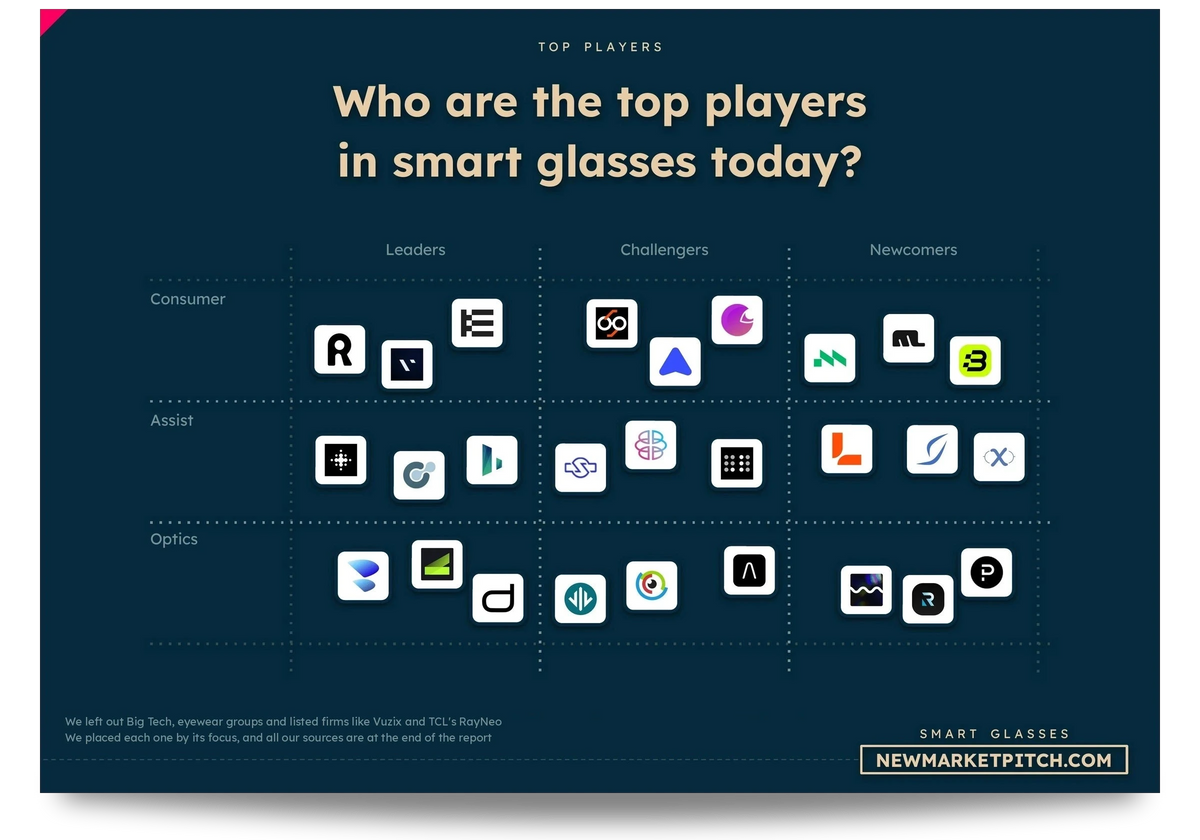
In our research about smart glasses, we turn what is vague and complex into simple, useful visuals. Market maps like this one show you at a glance where every startup stands.
Is smart glasses startup funding finally taking off this year?
Yes, smart glasses startup funding has picked up sharply this year, although the biggest deals still weigh heavily.
So far this year, we have recorded 28 deals involving 21 companies and at least $516M. At the same calendar point in 2025, we had 15 deals among 14 companies worth at least $189M. At the same point in 2024, we also had 15 deals and 14 companies, worth at least $211M. The earlier samples are small, so the direction is clear without claiming a precise growth percentage.
The market's commercial context has changed. EssilorLuxottica disclosed sales above 7 million pairs of AI eyewear across its Meta-linked brands in 2025. Google announced more Android XR eyewear partnerships in May 2026, and Meta widened its consumer offerings in September 2026. The big brands are not part of our startup counts. Their product launches make it easier to see why investors are paying attention.
Has smart glasses funding already passed the previous full year?
It has: smart glasses startups have already raised more this partial year than in either of the last two complete years.
Our tracked startups raised at least $516M in this incomplete year, while the full year 2025 registered at least $203M and the full year 2024 at least $220M. In deal count, the current partial year has 28, against 19 in the full year 2025 and 16 in the full year 2024. These are direct totals, not an annualized forecast. Nothing from the remaining weeks has been counted in advance.
There is no need to assume a late-year rush to beat those benchmarks. Large financings for Even Realities, VITURE and XREAL have already changed the annual picture. But the size of those rounds also raises the bar for interpreting the result: removing the biggest deals is essential before claiming a broad revival.
Would smart glasses investment still be rising without the biggest rounds?
Yes, smaller smart glasses financings are doing better too, even after excluding the largest disclosed deals.
Removing rounds above $50M leaves at least $166M this year to date, against at least $89M in the equivalent part of 2025 and at least $81M in the equivalent part of 2024. Removing rounds above $100M leaves at least $366M this year, alongside at least $189M and at least $211M in those earlier periods. These are alternative views of one financing pool, not amounts to be added together.
The underlying deals span different kinds of businesses. INAIR's $2.8M Series A in April 2026 targets spatial computing. Shoujing Technology's $4.2M Series A in March 2026 serves enterprise AR applications. The Subvocal Company's $500K Seed round in April 2026 supports silent-speech eyewear. Each team is trying to solve a different problem.

Your time is limited. In our market report about smart glasses, we put numbers on each part of the market, so you can see where it makes sense to focus.
Is this smart glasses boom different from the previous two years?
Smart glasses funding is busier this year, and large checks have appeared in several different quarters.
The full year 2024 produced 16 tracked deals and at least $220M. The full year 2025 produced 19 deals and at least $203M. This year's incomplete total is already much higher. The preceding years were not completely inactive: Rokid had a $70M Series C in January 2024, and VITURE had a $100M Series B in September 2025. What changed is the coexistence of more deals and several exceptionally large financings in the current period.
Funding wobbled between 2024 and 2025. This year brought more deals alongside big checks that arrived at different points in the calendar.
Is smart glasses funding accelerating every quarter?
No, smart glasses funding jumps when a large deal lands, while quieter quarters can still contain plenty of smaller checks.
Q1 2026 brought 7 deals and at least $257M, followed by Q2 2026 with 9 deals and at least $37M. Q3 2026 then produced 7 deals and at least $209M. Q4 2026 is still partial, so its current activity should not be read as a completed-quarter decline. Looking only at dollars would miss the busy spring quarter.
One very large hardware round can transform a quarter without bringing in more companies. Funding dates do not tell us when customers buy glasses. Major announcements from VITURE and Even Realities illustrate how large checks can dominate a quarter.
The table below shows the recorded quarterly smart glasses funding series, with the current quarter clearly marked as incomplete.
| Period | Deals | Companies | Capital |
|---|---|---|---|
| Q1 2024 | 3 | 3 | $130M+ |
| Q2 2024 | 2 | 2 | $553K+ |
| Q3 2024 | 6 | 6 | $33M+ |
| Q4 2024 | 5 | 5 | $56M+ |
| Q1 2025 | 2 | 2 | $7.1M |
| Q2 2025 | 4 | 4 | $38M+ |
| Q3 2025 | 8 | 8 | $144M+ |
| Q4 2025 | 5 | 5 | $14M+ |
| Q1 2026 | 7 | 7 | $257M+ |
| Q2 2026 | 9 | 7 | $37M+ |
| Q3 2026 | 7 | 7 | $209M+ |
| Q4 2026 (partial) | 5 | 5 | $13M+ |
“+” means at least, and some round amounts are undisclosed. Quarterly amounts are rounded independently.
Does a busy quarter mean bigger smart glasses funding rounds?
Not at all: the busiest smart glasses quarter by deal count brought in much less disclosed money than a quieter quarter.
Q2 2026 led this year's quarterly deal volume with 9 deals, yet it raised at least $37M. Q1 2026 had fewer deals but substantially more disclosed capital. Deal counts and dollar totals tell different stories. Q2 included smaller and undisclosed financings, while Q1 contained large commitments to established display makers.
The busy quarter included several different types of checks. Rokid completed Growth Equity financings in April 2026, The Subvocal Company raised a $500K Seed round in April 2026, and INAIR raised a $2.8M Series A in April 2026. That activity did not require another giant round.

In our document detailing everything you need to know about smart glasses, we always try to gather several sources and make estimates that make sense, so you can work with solid numbers.
Is Even Realities behind the smart glasses funding boom?
Even Realities made a big difference to smart glasses funding, but the boom was already underway before its summer round.
July 2026 was the strongest month by capital this year, with $163M. Even Realities' $150M pre-Series B round in July 2026, which our stage counts place with Series A, was the largest individual deal of the year. However, substantial funding had already reached other companies earlier: VITURE raised $100M in February 2026 and XREAL raised $100M in January 2026, both in rounds of undisclosed stage.
In a July 2026 interview with TechCrunch, Even Realities explained why its glasses have no camera. Even G2 puts contextual information into a lightweight frame rather than relying on the familiar camera-first smart-glasses proposition. The company said its early sales had exceeded its initial product target, which helps explain why the deal caught attention.
Do the latest smart glasses funding figures signal a slowdown?
No clear slowdown has appeared in smart glasses startup funding, and the latest quarter is still incomplete.
Q4 2026 has recorded 5 deals and at least $13M so far, while Q3 2026 closed with 7 deals and at least $209M. One is a finished quarter. The other is still underway. October 2026 included Unseen Reality's $10M round of undisclosed stage, a Seed for Bitmojo (NIMO) whose amount was not published and other financings with unpublished amounts.
Rounds without a published amount count as deals but add nothing to the disclosed-dollar total. That is why a quieter unfinished quarter is weak evidence of a downturn.
Are the typical smart glasses funding rounds getting larger?
The typical disclosed smart glasses check is bigger than at this point last year, but still smaller than the comparable 2024 check.
Among deals with disclosed values, this year's median is $8.8M. At the same calendar point in 2025, the median was $6.9M. At the same point in 2024, the exact median was $13.8M. The current median sits between those earlier benchmarks, even as the present year's total capital is higher. The older samples are thin, so it would be wrong to turn those medians into a confident growth-rate story.
For founders, the middle-sized round matters more than the headline. A $100M financing for a manufacturer building sophisticated optics can move the market's total without altering what a typical smaller team can secure. This year also includes 5 disclosed deals under $5M, and 9 deals from $5M to under $20M. A startup building a narrow feature is playing a different game from a manufacturer scaling advanced optics.

Our report covering the smart glasses market gets updated several times a month, so you always get the latest view of where things stand.
Are there more $100M smart glasses rounds this year?
A few more, but $100M smart glasses rounds are still unusual, even after several high-profile checks this year.
The current year contains 3 rounds of $100M or more, totaling $350M. At the same point in 2025 there was 1 such round, while the comparable period of 2024 contained no deal in that bucket. The three current large rounds went to Even Realities, VITURE and XREAL. The companies sell different things: private information displays, entertainment screens and spatial computing.
VITURE's February 2026 company statement placed its $100M financing after another major raise in September 2025. Even Realities drew attention for its camera-free design. Google subsequently introduced XREAL AURA in October, confirming that display glasses continue to connect with broader software platforms.
Are investors writing bigger checks for early smart glasses startups?
Yes, early-stage smart glasses companies are getting a larger share of disclosed funding, driven in part by one enormous round.
Among deals with a named stage, early-stage rounds accounted for 68% this year to date, against 62% at the equivalent point in 2025 and 60% in 2024. Early-stage shares of the disclosed capital with a named stage were 65%, 13% and 4% respectively. A big part of that change comes from Even Realities' $150M pre-Series B round of July 2026, which our stage counts place with Series A. Early-stage is a funding label, not proof the product is untested.
The current stage mix includes 8 Seed deals and 7 Series A deals. Series C companies also raised major sums. Rounds whose stage was not disclosed hold the most disclosed money, at least $218M, because the $100M rounds of VITURE and XREAL did not name a stage. Investors are writing checks at several stages, rather than concentrating only on seed companies or mature manufacturers.
The table below shows the tracked smart glasses stage breakdown for this year to date.
| Stage | Deals | Capital | Capital share |
|---|---|---|---|
| Unknown | 6 | $218M+ | 42% |
| Series A | 7 | $157M+ | 30% |
| Series C | 3 | $59M+ | 11% |
| Growth Equity | 3 | $44M | 9% |
| Seed | 8 | $38M+ | 7% |
| Series B | 1 | Undisclosed | 0% |
Capital shares refer only to deals with a disclosed amount, and “+” means at least.
Are seed rounds losing ground in the smart glasses market?
Seed rounds are still being funded in smart glasses, but other stages now make up more of the activity.
We tracked 8 Seed rounds this year to date, versus 7 at the equivalent point in 2025 and 8 in 2024. Seed accounts for 29% of deals now, down from 47% and 53% in those earlier periods. More Series A activity explains part of the shift.
Those seed checks fund very different kinds of glasses. ENGO Eyewear raised a $5.6M Seed in July 2026 for performance display glasses, The Subvocal Company raised a $500K Seed in April 2026 for silent-speech sensing, and BleeqUp raised a Seed of at least $14M in February 2026 for sports-focused camera glasses. So a Seed label says little about how ready the technology is, how much capital it needs or what kind of product it is.
Can smart glasses startups still raise a Series A?
Yes, more smart glasses startups are getting Series A checks this year, although one deal dominates the dollars.
Our current-year sample includes 7 Series A deals raising at least $157M, compared with 1 Series A deal at the equivalent point in 2025 and 1 at the equivalent point in 2024. There are clearly more Series A events, but the earlier counts are too small for trustworthy growth percentages. Even Realities' financing is the dominant headline within that stage.
Other Series A businesses operate far from the premium consumer-display contest. Shoujing Technology raised a $4.2M Series A in March 2026 for enterprise augmented reality applications. INAIR raised $2.8M in April 2026 for spatial computing and AR products. Both got follow-on backing for specific products without needing the kind of check raised by a global consumer brand.

In our research about smart glasses, we look at what the winners do differently, so you can learn from the best instead of guessing.
Are investors choosing AR glasses over portable display glasses?
No, portable display glasses still raise slightly more disclosed smart glasses money, while AR glasses attract the most funding events.
Binocular AR glasses account for 9 deals and at least $217M this year to date, making them the most active product category by deal count. Media display glasses account for 7 deals and at least $219M, just ahead by money raised, with the same 42% share of disclosed capital after rounding. Both product types had investors in earlier years too. Their share of the money has shifted as bigger deals arrived.
The two product types are starting to overlap. Google and XREAL introduced AURA in October 2026 as transparent Android XR glasses designed for spatial applications. Meta's Ray-Ban Display already lets users see notifications and other information in-lens. The line is blurring, because a wearable screen can also run apps that interact with the world.
The table below shows the smart glasses product categories, ordered by disclosed capital raised this year to date.
| Category | Deals | Capital | Capital share |
|---|---|---|---|
| Media Display Glasses | 7 | $219M+ | 42% |
| Binocular AR Glasses | 9 | $217M+ | 42% |
| Enterprise Assisted-Reality Glasses | 3 | $57M+ | 11% |
| Camera smart glasses | 1 | $14M+ | 3% |
| Monocular HUD Glasses | 4 | $8.6M+ | 2% |
| Non-Display AI Glasses | 3 | $1.3M+ | <1% |
| Assistive smart glasses | 1 | Undisclosed | 0% |
Shares refer to disclosed capital only, and “+” means at least.
Are AI glasses without screens attracting serious startup funding?
Display-less AI smart glasses draw very little visible startup funding, despite the huge consumer appeal of camera-and-audio eyewear.
The non-display AI glasses category has 3 deals raising at least $1.3M this year to date. That is much less disclosed capital than binocular AR or media display glasses. The Subvocal Company has been working on silent-speech interfaces, while other teams explore voice assistants without the expense of a full optical display. The small rounds may say more about how early these startups are than about consumer interest.
Consumer sales look very different from the venture numbers. Counterpoint Research reported in September 2026 that display-less AI glasses dominated industry unit volume, largely through Meta and EssilorLuxottica. Meta also introduced a dedicated Ray-Ban Meta Audio range in September 2026. That is evidence that demand and corporate investment are not confined to screen-equipped eyewear.
Are enterprise smart glasses becoming less attractive to investors?
Enterprise smart glasses still attract funding, but their deal count is not driving the broader rise.
We recorded 3 enterprise assisted-reality deals raising at least $57M this year to date. At the same point in 2025, the category also had 3 deals and at least $16M. At the equivalent point in 2024, the category had 3 deals and at least $3.9M. Investor interest has not vanished, and the disclosed checks are bigger in the latest period.
The latest financing includes LLVision's Series C of at least $45M in September 2026 and RealWear's $7.7M round of undisclosed stage in July 2026. LLVision describes workflows such as remote collaboration and professional assistance, and RealWear's Navigator family is designed for hands-free industrial work. A technician cares about safety, software integration and getting a job done with both hands free.

In our market report about smart glasses, we don't want to repeat what boring consulting reports say. Instead, we show you the real and latest market signals that matter.
Is China taking control of smart glasses startup funding?
China has become the clear leader in smart glasses startup financing, though US brands remain powerful with consumers.
China accounted for 22 deals and at least $391M this year to date. At the same point in 2025, Chinese companies accounted for 8 deals and at least $72M. In 2024, Chinese companies had 7 deals and at least $158M. That wider activity includes more Chinese companies beyond the biggest names.
The roster spans XREAL, Rokid, INMO, LLVision, Bitmojo (NIMO) and smaller companies developing different types of optical and AI eyewear. China's optics and electronics supply chains may help these teams, but the funding figures do not prove that connection.
Counterpoint's September 2026 shipment research helps separate the issues. Chinese brands are important within augmented-reality glasses, while Meta commands the bulk of mainstream display-less AI-glasses shipments globally. China leads the startup funding comparison. Meta still sets the pace in mainstream display-less sales.
Are US smart glasses startups falling behind China right now?
On deal count, yes: US smart glasses startups still raise serious money, but China is now funding many more separate deals.
American-headquartered companies received 5 deals and $119M this year to date. The equivalent part of 2025 had 5 deals worth $111M, while the equivalent part of 2024 had 3 deals worth $45M. American funding has continued. What changed most visibly is the much larger amount of funding activity among Chinese-headquartered startups.
VITURE's $100M round of February 2026, whose stage was not disclosed, is the major American-headquartered deal in our current-year data. RealWear serves industrial use cases, and The Subvocal Company is developing silent-speech eyewear. American startups are building industrial tools and silent-speech glasses alongside entertainment displays. One major deal still dominates their disclosed money.
Headquarters-based startup funding tells only part of the global industry story. Meta and Snap are publicly traded companies, not qualifying independent startups in this series. Snap announced its standalone Specs glasses in June 2026, and Meta expanded its eyewear portfolio in September. Those activities matter commercially without appearing as venture rounds here.
Can Europe's smart glasses startups catch up with Asia?
European smart glasses startups are far behind Asia on funding activity, even though some serve useful niches.
Europe recorded 1 deal and $5.6M this year to date, compared with 1 deal and $5.5M at the same point in 2025 and 3 deals worth $4.5M at the same point in 2024. The latest European activity includes ENGO Eyewear's $5.6M Seed round in July 2026, for sports performance eyewear. Europe is not closing the deal-volume gap.
Bpifrance's July 2026 announcement described ENGO as a Grenoble-based maker seeking lighter, less intrusive displays for runners and cyclists. That is a credible place to compete because specialized customers may value live metrics and comfort over a general AI assistant. Earlier European examples such as dotLumen and Lighthouse Tech show that useful eyewear applications need not mirror consumer entertainment.
ENGO could build a valuable business serving athletes. Matching Asia's funding activity, though, would take more companies raising again and again. We do not yet see that breadth in the current figures.

Learning from others' mistakes is the cheapest lesson there is. In our document detailing everything you need to know about smart glasses, we look at what broke startups before you, so you don't repeat it.
Are more investors starting to fund smart glasses?
More investors are joining smart glasses deals, though the disclosed leads are not yet returning for repeated investments.
We identified 38 unique investors so far this year, against 15 at the equivalent point in 2025 and 19 in 2024. Among disclosed lead investors, we counted 15 unique names this year, against 6 at each earlier comparison point. No lead investor was recorded leading more than one of the current year's deals. We count investors named in financing announcements, not everyone who explored a deal.
No single investor tops the lead list. Meituan and Tencent co-led the largest round, Even Realities' $150M financing. Legend Capital led VITURE's February 2026 financing, and Gobi Partners led Bitmojo (NIMO)'s October 2026 round. The round totals do not reveal each investor's personal check.
Will Meta, Google and Snap squeeze out funded glasses startups?
Meta, Google and Snap give smart glasses startups a bigger market to sell into, but also much tougher rivals.
Meta expanded its AI eyewear options in September 2026, Google launched XREAL AURA with Android XR in October 2026, and Snap introduced its standalone Specs product in June 2026. These companies can offer software and hardware that smaller teams would struggle to build alone. A startup can benefit from growing awareness and shared platforms, but it may struggle to win broad consumer attention against those brands.
Our funding evidence shows investors are not abandoning independent developers. Venture-backed companies continue to raise for private displays, sports glasses, industrial assistance and new interaction methods. Even Realities deliberately excludes a camera from its G2 design, while ENGO concentrates on athletic information and LLVision on workplace applications. Each startup has a clearer niche than trying to sell general-purpose AI glasses to everyone.
Future checks will depend on whether those products keep selling after launch. Big-brand announcements cannot replace the sales and repeat customers a startup needs.
So, where are smart glasses funding trends heading now?
Smart glasses funding is heading upward, but regular funding for more companies matters more now than another record check.
This year's strong deal activity and capital total have already outpaced the prior full-year benchmarks. Large rounds demonstrate that investors can commit deeply to some manufacturers, while financing below the largest thresholds shows opportunities remain for smaller teams. Rich quarters still alternate with busy quarters full of smaller checks.
We see the strongest new concentration in China and in products with displays, despite the consumer popularity of display-less AI eyewear. Meanwhile, the continuing rise of Google, Snap and Meta makes platform access and a clear customer niche increasingly important. There is plenty of interest now. The harder task is building a market that supports independent companies beyond the biggest names.
The table below shows what we found.
| Question | Answer |
|---|---|
| Has the money arrived across the whole year? | Funding is clearly stronger, but still moves in bursts. Q1 2026 alone attracted at least $257M in disclosed capital. Large individual checks still make the annual pattern uneven. |
| Is this year's surge bigger than prior totals? | The incomplete year already exceeds the previous complete-year financing totals. The full year 2025 recorded at least $203M. That comparison requires no forecast for the remaining weeks. |
| Is broader funding visible beyond the giant winners? | Yes, smaller smart glasses rounds still attract meaningful commitments. Excluding deals above $50M leaves at least $166M this year. That supports a wider opportunity beneath the headline rounds. |
| Is the busiest quarter also the richest quarter? | No, the most active quarter was not the wealthiest. Q2 2026 recorded 9 deals and a smaller capital total. Deal activity and investor check sizes tell different stories. |
| Are blockbuster checks becoming an ordinary startup outcome? | No, very large smart glasses checks remain concentrated. The current year has 3 deals of $100M or more. Most financings occur at smaller sizes despite the big names. |
| Are Series A rounds finally getting easier? | More smart glasses Series A transactions are reaching announcement. We counted 7 such deals so far this year. A giant round makes their combined capital misleadingly high. |
| Are full AR devices now collecting every dollar? | No, portable media displays remain attractive to investors. Media display glasses raised at least $219M this year. Binocular AR attracts more transactions, showing different investor preferences. |
| Is the display-less commercial boom reaching startups? | Not proportionately, given the consumer shipment success of audio eyewear. Non-display AI glasses raised at least $1.3M this year. Major incumbents capture much of the mainstream commercial volume. |
| Is Chinese venture activity now the decisive center? | China leads the current startup funding geography clearly. Chinese companies received 22 deals so far this year. Global consumer sales leadership is a separate question entirely. |
| Are American startups still drawing serious funding? | American smart glasses ventures still win substantial financing. American startups raised $119M from 5 deals this year. China still has a much broader set of financed companies. |
| Is the next funding wave guaranteed to continue? | Continued growth is plausible, but consistent deal flow remains unproven. Q4 2026 is still partial at 5 deals. Completed future quarters will test whether this cycle lasts. |

If you build or invest in the smart glasses market, you need to know which business models pay off now and which ones are fading. That's why our report covering it has a whole section on it.
Our methodology
Our data runs through November 17, 2026. We then reviewed this article and updated its answers on November 18, 2026, the date shown under the title. We track smart glasses startup financing from January 2024 through that date and focus the current analysis on January 1, 2026 to November 17, 2026. For fair comparisons we use January 1 to November 17 in 2025 and 2024. We show the complete calendar years 2025 and 2024 separately, and never annualize a partial year. Earlier comparison groups are small, making percentage-growth claims unreliable.
We count equity financings of private companies worth at least $300K, excluding debt, grants, loans, unconverted convertibles, SAFEs and public offerings. An undisclosed equity round can be included in the count when it otherwise qualifies, but not in the funding total. Every financing event is counted once, and duplicate coverage of an announcement is merged.
Smart glasses are eyewear with digital functions for viewing information, capturing or communicating, or interacting with the world. We include audio and camera glasses, AI eyewear, monocular and binocular displays, augmented-reality eyewear, enterprise-assisted reality and assistive navigation or captioning glasses. We keep qualifying borderline products in rather than excluding them automatically. We exclude ordinary frames, standalone components, software-only XR services, contact lenses and enclosed VR headsets.
Every counted company qualifies as a startup: an independent growth-oriented technology maker founded in 2000 or later, privately held or listed within the last five years, with recently acquired companies retained for up to three years within the acquirer. We use named stages where disclosed, keep unknown stages distinct, group early and later stages consistently and classify first financings versus follow-ons when funding history permits. Regions follow headquarters country. Categories follow our own product classification.
Our primary evidence comes from company releases, investor statements, regulatory filings and reliable reporting. Some public financing totals are minimums because rounds without a disclosed amount contribute to the deal count but not to dollar totals. This is also why capital shares for regions, stages and categories are calculated over financing with public amounts, not every deal.
Rounds confirmed by a company announcement, a press article or a regulatory filing are counted in full. Where no article exists, a round is counted only when at least two recognised databases agree on its date (within one month) and amount (within 5%), and it is marked as low confidence; a round found in a single database stays in the company's history but is left out of totals. For companies that have raised more than $100M, every round counted is backed by an article.
If a published market figure looks larger, it may cover public-company spending, acquisitions, debt, grants, component suppliers or VR headsets that are outside this definition. The latest quarter is incomplete by construction, so we do not treat its lower dollar total as evidence of a slowdown. These boundaries preserve comparability across years while leaving room to explain how technology and customer demand are changing outside the financing series.
Key sources include EssilorLuxottica's reported 2025 AI eyewear sales, Meta's new AI eyewear lines and September 2026 expansion, Meta's September 2026 display-eyewear capabilities and market rollout, Meta's prescription AI glasses positioning, Google's May 2026 intelligent eyewear roadmap, Google's launch of XREAL AURA in October 2026, Google and XREAL's earlier AURA presentation in June 2026, Even Realities financing and camera-free product approach, VITURE's repeat major funding and product development, ENGO sports smart glasses financing and product development, LLVision professional augmented reality solutions, RealWear's frontline and industrial wearable devices, Counterpoint market evidence for display-less AI glasses, Specs Inc. organization and product commitment, and Snap's June 2026 standalone Specs launch.

In our research about smart glasses, we like to show you the big picture. We know your time is precious, so we make every page quick to read and packed with as much learning as possible per minute.
Written by the New Market Pitch teamWe track new markets so founders and investors can move faster. About us