Solid-state battery funding: where is the money going?
Whether you're building or investing in the solid-state battery market, our report covers everything you need to know: the players, the money, and what's coming next.
Summary
More solid-state battery startups are raising money, but a few huge checks still dominate the total. We tracked 33 deals worth at least $635M in the last 12 months, led by QingTao Energy's $277M Series D+ in February 2026. The 12 months before produced 18 deals and at least $101M.
The headline looks like a boom. The earlier period, however, is too small for a dependable growth rate, so the big rounds need a closer look.
Without rounds above $50M, the last 12 months produced at least $121M. Most of the headline increase therefore came from the biggest checks, not an equally large expansion across ordinary deals.
More companies got funded, too: 30 startups raised money in the last 12 months, versus 17 previously. The median disclosed round also grew, showing that publicly priced transactions moved up in size.
The biggest checks went to existing businesses. Follow-on rounds represented 99% of disclosed capital in the last 12 months, while first financings accounted for 1%. New startups were funded, but almost none of the publicly reported money went to them.
Hybrid solid-state cell developers collected at least $365M, or 58% of disclosed capital. All-solid-state cell developers drew at least $198M. Investors have not settled on a single type of solid-state battery.
The country split is starker still. China accounted for 26 deals and at least $512M in the last 12 months. The United States recorded 4 deals and at least $100M, while Europe managed 2 deals and at least $5.3M.
Real test vehicles and pilot plants make it easier to judge which battery projects are progressing. They cannot tell us why a particular investor wrote a check. BMW and Mercedes-Benz have driven solid-state test vehicles, and Toyota's materials partner Idemitsu has begun building a larger electrolyte pilot facility.
A new factory or successful road test does not mean cells can yet be made cheaply, consistently and in high volumes. The companies able to bridge that gap have a credible argument for larger rounds; a successful chemistry demonstration alone is not enough.
Our conclusion: more companies can raise money, but the biggest amounts still go to a few expensive attempts to reach production. The market is moving forward, but it is too early to call this a broad, self-sustaining boom.

Written by the New Market Pitch teamWe track new markets so founders and investors can move faster. About us

In our report covering the solid-state battery market, you will always find fresh funding data, taken straight from our own verified funding database.
All funding deals in the solid state battery market over the last 24 months
Below is the table listing all the deals. You can find our methodology at the end of this page.
If you want a deeper understanding of the market and its current dynamics, get our solid state battery market report.
| Company | Category | Date | Stage | Deal size | What they do | Region | Lead investors | Country | Rank |
|---|---|---|---|---|---|---|---|---|---|
| LionGo New Energy | Oxide Electrolytes | November 2026 | Series B | ~$28M | Develops and manufactures oxide-based solid electrolytes and related hybrid electrolytes for semi-solid and all-solid-state battery cells. | Asia-Pacific | Not disclosed | China | |
| Tuopu Technology | Hybrid Solid-State Cell Developers | November 2026 | Series A | $1.4M+ | Develops and produces quasi-solid battery cells with oxide-polymer composite solid electrolytes for drones and other high-energy applications. | Asia-Pacific | Not disclosed | China | |
| Gaoneng Digital Manufacturing | Solid-State Manufacturing & Process Technology | November 2026 | Series B | ~$14M | Develops dry-electrode equipment and integrated manufacturing lines designed for all-solid-state battery cell production. | Asia-Pacific | Not disclosed | China | |
| Sichuan All-Solid-State New Materials | Sulfide Electrolytes | October 2026 | Series A | Undisclosed | Produces lithium sulfide feedstock for sulfide solid-state battery electrolytes. | Asia-Pacific | Hongrong Capital, Mingshi Capital | China | |
| Yuanqi Membrane Innovation | Polymer Electrolytes | October 2026 | Seed | Undisclosed | Nanofiber composite solid-state electrolyte membranes | Asia-Pacific | Spark Seedling Fund (Wuhan Innovation Investment Group) | China | |
| Adden Energy | All-Solid-State Cell Developers | September 2026 | Series B | $17M | Fast-charging lithium-metal solid-state batteries | North America | Not disclosed | United States | |
| Golden Feather New Energy | All-Solid-State Cell Developers | September 2026 | Series B | Undisclosed | Manufactures solid-state lithium-metal battery systems | Asia-Pacific | Not disclosed | China | |
| SEVC Power | All-Solid-State Cell Developers | August 2026 | Series A | Undisclosed | Develops sulfide all-solid-state batteries | Asia-Pacific | Saike Investment, CICC Capital | China | |
| INX Technology | All-Solid-State Cell Developers | August 2026 | Series B | $100M+ | High-energy solid-state lithium-metal cells | Asia-Pacific | Puhua Capital | China | |
| Solivis | Sulfide Electrolytes | August 2026 | Series C | $17M | Sulfide solid electrolyte manufacturing | Asia-Pacific | Openwater Investment | South Korea | |
| Keyuan Solid Energy | Oxide Electrolytes | August 2026 | Unknown | $5.6M | Solid-state battery electrolyte materials | Asia-Pacific | Shanghai Xiba Technology | China | |
| Guxin Energy | Hybrid Solid-State Cell Developers | August 2026 | Series B | Undisclosed | Semi-solid and solid-state batteries | Asia-Pacific | Toukong Donghai | China | |
| TaiSan | Polymer Electrolytes | July 2026 | Seed | $5.3M | Quasi-solid electrolytes for sodium batteries | Europe | Eos Advisory, Midlands Engine Investment Fund II (Mercia Ventures) | United Kingdom | |
| Zhaona New Energy | All-Solid-State Cell Developers | July 2026 | Seed | Undisclosed | Solid-state sodium battery technology | Asia-Pacific | Not disclosed | China | |
| Heyuan Lichuang New Energy | Hybrid Solid-State Cell Developers | June 2026 | Series A | Undisclosed | Solid-state battery cell manufacturing | Asia-Pacific | Xiaomi Yangtze River Industry Fund | China | |
| Sichuan All-Solid-State New Materials | Sulfide Electrolytes | June 2026 | Seed | Undisclosed | Produces lithium sulfide feedstock for sulfide solid-state battery electrolytes. | Asia-Pacific | Not disclosed | China | |
| Zhonggu Era | Hybrid Solid-State Cell Developers | May 2026 | Series B | $2.1M | Solid-state battery cells for energy storage | Asia-Pacific | Not disclosed | China | |
| Tianshi Kefeng | Sulfide Electrolytes | May 2026 | Seed | Undisclosed | Sulfide solid electrolyte powder manufacturing | Asia-Pacific | Oriza Seed | China | |
| Chunli New Energy | All-Solid-State Cell Developers | May 2026 | Seed | Undisclosed | Develops solid-state cells and electrolytes | Asia-Pacific | Not disclosed | China | |
| Ruiyi New Materials | Oxide Electrolytes | April 2026 | Unknown | Undisclosed | Solid state battery electrolyte materials | Asia-Pacific | Not disclosed | China | |
| Jihui Chuangzhi | Sulfide Electrolytes | March 2026 | Seed | Undisclosed | Sulfide all-solid-state battery cells and electrolytes | Asia-Pacific | Keda Silicon Valley Guidance Fund | China | |
| Basquevolt | All-Solid-State Cell Developers | March 2026 | Unknown | Undisclosed | Lithium-metal solid-state battery technology | Europe | Not disclosed | Spain | |
| Yaoshi Lithium | Hybrid Solid-State Cell Developers | February 2026 | Series A | ~$29M | Solid-state lithium battery technology | Asia-Pacific | Wuyuefeng Capital | China | |
| QingTao Energy | Hybrid Solid-State Cell Developers | February 2026 | Series D+ | $277M | Hybrid and solid-state lithium batteries | Asia-Pacific | Not disclosed | China | |
| Zhonggu Era | Hybrid Solid-State Cell Developers | February 2026 | Series B | Undisclosed | Solid-state battery cells for energy storage | Asia-Pacific | Not disclosed | China | |
| Yinshi New Materials | Sulfide Electrolytes | January 2026 | Seed | Undisclosed | Sulfide solid electrolytes and electrolyte membranes | Asia-Pacific | Ruicheng Fund | China | |
| Jinghe Energy | All-Solid-State Cell Developers | January 2026 | Seed | Undisclosed | Solid-state battery cells and power systems | Asia-Pacific | Sky Factory Venture Capital Fund | China | |
| Piersica | Polymer Electrolytes | January 2026 | Seed | $2.1M | High-energy solid-state lithium batteries | North America | Not disclosed | United States | |
| Lasagna.one | All-Solid-State Cell Developers | January 2026 | Unknown | Undisclosed | Develops compact high-voltage solid-state batteries | North America | JIC Venture Growth Investments | United States | |
| Solid State Ion Energy Technology | Polymer Electrolytes | January 2026 | Seed | Undisclosed | Polymer solid electrolytes for batteries | Asia-Pacific | Not disclosed | China | |
| Blue Current | All-Solid-State Cell Developers | December 2025 | Series D+ | $81M | Silicon-based solid-state battery manufacturer | North America | Amazon | United States | |
| Talent New Energy | Hybrid Solid-State Cell Developers | December 2025 | Series B | $56M+ | Solid-state lithium battery development | Asia-Pacific | Not disclosed | China | |
| Tianshi Kefeng | Sulfide Electrolytes | December 2025 | Seed | Undisclosed | Sulfide solid electrolyte powder manufacturing | Asia-Pacific | Not disclosed | China | |
| LionGo New Energy | Oxide Electrolytes | November 2025 | Series B | $28M+ | Develops and manufactures oxide-based solid electrolytes and related hybrid electrolytes for semi-solid and all-solid-state battery cells. | Asia-Pacific | Not disclosed | China | |
| BTRY | All-Solid-State Cell Developers | November 2025 | Seed | $5.7M | Ultra-thin solid-state microbatteries | Europe | Redstone VC | Switzerland | |
| Natrion | Composite Solid Electrolytes & Membranes | November 2025 | Unknown | $4.6M | Ceramic-polymer solid electrolyte separators | North America | Not disclosed | United States | |
| WeLion New Energy | Hybrid Solid-State Cell Developers | October 2025 | Series D+ | Undisclosed | Hybrid solid-state lithium battery manufacturing | Asia-Pacific | Beijing Green Energy, Low-Carbon Industry Investment Fund, Beijing New Materials Industry Investment Fund | China | |
| Qkera | Oxide Electrolytes | October 2025 | Seed | Undisclosed | Ceramic solid-state electrolyte membranes | Europe | EIT InnoEnergy | Germany | |
| Zhongke Solid Energy | Sulfide Electrolytes | October 2025 | Seed | Undisclosed | Develops sulfide electrolytes and battery cells | Asia-Pacific | Not disclosed | China | |
| ASET | Oxide Electrolytes | September 2025 | Seed | $2.2M | Solid state battery materials and cells | Asia-Pacific | Not disclosed | South Korea | |
| INX Technology | All-Solid-State Cell Developers | August 2025 | Series A | $28M+ | High-energy solid-state lithium-metal cells | Asia-Pacific | CMB International Capital, Yuanzhi Energy Storage Fund, Fortune Capital | China | |
| Hytzer Energy | All-Solid-State Cell Developers | August 2025 | Seed | Undisclosed | Commercializes polymer solid-state batteries | Asia-Pacific | Not disclosed | China | |
| Deegares Energy | All-Solid-State Cell Developers | July 2025 | Series A | Undisclosed | Manufactures solid-state batteries and electrolytes | Asia-Pacific | Not disclosed | China | |
| Zhonggu Era | Hybrid Solid-State Cell Developers | June 2025 | Unknown | $1.4M | Solid-state battery cells for energy storage | Asia-Pacific | Not disclosed | China | |
| Lasagna.one | All-Solid-State Cell Developers | March 2025 | Unknown | Undisclosed | Develops compact high-voltage solid-state batteries | North America | Not disclosed | United States | |
| Guxin Energy | Hybrid Solid-State Cell Developers | March 2025 | Series B | ~$6.9M | Semi-solid and solid-state batteries | Asia-Pacific | Not disclosed | China | |
| Zhaona New Energy | All-Solid-State Cell Developers | March 2025 | Seed | Undisclosed | Solid-state sodium battery technology | Asia-Pacific | Jinbang Capital, Jinyuan Development Group | China | |
| Tianshi Kefeng | Sulfide Electrolytes | March 2025 | Seed | Undisclosed | Sulfide solid electrolyte powder manufacturing | Asia-Pacific | Cuiying Venture Capital | China | |
| Basquevolt | All-Solid-State Cell Developers | March 2025 | Series A | $12M | Lithium-metal solid-state battery technology | Europe | Not disclosed | Spain | |
| Solivis | Sulfide Electrolytes | February 2025 | Series B | ~$8.6M | Sulfide solid electrolyte manufacturing | Asia-Pacific | Not disclosed | South Korea | |
| INX Technology | All-Solid-State Cell Developers | February 2025 | Series A | ~$4M | High-energy solid-state lithium-metal cells | Asia-Pacific | Not disclosed | China |

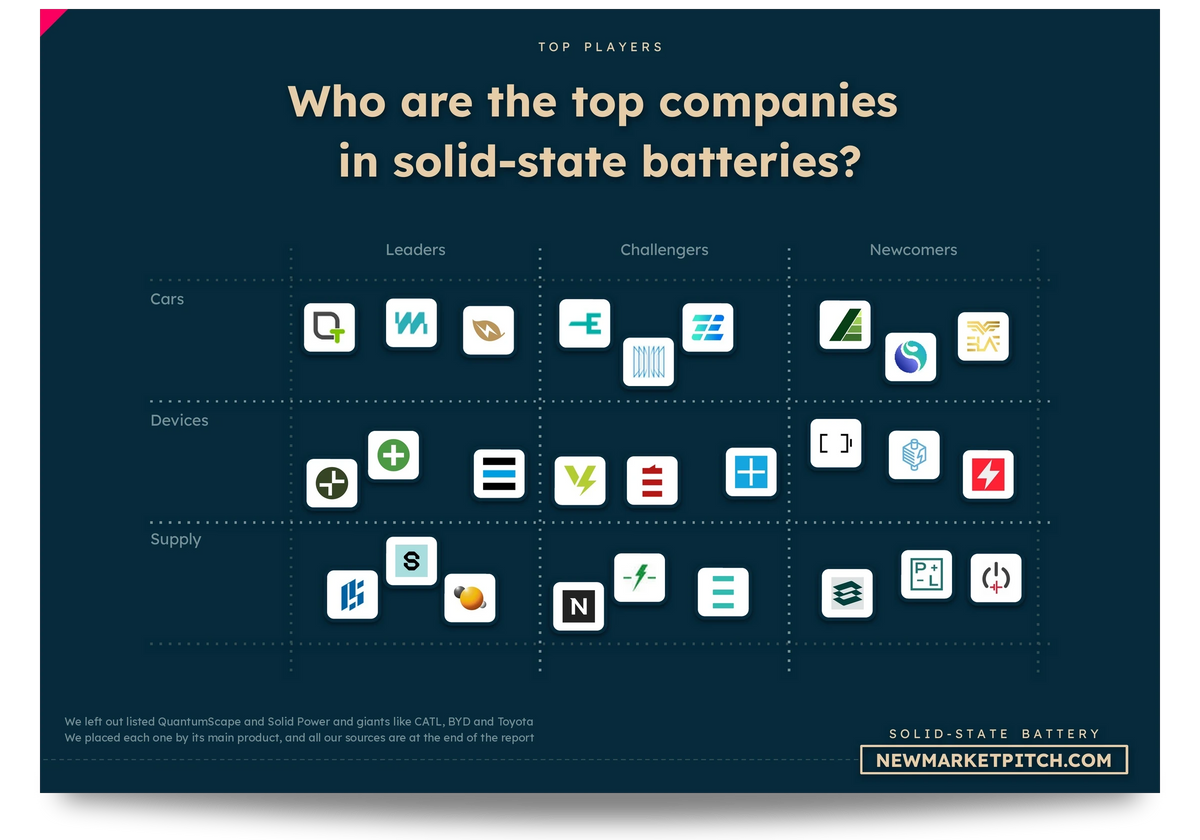
In our research about solid-state batteries, we turn what is vague and complex into simple, useful visuals. Market maps like this one show you at a glance where every startup stands.
Is solid-state battery funding actually getting healthier?
Solid-state battery funding now reaches more startups, but a few giant rounds still determine how much money appears to be flowing in.
There are more funded solid-state battery startups today than in the preceding comparison period. The previous period also had several quiet months with no reported deals. More companies now get money, although a few huge checks still set the disclosed total.
Solid-state cells have reached road testing and pilot production, so investors can judge more than laboratory results. Mercedes-Benz demonstrated Factorial-equipped cells in a real vehicle during 2025, while other companies have started testing repeatable manufacturing processes. Neither milestone proves that young cell makers can produce cheaply enough to sell at scale.
Would solid-state battery funding look healthy without giant rounds?
Only partly: without the biggest rounds, solid-state battery funding has improved only modestly.
We recorded 4 rounds above $50M in the last 12 months, together worth at least $514M. The earlier 12-month period had no round above $50M. Without them, disclosed capital rose only modestly, from at least $101M to at least $121M. Removing only rounds above $100M leaves at least $358M in the latest period, which illustrates just how sensitive the story is to the threshold used.
Large projects clearly find money. Smaller solid-state battery startups, by contrast, are raising far less than the headline suggests. When the U.S. Department of Energy announced its Battery Manufacturing Accelerator in October 2026, it pointed to the difficult move from laboratory chemistry to commercial production. That makes giant, equipment-oriented financings understandable, but it does not make smaller laboratories any easier to fund.
The table below shows the principal funding measures for the two consecutive periods.
| Measure | Last 12 months | Previous 12 months |
|---|---|---|
| Deals | 33 | 18 |
| Companies | 30 | 17 |
| Disclosed capital | $635M+ | $101M+ |
| Excluding above $50M | $121M+ | $101M+ |
| Median round | $17M | $6.3M |
| Public amounts | 14 | 10 |
| Undisclosed amounts | 19 | 8 |
| Rounds above $50M | 4 | 0 |
| Active lead investors | 19 | 11 |
A plus sign indicates a minimum because some deal amounts were not disclosed. Medians are rounded; exact values are given in the text.
Are more solid-state battery startups getting funded now?
More solid-state battery startups are getting funded now, and the increase extends beyond repeat rounds by familiar names.
The last 12 months included 30 funded companies compared with 17 in the 12 months before. Of the latest companies, 27 raised once during the period and 3 raised twice. In the earlier period, 16 raised once and 1 raised twice. That rules out the idea that only a few familiar companies returned to raise money.
The newly funded companies work on different types of batteries. All-solid-state cell developers accounted for 10 deals, hybrid solid-state cell developers for 8 deals, and sulfide electrolyte specialists for 7 deals in the latest period. But those companies are not all getting comparable checks. Yuanqi Membrane Innovation, for example, raised a Seed round of undisclosed amount in October 2026 for its composite solid-electrolyte membranes, while Blue Current's later-stage round supported a much more mature manufacturing operation. The market is financing both new approaches and established buildouts, but at very different dollar levels.

Your time is limited. In our market report about solid-state batteries, we put numbers on each part of the market, so you can see where it makes sense to focus.
Are solid-state battery startups getting bigger checks?
Solid-state battery startups are raising bigger publicly reported rounds, although most financings still have no published amount.
The median disclosed financing was $17.0M in the last 12 months, compared with $6.3M in the preceding 12 months. That difference is not a percentage-growth claim: the earlier period is too thin for one. Only 14 latest deals had public amounts and 19 did not. We cannot pretend the public median represents the rounds whose amounts remain private.
The median amount raised per company also increased over the earlier period. Once companies build production lines, they need bigger budgets. A 2023 U.S. Department of Energy manufacturing call singled out tooling, processing and verification as bottlenecks. A team can fund laboratory experiments with small checks; building cells repeatedly on a pilot line costs far more. Still, better disclosure by large issuers could influence the apparent median, so the funding amounts should be read together with the undisclosed deal count.
Are $100M solid-state battery rounds normal now?
No, $100M solid-state battery rounds are still unusual, even after the recent burst of large deals.
Only 1 round went above $100M in the last 12 months: QingTao Energy's $277M Series D+. Counting rounds of $100M or more adds a second one, for 2 in all. The 12 months before had none. That is far too small a group to call nine-figure rounds normal.
INX Technology's $100M+ Series B in August 2026 highlights the difference between a manufacturing bet and a routine product round. A factory needs equipment, consistent materials and strict quality control alongside good chemistry. In September 2026, listed Factorial announced an agreement with Mitsui Kinzoku to help industrialize its sulfide-based all-solid-state battery platform. An industrial agreement like this is not an equity round, so it stays out of our deal totals. The partnership shows why making batteries at scale calls for much larger budgets than developing them in a laboratory. Very large raises are more plausible now; they are still reserved for a narrow group.
Is most solid-state battery money going to older startups?
Most disclosed solid-state battery money now goes to later-stage companies, even though seed rounds are still common.
Among deals with a named stage, later-stage rounds represented 41% in the last 12 months, versus 27% in the previous 12 months. Later-stage rounds took 94% of the latest period's disclosed capital. Seed deals alone numbered 12, but their disclosed total was at least $7.4M, compared with $358M for the 2 Series D+ rounds. A young startup can get funding and still receive only a small fraction of the money available to mature developers.
Startups face very different expenses as they grow. Early teams test electrolytes and cell designs; later teams need qualification, manufacturing lines and repeatable output. QuantumScape's February 2026 Eagle Line announcement explicitly described a pilot operation built for customer sampling, production-process learning and later technology transfer. We do not include the listed company in the startup statistics, but the milestone shows why later-stage companies can absorb much larger checks. Getting a cell to work in a lab is easier than making thousands of consistent cells.
The table below shows how the latest period's deals and disclosed capital were distributed by stage.
| Stage | Deals | Capital | Capital share |
|---|---|---|---|
| Series D+ | 2 | $358M | 56% |
| Series B | 9 | $216M+ | 34% |
| Series A | 5 | $30M+ | 5% |
| Series C | 1 | $17M | 3% |
| Seed | 12 | $7.4M+ | 1% |
| Unknown | 4 | $5.6M+ | 1% |
| Growth | No deal | - | - |
Capital share is the share of disclosed capital, not all capital.

In our document detailing everything you need to know about solid-state battery, we always try to gather several sources and make estimates that make sense, so you can work with solid numbers.
Can a new solid-state battery startup still raise money?
Yes, new solid-state battery startups still raise first rounds, but established developers get most of the published dollars.
We identified 5 first financings among the last 12 months' deals, with at least $5.6M disclosed. The preceding 12 months contained 1 first financing with no public amount. First financings represented 15% of latest deals but just 1% of disclosed capital. In contrast, 25 follow-on deals drew at least $629M and 99% of disclosed money. We could not confirm whether 3 other deals were first financings or follow-ons.
The new entries include Jinghe Energy's Seed round of undisclosed amount in January 2026 and Keyuan Solid Energy's $5.6M round of undisclosed stage in August 2026. New materials and chemistry teams are still finding investors. Yet the contrast with the factory projects is striking. The DOE's 2023 manufacturing call acknowledged that novel technologies can take substantial development before their processes are ready for production. The hardest step comes later, when a young company needs enough money to prove its cells can be made at scale.
Are solid-state battery startups raising again any faster?
Solid-state battery startups are raising follow-on rounds a little faster in the measurable sample, but the shift is small.
Among the round-to-round gaps for which we could measure timing, the median was 14 months in the latest 12-month period and 16 months in the preceding one. Among those measured gaps, 65% were under 18 months and 80% were under 24 months. The timing sample covers 61% of eligible gaps between rounds, not 61% of the companies. So this speed measure tells only part of the story.
Battery startups can return quickly to investors because they hit a milestone, or simply because the next experiment costs more. In February 2026, QuantumScape opened a pilot line designed to turn separator processing into repeatable output; that type of transition normally requires successive engineering iterations. That public company's progress does not explain private fundraising timelines, and an earlier next check does not prove a better battery. What the data does show is that subsequent money remains essential, and the measured intervals have not collapsed into a fundamentally new pace.
Is QingTao Energy behind most solid-state battery funding?
QingTao Energy drives much of the solid-state battery funding total, but other startups are getting checks too.
QingTao Energy raised $277M in a Series D+ in February 2026, the largest deal and highest company total in the last 12 months. INX Technology's $100M+ Series B in August 2026 and Blue Current's $81M Series D+ in December 2025 were also unusually large. Those big deals explain much of the money reported for the sector. Yet we still recorded 30 distinct funded startups in the last 12 months, which means activity was not confined to QingTao alone.
The chemistry also matters. Our category split places QingTao in hybrid solid-state cell development rather than treating every battery described as solid-state as fully solid. That distinction changes the story of where the money went. Toyota's partnership with Idemitsu is focused on a different, sulfide-based all-solid-state production pathway, while Samsung SDI has described an anode-free all-solid-state roadmap. Competing architectures are advancing in parallel. QingTao's financing says that a hybrid route can win very large support; it does not settle which chemistry ultimately prevails.

Our report covering the solid-state battery market gets updated several times a month, so you always get the latest view of where things stand.
Why are hybrid solid-state batteries getting the big checks?
Hybrid solid-state battery makers are getting the biggest checks, largely because a few Chinese companies raised so much.
Hybrid developers recorded 8 deals and at least $365M in the last 12 months, accounting for 58% of disclosed capital. The 12 months before brought 3 hybrid deals and at least $8.3M, representing 8% of disclosed capital. QingTao Energy's Series D+ and Talent New Energy's $56M+ Series B in December 2025 show how much a couple of big rounds can change the category's dollar share.
Hybrid cells can keep parts of existing battery production while using a real solid-electrolyte phase. That could make production easier, although the label needs care: adding silicon or improving an ordinary liquid-electrolyte cell does not make it a solid-state battery. The funding lead does not settle which technology will work best at scale. Investors have backed a potentially easier bridge to manufacturing, but actual cost, lifetime and performance at scale remain open tests.
Are all-solid-state battery startups losing investors to hybrids?
No, all-solid-state battery startups still win substantial funding, even while hybrid cell makers raise more money overall.
All-solid-state cell companies completed 10 deals involving 10 startups in the last 12 months and raised at least $198M. All-solid-state developers' share of disclosed capital was 31%. They led the market in deal count, whereas hybrid developers led in dollars. INX Technology's $100M+ Series B in August 2026 illustrates how high the stakes have become for cell makers pursuing a more complete solid-electrolyte architecture.
The small companies also face giant competitors. BMW announced in May 2025 that it was driving an i7 powered by Solid Power all-solid-state cells. Samsung SDI said in 2026 that its SolidStack program was targeting production in the second half of 2027. Neither listed manufacturer is part of our private-startup count. Those projects show that big manufacturers still believe the fully solid route is worth pursuing. Startup funders may be selective, but the funding split gives no basis for declaring all-solid-state cells a losing bet.

In our research about solid-state batteries, we look at what the winners do differently, so you can learn from the best instead of guessing.
Can solid-electrolyte startups compete with cell makers for funding?
Solid-electrolyte startups still raise money, but they get much smaller reported checks than companies building complete batteries.
In the last 12 months, sulfide electrolyte companies completed 7 deals, oxide electrolyte companies completed 3 deals and raised at least $33M, and polymer electrolyte companies completed 4 deals and raised at least $7.4M. Cell developers absorbed far more disclosed capital. Without reliable solid electrolytes, cell makers will struggle with production yields and battery life. The small fundraising totals for materials firms should not hide the work they do.
Idemitsu's January 2026 announcement offers a scale reference. It began constructing a large solid-electrolyte pilot facility intended to support Toyota's commercialization plans. Germany's Qkera is taking another route, developing ceramic electrolyte membranes, while Britain's TaiSan is building solid-electrolyte technology for sodium batteries. Their businesses need different equipment and budgets, so equal funding would prove little. The real question is whether materials companies can deliver consistent, low-cost supply as cell production expands. The disclosed funding suggests investors recognize their role, but currently reserve the biggest amounts for developers integrating complete batteries.
Is China winning the solid-state battery funding race?
China now leads solid-state battery startup funding by both deal count and disclosed money.
China accounted for 26 deals involving 23 companies and at least $512M in the last 12 months, representing 79% of deals and 81% of disclosed capital. In the 12 months before, Chinese companies recorded 11 deals and at least $68M. Asia-Pacific overall accounted for 27 deals and at least $529M in the latest period. That gives Chinese private companies a clear funding lead, but it does not guarantee they will win every battery market.
Japan and South Korea also have large battery programs, many of them funded inside established companies. Samsung SDI, for example, runs a solid-state pilot program with a stated production goal. Groups like that are not independent startups, so they stay out of these numbers. China leads startup funding, but it is far from the only place doing serious battery engineering. Still, for founders seeking venture-scale funding today, the geographic imbalance is difficult to dismiss.
Can U.S. solid-state battery startups still raise big money?
Yes, U.S. solid-state battery startups can still raise large rounds, but far fewer companies get funded than in China.
U.S.-headquartered companies recorded 4 deals and at least $100M in the last 12 months, across 4 startups. The earlier 12 months had 2 U.S. deals and at least $4.6M. Blue Current's $81M Series D+ in December 2025 makes the most visible U.S. contribution to the latest period, with Adden Energy's $17M Series B in September 2026 providing another example. That is meaningful funding, although the overall deal count is too small to show a broad national funding surge.
There is substantial technical activity beyond venture rounds. The DOE announced its Battery Manufacturing Accelerator in October 2026 to help discoveries reach domestic production. Listed U.S. battery maker Factorial also signed a September 2026 manufacturing-development agreement with Mitsui Kinzoku. Those efforts are separate from the private startup rounds we count, but they show that American battery engineering remains active. Only a small group of U.S. startups is getting the kind of big checks that attract attention.

In our market report about solid-state batteries, we don't want to repeat what boring consulting reports say. Instead, we show you the real and latest market signals that matter.
Has Europe fallen behind in solid-state battery fundraising?
Europe is falling behind in solid-state battery startup funding, despite serious work by its battery developers and automakers.
Europe recorded 2 deals and at least $5.3M in the last 12 months, compared with 3 deals and a larger disclosed amount in the prior period. The latest numbers are small and should not be exaggerated into a long-term verdict. They also miss forms of industrial commitment that are not startup equity financings. ProLogium, for example, began construction of its planned Dunkirk battery factory in February 2026, while Spain's Basquevolt announced a joint development agreement with Renault Group's Ampere that month.
Basquevolt's work focuses on polymer-electrolyte lithium-metal batteries, with the goal of validating cells for automotive applications. Britain's TaiSan is targeting different uses for sodium cells, and Germany's Qkera is building ceramic membranes. Europe has different businesses tackling different parts of the problem. By our count, Europe's private startup funding is smaller in the latest period. It does not establish that European laboratories, automakers or manufacturers have stopped developing solid-state batteries. A convincing funding comeback would require more recurring private rounds, not merely more factory announcements.
Is a handful of funds controlling solid-state battery funding?
No fund appears to dominate reported solid-state battery financings today; many investors appear in the deals, and named leads rarely repeat.
We identified 69 unique participating investors and 19 unique disclosed lead investors in the last 12 months, compared with 25 participants and 11 leads previously. The number of active names broadened. Yet none of the disclosed leads led another deal within the latest period, and only 48% of the latest rounds named a lead. A short, incomplete lead-investor list cannot prove that a handful of funds run the market.
Puhua Capital comes first among lead investors only because it led INX Technology's $100M+ Series B, its single lead in the last 12 months. That figure is the size of the round, not Puhua's own check. Startups are also trying to show that their cells can be manufactured repeatedly. The U.S. DOE's 2023 manufacturing call emphasized advanced tooling, high-volume processing and verification for solid-state batteries, and Nissan also partnered with LiCAP in August 2025 to improve dry-electrode production for all-solid-state cells. These technical hurdles make selective checks understandable. The data establishes who participated and the stages financed, not the private criteria used in each investment meeting.
Will new battery factories help solid-state startups raise money?
New solid-state battery factories give startups something concrete to show investors, but they also make competing more expensive.
The last 12 months included 2 Series D+ rounds carrying $358M in disclosed capital, alongside 9 Series B deals with at least $216M. Those checks are consistent with expensive later-stage development, although deal size alone cannot tell us how each company used its money. Solid-state manufacturing must deliver repeatable electrolytes, controlled interfaces, reliable yield and safety over many cycles, not just an impressive single-cell result.
Factories face those problems right now. In September 2026, Factorial announced a manufacturing-development agreement with Japanese materials maker Mitsui Kinzoku. Nissan has also worked with LiCAP on dry-electrode manufacturing, while ProLogium began building a planned French battery factory in February 2026. That gives investors more concrete things to ask about than a lab test. Smaller companies can struggle to raise enough money when their laboratory process still needs major changes before factory production.

Learning from others' mistakes is the cheapest lesson there is. In our document detailing everything you need to know about solid-state battery, we look at what broke startups before you, so you don't repeat it.
Do solid-state battery test cars prove the technology is ready?
No, solid-state battery test cars show the cells can work on the road, not that factories can make them cheaply at scale.
Mercedes-Benz said in September 2025 that its Factorial-equipped EQS traveled 1,205 kilometers without recharging. BMW began road testing an i7 using Solid Power all-solid-state cells in May 2025. Stellantis reported in June 2026 that it had integrated Factorial cells into a Dodge Charger Daytona development vehicle for road testing. Each test took a battery beyond the lab, although the cars used different cells and pack designs.
They are not proof that production lines can make millions of identical cells at a cost drivers will accept. QuantumScape's SEC filings describe difficult remaining work in consistency, throughput, reliability and pressure management. There is also an important distinction in the funding totals: BMW, Mercedes-Benz and Stellantis are large automakers, while Solid Power and Factorial now raise their money on the stock market. None of those names has a private round in these deal totals. Their demonstrations strengthen the case that the industry is technically advancing; they do not validate the valuations, economics or selection of every startup funded over the last 12 months.
What could make investors pull back from solid-state batteries?
Investors could quickly pull back from solid-state batteries if expensive pilot lines cannot produce reliable cells at a workable cost.
The last 12 months' disclosed capital was dominated by rounds above $50M, while first financings represented 1% of disclosed capital. That combination makes the market vulnerable to disappointment among a small set of large projects. The headline can quickly turn weaker if large projects disappoint and smaller checks cannot fill the gap.
The main test now is manufacturing. A September 2026 U.S. Department of Energy science article described research into ion motion in sulfide conductors, underscoring that even promising electrolyte materials still require careful engineering. QuantumScape's 2026 SEC reporting described scale-up and reliability risks, while Nissan's dry-electrode partnership targeted manufacturing productivity. Investors will need to see stable output, cell lifetime, customer validation and economics that work outside a pilot line. We cannot predict which company will pass, and the deal record does not contain those operating milestones. Big fundraising announcements can arrive long before a company proves that its batteries can be made profitably.
So, what does solid-state battery funding look like right now?
Solid-state battery funding is reaching more startups, but most published money is going to established manufacturers, especially in China.
Over the last 12 months, we counted 33 deals worth at least $635M and 30 funded startups. QingTao Energy led the period with the largest round, a Series D+ in February 2026. The 12 months before had 18 deals and a much smaller disclosed total, a sample too thin for a trustworthy percentage-change claim. Stripping out rounds above $50M leaves the latest period with at least $121M, which is a much less exuberant market than the headline suggests.
The direction is clear, even if the outcomes differ. More distinct startups got checks, while follow-ons absorbed nearly all published dollars. Hybrid cell makers led in funding dollars, all-solid-state developers led in deals, and China's startup ecosystem dominated the geography. The industry is moving from promises to road tests and pilot lines; the financing record alone cannot tell us which chemistry or company will manufacture profitably.
The table below shows what we found.
| Question | Answer |
|---|---|
| Is the fundraising rebound broadly based? | Participation has improved, but the capital picture is much narrower. The last 12 months financed 30 solid-state battery startups. Most disclosed money went to a few large rounds. |
| Are headline dollars a reliable health test? | No, the giant checks dominate the picture today. Rounds above $50M absorbed at least $514M in the period. The ordinary market looks less dramatic than total capital. |
| Did more businesses actually attract investors? | Yes, the recovery reaches beyond repeat rounds alone. We counted 30 funded startups, against 17 the 12 months before. Breadth is a stronger signal than one blockbuster financing. |
| Is a large battery round now typical? | Not necessarily, despite the higher median among publicly reported rounds. The disclosed-round median reached $17.0M in the latest period. Many smaller financings still have no published amount. |
| Have nine-figure checks become routine? | They remain unusual in this young manufacturing market. Only 1 round exceeded $100M in the latest period. Industrial ambition explains the size, not automatic commercial success. |
| Is early funding matching late-stage spending? | No, newer battery projects get much less reported capital. First financings represented just 1% of disclosed money. That gap is the main weakness beneath rising activity. |
| Are established battery companies collecting most money? | Yes, investors are sending the biggest checks to existing companies. Follow-ons absorbed 99% of the period's disclosed capital. Much less money went into funding first-time startup teams. |
| Are hybrid architectures winning the entire market? | Hybrid cells lead in dollars, but the race remains open. Hybrid developers took 58% of disclosed capital this period. All-solid-state developers still led in the number of deals. |
| Can America still finance meaningful battery projects? | Yes, though American fundraising remains concentrated in few issuers. U.S. companies raised at least $100M in the period. Blue Current shows serious backing still exists outside China. |
| Is China the clear fundraising center? | For private startup funding, China is clearly out in front. Chinese developers accounted for 26 deals in the latest period. Other countries still run serious battery factories and research programs. |
| Does the funding revival prove mass production? | No, producing cells consistently remains a difficult engineering challenge. The latest period included 2 Series D+ rounds. Large checks finance that transition; they do not complete it. |

If you build or invest in the solid-state battery market, you need to know which business models pay off now and which ones are fading. That's why our report covering it has a whole section on it.
Our methodology
Our data runs through November 14, 2026. We then reviewed this article and updated its answers on November 17, 2026, the date shown under the title. We compare the last 12 months, November 15, 2025 to November 14, 2026, with the previous 12 months, November 15, 2024 to November 14, 2025. We tested 12 months against 12 months; the earlier period contained 18 deals. We did not extend to 18 months because that would begin before our complete market coverage started in January 2024. The earlier sample is too small for reliable percentage changes, so we present counts and disclosed amounts side by side rather than implying precision they cannot support.
We include equity financings of private businesses at or above $300K. We exclude debt, grants, loans, unconverted convertibles, SAFEs and public offerings. The market covers independent businesses chiefly developing all-solid-state or genuine semi-solid-state battery cells, dedicated electrolytes and separators, or processes designed specifically to make those cells. Sodium-based solid-state batteries qualify when the electrolyte architecture fits. We include borderline specialists rather than silently excluding an emerging technical approach, but not generic battery producers or recyclers with only incidental solid-state activity.
Each company we count is a startup: independent, founded in 2000 or later, seeking rapid growth through a new technology or product, funded by founders or outside backers, and private or publicly listed within the past five years. Recently acquired startups remain eligible within three years of acquisition. Large established manufacturers and longtime public companies appear only as industry context, not in the deal totals.
We count each financing announcement once, merge duplicates, and distinguish successive genuine rounds from repeated coverage of the same event. An undisclosed deal adds to the deal count but not to disclosed capital. That is why totals with a plus sign are minimums. Company headquarters determine geography, while our technical categories separate complete cell architectures from electrolyte and process suppliers. Early and later-stage aggregates use deals with a named stage; unspecified stages remain separate.
Rounds confirmed by a company announcement, a press article or a regulatory filing are counted in full. Where no article exists, a round is counted only when at least two recognised databases agree on its date (within one month) and amount (within 5%), and it is marked as low confidence; a round found in a single database stays in the company's history but is left out of totals. For companies that have raised more than $100M, every round counted is backed by an article.
We prioritize company releases, regulatory filings and reliable reporting for dates, stage labels, investors and disclosed amounts. We do not interpret a venture round as proof that a battery chemistry has reached commercial output. Our first-versus-follow-on labels reflect verifiable financing histories, and our round-velocity figures describe intervals between rounds only where both dates can be established.
A reader may see larger solid-state battery figures elsewhere because those totals can mix grants, listed companies, investments in diversified manufacturers, debt, or spending commitments with private startup equity. We keep those sources of capital separate. Our latest month is also an incomplete market observation until all delayed disclosures become public; we do not convert missing amounts into invented estimates.
Key sources include Blue Current's Series D, Amazon involvement and pilot-cell manufacturing milestones., QuantumScape's February 2026 manufacturing pilot milestone., BMW's all-solid-state BMW i7 road test., Mercedes-Benz solid-state EQS long-distance demonstration., Stellantis and Factorial's 2026 development-vehicle road testing., Idemitsu's 2026 pilot solid-electrolyte facility for Toyota., Nissan's dry-electrode production partnership., DOE's October 2026 manufacturing commercialization initiative., DOE's identified scale-up and precision-manufacturing challenges., DOE's 2026 solid-electrolyte ion-transport research., QuantumScape's manufacturing risks and PowerCo collaboration update., Samsung SDI's SolidStack development and production objective., Qkera ceramic membrane commercialization and pre-seed financing., TaiSan's sodium solid-electrolyte development and pilot testing plans., Basquevolt's technology and commercialization history., Renault Group's 2026 agreement with Basquevolt., ProLogium's Dunkirk factory construction announcement., Stellantis' automotive-scale cell validation and testing aims., and Factorial and Mitsui Kinzoku's September 2026 agreement to scale solid-electrolyte manufacturing..

In our research about solid-state batteries, we like to show you the big picture. We know your time is precious, so we make every page quick to read and packed with as much learning as possible per minute.
Written by the New Market Pitch teamWe track new markets so founders and investors can move faster. About us