Which top solid-state battery startups will mass-produce?
Whether you're building or investing in the solid-state battery market, our report covers everything you need to know: the players, the money, and what's coming next.
Summary
ProLogium and Factorial Energy are the top solid-state battery startups most likely to reach meaningful automotive production first, while QuantumScape and Solid Power have credible paths to much larger industrial volumes through manufacturing partners.
ProLogium has the strongest manufacturing record. Its Taoke factory had 0.5 GWh of stated annual cell capacity in 2025, and in September 2026 the company announced mass production of its Gen 3.5 all-solid-state batteries. It has reported more than 2.4 million cumulative cell shipments across its battery platform.
Factorial has the more convincing near-term vehicle story. Its batteries have powered a Mercedes-Benz EQS over 1,205 kilometers on a single charge, entered a Stellantis Dodge Charger test vehicle, and secured initial passenger-vehicle orders. Its Karma Automotive program targets a premium sports car scheduled for late 2027.
QuantumScape is pursuing a different business model. Its automated Eagle Line began producing QSE-5 cells in 2026, while Volkswagen's PowerCo holds a manufacturing license framework covering up to 40 GWh annually, potentially expandable to 80 GWh. Those figures describe potential licensed capacity, not batteries already being manufactured.
Solid Power could establish an industrial business without becoming a major finished-cell manufacturer. Its strongest opportunity lies in supplying sulfide electrolyte and transferring manufacturing technology to partners including SK On, Samsung SDI and BMW.
The operating-capacity gap remains enormous. ProLogium's stated 2025 Taoke capacity was approximately 333 times Ilika's 1.5 MWh annual Goliath pilot-line capacity. Yet even 0.5 GWh could supply only about 6,250 electric vehicles per year using 80 kWh batteries, assuming full utilization.
Factory compatibility may determine who scales fastest. Factorial says its FEST technology can reuse up to 80% of existing lithium-ion manufacturing equipment. If validated under commercial conditions, that could substantially reduce the investment required to expand production.
Strong laboratory performance is becoming less decisive than factory execution. Factorial has reported 375 Wh/kg in automotive-size cells, QuantumScape has demonstrated more than 800 Wh/L, and ProLogium reported independently tested results of 381 Wh/kg and 903 Wh/L in September 2026. Consistent yields, durability and costs remain harder to establish.
Luxury vehicles, drones and specialty applications are likely to absorb the earliest commercial output. Customers in those markets can justify expensive batteries for better range, lower weight or faster charging, while mainstream electric vehicles require much more competitive manufacturing costs.
Toyota remains a formidable competitor, targeting all-solid-state battery commercialization around 2027–2028 with Idemitsu. But established manufacturers may also become the companies producing startup-developed batteries, making industrial partnerships as important as direct competition.
The clearest near-term bets are ProLogium for its own cell production and Factorial for premium automotive launches. QuantumScape and Solid Power could scale further through partners, but supplying hundreds of thousands of affordable EVs annually will require tens of gigawatt-hours of reliable production that none of these startup programs has yet demonstrated.

Written by the New Market Pitch teamWe track new markets so founders and investors can move faster. About us

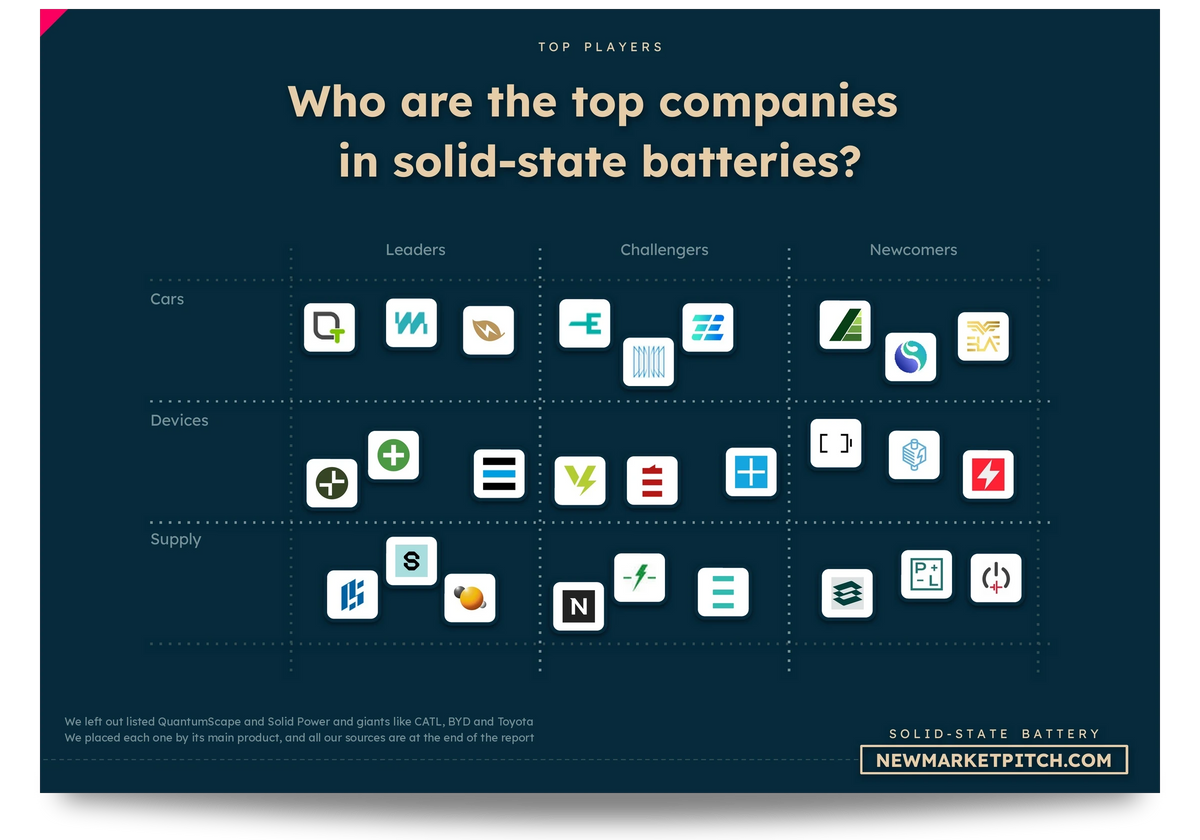
In our report covering the solid-state battery market, we turn what is vague and complex into simple, useful visuals. Market maps like this one show you at a glance where every startup stands.
Are solid-state battery startups finally ready for mass production?
Solid-state battery startups are finally building real production lines, but most are still years away from supplying electric vehicles in large volumes.
The industry has moved considerably beyond laboratory prototypes. ProLogium has an operating battery factory in Taiwan and announced mass production of its Gen 3.5 all-solid-state cells in September 2026. QuantumScape started producing cells on its automated Eagle Line in 2026, and Factorial Energy has installed its batteries in Mercedes-Benz and Stellantis test vehicles. Solid Power has also completed a pilot-line installation project with South Korea's SK On.
These developments bring the technology closer to commercialization, although they represent different stages of progress. ProLogium has existing manufacturing capacity, Factorial has demonstrated battery performance inside vehicles, and QuantumScape is trying to prove that its manufacturing process can run consistently.
The distinction matters when we talk about mass production. A startup can manufacture thousands of cells without being capable of supplying a major car factory. A 1 GWh plant, operating at full capacity, could theoretically supply approximately 12,500 vehicles with 80 kWh batteries. A manufacturer producing 500,000 comparable vehicles would need around 40 GWh annually.
That gap explains why the industry's recent progress is encouraging without yet proving that solid-state batteries are ready for mainstream EV production. Several startups can now make usable batteries. Very few have demonstrated the manufacturing volumes, costs and reliability that major automakers need.
Which solid-state battery startups are closest to mass production?
ProLogium, Factorial Energy, QuantumScape and Solid Power are currently the four strongest candidates for large-scale commercialization, although ProLogium has the clearest lead in operating manufacturing infrastructure.
We've separated companies with functioning production equipment from those mainly announcing future factories. The difference becomes obvious when we compare ProLogium's operating plant with QuantumScape's automated pilot line, Factorial's automotive programs and Solid Power's electrolyte production strategy.
ProLogium has already manufactured and shipped batteries over several years, and now claims mass production of its latest large-format all-solid-state cells. Factorial has secured initial commercial orders and demonstrated its technology in vehicles. QuantumScape has installed a production process that its manufacturing partners could eventually replicate. Solid Power could reach significant industrial volumes by supplying electrolyte to established battery manufacturers.
Ilika deserves attention for its operating pilot line, while Blue Solutions brings years of experience manufacturing solid-polymer batteries. Neither currently offers the same combination of automotive momentum and expansion potential as the four leading challengers.
| Company | Strongest evidence | Current production position | Our assessment |
|---|---|---|---|
| ProLogium | Operating Taoke factory; September 2026 Gen 3.5 mass-production announcement | 0.5 GWh of stated cell capacity in 2025 | Closest to established industrial cell manufacturing |
| Factorial Energy | Mercedes-Benz and Stellantis vehicle tests; initial commercial orders | Commercial programs and manufacturing partnerships | Strongest contender for early automotive launches |
| QuantumScape | QSE-5 cells produced on Eagle Line | Automated pilot production | Strong candidate for licensed mass production |
| Solid Power | BMW testing and SK On pilot-line installation | Electrolyte and cell-development facilities | Strong materials-supplier opportunity |
| Blue Solutions | Long history of solid-polymer battery production | Existing industrial experience; newer technology under development | Credible incumbent-backed competitor |
| Ilika | Operating Goliath pilot line | 1.5 MWh annual pilot capacity | Promising but much smaller scale |
| Donut Lab | Independent tests of selected battery characteristics | Commercial manufacturing volumes unverified | Too early to rank among production leaders |
Our ranking favors actual manufacturing and customer progress over spectacular battery specifications. ProLogium leads today, but Factorial may be better placed to secure the first meaningful premium-vehicle programs.
If you want more recent data on this point, please see our latest solid-state battery market report.

Our research about solid-state batteries gets updated several times a month, so you always get the latest view of where things stand.
Has ProLogium already figured out how to mass-produce solid-state batteries?
ProLogium has gone further into actual solid-state battery manufacturing than most startups, although its current factory remains small compared with mainstream EV battery plants.
The Taiwanese company began supplying batteries for smaller applications in 2013 and inaugurated its Taoke facility in 2024. According to its May 2026 investor presentation, Taoke had 0.5 GWh of cell production capacity in 2025, with plans to exceed 1 GWh by 2030.
The company's September 2026 announcement strengthened its manufacturing case. ProLogium said its Gen 3.5 lithium ceramic battery had entered mass production in Taiwan. A large-format 185.4 Ah cell achieved 381 Wh/kg and 903 Wh/L in third-party energy-density testing, while separate testing supported its classification as all-solid-state under a Chinese technical standard.
ProLogium also updated its manufacturing record to more than 2.4 million cumulative cell shipments across its lithium ceramic battery platform. That is considerably stronger evidence of accumulated production experience than a newly commissioned pilot line.
Still, cumulative shipments include smaller cells and applications outside passenger vehicles. The announcement did not establish that ProLogium was already shipping enough large-format automotive cells to supply tens of thousands of EVs each year. Its mass-production designation and its demonstrated automotive-scale output are two different questions.
ProLogium's European expansion will be a much bigger test. Construction began at its Dunkirk facility in France in February 2026. The company targets commercial operations by the end of 2029 and 4 GWh of capacity by 2030, with a maximum site design of 44 GWh.
At 4 GWh, the French factory could theoretically supply around 50,000 EVs annually using 80 kWh packs. That's eight times the stated 2025 capacity of Taoke. The full 44 GWh design would be another elevenfold increase.
The factory project also introduces a financing challenge. ProLogium announced a business combination with Translational Development Acquisition Corp. in 2026 to support expansion and other activities. Its SEC disclosures identify construction costs, subsidies, financing and production ramp-up as risks.
We give ProLogium the lead for manufacturing readiness because it has a working factory, years of production experience and an announced commercial manufacturing process for its latest cells. It still has to prove that this advantage survives a much larger European expansion and further changes to its battery architecture.
Can Factorial Energy turn Mercedes-Benz testing into mass production?
Factorial Energy currently has the strongest case for getting solid-state batteries into commercial passenger vehicles soon, supported by real driving tests and its first customer orders.
Mercedes-Benz tested Factorial cells in a modified EQS that traveled 1,205 kilometers without recharging in September 2025. Stellantis then moved from validating individual cells to installing Factorial's FEST batteries in a Dodge Charger Daytona development vehicle, announcing road testing in June 2026.
The Stellantis program followed tests of 77 Ah cells that delivered a reported 375 Wh/kg and charged from 15% to 90% in 18 minutes. Those are attractive characteristics for an automotive cell, especially when combined with successful installation in a complete vehicle.
Factorial's commercial position also changed during 2026. The company reported its first passenger-vehicle orders in January and aerospace orders in July. Its agreement with Karma Automotive targets the Kaveya sports car, scheduled for production in late 2027.
There is a difference between a long-distance test, a production order and a vehicle rolling off an assembly line. Factorial has reached the first two milestones but has not publicly demonstrated sustained gigawatt-hour production for car manufacturers.
The company is trying to avoid building an entire manufacturing network itself. In July 2026, it signed a memorandum of understanding with SK On to explore production using the Korean manufacturer's existing capabilities. Two months later, Factorial partnered with Mitsui Kinzoku on materials for its Solstice battery technology.
Factorial has the best near-term opportunity among the U.S. challengers to launch batteries in premium and specialty vehicles. Its next test is whether these initial programs become recurring orders large enough to support industrial production.

In our market report about solid-state batteries, we look at what the winners do differently, so you can learn from the best instead of guessing.
Will QuantumScape finally mass-produce solid-state batteries with Volkswagen?
QuantumScape has a credible route to mass production through Volkswagen's PowerCo, but it still needs to show that its automated process can manufacture good cells consistently at much higher volumes.
QuantumScape's QSE-5 lithium-metal cell has demonstrated more than 800 Wh/L of volumetric energy density and charging from 10% to 80% in less than 15 minutes under company-reported test conditions.
The company's major manufacturing development has been its Cobra process, designed to produce ceramic separators faster than its earlier equipment. After shipping Cobra-produced QSE-5 cells in 2025, QuantumScape inaugurated the Eagle Line in San Jose in February 2026.
In its April 2026 shareholder letter, QuantumScape confirmed that installation was complete, startup operations were underway and initial volumes of QSE-5 cells were being produced. The company was working to improve equipment uptime, throughput, process stability and cell quality.
Eagle Line is important because PowerCo and other potential licensees need a manufacturing process they can reproduce. QuantumScape has already shown its batteries working in a Ducati V21L electric motorcycle, but making cells for demonstrations is a much smaller challenge than supplying a high-volume vehicle platform.
The PowerCo licensing agreement provides a potentially enormous opportunity. Its original framework covered production of up to 40 GWh annually, potentially expandable to 80 GWh. At 40 GWh, the technology could theoretically support approximately 500,000 EVs with 80 kWh packs every year.
Those figures are licensed-production ceilings, however, not existing QuantumScape factory output or a guaranteed manufacturing commitment at that scale.
Its partnership with PowerCo also makes the business different from ProLogium. QuantumScape expects industrial partners to manufacture its technology under license, reducing its need to finance gigafactories directly.
We see QuantumScape as a serious contender for large-scale production later in the decade. The potential is substantial, perhaps larger than that of startups planning to finance their own factories. But until PowerCo qualifies the technology for commercial manufacture, QuantumScape's biggest production numbers remain contractual possibilities rather than operational achievements.
If you want more recent data on this point, please see our latest solid-state battery market report.
Could Solid Power mass-produce battery materials before complete batteries?
Solid Power may reach meaningful industrial scale first by supplying solid electrolyte to battery manufacturers, rather than manufacturing millions of finished EV cells itself.
BMW installed Solid Power batteries in an i7 test vehicle in 2025, giving the company an important automotive validation milestone. Its manufacturing strategy has since become increasingly focused on specialized materials and licensing.
In May 2026, Solid Power announced that it had completed site acceptance testing of the pilot cell line installed for SK On. The company's second-quarter results in August confirmed completion of the installation agreement and discussions about a new collaboration arrangement.
Meanwhile, Solid Power is developing a continuous manufacturing line for sulfide electrolyte, with commissioning and operational startup planned for late 2026. It has also supplied electrolyte to Samsung SDI under a joint evaluation agreement involving BMW.
These relationships give Solid Power access to manufacturing capabilities across several countries. The approach could eventually support higher production volumes without Solid Power paying for every battery factory itself.
The financial figures show how early the business remains. Solid Power reported $2.8 million in revenue and grant income for the first half of 2026 and held approximately $419 million in liquidity at the end of June. It still needs to turn technical partnerships into larger recurring commercial purchases.
We would rank Solid Power below Factorial for near-term finished EV battery deliveries, but its electrolyte business could become substantial even if other manufacturers build most of the cells.

In our document detailing everything you need to know about solid-state battery, you will always find fresh funding data, taken straight from our own verified funding database.
How much solid-state battery production capacity actually exists?
The solid-state battery industry's operating capacity is still tiny compared with the huge factories being discussed for the next decade.
ProLogium's Taoke facility provides the clearest published example among the leading startups, with 0.5 GWh of stated cell capacity in 2025. Ilika's completed Goliath pilot line has 1.5 MWh of annual capacity, equivalent to just 0.0015 GWh.
That makes ProLogium's stated capacity approximately 333 times larger than Ilika's. Yet ProLogium itself would need to multiply its existing capacity eightfold to reach its first 4 GWh target in France.
A second issue is that companies often publish planned factory capacity without disclosing actual annual production. The distinction is enormous. A factory designed for 10 GWh does not produce 10 GWh merely because its buildings and equipment have been installed.
ProLogium's September 2026 announcement adds useful evidence that large-format solid-state cells are being manufactured at its Taiwanese facility. It does not replace the need for disclosed utilization, annual output and automotive qualification data.
Our review of the main startup programs shows a wide gap between working equipment and announced expansion plans.
| Facility or project | Publicly disclosed scale | Current status |
|---|---|---|
| ProLogium Taoke | 0.5 GWh of cell capacity in 2025 | Operating; Gen 3.5 mass production announced in September 2026 |
| ProLogium Dunkirk, first phase | 4 GWh targeted by 2030 | Under construction |
| ProLogium Dunkirk, full site | 44 GWh maximum design | Long-term planned expansion |
| QuantumScape Eagle Line | Capacity not publicly disclosed in GWh | Automated pilot production |
| Factorial / SK On | No dedicated solid-state capacity disclosed | Manufacturing feasibility partnership |
| Solid Power electrolyte line | Pilot-scale output; no commercial GWh figure | Installation and commissioning program |
| SK On / Solid Power | Cell pilot line; volume undisclosed | Installation acceptance completed |
| Ilika Goliath | 1.5 MWh annually | Operating pilot line |
For perspective, 40 GWh would be needed annually to supply 500,000 vehicles using 80 kWh batteries. None of these startup programs has yet publicly established sustained production at that level.
Are solid-state batteries already better than lithium-ion batteries?
Some solid-state battery startups are demonstrating impressive energy density and charging performance, but no leading startup has publicly proven that its technology beats conventional lithium-ion batteries on performance, lifespan and manufacturing cost together.
Factorial's automotive-size cells reached a reported 375 Wh/kg, while QuantumScape's QSE-5 demonstrated more than 800 Wh/L. These measure different things: energy relative to weight and energy relative to volume.
ProLogium added another notable result in September 2026. Its 185.4 Ah Gen 3.5 cell reached 381 Wh/kg and 903 Wh/L in third-party testing. Those results support the company's technical claims, although they do not establish automotive lifetime performance or cost competitiveness at large manufacturing volumes.
Blue Solutions is also working toward higher-performance GEN4 batteries after years of manufacturing solid-polymer cells. Its latest development work targets more than 400 Wh/kg, while testing of smaller cells has provided evidence about cycle life.
The companies are tackling different technical problems. Factorial has demonstrated attractive performance in automotive-size batteries. QuantumScape has emphasized fast charging and energy density. ProLogium combines strong cell specifications with manufacturing experience. Blue Solutions brings experience with solid-polymer technology and its operating requirements.
Battery chemistry complicates comparisons further. Factorial develops both its FEST platform and its Solstice all-solid-state technology. Ilika's Goliath uses a quasi-solid electrolyte, while ProLogium is developing several generations of lithium ceramic technology, including a superfluidized inorganic architecture.
These designs may reach production at different speeds because they require different materials and manufacturing processes.
We would give more weight to a battery delivering reliable performance after years of daily driving than to a spectacular laboratory energy-density figure. The technical race is increasingly impressive. The cost and durability race is much less settled.
If you want more recent data on this point, please see our latest solid-state battery market report.

Learning from others' mistakes is the cheapest lesson there is. In our report covering the solid-state battery market, we look at what broke startups before you, so you don't repeat it.
Which solid-state battery startups have the strongest carmaker support?
Factorial Energy has the broadest collection of high-profile automaker relationships among the leading challengers, while QuantumScape and Solid Power have particularly valuable links to companies that can manufacture batteries.
Factorial works with Mercedes-Benz, Stellantis, Hyundai and Kia. Its relationships have produced actual vehicle programs, which makes them more meaningful than partnerships limited to laboratory research.
QuantumScape's most important relationship is with Volkswagen's PowerCo, which has committed to developing a manufacturing route for its technology. Solid Power works with BMW, Samsung SDI and SK On across testing, electrolyte development and production equipment.
ProLogium also has a relationship with Mercedes-Benz. Its European factory plans aim to provide local battery supply for car manufacturers, though the factory must still be built and qualified.
Across these companies, the evidence points to three different forms of support. Automakers are testing battery performance, cell manufacturers are developing production processes, and materials suppliers are working on industrial supply chains.
Factorial stands out for the number of automotive programs. QuantumScape and Solid Power may have an advantage once their manufacturing partners are ready to invest in production.
The decisive milestone will be a confirmed production-vehicle program backed by recurring cell purchases and disclosed manufacturing capacity. Until then, even a partnership with a major automaker leaves plenty of room for delays.
Can Factorial make solid-state batteries using existing lithium-ion factories?
Factorial Energy has one of the clearest plans to manufacture solid-state batteries using existing lithium-ion equipment, which could give it a major advantage over startups building entirely new factories.
According to the company's February 2026 announcement with Karma Automotive, its FEST technology can use up to 80% of existing lithium-ion manufacturing equipment.
That matters because the battery industry has already spent billions building factories, training employees and establishing supply chains for conventional cells. Reusing equipment could make new battery technology much easier to introduce.
Factorial's agreement with SK On is designed to examine that possibility. The Korean manufacturer reported more than 200 GWh of global battery-production capacity when the partnership was announced in July 2026.
If even 1% of that existing capacity could eventually be converted to Factorial's technology, it would represent 2 GWh, enough for approximately 25,000 EVs with 80 kWh packs annually. That is a hypothetical illustration, though, since SK On has not committed any specific capacity to Factorial production.
QuantumScape takes a different route. Its Cobra process and Eagle Line are meant to establish manufacturing steps that licensing partners can reproduce. Solid Power is developing electrolyte manufacturing methods that could be adopted by established suppliers.
We favor Factorial's approach for relatively fast entry into commercial production, provided the claimed equipment compatibility holds up under factory conditions. The difficult work now involves yields, quality control and the cost of adapting existing lines.

Your time is limited. In our research about solid-state batteries, we put numbers on each part of the market, so you can see where it makes sense to focus.
Can solid-state battery startups compete with lithium-ion battery prices?
Solid-state battery startups have not yet demonstrated a convincing cost advantage over conventional lithium-ion cells at automotive mass-production volumes.
Higher energy density could make batteries lighter and reduce the amount of material required for some vehicle designs. Certain solid-state architectures may also reduce cooling or safety-system requirements.
Ilika commissioned research from Balance Batteries suggesting that its Goliath technology could potentially reduce battery-pack weight by 20% and lower manufacturing costs by £2,500 per vehicle. These are projected benefits from a proposed battery system, rather than savings measured across large production runs.
The manufacturing challenges remain substantial. Ceramic separators, sulfide electrolytes and lithium-metal components can require specialized processing, and a high rejection rate can quickly erase any material savings.
Established lithium-ion producers also benefit from years of factory optimization. A new solid-state startup must compete against manufacturers that already purchase materials in huge quantities and operate large production networks.
That competition may favor premium vehicles first. A manufacturer selling an expensive sports car can accept higher battery costs in exchange for increased range, lower weight or faster charging.
For mainstream EVs, cell production costs will eventually carry much more weight. Until startups disclose actual factory-level costs and yields, claims of cheaper solid-state batteries should be treated as targets.
We do not see evidence yet for solid-state batteries disrupting affordable lithium-ion EVs on price. The more realistic route is to enter markets that reward better performance, improve production yields, and only then challenge the lowest-cost battery manufacturers.
If you want more recent data on this point, please see our latest solid-state battery market report.
Will solid-state batteries first take off in luxury cars and drones?
Luxury vehicles, drones and specialized industrial products are currently the most realistic early markets for solid-state battery startups, because customers can justify higher prices for better battery performance.
Factorial's first passenger-vehicle program with Karma Automotive targets the Kaveya, a high-performance sports car. Its development work with Mercedes-Benz and Stellantis also focuses on vehicles where long range, charging performance and weight reduction carry considerable value.
The company is pursuing aerospace applications as well. In 2026, Factorial reported that its battery technology improved drone range by more than 30% in an initial flight test, and subsequently announced its first commercial aerospace order.
QuantumScape has also explored applications outside passenger vehicles, alongside its core automotive development. ProLogium's earlier commercial activity included smaller-format batteries, providing manufacturing experience before its larger EV projects.
There is an important commercial pattern here. Startups are finding applications where a relatively small number of advanced batteries can create meaningful value for customers. That makes early revenues possible while manufacturers work on larger production volumes.
We expect initial commercial growth to be concentrated in premium and specialized markets. Affordable, mass-market EVs will be a later challenge because buyers and manufacturers are much more sensitive to battery prices.

In our market report about solid-state batteries, we always try to gather several sources and make estimates that make sense, so you can work with solid numbers.
Could Toyota beat the solid-state battery startups to mass production?
Toyota is a serious threat to solid-state battery startups because it has the resources, automotive experience and manufacturing relationships needed to turn a working battery into a mass-produced product.
Toyota and Idemitsu have been developing sulfide solid electrolytes together, with plans to commercialize all-solid-state batteries around 2027–2028 and expand manufacturing afterward.
The timing overlaps with Factorial's early vehicle programs and ProLogium's European factory expansion. QuantumScape and Solid Power are also targeting industrialization during the second half of the decade.
Toyota's advantage is its ability to integrate new batteries into vehicles while working with established manufacturing partners. Startups generally need to win these capabilities through partnerships or develop them independently.
The competition is also more complicated than Toyota against startups. QuantumScape depends on Volkswagen's PowerCo for its scaling strategy, Solid Power works with major cell producers, and Factorial wants to use existing battery factories.
Large manufacturers could therefore become the companies that ultimately mass-produce some of the strongest startup technologies.
We would not assume Toyota will win the race based on its targets alone. Its program still faces industrial scale-up challenges, but established manufacturers should be considered alongside startups when assessing who will put large numbers of solid-state batteries on the road first.
What could still stop solid-state battery startups from mass-producing?
Manufacturing consistency is the biggest unresolved obstacle for most solid-state battery startups, followed closely by costs, long-term durability and the challenge of winning large customer orders.
QuantumScape needs to demonstrate that its ceramic-separator process delivers consistently high-quality cells as production speeds increase. Factorial must show that its battery performance can be reproduced economically in commercial factories. Solid Power needs to deliver industrial quantities of reliable electrolyte. ProLogium must scale from an existing Taiwanese factory to a much larger European operation.
These are concrete manufacturing problems. Small defects can reduce cell life or performance, and factories producing expensive batteries cannot afford high rejection rates.
The sector also shows why spectacular performance claims need scrutiny. Donut Lab has published independent tests supporting selected characteristics of its proposed battery, including energy-density results, but these tests have not established that the complete battery system is ready for large-scale automotive manufacturing.
Even startups with stronger industrial evidence face delays. New production processes require equipment validation, automotive qualification, financing and customer commitments. Those steps can take years after the chemistry itself has shown promising results.
We are therefore more confident about which companies have genuinely advanced their technology than about their exact mass-production schedules. A factory consistently shipping qualified commercial cells will settle those questions far more convincingly than another record-setting battery test.

If you build or invest in the solid-state battery market, you need to know which business models pay off now and which ones are fading. That's why our report covering it has a whole section on it.
So which top solid-state battery startups will actually mass-produce?
ProLogium is our strongest candidate for scaling its own solid-state battery production, Factorial Energy looks best placed for early commercial automotive launches, and QuantumScape and Solid Power have credible paths toward much larger manufacturing volumes through partners.
ProLogium has the clearest advantage in operating production equipment and years of manufacturing experience. Its September 2026 Gen 3.5 announcement adds evidence that large-format all-solid-state cells have moved into production. Its immediate challenge is turning the existing Taoke operation into a much larger industrial business, especially through the planned Dunkirk factory.
Factorial currently has the more compelling near-term customer story. Its batteries have already been integrated into Mercedes-Benz and Stellantis vehicles, initial commercial orders have been announced, and the company is building relationships with manufacturers capable of supporting production.
QuantumScape could ultimately become a major technology supplier if Volkswagen's PowerCo successfully industrializes its processes. Its licensed production framework is ambitious enough to make it one of the largest potential winners, although reaching that scale remains unproven. Solid Power has an equally interesting, though different, opportunity in supplying electrolyte to established battery producers.
We would put Ilika and Blue Solutions in the next group to watch. Ilika has a functioning pilot line but still operates at a far smaller scale. Blue Solutions has industrial experience and a newer battery platform to develop, making it difficult to compare directly with younger startups building their first production facilities.
Our conclusion is that ProLogium and Factorial are the strongest near-term bets, while QuantumScape and Solid Power offer credible longer-term routes to industrial scale. The first meaningful commercial successes are likely to appear in specialty applications and premium vehicles. Supplying hundreds of thousands of affordable EVs each year will take substantially more manufacturing progress.
The race is already producing real factories, vehicles and orders. What remains unproven is which companies can turn those early successes into tens of gigawatt-hours of reliable, competitively priced batteries every year.
If you want more recent data on this point, please see our latest solid-state battery market report.
Our methodology
This analysis identifies which solid-state battery startups have the strongest prospects of reaching industrial mass production. We compare ProLogium, Factorial Energy, QuantumScape, Solid Power and other challengers through manufacturing execution, operational capacity, automotive validation, industrial partnerships, technology performance, commercialization economics and production scalability.
We built the assessment from a structured aggregation of recent industrial and commercial evidence. For each dimension, we gathered fresh developments, compared observable progress across companies, evaluated the strength of the evidence and combined the findings into our assessment of manufacturing readiness. Commissioned equipment, actual cell production, completed road tests, customer orders and production agreements carried more weight than factory ambitions or battery-performance announcements alone.
We assessed manufacturing progress over time. Each recent milestone was examined alongside earlier developments to establish whether it reflected sustained advancement from prototypes to pilot production, repeatable manufacturing or commercial qualification. We also distinguished between three industrial models: companies manufacturing finished cells themselves, those licensing their technology to established producers, and those supplying solid electrolytes or other critical materials.
Our production comparison uses disclosed annual nameplate capacity, operating status, equipment acceptance, manufacturing plans and construction milestones. Capacity is not treated as actual output. Where useful, we converted GWh figures into theoretical EV volumes using an 80 kWh battery, assuming full utilization and without implying that production yields, customer qualification or contractual demand have been established.
We assessed technical specifications alongside automotive and customer validation. Energy density, charging speed and cycle-performance claims were examined in the context of cell size, testing conditions, vehicle integration and manufacturing maturity. We distinguished company-reported performance from third-party testing, and avoided treating isolated technical results as proof of commercial readiness.
For ProLogium, we compared its May 2026 investor presentation, its Dunkirk construction announcement and its September 2026 Gen 3.5 production announcement. The latter was particularly important because it reported mass production of large-format all-solid-state cells, third-party energy-density testing and an updated cumulative shipment record. We treated the mass-production claim as a company-reported manufacturing milestone, while distinguishing it from disclosed annual automotive cell output.
For Factorial, we used Mercedes-Benz's 1,205 km road test, the Stellantis vehicle integration announcement, the Karma Automotive production program and the SK On manufacturing memorandum. We also considered the aerospace flight-test partnership and the Mitsui Kinzoku materials agreement. Together, these developments allowed us to compare technical validation, initial customer demand and the feasibility of reusing existing battery manufacturing infrastructure.
For QuantumScape, we examined the Eagle Line inauguration, its first-quarter 2026 shareholder letter, the original PowerCo licensing framework and the expanded industrialization agreement. These sources establish the distinction between pilot-line operation, process transfer and the much larger potential licensed manufacturing volumes.
For Solid Power, we used BMW's in-vehicle cell-testing announcement, Solid Power's first-quarter 2026 results and its quarterly financial disclosures. We assessed its electrolyte manufacturing strategy separately from finished-cell production, since these represent different commercialization routes.
We also used Ilika's Goliath pilot-line commissioning announcement to anchor smaller-scale operating capacity. For established-manufacturer competition, we examined Toyota and Idemitsu's solid-state collaboration and Toyota's cathode-materials development with Sumitomo Metal Mining.
Finally, we evaluated the economics of early commercialization by comparing premium vehicles, aerospace and specialty applications with mass-market EV requirements. Strong technical performance may support initial high-value orders without establishing competitive battery costs for mainstream cars. Our conclusions therefore reflect the convergence of manufacturing, customer, technical and financial evidence, with the greatest weight placed on production milestones that can be independently distinguished from long-term targets.

In our report covering the solid-state battery market, we don't want to repeat what boring consulting reports say. Instead, we show you the real and latest market signals that matter.
Written by the New Market Pitch teamWe track new markets so founders and investors can move faster. About us