Solid-state battery funding tracker (70+ deals)
Whether you're building or investing in the solid-state battery market, our report covers everything you need to know: the players, the money, and what's coming next.
Summary
Since January 2024, solid-state battery startups have announced 71 deals totaling at least $815M. QingTao Energy raised the most, with a $277M Series D+ in February 2026 that was also the largest individual round.
Most founders are not getting checks anywhere near that size. Just 4 deals above $50M account for $514M+. Without them, the total falls to $301M+.
The typical disclosed solid-state battery round was $6.9M. That tells us far more about the checks startups usually get than the biggest deal headlines do.
Funding reached 47 startups, but only 18 raised repeatedly. Investors continue to back new teams while reserving the biggest checks for a smaller group that has already made progress.
Seed is busy, but the money goes elsewhere. Early-stage deals make up 71% of rounds with a named stage, while later stages account for 81% of the disclosed capital within that group.
The chemistry behind a battery also changes the size of the check. Hybrid cell developers drew more disclosed money than all-solid-state developers, even though they completed fewer rounds.
China is hard to miss: its startups account for 46 deals and 71% of disclosed funding. US companies still have serious programs, but their private financing totals are much smaller.
The monthly numbers are jumpy. Of 34 completed months, 7 had no recorded deal, and a single blockbuster month changed the reported total dramatically.
The startups are not all chasing the next car battery. Some make sodium-based storage cells, some make thin batteries for sensors, and others sell electrolytes that cell manufacturers need.
Our conclusion is straightforward: solid-state batteries are attracting real money, but investors are picking their bets carefully. A working production process still matters much more than a promising laboratory result.

Written by the New Market Pitch teamWe track new markets so founders and investors can move faster. About us

In our report covering the solid-state battery market, you will always find fresh funding data, taken straight from our own verified funding database.
Our funding tracker covering the solid state battery market
Below is the table listing all the deals. You can find our methodology at the end of this page.
If you want a deeper understanding of the market and its current dynamics, get our solid state battery market report.
| Company | Category | Date | Stage | Deal size | What they do | Region | Lead investors | Country | Rank |
|---|---|---|---|---|---|---|---|---|---|
| LionGo New Energy | Oxide Electrolytes | November 2026 | Series B | ~$28M | Develops and manufactures oxide-based solid electrolytes and related hybrid electrolytes for semi-solid and all-solid-state battery cells. | Asia-Pacific | Not disclosed | China | |
| Tuopu Technology | Hybrid Solid-State Cell Developers | November 2026 | Series A | $1.4M+ | Develops and produces quasi-solid battery cells with oxide-polymer composite solid electrolytes for drones and other high-energy applications. | Asia-Pacific | Not disclosed | China | |
| Gaoneng Digital Manufacturing | Solid-State Manufacturing & Process Technology | November 2026 | Series B | ~$14M | Develops dry-electrode equipment and integrated manufacturing lines designed for all-solid-state battery cell production. | Asia-Pacific | Not disclosed | China | |
| Sichuan All-Solid-State New Materials | Sulfide Electrolytes | October 2026 | Series A | Undisclosed | Produces lithium sulfide feedstock for sulfide solid-state battery electrolytes. | Asia-Pacific | Hongrong Capital, Mingshi Capital | China | |
| Yuanqi Membrane Innovation | Polymer Electrolytes | October 2026 | Seed | Undisclosed | Nanofiber composite solid-state electrolyte membranes | Asia-Pacific | Spark Seedling Fund (Wuhan Innovation Investment Group) | China | |
| Adden Energy | All-Solid-State Cell Developers | September 2026 | Series B | $17M | Fast-charging lithium-metal solid-state batteries | North America | Not disclosed | United States | |
| Golden Feather New Energy | All-Solid-State Cell Developers | September 2026 | Series B | Undisclosed | Manufactures solid-state lithium-metal battery systems | Asia-Pacific | Not disclosed | China | |
| SEVC Power | All-Solid-State Cell Developers | August 2026 | Series A | Undisclosed | Develops sulfide all-solid-state batteries | Asia-Pacific | Saike Investment, CICC Capital | China | |
| INX Technology | All-Solid-State Cell Developers | August 2026 | Series B | $100M+ | High-energy solid-state lithium-metal cells | Asia-Pacific | Puhua Capital | China | |
| Solivis | Sulfide Electrolytes | August 2026 | Series C | $17M | Sulfide solid electrolyte manufacturing | Asia-Pacific | Openwater Investment | South Korea | |
| Keyuan Solid Energy | Oxide Electrolytes | August 2026 | Unknown | $5.6M | Solid-state battery electrolyte materials | Asia-Pacific | Shanghai Xiba Technology | China | |
| Guxin Energy | Hybrid Solid-State Cell Developers | August 2026 | Series B | Undisclosed | Semi-solid and solid-state batteries | Asia-Pacific | Toukong Donghai | China | |
| TaiSan | Polymer Electrolytes | July 2026 | Seed | $5.3M | Quasi-solid electrolytes for sodium batteries | Europe | Eos Advisory, Midlands Engine Investment Fund II (Mercia Ventures) | United Kingdom | |
| Zhaona New Energy | All-Solid-State Cell Developers | July 2026 | Seed | Undisclosed | Solid-state sodium battery technology | Asia-Pacific | Not disclosed | China | |
| Heyuan Lichuang New Energy | Hybrid Solid-State Cell Developers | June 2026 | Series A | Undisclosed | Solid-state battery cell manufacturing | Asia-Pacific | Xiaomi Yangtze River Industry Fund | China | |
| Sichuan All-Solid-State New Materials | Sulfide Electrolytes | June 2026 | Seed | Undisclosed | Produces lithium sulfide feedstock for sulfide solid-state battery electrolytes. | Asia-Pacific | Not disclosed | China | |
| Zhonggu Era | Hybrid Solid-State Cell Developers | May 2026 | Series B | $2.1M | Solid-state battery cells for energy storage | Asia-Pacific | Not disclosed | China | |
| Tianshi Kefeng | Sulfide Electrolytes | May 2026 | Seed | Undisclosed | Sulfide solid electrolyte powder manufacturing | Asia-Pacific | Oriza Seed | China | |
| Chunli New Energy | All-Solid-State Cell Developers | May 2026 | Seed | Undisclosed | Develops solid-state cells and electrolytes | Asia-Pacific | Not disclosed | China | |
| Ruiyi New Materials | Oxide Electrolytes | April 2026 | Unknown | Undisclosed | Solid state battery electrolyte materials | Asia-Pacific | Not disclosed | China | |
| Jihui Chuangzhi | Sulfide Electrolytes | March 2026 | Seed | Undisclosed | Sulfide all-solid-state battery cells and electrolytes | Asia-Pacific | Keda Silicon Valley Guidance Fund | China | |
| Basquevolt | All-Solid-State Cell Developers | March 2026 | Unknown | Undisclosed | Lithium-metal solid-state battery technology | Europe | Not disclosed | Spain | |
| Yaoshi Lithium | Hybrid Solid-State Cell Developers | February 2026 | Series A | ~$29M | Solid-state lithium battery technology | Asia-Pacific | Wuyuefeng Capital | China | |
| QingTao Energy | Hybrid Solid-State Cell Developers | February 2026 | Series D+ | $277M | Hybrid and solid-state lithium batteries | Asia-Pacific | Not disclosed | China | |
| Zhonggu Era | Hybrid Solid-State Cell Developers | February 2026 | Series B | Undisclosed | Solid-state battery cells for energy storage | Asia-Pacific | Not disclosed | China | |
| Yinshi New Materials | Sulfide Electrolytes | January 2026 | Seed | Undisclosed | Sulfide solid electrolytes and electrolyte membranes | Asia-Pacific | Ruicheng Fund | China | |
| Jinghe Energy | All-Solid-State Cell Developers | January 2026 | Seed | Undisclosed | Solid-state battery cells and power systems | Asia-Pacific | Sky Factory Venture Capital Fund | China | |
| Piersica | Polymer Electrolytes | January 2026 | Seed | $2.1M | High-energy solid-state lithium batteries | North America | Not disclosed | United States | |
| Lasagna.one | All-Solid-State Cell Developers | January 2026 | Unknown | Undisclosed | Develops compact high-voltage solid-state batteries | North America | JIC Venture Growth Investments | United States | |
| Solid State Ion Energy Technology | Polymer Electrolytes | January 2026 | Seed | Undisclosed | Polymer solid electrolytes for batteries | Asia-Pacific | Not disclosed | China | |
| Blue Current | All-Solid-State Cell Developers | December 2025 | Series D+ | $81M | Silicon-based solid-state battery manufacturer | North America | Amazon | United States | |
| Talent New Energy | Hybrid Solid-State Cell Developers | December 2025 | Series B | $56M+ | Solid-state lithium battery development | Asia-Pacific | Not disclosed | China | |
| Tianshi Kefeng | Sulfide Electrolytes | December 2025 | Seed | Undisclosed | Sulfide solid electrolyte powder manufacturing | Asia-Pacific | Not disclosed | China | |
| LionGo New Energy | Oxide Electrolytes | November 2025 | Series B | $28M+ | Develops and manufactures oxide-based solid electrolytes and related hybrid electrolytes for semi-solid and all-solid-state battery cells. | Asia-Pacific | Not disclosed | China | |
| BTRY | All-Solid-State Cell Developers | November 2025 | Seed | $5.7M | Ultra-thin solid-state microbatteries | Europe | Redstone VC | Switzerland | |
| Natrion | Composite Solid Electrolytes & Membranes | November 2025 | Unknown | $4.6M | Ceramic-polymer solid electrolyte separators | North America | Not disclosed | United States | |
| WeLion New Energy | Hybrid Solid-State Cell Developers | October 2025 | Series D+ | Undisclosed | Hybrid solid-state lithium battery manufacturing | Asia-Pacific | Beijing Green Energy, Low-Carbon Industry Investment Fund, Beijing New Materials Industry Investment Fund | China | |
| Qkera | Oxide Electrolytes | October 2025 | Seed | Undisclosed | Ceramic solid-state electrolyte membranes | Europe | EIT InnoEnergy | Germany | |
| Zhongke Solid Energy | Sulfide Electrolytes | October 2025 | Seed | Undisclosed | Develops sulfide electrolytes and battery cells | Asia-Pacific | Not disclosed | China | |
| ASET | Oxide Electrolytes | September 2025 | Seed | $2.2M | Solid state battery materials and cells | Asia-Pacific | Not disclosed | South Korea | |
| INX Technology | All-Solid-State Cell Developers | August 2025 | Series A | $28M+ | High-energy solid-state lithium-metal cells | Asia-Pacific | CMB International Capital, Yuanzhi Energy Storage Fund, Fortune Capital | China | |
| Hytzer Energy | All-Solid-State Cell Developers | August 2025 | Seed | Undisclosed | Commercializes polymer solid-state batteries | Asia-Pacific | Not disclosed | China | |
| Deegares Energy | All-Solid-State Cell Developers | July 2025 | Series A | Undisclosed | Manufactures solid-state batteries and electrolytes | Asia-Pacific | Not disclosed | China | |
| Zhonggu Era | Hybrid Solid-State Cell Developers | June 2025 | Unknown | $1.4M | Solid-state battery cells for energy storage | Asia-Pacific | Not disclosed | China | |
| Lasagna.one | All-Solid-State Cell Developers | March 2025 | Unknown | Undisclosed | Develops compact high-voltage solid-state batteries | North America | Not disclosed | United States | |
| Guxin Energy | Hybrid Solid-State Cell Developers | March 2025 | Series B | ~$6.9M | Semi-solid and solid-state batteries | Asia-Pacific | Not disclosed | China | |
| Zhaona New Energy | All-Solid-State Cell Developers | March 2025 | Seed | Undisclosed | Solid-state sodium battery technology | Asia-Pacific | Jinbang Capital, Jinyuan Development Group | China | |
| Tianshi Kefeng | Sulfide Electrolytes | March 2025 | Seed | Undisclosed | Sulfide solid electrolyte powder manufacturing | Asia-Pacific | Cuiying Venture Capital | China | |
| Basquevolt | All-Solid-State Cell Developers | March 2025 | Series A | $12M | Lithium-metal solid-state battery technology | Europe | Not disclosed | Spain | |
| Solivis | Sulfide Electrolytes | February 2025 | Series B | ~$8.6M | Sulfide solid electrolyte manufacturing | Asia-Pacific | Not disclosed | South Korea | |
| INX Technology | All-Solid-State Cell Developers | February 2025 | Series A | ~$4M | High-energy solid-state lithium-metal cells | Asia-Pacific | Not disclosed | China | |
| Johnson Energy Storage | All-Solid-State Cell Developers | October 2024 | Series A | $1M | Glass-electrolyte solid-state lithium batteries | North America | Not disclosed | United States | |
| Adden Energy | All-Solid-State Cell Developers | October 2024 | Series A | $15M | Fast-charging lithium-metal solid-state batteries | North America | At One Ventures | United States | |
| ASET | Oxide Electrolytes | October 2024 | Unknown | $3M | Solid state battery materials and cells | Asia-Pacific | Not disclosed | South Korea | |
| Hytzer Energy | All-Solid-State Cell Developers | October 2024 | Seed | Undisclosed | Commercializes polymer solid-state batteries | Asia-Pacific | Temasek | China | |
| MATenergy | Oxide Electrolytes | September 2024 | Seed | Undisclosed | Flexible ceramic solid-electrolyte films | Asia-Pacific | Not disclosed | China | |
| Talent New Energy | Hybrid Solid-State Cell Developers | August 2024 | Series B | Undisclosed | Solid-state lithium battery development | Asia-Pacific | Anhe Fund, China South Industries Group | China | |
| TaiSan | Polymer Electrolytes | July 2024 | Seed | $1.7M | Quasi-solid electrolytes for sodium batteries | Europe | EIT InnoEnergy, TSP Ventures | United Kingdom | |
| Guyan Solid | Sulfide Electrolytes | July 2024 | Seed | Undisclosed | Manufactures sulfide solid electrolyte materials | Asia-Pacific | Renhe Capital | China | |
| Zhonggu Era | Hybrid Solid-State Cell Developers | May 2024 | Series A | Undisclosed | Solid-state battery cells for energy storage | Asia-Pacific | Not disclosed | China | |
| Ronggu New Materials | Oxide Electrolytes | March 2024 | Seed | Undisclosed | Develops advanced solid electrolyte materials | Asia-Pacific | Not disclosed | China | |
| LiNa Energy | All-Solid-State Cell Developers | March 2024 | Seed | $3.5M | Solid-state sodium batteries for storage | Europe | Jacob Wolff-Petersen | United Kingdom | |
| Yihua New Energy | All-Solid-State Cell Developers | March 2024 | Seed | Undisclosed | Develops solid-state sodium battery technology | Asia-Pacific | Not disclosed | China | |
| Solivis | Sulfide Electrolytes | March 2024 | Series B | $15M | Sulfide solid electrolyte manufacturing | Asia-Pacific | Not disclosed | South Korea | |
| Solid Ionics | Sulfide Electrolytes | March 2024 | Seed | $2.2M | Solid-state battery electrolyte materials | Asia-Pacific | Samyang Corporation | South Korea | |
| Zhongke Solid Energy | Sulfide Electrolytes | March 2024 | Seed | Undisclosed | Develops sulfide electrolytes and battery cells | Asia-Pacific | Hexuan Capital | China | |
| Anthro Energy | Polymer Electrolytes | February 2024 | Series A | $20M | Flexible advanced battery materials and cells | North America | Collaborative Fund | United States | |
| LionVolt | All-Solid-State Cell Developers | February 2024 | Series A | $17M | Solid-state battery cells for drones | Europe | Not disclosed | Netherlands | |
| Piersica | Polymer Electrolytes | February 2024 | Seed | $500K | High-energy solid-state lithium batteries | North America | Not disclosed | United States | |
| BTRY | All-Solid-State Cell Developers | January 2024 | Seed | $1M | Ultra-thin solid-state microbatteries | Europe | High-Tech Gründerfonds | Switzerland | |
| INX Technology | All-Solid-State Cell Developers | January 2024 | Series A | Undisclosed | High-energy solid-state lithium-metal cells | Asia-Pacific | Not disclosed | China |

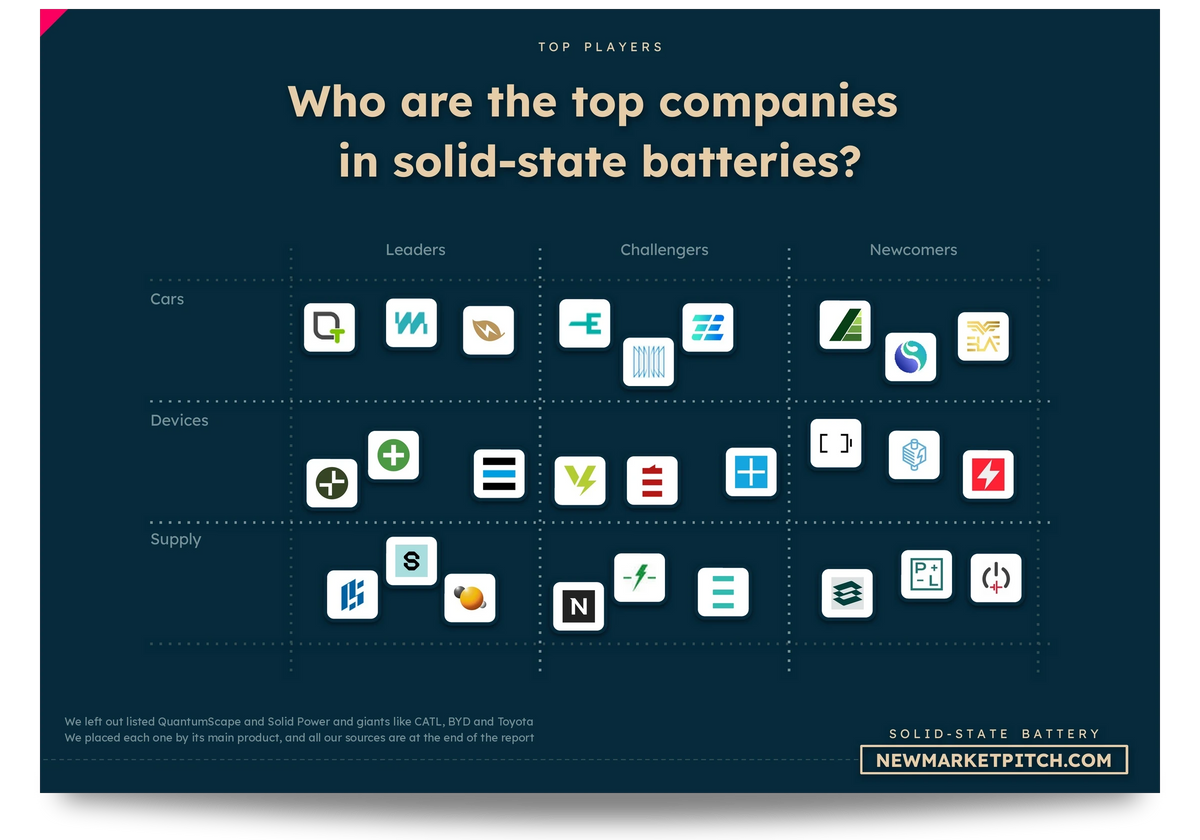
In our research about solid-state batteries, we turn what is vague and complex into simple, useful visuals. Market maps like this one show you at a glance where every startup stands.
Is solid-state battery funding a big market yet?
Solid-state battery funding is substantial, but a few giant checks make the market look bigger than it feels to most founders.
We identified 71 equity deals involving 47 companies, raising at least $815M. It is substantial funding for a technology that is still difficult to manufacture. But only a few companies can afford to attempt automotive-scale production. The normal disclosed check is far smaller than the headline financing, and only a minority of companies have returned for further rounds.
Look at the products being funded. Blue Current, a California company developing silicon-rich solid-state cells, secured an $81M Series D+ in December 2025 anchored by Amazon. By contrast, BTRY, which makes ultra-thin solid-state microbatteries for sensors and wearables, raised a $5.7M Seed in November 2025 to develop roll-to-roll manufacturing. Both qualify as solid-state battery startups, yet they need different factories and sell to different customers.
How rare are $100M solid-state battery rounds?
Very rare, since only 2 of the 71 solid-state battery deals we track reached $100M or more.
Those 2 deals make up 6% of the deals with a disclosed amount. Only 4 rounds went above $50M, and together they raised at least $514M. Excluding those big rounds leaves at least $301M. Most startups are raising far less than the companies behind the splashiest headlines.
INX Technology's $100M+ Series B in August 2026 stands far beyond the size of a routine seed financing. Talent New Energy's $56M+ Series B in December 2025 also illustrates how much the biggest checks differ from an initial laboratory raise. Companies receiving this kind of funding need to show how they can turn electrochemical performance into reliable cells, qualified products and repeatable industrial output.
BMW's work with listed Solid Power illustrates why manufacturing maturity costs money: its 2025 test vehicle used large-format all-solid-state cells, with partners still validating performance outside the laboratory. A $100M announcement is therefore a sign of a particularly demanding development stage, not evidence that every new solid-electrolyte company can raise on that scale.
Did QingTao Energy dominate recent solid-state battery fundraising?
Yes, QingTao Energy raised more solid-state battery funding than any other startup we tracked.
QingTao Energy raised $277M in a Series D+ in February 2026, the largest individual deal and the largest company total we recorded. Its focus on hybrid and solid-state lithium batteries helps explain why this was not just a laboratory-materials raise. An investor evaluating an advanced cell developer must think about repeatable production, product qualification and the cash required to meet eventual customer orders.
INX Technology, by contrast, raised money repeatedly for its lithium-metal cells. The ways these companies finance development are quite different. QingTao's one exceptional round can dominate a month's disclosed total without implying that every Chinese battery startup has reached the same scale.
Hybrid cells have already reached some commercial applications, while fully inorganic designs still face difficult manufacturing tests. QingTao's draft Hong Kong listing documents, filed in April 2026, also disclose commercial revenue alongside continuing losses, evidence of a manufacturing business rather than only a research program. QingTao's position therefore signals a route toward deployment, not proof that all-solid-state cells are commercially mature everywhere.

Your time is limited. In our market report about solid-state batteries, we put numbers on each part of the market, so you can see where it makes sense to focus.
Which solid-state battery companies have attracted the biggest checks recently?
QingTao Energy, INX Technology and Blue Current have attracted the biggest solid-state battery checks, though they got there in different ways.
QingTao Energy tops the company funding list with 1 exceptionally large round. INX Technology follows with at least $132M across 4 rounds, and Blue Current has $81M in 1 round. Talent New Energy and LionGo New Energy each have $56M+ across 2 rounds; Solivis follows with $40M across 3 rounds. One giant check can put a company ahead of rivals that have raised repeatedly.
The businesses are not all making identical batteries. INX Technology markets high-energy lithium-metal cells for robotics, consumer electronics and low-altitude aviation, while Blue Current describes a silicon-rich cell platform for mobility and stationary storage. Solivis manufactures sulfide electrolyte, a material other battery developers could use without becoming cell producers themselves.
Blue Current says its Hayward pilot line is operational and producing cells; Solivis says its Korean electrolyte factory is operating. Investors increasingly want to see something working outside the lab. These milestones do not establish profitability or guarantee that a planned product will be adopted at automotive scale.
Does a normal solid-state battery startup raise tens of millions?
No, a typical solid-state battery round is far smaller than the $100M announcements suggest.
The median funding round is $6.9M. Among deals with publicly disclosed amounts, 14 were under $5M, accounting for 40%, while another 12 fell between $5M and under $20M, accounting for 34%. Most of these checks help develop cells and test production methods; they do not pay for a full-scale factory.
Examples make that scale easier to understand. BTRY's $5.7M Seed in November 2025 targeted industrialization of miniature cells, while TaiSan's $5.3M Seed in July 2026 backed its quasi-solid sodium battery work. Adden Energy's $15M Series A, announced in October 2024, supported a pilot-production plan for fast-charging lithium-metal solid-state technology. Different products reach important milestones with checks of widely varying size.
At One Ventures described Adden's strategy as moving from laboratory results toward a roll-to-roll pilot facility. A smaller check can still pay for the next critical manufacturing step. We treat the median as the better guide for the normal financing conversation, while the largest rounds describe a separate problem: paying to industrialize technology that is already more developed.
Are lots of solid-state battery startups getting funded?
Plenty of solid-state battery startups have raised money, but far fewer have persuaded investors to come back.
Our research covers 47 companies. Of those, 29 raised only 1 round during the period, 14 raised 2 and 4 raised 3 or more. There are many funded teams, but relatively few have raised again. A second check tells us something a first one cannot: investors have seen more work and decided to continue.
INX Technology recorded 4 rounds and worked across high-energy lithium-metal cells. Solivis recorded 3 rounds while developing industrial sulfide-electrolyte manufacturing. Zhonggu Era has also raised several times, although several of its financing amounts remain undisclosed. Those undisclosed checks still count as deals, although their amounts cannot be added.
INX Technology says it has shipped lithium-metal solid-state cells from its Hangzhou operations. That does not prove strong sales, but it helps explain why investors keep going back.

In our document detailing everything you need to know about solid-state battery, we always try to gather several sources and make estimates that make sense, so you can work with solid numbers.
Are solid-state battery investors mostly funding seed-stage companies?
Yes, seed is the busiest solid-state battery funding stage, even though later checks account for most disclosed money.
Seed accounts for 30 deals, or 42% of all deals, while Series A and Series B account for 15 and 14 deals respectively. Among deals with a named stage, early-stage activity represents 71% of the deals, but later stages capture 81% of the disclosed capital in that named-stage group. Investors will fund early experiments, but the large checks tend to follow evidence that someone can actually make the product.
TaiSan and Qkera show what the early end looks like. EIT InnoEnergy led TaiSan's initial funding for a sodium-based polymer electrolyte and Qkera's early financing for ceramic membranes. Blue Current and QingTao Energy illustrate the other end, where later-stage financing accompanies a much larger manufacturing problem.
The table below shows the solid-state battery funding stages and their share of disclosed capital.
| Stage | Deals | Capital | Capital share |
|---|---|---|---|
| Series D+ | 3 | $358M+ | 44% |
| Series B | 14 | $275M+ | 34% |
| Series A | 15 | $126M+ | 15% |
| Seed | 30 | $24M+ | 3% |
| Series C | 1 | $17M | 2% |
| Unknown | 8 | $15M+ | 2% |
| Growth | No deal | – | – |
Is Series C where solid-state battery fundraising gets difficult?
Very few solid-state battery startups show a Series C round, and that gap is hard to ignore.
We counted 15 Series A deals and 14 Series B deals, but only 1 Series C deal and 3 Series D+ deals. This is not evidence that every startup must move through the labels sequentially. Some rounds have undisclosed stages, and some businesses reuse a stage designation. What stands out is how few clearly labeled later rounds appear.
Solivis provides the clear Series C example: the Korean sulfide-electrolyte developer raised $17M in August 2026. Its company announcement linked the financing to further global business development and described its operating factory in Hoengseong. Blue Current, by contrast, announced an $81M Series D+ in December 2025, while QingTao Energy raised a much larger Series D+ in February 2026. The stage labels differ, but later-stage funding clearly exists for selected companies.
The hard part happens on the production line. A sulfide powder that performs in a laboratory has to be manufactured with repeatable quality, and a cell that survives a short test must function reliably through customers' qualification processes. A sparse Series C count is a useful warning about that climb, not a forecast that Series B startups cannot succeed.

Our report covering the solid-state battery market gets updated several times a month, so you always get the latest view of where things stand.
How old are solid-state battery startups when investors fund them?
Solid-state battery startups often raise while they are young, but the biggest checks tend to go to older companies.
The median funded company age at a deal was 3 years. Among rounds above $50M, the median company age was 8.5 years; among rounds under $5M, it was 3.5 years. Across the companies in our research, 81% were founded since 2020 and 60% since 2022. Those figures identify an unusually young field, yet the most expensive stages generally demand experience, prototypes and production development.
Basquevolt was founded in 2022 as a spinout of CIC energiGUNE. The company describes a progression from initial cells and industry agreements to a 2026 partnership with Renault Group's Ampere business. Adden Energy emerged from Harvard research and used its 2024 Series A to plan a pilot production line. Meanwhile, Blue Current says it was founded in 2014 and spent years on cell research before its biggest round.
That age gap makes sense when we look at what the money has to pay for. A new electrolyte formulation may justify seed investment relatively quickly; a high-volume cell must also demonstrate that it can be manufactured and used repeatedly. Investors pay for a technology journey that rarely ends with the first promising laboratory test.
Are solid-state battery startups still getting first-time financing?
Yes, new solid-state battery companies still win their first checks, while follow-on rounds take most disclosed funding.
We classified 11 deals as first financings, representing 15% of the total, and 53 as follow-ons, representing 75%. First financings account for $8.3M+ and 1% of disclosed capital, while follow-ons account for $804M+ and 99%. Another 7 deals could not be assigned confidently to either category. New teams still get funded. The much larger follow-on amounts go to businesses that have already made progress.
Qkera's pre-seed round in October 2025 was its first recorded financing, after ceramic-electrolyte research at the Technical University of Munich. BTRY's January 2024 pre-seed round was also its first financing, with further funding appearing later. More recent first-financing examples include Jinghe Energy's January 2026 Seed and Keyuan Solid Energy's August 2026 round of undisclosed stage.
Can solid-state battery startups raise again quickly?
Some solid-state battery startups raise again within a year, but most repeat financings take longer.
For companies with multiple rounds and enough timing information, the median gap was 14.5 months. Among those observed gaps, 36% were under 12 months, 61% were under 18 months and 75% were under 24 months. These are shares of intervals between rounds, not shares of companies; a startup that raised repeatedly can contribute several gaps.
INX Technology illustrates rapid repeated financing. The company announced rounds in February and August 2025, followed by its much larger August 2026 Series B. Solivis raised in March 2024, February 2025 and August 2026. TaiSan's financing path stretched from its July 2024 Seed to a July 2026 Seed, with different investors taking the lead later on. Those companies came back for money on different schedules because their engineering work moved at different speeds.
TaiSan, for example, said its later financing would support pilot tests with manufacturers. Coming back for more money can mean either scaling a promising product or getting past a hard technical step. Investors should read the intervals together with those operating objectives, not treat faster fundraising as automatic evidence of a better battery.

In our research about solid-state batteries, we look at what the winners do differently, so you can learn from the best instead of guessing.
Does China dominate solid-state battery startup funding?
China leads private solid-state battery fundraising by both the number of deals and disclosed dollars.
Chinese companies accounted for 46 deals involving 31 companies and raised at least $581M. That represents 65% of the deals and 71% of the disclosed capital. No other single country comes close on the measures used here. The biggest individual round belongs to QingTao Energy, but the wider Chinese list also includes INX Technology, Talent New Energy, LionGo New Energy and developers of sulfide and oxide electrolytes.
China's reach goes well beyond QingTao Energy. The deal history includes entire cell developers, companies making ceramic or sulfide electrolytes, and businesses supplying equipment and processing technology. INX Technology describes shipping battery cells into emerging applications including robotics and low-altitude aviation, while SEVC Power says its funding supports sulfide-material and cell-production expansion.
Chinese startups lead this private funding record, but that does not settle who will sell the best batteries globally. BMW and Toyota are pursuing solid-state development with major industrial partners that are not part of our independent-startup counts. China's leading position is a fact about this private financing market, not a claim that companies elsewhere have stopped innovating.
Are American solid-state battery startups still raising real money?
Yes, American solid-state battery startups have raised at least $141M across 10 deals, far less than Chinese developers, and several are already working with pilot production.
The United States accounts for 10 deals involving 7 companies and at least $141M. Its share is 14% of deals and 17% of disclosed capital, compared with China's much larger footprint. Yet Blue Current, Adden Energy, Anthro Energy and Natrion pursue distinct routes, from silicon-rich cells to solid-electrolyte materials and flexible battery technology.
Blue Current's December 2025 financing was anchored by Amazon and linked to commercialization for mobility and stationary-storage uses. Adden Energy's Series A, announced in October 2024, funded a planned roll-to-roll pilot line. Anthro Energy's February 2024 Series A backed scaling its advanced electrolyte platform, while Natrion has worked on a composite solid-electrolyte separator intended to be compatible with existing battery manufacturing methods.
According to Blue Current's company history, its pilot line has started producing cells in Hayward. This is a real production step, although it does not prove high-volume sales. The American story is therefore not a lack of serious projects; it is a smaller and more concentrated private financing market than the one currently visible in China.
Is European solid-state battery funding too small to matter?
Europe attracts less solid-state battery funding, but its startups are developing products that serve different customers.
Europe recorded 9 deals across 6 companies and at least $45M, corresponding to 13% of deal activity and 6% of disclosed capital. By comparison, Asia-Pacific raised at least $629M and North America at least $141M. Undisclosed checks could make the actual totals higher. Europe's smaller financing base does not erase its specialist businesses.
Basquevolt works on lithium-metal technology and a solid-electrolyte supply strategy. Renault Group announced a joint development agreement with Basquevolt in February 2026 to test next-generation cells for electric vehicles. BTRY has targeted microbatteries thin enough for connected devices, while Qkera develops flexible ceramic electrolyte membranes. TaiSan and LiNa Energy address sodium-based applications rather than copying every conventional electric-vehicle project.
Several of those businesses deliberately avoid funding a complete automotive cell factory at the outset. BTRY's November 2025 financing targeted roll-to-roll production for miniature cells, and Qkera's investor emphasizes membranes that can integrate with existing manufacturing processes. Europe is not matching the largest Chinese rounds, but its startups could still win parts of the battery value chain that require less capital to enter.

In our market report about solid-state batteries, we don't want to repeat what boring consulting reports say. Instead, we show you the real and latest market signals that matter.
Are hybrid solid-state batteries attracting more money than all-solid-state cells?
Yes, hybrid solid-state battery companies have raised more disclosed funding than all-solid-state cell developers.
Hybrid solid-state cell developers raised at least $374M across 13 deals, accounting for 46% of disclosed capital and 18% of deals. All-solid-state cell developers raised at least $284M across 26 deals, representing 35% of disclosed capital and 37% of deals. The gap makes sense once we stop treating every solid-state battery chemistry as equally close to market.
QingTao Energy, Talent New Energy and WeLion New Energy sit on the hybrid side of the market. WeLion has supplied semi-solid cells for NIO battery packs, an example of a hybrid approach reaching actual vehicles. All-solid-state developers such as Blue Current, INX Technology and Adden Energy are making a different claim: that a solid-electrolyte architecture can ultimately support significant gains in safety and energy density at scale.
Fraunhofer notes that hybrid and semi-solid designs are further along in some real-world applications than fully inorganic designs. Investors are paying for products that can reach customers sooner, as well as the harder effort to make fully solid cells practical. Neither route has settled the contest over battery performance and cost.
The table below shows how the solid-state battery categories compare by deals and disclosed capital.
| Category | Deals | Capital | Capital share |
|---|---|---|---|
| Hybrid Solid-State Cell Developers | 13 | $374M+ | 46% |
| All-Solid-State Cell Developers | 26 | $284M+ | 35% |
| Oxide Electrolytes | 9 | $66M+ | 8% |
| Sulfide Electrolytes | 14 | $43M+ | 5% |
| Polymer Electrolytes | 7 | $30M+ | 4% |
| Solid-State Manufacturing & Process Technology | 1 | $14M | 2% |
| Composite Solid Electrolytes & Membranes | 1 | $4.6M | 1% |
Which solid electrolytes are attracting the most funding?
Oxide-electrolyte startups lead in disclosed funding, while sulfide specialists have more solid-state battery deals.
Oxide-electrolyte developers recorded 9 deals and raised at least $66M. Sulfide-electrolyte developers recorded 14 deals and raised at least $43M, while polymer-electrolyte developers had 7 deals and at least $30M. The three materials solve different problems and bring different headaches in processing, stability and cell design.
LionGo New Energy, which develops oxide-based electrolytes, raised a $28M+ Series B in November 2025 and a further ~$28M Series B round, which the company calls Series B+, in November 2026. Solivis focuses on sulfide powder and expanded its manufacturing work through a $17M Series C in August 2026. Qkera takes another oxide route, producing ceramic membranes rather than a complete finished vehicle battery. TaiSan's polymer-based sodium design targets mobility applications where energy density and affordability need to work together.
Investors are backing different answers to those processing and stability problems. Which material wins will depend on the cells manufacturers can actually produce and sell.

Learning from others' mistakes is the cheapest lesson there is. In our document detailing everything you need to know about solid-state battery, we look at what broke startups before you, so you don't repeat it.
Are sulfide solid-state battery materials finally moving into factories?
Sulfide solid-state battery materials are now coming out of production facilities, although large-scale customer adoption remains unproven.
The clearest private-company example in our research is Solivis, which has raised $40M in the period across 3 rounds. Its $17M Series C in August 2026 was accompanied by company statements about operating a plant in Hoengseong and expanding its customer-facing business. In China, SEVC Power announced financing in August 2026 to expand sulfide-electrolyte and all-solid-state cell capacity, while Tianshi Kefeng repeatedly attracted early backing for sulfide-electrolyte powder.
The wider industry has reached related milestones. Listed Solid Power announced in October 2026 that it had begun commissioning a continuous sulfide-electrolyte pilot line in Colorado. That is important context, but it is not an additional private financing deal in our count.
The remaining test is cost and repeatability. Sulfide materials can conduct ions effectively, but they also require stringent handling and stable interfaces with electrodes. As Fraunhofer explains, industrial-scale production still introduces challenges that do not disappear when a successful cell prototype is demonstrated. Factory construction marks progress; production yield, qualification and customers determine what the funding eventually achieves.
Are sodium-based solid-state batteries attracting real investors?
Yes, investors are backing solid-state sodium battery startups alongside the better-known lithium developers.
TaiSan's $1.7M Seed in July 2024 and $5.3M Seed in July 2026 illustrate a path built around quasi-solid polymer electrolytes and sodium chemistry. LiNa Energy's $3.5M Seed in March 2024, counted without the grant announced alongside it, appears in our deal history for a different sodium approach targeting longer-duration storage. China has also produced financed specialists including Zhaona New Energy and Yihua New Energy, although their listed amounts are undisclosed.
TaiSan says it is working on sodium cells suited to electric bikes, scooters, tools and vehicles, with its later financing intended to support pilot tests with manufacturers. LiNa Energy announced a pilot manufacturing facility and has emphasized stationary storage applications using a solid ceramic electrolyte. The businesses are solving distinct problems: one aims to make mobile batteries more practical without lithium, while the other emphasizes accessible materials and storage economics.
The classification matters because sodium-ion describes the charge carrier, not whether the electrolyte is liquid or solid. We include sodium specialists only when a genuine solid-electrolyte architecture is central to the product. Their funding shows the market is not exclusively a competition to build the next premium lithium battery for a passenger car.
Are investors funding machines for solid-state battery factories?
Barely, since the 71 solid-state battery deals we track include just 1 manufacturing-process round, and its lead investors were not disclosed.
The solid-state manufacturing and process technology category contains 1 deal, worth $14M, for Gaoneng Digital Manufacturing's Series B in November 2026. That contrasts with the much larger totals for cell makers and electrolyte-material specialists. It does not mean manufacturers are ignoring equipment. Many industrial improvements are carried out inside diversified equipment groups or incumbent battery companies outside our independent-startup definition.
Toyota's own manufacturing disclosures describe the challenge of stacking fragile battery layers precisely while maintaining intimate contact between electrodes and solid electrolytes. Solid Power, which is listed and raises its money on the stock market rather than in private rounds, has been commissioning continuous electrolyte manufacturing equipment.
That small equipment category is worth watching. Investors may be financing production engineering indirectly through cell companies, or backing industrial suppliers that do not qualify for this startup market. The visible private deals say relatively little money goes to independent solid-state-specific equipment specialists, not that manufacturing equipment is unimportant to the technology's future.

If you build or invest in the solid-state battery market, you need to know which business models pay off now and which ones are fading. That's why our report covering it has a whole section on it.
Does solid-state battery funding arrive steadily or in bursts?
Solid-state battery fundraising comes in bursts, and one big round can dominate an entire month.
Across 34 completed months, the median month contained 2 deals and $1.2M in disclosed funding, and 7 months had no deal. The busiest month by deal count was March 2024, with 6 financings. The largest month by disclosed amount was February 2026 at $306M+, dominated by QingTao Energy's giant financing. That difference between deal frequency and dollar volume is the essential pattern.
It is visible in the recent monthly sequence. January 2026 had 5 deals but only $2.1M+ disclosed, while February 2026 had 3 deals with a much larger reported amount. August 2026 brought 5 deals and $123M+, helped by INX Technology's Series B. October 2026 had 2 deals with no disclosed amount; it would be a mistake to conclude that no money changed hands.
A battery factory does not raise money on the tidy schedule of a software startup. Companies often announce financing after a technical milestone, a pilot expansion or a lengthy institutional process. The monthly data show why funding momentum should not be judged from a single large press release or from a quiet month.
The table below shows the reported month-by-month pattern for the current year to date.
| Month | Deals | Disclosed capital |
|---|---|---|
| January 2026 | 5 | $2.1M+ |
| February 2026 | 3 | $306M+ |
| March 2026 | 2 | $0 |
| April 2026 | 1 | $0 |
| May 2026 | 3 | $2.1M+ |
| June 2026 | 2 | $0 |
| July 2026 | 2 | $5.3M+ |
| August 2026 | 5 | $123M+ |
| September 2026 | 2 | $17M+ |
| October 2026 | 2 | $0 |
| November 2026 | 3 | $43M+ |
A displayed $0 means no public deal amount, not necessarily no money raised. November 2026 is partial.
What gets a solid-state battery startup a bigger check?
Bigger solid-state battery rounds increasingly go to startups that can show working production and serious customer interest.
The biggest solid-state battery checks fund more than a laboratory prototype. Investors want evidence that the company can make cells or materials repeatedly, and the rounds above $50M went to companies that had been around much longer than the typical seed-stage team.
Other companies are finding applications with smaller physical dimensions. BTRY is industrializing microbatteries for sensors and connected devices; TaiSan is pursuing sodium batteries for light mobility; LiNa Energy works on stationary sodium storage. Their financing targets need not be identical to those of a premium electric-vehicle cell developer, but all must move from materials research to a process that reliably makes something buyers want.
Fraunhofer has highlighted unstable material interfaces, pressure requirements and process changes as obstacles to fully inorganic solid-state systems. Toyota's own manufacturing work stresses precision stacking and repeatability. A prototype gets attention. Reliable production, acceptable costs and real buyers are what can justify the next big check.
So, what does solid-state battery funding really look like today?
Solid-state battery funding is real but concentrated, with a handful of giant rounds far above what most startups raise.
This is a young market of cell developers, material specialists and process businesses, each on its own path. QingTao Energy raised the largest single round, EIT InnoEnergy led the most rounds among disclosed lead investors, and Chinese startups dominate the recorded financing. The biggest contrast is between the many early-stage deals and the later-stage checks that take most of the money.
The commercial picture is equally mixed. WeLion has shown that semi-solid batteries can enter vehicles, while Renault and Basquevolt are working through qualification for a different chemistry. Blue Current describes a working pilot line, and BTRY is pursuing small batteries for uses that do not require an automotive gigafactory. The sector is past pure speculation, but most companies are still far from selling at scale.
The table below shows what we found.
| Question | Answer |
|---|---|
| Has private battery funding become substantial? | Yes, solid-state startups have raised at least $815M since January 2024. That comes from 71 recorded financings across several technologies. The total is meaningful, but its distribution remains extremely uneven. |
| Do giant checks reflect ordinary rounds? | No, the median disclosed solid-state financing is just $6.9M. The largest announcements sit far above that typical round size. Most founders still face a comparatively modest first industrial budget. |
| Is one company unusually influential here? | Yes, QingTao Energy raised $277M in its February 2026 round. That is the single largest financing in this market. Its size helps explain the sharp concentration of headline dollars. |
| Are large rounds widespread among startups? | Not yet; 4 big financings represent an exceptional group. Together they account for $514M+ of disclosed solid-state funding. Without them, the market still operates at a much smaller scale. |
| Do most companies return for investment? | No, only 18 companies in this market raised repeatedly. Another 29 completed just 1 round during the period. That limits how broadly repeat investor confidence can be demonstrated. |
| Are investors still entering at seed stage? | Yes, Seed accounts for 30 solid-state battery financings. Those deals represent 42% of recorded startup rounds. Seed funding remains common, but getting bigger checks is harder. |
| Do older companies collect bigger checks? | Generally, major rounds favor startups with longer operating histories. The median age for rounds above $50M was 8.5 years. Industrial development and qualification usually take substantial time to prove. |
| Has China become the fundraising center? | Yes, China accounts for 46 recorded solid-state battery deals. Its startups received 71% of the disclosed capital. That leadership does not include the work of diversified incumbents elsewhere. |
| Are hybrid cells winning funding attention? | Yes, hybrid solid-state developers attracted $374M+ in disclosed financing. That accounts for 46% of the market's disclosed capital. Their nearer-term production routes help explain their financial weight. |
| Is the month-to-month flow predictable? | No, the median completed month recorded just 2 financings. February 2026 nevertheless brought $306M+ in disclosed capital. Giant announcements can transform one month without changing ordinary fundraising. |
| Can materials businesses succeed without vehicle plants? | Yes, Solivis has raised $40M across its specialist financing rounds. Its product is sulfide electrolyte rather than a finished car. Component suppliers can pursue customers without owning every stage of cell manufacturing. |

In our research about solid-state batteries, we like to show you the big picture. We know your time is precious, so we make every page quick to read and packed with as much learning as possible per minute.
Our methodology
Our data runs through November 14, 2026. We then reviewed this article and updated its answers on November 17, 2026, the date shown under the title. We cover financings dated from January 1, 2024 to November 14, 2026, using a $300K minimum equity-deal size. The period is one continuous record of the market rather than an annualized estimate.
We count private-company equity financings and exclude debt, grants, loans, unconverted convertibles, SAFEs and public offerings. We cover independent companies principally developing solid-electrolyte battery cells, genuine semi-solid and quasi-solid hybrids, specialist electrolytes and membranes, or manufacturing processes designed specifically for those cells. We include borderline electrochemical designs when the solid-electrolyte technology is genuinely central, rather than silently excluding them.
Every company counted meets our startup definition: founded in 2000 or later, independent and built to grow around a new product or technology, with private funding or founder backing, and not a long-established listed incumbent. Companies first listed within the past five years or acquired within the past three years still count; established automotive and battery conglomerates are context, not qualifying startup rounds.
We merge duplicate announcements so each financing counts once. Deals without published amounts contribute to deal counts but not disclosed-capital totals; accordingly, totals ending in a plus sign are minimums. Stages reflect the announced financing label. We group the market by the principal cell or electrolyte technology, and we assign geography by the headquarters country.
Rounds confirmed by a company announcement, a press article or a regulatory filing are counted in full. Where no article exists, a round is counted only when at least two recognised databases agree on its date (within one month) and amount (within 5%), and it is marked as low confidence; a round found in a single database stays in the company's history but is left out of totals. For companies that have raised more than $100M, every round counted is backed by an article.
We prioritize company disclosures, filings and reliable reporting for financing facts and use commercial database figures only under the corroboration rule. Our categories span companies at very different stages of development, from materials and equipment specialists to cell developers.
A reader may find higher totals in industry reports because those reports include Toyota, listed Solid Power, diversified manufacturers, grants, debt or businesses that only research solid-state batteries as a side project. We exclude those transactions consistently. A weak-looking recent month can also reflect undisclosed financing amounts or an incomplete current month, rather than an absence of fundraising.
Key sources include QingTao Energy draft listing accounts and recent equity proceeds, Blue Current company history, pilot line and Amazon-anchored Series D, Blue Current Series D financing and commercialization context, INX Technology's lithium-metal cell products and manufacturing claims, Solivis Series C, sulfide factory and use of proceeds, TaiSan financing, investors and pilot-test plans, Qkera financing and ceramic electrolyte commercialization, TaiSan's initial polymer-electrolyte investment and development goals, BTRY financing and microbattery manufacturing plan, LiNa Energy equity financing and separate grant funding, LiNa Energy's sodium-battery pilot plant, Adden Energy Series A and pilot manufacturing plans, Anthro Energy's Series A, materials strategy and factory updates, Natrion's composite solid-electrolyte separator technology, SEVC Power's sulfide cell and electrolyte manufacturing plans, Basquevolt's timeline and industrial-development strategy, Renault and Basquevolt automotive development agreement, WeLion's semi-solid battery roadmap and vehicle applications, Fraunhofer analysis of industrial-readiness gaps and battery chemistry, BMW and Solid Power vehicle-scale cell demonstration, Toyota's production-process challenges for solid-state cells, and Listed Solid Power's continuous sulfide-electrolyte manufacturing line.

When you build or invest in the solid-state battery market, you need clarity, not confusion. In our market report about solid-state batteries, we always try to put numbers on and quantify whatever is usually vague and confusing.
Written by the New Market Pitch teamWe track new markets so founders and investors can move faster. About us