What are the funding trends in Solid-State Batteries?
Whether you're building or investing in the solid-state battery market, our report covers everything you need to know: the players, the money, and what's coming next.
Summary
Solid-state battery startup funding is rising strongly this year, but the trend is dominated by large industrial bets in China. We tracked 30 deals worth at least $498M this year to date, led by QingTao Energy's $277M Series D+ in February 2026. The same period of 2025 recorded 18 deals and at least $101M.
The same months of 2024 brought 20 deals and at least $79M.
This year's disclosed money has already exceeded the full-year 2025 total. Funding so far equals 209% of the preceding full year's disclosed amount, while this year's deal count is 143% of that full-year count.
A few very large rounds explain much of the jump. Without rounds above $50M, disclosed funding is at least $121M this year to date. The rise is far smaller once the exceptional checks disappear.
The typical publicly disclosed round has grown, too. The median is $15.4M this year to date, compared with $6.3M at the same point in 2025 and $3.0M at the same point in 2024. However, only 40% of this year's rounds have public amounts.
The biggest checks now go to later-stage companies. Later-stage financings received 92% of disclosed money this year to date, while early-stage financings received 8%. Seed rounds still take place, but they no longer describe where most announced capital is going.
Hybrid solid-state cell developers lead disclosed investment with at least $309M and 62% of the capital. Fully solid-state cell developers continue to lead in deal count. Investors are still backing more than one type of solid-state cell.
China accounts for 24 deals and at least $456M this year to date, or 92% of disclosed capital. The United States and Europe are funding fewer independent startups, even as major manufacturers and automakers continue serious battery development outside China.
The quarter-by-quarter view is much less smooth. Q1 2026 recorded at least $308M, then reported capital dropped sharply before Q3 2026 rebounded to at least $145M. One strong quarter does not mean the next will be just as busy.
This year has brought more deals and larger checks, but the growth is neither steady nor spread evenly across countries. Investors are directing much of the available money toward larger projects and Chinese companies, while the path to economical mass production remains unfinished.

Written by the New Market Pitch teamWe track new markets so founders and investors can move faster. About us

In our report covering the solid-state battery market, you will always find fresh funding data, taken straight from our own verified funding database.
All funding deals in the solid state battery market over the last years
Below is the table listing all the deals. You can find our methodology at the end of this page.
If you want a deeper understanding of the market and its current dynamics, get our solid state battery market report.
| Company | Category | Date | Stage | Deal size | What they do | Region | Lead investors | Country | Rank |
|---|---|---|---|---|---|---|---|---|---|
| LionGo New Energy | Oxide Electrolytes | November 2026 | Series B | ~$28M | Develops and manufactures oxide-based solid electrolytes and related hybrid electrolytes for semi-solid and all-solid-state battery cells. | Asia-Pacific | Not disclosed | China | |
| Tuopu Technology | Hybrid Solid-State Cell Developers | November 2026 | Series A | $1.4M+ | Develops and produces quasi-solid battery cells with oxide-polymer composite solid electrolytes for drones and other high-energy applications. | Asia-Pacific | Not disclosed | China | |
| Gaoneng Digital Manufacturing | Solid-State Manufacturing & Process Technology | November 2026 | Series B | ~$14M | Develops dry-electrode equipment and integrated manufacturing lines designed for all-solid-state battery cell production. | Asia-Pacific | Not disclosed | China | |
| Sichuan All-Solid-State New Materials | Sulfide Electrolytes | October 2026 | Series A | Undisclosed | Produces lithium sulfide feedstock for sulfide solid-state battery electrolytes. | Asia-Pacific | Hongrong Capital, Mingshi Capital | China | |
| Yuanqi Membrane Innovation | Polymer Electrolytes | October 2026 | Seed | Undisclosed | Nanofiber composite solid-state electrolyte membranes | Asia-Pacific | Spark Seedling Fund (Wuhan Innovation Investment Group) | China | |
| Adden Energy | All-Solid-State Cell Developers | September 2026 | Series B | $17M | Fast-charging lithium-metal solid-state batteries | North America | Not disclosed | United States | |
| Golden Feather New Energy | All-Solid-State Cell Developers | September 2026 | Series B | Undisclosed | Manufactures solid-state lithium-metal battery systems | Asia-Pacific | Not disclosed | China | |
| SEVC Power | All-Solid-State Cell Developers | August 2026 | Series A | Undisclosed | Develops sulfide all-solid-state batteries | Asia-Pacific | Saike Investment, CICC Capital | China | |
| INX Technology | All-Solid-State Cell Developers | August 2026 | Series B | $100M+ | High-energy solid-state lithium-metal cells | Asia-Pacific | Puhua Capital | China | |
| Solivis | Sulfide Electrolytes | August 2026 | Series C | $17M | Sulfide solid electrolyte manufacturing | Asia-Pacific | Openwater Investment | South Korea | |
| Keyuan Solid Energy | Oxide Electrolytes | August 2026 | Unknown | $5.6M | Solid-state battery electrolyte materials | Asia-Pacific | Shanghai Xiba Technology | China | |
| Guxin Energy | Hybrid Solid-State Cell Developers | August 2026 | Series B | Undisclosed | Semi-solid and solid-state batteries | Asia-Pacific | Toukong Donghai | China | |
| TaiSan | Polymer Electrolytes | July 2026 | Seed | $5.3M | Quasi-solid electrolytes for sodium batteries | Europe | Eos Advisory, Midlands Engine Investment Fund II (Mercia Ventures) | United Kingdom | |
| Zhaona New Energy | All-Solid-State Cell Developers | July 2026 | Seed | Undisclosed | Solid-state sodium battery technology | Asia-Pacific | Not disclosed | China | |
| Heyuan Lichuang New Energy | Hybrid Solid-State Cell Developers | June 2026 | Series A | Undisclosed | Solid-state battery cell manufacturing | Asia-Pacific | Xiaomi Yangtze River Industry Fund | China | |
| Sichuan All-Solid-State New Materials | Sulfide Electrolytes | June 2026 | Seed | Undisclosed | Produces lithium sulfide feedstock for sulfide solid-state battery electrolytes. | Asia-Pacific | Not disclosed | China | |
| Zhonggu Era | Hybrid Solid-State Cell Developers | May 2026 | Series B | $2.1M | Solid-state battery cells for energy storage | Asia-Pacific | Not disclosed | China | |
| Tianshi Kefeng | Sulfide Electrolytes | May 2026 | Seed | Undisclosed | Sulfide solid electrolyte powder manufacturing | Asia-Pacific | Oriza Seed | China | |
| Chunli New Energy | All-Solid-State Cell Developers | May 2026 | Seed | Undisclosed | Develops solid-state cells and electrolytes | Asia-Pacific | Not disclosed | China | |
| Ruiyi New Materials | Oxide Electrolytes | April 2026 | Unknown | Undisclosed | Solid state battery electrolyte materials | Asia-Pacific | Not disclosed | China | |
| Jihui Chuangzhi | Sulfide Electrolytes | March 2026 | Seed | Undisclosed | Sulfide all-solid-state battery cells and electrolytes | Asia-Pacific | Keda Silicon Valley Guidance Fund | China | |
| Basquevolt | All-Solid-State Cell Developers | March 2026 | Unknown | Undisclosed | Lithium-metal solid-state battery technology | Europe | Not disclosed | Spain | |
| Yaoshi Lithium | Hybrid Solid-State Cell Developers | February 2026 | Series A | ~$29M | Solid-state lithium battery technology | Asia-Pacific | Wuyuefeng Capital | China | |
| QingTao Energy | Hybrid Solid-State Cell Developers | February 2026 | Series D+ | $277M | Hybrid and solid-state lithium batteries | Asia-Pacific | Not disclosed | China | |
| Zhonggu Era | Hybrid Solid-State Cell Developers | February 2026 | Series B | Undisclosed | Solid-state battery cells for energy storage | Asia-Pacific | Not disclosed | China | |
| Yinshi New Materials | Sulfide Electrolytes | January 2026 | Seed | Undisclosed | Sulfide solid electrolytes and electrolyte membranes | Asia-Pacific | Ruicheng Fund | China | |
| Jinghe Energy | All-Solid-State Cell Developers | January 2026 | Seed | Undisclosed | Solid-state battery cells and power systems | Asia-Pacific | Sky Factory Venture Capital Fund | China | |
| Piersica | Polymer Electrolytes | January 2026 | Seed | $2.1M | High-energy solid-state lithium batteries | North America | Not disclosed | United States | |
| Lasagna.one | All-Solid-State Cell Developers | January 2026 | Unknown | Undisclosed | Develops compact high-voltage solid-state batteries | North America | JIC Venture Growth Investments | United States | |
| Solid State Ion Energy Technology | Polymer Electrolytes | January 2026 | Seed | Undisclosed | Polymer solid electrolytes for batteries | Asia-Pacific | Not disclosed | China | |
| Blue Current | All-Solid-State Cell Developers | December 2025 | Series D+ | $81M | Silicon-based solid-state battery manufacturer | North America | Amazon | United States | |
| Talent New Energy | Hybrid Solid-State Cell Developers | December 2025 | Series B | $56M+ | Solid-state lithium battery development | Asia-Pacific | Not disclosed | China | |
| Tianshi Kefeng | Sulfide Electrolytes | December 2025 | Seed | Undisclosed | Sulfide solid electrolyte powder manufacturing | Asia-Pacific | Not disclosed | China | |
| LionGo New Energy | Oxide Electrolytes | November 2025 | Series B | $28M+ | Develops and manufactures oxide-based solid electrolytes and related hybrid electrolytes for semi-solid and all-solid-state battery cells. | Asia-Pacific | Not disclosed | China | |
| BTRY | All-Solid-State Cell Developers | November 2025 | Seed | $5.7M | Ultra-thin solid-state microbatteries | Europe | Redstone VC | Switzerland | |
| Natrion | Composite Solid Electrolytes & Membranes | November 2025 | Unknown | $4.6M | Ceramic-polymer solid electrolyte separators | North America | Not disclosed | United States | |
| WeLion New Energy | Hybrid Solid-State Cell Developers | October 2025 | Series D+ | Undisclosed | Hybrid solid-state lithium battery manufacturing | Asia-Pacific | Beijing Green Energy, Low-Carbon Industry Investment Fund, Beijing New Materials Industry Investment Fund | China | |
| Qkera | Oxide Electrolytes | October 2025 | Seed | Undisclosed | Ceramic solid-state electrolyte membranes | Europe | EIT InnoEnergy | Germany | |
| Zhongke Solid Energy | Sulfide Electrolytes | October 2025 | Seed | Undisclosed | Develops sulfide electrolytes and battery cells | Asia-Pacific | Not disclosed | China | |
| ASET | Oxide Electrolytes | September 2025 | Seed | $2.2M | Solid state battery materials and cells | Asia-Pacific | Not disclosed | South Korea | |
| INX Technology | All-Solid-State Cell Developers | August 2025 | Series A | $28M+ | High-energy solid-state lithium-metal cells | Asia-Pacific | CMB International Capital, Yuanzhi Energy Storage Fund, Fortune Capital | China | |
| Hytzer Energy | All-Solid-State Cell Developers | August 2025 | Seed | Undisclosed | Commercializes polymer solid-state batteries | Asia-Pacific | Not disclosed | China | |
| Deegares Energy | All-Solid-State Cell Developers | July 2025 | Series A | Undisclosed | Manufactures solid-state batteries and electrolytes | Asia-Pacific | Not disclosed | China | |
| Zhonggu Era | Hybrid Solid-State Cell Developers | June 2025 | Unknown | $1.4M | Solid-state battery cells for energy storage | Asia-Pacific | Not disclosed | China | |
| Lasagna.one | All-Solid-State Cell Developers | March 2025 | Unknown | Undisclosed | Develops compact high-voltage solid-state batteries | North America | Not disclosed | United States | |
| Guxin Energy | Hybrid Solid-State Cell Developers | March 2025 | Series B | ~$6.9M | Semi-solid and solid-state batteries | Asia-Pacific | Not disclosed | China | |
| Zhaona New Energy | All-Solid-State Cell Developers | March 2025 | Seed | Undisclosed | Solid-state sodium battery technology | Asia-Pacific | Jinbang Capital, Jinyuan Development Group | China | |
| Tianshi Kefeng | Sulfide Electrolytes | March 2025 | Seed | Undisclosed | Sulfide solid electrolyte powder manufacturing | Asia-Pacific | Cuiying Venture Capital | China | |
| Basquevolt | All-Solid-State Cell Developers | March 2025 | Series A | $12M | Lithium-metal solid-state battery technology | Europe | Not disclosed | Spain | |
| Solivis | Sulfide Electrolytes | February 2025 | Series B | ~$8.6M | Sulfide solid electrolyte manufacturing | Asia-Pacific | Not disclosed | South Korea | |
| INX Technology | All-Solid-State Cell Developers | February 2025 | Series A | ~$4M | High-energy solid-state lithium-metal cells | Asia-Pacific | Not disclosed | China | |
| Johnson Energy Storage | All-Solid-State Cell Developers | October 2024 | Series A | $1M | Glass-electrolyte solid-state lithium batteries | North America | Not disclosed | United States | |
| Adden Energy | All-Solid-State Cell Developers | October 2024 | Series A | $15M | Fast-charging lithium-metal solid-state batteries | North America | At One Ventures | United States | |
| ASET | Oxide Electrolytes | October 2024 | Unknown | $3M | Solid state battery materials and cells | Asia-Pacific | Not disclosed | South Korea | |
| Hytzer Energy | All-Solid-State Cell Developers | October 2024 | Seed | Undisclosed | Commercializes polymer solid-state batteries | Asia-Pacific | Temasek | China | |
| MATenergy | Oxide Electrolytes | September 2024 | Seed | Undisclosed | Flexible ceramic solid-electrolyte films | Asia-Pacific | Not disclosed | China | |
| Talent New Energy | Hybrid Solid-State Cell Developers | August 2024 | Series B | Undisclosed | Solid-state lithium battery development | Asia-Pacific | Anhe Fund, China South Industries Group | China | |
| TaiSan | Polymer Electrolytes | July 2024 | Seed | $1.7M | Quasi-solid electrolytes for sodium batteries | Europe | EIT InnoEnergy, TSP Ventures | United Kingdom | |
| Guyan Solid | Sulfide Electrolytes | July 2024 | Seed | Undisclosed | Manufactures sulfide solid electrolyte materials | Asia-Pacific | Renhe Capital | China | |
| Zhonggu Era | Hybrid Solid-State Cell Developers | May 2024 | Series A | Undisclosed | Solid-state battery cells for energy storage | Asia-Pacific | Not disclosed | China | |
| Ronggu New Materials | Oxide Electrolytes | March 2024 | Seed | Undisclosed | Develops advanced solid electrolyte materials | Asia-Pacific | Not disclosed | China | |
| LiNa Energy | All-Solid-State Cell Developers | March 2024 | Seed | $3.5M | Solid-state sodium batteries for storage | Europe | Jacob Wolff-Petersen | United Kingdom | |
| Yihua New Energy | All-Solid-State Cell Developers | March 2024 | Seed | Undisclosed | Develops solid-state sodium battery technology | Asia-Pacific | Not disclosed | China | |
| Solivis | Sulfide Electrolytes | March 2024 | Series B | $15M | Sulfide solid electrolyte manufacturing | Asia-Pacific | Not disclosed | South Korea | |
| Solid Ionics | Sulfide Electrolytes | March 2024 | Seed | $2.2M | Solid-state battery electrolyte materials | Asia-Pacific | Samyang Corporation | South Korea | |
| Zhongke Solid Energy | Sulfide Electrolytes | March 2024 | Seed | Undisclosed | Develops sulfide electrolytes and battery cells | Asia-Pacific | Hexuan Capital | China | |
| Anthro Energy | Polymer Electrolytes | February 2024 | Series A | $20M | Flexible advanced battery materials and cells | North America | Collaborative Fund | United States | |
| LionVolt | All-Solid-State Cell Developers | February 2024 | Series A | $17M | Solid-state battery cells for drones | Europe | Not disclosed | Netherlands | |
| Piersica | Polymer Electrolytes | February 2024 | Seed | $500K | High-energy solid-state lithium batteries | North America | Not disclosed | United States | |
| BTRY | All-Solid-State Cell Developers | January 2024 | Seed | $1M | Ultra-thin solid-state microbatteries | Europe | High-Tech Gründerfonds | Switzerland | |
| INX Technology | All-Solid-State Cell Developers | January 2024 | Series A | Undisclosed | High-energy solid-state lithium-metal cells | Asia-Pacific | Not disclosed | China |

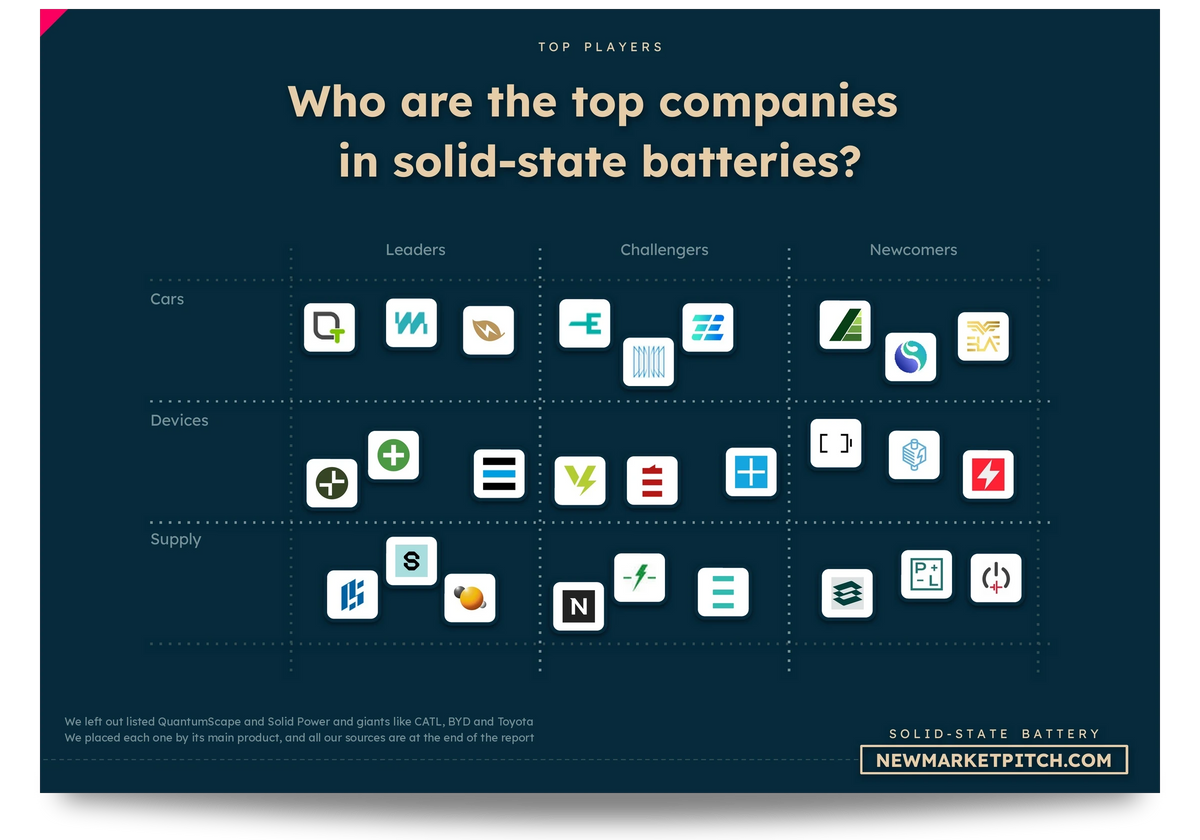
In our research about solid-state batteries, we turn what is vague and complex into simple, useful visuals. Market maps like this one show you at a glance where every startup stands.
Is funding for solid-state battery startups really rising?
Yes, solid-state battery startups have raised more money in more deals this year to date than at the same point in recent years.
We counted 30 financings involving 28 companies and at least $498M this year to date. Over the same calendar months of 2025, there were 18 deals involving 17 companies and at least $101M. In the matching months of 2024, there were 20 deals involving 20 companies and at least $79M. Because the 2025 comparison contains fewer than 20 deals, we do not publish a growth percentage against it. Against the comparable 2024 period, deal count is up 50% and disclosed money is up 528%.
More fundraising still does not mean manufacturers have solved mass-market production. In February 2026, QuantumScape opened its Eagle pilot line, designed to produce test cells and help license manufacturing processes. QuantumScape is listed and sits outside our private-startup numbers, but its progress illustrates the engineering work happening alongside the funding surge. Investors are now writing much larger checks to a narrow group trying to build batteries at industrial scale.
Has solid-state battery funding already beaten all of last year?
Solid-state battery startup funding has already topped the entire previous calendar year in both disclosed money and deal count.
Even before the current calendar year closes, private solid-state battery deals and disclosed capital have passed their full-year 2025 levels. The complete 2025 calendar year produced 21 deals and at least $238M. This year's deal count is already 143% of the full-year 2025 count, and its disclosed money 209% of the full-year 2025 amount. That is a partial year compared with a complete year, not a claim about the final result of 2026.
But beating a previous full year does not mean sales or production have taken off. Blue Current raised $81M in a Series D+ in December 2025 and later reported pilot-cell output. An even bigger Chinese Series D+ followed in February 2026. Those rounds pay for long engineering efforts; they are not evidence of recurring customer sales. Beating the previous full year is meaningful, even if a few enormous deals have done much of the work.
Is solid-state battery funding growing every quarter?
No, solid-state battery funding keeps jumping between quiet quarters and big funding bursts.
The current quarters tell the story. Q1 2026 had 10 deals and at least $308M, Q2 2026 had 6 deals and very little disclosed capital, and Q3 2026 had 9 deals and at least $145M. Q4 2026 is still partial, with 5 deals and at least $43M. The small published Q2 total does not mean startups stopped raising money; many deals kept their amounts private. It means the published-dollar record is volatile.
The earlier year had its own sudden jump. Q4 2025 had 9 deals and at least $175M, compared with 4 deals and at least $30M in Q3 2025. A large February 2026 financing greatly affected the opening quarter's reported total. Big battery projects raise money in bursts, usually when they need to pay for the next expensive stage.
The table below shows the number of deals and the disclosed amounts for each quarter since Q1 2024.
| Period | Deals | Capital |
|---|---|---|
| Q1 2024 | 11 | $59M+ |
| Q2 2024 | 1 | $0 |
| Q3 2024 | 4 | $1.7M+ |
| Q4 2024 | 4 | $19M+ |
| Q1 2025 | 7 | $31M+ |
| Q2 2025 | 1 | $1.4M |
| Q3 2025 | 4 | $30M+ |
| Q4 2025 | 9 | $175M+ |
| Q1 2026 | 10 | $308M+ |
| Q2 2026 | 6 | $2.1M+ |
| Q3 2026 | 9 | $145M+ |
| Q4 2026 (partial) | 5 | $43M+ |
"+" means at least: some round amounts were not disclosed. A $0 means no public amount, not no money raised.

Your time is limited. In our market report about solid-state batteries, we put numbers on each part of the market, so you can see where it makes sense to focus.
Are solid-state battery startups raising bigger rounds now?
Solid-state battery startups are raising much bigger disclosed rounds this year than at the same point two years ago.
The median disclosed round is $15.4M this year to date, up 409% from $3.0M in the same months of 2024. The matching 2025 median was $6.3M, but that smaller sample is not strong enough for a reliable growth rate. Only 12 of this year's deals reported an amount, representing 40% of transactions. The median therefore describes visible prices, not every undisclosed round.
A bigger battery company must prove it can make dependable cells repeatedly. Nissan partnered with LiCAP on dry electrodes in August 2025, while Factorial announced a September 2026 agreement with Mitsui Kinzoku to industrialize its battery materials supply. Those publicly described milestones illustrate why financing needs can expand when a company goes beyond small laboratory cells. They do not imply that every large round is justified. Public round sizes have climbed, even if the undisclosed checks could tell a different story.
How many $100M solid-state battery rounds happened this year?
Only 2 solid-state battery rounds reached $100M or more this year, so these giant checks are still rare, yet they can change the whole year's total.
This year to date, 2 deals of $100M or more brought in at least $377M: QingTao Energy's $277M Series D+ in February 2026 and INX Technology's $100M+ Series B in August 2026. Only QingTao Energy's round went above $100M. The same months of 2025 and 2024 had no deal of that size. With so few giant deals, such checks remain exceptional.
Battery manufacturers are preparing to spend heavily on production lines. Samsung SDI has described plans to bring its SolidStack technology into production in 2027. In September 2026, Factorial announced a materials-development agreement with Mitsui Kinzoku to help industrialize its all-solid-state cells. Samsung SDI is an established group and Factorial now raises money on the stock market, so neither appears in our private deal totals, but their commitments show the scale of equipment and manufacturing expertise the sector requires. Large startup rounds have become possible; they are not yet representative of the market.
Can small solid-state battery startups still raise seed money?
Yes, small solid-state battery startups are still getting seed rounds, even while larger companies take most published funding.
We tracked 11 seed deals this year to date, representing 37% of all reported rounds, with at least $7.4M in disclosed financing. In the matching period of 2024, there were also 11 seed deals, accounting for 55% of rounds and at least $8.9M. Seed financing remains visible, while later stages have attracted a much greater share of capital. That does not prove fewer founders are getting started: the seed counts match.
New materials startups still have a way in. Yuanqi Membrane Innovation raised a Seed round of undisclosed amount in October 2026 for its composite solid-electrolyte membranes. TaiSan, meanwhile, is developing solid electrolytes for sodium battery applications, where smaller vehicle and portable-power markets may allow different development pathways. Neither company needs to follow the exact path of a car-battery factory. Founders can still get started, but getting the next big check to build a factory is much harder.

In our document detailing everything you need to know about solid-state battery, we always try to gather several sources and make estimates that make sense, so you can work with solid numbers.
Are investors putting more money into established battery startups?
Investors are putting most disclosed solid-state battery money into later-stage companies, leaving early rounds far behind in dollars.
Among deals with a named stage, later-stage financings accounted for 38% this year to date, compared with 11% in the same period of 2024. Later-stage rounds took 92% of disclosed funding this year, compared with 19% in the matching 2024 period. This year's 8 Series B deals raised at least $160M, while the single Series D+ round accounted for 56% of disclosed capital. Seed and Series A rounds continue, but they no longer dominate the dollar picture.
A lab test might win an early check. Making thousands of consistent cells usually demands much more money. In 2026, Blue Current reported operating a pilot line, while Mercedes-Benz had road-tested an EQS with Factorial cells in 2025. Mercedes-Benz is an automaker, not a private startup in the deal totals, and its test cars are not equivalent to a startup's factory line. But they illustrate what larger companies and their customers now expect: cell-level performance, repeatable manufacturing and integrated validation.
The table below shows the latest stage distribution and disclosed capital.
| Stage | Deals | Capital | Capital share |
|---|---|---|---|
| Series D+ | 1 | $277M | 56% |
| Series B | 8 | $160M+ | 32% |
| Series A | 5 | $30M+ | 6% |
| Series C | 1 | $17M | 3% |
| Seed | 11 | $7.4M+ | 1% |
| Unknown | 4 | $5.6M+ | 1% |
| Growth | No deal | - | - |
Capital share is the share of disclosed capital. Early- and later-stage shares elsewhere refer only to deals with a named stage.
Are investors still funding fully solid-state battery cells?
Yes, investors still fund fully solid-state battery developers more often than hybrid makers, though hybrid projects attract more money.
All-solid-state cell developers recorded 9 deals involving 9 companies and at least $117M this year to date, representing 30% of deals and 23% of disclosed capital. The same category had 8 deals in the comparable part of 2025 and 8 deals in the equivalent 2024 window. Fully solid cells have attracted a steady stream of deals, not just a sudden burst.
INX Technology's $100M+ Series B in August 2026 gives the current category a large financing anchor. Elsewhere, BMW announced in May 2025 that it had begun operating an i7 test vehicle with Solid Power all-solid-state cells. Nissan said its in-house all-solid-state pilot line began operating in January 2025. Both BMW and Nissan are established automakers, while Solid Power is listed, so these programs do not enter the private deal series. The work shows why fully solid cells still attract investment despite the manufacturing hurdles. The category is still active; it simply no longer takes the largest share of announced funding dollars.
Are hybrid solid-state batteries getting most of the money?
Hybrid solid-state battery startups now collect most disclosed money, mainly because a few companies raised giant rounds.
Hybrid cell developers recorded 7 deals involving 6 companies and at least $309M this year to date. Hybrid developers made up 23% of deals but 62% of disclosed capital. The same period of 2024 included 2 hybrid deals, while the same period of 2025 included 3 deals and at least $8.3M. The hybrid category's biggest financing explains much of its dominance in publicly reported dollars.
There is a practical difference between hybrid and fully solid cells. Genuine hybrid solid-state batteries use a functioning solid-electrolyte phase while retaining some liquid or gel components. Such designs can offer a bridge toward commercialization without facing every hurdle of an entirely solid interface at once. Toyota, for one, is pursuing a sulfide all-solid-state route with materials suppliers. That is why the funding lead does not tell us which chemistry will ultimately win. The funding trend shows where exceptionally large startup checks went, not which technology will produce the cheapest, longest-lived battery.

Our report covering the solid-state battery market gets updated several times a month, so you always get the latest view of where things stand.
Are solid-state electrolyte makers losing out on funding?
Solid-state electrolyte makers are still getting funded, but the biggest checks go to startups producing whole battery cells.
This year to date, sulfide electrolyte startups recorded 6 deals and at least $17M, oxide electrolyte developers recorded 3 deals and at least $33M, and polymer electrolyte developers recorded 4 deals and at least $7.4M. The manufacturing-and-process category added 1 deal worth $14M. In contrast, hybrid cell developers took at least $309M and all-solid-state cell developers at least $117M. A membrane producer usually needs a different budget from a company building an entire battery factory.
In January 2026, Idemitsu said it had started building a larger solid-electrolyte pilot facility. In October 2025 InnoEnergy backed Qkera's ceramic membrane process, while Nissan's dry-electrode work with LiCAP targeted the speed and efficiency of battery manufacturing. These developments show that processing and materials are commercially important even when they do not dominate venture funding. The biggest reported checks still go to companies making whole cells, even though electrolyte suppliers remain essential.
Is China's share of solid-state battery funding growing this year?
Yes, China's share of solid-state battery startup funding has grown a lot: 80% of deals this year, against 45% in the same months of 2024.
Chinese companies recorded 24 deals involving 22 startups and at least $456M this year to date. That represents 80% of all deals and 92% of disclosed capital. In the same calendar period of 2024, Chinese companies recorded 9 deals, or 45% of the market's deal count. We can see the shift without forcing a growth percentage out of the smaller 2025 sample.
INX Technology, Yaoshi Lithium and LionGo New Energy show how Chinese funding reaches both cell makers and materials specialists. Asia-Pacific overall recorded 25 deals and at least $473M this year to date. The global engineering field is broader: Toyota and Idemitsu are developing a Japanese sulfide-electrolyte chain, while Samsung SDI is advancing SolidStack in South Korea. Those incumbents are not Chinese private startups and do not belong in our financing total. Chinese startups lead the financing data, while serious battery development continues in several other countries.

In our research about solid-state batteries, we look at what the winners do differently, so you can learn from the best instead of guessing.
Are U.S. solid-state battery startups falling behind China?
U.S. solid-state battery startups are still raising money, but Chinese developers have pulled far ahead this year.
We counted 3 American deals involving 3 companies and at least $19M this year to date, equal to 4% of disclosed capital. In the comparable period of 2024, U.S. startups had 4 deals and $36M, or 46% of disclosed capital. In the comparable 2025 period, they had 2 deals and at least $4.6M. The difference is stark, although a small U.S. deal sample cannot predict every company's future.
Adden Energy's $17M Series B in September 2026 shows that U.S. solid-state cell developers can still raise meaningful rounds. Other U.S. work includes QuantumScape's Eagle pilot line and the listed Solid Power's test program with BMW. The DOE's October 2026 Battery Manufacturing Accelerator also targets the difficult transition from laboratory discovery to production. These efforts matter, but they are different from completed private startup financings. The current venture funding race favors China; the U.S. has not stopped competing in technology development.
Are European solid-state battery startups missing the funding boom?
European solid-state battery startups are getting little of this year's disclosed money, even as European factories and test programs advance.
European startups completed 2 deals and raised at least $5.3M this year to date, compared with 4 deals and $23M in the comparable part of 2024. This year's European share was 1% of disclosed capital; it was 29% in the comparable 2024 period. With so few deals, a large European announcement could quickly change the published total.
There is still substantial work underway in Europe. Renault Group's Ampere signed a joint development agreement with Basquevolt in February 2026 to validate lithium-metal battery technology for vehicles. ProLogium began construction of its French factory in the same month. Britain's TaiSan announced funding for sodium cells with a solid-electrolyte approach, while Germany's Qkera has continued developing ceramic membranes. These projects are at different stages, and the industrial investments are not counted as startup venture rounds. Europe is not technically shut out; the weakness is in the number and size of equity financings reaching independent European startups this year.
Are more investors now backing solid-state batteries?
More investors are turning up in solid-state battery deals this year, without any one named lead dominating the rounds.
We identified 62 unique participating investors this year to date, compared with 25 in the comparable period of 2025 and 26 in the corresponding 2024 period. There are 18 unique named lead investors in this year's data, compared with 12 in the same 2024 period. No named lead investor led multiple deals during this year's observation window. Only 50% of deals named a lead, so no investor has enough visible activity here to claim control of the market.
Puhua Capital comes first among lead investors only because it led INX Technology's $100M+ Series B in August 2026, its single lead this year; that figure is the size of the round, not Puhua's own check. The backers have little in common. The Xiaomi Yangtze River Industry Fund led Heyuan Lichuang New Energy's Series A in June 2026, while Oriza Seed led Tianshi Kefeng's Seed round in May 2026. More names appear in funding announcements, and they are backing quite different businesses.

In our market report about solid-state batteries, we don't want to repeat what boring consulting reports say. Instead, we show you the real and latest market signals that matter.
Are new solid-state battery startups still getting funded?
Yes, new solid-state battery companies can still raise their first financing, although first-round funding remains small.
We identified 5 first financings this year to date, accounting for 17% of deals and at least $5.6M. The comparable 2024 window contained 5 first financings and at least $2.7M, while the corresponding 2025 window contained 1 first financing with no public amount. For 3 current deals, we could not verify whether they were first financings or follow-ons. This is a count of identifiable first rounds, not every startup founded.
Company ages tell a similar story. Among companies funded this year, 64% were founded in 2022 or later. New companies still manage to raise money, even while mature battery projects take the largest checks. Qkera's university spinout route and BTRY's work on ultra-thin microbatteries illustrate the kinds of specialized technologies that can attract seed support without immediately building an automotive gigafactory. The evidence rejects the idea that new founders have been excluded. It also shows that first funding and the much larger cost of commercial production are separate challenges.
Are solid-state batteries finding uses beyond electric cars?
Solid-state batteries are already being built for sensors, power tools and stationary storage as well as cars.
Our funding categories describe battery chemistry rather than the product it powers, so we cannot say what share of deals went to wearables or storage. The company plans are easy to see. Blue Current says it is developing products for stationary storage as well as mobility. TaiSan's July 2026 announcement described sodium cells for e-bikes, scooters and power tools. BTRY's November 2025 seed release focused on ultra-thin cells for sensors, connected labels and wearables.
Publicly traded Ilika offers another benchmark outside the startup totals: in March 2026 it reported its first commercial delivery of Stereax electrodes to Cirtec Medical for microbattery manufacture. Samsung SDI also displayed a pouch-type all-solid-state sample aimed at physical AI applications during 2026. Those examples make it clear that cars are only one possible market for solid-state cells. Smaller devices can value thinness, safety and extreme-temperature performance differently from a car maker. What that means for funding will vary from one product to the next.
Are solid-state batteries finally ready for real cars?
Not yet: automakers are testing solid-state batteries in real cars, but mass-market production remains unproven.
BMW announced in May 2025 that it was testing a BMW i7 fitted with Solid Power all-solid-state cells. Mercedes-Benz said in September 2025 that its Factorial-equipped EQS completed a long-distance road demonstration. Stellantis reported in June 2026 that it had integrated Factorial cells into a Dodge Charger Daytona development vehicle for road testing. These public statements are evidence of engineering progress, not proof of commercially profitable battery production.
Nissan's operating pilot line and Factorial's 2026 work with materials partner Mitsui Kinzoku show another step: preparing manufacturing before mass-market cars reach customers. These programs stay out of our equity totals because they are not private funding rounds. These milestones give investors more real-world evidence, although no single test drive explains the rise in funding. The hard part is still making reliable cells again and again on a production line.

Learning from others' mistakes is the cheapest lesson there is. In our document detailing everything you need to know about solid-state battery, we look at what broke startups before you, so you don't repeat it.
Can Japan still challenge China on solid-state batteries?
Japan can still challenge China in solid-state battery manufacturing, despite China's lead in startup financing.
Idemitsu announced in January 2026 that it had started construction of a large solid-electrolyte pilot facility to support Toyota's all-solid-state program. Toyota and Idemitsu have targeted commercialization in 2027-2028. Nissan said in August 2025 that its pilot line had begun operating earlier that year and announced a partnership with LiCAP to improve dry-electrode manufacturing. These are concrete industrial steps, not simply battery research presentations.
Our financing totals include independent startups, not the spending of Japan's listed manufacturers. Japan does not appear among the current leading countries in these private financing totals, while Chinese startups lead the reported deal flow this year. Both things can be true at once. Japan's large manufacturers can spend internally or with partners without creating a startup financing event. A country can be serious about the technology without showing up in a list of startup equity rounds. Japan's production-readiness programs deserve attention even when the private funding league table is dominated elsewhere.
Could solid-state battery funding drop again soon?
Yes, solid-state battery funding could drop if the next giant factory rounds fail to materialize.
The risk starts with the giant checks. This year to date, 2 financings of $100M or more accounted for at least $366M, while the capital raised excluding rounds above $50M was at least $121M. Just 40% of current deals disclosed an amount. Q2 2026 had very little publicly priced capital, showing how hidden round amounts and the timing of big financings can create sharp quarterly swings.
Now factories have to prove they can deliver. QuantumScape's 2026 SEC report described challenges in output consistency, throughput, reliability and pressure management, despite progress on its production process. The DOE's October 2026 Battery Manufacturing Accelerator was explicitly designed to help emerging technologies cross the gap to domestic manufacturing. Those unresolved factory problems explain why the funding path is uncertain after the first big check, even as the technology keeps advancing. An industry that depends on a small number of enormous financings can look weaker quickly if manufacturing milestones slip, even as laboratories and pilot lines continue operating.
So, what are the solid-state battery funding trends right now?
Solid-state battery funding is rising this year, with bigger rounds and more funded startups, but China and a few large deals dominate.
We tracked 30 deals and at least $498M this year to date, compared with 18 deals and at least $101M in the matching period of 2025 and 20 deals with at least $79M in the matching 2024 period. QingTao Energy leads this year's financing by company and largest deal, with its Series D+ in February 2026. The latest total has already surpassed the entire preceding calendar year, but large financings account for much of the difference.
The biggest change is where the large checks are going. Later-stage rounds dominate disclosed money, hybrid cell developers lead in dollars, and all-solid-state developers remain active in deal count. China leads current startup financing while Europe and the U.S. pursue a mixture of smaller private rounds and large industrial programs. The quarterly sequence warns against treating the funding boom as a steady monthly trend, and the manufacturing evidence warns against confusing a successful pilot with profitable mass production.
The table below shows what we found.
| Question | Answer |
|---|---|
| Is funding activity genuinely stronger now? | Yes, the startup deal flow is clearly larger. We tracked 30 deals this year to date. The comparable 2025 period contained far fewer transactions. |
| Has the market passed a full prior year? | It has already cleared the preceding calendar-year total. Current disclosed capital equals 209% of full-year 2025 funding. This is still a partial-year figure, not annualized. |
| Is the boom more than one year? | The business has changed across several years, though unevenly. The comparable 2024 period had 20 solid-state battery deals. Giant checks still make year-to-year dollar totals jump sharply. |
| Did every quarter show stronger funding? | No, large financings arrived in uneven bursts throughout the year. Q2 2026 recorded 6 deals with little disclosed money. Hidden amounts and giant checks make quarterly comparisons difficult. |
| Did a breakthrough quarter drive enthusiasm? | The capital jump became visible before this year began. Q4 2025 logged at least $175M in funding. That set up another exceptionally large following quarter. |
| Are disclosed venture checks now substantially bigger? | Yes, the typical reported battery round is much bigger. The current disclosed-round median stands at $15.4M this year. Private amounts could still change our view of typical checks. |
| Are nine-figure transactions the new normal? | No, they remain unusual in solid-state battery financing. Just 2 current deals reached $100M or more. A small number of issuers dominate announced capital. |
| Are seed rounds disappearing from batteries? | No, new battery chemistry teams are still getting checks. This year includes 11 seed rounds across the market. Much larger later-stage rounds take most of the dollars. |
| Do hybrid batteries own the investment wave? | Hybrid developers collect most reported money, but have not won. Hybrid developers' share reached 62% of disclosed capital this year. Fully solid-state cell makers still lead in deal count. |
| Is China leading only by deal count? | China leads both the number of deals and dollars. Chinese startups recorded 24 deals this year to date. Big groups in Japan and Korea still build their own lines in-house. |
| Does strong funding imply production is solved? | No, industrial scale-up remains a demanding technical task. The current year includes 2 deals of $100M or more. Raising money does not guarantee consistent or economical battery production. |

If you build or invest in the solid-state battery market, you need to know which business models pay off now and which ones are fading. That's why our report covering it has a whole section on it.
Our methodology
Our data runs through November 14, 2026. We then reviewed this article and updated its answers on November 17, 2026, the date shown under the title. We examine financings from January 2024 through that date. The main comparison uses January 1, 2026 to November 14, 2026, against January 1 to November 14 of 2025 and 2024. Full-year 2025 and 2024 totals are kept separate and used only where a full-year comparison is explicitly stated. This year's result is year to date, not a complete calendar year, and we never annualize it.
We count private-company equity financings of at least $300K. Debt, grants, loans, unconverted convertibles, SAFEs and public offerings are excluded. Our solid-state battery scope covers independent producers of all-solid-state and genuinely hybrid solid-electrolyte cells, dedicated electrolyte materials and membranes, and manufacturing technologies designed chiefly for those cells. We include relevant sodium battery specialists and borderline electrolyte approaches rather than silently dropping them, but exclude generic battery companies whose solid-state work is incidental.
Every company counted is a startup under our working definition: independent, founded in 2000 or later, built to grow quickly around a novel technology or product, backed by founders or outside financiers, and private or listed within the past five years. Recently acquired startups remain eligible within three years of an acquisition. Diversified automakers and longstanding public battery manufacturers appear as industrial context only.
We merge duplicate reports and count each separate financing once. Undisclosed transactions are included in deal counts, but not assigned guessed amounts, making some funding totals minimums. Stages follow the named Seed, Series A, Series B, Series C and Series D+ categories, with unknown stages kept separate. Our technology grouping distinguishes complete cell developers from electrolyte specialists and process suppliers. Regions are based on company headquarters, not customers or factories.
Rounds confirmed by a company announcement, a press article or a regulatory filing are counted in full. Where no article exists, a round is counted only when at least two recognised databases agree on its date (within one month) and amount (within 5%), and it is marked as low confidence; a round found in a single database stays in the company's history but is left out of totals. For companies that have raised more than $100M, every round counted is backed by an article.
We use company announcements, regulatory documents and reliable press first, with database records only under the rule above. The same-period 2025 comparison has fewer than 20 deals, so we publish its deal counts and disclosed totals without percentage changes. The same-period 2024 and complete-year comparisons have adequate samples for the published comparisons. Quarter totals use the actual deal dates, and Q4 2026 remains partial.
A press article may report far more money in the battery industry because it includes factory investment, listed manufacturers, state grants or financing outside our solid-state market definition. That is not the same as qualifying private-startup equity. A recent quarter may also look weak because completed deals have undisclosed amounts or later public reporting. We retain these distinctions so the trend reflects documented startup financings rather than optimistic estimates.
Key sources include Blue Current's pilot-line progress and previously announced financing., QuantumScape's 2026 Eagle pilot line and intended production role., QuantumScape's continuing scale-up risks and commercialization roadmap., Idemitsu's 2026 construction of a solid-electrolyte pilot facility., Toyota and Idemitsu's solid-electrolyte mass-production partnership., Nissan's 2025 dry-electrode partnership and operating pilot line., BMW's solid-state i7 test program., Mercedes-Benz solid-state EQS demonstration drive., Stellantis' June 2026 Factorial-powered test vehicle., Samsung SDI's SolidStack roadmap and sample demonstration., DOE's October 2026 battery manufacturing initiative., InnoEnergy's early backing of Qkera's ceramic membranes., TaiSan's sodium solid-electrolyte technology and July 2026 plans., BTRY's ultra-thin solid-state battery applications and seed raise., Ampere and Basquevolt's 2026 joint development agreement., ProLogium's 2026 construction start in France., Ilika's first commercial Stereax electrode delivery in 2026., DOE's identified battery manufacturing scale-up needs., and Factorial and Mitsui Kinzoku's September 2026 joint development agreement..

In our research about solid-state batteries, we like to show you the big picture. We know your time is precious, so we make every page quick to read and packed with as much learning as possible per minute.
Written by the New Market Pitch teamWe track new markets so founders and investors can move faster. About us