How big is the solid-state battery market before cars?
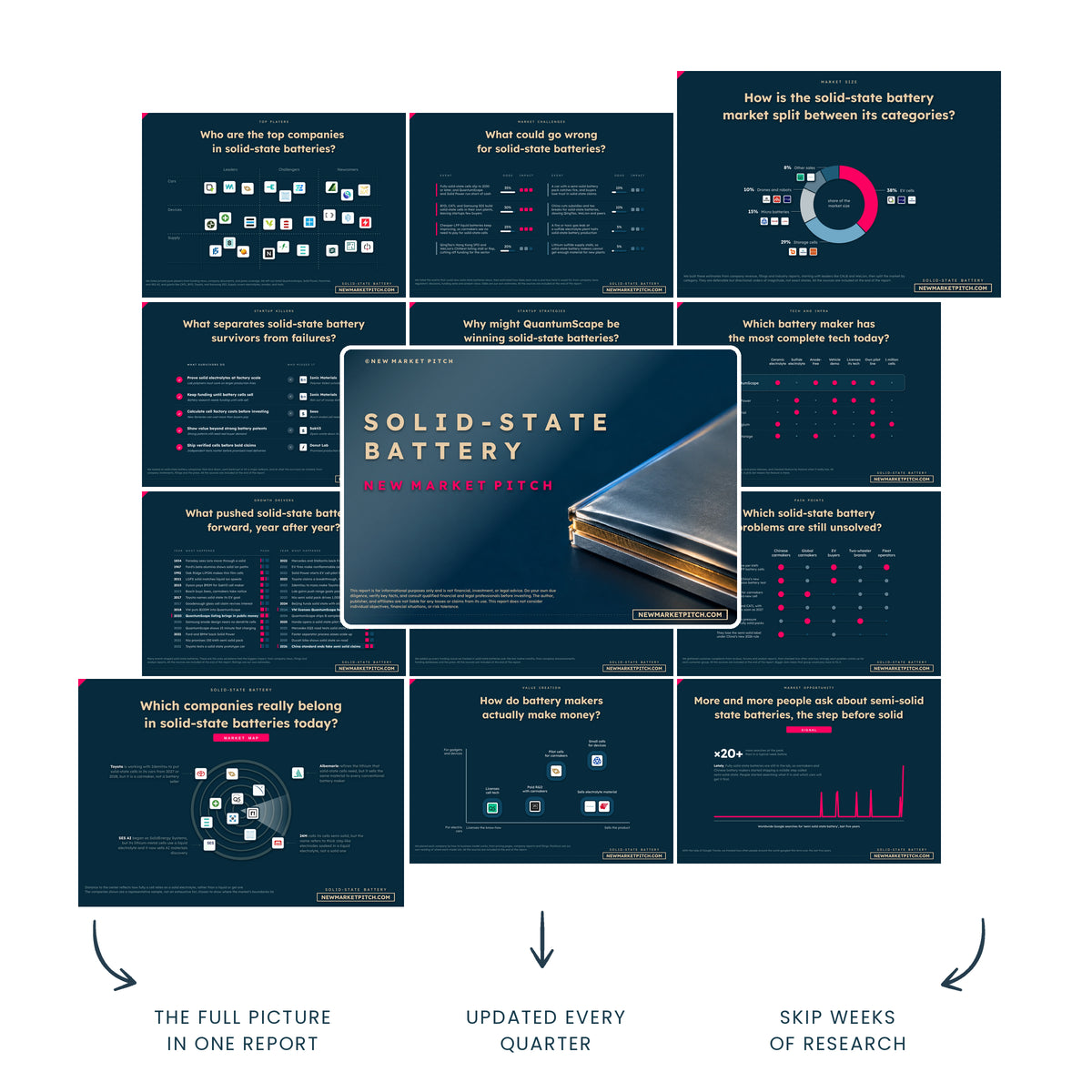
Whether you're building or investing in the solid-state battery market, our report covers everything you need to know: the players, the money, and what's coming next.
Summary
The solid-state battery market is already commercially real before mass-market electric cars, but its size is easy to exaggerate. The broader market is estimated at $2.3 billion in 2026, while revenue from strictly all-solid-state batteries outside automotive applications remains much smaller and has no reliable consolidated estimate.
The biggest distortion comes from semi-solid batteries. EVTank reported 8 GWh of broadly defined solid-state shipments in 2025, but hybrid solid-liquid designs accounted for most of that volume. Its 2030 forecast of 607.2 GWh still assumes that approximately 80% of shipments will use something other than fully solid-state technology.
Solid-state batteries were commercial long before the electric-car race. TDK has sold miniature ceramic batteries for low-power electronics, while Blue Solutions deployed lithium-metal-polymer batteries in hundreds of electric buses. Both prove that the technology can work commercially, although neither establishes a large market for next-generation cells.
Wearables could eventually deliver millions of customers. TDK's experimental 1,000 Wh/L battery material points toward better batteries for earbuds, hearing aids and smartwatches, but the gap between a laboratory material breakthrough and millions of qualified consumer cells remains considerable.
Medical devices offer a more immediate premium market. Ilika and Cirtec moved into commercial electrode deliveries in 2026, yet Ilika's annual revenue was only £112,800. The commercial opportunity is credible because implant manufacturers value miniature, reliable batteries, even when annual volumes are relatively small.
Drones may become the first substantial revenue opportunity for larger specialized cells. Factorial reported more than 30% additional flight range in early testing with Tulip Tech and secured an initial aerospace battery order in July 2026. Repeat deliveries and recognized revenue are still the missing evidence.
The drone economics are attractive without requiring automotive-scale production. At an illustrative $300/kWh, shipping 500 MWh annually would produce $150 million in cell revenue, while a $1 billion business would require approximately 3.33 GWh. These are scale scenarios, not reported sales.
Manufacturing progress is ahead of the revenue figures. ProLogium reported more than 2.4 million cumulative cell shipments, yet public disclosures do not establish equivalent annual GWh volumes or recognized battery revenue. Meanwhile, global lithium-ion manufacturing capacity already exceeds 4 TWh.
The financial statements of leading developers remain a reality check. Solid Power reported $21.7 million in combined revenue and grant income in 2025, Ilika remained below £0.12 million in annual revenue, and QuantumScape was still pre-revenue. Large investments and factory plans should not be confused with recurring commercial battery sales.
The strongest pre-car opportunities are applications where battery performance commands a premium: medical implants, specialized drones, aerospace systems and eventually robotics and wearables. Hundreds of millions of dollars in specialized annual sales look plausible as production expands, but a verified multibillion-dollar market for strictly non-automotive all-solid-state cells has not yet emerged.

Written by the New Market Pitch teamWe track new markets so founders and investors can move faster. About us

Your time is limited. In our report covering the solid-state battery market, we put numbers on each part of the market, so you can see where it makes sense to focus.
Is there already a real solid-state battery market without electric cars?
Yes, solid-state batteries already have a commercial market outside passenger cars, but today's sales are concentrated in small electronic devices and specialized applications. The much bigger market promised by next-generation batteries is still taking shape.
Grand View Research estimates the global solid-state battery market at $1.6 billion in 2025 and $2.3 billion in 2026. EVTank separately reports that worldwide solid-state battery shipments reached 8 GWh in 2025, up 51.9% from the previous year. Those numbers look impressive, but they include different battery technologies and end markets. Neither gives us a clean measure of fully solid-state batteries already being sold outside cars.
The clearest commercial examples are quite different from the batteries being developed for electric vehicles. TDK has sold miniature ceramic batteries for electronic devices, Blue Solutions deployed lithium-metal-polymer batteries in electric buses, and companies such as Ilika and Factorial are moving into medical devices and drones.
The question is how much business exists beyond those early applications. We can already identify working products, manufacturing facilities and paying customers. What we cannot yet identify is a large, independently verifiable revenue base for next-generation all-solid-state cells.
How big is the solid-state battery market today?
The global solid-state battery market is estimated at around $2.3 billion in 2026, but the actual market for fully solid-state batteries outside cars is considerably smaller. There is no reliable published total for that narrower business.
Grand View Research expects the broader market to reach $15.7 billion by 2033, implying compound annual growth of approximately 31.8% from 2026. That forecast includes a much wider range of technologies and applications than the small market we are trying to measure.
Company financial statements show why the distinction matters. Solid Power reported $21.7 million in combined revenue and grant income in 2025, largely from development partnerships. Ilika recorded just £112,800 in revenue for its financial year ending April 2026, including early commercial manufacturing activity.
We cannot use those figures to calculate total industry revenue. Large manufacturers such as TDK do not separately disclose all their solid-state battery sales, and several smaller producers are private. Still, they give us a useful reality check: the most visible next-generation developers are operating at a completely different commercial scale from the multibillion-dollar market forecasts.
| Market measurement | Latest figure | What it measures |
|---|---|---|
| Broad solid-state battery market, 2025 | $1.6B | Grand View Research estimate |
| Broad market, 2026 | $2.3B | Grand View Research estimate |
| Broad market, 2033 | $15.7B | Industry forecast |
| Forecast growth, 2026–2033 | 31.8% annually | Broad-market CAGR |
| Worldwide solid-state shipments, 2025 | 8 GWh | EVTank, including hybrid designs |
| Shipment growth in 2025 | 51.9% | EVTank year-over-year increase |
| Strict non-automotive all-solid-state sales | Not disclosed | No reliable consolidated total |
| Global EV battery deployment, 2025 | About 1,200 GWh | IEA benchmark for scale |

In our research about solid-state batteries, we always try to gather several sources and make estimates that make sense, so you can work with solid numbers.
Are semi-solid batteries making the solid-state market look bigger?
Yes, semi-solid and hybrid batteries make the solid-state battery market look considerably more advanced than the fully solid-state industry actually is.
The difference comes down to what is inside the cell. A fully solid-state battery replaces the conventional liquid electrolyte with a solid material. Semi-solid and hybrid designs retain some liquid or gel components. They can still improve energy density, safety and battery performance, but their manufacturing requirements are different.
EVTank's 2026 industry assessment reported 8 GWh of global solid-state battery shipments in 2025, with hybrid solid-liquid batteries accounting for most of that volume. It projected 607.2 GWh of broadly defined solid-state shipments by 2030, with all-solid-state designs representing approximately 20%.
That works out to roughly 121 GWh of all-solid-state cells and 486 GWh of other designs in the 2030 forecast. Around four-fifths of the projected market would therefore remain outside a strict all-solid-state definition.
So a spectacular increase in reported solid-state shipments could happen without manufacturers having solved the much harder problem of producing fully solid-state cells cheaply and reliably at scale. The distinction gets lost surprisingly often in market forecasts.
If you want more recent data on this point, please see our latest solid-state battery market report.
Were solid-state batteries already commercial before the electric-car race?
Yes, fully solid-state batteries were already commercial products years before carmakers started promoting them as the next big breakthrough. The earliest successful batteries, though, were tiny.
TDK introduced its CeraCharge ceramic battery technology commercially in the late 2010s. Its surface-mounted battery measures approximately 4.4 × 3.0 × 1.1 millimeters and provides 100 microampere-hours at 1.5 volts.
That gives each cell an energy capacity of just 0.00015 watt-hours. To match the 60 kWh stored in a typical electric-car battery, we would theoretically need 400 million of them, ignoring packaging and electrical limitations.
CeraCharge was designed for real-time clocks, Bluetooth beacons, sensors and other low-power electronics. These products demonstrate that ceramic batteries can be manufactured and sold consistently, but they tell us relatively little about the economics of much larger cells.
There was also a commercial history in transportation. Blue Solutions developed lithium-metal-polymer batteries that powered hundreds of Bluebus electric buses over more than a decade.
That story took an important turn in September 2026, when Bolloré announced a proposal to permanently discontinue Bluebus production and refocus Blue Solutions on its next-generation battery strategy. The group cited severe pricing pressure, disappointing demand and insufficient manufacturing scale.
Bluebus had delivered approximately 700 electric buses to around 60 operators. That is enough to demonstrate years of practical operation, but the company still struggled to compete with established bus manufacturers.
More than a decade of real-world deployment, and still a niche business. It's a useful warning against treating technical success as proof of a scalable market.

In our market report about solid-state batteries, we don't want to repeat what boring consulting reports say. Instead, we show you the real and latest market signals that matter.
Could wearables become the first mass market for solid-state batteries?
Wearables could become the first consumer market to buy solid-state batteries in very large quantities, especially if manufacturers can use them to improve battery life without making devices bigger.
The opportunity is straightforward. Wireless earbuds, hearing aids, smartwatches and health-monitoring devices have very little room for batteries. A meaningful increase in energy stored per cubic millimeter would allow manufacturers to offer longer runtime or smaller products.
TDK made an important announcement in June 2024 when it reported developing a solid-state battery material with an energy density of 1,000 Wh/L. That was approximately 100 times the volumetric energy density of its conventional CeraCharge product. The company identified earbuds, hearing aids and smartwatches as possible applications.
But the reported figure concerned a newly developed battery material. It did not mean that millions of high-energy-density solid-state batteries were already shipping inside consumer devices. TDK still needed to develop the corresponding cell structures and manufacturing processes.
A battery manufacturer has to deliver millions of consistent cells, with acceptable lifetime, charging behavior and costs, before a major device brand will redesign an existing product around them.
Wearables offer a large potential customer base. We are still missing the high-volume product launches that would show this opportunity turning into substantial revenue.
Are medical devices a better early market for solid-state batteries than smartphones?
Medical devices are currently a more convincing early market for miniature solid-state batteries than smartphones because manufacturers can justify paying more for reliability, size and specialized battery performance.
Ilika's Stereax technology is a good example. Its miniature solid-state cells target implantable medical devices, including neurostimulators, monitoring systems and orthopedic applications.
The company spent several years transferring manufacturing processes to Cirtec Medical's facility in Lowell, Massachusetts. In 2025, the partners completed manufacturing process qualification. Ilika then received its first revenue-generating electrode purchase order in January 2026 and delivered the initial commercial-grade batch in March.
Ilika's financial results published in July 2026 showed annual revenue increasing from £73,500 to £112,800. That is growth of around 53%, but the revenue base remains extremely small.
Medical batteries can be economically attractive even when the quantities are modest. A miniature cell inside an implantable device can be more valuable to the customer than a similar battery in an inexpensive consumer gadget. Implant manufacturers also care intensely about battery stability and long operating life.
The drawback is the approval process. Medical manufacturers may need years of testing before changing a battery in a regulated product.
For now, medical devices offer a credible commercial niche with better prospects for premium pricing than enormous near-term shipment volumes. That's probably the more realistic starting point for miniature solid-state batteries.
If you want more recent data on this point, please see our latest solid-state battery market report.

In our document detailing everything you need to know about solid-state battery, we like to show you the big picture. We know your time is precious, so we make every page quick to read and packed with as much learning as possible per minute.
Are drones becoming the biggest opportunity for solid-state batteries before cars?
Drones are currently one of the strongest candidates for a meaningful solid-state battery market before passenger cars, and recent flight tests have produced some of the clearest evidence that customers could benefit.
Factorial's progress is worth following. In May 2025, the company shipped FEST lithium-metal battery cells to Canadian drone manufacturer Avidrone Aerospace for evaluation. In May 2026, it expanded its integration partnerships in the United States, Europe and South Korea.
In July 2026, Factorial and Dutch company Tulip Tech announced that initial drone flight testing had increased flight range by more than 30%, before further engineering optimization.
That improvement has an obvious commercial use. A longer-range drone can potentially cover more territory, carry out longer inspections or reduce the frequency of battery changes.
Factorial then announced its first commercial aerospace battery order from a US drone manufacturer later in July. The company's regulatory filings make an important distinction, however: the order covered products combining solid-state technology and liquid electrolytes, and it could be fulfilled partly using third-party manufactured cells.
Factorial's August 2026 shareholder letter also stated that it expected its first commercial revenue in 2027.
We now have a progression from battery evaluation to flight testing and an initial commercial order. That's encouraging. The industry still needs repeat orders, larger deliveries and independently demonstrated operating performance.
How much money could solid-state drone batteries actually generate?
Solid-state drone batteries could eventually generate hundreds of millions of dollars annually, but current commercial disclosures do not support treating that revenue as already established.
We can estimate the opportunity using three variables: battery capacity, annual shipments and selling price per kWh.
Consider a specialized 1 kWh drone battery sold at $300/kWh. Each battery would generate $300 in cell revenue. Selling 100,000 units annually would produce $30 million. Reaching one million units would bring revenue to $300 million.
Larger drones change the calculation quickly. A 5 kWh battery sold at the same price generates $1,500. At 100,000 annual units, that becomes a $150 million cell business.
These prices are illustrative assumptions rather than verified solid-state selling prices. Actual contracts would depend on chemistry, energy density, production volumes, qualification requirements and whether the supplier sells individual cells or complete packs.
Tulip Tech has reported pack manufacturing capability exceeding 100,000 units in a month, which gives some indication of what an established integration partner can handle. That figure represents existing manufacturing capability, not confirmed sales of Factorial batteries.
The calculations below show how much volume would be needed to build a sizable business.
| Annual battery packs | Capacity per pack | Assumed cell price | Annual cell revenue |
|---|---|---|---|
| 10,000 | 1 kWh | $300/kWh | $3M |
| 50,000 | 1 kWh | $300/kWh | $15M |
| 100,000 | 1 kWh | $300/kWh | $30M |
| 250,000 | 1 kWh | $300/kWh | $75M |
| 500,000 | 1 kWh | $300/kWh | $150M |
| 1,000,000 | 1 kWh | $300/kWh | $300M |
| 100,000 | 5 kWh | $300/kWh | $150M |
| 500,000 | 5 kWh | $300/kWh | $750M |

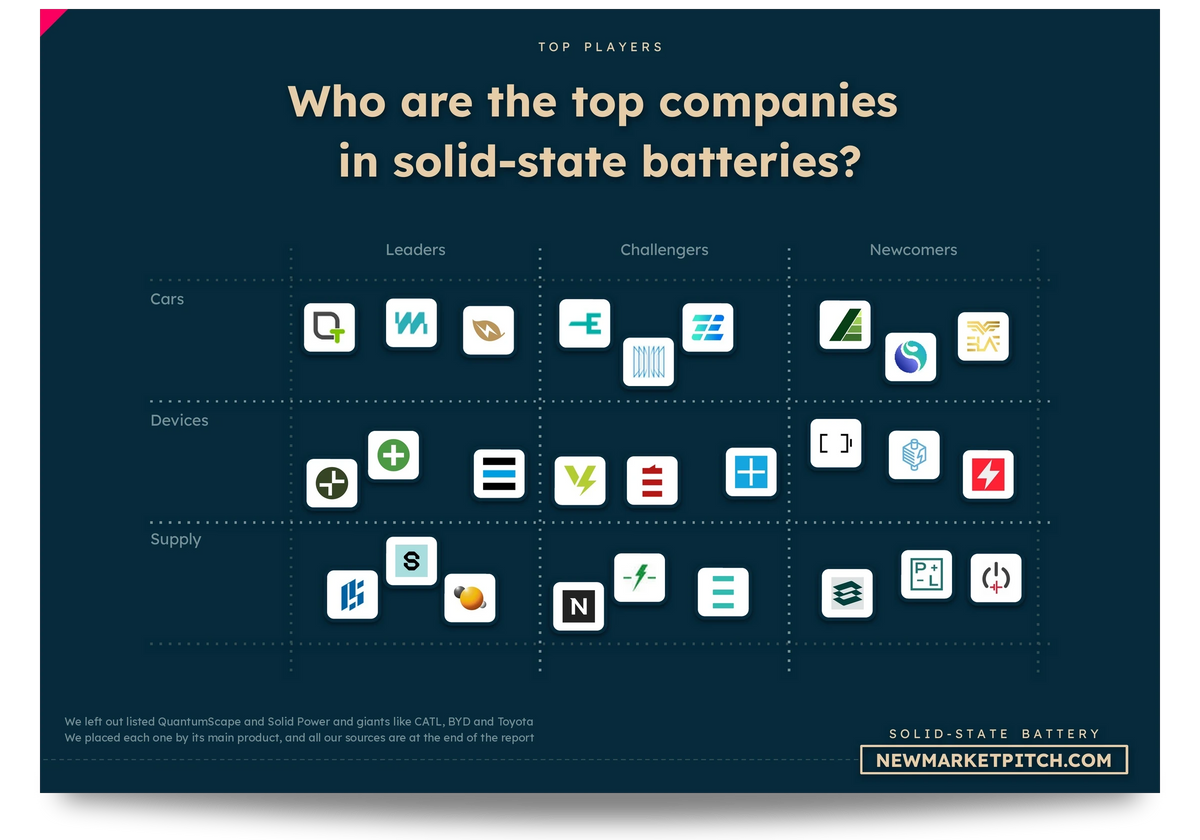
In our report covering the solid-state battery market, we turn what is vague and complex into simple, useful visuals. Market maps like this one show you at a glance where every startup stands.
Could military drones push solid-state batteries into mass production?
Military drones could become an important early market for solid-state batteries, especially for aircraft where longer flight time and lower battery weight are worth paying a premium for.
The strongest cases involve reconnaissance, surveillance and reusable long-range platforms. These drones may benefit substantially from lighter batteries, particularly when energy storage limits how far they can travel or how long they can remain airborne.
Factorial is already targeting this market. Its battery integration partnerships include KULR Technology, Tulip Tech and JRES, giving the company relationships across different aerospace and defense ecosystems.
The company has also attracted investment from IQT, which works with technologies relevant to US national security. That connection adds commercial credibility, although it does not establish any specific military procurement volume.
The opportunity is more selective than the headline military-drone market might suggest. Many inexpensive, expendable drones are designed around strict cost limits. Paying substantially more for an advanced battery makes little sense if the aircraft is used only once and additional range provides little benefit.
Reusable surveillance drones and specialized aircraft have a stronger economic case. Even there, customers will want dependable performance under repeated cycling, temperature changes, vibration and storage conditions.
Defense could help manufacturers reach meaningful production volumes earlier than consumer electronics. But the real opportunity is probably concentrated in expensive, reusable platforms, rather than the enormous quantities of cheap drones attracting so much attention. Publicly disclosed orders are still too limited to quantify this market.
If you want more recent data on this point, please see our latest solid-state battery market report.
Has solid-state battery production reached real industrial scale?
Solid-state battery production has reached commercial scale at a few manufacturers, but next-generation all-solid-state cells are still far behind conventional lithium-ion batteries in production volume.
ProLogium provides one of the better-documented examples. In July 2025, the Taiwanese manufacturer reported more than 2.4 million cumulative lithium-ceramic battery cell shipments since beginning production in 2013. More than 500,000 of those cells had come from its Taoyuan gigafactory during roughly 18 months of operation.
In May 2026, the company reported that cumulative shipments remained above 2.4 million, including more than 800,000 third-generation batteries produced at the Taiwan facility. ProLogium was also pursuing a public listing with an expected pre-money valuation of around $3.8 billion.
These shipment figures give us stronger evidence of manufacturing progress than factory announcements alone. Yet they still leave out two crucial details: average cell capacity and recognized battery revenue. Without those, we cannot reliably convert cumulative cell shipments into GWh or annual market value.
For comparison, the International Energy Agency reported that global lithium-ion battery manufacturing capacity exceeded 4 TWh by the end of 2025. China accounted for more than 80% of that capacity.
The gap is enormous. A solid-state manufacturer operating a plant measured in hundreds of MWh is still competing against a lithium-ion industry measured in thousands of GWh of annual manufacturing capacity.

Our research about solid-state batteries gets updated several times a month, so you always get the latest view of where things stand.
Why aren't solid-state batteries already inside most smartphones?
Solid-state batteries have not replaced conventional lithium-ion batteries in smartphones because manufacturers still cannot consistently offer better performance at a competitive price and production scale.
Lithium-ion technology has decades of manufacturing experience behind it. Battery suppliers already know how to make enormous numbers of cells with predictable performance, standardized quality controls and acceptable failure rates.
Solid-state designs introduce new manufacturing difficulties. Ceramic electrolytes can be challenging to process into larger cells, the interfaces between solid components must remain stable during cycling, and lithium-metal designs can face problems with mechanical stress and unwanted lithium growth.
That helps explain why TDK has an established business in miniature ceramic batteries while developing a separate high-energy-density product for more demanding applications.
Smartphone makers also have alternatives. Improvements in silicon-rich anodes, cell packaging and conventional lithium-ion chemistry can increase battery capacity without requiring an entirely new supply chain.
A solid-state battery with impressive laboratory energy density therefore has to beat a moving target. It must deliver enough practical improvement to justify higher costs, manufacturing risk and product redesign.
So far, the industry's most convincing advantages have appeared in smaller specialized markets where customers are more willing to pay for them.
Are solid-state battery companies making much money yet?
Most publicly visible next-generation solid-state battery developers are still making very little money from actual battery sales, even when their reported revenue looks healthier.
Solid Power reported $21.7 million in combined revenue and grant income in 2025, up from approximately $20.1 million in 2024. Of that 2025 total, $15.8 million came from collaborative non-government revenue, while government revenue and grant income contributed approximately $6.0 million.
The company also recorded an operating loss of $100.8 million. That is nearly five times its combined annual revenue and grant income.
Ilika shows a similar imbalance on a much smaller scale. For the financial year ending April 2026, it reported around £1.06 million in total income, including approximately £951,000 in grants. Actual revenue was only £112,800.
QuantumScape provides another comparison. Its 2025 Form 10-K described the company as pre-revenue, even though it incurred approximately $472.6 million in operating losses during the year.
These three companies are developing different technologies and following different commercialization strategies, so their numbers cannot be treated as representative of every manufacturer. Still, their combined financial picture is revealing.
Large amounts of research spending, strategic investment and customer-development work have not yet turned into large recurring battery sales. That's a hard fact to reconcile with claims that next-generation all-solid-state batteries are already a multibillion-dollar commercial industry.

In our market report about solid-state batteries, you will always find fresh funding data, taken straight from our own verified funding database.
Are solid-state battery factories being built before there are enough customers?
Yes, much of the solid-state battery industry's planned manufacturing capacity is still ahead of proven customer demand, particularly for large-format next-generation cells.
ProLogium has pursued an expansion strategy that includes a planned gigafactory in Dunkirk, France, supported by an approved French subsidy package of up to approximately €1.4 billion.
Solid Power has focused on producing electrolyte materials and transferring manufacturing technology to partners. Its relationship with SK On includes a pilot manufacturing line and technology-development work.
QuantumScape has placed greater emphasis on licensing and manufacturing partnerships than on building a fully integrated global network of battery factories. Factorial has promoted the ability of its FEST platform to use up to 80% of conventional lithium-ion manufacturing equipment.
These choices reflect different ways of managing the same risk. Battery makers need to show customers that they can manufacture consistently, but investing heavily in factories before securing long-term orders can be extremely expensive.
ProLogium's reported shipments offer evidence of operating production lines. By contrast, planned capacity, development agreements and subsidized construction projects tell us much less about near-term sales.
The industry's next manufacturing milestone should be judged by annual customer shipments, production yields and recurring orders. Factory capacity announcements have become almost too easy to make. Filling those factories with profitable customer orders is the real test.
If you want more recent data on this point, please see our latest solid-state battery market report.
Can solid-state batteries compete with lithium-ion on price?
Solid-state batteries can compete on value in specialized products, but conventional lithium-ion remains the stronger choice in markets where battery cost matters more than extra performance.
The scale advantage is substantial. According to the IEA's Global EV Outlook 2026, lithium-ion manufacturing capacity exceeded 4 TWh in 2025. Established battery manufacturers can spread their development costs across enormous production volumes while continuing to improve their products.
Solid-state manufacturers are working with much smaller factories, less mature production processes and often more expensive materials.
That makes the economics different across applications. A battery that extends a surveillance drone's range by 30% could be worth paying significantly more for. A battery that only marginally improves an inexpensive home sensor may struggle to justify a higher price.
Grid storage presents an even tougher challenge. Developers need to optimize the lifetime cost of stored electricity, and inexpensive lithium iron phosphate batteries already offer good cycle life, safety and manufacturing scale.
Solid-state technology has the best chance of succeeding first where specific performance advantages translate into higher product value. Competing directly against commodity lithium-ion cells will require much larger production volumes and significant cost reductions.

In our document detailing everything you need to know about solid-state battery, we look at what the winners do differently, so you can learn from the best instead of guessing.
How big could the solid-state battery market get before mass-market cars?
The solid-state battery market could become a substantial business before mass-market electric cars adopt the technology, although there is not yet enough evidence to support a reliable multibillion-dollar forecast for non-automotive all-solid-state cells alone.
The most promising markets have very different economics. Medical implants use extremely small batteries that may command premium prices. Wearables offer the possibility of millions of units, provided manufacturers can deliver at consumer-electronics costs. Drones need larger batteries and may pay more for improved endurance.
Robotics could eventually become another important customer. Mobile robots and humanoids need batteries that balance operating time, weight and safety. However, there are still few public examples of large-scale commercial solid-state battery deployments in robotics.
We can put the opportunities into perspective with a few calculations.
A supplier selling 10 million miniature batteries annually at $2 each would generate $20 million. Delivering 500 MWh of specialized drone batteries at $300/kWh would generate $150 million. Reaching $1 billion at that selling price would require around 3.33 GWh of annual cell shipments.
Robotics would need considerable deployment volume to reach similar numbers. An installed base purchasing one million replacement batteries of 2 kWh each annually would consume 2 GWh. At $200/kWh, that would generate $400 million in battery sales.
Those are illustrative scenarios, not current revenue or shipment forecasts. They show how battery capacity can matter more than the number of devices sold. Millions of microscopic sensor batteries may generate less revenue than a much smaller number of large aerospace batteries.
For this reason, drones and specialized industrial systems may produce meaningful revenue sooner, while wearables could eventually offer much greater unit volumes.
The most realistic route to a large pre-car market is the gradual combination of several applications rather than one immediate mass-market breakthrough.
How big is the solid-state battery market before cars, really?
The solid-state battery market is already commercially real without passenger cars, but the fully solid-state business remains small compared with the industry's multibillion-dollar forecasts. The broader market is estimated at approximately $2.3 billion in 2026, while the narrower market for genuinely all-solid-state batteries sold outside automotive applications still has no reliable consolidated revenue figure.
Looking across company shipments, financial reports and commercial deployments, we can already identify several genuine businesses. TDK has an established miniature ceramic battery product. ProLogium has shipped millions of lithium-ceramic cells over its manufacturing history. Ilika and Cirtec have started commercial medical-battery supply, while Factorial has progressed from aerospace testing to its first drone battery order.
Yet none of those examples establishes a large non-automotive market by itself. The reported 8 GWh of industry shipments in 2025 includes hybrid battery designs, and the financial statements of several leading next-generation developers still show modest revenue, substantial development spending or no commercial revenue at all.
The most promising opportunities before cars are specialized drones, implantable medical devices and premium miniature electronics. Robotics may become more important as mobile systems are deployed in larger numbers. These markets offer customers concrete benefits from lighter, safer or more compact batteries, even when production costs remain high.
There is also a cautionary example in Blue Solutions. More than a decade of electric-bus deployments did not prevent its associated bus manufacturer from proposing to discontinue production under competitive pressure. Technical success can bring customers without guaranteeing a scalable business.
Our assessment is that solid-state batteries can become a meaningful industry before mass-market electric cars adopt them, potentially supporting hundreds of millions of dollars in specialized annual sales as commercial production expands. But claims that strict non-automotive all-solid-state batteries already represent a multibillion-dollar market go beyond the verified evidence.
The first real winners may be companies supplying small, expensive batteries to customers who badly need better performance. The much larger opportunity will come when manufacturers can produce advanced solid-state cells cheaply enough for markets where price matters just as much as performance.
If you want more recent data on this point, please see our latest solid-state battery market report.

If you build or invest in the solid-state battery market, you need to know which business models pay off now and which ones are fading. That's why our report covering it has a whole section on it.
Our methodology
This analysis examines how big the solid-state battery market is before mass-market passenger-car adoption, separating established commercial products from next-generation technologies still moving through testing, qualification and early production. The central distinction is between the broadly reported solid-state battery market, which includes hybrid and semi-solid technologies, and the narrower market for genuinely all-solid-state batteries outside automotive applications.
We used a structured aggregation of recent evidence across six dimensions: market size and definitions, commercial adoption, company revenue, manufacturing scale, application-level economics and competition with conventional lithium-ion batteries. For each dimension, we gathered recent company disclosures, regulatory filings, institutional statistics, technical announcements and market research, assessed their relevance and limitations, and combined the strongest findings to establish a more reliable picture of commercialization.
For market sizing, we compared Grand View Research's 2025–2026 estimates and longer-term forecast with EVTank's 2025 shipment figures and 2030 technology mix projections. We distinguished monetary market estimates from physical battery shipments and separated fully solid-state designs from technologies retaining liquid or gel electrolytes. We also used the IEA's global battery deployment and manufacturing data to establish the relative industrial scale of emerging solid-state production.
Commercial adoption was assessed through identifiable manufacturing and customer milestones. TDK's CeraCharge products established the history of commercial miniature ceramic batteries, while Blue Solutions' electric-bus deployments provided a longer-running transportation example. We then examined Ilika's medical-battery manufacturing qualification and deliveries, Factorial's drone evaluations, flight tests and aerospace order, and ProLogium's cumulative cell shipments. We distinguished technical demonstrations, announced orders, actual deliveries and recurring sales rather than treating them as equivalent milestones.
For company financial performance, we examined Solid Power's full-year 2025 results, Ilika's financial year ending April 2026 and QuantumScape's 2025 annual report. Revenue from development partnerships, government funding and grants was kept distinct from battery product sales. These disclosures helped test whether commercial activity among next-generation developers was consistent with the scale suggested by broader industry forecasts.
We also modeled application-level economics using battery capacity, annual shipment volumes and assumed selling prices. Drone scenarios used illustrative prices of $300/kWh, while robotics scenarios used $200/kWh and miniature consumer batteries were modeled at $2 per unit. These calculations measure the volume required to reach different revenue levels; they are not estimates of existing sales or forecasts of future customer orders. Manufacturing announcements and projected capacity were assessed separately from demonstrated output and realized demand.
Finally, we compared findings across these dimensions. Market estimates established the potential opportunity, product deliveries confirmed existing commercial activity, financial statements tested the scale of recognized business, and manufacturing and application economics showed what would be required for expansion. This allowed us to distinguish the established specialty market from companies beginning to scale and from applications that remain prospective.
Key sources include Grand View Research's solid-state battery market analysis, the IEA's Global EV Outlook 2026 battery assessment and manufacturing and trade data, TDK's CeraCharge product specifications, TDK's high-energy-density solid-state battery material announcement, Ilika's first commercial delivery to Cirtec Medical, Factorial's Avidrone cell shipment, Factorial and Tulip Tech's drone flight-testing announcement, Factorial's second-quarter 2026 shareholder letter, ProLogium's manufacturing and commercialization disclosures, Solid Power's 2025 financial results, QuantumScape's 2025 annual report, and Bolloré's September 2026 announcement concerning Bluebus and Blue Solutions.

When you build or invest in the solid-state battery market, you need clarity, not confusion. In our research about solid-state batteries, we always try to put numbers on and quantify whatever is usually vague and confusing.
Written by the New Market Pitch teamWe track new markets so founders and investors can move faster. About us