Is Amazon Leo already losing to Starlink?
Building a startup or looking for your next investment in space economy? Our report gives you the full picture.
Summary
Yes. Amazon Leo is already losing to Starlink on the measures that matter today: satellites in orbit, paying customers, active service and revenue. Starlink has more than 11,000 satellites and 13.6 million consumer subscribers; Leo has deployed 396 satellites and has no comparable published subscriber base.
The lead is still widening commercially. Starlink added 1.6 million consumer subscribers in one quarter, while Amazon is preparing its first broad commercial rollout.
Amazon’s bottleneck is launch capacity, not simply satellite production. It has manufactured more than 1,000 spacecraft but deployed fewer than 400, despite contracts covering more than 100 launches.
The regulatory setback is real. Amazon missed the FCC’s July 2026 halfway deployment deadline of 1,616 satellites and needed a conditional waiver, leaving the July 2029 full-deployment target as a major test.
SpaceX has a structural advantage: it owns the rockets launching Starlink and can coordinate launches, upgrades and replacements internally. Amazon depends on schedules controlled by four launch providers, including SpaceX itself.
Counting satellites actually understates the competitive challenge. SpaceX is moving to larger Starlink V3 spacecraft with much more capacity per launch, so Amazon cannot catch up merely by narrowing the numerical gap.
Leo’s technology is promising but not yet proven at commercial scale. A 400-plus-Mbps Army demonstration and gigabit-capable terminals are encouraging; Starlink already delivers real-world service across a global network.
Starlink can also finance its lead. Its Connectivity division generated $5.25 billion in quarterly revenue and $2.37 billion in operating income, while Amazon has invested over $10 billion in Leo without reporting comparable recurring revenue.
Amazon has nevertheless found buyers before turning on the network widely. Delta’s 500-aircraft commitment, NBN Co in Australia and Herotel in South Africa show that airlines and local operators want another supplier.
The next competitive front may be phones, not home broadband. Amazon’s proposed Globalstar acquisition and Apple agreement could give it spectrum and distribution, although Starlink already has an operating direct-to-cell business.
The verdict will change only when Leo converts launches and contracts into active service, independent performance data and several quarters of customer and revenue growth. Amazon can build a worthwhile rival without overtaking Starlink worldwide.

Written by the New Market Pitch teamWe track new markets so founders and investors can move faster. About us

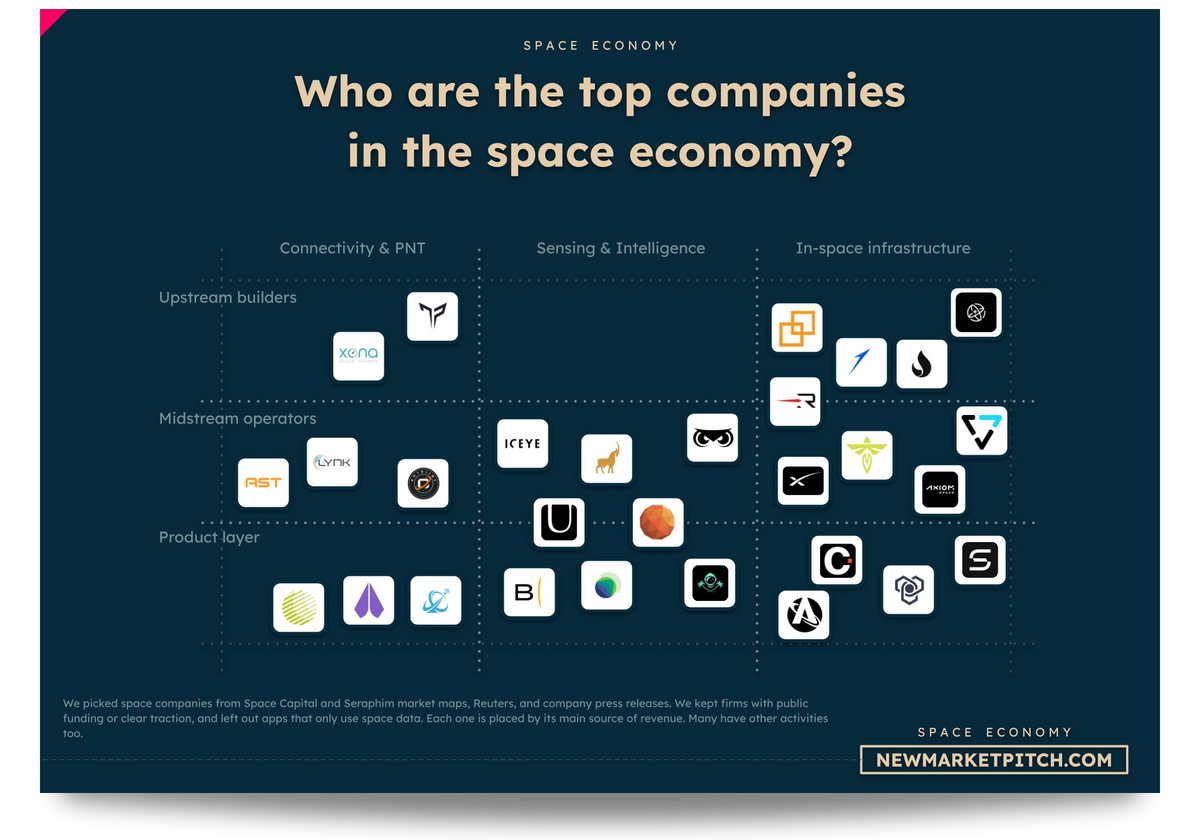
In our report covering the space economy market, we turn what is vague and complex into simple, useful visuals. Market maps like this one show you at a glance where every startup stands.
Is Amazon Leo already too late to challenge Starlink?
Amazon Leo is already far behind Starlink, and the gap is still growing. SpaceX has built a profitable satellite internet business with millions of customers, while Amazon is preparing its first commercial services. But Amazon has secured several major customers before launching broadly, which suggests Starlink has yet to lock up the entire market.
According to SpaceX's latest quarterly results, Starlink reached 13.6 million consumer subscribers, up from 7.2 million a year earlier. SpaceX's Connectivity division, which includes Starlink, generated $5.25 billion in quarterly revenue and $2.37 billion in operating income.
Amazon's position looks very different. Its latest mission update reported 396 satellites in orbit, against more than 11,000 for Starlink. Amazon has also missed a major FCC deployment deadline and has yet to establish a comparable paying customer base.
Still, Delta Air Lines has agreed to install Amazon Leo on 500 aircraft beginning in 2028. Australia's NBN Co plans to use Leo for rural broadband, and Amazon has announced an agreement to acquire Globalstar, bringing satellite-to-phone connectivity into its strategy.
So Amazon is clearly losing the race to build and operate a global satellite broadband network. Whether Starlink can keep that lead across airlines, governments, telecom operators, and mobile devices is a more interesting question.
If you want more recent data on this point, please see our latest space economy report.
How far behind Starlink is Amazon Leo right now?
Starlink currently operates on a completely different scale from Amazon Leo, with roughly 28 times as many satellites and a consumer base already exceeding 13 million subscribers.
The two companies began commercial deployment at very different times. Starlink introduced its public beta service in 2020 and started scaling internationally soon afterward. Amazon launched its first production satellites in April 2025, following several years of development and two prototype satellites launched in 2023.
By October 2026, Amazon had completed 14 production missions and deployed 396 satellites, according to its October 14 mission update. Its first-generation constellation is designed to contain 3,232 satellites, meaning only 12.3% had been placed in orbit.
Starlink's commercial lead is even more striking. SpaceX added 1.6 million consumer subscribers during the third quarter of 2026 alone. That is more than 500,000 net additions per month, before including enterprise customers.
| Metric | Amazon Leo | Starlink |
|---|---|---|
| Satellites in orbit | 396 | More than 11,000 |
| Consumer subscribers | No comparable published base | 13.6 million |
| Commercial status | Initial rollout pending | Operating globally |
| First-generation planned fleet | 3,232 satellites | Multiple generations deployed |
| Latest quarterly connectivity revenue | Not separately disclosed | $5.25 billion |
| Latest quarterly connectivity operating income | Not separately disclosed | $2.37 billion |
| Airline installations | Future deployments contracted | More than 3,800 aircraft equipped |
| Main constraint | Launching and activating satellites | Expanding network capacity |
The subscriber figures are particularly revealing because Starlink is still growing quickly despite its large installed base. Amazon is entering a market where its leading competitor continues to gain customers at a substantial rate.

Our research about the space economy gets updated several times a month, so you always get the latest view of where things stand.
Has Amazon Leo already missed a critical satellite launch deadline?
Amazon Leo has already missed its original FCC halfway deployment deadline by a huge margin, confirming that its rollout has taken considerably longer than regulators initially allowed.
When the Federal Communications Commission approved Amazon's constellation in July 2020, it required the company to deploy half of its authorized 3,232 satellites by July 30, 2026. That meant 1,616 satellites in service within six years.
Amazon had launched 180 satellites when it requested regulatory relief in January 2026. Even its projected deployment of approximately 700 satellites by the deadline would have fallen well short.
In June, the FCC granted a conditional waiver rather than forcing Amazon to forfeit its remaining authorization. At that point, Amazon reported 331 deployed satellites, barely one-fifth of the original halfway requirement.
The decision came with consequences. The FCC introduced conditions affecting the spectrum priority of satellites launched after the missed deadline, creating an incentive for Amazon to deploy its constellation more quickly.
Amazon must also work toward its July 2029 full-deployment milestone.
The waiver gives Amazon room to recover, but the missed deadline establishes something important: its deployment problems were serious enough to require federal regulatory intervention.
Why is Amazon Leo launching satellites so slowly?
Amazon Leo's main problem is getting satellites into orbit fast enough, even though its manufacturing operation is already producing them at scale.
Amazon disclosed in October 2026 that it had manufactured more than 1,000 satellites at its Kirkland, Washington, facility. Yet its mission update reported fewer than 400 in orbit, leaving a gap of more than 600 spacecraft between cumulative production and deployment.
That difference includes satellites at various stages of testing, shipping, and launch preparation. Nevertheless, the figures strongly suggest that launch capacity has become a major constraint.
Amazon initially contracted launches from United Launch Alliance, Arianespace, and Blue Origin. All three were developing or introducing major launch vehicles during the period in which Amazon needed substantial capacity.
Amazon consequently added Falcon 9 missions from SpaceX, its biggest satellite internet competitor. It also expanded its Ariane 6 contract in September 2026, adding six launches and increasing its Arianespace commitment from 18 to 24 missions.
It's a strange spot to be in: Amazon has booked more than 100 launches across providers, but it still needs those rockets to fly often enough.
Amazon's production line can manufacture up to 30 satellites per week, according to the company. At that theoretical pace, it could produce more than 1,500 spacecraft annually. Manufacturing capacity therefore appears considerably stronger than demonstrated launch throughput.

In our market report about the space economy, we look at what the winners do differently, so you can learn from the best instead of guessing.
Can Amazon Leo finally accelerate its launches?
Amazon Leo has a credible path to much faster satellite deployment, but its launch schedule still needs to prove itself.
Amazon expects heavier launch vehicles to carry substantially more satellites per mission. Its initial Atlas V launches carried 27 satellites, later configurations are designed for approximately 29, Vulcan Centaur can carry around 40, and New Glenn is expected to deploy even larger batches.
Arianespace provides another route. By September 2026, Ariane 6 had deployed 100 Amazon satellites across three missions in less than five months.
Amazon announced plans in March for more than 20 launches over the following year. If those missions carried an average of 40 satellites, they would deliver approximately 800 spacecraft.
That is a meaningful increase over Amazon's earlier annual deployment rate, but the calculation also exposes the scale of its challenge. Even 800 additional satellites would bring the constellation to only about 1,200, assuming the 396-satellite baseline.
Amazon would still be below the 1,616 satellites originally required by its halfway milestone.
The company has invested heavily in launch preparation facilities, including a $140 million processing site at Kennedy Space Center designed to support several launch campaigns simultaneously.
The launch infrastructure is taking shape. The regular launches? Those still need to happen.
Does SpaceX have an unfair advantage because it owns its rockets?
SpaceX's control of Falcon 9 gives Starlink a major advantage over Amazon Leo, because SpaceX can coordinate satellite production and launches within the same company.
Amazon must reserve missions, coordinate technical requirements, and adapt to launch schedules controlled by external providers. SpaceX can allocate Falcon 9 capacity directly to Starlink alongside commercial and government missions.
That difference becomes especially important when a constellation needs regular satellite replacements, software upgrades, and additional capacity in high-demand regions.
SpaceX has also developed reusable launch operations over more than a decade. By the time Amazon began deploying production satellites, Falcon 9 was already carrying out missions at a pace that competing heavy-lift systems had not matched.
Amazon tried to reduce supplier dependence by contracting multiple providers. It now works with ULA, Arianespace, Blue Origin, and SpaceX, giving it several possible launch paths.
But diversification cannot eliminate the delays associated with new rockets. Amazon's FCC waiver application explicitly identified launch availability as a major problem.
There is also a financial dimension. SpaceX can supply its own launch services while earning revenue from Starlink customers. Amazon has to purchase launch services before its network produces substantial recurring income.
SpaceX's advantage here is both operational and economic, and Amazon cannot easily reproduce it.
If you want more recent data on this point, please see our latest space economy report.

In our document detailing everything you need to know about space economy, you will always find fresh funding data, taken straight from our own verified funding database.
Could Amazon Leo ever match Starlink's satellite fleet?
Amazon Leo is unlikely to catch Starlink in satellite numbers anytime soon, even if Amazon substantially increases its launch rate.
Using the latest reported figures, the gap exceeds 10,600 satellites.
Suppose Amazon managed to deploy 800 satellites annually. Even if SpaceX stopped launching new Starlink satellites entirely, Amazon would need more than thirteen years to close that difference from its current starting point.
That hypothetical is deliberately generous to Amazon. SpaceX is still launching satellites, replacing older spacecraft, and introducing more capable generations.
In its latest quarterly results, SpaceX reported that its first revenue-generating Starship mission deployed 26 Starlink V3 satellites, adding approximately ten times the downlink capacity of a conventional Falcon 9 Starlink launch.
This also highlights the weakness of using satellite counts alone. A newer satellite can deliver considerably more capacity than an older spacecraft, depending on its design, communications hardware, and spectrum availability.
Amazon does not need to match Starlink's fleet to serve selected countries or enterprise customers. However, catching Starlink's total network capacity would require extraordinary deployment progress, especially as SpaceX introduces larger satellites.
For global network scale, Starlink's lead looks secure for the foreseeable future.
Is Amazon Leo's technology better than Starlink's?
Amazon Leo has demonstrated impressive broadband speeds, but Starlink still has a much stronger record of delivering consistent service to real customers.
Amazon has developed several types of customer terminals. Its Leo Ultra enterprise antenna is designed to support download speeds of up to 1 Gbps and upload speeds of up to 400 Mbps.
During an October 2026 demonstration at the U.S. Army's C5ISR Center in Maryland, Amazon reported peak downloads exceeding 400 Mbps using its Leo Pro equipment and satellites already in orbit.
That is a meaningful technical achievement for a network still under construction.
However, Starlink has already demonstrated comparable capabilities across a much larger commercial network. SpaceX reported median residential download speeds of approximately 225 Mbps during peak hours and median latency around 25 milliseconds in its June 2026 investor materials.
The figures measure different things. Amazon's results come from a controlled demonstration, whereas Starlink's figures describe real-world performance across a commercial service.
We still need independent measurements of Amazon Leo under sustained customer demand, including congestion, latency, outages, and performance across different locations.
Amazon's hardware looks competitive. Whether its overall network can consistently beat Starlink remains unproven.

Learning from others' mistakes is the cheapest lesson there is. In our report covering the space economy market, we look at what broke startups before you, so you don't repeat it.
Could Amazon Leo offer cheaper satellite internet than Starlink?
Amazon Leo could undercut Starlink in selected markets, but there is currently too little commercial pricing information to establish a genuine price advantage.
Amazon has repeatedly positioned Leo as a relatively affordable, high-performance service. The company has developed several antenna models for different customers and is working with telecommunications providers that already handle broadband subscriptions and customer support.
In South Africa, Herotel plans to introduce an Amazon-powered satellite service called evry in 2027. Its management has indicated that pricing should be comparable with existing fiber products.
That suggests Amazon may compete through local internet providers rather than selling exclusively through its own subscription platform.
Starlink already has substantial pricing flexibility, however. Its latest financial results show average monthly consumer revenue of $69, compared with $83 a year earlier.
That represents a year-over-year decline of approximately 17%, although customer mix, geographic expansion, and plan choices all contribute to the change.
The latest quarter also showed ARPU rising from $66 to $69, suggesting that prices and customer mix can move in either direction as the business evolves.
Amazon will therefore enter a market where Starlink has already adjusted pricing to serve different countries and customer groups.
Until Amazon publishes comparable service plans, installation costs, and equipment prices across several markets, declaring it the cheaper provider would be speculation.
Is Starlink already too profitable for Amazon Leo to compete?
Starlink's financial strength makes Amazon Leo's challenge much harder, because SpaceX can fund continued satellite investment through a large and growing connectivity business.
SpaceX reported $12.80 billion in Connectivity revenue during the first nine months of 2026, compared with $8.16 billion during the same period a year earlier.
Revenue grew approximately 57%, while operating income rose from $3.15 billion to $5.21 billion, an increase of about 66%.
The latest quarter was particularly strong. Connectivity produced $5.25 billion in revenue and $2.37 billion in operating income, giving the division an operating margin of roughly 45%.
Consumer revenue reached $3.12 billion, but enterprise and government customers also contributed $2.13 billion. That second category grew approximately 91% year over year, faster than consumer revenue.
| Starlink Connectivity metric | Q3 2025 | Q3 2026 | Change |
|---|---|---|---|
| Quarterly revenue | $3.10B | $5.25B | +69% |
| Consumer revenue | $1.99B | $3.12B | +57% |
| Enterprise and government revenue | $1.11B | $2.13B | +91% |
| Operating income | $1.19B | $2.37B | +99% |
| Operating margin | 38.4% | 45.1% | +6.7 percentage points |
| Consumer subscribers | 7.2M | 13.6M | +89% |
| Monthly consumer ARPU | $83 | $69 | -17% |
| Quarterly capital expenditure | $1.01B | $1.54B | +53% |
The standout result is the combination of rapid growth and rising profitability. SpaceX almost doubled quarterly operating income while increasing capital expenditure by more than half.
Amazon has already invested more than $10 billion in Leo, according to the company's January 2026 disclosure, but has yet to report comparable commercial revenue.
Amazon's broader financial resources give it plenty of room to keep investing. Still, Starlink can now expand its network using the profits from an established business, while Amazon must demonstrate that Leo can eventually generate adequate returns.
If you want more recent data on this point, please see our latest space economy report.

In our research about the space economy, we always try to gather several sources and make estimates that make sense, so you can work with solid numbers.
Why are major companies choosing Amazon Leo before it launches?
Amazon Leo is already winning major contracts because large customers want alternatives to Starlink and see value in Amazon's existing technology relationships.
Delta Air Lines provides the clearest example. In March 2026, Delta announced an agreement to install Amazon Leo Wi-Fi on an initial 500 aircraft beginning in 2028.
Delta already uses AWS for major operational systems, including reservations and customer-facing technology. Choosing Amazon for satellite connectivity extends that existing relationship.
Australia's NBN Co made a similar commitment in a different market. It selected Amazon Leo to support future broadband services for remote communities as its older Sky Muster satellite infrastructure approaches retirement.
In August 2026, NBN Co reported progress in preparing service plans and transition arrangements for eligible customers.
South African provider Herotel offers another example. Amazon announced a partnership in July 2026 to deliver satellite broadband through Herotel's existing regional internet business.
These agreements share an important feature: Amazon is reaching customers through organizations that already have large distribution networks.
Delta operates the aircraft, NBN Co manages broadband infrastructure, and Herotel already serves hundreds of thousands of customers.
Amazon is therefore building a commercial pipeline before its constellation reaches full deployment. Those contracts won't guarantee successful service, but they show that Starlink's early lead has not prevented major customers from choosing a future competitor.
Has Starlink already won the airline Wi-Fi market?
Starlink has taken a huge early lead in airline internet, although Amazon Leo's deal with Delta shows that some major airline contracts are still available.
SpaceX reported more than 3,800 aircraft equipped with Starlink by September 2026. Its aviation customers include United Airlines, Qatar Airways, Air France, and Hawaiian Airlines.
United provides an example of how quickly these partnerships can move beyond announcements. Its installation tracker showed 649 Starlink-equipped aircraft in October 2026, representing approximately 43% of its fleet.
Amazon's position is at an earlier stage. Delta plans to install Leo on 500 aircraft beginning in 2028, and JetBlue has also selected the network for future connectivity.
The difference between operating installations and future commitments is substantial. Starlink already serves passengers on thousands of aircraft, while Amazon's biggest aviation projects still depend on completing its network and beginning installation programs.
Nevertheless, the Delta deal is significant because airlines tend to select connectivity systems through long-term procurement decisions.
Amazon also has a credible hardware proposition. Its aviation antenna is designed for up to 1 Gbps of download capacity and 400 Mbps of upload capacity.
Starlink has won the early installation race, but Delta demonstrates that major carriers are still willing to commit to a rival network years before service begins.

If you build or invest in the space economy market, you need to know which business models pay off now and which ones are fading. That's why our report covering it has a whole section on it.
Could Amazon Leo beat Starlink in countries where Starlink is restricted?
Amazon Leo has a real chance to enter some markets ahead of Starlink, particularly where local partnerships help overcome commercial or regulatory barriers.
South Africa is one of the clearest examples. Starlink has struggled to secure the necessary regulatory arrangements because of the country's telecommunications licensing requirements.
Amazon, meanwhile, partnered with Herotel in July 2026 to introduce its evry satellite broadband service, targeting commercial availability in 2027.
Herotel already operates across hundreds of South African towns, making it a useful distribution partner for satellite connectivity in rural and underserved areas.
Australia illustrates a different opportunity. Through NBN Co, Amazon can provide satellite capacity as part of an established national broadband system. Customers may receive the service through familiar retail providers rather than having to purchase directly from Amazon.
Amazon has also announced plans to introduce Leo connectivity in Uzbekistan, expanding its list of future markets beyond North America and Europe.
Of course, partnerships alone do not guarantee regulatory approval or immediate commercial availability. Starlink may also secure entry into countries where it currently faces restrictions.
But Amazon has already shown that direct-to-consumer expansion is only one route into satellite broadband. Working with local operators could give Leo an advantage in particular markets even while Starlink maintains a much larger global footprint.
If you want more recent data on this point, please see our latest space economy report.
Can AWS help Amazon Leo steal customers from Starlink?
AWS gives Amazon Leo a credible advantage with enterprise customers, particularly those already buying cloud services, although that advantage has yet to produce measurable satellite revenue.
Amazon's cloud business has existing relationships with airlines, governments, industrial companies, and telecom operators. These customers often need connectivity for remote sites, aircraft, vehicles, and equipment.
Satellite broadband could become another service purchased through those relationships.
Delta provides a practical example. Its use of AWS helped establish a connection between Amazon's existing technology business and the future Leo aviation service.
The U.S. Army's October 2026 demonstration offers another. Amazon tested Leo communications at Aberdeen Proving Ground, reaching peak downloads above 400 Mbps. Future work is expected to examine mobile scenarios and integration with existing Army tactical networks.
For businesses operating mines, energy infrastructure, or remote industrial equipment, integration with cloud systems could also simplify networking and data management.
Still, Starlink customers can already access AWS over their internet connections. Amazon must offer something beyond basic compatibility, whether through easier procurement, security arrangements, integrated support, or more attractive commercial terms.
The AWS relationship should help Amazon enter enterprise accounts. How much business it can actually take from Starlink will become clearer once Leo has paying customers and established service performance.

Theory only gets you so far. In our document detailing everything you need to know about space economy, we dig up the real signals from the field and show you the ones worth watching.
Is Amazon Leo becoming a serious competitor in satellite-to-phone services?
Amazon Leo is making a major move into satellite-to-phone connectivity through its proposed Globalstar acquisition and its agreement with Apple. This could become one of Amazon's strongest opportunities to compete with SpaceX.
In April 2026, Amazon announced an agreement to acquire Globalstar, the satellite communications company already supporting satellite features on compatible iPhones and Apple Watches.
The proposed acquisition would give Amazon access to Globalstar's existing satellite infrastructure, operational expertise, and valuable L-band and S-band spectrum rights.
Amazon also announced a separate agreement with Apple covering satellite services for supported devices, including emergency communications, messaging, and roadside assistance.
The commercial implications are substantial. Amazon could eventually serve mobile devices without requiring customers to purchase dedicated Leo broadband antennas.
There are important limits, though. Globalstar's acquisition remains subject to closing conditions, and Amazon's planned direct-to-device constellation has not yet been deployed at commercial scale.
Starlink already has working direct-to-cell services through telecommunications partnerships, including T-Mobile. SpaceX's latest earnings call reported 22 million monthly Starlink Mobile users, up 37% from the previous quarter.
The race is opening up on a second front. Starlink leads in current deployment, while Amazon is trying to acquire established spectrum and customer relationships rather than develop everything from scratch.
The Globalstar transaction could make Amazon more competitive in mobile satellite connectivity than its current broadband satellite count suggests.
What would show that Amazon Leo is actually catching up with Starlink?
Amazon Leo would start genuinely catching up when its launch growth turns into widespread commercial service and recurring revenue. Right now, its progress is easier to measure through satellites built, contracts signed, and launches reserved than customers paying.
A few milestones would change that assessment.
| What to measure | Where Amazon Leo stands | What would show real progress |
|---|---|---|
| Satellites deployed | 396 | More than 1,000 operating satellites |
| Manufacturing | More than 1,000 built | Consistent conversion of inventory into launches |
| Launch frequency | 14 completed production missions | Sustained monthly heavy-lift missions |
| Commercial availability | Initial rollout pending | Live service in several major markets |
| Consumer customers | No comparable published base | Regular subscriber reporting and sustained growth |
| Enterprise contracts | Delta, NBN Co, Herotel and others | Large numbers of active installations |
| Network performance | Successful demonstrations | Independent commercial speed and reliability data |
| Revenue | Not separately disclosed | Material recurring Leo revenue |
| Regulatory deployment | FCC halfway waiver | Reliable progress toward final deployment obligations |
The first major physical milestone is relatively straightforward. Reaching 1,000 deployed satellites would mean Amazon had placed roughly 31% of its first-generation constellation in orbit, substantially improving its ability to support commercial operations.
The more revealing milestone would be a few consecutive quarters of subscriber and revenue growth.
That would allow us to compare actual adoption with Starlink's commercial trajectory rather than relying on Amazon's manufacturing achievements or future contract commitments.
Amazon's progress deserves attention, but a network's competitive position ultimately depends on the connectivity it delivers and the customers willing to pay for it.

In our report covering the space economy market, we don't want to repeat what boring consulting reports say. Instead, we show you the real and latest market signals that matter.
Is Amazon Leo already losing to Starlink?
Yes. Amazon Leo is already losing badly to Starlink in satellite deployment, commercial availability, customer adoption, and revenue. But Starlink has yet to eliminate Amazon's chances of becoming a serious competitor.
The scale of SpaceX's lead is difficult to overstate. Starlink has more than 11,000 satellites in orbit and 13.6 million consumer subscribers. Its Connectivity business generated $12.80 billion in revenue over the first nine months of 2026, while its quarterly operating margin has risen above 45%.
More importantly, Starlink keeps growing. It added 1.6 million consumer subscribers in a single quarter, enterprise and government revenue rose 91% year over year, and its latest satellite generation promises significantly greater network capacity.
Amazon, meanwhile, has missed its original FCC halfway deployment deadline and remains well short of completing its first constellation.
Yet Amazon has several advantages that make a complete defeat far from inevitable. It has built more than 1,000 satellites, reserved over 100 launches, secured agreements with Delta and NBN Co, and developed partnerships that could help it enter markets through existing telecommunications providers.
Its planned Globalstar acquisition and Apple agreement also open a second competitive front in direct-to-device services.
Our conclusion is that Starlink has already won the first major phase of satellite broadband competition. Amazon is entering years later, with a much smaller network and no comparable operating business.
But Amazon doesn't need to become bigger than Starlink worldwide to justify a place in this market. Enterprise customers, national broadband programs, airlines, and mobile operators may support more than one major satellite provider.
The next decisive test is whether Amazon can convert its manufacturing output and commercial commitments into a network that customers actually use at scale.
Until that happens, Starlink's lead is overwhelming. Amazon Leo remains a credible future rival, but today it is still chasing a business that has already reached global scale.
If you want more recent data on this point, please see our latest space economy report.
Sources and methodology
This analysis compares Amazon Leo and Starlink across constellation deployment, launch execution, network performance, commercial adoption, financial strength, regulatory progress and direct-to-device opportunities. We distinguish operating satellites and installed customer equipment from manufacturing capacity, launch reservations and contracts that have not yet entered service.
For network scale and financial performance, we use SpaceX’s third-quarter financial filing and official Amazon Leo mission updates. We compare Starlink’s consumer subscribers, Connectivity revenue and operating income with Amazon’s disclosed launches and satellite production, while keeping promotional speed claims separate from real-world service metrics.
The FCC’s deployment-milestone waiver and constellation authorization record establish the original deadlines and regulatory conditions. We also use Arianespace’s launch announcement and Amazon’s manufacturing update to separate planned launch capacity from deployments already completed.
For technology, we draw on Starlink’s network update, Amazon’s Leo Ultra specifications and its U.S. Army demonstration. Advertised terminal speeds and a controlled test cannot be compared directly with median speeds experienced by commercial users.
For market adoption, we give more weight to installations already operating than to future contracts. Key customer sources include Delta’s 500-aircraft agreement, United’s installation tracker, NBN Co’s operational update and Amazon’s Herotel partnership.
For the emerging satellite-to-phone market, we use Amazon’s proposed Globalstar acquisition announcement and its direct-to-device strategy explanation. We treat pending acquisitions, planned networks and future airline installations as opportunities rather than completed commercial results.

In our research about the space economy, we like to show you the big picture. We know your time is precious, so we make every page quick to read and packed with as much learning as possible per minute.
Written by the New Market Pitch teamWe track new markets so founders and investors can move faster. About us