Is Blue Origin falling further behind SpaceX?
Whether you're building or investing in the space economy, our report covers everything you need to know: the players, the money, and what's coming next.
Summary
Yes. Blue Origin is falling further behind SpaceX in orbital launches, commercial scale, and operational experience, even as New Glenn closes some important technological gaps.
The launch numbers reveal the scale of the problem. SpaceX completed 165 successful Falcon missions in 2025 alone, while Blue Origin has flown New Glenn just three times in total. SpaceX's advantage is now measured in hundreds of missions and years of accumulated operating experience.
Blue Origin has nevertheless achieved something substantial. New Glenn reached orbit, recovered its booster on its second flight, and successfully reused that booster on its third. Those milestones establish it as a credible reusable heavy-lift rocket, even if they remain far from SpaceX's routine operations.
The timing of Blue Origin's setbacks has been particularly damaging. An April 2026 upper-stage problem left a commercial satellite in an unusable orbit, followed by a May ground-test accident that damaged critical launch infrastructure. Both occurred just as New Glenn needed to establish a regular flight schedule.
SpaceX's apparent lead is partly amplified by its own satellite business. Of its 165 Falcon missions in 2025, 122 supported internal operations, primarily Starlink. Blue Origin therefore faces a much smaller competitive target in externally purchased launches than the headline launch totals suggest.
Yet Starlink is precisely what makes SpaceX so difficult to challenge. Its recurring subscription revenue finances expansion, while its satellite constellation generates launch demand that keeps rockets flying, engineers learning, and boosters accumulating experience. Blue Origin has no comparable internal demand engine.
New Glenn's economics remain largely untested. SpaceX reused first stages on approximately 95% of its Falcon 9 launches in 2025, while Blue Origin has demonstrated one New Glenn booster reflight. Landing a rocket is impressive; refurbishing and relaunching it cheaply dozens of times is a different challenge.
Blue Origin does have a substantial commercial backlog. Amazon initially contracted 12 New Glenn launches with options for another 15, while NASA and the U.S. military have awarded important programs. The weakness is execution: signed contracts have yet to become a steady stream of completed orbital missions.
Starship adds another layer of pressure. SpaceX has begun using its next-generation rocket for revenue-generating Starlink deployments, potentially bringing much greater payload capacity into commercial service before New Glenn achieves regular operations. Starship's promised cost advantages are still unproven, but the threat is increasingly concrete.
The lunar competition is less one-sided. SpaceX has conducted more integrated flight testing, but its Starship lunar lander faces difficult orbital-refueling requirements. Blue Origin's Blue Moon program offers NASA an alternative architecture, and neither company has secured an easy path to crewed lunar landings.
Financial comparisons also require care. SpaceX has reported substantial revenue from connectivity, space operations, and artificial intelligence, whereas Blue Origin does not publish comparable consolidated financial statements. There is no convincing evidence that Blue Origin is running out of money, but SpaceX has built a much larger operating business.
Blue Origin's realistic opportunity is to become a dependable second American heavy-lift launch provider rather than match SpaceX's total flight volume. Its engines, large payload fairing, Amazon contracts, military work, and lunar systems offer a credible foundation. Until New Glenn demonstrates consistent launches and successful customer deliveries, however, SpaceX's overall lead will keep growing.

Written by the New Market Pitch teamWe track new markets so founders and investors can move faster. About us

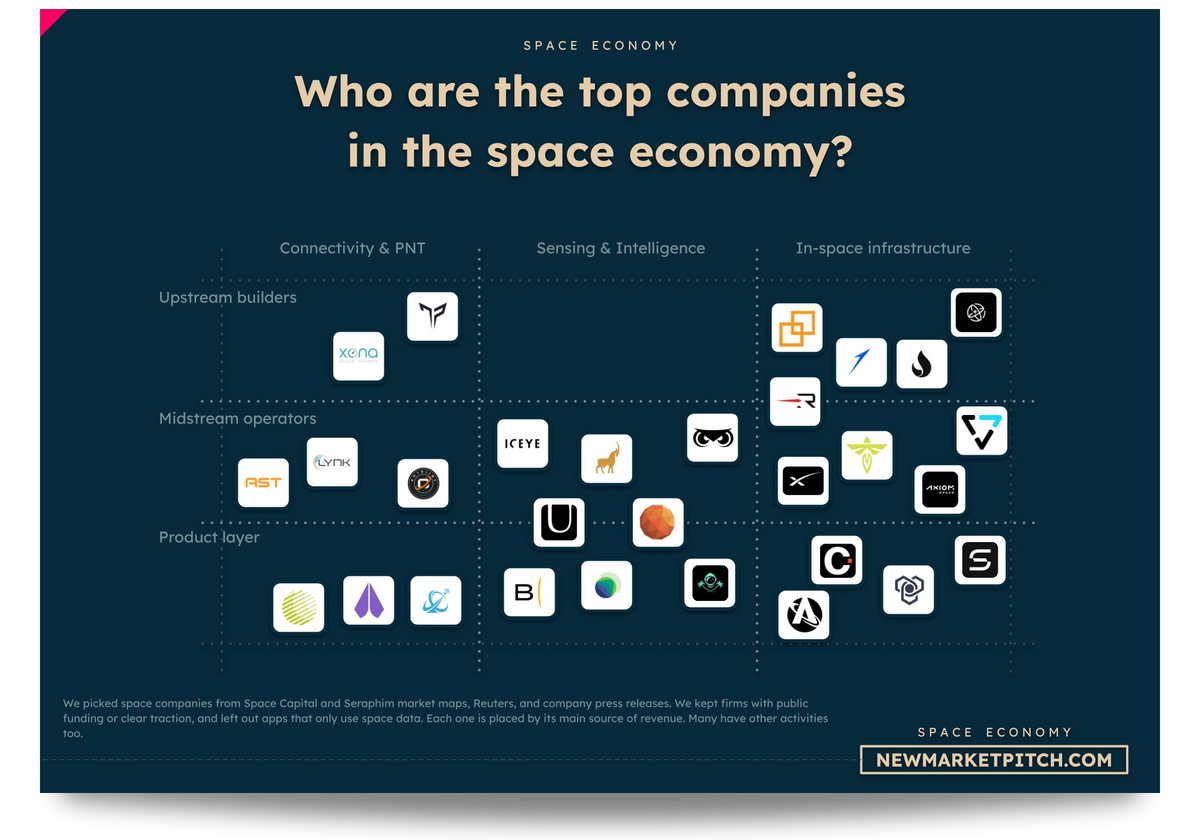
In our report covering the space economy market, we turn what is vague and complex into simple, useful visuals. Market maps like this one show you at a glance where every startup stands.
Is Blue Origin falling further behind SpaceX right now?
Blue Origin is falling further behind SpaceX in orbital launches, commercial scale, and operational experience, even though New Glenn has made real technological progress.
The gap became especially visible in 2026. Blue Origin's third New Glenn flight, on April 19, successfully reused and recovered a booster. But the rocket's upper stage left AST SpaceMobile's BlueBird 7 satellite in an orbit too low to sustain operations. Six weeks later, a ground-test accident damaged critical launch infrastructure at Cape Canaveral.
SpaceX, meanwhile, kept launching Falcon rockets, testing Starship, deploying Starlink satellites, and expanding its commercial business. Its latest quarterly earnings showed $14.6 billion in revenue across space, connectivity, and artificial intelligence operations.
Blue Origin has never been closer to becoming a serious orbital launch competitor. New Glenn has reached orbit, landed its booster, and demonstrated booster reuse. NASA, Amazon, and the U.S. military have also committed substantial business to the company.
Yet SpaceX has spent years turning those same achievements into routine operations. While Blue Origin is still working toward a regular launch schedule, SpaceX is already operating a much larger business built around reusable rockets.
The gap depends on what we measure. Blue Origin is catching up technologically in some areas, but SpaceX continues pulling ahead in the scale of its operations.
If you want more recent data on this point, please see our latest space economy report.
How far behind SpaceX is Blue Origin in actual rocket launches?
SpaceX is still overwhelmingly ahead of Blue Origin in orbital launches, with a gap measured in hundreds of missions rather than a few successful flights.
SpaceX completed 96 successful Falcon launches in 2023, 134 in 2024, and 165 in 2025, according to its company disclosures. That represents 395 Falcon missions in three years.
Blue Origin completed two New Glenn launches in 2025 and one in 2026 before operations were interrupted. Its total orbital flight history therefore consists of three New Glenn missions.
That operational head start has consequences beyond the number of satellites delivered. SpaceX has had hundreds of opportunities to improve booster recovery, engine inspection, launch-pad turnaround, and flight procedures.
New Glenn has accumulated very little comparable experience.
The distinction becomes even clearer when we separate SpaceX's own satellite deployments from launches purchased by external customers. SpaceX reported 43 external Falcon customer missions in 2025, with the remaining 122 supporting internal operations.
Blue Origin does not need to match every Starlink launch to compete commercially. But even against SpaceX's external customer business, its current flight rate remains far behind.
| Launch metric | SpaceX | Blue Origin |
|---|---|---|
| First successful orbital launch | 2008 | 2025 |
| Orbital launches in 2023 | 96 successful Falcon missions | 0 |
| Orbital launches in 2024 | 134 successful Falcon missions | 0 |
| Orbital launches in 2025 | 165 successful Falcon missions | 2 New Glenn missions |
| Orbital launches in 2026 through mid-October | Approximately 120 attempts across Falcon and Starship | 1 New Glenn mission |
| Orbital launch vehicles flown | Falcon 9, Falcon Heavy, Starship | New Glenn |
| Reusable orbital boosters | Hundreds of Falcon recoveries | New Glenn recovered on flights 2 and 3 |
| Regular orbital launch service | Established | Not yet established |

Our research about the space economy gets updated several times a month, so you always get the latest view of where things stand.
Did New Glenn's successful landing put Blue Origin closer to SpaceX?
New Glenn's successful booster landing brought Blue Origin much closer to SpaceX technologically, but it has barely changed the commercial competition so far.
On November 13, 2025, Blue Origin launched NASA's two ESCAPADE spacecraft and successfully landed New Glenn's first stage on its Atlantic recovery ship, Jacklyn.
Achieving a booster landing on the rocket's second flight was impressive. New Glenn is approximately 98 meters tall and uses seven BE-4 methane engines on its first stage. Recovering such a large vehicle is a major engineering achievement.
The company went further on April 19, 2026, when it launched a previously flown booster and recovered it again. That proved Blue Origin could refurbish an orbital-class first stage and fly it a second time.
But the mission also exposed a serious problem. According to Blue Origin and AST SpaceMobile, an upper-stage engine failed to deliver sufficient performance, leaving the BlueBird 7 satellite in an unusable orbit.
A successful booster recovery does not compensate a customer for losing its satellite mission.
The comparison with SpaceX is revealing. In 2025, 157 of its 165 Falcon 9 launches used previously flown boosters, meaning approximately 95% of missions relied on reused first stages.
SpaceX also has boosters that have flown dozens of times, whereas New Glenn has demonstrated one booster reflight.
Blue Origin has now proved that its reusable rocket design works. What remains unproven is whether it can keep flying recovered hardware reliably, with short turnaround times and affordable refurbishment.
Has Blue Origin's latest New Glenn setback made the gap even worse?
Blue Origin's recent New Glenn problems have made its commercial position worse because they interrupted the program just as the company needed to start launching regularly.
The first major setback came during the April 2026 BlueBird 7 mission. New Glenn's booster performed successfully, but the upper stage delivered the spacecraft into an orbit too low for operational use.
Then, on May 28, an integrated launch-vehicle hotfire test at Launch Complex 36 caused extensive damage to ground infrastructure.
In a June 30 update, Blue Origin CEO Dave Limp confirmed that the company lost its lightning tower, transporter-erector, and hydraulic cylinders. Fortunately, the propellant tank farm, integration facility, and several other important structures survived.
Blue Origin subsequently identified the main oxygen valve on a BE-4 engine as the origin of the ground-test anomaly. In its August 5 update, the company said it was developing modifications to the valve and testing the proposed fixes.
The two accidents involved different parts of New Glenn's operation. One affected flight performance, while the other damaged the infrastructure needed to launch the rocket.
Together, however, they created a particularly expensive interruption. Blue Origin had already demonstrated booster reuse but still lacked the flight history required to establish confidence among commercial customers.
The company decided to accelerate a different launch-pad operating approach, integrating rocket stages horizontally before moving the vehicle to the pad and raising it vertically.
That approach could eventually simplify some operations, but the immediate priority is getting New Glenn back into service.
Every additional month without regular launches gives SpaceX more opportunities to accumulate flight experience and serve customers. And that's time Blue Origin cannot recover.

In our market report about the space economy, we look at what the winners do differently, so you can learn from the best instead of guessing.
Is SpaceX's lead over Blue Origin still growing?
SpaceX's cumulative advantage over Blue Origin is still growing, although the gap looks different when we compare total launches with launches sold to outside customers.
Between 2023 and 2025, SpaceX increased annual successful Falcon launches from 96 to 165, a rise of approximately 72%. Over the same period, Blue Origin went from zero orbital launches to two.
That is meaningful technological progress for Blue Origin, but the absolute difference continued widening.
There is an important detail hidden in SpaceX's figures. Its external Falcon customer launches increased from 33 in 2023 to 45 in 2024, before easing slightly to 43 in 2025.
We can calculate that approximately 74% of Falcon launches in 2025 served SpaceX's own needs, compared with roughly 66% in 2023.
In other words, Starlink has been responsible for a growing share of SpaceX's launch activity.
This changes how we should judge Blue Origin's chances. Catching SpaceX's total annual launch count would require competing with a company that generates most of its own demand. Winning a meaningful share of the external commercial market is a smaller, more realistic challenge.
Still, the internally generated flights give SpaceX real advantages. Engineers gain experience, boosters accumulate flights, and launch teams refine procedures regardless of who owns the satellite.
For now, Blue Origin is narrowing some technical differences while falling further behind in the number of times those technologies have been put to work.
If you want more recent data on this point, please see our latest space economy report.
Can New Glenn really compete with SpaceX's Falcon Heavy?
New Glenn has the performance and payload capacity to compete with Falcon Heavy, but SpaceX still offers a far more proven heavy-launch service.
Blue Origin designed New Glenn to carry approximately 45 metric tons to low Earth orbit and around 13 metric tons to geostationary transfer orbit.
Falcon Heavy advertises a maximum low Earth orbit capacity of 63.8 metric tons. However, that figure reflects its highest-performance configuration, and recovering boosters reduces the mass available for payloads.
New Glenn also has a seven-meter payload fairing, considerably wider than the standard Falcon Heavy fairing. That extra room can accommodate large spacecraft that are difficult to fit inside narrower launch vehicles.
For satellite manufacturers, fairing dimensions can be just as important as the rocket's maximum lifting capacity.
Falcon Heavy's major advantage is its operating history. It has already launched demanding missions, including NASA's Europa Clipper in October 2024, and has supported national-security and commercial customers.
New Glenn has completed only three orbital flights, with one commercial payload ending up in an unusable orbit.
Blue Origin also faces competition from United Launch Alliance's Vulcan Centaur, which serves several of the same commercial and government markets.
New Glenn is a serious heavy-lift rocket, particularly for customers building large satellites. But Blue Origin needs a string of successful deliveries before launch buyers can treat it as equally dependable.

In our document detailing everything you need to know about space economy, you will always find fresh funding data, taken straight from our own verified funding database.
Has SpaceX already beaten Blue Origin on reusable rocket costs?
SpaceX has a clear lead in the economics of reusable rockets because it has demonstrated routine reuse at scale. Blue Origin has not yet published enough operating data to show what New Glenn actually costs per flight.
We can see the benefits of reuse in SpaceX's financial disclosures.
In 2025, SpaceX reported that increased Falcon reusability reduced depreciation costs by approximately $240 million. At the same time, 157 Falcon 9 launches used flight-proven boosters.
That means SpaceX avoided manufacturing a completely new first stage for the overwhelming majority of those missions.
But booster recovery is only part of the calculation. Refurbishment expenses, engine maintenance, recovery ships, launch facilities, and staffing all affect the final cost.
A booster that survives two flights may still be expensive if extensive inspections and repairs are required between launches.
Blue Origin has shown that New Glenn can recover and reuse its first stage, but the company has not disclosed its refurbishment cost, average turnaround time, or expected number of flights per booster.
That makes precise claims about New Glenn being cheaper or more expensive than Falcon Heavy impossible to verify.
SpaceX, however, has already spread its launch infrastructure and development experience across hundreds of commercial and internal missions. Blue Origin is still operating with a much smaller number of flights over which to distribute those expenses.
Until New Glenn launches regularly, SpaceX remains the only one of the two with a well-demonstrated, high-volume reusable orbital launch business.
Is Starlink giving SpaceX an advantage Blue Origin cannot match?
Starlink is currently one of SpaceX's biggest advantages over Blue Origin because it generates billions in recurring revenue and creates constant demand for rocket launches.
According to SpaceX's third-quarter 2026 earnings release, Starlink had reached 13.6 million consumer subscribers by September 30, along with hundreds of thousands of additional enterprise customers.
Its Connectivity business generated approximately $5.25 billion in quarterly revenue, up 69% from the previous year. Operating income reached $2.37 billion, almost double the year-earlier level.
The company can build Starlink satellites, launch them on Falcon 9 or Starship, and earn subscription revenue after they begin operating.
Starlink also creates an unusually large customer for SpaceX's launch division. In 2025, 122 of 165 Falcon missions supported internal operations.
Blue Origin has no equivalent operating broadband network. Its Blue Ring spacecraft platform and proposed TeraWave communications system could open new markets, but neither currently generates revenue or launch demand on Starlink's scale.
Amazon Leo may eventually help New Glenn establish recurring launch activity, but Blue Origin does not own Amazon's satellite business or automatically receive all its launches.
We can already see how SpaceX's different businesses reinforce one another. Higher Starlink demand drives more satellite launches, while improvements in launch capacity help SpaceX expand the network.
Blue Origin can build a better rocket and still struggle to reproduce that business model. SpaceX has effectively created its own launch market, and that's an enormous advantage.
If you want more recent data on this point, please see our latest space economy report.

Learning from others' mistakes is the cheapest lesson there is. In our report covering the space economy market, we look at what broke startups before you, so you don't repeat it.
Could Amazon Leo help Blue Origin catch SpaceX?
Amazon Leo could become one of Blue Origin's most important commercial customers, but its launch contracts have not yet translated into regular New Glenn missions.
In April 2022, Amazon announced agreements for up to 83 launches with Blue Origin, United Launch Alliance, and Arianespace to deploy its satellite internet constellation, then called Project Kuiper.
Blue Origin received contracts for 12 New Glenn launches, with options for 15 additional missions.
If Amazon eventually exercises all those options, New Glenn could conduct 27 launches for the constellation alone.
That would represent a substantial amount of business for a rocket that has so far completed only three orbital missions.
But Amazon also has strong reasons to spread launches across multiple providers. Satellite deployment is tied to regulatory obligations, manufacturing schedules, network coverage, and commercial commitments.
In December 2023, Amazon even purchased three Falcon 9 launches from SpaceX, despite the rivalry between Jeff Bezos and Elon Musk.
That decision says something important about the launch market: customers will use a competitor's rocket when the schedule or available capacity makes it attractive.
Blue Origin could benefit enormously from Amazon Leo, especially if New Glenn begins launching multiple times per quarter. Such a workload would also help the company improve manufacturing and refurbishment processes.
For now, the contracts represent a valuable backlog rather than proof of commercial scale.
Is SpaceX winning more military launch contracts than Blue Origin?
SpaceX is currently winning a much larger share of the most demanding U.S. military launch work, although Blue Origin has secured a meaningful place in future procurement.
In April 2025, the U.S. Space Force selected SpaceX, United Launch Alliance, and Blue Origin for National Security Space Launch Phase 3 Lane 2 contracts.
The anticipated contract values were approximately $5.92 billion for SpaceX, $5.37 billion for ULA, and $2.39 billion for Blue Origin.
The government initially planned to allocate 28 missions to SpaceX, 19 to ULA, and seven to Blue Origin.
That gave SpaceX four times as many anticipated missions as Blue Origin.
Early assignments showed a similar pattern. The Space Force awarded seven fiscal-year 2025 Lane 2 missions to SpaceX and two to ULA, with Blue Origin scheduled to become eligible for assignments in the following fiscal year.
There is also a distinction between receiving a contract and actually performing the launches. The announced values represent anticipated procurement opportunities, rather than revenue already earned.
Still, Blue Origin's inclusion is significant. The government wants multiple launch providers for national-security missions, reducing dependence on any single company's rocket fleet.
That creates an opportunity for New Glenn even if SpaceX remains the largest contractor.
| National-security launch metric | SpaceX | Blue Origin | United Launch Alliance |
|---|---|---|---|
| Selected for NSSL Phase 3 Lane 2 | Yes | Yes | Yes |
| Anticipated contract value | $5.92B | $2.39B | $5.37B |
| Initially anticipated missions | 28 | 7 | 19 |
| Share of 54 planned missions | 51.9% | 13.0% | 35.2% |
| FY2025 Lane 2 missions initially assigned | 7 | 0 | 2 |
| Orbital launch experience | Extensive | Limited | Extensive |
| Main heavy-launch vehicle | Falcon Heavy | New Glenn | Vulcan Centaur |
| Current position | Largest planned share | Emerging third provider | Established alternative |

In our research about the space economy, we always try to gather several sources and make estimates that make sense, so you can work with solid numbers.
Could Blue Origin beat SpaceX in the race to land astronauts on the Moon?
Blue Origin could still beat SpaceX to some important lunar milestones, but SpaceX has progressed further in integrated flight testing while both companies face major technical challenges.
NASA selected SpaceX in April 2021 to develop the Starship Human Landing System, initially awarding a contract worth approximately $2.89 billion.
In May 2023, NASA also selected Blue Origin to build a second crewed lunar landing system under a contract valued at approximately $3.4 billion.
The two programs differ substantially.
SpaceX plans to use a lunar version of Starship, supported by launches of propellant tankers and orbital refueling operations. Blue Origin is developing its Blue Moon lander family, including a smaller robotic spacecraft and a dedicated crewed lander.
NASA's Office of Inspector General reported in March 2026 that both companies were facing development and integration delays. The report concluded that SpaceX's lander would not be ready for a lunar surface mission by June 2027.
That provides an opening for Blue Origin, although its own lunar hardware still needs extensive testing.
Blue Origin plans to conduct a robotic Blue Moon Mark 1 demonstration before attempting crewed missions. Success would give the company valuable experience with lunar descent, landing, and surface operations.
SpaceX, meanwhile, has performed more integrated Starship flight tests, but it still needs to demonstrate the orbital refueling and mission operations required for its lunar architecture.
This is one area where SpaceX's lead in orbital launches does not settle the competition. A company can fly more rockets while still facing difficult engineering work on its lunar lander.
Blue Origin has a genuine opportunity to establish itself as a major lunar transportation provider, although declaring it ahead of SpaceX today would be premature.
Is Starship about to make New Glenn obsolete?
Starship is becoming a much bigger threat to New Glenn, particularly after SpaceX began using it for revenue-generating satellite deployments, but New Glenn still has a place in the launch market.
SpaceX made several important advances during 2026. Its Starship Flight 13 deployed 20 production Starlink V3 satellites, while the company's third-quarter earnings release confirmed its first revenue-generating Starship mission.
That commercial mission deployed 26 Starlink V3 satellites. SpaceX stated that the launch added approximately ten times the downlink capacity of a Falcon 9 Starlink mission.
This is a substantial change from the early Starship tests, which were primarily focused on validating engines, staging, reentry, and vehicle control.
Starship is beginning to carry useful payloads, moving the program closer to regular service.
However, SpaceX has not yet demonstrated the rapid full reusability that forms the basis of Starship's ambitious cost targets.
New Glenn follows a simpler approach, recovering its first stage while using an expendable upper stage. Its size, fairing volume, and performance could remain attractive for customers that do not require Starship's enormous potential carrying capacity.
There are also procurement reasons for customers to maintain alternatives. Government agencies and commercial satellite operators may prefer access to several launch providers rather than relying exclusively on SpaceX.
Still, the risk for Blue Origin is growing. If Starship achieves reliable operations and substantially lower launch costs before New Glenn reaches regular service, competing on price could become extremely difficult.
And if that happens, New Glenn could end up competing against SpaceX's next generation of rockets before it has fully established itself against the current one.
If you want more recent data on this point, please see our latest space economy report.

If you build or invest in the space economy market, you need to know which business models pay off now and which ones are fading. That's why our report covering it has a whole section on it.
Does Blue Origin have anything SpaceX cannot easily replace?
Blue Origin has valuable engines, spacecraft technologies, and government relationships that give it opportunities beyond competing directly with Falcon and Starship.
Its BE-4 engine is a particularly important asset. Blue Origin supplies the methane-fueled engine to United Launch Alliance for Vulcan Centaur, while also using seven BE-4 engines on New Glenn's first stage.
That makes Blue Origin an important supplier to another major American launch company.
New Glenn's seven-meter payload fairing is another advantage for certain large satellites. Spacecraft designers sometimes face size limitations before they reach a rocket's theoretical mass limit.
Blue Origin is also developing Blue Ring, a spacecraft platform intended for hosting payloads and carrying out missions after reaching orbit.
The company has invested in lunar systems as well, including the BE-7 engine and its Blue Moon landers.
These businesses could give Blue Origin several ways to earn revenue, from rocket engines and spacecraft platforms to lunar transportation services.
However, most of these opportunities are still developing. SpaceX already operates a larger commercial launch business and has expanded into satellite manufacturing, military space services, and broadband connectivity.
Blue Origin's technology portfolio is substantial, but the company still needs to turn more of those capabilities into recurring customer deliveries.
Its best chance may be in specialized markets where customers need something different from SpaceX's standard launch and satellite services.
Is Blue Origin running out of money while SpaceX gets richer?
There is no convincing public evidence that Blue Origin is running out of money, but SpaceX has built a much larger business with independently reported revenue and cash-generating operations.
Blue Origin remains privately held and does not publish detailed consolidated financial statements. That prevents us from making reliable comparisons of annual revenue, profitability, debt, or cash reserves.
SpaceX, by contrast, reported approximately $18.67 billion in revenue for 2025, according to its SEC filings.
Its business then expanded considerably during 2026. The company reported third-quarter revenue of $14.58 billion, including approximately $5.25 billion from Connectivity, $1.77 billion from Space, and $7.56 billion from Super Intelligence.
The last category includes artificial intelligence and computing operations, so SpaceX's consolidated revenue should not be confused with revenue generated by rocket launches.
Its space business also remains expensive to develop. SpaceX reported approximately $1.21 billion in operating losses for its Space segment during the first nine months of 2026, reflecting substantial investment in programs including Starship.
Nevertheless, Starlink provides a major source of operating income. The Connectivity segment generated approximately $5.21 billion in operating income over those same nine months.
Blue Origin has access to funding from Jeff Bezos, whose personal wealth gives the company unusual financial backing. But we do not know how much capital is available to Blue Origin or how much it spends annually.

Theory only gets you so far. In our document detailing everything you need to know about space economy, we dig up the real signals from the field and show you the ones worth watching.
Why has Blue Origin taken so long to catch SpaceX?
Blue Origin has fallen behind largely because SpaceX started building an orbital launch business much earlier, despite being founded two years later.
Jeff Bezos founded Blue Origin in 2000, while Elon Musk established SpaceX in 2002.
Yet SpaceX reached orbit with Falcon 1 in September 2008. Blue Origin did not achieve its first orbital launch until January 2025, more than sixteen years later.
The companies spent those years pursuing different priorities.
Blue Origin concentrated heavily on suborbital technology through New Shepard, which first reached space in 2015 and later carried commercial passengers and research payloads.
SpaceX developed Falcon 9, Dragon, reusable boosters, crew transportation, and eventually Starlink.
By the time New Glenn first flew, SpaceX had already transported astronauts to the International Space Station, recovered hundreds of boosters, and launched thousands of satellites.
Blue Origin's suborbital work was technically valuable. New Shepard helped the company develop propulsion, landing systems, and flight operations, while the BE-4 engine program created a major industrial capability.
But the commercial orbital launch market rewarded SpaceX's earlier approach much more quickly.
The company gained paying customers, learned from frequent flights, improved its rockets, and used that experience to expand into larger projects.
Blue Origin is now trying to establish a similar cycle with New Glenn, but it is entering a market where SpaceX already has a huge operational head start.
Can Blue Origin still catch SpaceX in the commercial rocket market?
Blue Origin can still become a major commercial launch competitor, but catching SpaceX's total launch volume is no longer a realistic near-term target.
The more useful comparison is with the market for launches purchased by external customers.
SpaceX completed 43 external Falcon customer missions in 2025. That is a much smaller number than its 165 total Falcon launches because Starlink accounted for most of the company's activity.
Suppose New Glenn eventually reaches 20 successful launches per year, with most serving external customers.
That would represent nearly half of SpaceX's 2025 external Falcon mission count, even though it would remain a small fraction of SpaceX's total launch activity.
Twenty annual launches is an illustrative scenario, not an official Blue Origin forecast. The company has yet to demonstrate anything close to that cadence.
But the calculation shows why market share should not be judged purely through total rocket launches.
A smaller operator can serve a meaningful share of commercial demand if it delivers valuable missions reliably and at competitive prices.
Blue Origin already has several potential sources of demand: Amazon Leo deployments, national-security launches, commercial communications satellites, and NASA lunar missions.
The challenge is converting that backlog into completed flights.
SpaceX also retains important customer advantages, including established launch schedules, known reliability, and the ability to operate from multiple sites.
Blue Origin could eventually become a strong second provider in the American heavy-launch market. Overtaking SpaceX across the wider space industry would require far more than successful New Glenn missions.

In our report covering the space economy market, we don't want to repeat what boring consulting reports say. Instead, we show you the real and latest market signals that matter.
Is Blue Origin falling further behind SpaceX?
Yes. Blue Origin is still falling further behind SpaceX overall, despite making some of its most important technological advances in recent years.
The launch gap is overwhelming. SpaceX completed 165 successful Falcon missions in 2025 alone, while Blue Origin has completed only three New Glenn flights in total. New Glenn's booster recovery and successful reflight were major achievements, but a failed commercial satellite delivery and a serious ground-test accident interrupted the company's progress.
SpaceX also has a financial advantage that is becoming harder to match. Starlink now serves more than 13 million consumer subscribers, generates billions in quarterly revenue, and gives SpaceX a constant reason to launch its own satellites.
The emergence of revenue-generating Starship missions adds another challenge. SpaceX is beginning to commercialize its next rocket generation while Blue Origin is still establishing regular operations with its first orbital vehicle.
Still, the competition is far from meaningless.
New Glenn is a genuine reusable heavy-lift rocket. Blue Origin has major commitments from Amazon and NASA, a place in the U.S. military launch market, and valuable technologies including BE-4 engines and Blue Moon lunar landers.
There is enough demand, particularly from governments and large satellite operators, for another reliable American heavy-lift provider.
Blue Origin's near-term opportunity is to become that provider. If New Glenn returns to flight successfully, launches regularly, and begins fulfilling its commercial backlog, the company could build a substantial business without ever matching SpaceX's total launch count.
For now, though, SpaceX remains far ahead in operational experience, recurring revenue, and the scale of its technology development.
We see Blue Origin getting closer to becoming a serious competitor, but the distance separating the two companies is still growing. SpaceX has turned reusable orbital launch into a mature operating business, and Blue Origin has yet to prove it can do the same.
If you want more recent data on this point, please see our latest space economy report.
Sources and methodology
This analysis examines whether Blue Origin is falling further behind SpaceX by comparing their orbital launch activity, reusable rocket performance, commercial contracts, financial resources, and progress on future space transportation systems. We focus on measurable achievements rather than technological promises or isolated mission announcements.
Our primary operational benchmark is completed orbital launches. We compare SpaceX's Falcon launch history with Blue Origin's New Glenn missions, paying particular attention to successful payload delivery, booster recovery, demonstrated reuse, and the ability to sustain regular operations. We distinguish SpaceX's internal satellite launches from missions purchased by external customers because these represent different measures of commercial competition.
For reusable rocket economics, we examine demonstrated flight-proven booster use, reported cost improvements, and available operational information. A successful landing or booster reflight is treated as a technological milestone, while routine reuse at commercial scale requires a longer operating record. We do not assign precise refurbishment costs to New Glenn without disclosed data.
Commercial traction is assessed through launch contracts, customer missions, and government procurement. We distinguish anticipated contract values and future launch options from completed missions and recognized revenue. Amazon Leo commitments, NASA lunar lander awards, and National Security Space Launch contracts are evaluated as potential sources of future demand rather than evidence of launches already performed.
For financial comparisons, we use SpaceX's reported revenue and operating disclosures while recognizing that Blue Origin does not publish equivalent consolidated financial statements. We also separate SpaceX's launch-related operations from its connectivity and artificial intelligence businesses to avoid treating total corporate revenue as rocket-launch revenue.
Our assessment of future competition considers New Glenn's payload capacity and fairing dimensions, Falcon Heavy's established launch record, Starship's developing capabilities, and the distinct technical challenges facing both companies' lunar landing programs. Prospective launch cadence and market-share scenarios are treated as illustrations, not forecasts.
Key sources used for operational and technical comparisons include SpaceX's June 2026 prospectus, SpaceX's Falcon 9 specifications, Falcon Heavy specifications, Blue Origin's New Glenn technical overview, Blue Origin's orbital mission records, and the official NG-2 mission report.
For New Glenn's 2026 operational setbacks, we reviewed Blue Origin's return-to-flight update, its GS1-3 hotfire investigation updates, and AST SpaceMobile's mission history. These sources help distinguish booster performance, upper-stage delivery problems, and damage to ground infrastructure.
For commercial and government commitments, we relied on Amazon's original Project Kuiper launch procurement announcement, Amazon's subsequent SpaceX launch agreement, the U.S. Space Force's NSSL Phase 3 Lane 2 contract announcement, and Space Systems Command's fiscal-year 2025 mission assignments.
Our lunar program comparison draws on NASA's original SpaceX Human Landing System selection, NASA's Blue Origin lunar lander award, NASA's Office of Inspector General assessment of Human Landing System contracts, and NASA's Europa Clipper mission record. We also used SpaceX's official mission and reusability overview for the company's stated launch and cost-reduction objectives.
Our overall judgment weighs proven operations more heavily than future plans while recognizing that New Glenn's technical milestones and contracted backlog could support a substantial commercial business. The conclusion reflects the gap in demonstrated launch capability and operating scale, rather than assuming that SpaceX must win every part of the space transportation market.

In our research about the space economy, we like to show you the big picture. We know your time is precious, so we make every page quick to read and packed with as much learning as possible per minute.
Written by the New Market Pitch teamWe track new markets so founders and investors can move faster. About us