Is China catching up with SpaceX?
Everything we know about the space economy, in one place. Get our report whether you build or invest.
Summary
Yes, China is catching up with SpaceX in reusable rocket technology, but it remains far behind in launch frequency, operational experience, and satellite internet. The engineering gap is narrowing much faster than the commercial one.
China achieved two important recovery milestones within weeks in 2026. A Long March 10B booster was recovered at sea in July, followed by LandSpace's Zhuque-3 completing a controlled landing on legs in August. SpaceX achieved its first Falcon 9 landing back in 2015.
Recovering a rocket is only the beginning. SpaceX has completed hundreds of booster landings and reflights, with individual Falcon 9 first stages flying more than 30 times. China has yet to demonstrate comparable orbital booster reuse.
The launch numbers show how unusual this competition has become. China conducted three more orbital launches than SpaceX in 2022, but by 2025, SpaceX was launching 170 times annually against China's 92. Both expanded, yet SpaceX grew much faster.
There are early signs of improvement in China's relative launch pace. By mid-October 2026, its 72 orbital attempts represented 60% of SpaceX's 120 launches, compared with 54% for the full year 2025. That's encouraging, although not enough to prove the gap is shrinking sustainably.
LandSpace looks like China's strongest private challenger. Its methane-powered Zhuque-2 reached orbit in 2023, and Zhuque-3 has now demonstrated orbital launch and booster recovery. Galactic Energy and other developers are progressing too, giving China several independent routes toward reusable launch operations.
Starlink is where China's disadvantage becomes overwhelming. In mid-October 2026, Starlink had approximately 11,154 satellites in orbit, against roughly 479 combined for China's Qianfan and Guowang networks. That's a constellation gap of about 23 to one.
The commercial gap is even more difficult to close. SpaceX reported $5.25 billion in quarterly Connectivity revenue and 13.6 million Starlink consumer subscribers, while China's main satellite broadband networks are still expanding deployment and have no comparable public operating record.
China's new Hainan commercial spaceport is making a measurable difference, having handled more than half of the principal Chinese broadband constellation satellites launched through August 2026. Launch infrastructure is becoming less of a bottleneck, although rocket production and reusable operations still need to catch up.
SpaceX is also moving the target with Starship. Its September 2026 mission deployed Starlink V3 satellites offering substantially more downlink capacity than conventional Falcon 9 deployments. If Starship becomes routinely reusable, Chinese rockets designed to rival Falcon 9 may face an even tougher challenge.
China does not necessarily need to beat SpaceX commercially to become a major strategic competitor. Government-backed satellite networks, domestic launch capacity, and independent military communications can justify continued investment without producing Starlink-level revenue.
Our conclusion is that China is becoming a credible technological rival, but it hasn't caught SpaceX as an operator. The milestones worth watching are successful Chinese booster reflights, 150–200 national launches annually, and broadband satellite deployments exceeding 1,000 per year. Until those capabilities become routine, SpaceX retains a commanding advantage.

Written by the New Market Pitch teamWe track new markets so founders and investors can move faster. About us

In our report covering the space economy market, we always try to gather several sources and make estimates that make sense, so you can work with solid numbers.
Why is China suddenly looking like a serious SpaceX competitor?
China is now a much more serious SpaceX competitor because its rocket industry has started doing something it had struggled with for years: bringing orbital-class boosters back to Earth.
In July 2026, China's state-owned aerospace industry recovered a Long March 10B first stage using a sea-based capture system. A month later, LandSpace became the first Chinese private company to land an orbital-class booster on deployable legs after its Zhuque-3 rocket delivered a satellite to orbit.
Both achievements came more than a decade after SpaceX's first successful Falcon 9 booster landing in December 2015. Still, the timing is significant. China went from having no successful orbital-class booster recoveries to demonstrating two different recovery methods within weeks.
The progress also extends beyond reusable rockets. Galactic Energy's Pallas-1 successfully reached orbit on its maiden flight in September 2026, while China's dedicated commercial launch infrastructure at Hainan has become an important hub for deploying broadband satellites.
These developments are connected to a longer industrial push. Since Beijing opened more of the launch sector to private investment in 2014, companies including LandSpace, Galactic Energy, Space Pioneer and iSpace have developed independent rocket programs alongside China's established state-owned contractors.
China has spent more than a decade building this industry. What has changed lately is that some of its most ambitious technologies are finally working in flight.
What would China need to do to actually catch SpaceX?
China would have to match SpaceX's ability to launch large numbers of satellites reliably, reuse rockets regularly and provide those services at competitive prices.
A successful booster landing is one step toward that goal. It shows that a rocket can survive its return from space and reach a designated recovery area. The bigger challenge is flying the recovered booster again, then repeating that process often enough to reduce costs.
Launch frequency provides another test. SpaceX conducted 170 launches in 2025, more than the entire Chinese space industry. Closing that gap would require China to increase the output of several rocket manufacturers and launch facilities simultaneously.
Satellite internet adds a third dimension. SpaceX operates Starlink, which gives the company a huge internal customer for its launches and a growing source of recurring revenue. China's Qianfan and Guowang constellations are pursuing a similar relationship between rockets and communications satellites.
There is also a distinction between commercial and strategic success. China could secure independent access to space for its government and military without winning international launch contracts from SpaceX.
For this comparison, we will focus primarily on reusable launch operations, annual launch capacity and satellite deployment. Those three measures tell us much more about the competitive gap than rocket specifications or future launch targets.
If you want more recent data on this point, please see our latest space economy report.

Theory only gets you so far. In our research about the space economy, we dig up the real signals from the field and show you the ones worth watching.
Is China actually closing the launch gap with SpaceX?
China is launching more rockets than ever, but SpaceX has grown so much faster that the gap remains enormous.
According to orbital launch records compiled by Jonathan McDowell and tracked by Flight Atlas, China conducted 64 orbital launch attempts in 2022, compared with 61 for SpaceX. Three years later, China recorded 92 attempts while SpaceX reached 170.
We calculated the growth over that period. China's annual launch total increased by approximately 44%, while SpaceX's increased by 179%. The difference in annual launches grew from three in China's favor to 78 in SpaceX's favor.
There is one encouraging development for China in the latest figures. By mid-October 2026, Flight Atlas had recorded 72 Chinese orbital attempts and 120 SpaceX launches. China's annual pace was therefore equivalent to 60% of SpaceX's, compared with 54% across 2025.
That suggests some narrowing, although the partial-year figures are too limited to establish a lasting trend. SpaceX is also conducting fewer launches than at the same point in 2025, according to Space Osmosis, which makes the apparent improvement less decisive.
The bigger picture remains clear: China's launch industry has expanded considerably, but SpaceX has expanded faster over the past several years.
| Year | China launches | SpaceX launches | SpaceX / China |
|---|---|---|---|
| 2019 | 34 | 13 | 0.38× |
| 2020 | 39 | 25 | 0.64× |
| 2021 | 55 | 31 | 0.56× |
| 2022 | 64 | 61 | 0.95× |
| 2023 | 67 | 98 | 1.46× |
| 2024 | 68 | 138 | 2.03× |
| 2025 | 92 | 170 | 1.85× |
| 2026, partial | 72 | 120 | 1.67× |
Has China finally mastered reusable rockets like SpaceX?
China has now mastered important parts of orbital booster recovery, but it is still far from matching SpaceX's routine rocket reuse.
The clearest evidence came from two different Chinese programs. In July 2026, a Long March 10B booster was recovered at sea using a capture system. In August, LandSpace's Zhuque-3 completed an orbital mission before its first stage descended under engine power and landed on legs.
The Zhuque-3 flight was particularly impressive because the rocket had failed to recover its booster during its December 2025 debut. LandSpace corrected enough of the problems to achieve a successful controlled landing on its second mission.
That was a real breakthrough. But a successful touchdown doesn't automatically mean the recovered first stage is ready to launch again. Its condition, refurbishment requirements and ability to survive another flight still have to be demonstrated.
SpaceX crossed this technical threshold in December 2015, then successfully flew a previously recovered Falcon 9 booster again in March 2017. It has since accumulated hundreds of booster landings and reflights.
The distinction is practical. Landing a booster demonstrates that the guidance, propulsion and descent systems work. Reusing it requires that the engines, tanks, structures and landing hardware remain serviceable after the mission.
China has recently made a substantial breakthrough in the first part. There is still no comparable record of repeated orbital booster reflights.

In our market report about the space economy, we don't want to repeat what boring consulting reports say. Instead, we show you the real and latest market signals that matter.
Which Chinese rocket company is closest to SpaceX?
LandSpace currently has the strongest claim among China's private rocket developers, thanks to its successful orbital launches and controlled Zhuque-3 booster landing.
Founded in 2015, LandSpace became the first company to reach orbit with a methane-powered rocket when Zhuque-2 succeeded in July 2023. That achievement came before SpaceX had successfully delivered an orbital payload using its methane-fueled Starship system.
LandSpace then developed Zhuque-3, a much larger stainless-steel rocket designed around reusable first-stage operations. Its second mission successfully deployed the Honghu-03 satellite and demonstrated a controlled landing, giving the company something more convincing than a prototype or a planned launch schedule.
Galactic Energy is another contender. Its Pallas-1 reached orbit on its first flight in September 2026. According to Xinhua, the rocket can carry approximately five to seven tonnes to low Earth orbit. Galactic Energy intends to add first-stage recovery to subsequent missions, but its debut flight was expendable.
Space Pioneer has chosen a different approach with Tianlong-3, a larger kerosene-powered vehicle intended for commercial satellite deployment. Its first orbital attempt failed in April 2026, leaving the company behind LandSpace in demonstrated flight results.
China's state-owned aerospace contractors remain important competitors too. The Long March 10B recovery showed that reusable rocket technology is advancing outside the private sector.
We would currently put LandSpace ahead of China's other private developers in demonstrated orbital recovery. But none has anything close to SpaceX's combination of hundreds of launches, reused boosters and established commercial customers.
| Developer | Rocket | Planned or demonstrated LEO capacity | Current achievement |
|---|---|---|---|
| LandSpace | Zhuque-3 | Up to 21.3 tonnes, expendable configuration | Orbital launch and controlled booster landing |
| CASC / CALT | Long March 10B | Around 16 tonnes | Successful first-stage sea recovery |
| Space Pioneer | Tianlong-3 | Around 17 tonnes | First orbital attempt failed |
| Galactic Energy | Pallas-1 | 5–7 tonnes | Successful maiden orbital flight |
| iSpace | Hyperbola-3 | Around 8.5 tonnes, planned | Reusable rocket under development |
| Deep Blue Aerospace | Nebula-1 | Around 2 tonnes, planned | High-altitude landing test experience |
| CAS Space | Kinetica rocket family | Depends on vehicle | Operational small-launch business and larger rockets in development |
If you want more recent data on this point, please see our latest space economy report.
How far behind SpaceX is China in reusing the same rockets?
China remains more than a decade behind SpaceX in accumulated orbital booster reuse experience, and the difference is still growing.
By 2026, individual Falcon 9 boosters had flown more than 30 missions. Associated Press reporting on China's July recovery milestone noted that SpaceX had already completed more than 600 booster landings.
That is an extraordinary amount of operational experience. Every landing gives SpaceX information about engine wear, thermal stress, structural fatigue and the parts that need replacing before another mission.
Consider the contrast with LandSpace. Zhuque-3 has demonstrated that its first stage can survive the flight back to the landing zone, but the company has yet to establish a history of flying recovered orbital boosters again.
The gap also affects turnaround times. SpaceX can support a launch schedule of more than three missions per week using a fleet of reusable rockets. Chinese operators still need to demonstrate that recovery can reduce the time and money required between flights.
We can therefore be much more confident about SpaceX's current operational advantage than about how quickly China might close it.
A Chinese booster flying successfully for the second and third time would be a major advance. A fleet accumulating hundreds of reflights would be the achievement that truly changes this comparison.

In our document detailing everything you need to know about space economy, we like to show you the big picture. We know your time is precious, so we make every page quick to read and packed with as much learning as possible per minute.
Can Chinese rockets become cheaper than Falcon 9?
Chinese rockets could eventually compete with Falcon 9 on launch prices, but nobody has yet demonstrated that China's reusable launchers are cheaper to operate.
SpaceX already publishes competitive prices for small satellites. Its rideshare program has advertised launches starting at $350,000 for a 50-kilogram payload to sun-synchronous orbit, equivalent to $7,000 per kilogram.
That gives customers a real commercial reference point. Chinese rocket manufacturers have announced plans to reduce launch costs through recovery and mass production, although comparable prices backed by frequent reused-booster missions are still unavailable.
The numbers also need to be interpreted carefully. SpaceX's advertised price is what customers pay, rather than its internal cost of launching a rocket. A rideshare flight carrying dozens of satellites has different economics from a dedicated mission carrying one spacecraft.
China does have a potentially valuable manufacturing advantage. Its industrial base is extensive, and companies such as LandSpace are designing engines, structures and production systems around large-scale manufacturing.
But a cheaper newly built booster can still be more expensive per launch than a Falcon 9 first stage used twenty times.
For now, SpaceX has the stronger economic evidence: published commercial prices, repeat customers and years of routine booster reuse. China's cost advantage remains a possibility that has to be proven through actual launches.
Is China's satellite internet network anywhere close to Starlink?
China's satellite internet networks are still nowhere near Starlink's scale, despite growing investment in Qianfan and Guowang.
According to satellite tracking data compiled by Space Atlas, Starlink had approximately 11,154 satellites in orbit in mid-October 2026. China's Qianfan and Guowang constellations had around 257 and 222 satellites respectively.
Together, the two Chinese networks accounted for roughly 479 satellites, or just 4.3% of Starlink's orbital count. Put differently, Starlink had about 23 satellites in space for every one operated by the two main Chinese broadband constellations.
Starlink also has a considerable head start in consumer services, international distribution, ground infrastructure and regulatory approvals.
China's planned networks are ambitious. Qianfan and Guowang each envision deploying thousands of satellites, potentially creating two of the world's largest communications constellations.
Yet constellation plans are far easier to announce than to execute. Each additional satellite requires manufacturing capacity, a place on a rocket, successful deployment and integration into the communications network.
China is clearly moving into the same market. At its current deployed scale, however, it cannot challenge Starlink's worldwide operating network on equal terms.

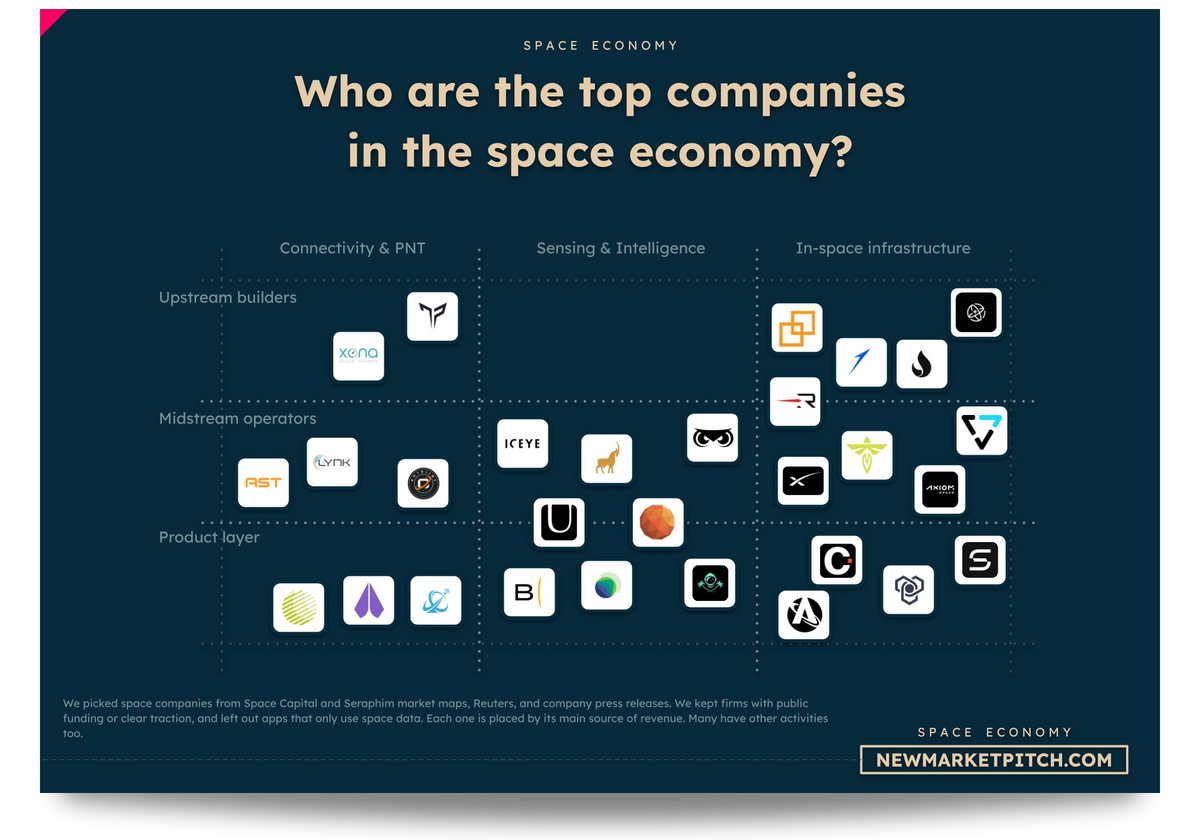
In our report covering the space economy market, we turn what is vague and complex into simple, useful visuals. Market maps like this one show you at a glance where every startup stands.
Is China launching internet satellites fast enough to catch Starlink?
China is still deploying broadband satellites too slowly to catch Starlink within the next few years at its current pace.
Space Osmosis reports that SpaceX conducted 127 Starlink launches in 2025, deploying approximately 3,207 satellites. That works out to more than 25 satellites per launch on average.
China's two main broadband constellations had accumulated fewer than 500 satellites in orbit by mid-October 2026, more than two years after Qianfan's first deployment.
We can see the scale of the problem through a simple calculation. At 1,000 new satellites per year, China would need more than ten years to reach Starlink's current orbital fleet, assuming no losses or retirements. Starlink would continue expanding and replacing older satellites in the meantime.
China's rocket capacity is part of the problem. Many Guowang and Qianfan launches have carried relatively small groups of satellites, often between five and twenty spacecraft. Increasing the number per flight would reduce the launches needed for each thousand satellites.
This is where vehicles such as Zhuque-3, Tianlong-3 and larger Long March rockets become particularly important. They could give China the lift capacity required for faster constellation deployment.
The next meaningful test is whether China can increase annual broadband satellite launches by several times and keep that pace going. Without that shift, Starlink's numerical advantage is unlikely to disappear.
How much money is Starlink making compared with China's satellite networks?
Starlink is already generating billions of dollars in quarterly revenue, while China's main satellite internet constellations are still building their businesses.
SpaceX's third-quarter 2026 results, published through the U.S. Securities and Exchange Commission, show that the company's Connectivity segment generated $5.25 billion in revenue, up 69% from the same quarter a year earlier.
Consumer services contributed $3.12 billion, while enterprise and government customers accounted for another $2.13 billion. The segment also reported $2.37 billion in operating income.
That represents an operating margin of approximately 45%, calculated directly from SpaceX's disclosed revenue and operating income. The figure demonstrates that Starlink is already a large, profitable business at the segment level.
Subscriber growth has been equally impressive. Starlink reported 13.6 million consumer subscribers at the end of September 2026, up from 7.2 million a year earlier. That is an increase of almost 89%.
We do not have comparable audited revenue and subscriber figures for China's Qianfan and Guowang constellations. Both are still in relatively early deployment, so a direct commercial comparison would be misleading.
SpaceX has already established a profitable communications business capable of supporting continued satellite investment. China still has to build a similarly large customer base after its constellations reach broader service availability.

Our research about the space economy gets updated several times a month, so you always get the latest view of where things stand.
Does China's huge domestic market give its space companies an advantage?
China's domestic market gives its space companies a guaranteed strategic opportunity, although its population does not automatically translate into millions of satellite internet customers.
With more than 1.4 billion inhabitants, China appears to offer an enormous potential market. But much of the country's population already has access to extensive fiber and mobile networks, which makes satellite broadband less attractive for ordinary urban households.
Demand is more concentrated in remote communities, maritime operations, aviation, emergency communications and military applications.
Government support could be particularly important. China has strong reasons to develop independent communications infrastructure that does not rely on an American company, regardless of whether the economics match Starlink's.
The same logic applies to launch services. Chinese military, navigation and scientific programs need dependable access to orbit, creating demand for domestic rocket providers.
SpaceX has a different advantage: access to a much broader international customer base. The company's financial disclosures describe Starlink operations across more than 160 countries, territories and other markets.
China may therefore have an easier time securing strategic domestic customers, while SpaceX is better positioned to monetize satellite connectivity across multiple continents.
Those advantages can coexist. China's domestic market could sustain a large space industry without producing a global commercial business as successful as Starlink.
If you want more recent data on this point, please see our latest space economy report.
Is China building enough launchpads to compete with SpaceX?
China is expanding commercial launch infrastructure quickly, and its new Hainan facilities are already making a measurable difference.
The Hainan Commercial Space Launch Site was developed to support the growing number of Chinese commercial rockets and satellite constellations. Its dedicated pads reduce dependence on China's traditional launch centers at Jiuquan, Xichang, Taiyuan and Wenchang.
The results are visible in satellite deployment data. According to an analysis published by KeepTrack, 218 of the 434 Guowang and Qianfan satellites launched through August 26, 2026, departed from Hainan's commercial facilities.
That means one relatively new launch site handled slightly more than half of China's principal broadband constellation deployments during the period studied.
For SpaceX, established infrastructure in Florida and California has supported a much higher frequency of Falcon launches. The company also operates its separate Starbase facilities in Texas for Starship development and missions.
China can build additional launchpads, but launch capacity depends on more than concrete and towers. Rocket manufacturing, payload integration, propellant supplies, range management and ground crews all have to support frequent operations.
Hainan's contribution shows that China is making progress on a genuine industrial bottleneck. The next question is how much annual launch capacity those facilities can support once more Chinese rocket families become operational.

In our market report about the space economy, you will always find fresh funding data, taken straight from our own verified funding database.
Could China's government-backed rocket industry overtake SpaceX?
China's government-backed space industry has the resources to become a formidable competitor, but state support alone has not produced SpaceX-level efficiency or launch frequency.
China combines large state-owned contractors with private companies pursuing different technologies. LandSpace specializes in methane-fueled rockets, Space Pioneer is developing the kerosene-powered Tianlong-3, and Galactic Energy has built a small-launch business while developing larger vehicles.
This gives China several independent opportunities to produce successful reusable rockets. A technical failure at one company does not prevent another from progressing.
State investment also supports programs with strategic value even when their immediate commercial returns are uncertain. China's BeiDou navigation system, Tiangong space station and lunar missions already demonstrate the breadth of the national space program.
SpaceX operates with a more integrated structure. The company develops its launch vehicles, manufactures satellites and sells broadband connectivity through Starlink. Its latest financial filings also describe substantial activities beyond traditional space services, but launch and connectivity remain closely connected operationally.
That integration gives SpaceX direct control over much of its launch demand, engineering feedback and satellite production.
China's broader industrial ecosystem may eventually offer greater manufacturing capacity and more launch alternatives. Yet those advantages have not delivered comparable launch output so far.
We would not assume that China needs one company capable of replicating SpaceX. Its state contractors and private developers could collectively provide a similar national capability, even if no individual Chinese firm becomes as commercially successful.
Is SpaceX's Starship making it even harder for China to catch up?
Starship is raising the difficulty of catching SpaceX because the company is already testing a much larger launch system while China works toward Falcon 9-style reuse.
SpaceX's September 2026 Flight 14 reached orbit and deployed 26 Starlink V3 satellites. According to the company's third-quarter earnings release, those satellites represented approximately ten times the downlink capacity added by a conventional Falcon 9 Starlink launch.
That was an important step for Starship. Delivering useful communications capacity demonstrates a purpose beyond experimental flight testing.
However, Starship has yet to match Falcon 9's established record of routine booster recovery, refurbishment and reuse. SpaceX still needs to prove that its larger system can operate frequently enough to achieve its ambitious cost targets.
China is also developing larger launch vehicles. The Long March 10 family is intended to support reusable operations and more demanding missions, while private developers are pursuing greater payload capacity for satellite constellations.
The immediate advantage belongs to SpaceX because it can continue flying Falcon 9 at high frequency while developing Starship.
If Starship eventually achieves rapid and economical reuse, Chinese rockets designed mainly to compete with Falcon 9 could find themselves chasing a moving target. That outcome is plausible, although not yet guaranteed by the available flight record.
If you want more recent data on this point, please see our latest space economy report.

In our document detailing everything you need to know about space economy, we look at what the winners do differently, so you can learn from the best instead of guessing.
Could China catch SpaceX in launches but still lose the commercial space race?
China could eventually match SpaceX's annual launch count while remaining far behind in satellite internet customers and commercial revenue.
The current figures already show why these metrics can diverge. China's national launch total is roughly 60% of SpaceX's in the latest partial-year comparison, yet its principal broadband constellations operate only a small fraction of Starlink's satellite fleet.
The gap in paying customers is harder to bridge. Starlink has built a large consumer business, signed enterprise and government customers, and developed distribution across numerous countries. China needs more than rockets to reproduce those relationships.
There is also a difference in what the two space industries are trying to achieve. China might prioritize military communications, secure national networks and independent launch capabilities over international consumer subscriptions.
Under that scenario, Chinese launch activity could grow rapidly while Starlink continues to dominate the commercial satellite broadband market.
The opposite is possible too. China could build a valuable satellite communications business focused on specific regions or government customers without matching SpaceX's launch frequency.
This makes commercial revenue and repeat launch performance more useful competitive measures than headline launch totals alone. China can become strategically much stronger without overtaking SpaceX as a business.
What would convince us that China is really catching SpaceX?
China would be genuinely catching SpaceX if its new reusable rockets began flying repeatedly, national launches approached 150–200 annually, and broadband satellite deployments grew by several times.
Those are concrete milestones rather than arbitrary claims about technological leadership.
A successful Chinese orbital booster reflight would show that the industry has moved beyond recovering hardware. Five or ten flights by the same booster would provide much stronger evidence that refurbishment and reuse work economically.
A national launch total above 150 would also change the picture. It would put China close to SpaceX's 2025 launch volume, although SpaceX could increase its own cadence during that period.
For satellite internet, we would want to see Qianfan and Guowang deploying well over 1,000 satellites annually, followed by evidence of actual service adoption. Subscriber counts, network capacity and commercial revenue would help establish whether that deployment is producing a competitive communications business.
The next five years will be particularly revealing because several Chinese rockets are approaching the point where planned capabilities must translate into repeatable operations.
China has already demonstrated that it can develop advanced reusable launch technology. Now we need to see whether its companies can manufacture rockets consistently, recover them intact and fly them again at scale.

If you build or invest in the space economy market, you need to know which business models pay off now and which ones are fading. That's why our report covering it has a whole section on it.
Is China catching up with SpaceX?
Yes, China is catching up with SpaceX in rocket technology, but the claim is exaggerated when applied to launch operations, satellite internet or commercial success.
China's recent achievements are substantial. Long March 10B and Zhuque-3 have demonstrated orbital-class booster recovery, Galactic Energy has successfully launched its larger Pallas-1 rocket, and new commercial spaceports are supporting national satellite constellations.
The operational gap remains large, however. SpaceX conducted 170 launches in 2025 compared with China's 92, while individual Falcon 9 boosters have accumulated dozens of flights. China has yet to build a comparable record of booster reuse.
Starlink makes the commercial difference even clearer. SpaceX already operates a broadband constellation of more than 11,000 satellites and generates billions of dollars in quarterly connectivity revenue. Chinese operators are still working toward broad deployment and commercial adoption.
There is a credible path for China to narrow these gaps, particularly through repeated booster reuse, larger satellite-launch vehicles and greater manufacturing capacity. Its state-backed industrial ecosystem also gives it reasons to keep investing even when international commercial demand is uncertain.
For now, we see China becoming a serious technological and strategic competitor rather than an equal commercial rival. The strongest evidence of catch-up is in reusable rocket engineering, where Chinese developers have made major advances. The weakest is in operating scale and satellite internet, where SpaceX's lead remains overwhelming.
China is getting much better at building the kinds of rockets SpaceX pioneered. Whether it can operate them as frequently and cheaply is the question that will decide the race.
If you want more recent data on this point, please see our latest space economy report.
Our methodology
This analysis examines whether China is catching up with SpaceX by comparing reusable rocket technology, orbital launch frequency, booster recovery and reflight experience, satellite constellation deployment, commercial performance, and launch infrastructure. We focus on what Chinese companies and state-owned programs have demonstrated in actual operations rather than on announced rocket capabilities or future deployment targets.
We use historical orbital launch records to establish how the competitive gap has changed, then examine the latest available 2026 launch figures for signs of improvement. Full-year totals and partial-year figures are kept separate because changes in launch schedules can distort short-term comparisons. National Chinese launch activity is compared with SpaceX's company-level launches to assess the scale of China's combined industrial effort against its leading American competitor.
For reusable rockets, we distinguish successful controlled landings, recovery of physical hardware, subsequent refurbishment, and actual booster reflights. These achievements represent different levels of technical and operational maturity. SpaceX's established Falcon 9 landing and reflight history provides the benchmark for assessing the progress of LandSpace, China's Long March programs, and other emerging launch providers.
Satellite internet is evaluated through deployed constellation size, deployment pace, launch capacity, service adoption and disclosed financial performance. We compare Starlink with China's Qianfan and Guowang networks using available orbital tracking records and company disclosures. SpaceX's Connectivity segment figures are used as the closest disclosed financial measure for Starlink-related operations, while distinguishing reported business performance from satellite deployment targets.
We also examine the relationship between launch technology and industrial scale. The Hainan Commercial Space Launch Site, Chinese rocket manufacturing programs, and SpaceX's Falcon 9 and Starship operations help explain whether technical progress can translate into higher launch frequency and larger satellite deployments. Payload capacities are identified as planned or demonstrated where relevant, since theoretical capacity alone does not establish commercial competitiveness.
Our assessment gives more weight to repeated launches, demonstrated booster reuse, satellites actually deployed, and disclosed financial results than to engineering announcements or long-term projections. The milestones proposed in the article, including repeated Chinese booster flights, 150–200 annual national launches, and more than 1,000 broadband satellites deployed annually, are forward-looking benchmarks for evaluating future progress.
Key sources used for this analysis include Jonathan McDowell's GCAT Launch Database and GCAT orbital launch lists for historical launches; SpaceX's official launch archive and mission timeline for Falcon and Starship operations; Xinhua's reporting on Long March 10B recovery, Zhuque-3's successful landing, and LandSpace's engineering and recovery challenges; Zhuque-2's methane-powered orbital achievement; Pallas-1's maiden orbital flight; and Tianlong-3's first launch attempt.
Additional primary references include SpaceX's Falcon 9 booster flight record, SpaceX's published rideshare prices, Starlink's official updates, SpaceX's third-quarter 2026 SEC filing for Connectivity revenue, operating income, and subscriber figures, the FCC's Starlink Gen2 authorization, Xinhua's reporting on China's broadband satellite launches, Hainan commercial launch infrastructure, and SpaceX's Starship Flight 14 mission details.

When you build or invest in the space economy market, you need clarity, not confusion. In our research about the space economy, we always try to put numbers on and quantify whatever is usually vague and confusing.
Written by the New Market Pitch teamWe track new markets so founders and investors can move faster. About us