How do stablecoin firms make money if transfers are free?
Whether you're building or investing in the stablecoin payments market, our report covers everything you need to know: the players, the money, and what's coming next.
Summary
Stablecoin firms make money even when transfers are free by earning interest on reserve assets, sharing that income with distribution partners, charging for payment services, and selling financial infrastructure. The biggest profits come from controlling large pools of digital dollars, not from charging people to move them.
Tether shows how lucrative the reserve model can become. It reported more than $10 billion in net profit for 2025, supported by enormous Treasury holdings and other investments, while USDT holders generally received none of the interest generated by the assets backing their tokens.
Circle demonstrates why reserve income does not automatically translate into large profits. It generated $2.75 billion in total revenue and reserve income in 2025, but distribution, transaction and related costs consumed approximately 61% of that amount before operating expenses.
Interest rates can change the entire financial equation. An issuer holding $1 billion in interest-bearing reserves earns $40 million annually at a 4% yield but only $20 million at 2%. Growing circulation can offset falling yields, though it may require increasingly expensive distribution agreements.
Coinbase demonstrates that distribution can be almost as valuable as issuance. It earned $1.35 billion in stablecoin revenue in 2025 without issuing USDC itself, benefiting from customer balances on its platform and the stablecoin's wider circulation.
Transaction volume is a misleading proxy for stablecoin revenue. In the second quarter of 2026, USDC onchain volume increased 151% year over year while Circle's reserve income grew only 5%. Moving the same dollars repeatedly creates blockchain activity without necessarily increasing the reserves that generate issuer income.
Payment companies have a separate opportunity. Stripe charges businesses for stablecoin acceptance, with published U.S. rates including 1.5% and a promotional 0.8% offering, because merchants need currency conversion, compliance, settlement and integration with traditional financial systems, not just cheap blockchain transfers.
Cross-border payments offer more room for monetization than simple wallet transfers. Startups can charge for solving expensive foreign-exchange and local-banking problems, although their margins depend on the payment corridor, liquidity costs and competition from established providers.
The competitive advantage increasingly lies in distribution and financial infrastructure. Banks, exchanges, card networks and payment platforms already have customer relationships that standalone stablecoin startups must acquire. The GENIUS Act may reinforce that advantage by raising compliance requirements while making regulated stablecoins more attractive to institutions.
The strongest demonstrated profits belong to companies controlling reserve balances and valuable distribution channels. Payment processing and enterprise software offer credible alternatives, but their profitability is less proven. As basic transfer fees approach zero, the money will increasingly go to businesses that control customer access or solve the complicated parts of moving and managing digital dollars.

Written by the New Market Pitch teamWe track new markets so founders and investors can move faster. About us
Why are stablecoin companies making billions when sending money costs almost nothing?
Stablecoin companies are making billions because they can earn money from the dollars users hold, even when transferring those dollars costs virtually nothing.
Tether reported more than $10 billion in net profit for 2025, while Circle generated $2.75 billion in revenue and reserve income. Both companies issue digital tokens backed by financial assets, predominantly cash and short-term government securities. Those assets produce investment income while the stablecoins remain in circulation.
The scale of this business has changed dramatically. According to Visa's stablecoin research, total stablecoin supply increased from approximately $186 billion at the end of 2024 to $274 billion at the end of 2025, a 47% increase. That's nearly $90 billion in additional digital dollars circulating worldwide in just one year.
Three businesses have emerged around those balances. Issuers such as Tether and Circle earn income from reserves. Distributors such as Coinbase receive a share of that income for attracting and retaining users. Payment companies such as Stripe charge businesses for services including currency conversion, compliance and payment acceptance.
And the economics are very different. Tether has demonstrated enormous profitability, Circle spends heavily on distribution, and independent payment startups face competition from companies that already control banking and merchant relationships.
Are stablecoin transfers actually free?
Stablecoin transfers can cost almost nothing, especially on newer blockchains, but sending digital dollars is only free when someone absorbs the network fee or provides the service without charging users.
The price depends partly on the blockchain. Transferring USDC over Solana or Base can cost fractions of a cent in network fees, while Ethereum transfers can be considerably more expensive when the network is congested. Tron, another major stablecoin network, has its own fee structure, and USDT transfers there are not universally cheap.
Blockchain fees generally go to the networks processing transactions rather than to Tether or Circle. Some wallets and payment platforms cover these costs for their customers, making the transfer appear completely free.
Yet moving tokens between two wallets is only one part of a financial transaction. A U.S. business paying a supplier in Brazil may need to convert dollars into stablecoins, transfer them across a blockchain and exchange them for Brazilian reais. Banking partners, liquidity providers and compliance systems are involved at different stages.

A good product starts with a real problem. In our report covering the stablecoin payments market, we show you the ones customers still live with.
How does Tether make billions without charging USDT transfer fees?
Tether makes billions mainly by earning returns on the assets backing USDT, giving it a large source of income that barely depends on how often people transfer the stablecoin.
Tether's 2025 reserve disclosure reported nearly $193 billion in assets backing its tokens and other obligations, with more than $186 billion in USDT circulating at year-end. Its reserves included more than $122 billion in direct U.S. Treasury holdings and over $141 billion in direct and indirect Treasury exposure.
These securities pay interest. If a company holds $100 billion in interest-bearing assets earning 4% annually, it generates $4 billion in gross interest income before expenses. It can earn that money even if the underlying stablecoins change hands thousands of times without anyone paying the issuer a transaction fee.
Tether's financial results show how powerful the model becomes at scale. Its disclosed net profit exceeded $10 billion in 2025, although that figure also reflected investment results beyond ordinary Treasury interest.
Tether also holds assets beyond short-term government securities, including investments whose values can fluctuate. In its second-quarter 2026 disclosure, Tether reported approximately $1.5 billion in operating profit, while market movements in other investments reduced its financial cushion.
Does Circle make money the same way as Tether?
Circle makes money from stablecoin reserves much like Tether, but its financial statements reveal a much more expensive business to run.
In the second quarter of 2026, Circle generated $701 million in total revenue and reserve income, including $668 million from the assets backing its stablecoins. Approximately 95% of its quarterly revenue therefore came from reserves.
The difference appears when we examine what Circle keeps. It recorded $412 million in distribution, transaction and other costs during the quarter, leaving approximately $289 million before operating expenses. Circle eventually reported $48 million in net income from continuing operations.
Its annual results tell a similar story. Reserve income increased from $1.66 billion in 2024 to $2.64 billion in 2025, but payments to distribution partners and other related costs also rose sharply.
Circle reported a net loss in 2025, partly because of substantial expenses associated with its public listing, including stock-based compensation. That made the year unusually expensive, but the underlying distribution costs were substantial even without those one-time expenses.
| Circle financial metric | 2024 | 2025 |
|---|---|---|
| Reserve income | $1.66B | $2.64B |
| Other revenue | $15.2M | $109.8M |
| Total revenue and reserve income | $1.68B | $2.75B |
| Distribution, transaction and other costs | $1.02B | $1.66B |
| Revenue after those costs | $658.9M | $1.08B |
| Distribution and related costs / revenue | 60.7% | 60.6% |
| Operating expenses | $491.7M | $1.18B |
| Net income (loss) | $155.7M | −$69.5M |

If you build or invest in the stablecoin payments market, you need to know which business models pay off now and which ones are fading. That's why our report covering it has a whole section on it.
How much can a stablecoin company earn from $1 billion in circulation?
A stablecoin issuer holding $1 billion in interest-bearing reserves can generate tens of millions of dollars annually, but the amount changes dramatically with interest rates.
At a 4% annual return, $1 billion produces $40 million in gross interest income. At 2%, the same reserves generate $20 million. If the issuer distributes half its interest revenue to commercial partners, its retained revenue falls to $10 million before other expenses.
This explains why stablecoin circulation is often more important financially than transaction volume. A customer holding $10 million in stablecoins for six months can generate significant reserve income, whereas thousands of instant transfers involving the same money may add almost nothing to issuer revenue.
Scale changes everything here. An issuer with $100 billion in interest-bearing reserves earning 3% produces $3 billion annually before expenses. A company holding $100 million under the same assumptions earns only $3 million.
These examples are theoretical calculations. Actual issuers may have non-interest-bearing assets, varying reserve yields, partner agreements and other expenses.
| Average interest-bearing reserves | 1% yield | 3% yield | 5% yield |
|---|---|---|---|
| $100M | $1M | $3M | $5M |
| $500M | $5M | $15M | $25M |
| $1B | $10M | $30M | $50M |
| $5B | $50M | $150M | $250M |
| $10B | $100M | $300M | $500M |
| $25B | $250M | $750M | $1.25B |
| $50B | $500M | $1.5B | $2.5B |
| $100B | $1B | $3B | $5B |
Why does Coinbase make money from USDC if Circle issues it?
Coinbase makes substantial money from USDC because its agreement with Circle rewards the exchange for attracting users and maintaining stablecoin balances.
Coinbase reported $1.35 billion in stablecoin revenue in 2025, compared with $910 million in 2024. That was an increase of approximately 48%, making stablecoins a major part of its subscription and services business.
Its annual report provides a rare breakdown of where that growth came from. Higher average USDC balances on Coinbase products contributed approximately $418 million in additional revenue, while increased circulation outside Coinbase contributed another $314 million. Lower interest rates reduced revenue by approximately $291 million, offsetting part of those gains.
In other words, increased balances contributed more than $730 million before the interest-rate effect. Coinbase benefited from both customers keeping USDC on its platform and growth in the stablecoin's broader circulation.
Circle needs partners such as Coinbase because issuing a stablecoin does not automatically guarantee that people will use it. Exchanges already have users, trading infrastructure and direct relationships with customers.

Learning from others' mistakes is the cheapest lesson there is. In our market report about stablecoin payments, we look at what broke startups before you, so you don't repeat it.
Could falling interest rates wipe out stablecoin profits?
Falling interest rates could seriously damage stablecoin issuer profits, particularly for companies that rely almost entirely on Treasury income.
Circle's 2025 results illustrate the exposure. Its annual report attributed approximately $442 million of downward pressure on reserve income to a 90-basis-point decline in average reserve yields. Total reserve income still increased because USDC circulation grew substantially, but the weaker yield consumed a meaningful part of that growth.
The pressure continued in the second quarter of 2026. Average USDC circulation increased 25% year over year, while average reserve returns fell by 66 basis points. Circle's reserve income increased only 5%, far below the growth in the amount of USDC outstanding.
Coinbase has the same vulnerability through its revenue-sharing arrangement. In its 2025 financial statements, the company estimated that a hypothetical 150-basis-point interest-rate change would have altered annual stablecoin revenue by approximately $540 million, using its balance assumptions and contractual arrangements.
For an issuer earning 4% on reserves, a decline to 2% would halve gross interest income unless the reserve balance doubled or other revenue sources compensated for the decline. That's a serious weakness for a business whose biggest revenue source is largely outside its control.
If you want more recent data on this point, please see our latest stablecoin payments market report.
Does more stablecoin transaction volume mean more money for issuers?
Higher stablecoin transaction volume does not necessarily mean higher issuer revenue, and Circle's recent numbers show just how far the two can diverge.
In the second quarter of 2026, USDC onchain transaction volume increased 151% year over year to $14.8 trillion. Average USDC circulation grew 25%, while the company's reserve income increased just 5%.
Transaction volume was growing roughly six times faster than average circulation and around 30 times faster than reserve income.
The same tokens can move repeatedly between wallets, exchanges and smart contracts without creating additional interest-bearing reserves. That makes transaction volume a poor standalone measure of an issuer's commercial success.
Visa's stablecoin research has also shown how dramatically reported transaction volumes can change depending on methodology. Its dashboard reported approximately $33 trillion in total volume over a trailing 12-month period, compared with roughly $10.2 trillion in adjusted volume after filtering certain types of activity.
The adjusted figure was approximately 31% of the raw amount. Even that narrower figure includes transactions beyond ordinary purchases of goods and services.

When you build or invest in the stablecoin payments market, you need clarity, not confusion. In our document detailing everything you need to know about stablecoin payments, we always try to put numbers on and quantify whatever is usually vague and confusing.
Can Stripe charge businesses when stablecoin transfers are nearly free?
Stripe can charge businesses substantial fees for stablecoin payments because its customers are paying for a complete payment service, including conversion, compliance and settlement.
Stripe's published U.S. pricing lists a standard 1.5% fee for stablecoin payments. It also lists a separate stablecoin acceptance offering at a promotional 0.8% through January 1, 2027, with an additional 0.2 percentage points thereafter.
Those prices are far above the cost of sending tokens on low-cost blockchains, but the service includes functions merchants would otherwise need to handle themselves. Stripe manages elements such as wallet screening, anti-money-laundering controls, conversion to fiat currency and network fees.
The comparison with card payments is revealing. Stripe's standard U.S. domestic card rate is 2.9% plus 30 cents. For a $1,000 payment, that means $29.30 in processing fees. At a 1.5% stablecoin rate, the cost would be $15; at 0.8%, it would be $8.
Stripe reinforced its commitment to the market by acquiring Bridge, a stablecoin infrastructure provider, in a deal valued at approximately $1.1 billion. Announced in 2024 and completed in 2025, the acquisition gave Stripe additional capabilities to connect stablecoins with existing payment systems.
Are stablecoins actually replacing Visa and Mastercard payments?
Stablecoins are becoming more important in global payments, but they have not come close to replacing Visa or Mastercard. Visa's own adoption figures suggest that much of the early opportunity involves improving existing payment networks.
Visa began experimenting with stablecoin settlement in 2023. By late 2025, its annualized stablecoin settlement volume exceeded $3.5 billion. That increased to approximately $7 billion in April 2026 and surpassed a $20 billion annualized run rate later in the year.
The growth is striking, but these volumes remain small compared with the trillions of dollars Visa processes annually.
Another development is the expansion of stablecoin-linked cards. Visa reported more than 160 live programs, with payment volume across those programs growing nearly 200% year over year in its fiscal second quarter of 2026.
These products often allow consumers to spend funds connected to stablecoin balances through conventional card infrastructure. The merchant can continue receiving money through familiar payment channels while stablecoins operate behind the scenes.
Visa also announced a live pilot with Lloyds Banking Group in September 2026. During seven days, Lloyds settled $750,000 of payment obligations with Visa using stablecoins. Funds arrived in less than an hour, including over the weekend.
The pilot was small, but it showed why banks might adopt stablecoins for settlement. Traditional payment systems can impose cut-off times and delays, while blockchain networks operate continuously.

In our report covering the stablecoin payments market, we look at what the winners do differently, so you can learn from the best instead of guessing.
Can stablecoin startups make real money from cross-border payments?
Cross-border payments are one of the clearest opportunities for stablecoin startups because international banking still creates expensive delays, currency-conversion costs and settlement problems.
The strongest use cases involve businesses making frequent payments across countries, especially when recipients need local currency quickly.
Visa's October 2026 research, drawing on an Allium analysis, identified $56 billion in service-fee payments, $43 billion in payroll payments and $28 billion in supplier payments across the stablecoin-related business flows it examined. Approximately 43% of geographically attributable business-to-business volume crossed borders.
These transactions show that stablecoins are being used for commercial activities rather than exclusively for cryptocurrency trading. However, the figures describe payment flows, not the revenue earned by service providers.
Consider a business sending $1 million to an overseas supplier. A provider charging 0.5% to handle conversion and settlement generates $5,000 in gross revenue. If it can deliver the payment faster and at a lower total cost than alternative banking arrangements, the fee may be attractive to the customer.
The economics depend heavily on the corridor. Transferring dollars between two well-connected U.S. bank accounts offers limited room for improvement. Moving funds to a country with expensive foreign exchange services, restrictive banking hours or fragmented payment infrastructure offers considerably more.
If you want more recent data on this point, please see our latest stablecoin payments market report.
Will stablecoin payment fees eventually fall to zero?
Basic stablecoin transfer fees are under strong competitive pressure, but services involving currency conversion, local banking and regulatory compliance should remain chargeable.
Sending the same token between compatible wallets is relatively easy for competitors to replicate. Once users can choose between several cheap networks and wallet providers, charging a substantial premium for that basic operation becomes difficult.
Business payments are more complicated. A merchant may need customer screening, fraud controls, currency conversion, accounting reconciliation and access to domestic bank transfers. Those services have real operating costs even when blockchain settlement is nearly free.
Stripe's pricing shows that merchants are already paying for this broader service. However, there is not yet a sufficiently consistent historical dataset to establish how quickly stablecoin payment-processing fees are declining.
A processor handling $10 billion annually earns $100 million at a 1% fee, $50 million at 0.5% and only $10 million at 0.1%. Unless volume increases or costs fall, fee compression directly reduces revenue.

Your time is limited. In our research about stablecoin payments, we put numbers on each part of the market, so you can see where it makes sense to focus.
Can stablecoin startups build profitable software businesses?
Stablecoin software startups have a credible path to recurring revenue, although the industry still lacks convincing public evidence that independent software providers can match the profitability of large issuers.
Businesses adopting stablecoins need tools to manage wallets, approve transactions, monitor compliance, reconcile payments and track their cash across multiple blockchains. Some of these services can be sold through subscriptions or enterprise contracts.
Circle is already expanding beyond reserve income. Its second-quarter 2026 financial statements recorded $34 million in other revenue, up 41% year over year. That category included subscription and services revenue, alongside other activities.
The growth is encouraging, but the business remains heavily dependent on reserves. Circle's quarterly reserve income was almost 20 times larger than its other revenue. Moreover, the non-reserve category cannot be treated entirely as recurring software revenue.
Stripe's Bridge acquisition also suggests that enterprise stablecoin infrastructure has substantial strategic value. Yet a $1.1 billion acquisition price does not tell us whether Bridge was profitable or what recurring revenue it generated.
The most promising software businesses serve complicated financial workflows. Banks may pay for compliance infrastructure, businesses for automated treasury management, and payment platforms for access to multiple blockchain and banking networks.
Who captures most of the money in the stablecoin industry?
Stablecoin issuers and major distributors have the strongest demonstrated revenue streams, while payment processors and infrastructure providers compete for the money generated around transactions.
Tether benefits from controlling a very large reserve pool. Circle earns substantial interest income but shares a large portion with commercial partners. As seen above, Coinbase's financial disclosures show how valuable those distribution relationships can become even for companies that do not issue stablecoins themselves.
Stripe follows a different model by charging merchants for payment services. Visa uses stablecoins to expand the capabilities of an existing global payment network.
The smaller infrastructure companies face a difficult choice. They can compete on cheap transaction processing, build specialized banking connections or sell enterprise software. The first option risks intense price competition, while the others require more investment and customer relationships.
There is also a gap in the available evidence. We have audited public-company financial statements for Circle and Coinbase, regular reserve disclosures from Tether, and published transaction pricing from Stripe. Comparable profitability data for private stablecoin infrastructure startups remains much harder to obtain.
| Stablecoin business | Revenue source | Example | Main challenge |
|---|---|---|---|
| Stablecoin issuer | Returns on reserve assets | Tether | Interest rates and reserve risk |
| Issuer sharing revenue | Reserve income after partner costs | Circle | Distribution expenses |
| Stablecoin distributor | Share of reserve economics | Coinbase | Holding customer balances |
| Merchant processor | Fees on transactions | Stripe | Processing costs and competition |
| Cross-border provider | Conversion and settlement fees | International payment startups | FX liquidity and local banking |
| Treasury software | Software contracts | Enterprise stablecoin platforms | Customer retention |
| Wallet infrastructure | API and platform charges | Wallet-as-a-service startups | Pricing pressure |
| Payment network | Network and settlement services | Visa | Commercial adoption |
If you want more recent data on this point, please see our latest stablecoin payments market report.

In our market report about stablecoin payments, we always try to gather several sources and make estimates that make sense, so you can work with solid numbers.
Will regulation help stablecoin companies make more money?
Stablecoin regulation could help established issuers attract more institutional customers, but it also makes operating a stablecoin more expensive and creates obstacles for smaller competitors.
The U.S. GENIUS Act, enacted in July 2025, created a federal framework for payment stablecoins. It introduced requirements covering reserve assets, redemption rights, disclosures and regulatory supervision.
Among its important provisions is the requirement for covered issuers to maintain reserves backing their payment stablecoins on at least a one-to-one basis, using permitted assets. The law also restricts issuers from paying interest or yield solely for holding or using their stablecoins.
That restriction limits an issuer's ability to pass reserve interest directly to token holders. Questions concerning rewards offered by third-party platforms have remained contentious.
Clearer regulation can make banks and large companies more comfortable using stablecoins. At the same time, issuers must pay for compliance, reserve management, audits, reporting and secure redemption infrastructure.
These costs favor companies with substantial circulation. A large issuer can spread regulatory expenses across billions of dollars in reserves, while a smaller issuer might struggle to achieve attractive margins.
Could banks and tech giants take stablecoin profits away from startups?
Banks and large technology companies could capture a substantial share of stablecoin profits because they already have the customer relationships and financial infrastructure that independent startups must build.
Coinbase demonstrates the importance of owning distribution. Its relationship with Circle allows it to earn substantial stablecoin revenue by attracting customers and supporting USDC usage.
Stripe has another advantage: millions of businesses already use its broader payment infrastructure. Stablecoin functionality can be integrated into those relationships without requiring merchants to adopt an entirely new provider.
Visa benefits from its established payment network and banking partnerships. Its expansion into stablecoin settlement allows it to offer additional capabilities while maintaining relationships with financial institutions and merchants.
This creates a serious problem for standalone startups that offer only cheaper transfers. Large platforms can integrate similar functionality into products customers already use, sometimes without charging a separate fee.
Specialized startups still have opportunities where large incumbents lack local expertise or technical flexibility. International payment corridors, regulatory compliance, treasury automation and banking connections in underserved markets can support independent businesses.
If you want more recent data on this point, please see our latest stablecoin payments market report.

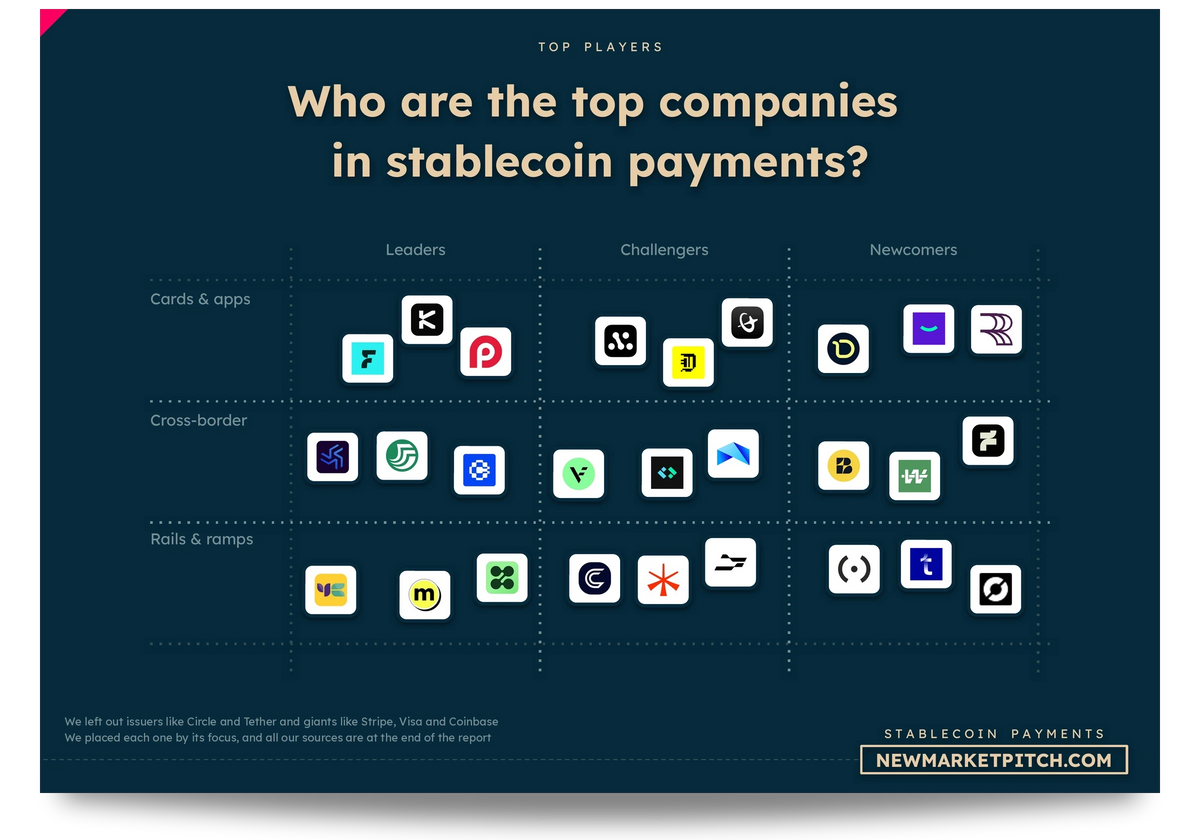
In our document detailing everything you need to know about stablecoin payments, we turn what is vague and complex into simple, useful visuals. Market maps like this one show you at a glance where every startup stands.
Can stablecoin issuers survive if customers want interest on their digital dollars?
Stablecoin issuers can remain profitable if users demand interest, but widespread revenue sharing would reduce the earnings they retain from each dollar in circulation.
The pressure comes from competition with interest-bearing financial products. Customers holding large amounts of digital dollars can compare their returns with Treasury bills, money market funds and bank deposits.
A stablecoin that pays no yield may still be useful for payments and trading. But holding millions of dollars in a non-interest-bearing asset becomes expensive when customers can earn several percentage points elsewhere.
Issuers can respond by paying distributors, offering other incentives or making their tokens more useful across financial applications. Greater spending on customer acquisition and retention, though, reduces retained reserve income.
There is a regulatory constraint as well. Under the U.S. framework, payment stablecoin issuers face restrictions on paying yield directly to holders. Rewards offered by independent intermediaries raise separate questions about the boundaries of those restrictions.
Companies with widely accepted stablecoins and deep liquidity networks may be able to retain more income because users value convenience and reliability. Smaller issuers could have to offer stronger incentives to attract balances.
What could make a profitable stablecoin company start losing money?
Stablecoin companies can lose money when reserve yields fall, customer balances shrink, distribution costs rise or investments lose value. Payment providers face additional risks from fraud, liquidity expenses and thin processing margins.
For issuers, the combination of interest rates and circulation is particularly important. A company that grows its reserves by 20% but experiences a large decline in yield may still report falling investment income.
Financial expenses create another risk. The gap between Circle's gross revenue and bottom-line profitability shows why partner payments, operating costs and one-time expenses need to be examined separately rather than relying on reserve income alone.
Tether faces different exposures through the composition of its reserves. Holding investment assets beyond cash and short-term Treasury securities can increase returns, but also introduces greater sensitivity to market prices.
Payment processors can struggle even when transaction volumes rise. A company charging 0.5% on payments has to cover banking, foreign exchange liquidity, compliance, customer support and operational costs within that fee. A small increase in expenses can eliminate much of its margin.
There is also the risk of rapid redemptions. Stablecoin issuers must remain capable of converting tokens back into dollars, including during periods when users withdraw significant amounts of money. Maintaining sufficiently liquid reserves is essential for both financial stability and customer confidence.

Our report covering the stablecoin payments market gets updated several times a month, so you always get the latest view of where things stand.
How do stablecoin firms make money if transfers are free?
Stablecoin firms make money by earning returns on reserves, sharing those returns through distribution agreements, charging businesses for payment services and selling financial infrastructure. Free blockchain transfers have not prevented the largest companies from generating substantial revenue.
The strongest evidence comes from reserve-backed stablecoins. Tether has demonstrated how profitable the model can become when a company controls an enormous pool of assets. Circle has shown that generating reserve income is much easier than keeping all of it, especially when distribution partners demand significant compensation.
Payment processors have a different opportunity. Merchants can save money compared with certain traditional payment methods while still paying a provider to manage conversion, compliance and settlement. Stripe's pricing shows that businesses will pay for those services.
Meanwhile, banks and established financial platforms are integrating stablecoins into existing products. That makes adoption more credible, but also raises the competitive pressure on independent infrastructure startups.
For now, the clearest stablecoin profits come from controlling large reserve pools and valuable distribution channels. Transaction processing and software can also generate revenue, but their profitability is less established, particularly for independent startups facing competition from major financial platforms.
If you want more recent data on this point, please see our latest stablecoin payments market report.
Sources and methodology
To answer how stablecoin firms make money when transfers are free, we broke the industry into its underlying economic models: reserve-backed issuance, stablecoin distribution, merchant processing, cross-border payments and enterprise infrastructure. For each, we examined recent financial results, commercial activity, pricing and regulatory developments, then aggregated the relevant evidence to assess which revenue mechanisms had demonstrated profitability and which remained emerging opportunities.
We distinguished income earned from holding stablecoin reserves from fees earned by moving or servicing those stablecoins. Our comparison also separates gross reserve income, revenue retained after distribution payments and bottom-line profit. These distinctions are particularly important when comparing Tether, Circle and Coinbase, whose economic exposure to stablecoins is significant but structurally different.
For financial performance, we prioritized published company filings and attributable disclosures. Circle and Coinbase's regulatory filings provide detailed information on revenue, partner payments, expenses and interest-rate sensitivity. Tether's reserve attestations and financial announcements offer a different level of disclosure and were evaluated accordingly. We used explicit reserve-yield calculations to test how issuer revenue changes with circulation and interest rates, without treating hypothetical income as reported earnings.
For payment adoption, we combined blockchain activity data with research identifying commercial transactions and institutional implementations. We distinguished raw onchain transfers from adjusted activity, payment flows from provider revenue, and announced payment capabilities from demonstrated usage. Published fee schedules were used to establish what providers charge, rather than to infer their actual margins or profitability.
We also assessed how regulation, distribution relationships and existing banking infrastructure affect the commercial position of each business model. The resulting conclusions reflect the combined evidence across these dimensions, with greater weight given to demonstrated financial outcomes than to transaction growth, market announcements or potential revenue opportunities alone.
Key financial sources include Tether's full-year 2025 results and reserve disclosures, Tether's second-quarter 2026 update, Circle's 2025 Form 10-K, Circle's second-quarter 2026 Form 10-Q, Circle's second-quarter earnings release, and Coinbase's 2025 Form 10-K.
For transaction economics and industry adoption, we drew on Stripe's published payment pricing, Stripe's Bridge acquisition announcement, Stripe's explanation of stablecoin acceptance, Visa's stablecoin market research, Visa's Onchain Analytics dashboard, its transaction measurement methodology, and Visa's research on stablecoin-linked card programs.
Additional evidence on commercial payment activity came from Allium's September 2026 State of Stablecoins and Payments, Allium and FXC Intelligence's cross-border payments research, and BCG and Allium's analysis of stablecoin payment activity. For the U.S. regulatory framework, we used the GENIUS Act, Public Law 119-27, rather than relying on secondary descriptions of its requirements.

In our research about stablecoin payments, we don't want to repeat what boring consulting reports say. Instead, we show you the real and latest market signals that matter.
Written by the New Market Pitch teamWe track new markets so founders and investors can move faster. About us