What’s the latest funding news in the warehouse robotics market? (October 2026)
Whether you're building or investing in the warehouse robotics market, our report covers everything you need to know: the players, the money, and what's coming next.
Warehouse robotics startups are attracting significant investment as fulfillment centers look for faster, more flexible ways to automate physical work.
From July to October 2026, 12 companies in our research announced financing related to robotic picking, packing, sorting, storage and warehouse operations.
These funding rounds show growing investor interest in practical automation, although some companies also serve manufacturing and other industrial markets.
And if you want to better understand this new industry, you can download our pitch covering the warehouse robotics market.
Insights
- Seven of the 12 warehouse robotics funding announcements came from US companies, representing approximately 58% of the list. American startups remain particularly visible in robotic fulfillment, warehouse automation software and material-handling systems.
- Maven Robotics announced the largest newly disclosed financing in this selection, raising $100 million in September 2026. However, its industrial robotics platform also targets manufacturing, making its warehouse-specific market exposure difficult to establish.
- Ultra Robotics raised $50 million in its October 2026 Series A, bringing total disclosed funding to $62 million. The Series A therefore represented approximately 81% of the company's cumulative financing.
- Warehouse robotics software is emerging as an important investment category alongside physical machines. Destro AI raised $8 million for robot orchestration, while Logibot secured approximately $1.65 million for hardware-independent deployment and control.
- September was the busiest month for the 12 companies we tracked, accounting for seven reported financings. These announcements covered mobile robots, warehouse control software, autonomous loading systems and broader industrial manipulation platforms.
- Investors are backing different business models for warehouse automation. Ultra and Motion emphasize subscription-based robotic services, while Vecna and UNIT AI focus on physical systems designed to improve existing fulfillment operations.
- TWINNY stands out for disclosing a valuation alongside its financing. Its September pre-IPO round valued the South Korean autonomous mobile robot company at approximately $145 million to $150 million after investment.
- Commercial execution has become a central part of warehouse robotics fundraising. Ultra reported processing more than 500,000 orders, while Sereact reported over 200 operating systems, showing why real customer deployments matter to investors.
- Funding headlines require careful interpretation. Sereact's $116 million represented its extended Series B total, not the amount invested by Zalando in July, while the amount of Zalando's incremental investment remained undisclosed.

Written by the New Market Pitch teamWe track new markets so founders and investors can move faster. About us

In our report covering the warehouse robotics market, you will always find fresh funding data, taken straight from our own verified funding database.
Summary table of the latest funding deals in the warehouse robotics market as of October 2026
We define the warehouse robotics market as robotic systems that automate work inside warehouses and fulfillment centers.
We include mobile robots, robotic picking, sorting and storage systems and their dedicated control software.
We exclude general warehouse software, road delivery vehicles and conventional conveyors without robotic functionality.
The following table presents 12 recent funding announcements, ordered from newest to oldest, with amounts converted into US dollars where possible. Companies with broader industrial activities are included with appropriate qualifications, and an undisclosed extension amount is not treated as a newly raised $116 million.
| Name | When | Amount in $ | Round Type | Category |
|---|---|---|---|---|
| Ultra Robotics | October 9, 2026 | $50M | Series A | Warehouse Packing & Sorting Robots |
| Destro AI | September 29, 2026 | $8M | Seed | Warehouse Robot Orchestration Software |
| Logibot | September 17, 2026 | ~$1.65M | Seed | Robot Integration & Fleet Management |
| Vecna Robotics | September 10, 2026 | $31M | Undisclosed Series | Autonomous Mobile Robots & Pallet Handling |
| Maven Robotics | September 10, 2026 | $100M | Series A | Robotic Palletizing & Industrial Manipulation |
| SENAD | September 7, 2026 | ~$28M | Reported Series C+ | Robotic Loading & Unloading |
| Locus Robotics | September 1, 2026 | $41.6M | Reported Series G | Autonomous Mobile Fulfillment Robots |
| TWINNY | September 1, 2026 | ~$10.5M | Pre-IPO | Autonomous Mobile Robots |
| Motion | August 27, 2026 | $2M | Pre-seed | Humanoid Robot Deployment Services |
| Avatar Robotics | August 5, 2026 | $6.5M | Seed | Robotic Packing & Teleoperation |
| UNIT AI | July 29, 2026 | $12M | Venture Financing | Robotic Storage & Retrieval Systems |
| Sereact | July 20, 2026 | Undisclosed* | Series B Extension | AI Robotic Picking & Control Software |
*Sereact's extended Series B reached $116 million in total, but the incremental investment announced in July was not disclosed. Other currency conversions are approximate, and SENAD reported nearly RMB 200 million rather than an exact amount.
All the latest funding deals in the warehouse robotics market as of October 2026
Ultra Robotics raised $50 million in a Series A round in October 2026 to expand its warehouse robotics business.
When was it?
Ultra Robotics announced its latest financing on October 9, 2026.
Who are they?
Ultra Robotics develops robotic systems that pack, sort and organize products inside e-commerce fulfillment warehouses, offering the machines through a subscription-based service.
Geographical focus?
Ultra Robotics is based in Brooklyn, New York, and primarily serves US fulfillment centers and third-party logistics operators.
Why do we include them in the warehouse robotics market?
Ultra Robotics directly automates warehouse packing, sorting and kitting, making its robotic manipulation systems a clear fit for warehouse fulfillment automation.
What is the company stage?
Ultra Robotics is entering commercial growth, with robots operating in customer warehouses and more than 500,000 orders reportedly processed.
How much did they raise?
Ultra Robotics raised $50 million in new Series A funding, bringing its total disclosed financing to $62 million across two rounds.
What round is it?
The financing was a Series A led by Framework Ventures, with Y Combinator participating and earlier seed funding led by Y Combinator and NextView Ventures.
Why did they raise?
Ultra Robotics plans to manufacture more robots, expand its installation and servicing teams, and bring its robots-as-a-service model to additional warehouses.
Destro AI raised $8 million in seed funding in September 2026 to coordinate robots across warehouses.
When was it?
Destro AI announced its seed financing on September 29, 2026.
Who are they?
Destro AI develops software that helps robots from different manufacturers work together with warehouse employees and existing business systems.
Geographical focus?
Destro AI operates from Brooklyn, New York, initially targeting American logistics operators while developing software for international warehouse customers.
Why do we include them in the warehouse robotics market?
Destro AI belongs to the warehouse robot orchestration category because its MothershipOS and VisionOS platforms coordinate robotic tasks, movements and workflows inside logistics facilities.
What is the company stage?
Destro AI is at the early commercialization stage, with its software already used in enterprise logistics operations, including a deployment associated with Yusen Logistics.
How much did they raise?
Destro AI raised $8 million in its announced seed financing.
What round is it?
The seed round was co-led by Base10 Partners and Bonfire Ventures, with participation from CoFound Partners.
Why did they raise?
Destro AI plans to deploy its orchestration software in more warehouses, improve its robotic intelligence products and expand its engineering and research teams.

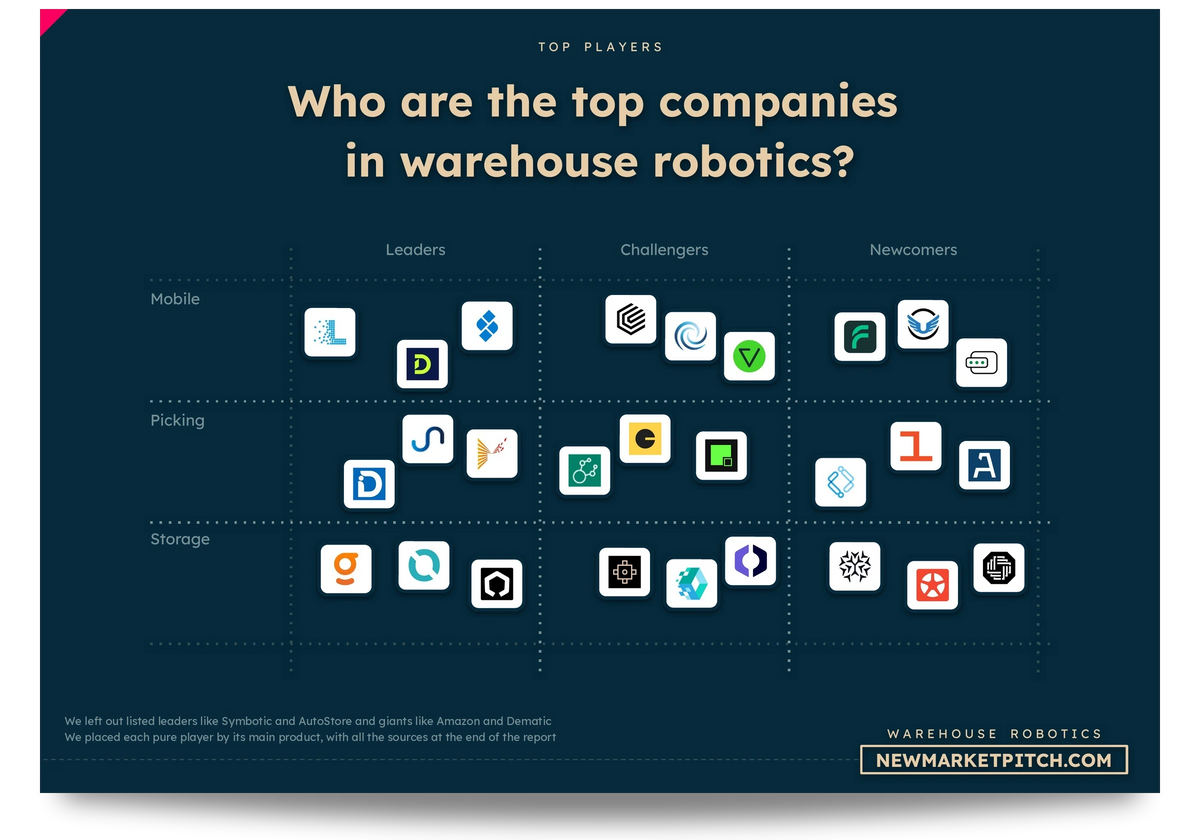
In our research about warehouse robots, we turn what is vague and complex into simple, useful visuals. Market maps like this one show you at a glance where every startup stands.
Logibot raised approximately $1.65 million in September 2026 to simplify warehouse robot deployment.
When was it?
Logibot announced its funding round on September 17, 2026.
Who are they?
Logibot develops software that helps warehouse operators select, simulate, deploy and manage robots supplied by different hardware manufacturers.
Geographical focus?
Logibot is headquartered in Belgium and focuses primarily on European warehouses, postal operators, parcel distribution companies and logistics service providers.
Why do we include them in the warehouse robotics market?
Logibot specializes in warehouse robot integration and control software, although its broader industrial customer exposure means its exact warehouse revenue concentration remains unverified.
What is the company stage?
Logibot is in early commercial development, with logistics customers and initial robotic deployments supporting its transition beyond product validation.
How much did they raise?
Logibot raised €1.4 million, equivalent to approximately $1.65 million using an illustrative exchange rate.
What round is it?
The seed round was led by BeamBerlin, with RDY Ventures, PMV and BAN Business Angels participating.
Why did they raise?
Logibot plans to make robotic automation easier to adopt by helping warehouse operators integrate different machines without replacing their existing infrastructure.
Vecna Robotics raised $31 million in September 2026 to expand autonomous warehouse material handling.
When was it?
Vecna Robotics publicly announced the $31 million financing on September 10, 2026, following earlier media reporting.
Who are they?
Vecna Robotics designs autonomous forklifts, robotic pallet jacks and mobile transport robots that move goods around warehouses and distribution facilities.
Geographical focus?
Vecna Robotics is based in Massachusetts and primarily serves North American warehouse, logistics and industrial customers.
Why do we include them in the warehouse robotics market?
Vecna Robotics supplies autonomous mobile robots and warehouse fleet software for pallet transport, case picking and dock-to-dock material handling.
What is the company stage?
Vecna Robotics is a commercial growth-stage company with established warehouse deployments, including systems used by logistics provider GEODIS.
How much did they raise?
Vecna Robotics secured $31 million in additional financing.
What round is it?
The company did not publicly assign a conventional series designation to the announcement, and the financing was led by Unless with several existing investors participating.
Why did they raise?
Vecna Robotics plans to expand its deployment teams, accelerate installations and develop additional capabilities for pallet stacking, unloading and trailer operations.

Your time is limited. In our market report about warehouse robots, we put numbers on each part of the market, so you can see where it makes sense to focus.
Maven Robotics raised $100 million in Series A funding in September 2026 to scale industrial robotic manipulation.
When was it?
Maven Robotics announced its financing on September 10, 2026.
Who are they?
Maven Robotics develops autonomous industrial robots that handle mixed-case palletizing, totes and increasingly complex physical tasks across logistics and manufacturing environments.
Geographical focus?
Maven Robotics is headquartered in Santa Clara, California, and initially serves US industrial customers while pursuing a broader international market.
Why do we include them in the warehouse robotics market?
Maven Robotics targets warehouse material handling and palletizing, but its manufacturing and assembly activities make it a broader industrial robotics company rather than a verified warehouse pure player.
What is the company stage?
Maven Robotics is in early commercial scaling, with robots already performing multiple autonomous shifts in customer operations.
How much did they raise?
Maven Robotics raised $100 million in Series A financing, the largest newly disclosed amount among these 12 announcements.
What round is it?
The financing was a Series A backed by investors including RoboStrategy, LocalGlobe, Vine Ventures and XTX Ventures, alongside other institutional participants.
Why did they raise?
Maven Robotics plans to manufacture and deploy additional machines, expand commercial operations and develop more complex robotic handling and assembly capabilities.
SENAD announced nearly $28 million in new financing in September 2026 for autonomous logistics handling robots.
When was it?
SENAD's latest financing was publicly reported on September 7, 2026.
Who are they?
SENAD develops intelligent robots that autonomously load, unload, sort and manipulate parcels and cargo inside logistics and industrial facilities.
Geographical focus?
SENAD is based in China, with domestic commercial deployments and international expansion through channels serving Europe, Japan and other overseas markets.
Why do we include them in the warehouse robotics market?
SENAD develops robotic loading and unloading systems for warehouse logistics, including machines designed to handle irregular cargo and mixed-product shipments.
What is the company stage?
SENAD is in commercial expansion, with robotic handling systems reportedly deployed across logistics, consumer goods, pharmaceuticals and other industrial supply chains.
How much did they raise?
SENAD raised nearly RMB 200 million, equivalent to approximately $28 million, although the Chinese announcement did not disclose an exact amount.
What round is it?
The financing was reported as a Series C extension by funding trackers, although contemporary Chinese news described it more generally as a new financing round.
Why did they raise?
SENAD plans to expand commercial deployments, develop more advanced robotic manipulation technology and strengthen its domestic and international market presence.

In our document detailing everything you need to know about warehouse robotics, we always try to gather several sources and make estimates that make sense, so you can work with solid numbers.
Locus Robotics secured $41.6 million in a reported Series G financing in September 2026 to expand warehouse automation.
When was it?
Locus Robotics' $41.6 million financing was reported by Axios on September 1, 2026, before additional coverage appeared the following day.
Who are they?
Locus Robotics develops autonomous mobile robots that help warehouse workers collect orders, transport inventory and coordinate fulfillment activities.
Geographical focus?
Locus Robotics is headquartered in the United States and operates internationally, serving warehouses across North America, Europe and Asia.
Why do we include them in the warehouse robotics market?
Locus Robotics is a dedicated warehouse automation provider specializing in autonomous mobile robots, robotic order fulfillment and fleet coordination software.
What is the company stage?
Locus Robotics is an established commercial-scale robotics company with enterprise logistics customers and an international deployment footprint.
How much did they raise?
Locus Robotics secured $41.6 million from existing investors, according to September 2026 reporting.
What round is it?
The financing was reported as part of a Series G, with participation from existing financial backers.
Why did they raise?
Locus Robotics is positioned to use additional capital to expand its robotic fulfillment operations, advance multi-robot orchestration and support wider adoption of warehouse automation systems.
TWINNY raised approximately $10.5 million in pre-IPO funding in September 2026 to expand its autonomous warehouse robots.
When was it?
TWINNY announced its pre-IPO financing on September 1, 2026, with additional valuation details reported later that month.
Who are they?
TWINNY develops autonomous mobile robots that transport goods and assist order picking inside warehouses without requiring fixed floor markers.
Geographical focus?
TWINNY is based in South Korea and serves domestic logistics customers while preparing to expand its autonomous robotics business internationally.
Why do we include them in the warehouse robotics market?
TWINNY belongs to the autonomous mobile robot category, with navigation technology and picking-support systems designed specifically for warehouse and logistics operations.
What is the company stage?
TWINNY is in commercial growth and pre-IPO preparation, with deployed logistics robots and plans for a potential KOSDAQ listing.
How much did they raise?
TWINNY raised KRW 14.4 billion, approximately $10.5 million, at a reported post-money valuation of KRW 204.4 billion, or roughly $145 million to $150 million.
What round is it?
The financing was a pre-IPO investment involving DS Asset Management, ATO Investment, ATO Management and other professional investors.
Why did they raise?
TWINNY plans to accelerate international commercialization, strengthen its autonomous mobile robot operations and prepare for a potential public listing.

Our report covering the warehouse robotics market gets updated several times a month, so you always get the latest view of where things stand.
Motion raised $2 million in pre-seed funding in August 2026 to expand humanoid robot deployments across Europe.
When was it?
Motion announced its pre-seed financing on August 27, 2026.
Who are they?
Motion provides humanoid robots through a subscription service that includes deployment, training, integration, maintenance and ongoing fleet management.
Geographical focus?
Motion is headquartered in Belgium and initially focuses on European industrial, warehouse and logistics customers.
Why do we include them in the warehouse robotics market?
Motion offers humanoid robots for warehouse material handling and repetitive logistics work, although its broader manufacturing activities prevent confirmation that warehouse automation dominates its business.
What is the company stage?
Motion is in early commercial validation, moving from industrial pilot projects toward recurring paid robot deployments.
How much did they raise?
Motion raised $2 million in its announced financing.
What round is it?
The financing was a pre-seed round led by Extantia Capital, with participation from Norrsken Evolve.
Why did they raise?
Motion plans to expand its humanoid robot fleet, improve integration and support services, and convert European pilot projects into commercial deployments.
Avatar Robotics raised $6.5 million in seed funding in August 2026 to expand remotely assisted warehouse robots.
When was it?
Avatar Robotics announced its seed financing on August 5, 2026.
Who are they?
Avatar Robotics deploys robots that pick, pack, sort and move warehouse products, using remote human operators when tasks are not yet fully autonomous.
Geographical focus?
Avatar Robotics is headquartered in San Francisco and primarily serves US warehouse operators, with remote robot operators working from international locations.
Why do we include them in the warehouse robotics market?
Avatar Robotics directly automates warehouse picking and packing, combining robotic manipulation, teleoperation and machine learning to complete physical fulfillment tasks.
What is the company stage?
Avatar Robotics is in early commercialization, with operating warehouse robots that have reportedly handled nearly one million products.
How much did they raise?
Avatar Robotics raised $6.5 million in seed financing, alongside disclosure of an earlier pre-seed investment whose amount was not specified.
What round is it?
The financing was a seed round led by AlleyCorp, while defy.vc led an earlier pre-seed round and additional investors included Headline.
Why did they raise?
Avatar Robotics plans to install hundreds more robots in operating warehouses and use data collected during remote-controlled work to develop greater robotic autonomy.

In our research about warehouse robots, we look at what the winners do differently, so you can learn from the best instead of guessing.
UNIT AI raised $12 million in July 2026 to expand its modular robotic fulfillment and returns systems.
When was it?
UNIT AI announced its financing on July 29, 2026.
Who are they?
UNIT AI develops modular warehouse automation systems that use robots to store, retrieve and manage individual products for e-commerce fulfillment and returns.
Geographical focus?
UNIT AI focuses on North America, particularly retailers, fulfillment centers and third-party logistics operators seeking accessible warehouse automation.
Why do we include them in the warehouse robotics market?
UNIT AI develops robotic storage and retrieval systems designed for warehouse inventory handling, order fulfillment and reverse logistics.
What is the company stage?
UNIT AI is in commercial growth, with a modular automation platform designed for deployment inside existing fulfillment facilities.
How much did they raise?
UNIT AI raised $12 million in its latest disclosed financing.
What round is it?
The venture financing was co-led by Prologis Ventures, Dynamo Ventures and Ground Up Ventures, with several additional investors participating.
Why did they raise?
UNIT AI plans to expand its installation capacity, improve its robotic fulfillment technology and make warehouse automation more accessible to retailers and logistics companies.
Sereact announced a new strategic investment in July 2026, bringing its extended Series B to $116 million.
When was it?
Sereact announced Zalando's strategic investment on July 20, 2026.
Who are they?
Sereact develops AI software that allows robotic arms and other machines to recognize, pick and manipulate products inside fulfillment centers.
Geographical focus?
Sereact is headquartered in Stuttgart, Germany, and serves warehouse and industrial customers across Europe, the United States and other international markets.
Why do we include them in the warehouse robotics market?
Sereact specializes in robotic picking intelligence and warehouse automation software, particularly for order fulfillment, product handling and e-commerce returns.
What is the company stage?
Sereact is commercially established, with more than 200 robotic systems reportedly deployed and over one billion production picks completed through its technology.
How much did they raise?
Sereact did not disclose the incremental amount invested by Zalando; the $116 million figure represents the total extended Series B rather than new July funding.
What round is it?
The transaction was a strategic extension of Sereact's Series B, originally led by Headline, with Zalando joining as a new investor.
Why did they raise?
Sereact plans to develop its next-generation Cortex robotic intelligence platform, expand internationally and automate additional warehouse workflows, including e-commerce returns processing.
Written by the New Market Pitch teamWe track new markets so founders and investors can move faster. About us