Warehouse robotics funding tracker (80+ deals)
Whether you're building or investing in the warehouse robotics market, our report covers everything you need to know: the players, the money, and what's coming next.
Summary
We tracked 87 warehouse robotics deals involving 59 companies and at least $2.3B in disclosed funding. Dexterity raised the most in our coverage window, with $200M across 2 rounds. Agility Robotics had the largest single deal, a $162M Series C in 2025.
The total looks impressive. Yet the median disclosed round was $14M, and large financings account for much of the disclosed money.
The market also has repeat winners. We found 24 companies with repeat financings, while 35 companies raised once during the covered period. One new announcement does not necessarily mean one new robotics startup.
Autonomous mobile robots attracted the most deals and at least $722M. Robotic picking also drew major checks, partly because identifying and gripping changing products is harder than moving goods down an aisle.
Palletizing and depalletizing robots received significant capital from just two developers. Investors will pay for machines that can handle heavy, repetitive work reliably, even when the field of funded suppliers is narrow.
Robotic storage, forklifts, sorting and control software tell a different story. Some companies have raised substantial sums, but one big financing can dominate a small category.
Age separates ordinary rounds from the biggest ones. The median company was 6 years old when it raised, and 8.5 years old for rounds above $50M. Hardware takes time to prove in live operations.
Customer deployments make the financing more credible. GXO has used Agility Robotics' Digit robots, Zalando is expanding robotic picking with Nomagic, and FedEx has worked with Nimble on autonomous fulfillment. None of those relationships, on its own, proves a startup is profitable.
The United States receives the biggest share of disclosed capital. European and Asian companies are still active, but the size of their checks often looks quite different.
Taken together, these deals show a market with working products and real customers, alongside startups still fighting to make their robots reliable and affordable. The useful question is what each check buys and how far the company has actually progressed.

Written by the New Market Pitch teamWe track new markets so founders and investors can move faster. About us

In our report covering the warehouse robotics market, you will always find fresh funding data, taken straight from our own verified funding database.
Our funding tracker covering the warehouse robotics market
Below is the table listing all the deals. You can find our methodology at the end of this page.
If you want a deeper understanding of the market and its current dynamics, get our warehouse robotics market report.
| Company | Category | Date | Stage | Deal size | What they do | Region | Lead investors | Country | Rank |
|---|---|---|---|---|---|---|---|---|---|
| Tutor Intelligence | Palletizing & Depalletizing Robots | November 2026 | Series B | $75M | General-purpose AI robots for warehouses | North America | Andreessen Horowitz | United States | |
| Ultra | Robotic Picking Systems | October 2026 | Series A | $50M | Robots-as-a-service for warehouse fulfillment | North America | Framework Ventures | United States | |
| Destro AI | Warehouse Robot Orchestration | September 2026 | Seed | $8M | AI orchestration for warehouse robots | North America | Base10 Partners, Bonfire Ventures | United States | |
| Logibot | Autonomous Mobile Robots | September 2026 | Seed | $1.5M | Autonomous mobile robots for warehouses | Europe | BeamBerlin | Belgium | |
| Yincheng Intelligent | Robotic Sorting Systems | September 2026 | Series A | ~$14M | Robots for warehouse and factory logistics | Asia-Pacific | Huamin Investment, Shanghai Semiconductor Industry Investment | China | |
| Vecna Robotics | Autonomous Mobile Robots | September 2026 | Series D+ | $31M | Autonomous material handling robots | North America | Unless | United States | |
| SENAD | Robotic Sorting Systems | September 2026 | Series C | ~$30M | Warehouse sorting and logistics robots | Asia-Pacific | Not disclosed | China | |
| Tiangong Robot | Robotic Sorting Systems | September 2026 | Unknown | Undisclosed | Warehouse automation robots and handling systems | Asia-Pacific | Chuxin Fund | China | |
| Twinny | Autonomous Mobile Robots | September 2026 | Growth Equity | ~$11M | Autonomous warehouse transportation and picking | Asia-Pacific | Not disclosed | South Korea | |
| Corvus Robotics | Autonomous Mobile Robots | August 2026 | Series A | $20M | Autonomous warehouse inventory drones | North America | Catalyst Investors | United States | |
| Locus Robotics | Autonomous Mobile Robots | August 2026 | Series D+ | $42M | Autonomous warehouse picking robots | North America | Not disclosed | United States | |
| Avatar Robotics | Robotic Picking Systems | August 2026 | Seed | $6.5M | Remotely operated industrial robots | North America | AlleyCorp, defy.vc | United States | |
| UNIT AI | Automated Storage & Retrieval Systems | July 2026 | Seed | $12M | Modular robotic storage retrieval systems | North America | Prologis Ventures, Dynamo Ventures, Ground Up Ventures | United States | |
| Sereact | Robotic Picking Systems | July 2026 | Series B | $6M | Physical AI robotic picking software | Europe | Not disclosed | Germany | |
| Cytronic | Warehouse Robot Orchestration | July 2026 | Seed | $14M | Robotics-led third-party fulfillment service | North America | Slow Ventures | United States | |
| SENAD | Robotic Sorting Systems | June 2026 | Series C | ~$44M | Warehouse sorting and logistics robots | Asia-Pacific | Full Truck Alliance | China | |
| ULTIROBOTICS | Robotic Sorting Systems | June 2026 | Series A | $1.5M+ | Autonomous robots for warehouse material handling | Asia-Pacific | Not disclosed | China | |
| Yincheng Intelligent | Robotic Sorting Systems | May 2026 | Seed | Undisclosed | Robots for warehouse and factory logistics | Asia-Pacific | DT Capital Partners | China | |
| Dexterity | Palletizing & Depalletizing Robots | May 2026 | Unknown | $105M | AI-powered industrial warehouse robots | North America | Not disclosed | United States | |
| Anscer Robotics | Autonomous Mobile Robots | May 2026 | Series A | $5.4M | Autonomous mobile intralogistics robots | Asia-Pacific | IAN Alpha Fund | India | |
| Sereact | Robotic Picking Systems | April 2026 | Series B | $110M | Physical AI robotic picking software | Europe | Headline | Germany | |
| ZIKOO Robotics | Automated Storage & Retrieval Systems | April 2026 | Unknown | Undisclosed | High-density robotic warehouse storage systems | Asia-Pacific | Suzhou Capital Group | China | |
| Smart Robotics | Robotic Picking Systems | April 2026 | Series A | ~$12M | AI robotic picking and palletizing | Europe | Rotterdamse Havendraken | Netherlands | |
| Twinny | Autonomous Mobile Robots | March 2026 | Series C | ~$14M | Autonomous warehouse transportation and picking | Asia-Pacific | Ato Investment | South Korea | |
| Anyware Robotics | Robotic Picking Systems | March 2026 | Unknown | Undisclosed | AI-powered mobile manipulation robots | North America | Not disclosed | United States | |
| SENAD | Robotic Sorting Systems | March 2026 | Growth Equity | $29M+ | Warehouse sorting and logistics robots | Asia-Pacific | Not disclosed | China | |
| Gather AI | Autonomous Mobile Robots | February 2026 | Series B | $40M | AI drone-based warehouse inventory monitoring | North America | Smith Point Capital Management | United States | |
| Nomagic | Robotic Picking Systems | January 2026 | Series B | $10M | AI robotic warehouse picking | Europe | Cogito Capital Partners | Poland | |
| LexxPluss | Autonomous Mobile Robots | January 2026 | Unknown | Undisclosed | Autonomous mobile industrial logistics robots | Asia-Pacific | Not disclosed | Japan | |
| NEOintralogistics | Autonomous Mobile Robots | January 2026 | Seed | ~$3.5M | Warehouse automation robots offered as service | Europe | Amadeus APEX Technology Fund, Cetus Holding | Germany | |
| Mytra | Automated Storage & Retrieval Systems | January 2026 | Series C | $120M | AI-powered robotic material handling | North America | Avenir Growth | United States | |
| LexxPluss | Autonomous Mobile Robots | January 2026 | Series B | Undisclosed | Autonomous mobile industrial logistics robots | Asia-Pacific | Not disclosed | Japan | |
| ZS Robotics | Automated Storage & Retrieval Systems | December 2025 | Series A | $1M+ | Automated pallet storage and warehouse robotics | Asia-Pacific | Yinfeng Capital | China | |
| Mujin | Warehouse Robot Orchestration | December 2025 | Series D+ | $133M | Robotic picking and pallet handling systems | Asia-Pacific | NTT Group, QIA | Japan | |
| Tutor Intelligence | Palletizing & Depalletizing Robots | December 2025 | Series A | $34M | General-purpose AI robots for warehouses | North America | Union Square Ventures, Fundomo | United States | |
| Dexory | Autonomous Mobile Robots | October 2025 | Series C | $100M | Autonomous warehouse inventory intelligence | Europe | Eurazeo | United Kingdom | |
| Seegrid | Autonomous Mobile Robots | October 2025 | Series D+ | $25M | Autonomous industrial vehicles and forklifts | North America | Not disclosed | United States | |
| Freespace Robotics | Automated Storage & Retrieval Systems | September 2025 | Unknown | Undisclosed | High-density automated warehouse storage | North America | Not disclosed | United States | |
| MagicStore Robotics | Automated Storage & Retrieval Systems | August 2025 | Unknown | Undisclosed | Robots moving goods between workshops and warehouses | Asia-Pacific | Waniu Capital | China | |
| Xpand | Automated Storage & Retrieval Systems | August 2025 | Growth Equity | $6M | Robotic dark stores and fulfillment | Middle East | Ibex Investors, Emerge | Israel | |
| Milvus Robotics | Autonomous Mobile Robots | July 2025 | Series A | $1M | Autonomous mobile robots for factories and warehouses | Europe | TT Ventures GSYF | Turkey | |
| Filics | Autonomous Mobile Robots | July 2025 | Series A | $15M | Autonomous pallet handling robots | Europe | Sandwater, F-LOG Ventures | Germany | |
| Milvus Robotics | Autonomous Mobile Robots | May 2025 | Series A | $4.5M | Autonomous mobile robots for factories and warehouses | Europe | TT Ventures GSYF | Turkey | |
| Multiway Robotics | Automated Forklifts | April 2025 | Series B | $14M+ | Autonomous industrial forklifts and AMRs | Asia-Pacific | Puhua Capital | China | |
| Contoro Robotics | Robotic Picking Systems | March 2025 | Series A | $12M | AI-powered container unloading robots | North America | Not disclosed | United States | |
| Galam Robotics | Automated Storage & Retrieval Systems | March 2025 | Series A | ~$11M | Autonomous robots for warehouse material handling | Europe | Supernova Invest, Bpifrance Amorçage Industriel | France | |
| Anyware Robotics | Robotic Picking Systems | March 2025 | Seed | $12M | AI-powered mobile manipulation robots | North America | GFT Ventures | United States | |
| Dexterity | Palletizing & Depalletizing Robots | March 2025 | Series C | $95M | AI-powered industrial warehouse robots | North America | Lightspeed Venture Partners, Sumitomo Corporation | United States | |
| Nomagic | Robotic Picking Systems | February 2025 | Series B | $44M | AI robotic warehouse picking | Europe | EBRD Venture Capital | Poland | |
| Anscer Robotics | Autonomous Mobile Robots | February 2025 | Seed | $2M | Autonomous mobile intralogistics robots | Asia-Pacific | Info Edge Ventures | India | |
| UVIONIX Innovations | Autonomous Mobile Robots | February 2025 | Seed | $3.5M | Autonomous drones for warehouse inventory checks | North America | LAUNCHub Ventures, PortfoLion | United States | |
| Freespace Robotics | Automated Storage & Retrieval Systems | January 2025 | Unknown | Undisclosed | High-density automated warehouse storage | North America | Not disclosed | United States | |
| Sereact | Robotic Picking Systems | January 2025 | Series A | $28M | Physical AI robotic picking software | Europe | Creandum | Germany | |
| ZS Robotics | Automated Storage & Retrieval Systems | January 2025 | Series A | Undisclosed | Automated pallet storage and warehouse robotics | Asia-Pacific | Anhui Sci-Tech Innovation Investment | China | |
| Agility Robotics | Robotic Picking Systems | 2025 | Series C | $162M | Bipedal robots for warehouse automation | North America | Not disclosed | United States | |
| Avatar Robotics | Robotic Picking Systems | 2025 | Seed | Undisclosed | Remotely operated industrial robots | North America | defy.vc | United States | |
| Deus Robotics | Warehouse Robot Orchestration | December 2024 | Seed | $3M | Warehouse robots and automation software | Europe | U.Ventures | Ukraine | |
| Slip Robotics | Autonomous Mobile Robots | December 2024 | Series B | $28M | Autonomous truck loading and unloading | North America | DCVC | United States | |
| Cuebus | Automated Storage & Retrieval Systems | December 2024 | Series B | Undisclosed | Urban automated robotic storage systems | Asia-Pacific | Not disclosed | Japan | |
| Pickle Robot | Robotic Picking Systems | November 2024 | Series B | $50M | Robotic truck and container unloading | North America | Not disclosed | United States | |
| Vecna Robotics | Autonomous Mobile Robots | November 2024 | Series C | $15M | Autonomous material handling robots | North America | Not disclosed | United States | |
| Third Wave Automation | Automated Forklifts | October 2024 | Series C | $27M | Autonomous and remotely assisted forklifts | North America | Woven Capital | United States | |
| Deli Smart Warehouse | Automated Storage & Retrieval Systems | October 2024 | Seed | Undisclosed | Automated warehouse robotics systems | Asia-Pacific | Jinyu Maowu | China | |
| Nimble Robotics | Robotic Picking Systems | October 2024 | Series C | $106M | Fully autonomous robotic fulfillment systems | North America | FedEx, Cedar Pine | United States | |
| Robotize | Autonomous Mobile Robots | October 2024 | Unknown | Undisclosed | AMRs for intrafactory pallet transportation | Europe | Not disclosed | Denmark | |
| Corvus Robotics | Autonomous Mobile Robots | October 2024 | Series A | $7.5M | Autonomous warehouse inventory drones | North America | S2G Ventures, Spero Ventures | United States | |
| Dexory | Autonomous Mobile Robots | October 2024 | Series B | $80M | Autonomous warehouse inventory intelligence | Europe | DTCP | United Kingdom | |
| Navflex | Automated Forklifts | September 2024 | Series A | $5.5M | Autonomous robots for trailer loading | North America | Not disclosed | United States | |
| Quicktron Robotics | Autonomous Mobile Robots | September 2024 | Series D+ | $100M+ | Autonomous mobile warehouse robots | Asia-Pacific | Golden Oriole Capital, FarGlory Group, Wuxi Liangxi Technology Innovation Fund, Weifang Yuanfei Industrial Fund | China | |
| Seegrid | Autonomous Mobile Robots | September 2024 | Series D+ | $50M | Autonomous industrial vehicles and forklifts | North America | Giant Eagle Incorporated, G2 Venture Partners | United States | |
| Gideon Brothers | Autonomous Mobile Robots | September 2024 | Unknown | Undisclosed | Autonomous mobile robots for logistics | Europe | Not disclosed | Croatia | |
| PHINXT Robotics | Warehouse Robot Orchestration | August 2024 | Seed | $2.6M | Autonomous warehouse robot coordination software | Europe | Sure Valley Ventures | United Kingdom | |
| Mytra | Automated Storage & Retrieval Systems | July 2024 | Series B | $50M | AI-powered robotic material handling | North America | Greenoaks | United States | |
| Floatic | Autonomous Mobile Robots | June 2024 | Seed | $3.8M | Warehouse picking robots and orchestration software | Asia-Pacific | Capstone Partners | South Korea | |
| XSQUARE Technologies | Automated Forklifts | May 2024 | Series A | $7.9M | Autonomous warehouse robots and fleet software | Asia-Pacific | Wavemaker Partners | Singapore | |
| Pickle Robot | Robotic Picking Systems | May 2024 | Unknown | $15M | Robotic truck and container unloading | North America | Not disclosed | United States | |
| Collaborative Robotics | Autonomous Mobile Robots | April 2024 | Series B | $100M | Collaborative mobile manipulation robots | North America | General Catalyst | United States | |
| Pickle Robot | Robotic Picking Systems | April 2024 | Series A | $42M | Robotic truck and container unloading | North America | Not disclosed | United States | |
| Gather AI | Autonomous Mobile Robots | March 2024 | Series A | $17M | AI drone-based warehouse inventory monitoring | North America | Bain Capital Ventures | United States | |
| Yueshi Robotics | Automated Forklifts | March 2024 | Seed | $2.8M+ | Autonomous forklifts for cold storage warehouses | Asia-Pacific | Not disclosed | China | |
| Reflex Robotics | Robotic Picking Systems | March 2024 | Seed | $7M | Wheeled dual arm humanoids for warehouses | North America | Khosla Ventures | United States | |
| Freespace Robotics | Automated Storage & Retrieval Systems | March 2024 | Unknown | Undisclosed | High-density automated warehouse storage | North America | Not disclosed | United States | |
| Cuebus | Automated Storage & Retrieval Systems | February 2024 | Series B | $1.5M | Urban automated robotic storage systems | Asia-Pacific | Not disclosed | Japan | |
| Mushiny | Robotic Sorting Systems | January 2024 | Series B | Undisclosed | Intelligent warehouse sorting automation systems | Asia-Pacific | Not disclosed | China | |
| Yueshi Robotics | Automated Forklifts | January 2024 | Seed | ~$14M | Autonomous forklifts for cold storage warehouses | Asia-Pacific | Shunchuang Industrial Investment | China | |
| Accio Robotics | Autonomous Mobile Robots | January 2024 | Seed | $1.8M | Warehouse picking and sortation robots | Asia-Pacific | BIG Capital | India | |
| Ultra | Robotic Picking Systems | 2024 | Seed | $12M | Robots-as-a-service for warehouse fulfillment | North America | Not disclosed | United States |

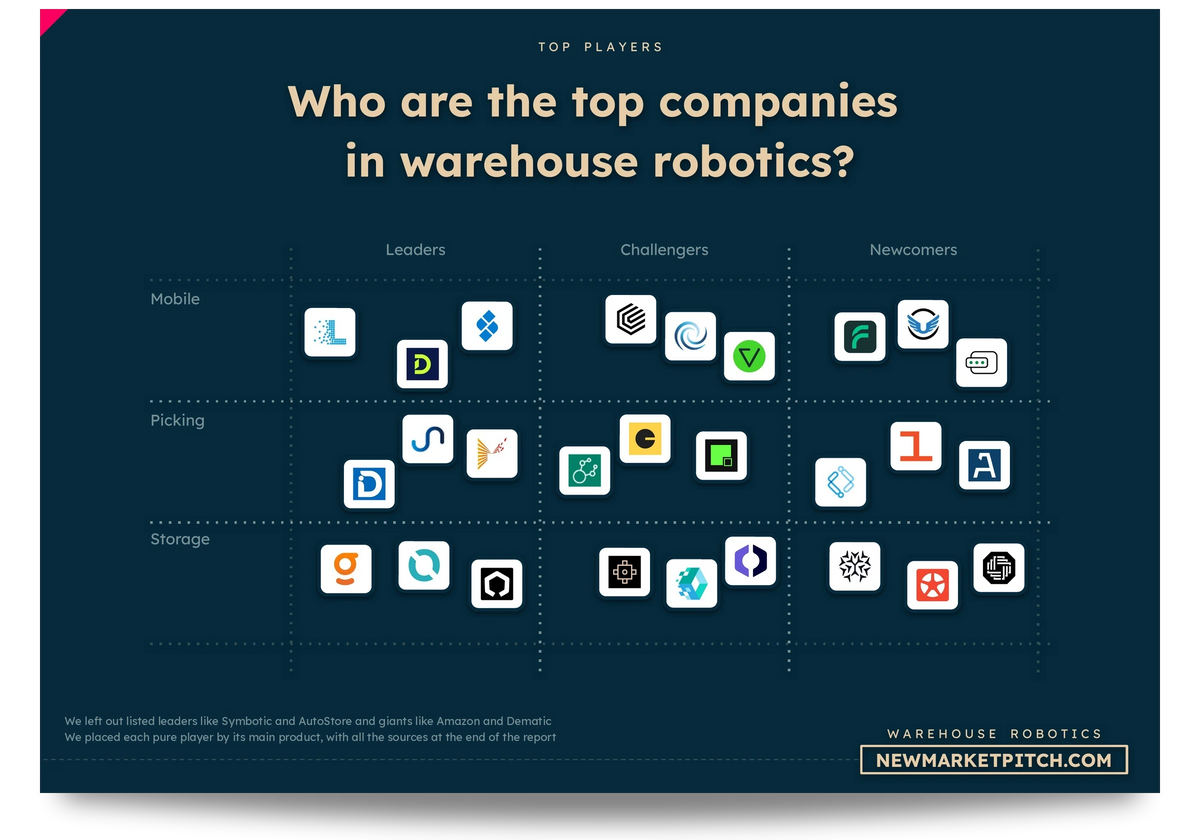
In our research about warehouse robots, we turn what is vague and complex into simple, useful visuals. Market maps like this one show you at a glance where every startup stands.
How much money has warehouse robotics actually raised?
Warehouse robotics startups raised at least $2.3B across 87 deals involving 59 companies in our complete coverage window.
That is a substantial amount for a specialist market, but the figure covers only the funding we can confirm.
We have public amounts for 70 deals, while 17 rounds have undisclosed amounts. We include only public amounts in the funding total. Earlier financings and private amounts could make a company's lifetime funding much larger.
The activity spans companies doing very different jobs. Dexterity builds robots for handling packages and pallets; Dexory scans warehouse inventory; Mytra moves and stores goods through robotic infrastructure. Their products have different installation costs, sales processes and opportunities for expansion. Grouping them under warehouse robotics is useful only if we also look at how the money divides among tasks.
The deals also cover companies at every level of maturity. A seed check for a new robotic coordinator and a later-stage round for machines already working in a distribution center belong in the same funding total. They do not tell us the same thing about customer demand or installation risk.
Is warehouse robotics funding mostly hype around giant rounds?
No, warehouse robotics financing has plenty of smaller rounds, even though a few giant checks take most of the attention.
The largest recorded transaction was Agility Robotics' $162M Series C in 2025, not a billion-dollar round.
Our research identifies 12 deals above $50M, representing 14% of recorded deals and at least $1.3B of disclosed funding. At the other end, 14 disclosed rounds were under $5M, and 26 were in the $5M to under $20M range. The market contains both companies buying time to prove a product and firms financing significant deployments.
Agility's announcement with GXO in October 2026 makes the distinction tangible. Its Digit robots had moved more than 100,000 totes in GXO's Georgia operation, and the partners announced further warehouse deployments planned for 2027. That is more persuasive than a laboratory video, but it does not mean every startup receiving a large round has equivalent experience running robots with customers.
A customer demonstration can help one supplier raise a giant check while other teams are still testing prototypes. Looking only at the biggest rounds makes the market look more mature than the typical funded startup really is.

Your time is limited. In our market report about warehouse robots, we put numbers on each part of the market, so you can see where it makes sense to focus.
What does a normal warehouse robotics funding round look like?
The typical disclosed warehouse robotics round is $14M, far below the checks that make headlines.
That median is a better guide to an ordinary financing than the eye-catching deals at the top of the market.
Among rounds with disclosed amounts, 20% were under $5M, 37% were $5M to under $20M, and 20% were $20M to under $50M. By contrast, 10% were $50M to under $100M, while 13% reached $100M or more. These shares describe the deals with public amounts, not every recorded financing.
Compare Destro AI's $8M Seed in September 2026 with Nomagic's $44M Series B in February 2025 and Dexory's $80M Series B in October 2024. Destro sells coordination software, Nomagic works on picking tasks, and Dexory scans inventory. Their checks fund different products at different stages, so one dollar figure cannot tell us which has the better business.
Nomagic's later rollout with Zalando also illustrates why the investment needs context. Zalando announced in March 2026 that it planned to install up to 50 Nomagic robots across its European network. A smaller earlier round may support very real customer adoption, while a larger round does not automatically mean a better product.
Are lots of warehouse robotics startups actually getting funded?
Yes, warehouse robotics funding reaches 59 companies, although some have raised repeatedly while others appear only once.
We tracked 35 companies with 1 round, 20 companies with 2 rounds and 4 companies with 3 or more rounds during the covered period.
Those counts cover deals during our window, not each company's entire funding history. A startup appearing once may have raised before this period. And a repeat round can add to the headline without adding another company to the market.
Pickle Robot unloads trucks, Corvus Robotics counts inventory from the air, and Mytra moves and stores goods. They all work in warehouses, but they compete for different customer budgets.
Customers also buy from established businesses outside this startup group. Amazon says its own fulfillment network deploys more than 1 million robots, but Amazon is a listed operator rather than a venture-backed warehouse robotics startup. It belongs in the competitive context, not in our financing count. There is room for specialists, but funding for startups is only one slice of the money spent automating warehouses.
Are warehouse robotics startups selling robots or fulfillment services?
Warehouse robotics startups sell both machines and fulfillment services, and that changes what customers are actually buying.
Some operators buy a robot, others pay for its use, and others outsource a warehouse task entirely.
Nimble is the clearest example of the fulfillment model. FedEx announced a commercial alliance and an investment in September 2024 to expand FedEx Fulfillment using Nimble's autonomous operations. Nimble then announced its $106M Series C in October 2024, connecting a large capital raise to a distribution partner with an existing customer network.
Ultra pursues a different entry point. Its $50M Series A in October 2026 supported robots-as-a-service for warehouse fulfillment, while the company also worked with Physical Intelligence on its robotics capabilities. Customers can adopt the technology without necessarily owning every machine upfront. Locus Robotics likewise provides mobile robots alongside software and services, allowing warehouses to adjust robotic capacity as workloads change.
Mytra supplies material-handling infrastructure, while Dexory sells a way to see what is actually on warehouse shelves. Funding alone cannot show which model makes the best margins. It does show investors backing several ways to take repetitive work out of the warehouse.

In our document detailing everything you need to know about warehouse robotics, we always try to gather several sources and make estimates that make sense, so you can work with solid numbers.
Why do warehouse mobile robots get so much funding?
Warehouse mobile robots draw the most funding deals because nearly every fulfillment center needs to move or locate goods.
We tracked 30 autonomous mobile robot deals across 21 companies, with at least $722M raised, or 32% of disclosed capital.
The category includes more than robots carrying shelves. Dexory's autonomous machines scan warehouse locations, Locus Robotics supports workers picking orders, and Corvus Robotics sends drones through indoor aisles to count inventory. Their customers value different outcomes, from reducing walking time to finding missing stock before it disrupts an order.
That range of jobs helps explain the interest, even though many suppliers will still struggle to compete. DHL's chief executive described Dexory's inventory robots in the group's May 2026 annual meeting, including deployments in the United States, the United Kingdom and the Netherlands. Locus describes a DHL facility where mobile robots allowed a major increase in processed orders without matching headcount growth. Those customers show that mobile robots can work in busy warehouses, although results will vary by site.
Moving goods is a common problem, so many companies can pitch a useful robot. Handling irregular items is harder, and the biggest checks can go elsewhere even when mobile robots produce the most deals.
The table below shows funding across the seven warehouse robotics categories with recorded deals.
| Category | Deals | Companies | Raised | Median |
|---|---|---|---|---|
| Autonomous Mobile Robots | 30 | 21 | $722M+ | $15M |
| Robotic Picking Systems | 19 | 11 | $684M+ | $15M |
| Palletizing & Depalletizing Robots | 4 | 2 | $309M | $85M |
| Automated Storage & Retrieval Systems | 15 | 10 | $201M+ | $11M |
| Warehouse Robot Orchestration | 5 | 5 | $160M | $8M |
| Robotic Sorting Systems | 8 | 5 | $118M+ | $29M |
| Automated Forklifts | 6 | 5 | $71M+ | $11M |
A plus sign means at least the stated amount; some rounds have no public amount.
Why are robotic picking startups raising so much money?
Robotic picking startups are getting serious warehouse robotics funding because grasping messy, changing products remains difficult.
Robotic picking systems attracted 19 deals across 11 companies and at least $684M of disclosed capital.
Picking is an especially difficult warehouse job because a robot must identify, grasp and place objects that change shape, packaging and position. A mobile robot can navigate a floor successfully and still leave a person responsible for picking items. That gap creates an opportunity for companies such as Sereact, Nomagic and Pickle Robot to sell a more specific reduction in manual work.
Sereact's $110M Series B in April 2026 came with useful evidence that customers were already using its robots. The company reported more than 200 deployed systems in Europe and said its robots had performed more than 1 billion production picks. Nomagic, meanwhile, worked with Zalando on picking and sortation workflows, including the challenge of handling shoeboxes without damaging them.
Investors have also backed more narrowly focused machines. Pickle Robot's $50M Series B in November 2024 followed production orders for truck-unloading machines, while its later Randa Apparel deployment showed the technology handling real inbound merchandise. Picking covers many kinds of machines. What attracts money is a reliable way to handle items that people still move by hand.

Our report covering the warehouse robotics market gets updated several times a month, so you always get the latest view of where things stand.
Why do palletizing robots receive such large checks?
Palletizing robots receive big warehouse robotics checks because they must handle heavy loads repeatedly without stopping the workflow.
Palletizing and depalletizing robots raised $309M across 4 deals involving 2 companies, Dexterity and Tutor Intelligence, with an $85M median disclosed round.
Dexterity's $105M round of undisclosed stage in May 2026 shows the scale of investment attached to moving boxes and building loads. It followed Dexterity's $95M Series C in March 2025. The company also publicly demonstrated automated truck loading with FedEx at the carrier's 2026 investor event, showing how a robot must handle irregular parcels rather than repeat an identical laboratory move.
Tutor Intelligence illustrates another path. Its $34M Series A in December 2025 preceded a $75M Series B in November 2026 led by Andreessen Horowitz. The investor described its Cassie and Sonny systems as robots built for practical tasks including case handling, palletizing and item picking, with remote human help used to improve performance as systems learn.
Only these two developers received these checks in our window. Building the equipment, training it on real packages and keeping it working at customer sites is expensive. Investors are backing the teams they think can do all of that.
Are automated storage and retrieval robots being overlooked?
No, warehouse storage robots are getting funded, but their disclosed funding is smaller than for mobile robots or robotic picking.
Automated storage and retrieval systems recorded 15 deals across 10 companies and at least $201M raised.
Mytra helps explain what those investments buy. Its $50M Series B in July 2024 preceded a $120M Series C in January 2026. In its January announcement, the company said it had signed large customers, including a Fortune 100 food business and a Fortune 500 industrial supply distributor, and had begun production at a new customer site. This is the kind of deployment work that can turn a storage robot into infrastructure.
The category also contains systems designed for tighter spaces and dense inventory arrangements, such as Cuebus and Galam Robotics. Installing robotic storage can mean redesigning shelves, aisles and workflows. That is a bigger commitment than adding mobile robots to an existing facility.
The smaller total does not mean warehouse operators need less storage automation. Our window excludes older rounds and spending by public equipment makers. Mytra shows why full-system deployments can still attract substantial venture money.
Will investors fund autonomous warehouse forklifts?
Yes, autonomous warehouse forklifts are drawing venture checks, although this remains a smaller corner of robotics.
We recorded 6 automated forklift deals across 5 companies, with at least $71M raised and an $11M median disclosed round.
Third Wave Automation's $27M Series C in October 2024 provides a useful example of what investors are financing. The company's Armada case study describes autonomous reach trucks integrated into a functioning distribution center, with shared control allowing human intervention when required. The deployment ran through January 2026 and reported strong inventory accuracy rather than just a successful demonstration.
Other approaches serve different warehouse layouts. Multiway Robotics raised $14M+ in a Series B in April 2025 for autonomous industrial forklifts and mobile robots. XSQUARE Technologies raised $7.9M in a Series A in May 2024 for warehouse robots and fleet software, showing that customers may need the coordination system as much as the vehicle.
The hard part is making a robotic forklift work around people, racks and existing software every day. Live deployments make the technology credible, but its funding remains smaller than the money going into mobile robots and robotic picking.

In our research about warehouse robots, we look at what the winners do differently, so you can learn from the best instead of guessing.
Why do robotic sorting startups attract less capital?
Robotic sorting startups have attracted little disclosed warehouse robotics capital compared with picking and mobile robots.
We recorded 8 robotic sorting deals across 5 companies, with at least $118M raised and a $29M median disclosed round.
SENAD accounts for most of that money, with three financings in 2026, including a ~$44M Series C in June. Yincheng Intelligent's ~$14M Series A in September 2026 and ULTIROBOTICS' $1.5M+ Series A in June 2026 illustrate how different the disclosed checks can be. The category also includes Mushiny's Series B of undisclosed amount in January 2024, which matters because a funding record with unknown prices can make the visible market look smaller than the actual market.
Sorting is also easy to confuse with adjacent systems. A mobile robot can transport goods toward a sorting station, while a picking robot can identify and place an item into the right destination. Our categories describe the principal product being funded, not every task that the product can perform in a warehouse.
Sorting can also be built into a much larger robot system, which makes pure sorting specialists hard to separate from adjacent businesses. The small disclosed total says what independent sorting startups have raised here. It says little about the equipment already installed by large warehouse operators.
Can software that coordinates warehouse robots raise big rounds?
Warehouse robot coordination software can raise substantial money, but the biggest check went to a much broader automation business.
Warehouse robot orchestration recorded 5 deals across 5 companies, $160M of disclosed capital and an $8M median round.
Mujin's $133M Series D+ in December 2025 dominates the category's visible financing. Its technology combines robot control with warehouse and factory automation, and NTT announced a business alliance to connect MujinOS with communications, cloud and AI capabilities. QIA also confirmed participation in the equity round.
At the earlier end, Destro AI raised an $8M Seed in September 2026 to help operators coordinate robots, people and inventory systems. PHINXT Robotics' $2.6M Seed in August 2024 addressed robot coordination from another direction. These products seek to reduce the friction of using multiple machines in the same warehouse.
A coordination product may be useful without a robot factory behind it. Still, Mujin's large transaction makes it risky to assume that pure software coordinators regularly raise checks of that size.

In our market report about warehouse robots, we don't want to repeat what boring consulting reports say. Instead, we show you the real and latest market signals that matter.
Can warehouse inventory drones compete with ground robots for funding?
Yes, warehouse inventory drones can win meaningful funding by making stock counts faster and more accurate.
Corvus Robotics raised a $20M Series A in August 2026, while Gather AI raised a $40M Series B in February 2026.
Both use airborne vision to find inventory problems, but their products and deployments are not interchangeable. Corvus describes autonomous warehouse scans across different facilities, including cold-storage environments, while Gather AI reports customers using vision systems to create a more current picture of warehouse inventory. Corvus has also described deployments at Southern Glazer's, Dermalogica and MSI Surfaces.
The competitive comparison is not limited to drones. Dexory's $100M Series C in October 2025 financed ground robots that also scan warehouse stock. DHL's chief executive discussed the use of Dexory machines in several countries during the group's May 2026 annual meeting. An operator can choose among different hardware designs while buying a similar outcome: fewer unknowns about what is physically in the building.
We classify the drones with autonomous mobile robots because the machines travel through the warehouse to do their work. Their rounds show that stock counting is an investable job, although there is no evidence here that drones have beaten ground robots.
Are humanoid robots taking over warehouse robotics funding?
No, humanoid robots have not taken over warehouse robotics funding; specialized machines still win large checks.
Agility Robotics is one funded example, but investors also finance truck loaders, automated storage and robotic picking.
Agility does have stronger operating evidence than a simple promise to build a general-purpose robot. In October 2026, GXO and Agility announced additional sites for Digit after years of work in a live Georgia facility. The partners specifically described repetitive tote handling, a narrow but valuable warehouse task that is easier to measure than a claim to automate everything.
Pickle Robot unloads trucks without legs, while Mytra stores and moves goods through a purpose-built system. Amazon's own fulfillment network also relies on specialized machines. The work matters more than whether a robot resembles a person.
Tutor Intelligence's $75M Series B in November 2026 adds another approach. Its investors describe robots entering production workflows with human help when needed, so the systems can improve during use. The hard test for every design is still whether customers can put it to work.
How old are warehouse robotics startups when they raise serious money?
Warehouse robotics startups usually need years of work before they can attract the biggest checks.
The median company age at financing was 6 years; it was 8.5 years for rounds above $50M and 5 years for rounds under $5M.
Company age is measured when a check arrives, not when a startup first gets customers. It takes time to build machines, make them work with warehouse software and prove they can survive a demanding shift.
Mytra shows the timetable can vary. Founded in 2022, it raised a $120M Series C in January 2026 after reporting major customer progress. Few robotics companies can rely on moving that quickly.
The founder pool is relatively recent: 90% of the tracked companies were founded since 2015, 49% since 2020 and 32% since 2022. These are young businesses building equipment that takes years to test. A funding announcement rarely tells the full story of how long a machine took to reach a warehouse.

Learning from others' mistakes is the cheapest lesson there is. In our document detailing everything you need to know about warehouse robotics, we look at what broke startups before you, so you don't repeat it.
Does warehouse robotics funding jump at Series B?
Yes, warehouse robotics checks become much bigger at Series B, although the largest median appears at Series C.
The Series B median was $44M, versus $12M at Series A and $3.8M at Seed.
At Seed, a robotics startup may still be building its first useful machine. By Series B, investors expect more proof that customers can install and use it repeatedly. Sereact said in April 2026 that its Series B would support a new robotics model and its entry into the United States, a clear illustration of expansion rather than initial invention.
Far fewer startups make it to Series C or Series D+. The stage label tells us the order of fundraising, not whether the robot has reached profitability or widespread use.
Growth-equity and undisclosed-stage financings also appear in this market. Not every company follows a neat path from Seed to Series D+.
The table below shows the stage distribution of recorded warehouse robotics financings.
| Stage | Deals | Companies | Raised | Median |
|---|---|---|---|---|
| Series C | 10 | 9 | $712M | $69M |
| Series B | 16 | 13 | $609M+ | $44M |
| Series D+ | 6 | 5 | $381M+ | $46M |
| Series A | 20 | 17 | $288M+ | $12M |
| Unknown | 12 | 10 | $120M+ | $60M |
| Seed | 20 | 18 | $109M+ | $3.8M |
| Growth Equity | 3 | 3 | $46M+ | $11M |
A plus sign means at least the stated amount; some rounds have no public amount.
Are $100M warehouse robotics rounds normal now?
Not yet: $100M warehouse robotics rounds happen, but they are still exceptional rather than routine.
Warehouse robotics startups closed 9 disclosed deals of $100M or more, 13% of the deals with a public amount.
The biggest checks do not all go to the same kind of robot. Collaborative Robotics raised a $100M Series B in April 2024 for mobile manipulation. Quicktron Robotics raised a $100M+ Series D+ in September 2024 for mobile warehouse robots. Dexory then raised a $100M Series C in October 2025 for inventory-scanning machines.
Those products have different costs and customers. A robot that carries goods through a facility faces different tests from one that scans inventory or grips packages. The round size tells us investors were willing to back the work, but it cannot tell us which product will win.
A founder should not build a plan around these exceptional financings. Most companies still have to prove a useful product with a much smaller check.

If you build or invest in the warehouse robotics market, you need to know which business models pay off now and which ones are fading. That's why our report covering it has a whole section on it.
Are American warehouse robotics startups getting most of the money?
Yes, American warehouse robotics startups are getting most of the disclosed funding.
United States-based companies attracted 39 deals involving 25 companies and at least $1.4B, or 62% of disclosed capital.
American recipients tackle a wide range of warehouse jobs. Agility Robotics handles totes with humanoids, Dexterity automates difficult handling, and Mytra builds robotic storage. Large checks are not reserved for one design.
China is a significant second market in transaction activity, with 17 deals involving 12 companies and at least $249M. Its tracked suppliers include Quicktron Robotics, which markets mobile robotic solutions for e-commerce and logistics, and the sorting-robot developer SENAD. Quicktron's published customer examples cover warehouse operations in several countries, showing that companies headquartered in China can also pursue international deployments.
We assign a country by the company's headquarters. American funding leadership therefore says where the startups are based, not where every robot is installed or every customer spends money.
Can European warehouse robotics startups compete for big checks?
Yes, European warehouse robotics startups can raise large rounds, although fewer do so than their American peers.
Europe recorded 18 deals across 13 companies and at least $431M, or 19% of disclosed funding in the covered period.
Dexory shows that European startups can build funding momentum. The United Kingdom-based inventory robotics company raised an $80M Series B in October 2024 and a $100M Series C in October 2025. Those machines scan real warehouse shelves, a narrower but easier-to-measure job than automating an entire facility.
Germany offers a different example: Sereact raised a $28M Series A in January 2025, then expanded its robotic picking business. France-based Galam Robotics raised a ~$11M Series A in March 2025 for automated warehouse handling. These are quite different companies, yet neither needed to be based in the United States to attract money.
At country level, the United Kingdom recorded 3 deals involving 2 companies and $183M, while Germany recorded 5 deals involving 3 companies and $162M. The figures show that a few large financings can change a country's visible total. Europe has serious developers. Its big funding checks are simply less common than in the United States.
Does warehouse robotics funding arrive steadily or in bursts?
Warehouse robotics funding comes in bursts rather than arriving at a steady pace every month.
Across 34 completed months, the median was 2 deals and $41M of disclosed funding per month; 2 months had no deal.
October 2024 was the highest-capital month, with at least $221M. Nimble Robotics' $106M Series C and Dexory's $80M Series B both occurred that month, demonstrating how a few substantial transactions can make a period look exceptionally busy. That pattern should not be mistaken for a sudden change in how every warehouse startup is funded.
September 2026 led by the number of transactions, with 7 deals and at least $95M. It included Destro AI's $8M Seed, Vecna Robotics' $31M Series D+ and several Chinese warehouse automation rounds. Several smaller financings created the activity that month.
A busy funding month does not mean every warehouse robotics company suddenly found customers. Several teams can announce deals near one another without sharing the same investors, products or business progress.

In our research about warehouse robots, we like to show you the big picture. We know your time is precious, so we make every page quick to read and packed with as much learning as possible per minute.
Are warehouse robotics investors mainly venture funds or warehouse customers?
Both venture funds and warehouse industry partners back robotics startups, and some deals bring them together.
We identified 127 unique investors and 76 distinct disclosed lead investors, while only 8 investors appeared across multiple deals.
FedEx invested in Nimble alongside a commercial fulfillment alliance. NTT Group and QIA led Mujin's $133M Series D+ in December 2025; NTT also outlined plans to combine its customer relationships with Mujin's automation technology. A buyer or distribution partner can help a robotics company reach warehouses as well as fund development.
Venture firms still write major checks. Avenir Growth led Mytra's $120M Series C in January 2026, Headline backed Sereact, and Andreessen Horowitz led Tutor Intelligence's $75M Series B in November 2026. Funding a warehouse robot usually means supporting manufacturing, installation and customer service as well as software development.
Only a few investors repeatedly led deals in this window. defy.vc led 2 rounds in Avatar Robotics, including its $6.5M Seed in August 2026 co-led with AlleyCorp, and TT Ventures GSYF led 2 rounds in Milvus Robotics totaling $5.5M, the second an extension of its Series A. There is no single venture firm financing the whole market.
So, what does the warehouse robotics funding picture look like today?
Warehouse robotics funding is real and substantial, but a normal startup still raises far less than the headline deals suggest.
The money goes to several jobs inside the warehouse: mobile movement, robotic picking, heavy pallet handling, storage and control software. Dexterity raised the most across our coverage window, while Agility Robotics held the record for one round. Neither result makes that company the winner in every product category.
There are also good reasons investors keep looking. Robots can already unload trucks, count stock and help warehouse staff move goods. What we still cannot tell from funding alone is which suppliers will earn dependable profits after installation and maintenance costs.
That is the clearest reading of the financing record today. The market has progressed well beyond demonstrations, but there is a wide gap between a working deployment and a large, repeatable business.
The table below shows what we found.
| Question | Answer |
|---|---|
| Are warehouse robots attracting serious money now? | Yes, warehouse robotics startups attracted 87 deals during our coverage window. They raised at least $2.3B in disclosed capital. The real total is higher because some round amounts remain private. |
| Do the headlines describe an ordinary startup check? | No, the median disclosed warehouse robotics round was $14M. The biggest financings attract far more attention in the press. Founders should plan around the ordinary market instead. |
| Did one startup take every funding record? | No, Dexterity raised $200M across 2 financings we tracked. Agility Robotics held the biggest single-round record at $162M. Those two funding records measure very different achievements. |
| Are mobile robots winning most individual funding deals? | Yes, autonomous mobile robots recorded 30 deals in our window. They solve several common warehouse jobs with different machines. That breadth supports a larger group of suppliers. |
| Can picking robots raise as much as movers? | Yes, robotic picking systems attracted at least $684M in disclosed capital. Handling irregular items requires difficult engineering and reliable customer operations. Investors are funding solutions to that difficult warehouse problem. |
| Why do pallet robots get such large checks? | Palletizing and depalletizing robots raised $309M across our window. Only two companies, Dexterity and Tutor Intelligence, received these major rounds. Heavy physical work can be expensive to automate well. |
| Do large robot checks usually go to newcomers? | Rarely, the median company raising more than $50M was 8.5 years old. Warehouse machines need lengthy tests and customer integration. Investors usually want more proof before writing giant checks. |
| Are investors still funding robots beyond early rounds? | Yes, Series C accounted for 10 warehouse robotics deals. These later financings support bigger deployments and more customers. Reaching that stage remains difficult for many startups. |
| Are American robotics companies taking most of funding? | Yes, United States-based startups attracted at least $1.4B in funding. That represented 62% of the disclosed warehouse robotics capital. It does not measure where robots are installed worldwide. |
| Does every month bring another warehouse robotics rush? | No, the median completed month had only 2 deals. Announcements arrived in bursts with quiet periods between them. One busy month tells little about the broader market. |
| Does funding prove the robots make good profits? | No, financing proves investors committed money to these warehouse companies. Deployments show that customers use some of their machines. Profitability still depends on costs, uptime and repeat orders. |

When you build or invest in the warehouse robotics market, you need clarity, not confusion. In our market report about warehouse robots, we always try to put numbers on and quantify whatever is usually vague and confusing.
Our methodology
Our data runs through November 2, 2026. We then reviewed this article and updated its answers on November 13, 2026, the date shown under the title. The complete coverage window begins January 1, 2024, and ends November 2, 2026. We track private-company equity financings of at least $300K and exclude debt, grants, loans, unconverted convertible instruments, SAFEs and public offerings. We count each qualifying financing once and merge duplicate coverage of the same announcement.
We define warehouse robotics as physical robotic systems and dedicated control software that automate work inside warehouses and fulfillment centers. The scope includes mobile robots, picking and sorting, robotic storage, automated forklifts, truck handling, inventory-counting drones, orchestration and robot-powered fulfillment where proprietary robotics is central. Borderline businesses with a genuine warehouse robotics product remain included; general warehouse software, conventional nonrobotic conveyors, factory-only machines and last-mile delivery robots do not qualify merely because they touch logistics.
Every company counted is a startup under our definition: an independent company founded in 2000 or later that was built to grow quickly around a product or technology, funded by venture capital, angels, grants or founders, and either private or listed within the previous five years. Recently acquired businesses can remain included for a limited period as part of the acquirer. Large public warehouse operators and equipment incumbents may appear as context, but we do not count their corporate spending as startup financing.
We first verify financings using company announcements, regulatory filings, investor statements and reliable reporting. Rounds confirmed by a company announcement, a press article or a regulatory filing are counted in full. Where no article exists, a round is counted only when at least two recognised databases agree on its date (within one month) and amount (within 5%), and it is marked as low confidence; a round found in a single database stays in the company's history but is left out of totals. For companies that have raised more than $100M, every round counted is backed by an article.
An undisclosed amount contributes to the number of deals but not the disclosed-capital total, so totals with a plus sign are minimums. The median round uses deals with a published amount. We use each company's headquarters to assign a country and region, and classify each round by the primary warehouse robotics category of the company at that financing. Stages retain their named labels, with unspecified stages reported separately rather than silently assigned.
We distinguish the number of transactions from the number of companies, and a company's capital raised within this coverage window from its lifetime funding. Seed and Series A are different from later rounds, but a disclosed stage is not evidence that a company has reached a certain revenue, profit or installation threshold. We treat customer deployments, announced contracts and business partnerships as separate operating evidence, not as additional financing events.
A reader may find higher figures in a news story about a particular financing or a lower total in a narrower industry screen. Announcements sometimes combine equity with debt, aggregate capital raised over many years or define logistics robotics more broadly than we do. We preserve the equity amount, the specific financing period and the same inclusion rules throughout; we do not add unsupported debt figures or move past rounds into the current window to make the headline larger.
Key sources include GXO expansion, commercial Digit operation and tote-handling evidence in October 2026, Mytra's January 2026 customer contracts, deployment progress and Series C, Sereact's April 2026 picking deployments, production activity and expansion plan, FedEx's September 2024 Nimble alliance and investment, Nimble's October 2024 Series C and fulfillment business model, Zalando's March 2026 expansion of Nomagic picking systems, Third Wave Automation's live autonomous forklift deployment with Armada, Corvus Robotics' warehouse inventory drone customer deployments, Dexory's warehouse inventory-scanning robots and software, Pickle Robot's production deployment with Randa Apparel, Pickle Robot's November 2024 funding and production orders, Quicktron Robotics' warehouse deployments and cross-border customer cases, Amazon's large incumbent robotic fulfillment operations, Gather AI's warehouse inventory technology and 2026 customer context, DHL chief executive's May 2026 remarks on Dexory deployments, DHL and Locus Robotics deployment and throughput case study, Dexterity's warehouse loading demonstrations with FedEx, Mujin's December 2025 equity funding distinguished from debt, NTT and Mujin's December 2025 warehouse and factory automation alliance, Destro AI's warehouse robot orchestration product and September 2026 seed financing, Andreessen Horowitz on Tutor Intelligence's 2026 warehouse robotics model, and Ultra's October 2026 robotics-as-a-service model and financing context.

A good product starts with a real problem. In our document detailing everything you need to know about warehouse robotics, we show you the ones customers still live with.
Written by the New Market Pitch teamWe track new markets so founders and investors can move faster. About us