Warehouse robotics funding: where is the money going?
Whether you're building or investing in the warehouse robotics market, our report covers everything you need to know: the players, the money, and what's coming next.
Summary
Warehouse robotics funding has accelerated on both money and activity: the last 12 months brought 35 deals and at least $981M, with Mujin raising the most at $133M. The market is stronger, but not every kind of robot is winning equally.
The 12 months before produced 24 deals and at least $468M. More companies received backing in the newer period, so this is not simply an existing startup collecting an exceptionally large check.
The largest rounds still matter enormously. Once we exclude rounds above $100M, the increase in funding is much less dramatic, even though capital raised below that threshold is still higher.
Investors have not abandoned smaller checks. Seed rounds and first financings continued, but follow-on rounds absorbed the overwhelming majority of disclosed capital.
The biggest shift is toward robots that handle awkward physical work. Palletizing and depalletizing robots drew $214M from just two companies, while autonomous mobile robots produced the greatest number of deals without leading the money ranking.
Warehouse robot orchestration also gained funding, although Mujin accounts for an important part of that category's strength. Software attached to real robot fleets is a different proposition from generic warehouse management software.
The money is geographically uneven. North America captured the largest disclosed total, while Asia-Pacific led on deal count and Europe attracted fewer financings than in the preceding period.
More investors led rounds, and recently founded companies make up a growing share of the funded startups. Established teams also came back for additional checks.
Customer rollouts give investors something concrete to evaluate. Logistics operators are using robotic unloading, picking, storage and fleet coordination in working facilities.
Warehouse robotics funding looks healthier today, but investors are still selective. The biggest checks increasingly go to companies that can point to working systems and customer expansion.

Written by the New Market Pitch teamWe track new markets so founders and investors can move faster. About us

In our report covering the warehouse robotics market, you will always find fresh funding data, taken straight from our own verified funding database.
All funding deals in the warehouse robotics market over the last 24 months
Below is the table listing all the deals. You can find our methodology at the end of this page.
If you want a deeper understanding of the market and its current dynamics, get our warehouse robotics market report.
| Company | Category | Date | Stage | Deal size | What they do | Region | Lead investors | Country | Rank |
|---|---|---|---|---|---|---|---|---|---|
| Tutor Intelligence | Palletizing & Depalletizing Robots | November 2026 | Series B | $75M | General-purpose AI robots for warehouses | North America | Andreessen Horowitz | United States | |
| Ultra | Robotic Picking Systems | October 2026 | Series A | $50M | Robots-as-a-service for warehouse fulfillment | North America | Framework Ventures | United States | |
| Destro AI | Warehouse Robot Orchestration | September 2026 | Seed | $8M | AI orchestration for warehouse robots | North America | Base10 Partners, Bonfire Ventures | United States | |
| Logibot | Autonomous Mobile Robots | September 2026 | Seed | $1.5M | Autonomous mobile robots for warehouses | Europe | BeamBerlin | Belgium | |
| Yincheng Intelligent | Robotic Sorting Systems | September 2026 | Series A | ~$14M | Robots for warehouse and factory logistics | Asia-Pacific | Huamin Investment, Shanghai Semiconductor Industry Investment | China | |
| Vecna Robotics | Autonomous Mobile Robots | September 2026 | Series D+ | $31M | Autonomous material handling robots | North America | Unless | United States | |
| SENAD | Robotic Sorting Systems | September 2026 | Series C | ~$30M | Warehouse sorting and logistics robots | Asia-Pacific | Not disclosed | China | |
| Tiangong Robot | Robotic Sorting Systems | September 2026 | Unknown | Undisclosed | Warehouse automation robots and handling systems | Asia-Pacific | Chuxin Fund | China | |
| Twinny | Autonomous Mobile Robots | September 2026 | Growth Equity | ~$11M | Autonomous warehouse transportation and picking | Asia-Pacific | Not disclosed | South Korea | |
| Corvus Robotics | Autonomous Mobile Robots | August 2026 | Series A | $20M | Autonomous warehouse inventory drones | North America | Catalyst Investors | United States | |
| Locus Robotics | Autonomous Mobile Robots | August 2026 | Series D+ | $42M | Autonomous warehouse picking robots | North America | Not disclosed | United States | |
| Avatar Robotics | Robotic Picking Systems | August 2026 | Seed | $6.5M | Remotely operated industrial robots | North America | AlleyCorp, defy.vc | United States | |
| UNIT AI | Automated Storage & Retrieval Systems | July 2026 | Seed | $12M | Modular robotic storage retrieval systems | North America | Prologis Ventures, Dynamo Ventures, Ground Up Ventures | United States | |
| Sereact | Robotic Picking Systems | July 2026 | Series B | $6M | Physical AI robotic picking software | Europe | Not disclosed | Germany | |
| Cytronic | Warehouse Robot Orchestration | July 2026 | Seed | $14M | Robotics-led third-party fulfillment service | North America | Slow Ventures | United States | |
| SENAD | Robotic Sorting Systems | June 2026 | Series C | ~$44M | Warehouse sorting and logistics robots | Asia-Pacific | Full Truck Alliance | China | |
| ULTIROBOTICS | Robotic Sorting Systems | June 2026 | Series A | $1.5M+ | Autonomous robots for warehouse material handling | Asia-Pacific | Not disclosed | China | |
| Yincheng Intelligent | Robotic Sorting Systems | May 2026 | Seed | Undisclosed | Robots for warehouse and factory logistics | Asia-Pacific | DT Capital Partners | China | |
| Dexterity | Palletizing & Depalletizing Robots | May 2026 | Unknown | $105M | AI-powered industrial warehouse robots | North America | Not disclosed | United States | |
| Anscer Robotics | Autonomous Mobile Robots | May 2026 | Series A | $5.4M | Autonomous mobile intralogistics robots | Asia-Pacific | IAN Alpha Fund | India | |
| Sereact | Robotic Picking Systems | April 2026 | Series B | $110M | Physical AI robotic picking software | Europe | Headline | Germany | |
| ZIKOO Robotics | Automated Storage & Retrieval Systems | April 2026 | Unknown | Undisclosed | High-density robotic warehouse storage systems | Asia-Pacific | Suzhou Capital Group | China | |
| Smart Robotics | Robotic Picking Systems | April 2026 | Series A | ~$12M | AI robotic picking and palletizing | Europe | Rotterdamse Havendraken | Netherlands | |
| Twinny | Autonomous Mobile Robots | March 2026 | Series C | ~$14M | Autonomous warehouse transportation and picking | Asia-Pacific | Ato Investment | South Korea | |
| Anyware Robotics | Robotic Picking Systems | March 2026 | Unknown | Undisclosed | AI-powered mobile manipulation robots | North America | Not disclosed | United States | |
| SENAD | Robotic Sorting Systems | March 2026 | Growth Equity | $29M+ | Warehouse sorting and logistics robots | Asia-Pacific | Not disclosed | China | |
| Gather AI | Autonomous Mobile Robots | February 2026 | Series B | $40M | AI drone-based warehouse inventory monitoring | North America | Smith Point Capital Management | United States | |
| Nomagic | Robotic Picking Systems | January 2026 | Series B | $10M | AI robotic warehouse picking | Europe | Cogito Capital Partners | Poland | |
| LexxPluss | Autonomous Mobile Robots | January 2026 | Unknown | Undisclosed | Autonomous mobile industrial logistics robots | Asia-Pacific | Not disclosed | Japan | |
| NEOintralogistics | Autonomous Mobile Robots | January 2026 | Seed | ~$3.5M | Warehouse automation robots offered as service | Europe | Amadeus APEX Technology Fund, Cetus Holding | Germany | |
| Mytra | Automated Storage & Retrieval Systems | January 2026 | Series C | $120M | AI-powered robotic material handling | North America | Avenir Growth | United States | |
| LexxPluss | Autonomous Mobile Robots | January 2026 | Series B | Undisclosed | Autonomous mobile industrial logistics robots | Asia-Pacific | Not disclosed | Japan | |
| ZS Robotics | Automated Storage & Retrieval Systems | December 2025 | Series A | $1M+ | Automated pallet storage and warehouse robotics | Asia-Pacific | Yinfeng Capital | China | |
| Mujin | Warehouse Robot Orchestration | December 2025 | Series D+ | $133M | Robotic picking and pallet handling systems | Asia-Pacific | NTT Group, QIA | Japan | |
| Tutor Intelligence | Palletizing & Depalletizing Robots | December 2025 | Series A | $34M | General-purpose AI robots for warehouses | North America | Union Square Ventures, Fundomo | United States | |
| Dexory | Autonomous Mobile Robots | October 2025 | Series C | $100M | Autonomous warehouse inventory intelligence | Europe | Eurazeo | United Kingdom | |
| Seegrid | Autonomous Mobile Robots | October 2025 | Series D+ | $25M | Autonomous industrial vehicles and forklifts | North America | Not disclosed | United States | |
| Freespace Robotics | Automated Storage & Retrieval Systems | September 2025 | Unknown | Undisclosed | High-density automated warehouse storage | North America | Not disclosed | United States | |
| MagicStore Robotics | Automated Storage & Retrieval Systems | August 2025 | Unknown | Undisclosed | Robots moving goods between workshops and warehouses | Asia-Pacific | Waniu Capital | China | |
| Xpand | Automated Storage & Retrieval Systems | August 2025 | Growth Equity | $6M | Robotic dark stores and fulfillment | Middle East | Ibex Investors, Emerge | Israel | |
| Milvus Robotics | Autonomous Mobile Robots | July 2025 | Series A | $1M | Autonomous mobile robots for factories and warehouses | Europe | TT Ventures GSYF | Turkey | |
| Filics | Autonomous Mobile Robots | July 2025 | Series A | $15M | Autonomous pallet handling robots | Europe | Sandwater, F-LOG Ventures | Germany | |
| Milvus Robotics | Autonomous Mobile Robots | May 2025 | Series A | $4.5M | Autonomous mobile robots for factories and warehouses | Europe | TT Ventures GSYF | Turkey | |
| Multiway Robotics | Automated Forklifts | April 2025 | Series B | $14M+ | Autonomous industrial forklifts and AMRs | Asia-Pacific | Puhua Capital | China | |
| Contoro Robotics | Robotic Picking Systems | March 2025 | Series A | $12M | AI-powered container unloading robots | North America | Not disclosed | United States | |
| Galam Robotics | Automated Storage & Retrieval Systems | March 2025 | Series A | ~$11M | Autonomous robots for warehouse material handling | Europe | Supernova Invest, Bpifrance Amorçage Industriel | France | |
| Anyware Robotics | Robotic Picking Systems | March 2025 | Seed | $12M | AI-powered mobile manipulation robots | North America | GFT Ventures | United States | |
| Dexterity | Palletizing & Depalletizing Robots | March 2025 | Series C | $95M | AI-powered industrial warehouse robots | North America | Lightspeed Venture Partners, Sumitomo Corporation | United States | |
| Nomagic | Robotic Picking Systems | February 2025 | Series B | $44M | AI robotic warehouse picking | Europe | EBRD Venture Capital | Poland | |
| Anscer Robotics | Autonomous Mobile Robots | February 2025 | Seed | $2M | Autonomous mobile intralogistics robots | Asia-Pacific | Info Edge Ventures | India | |
| UVIONIX Innovations | Autonomous Mobile Robots | February 2025 | Seed | $3.5M | Autonomous drones for warehouse inventory checks | North America | LAUNCHub Ventures, PortfoLion | United States | |
| Freespace Robotics | Automated Storage & Retrieval Systems | January 2025 | Unknown | Undisclosed | High-density automated warehouse storage | North America | Not disclosed | United States | |
| Sereact | Robotic Picking Systems | January 2025 | Series A | $28M | Physical AI robotic picking software | Europe | Creandum | Germany | |
| ZS Robotics | Automated Storage & Retrieval Systems | January 2025 | Series A | Undisclosed | Automated pallet storage and warehouse robotics | Asia-Pacific | Anhui Sci-Tech Innovation Investment | China | |
| Deus Robotics | Warehouse Robot Orchestration | December 2024 | Seed | $3M | Warehouse robots and automation software | Europe | U.Ventures | Ukraine | |
| Slip Robotics | Autonomous Mobile Robots | December 2024 | Series B | $28M | Autonomous truck loading and unloading | North America | DCVC | United States | |
| Cuebus | Automated Storage & Retrieval Systems | December 2024 | Series B | Undisclosed | Urban automated robotic storage systems | Asia-Pacific | Not disclosed | Japan | |
| Pickle Robot | Robotic Picking Systems | November 2024 | Series B | $50M | Robotic truck and container unloading | North America | Not disclosed | United States | |
| Vecna Robotics | Autonomous Mobile Robots | November 2024 | Series C | $15M | Autonomous material handling robots | North America | Not disclosed | United States |

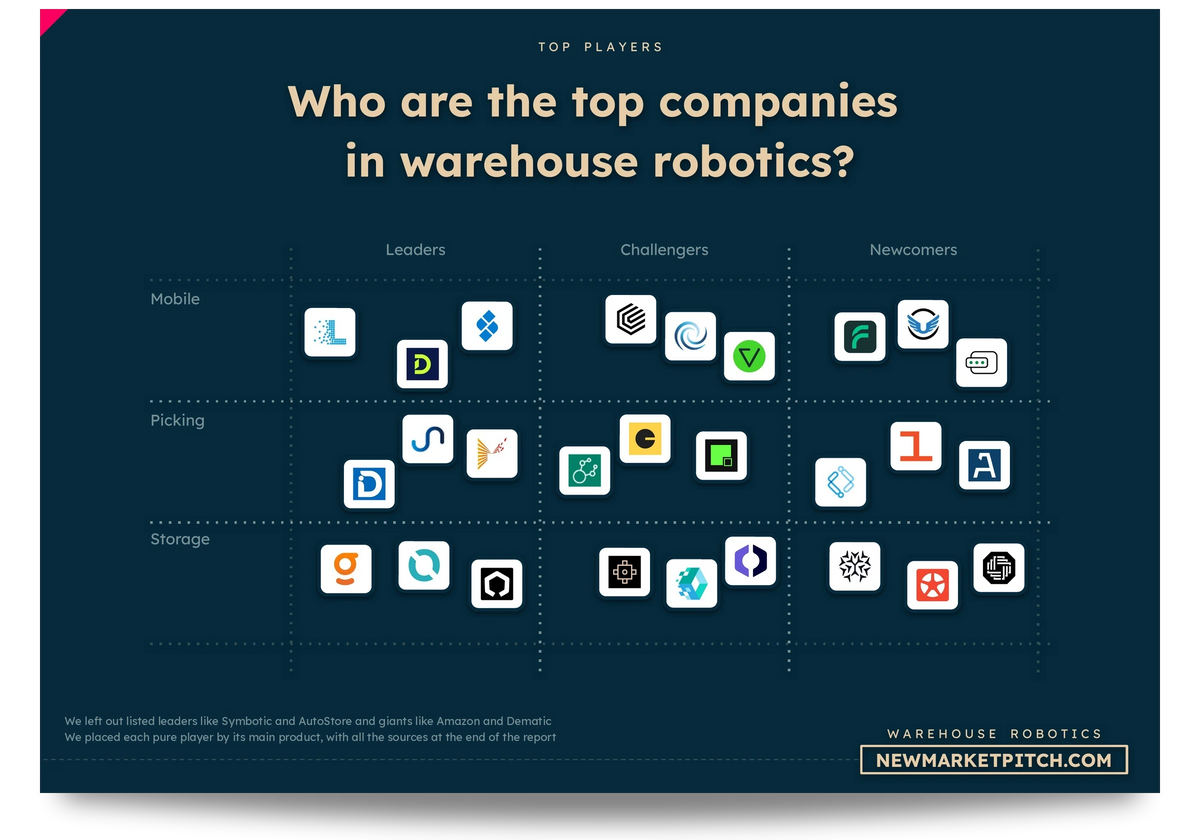
In our research about warehouse robots, we turn what is vague and complex into simple, useful visuals. Market maps like this one show you at a glance where every startup stands.
Is warehouse robotics funding actually stronger today?
Yes, warehouse robotics startups raised at least $981M across 35 deals in the last 12 months, a genuine increase in both cash and activity.
The 12 months before brought at least $468M across 24 deals. Our comparison puts the new period up 109% in disclosed funding and up 46% in deal count. Funded companies also increased to 28 from 22, so the additional money was not confined to an unchanged collection of recipients. What changed is both the number of chances investors took and the size of several checks.
Mujin, Mytra and Sereact illustrate three different bets: coordinating robots, moving inventory and automating difficult picking work. Mytra said in January that it had moved from pilots to larger customer contracts, while Sereact said in April that its picking systems were already operating across Europe. Those companies have something more useful than a prototype to show investors, although funding figures alone cannot tell us why each investor committed.
The growth is broad enough to take seriously. Its size still depends heavily on the largest rounds.
Would warehouse robotics funding still be growing without the giant rounds?
Without the giant checks, warehouse robotics funding would still be growing, but much more modestly.
Excluding rounds above $50M, companies raised at least $438M in the last 12 months, compared with at least $273M in the 12 months before, an increase of 60%. Excluding rounds above $100M leaves at least $513M versus at least $468M, up 10%. The headline increase is real, yet rounds above the upper threshold explain much of its apparent size.
That distinction matters because a single company can finance a large manufacturing or deployment expansion without implying that every smaller robot developer can raise on similar terms. Mujin's December 2025 financing is particularly instructive: Qatar Investment Authority separately identified an equity round and an additional debt package. We count the equity round, not the debt. Dexory's October 2025 announcement likewise combined a $100M Series C with other financing, but the equity component belongs to the earlier comparison period.
Are more warehouse robotics companies getting funding, or just the old winners?
More warehouse robotics companies are getting funded, even while familiar winners are returning for additional checks.
We counted 28 funded companies in the last 12 months versus 22 in the 12 months before, up 27%. That expansion coexists with a rise in repeat recipients: 6 companies raised more than once in the newer period, versus 2 companies in the earlier period. More startups found backing, but repeated checks still went to a select group.
The distinction becomes concrete in the deal histories. Sereact raised a $110M Series B in April 2026 and a $6M extension of that Series B in July 2026. Tutor Intelligence raised a $34M Series A in December 2025 and a $75M Series B in November 2026. SENAD appeared repeatedly across Growth Equity and Series C financings. Those are distinct disclosed financings in our count, not automatically new startups or proof of accelerating revenue.
At the other end, UNIT AI, Destro AI and Logibot received their first recorded financings during the newer period. These names show that entry has not closed. The problem for investors is distinguishing first-time teams with promising warehouse products from companies able to turn several pilot sites into repeatable installations.

Your time is limited. In our market report about warehouse robots, we put numbers on each part of the market, so you can see where it makes sense to focus.
Are $100M rounds becoming normal for warehouse robotics startups?
No, $100M rounds remain rare in warehouse robotics, despite several exceptionally large financings.
The last 12 months contained 4 rounds of $100M or more, compared with 1 such round in the 12 months before. In the newer period these represented 14% of rounds with disclosed amounts, while the share of all deals was 11%. None of the earlier rounds went above that size: Dexory's, the largest of that period, sat exactly on the line.
Mujin, Mytra and Dexterity do quite different jobs. Mujin sells robot control systems, Mytra builds modular storage and Dexterity loads trailers with robots. FedEx said in July 2026 that it was expanding Dexterity's trailer-loading deployment at its Hagerstown hub beyond an earlier pilot.
Big checks now exist for proven warehouse robot systems. A young developer still has to win customers and show that its hardware works beyond a test site.
Are investors backing warehouse robots that already work for customers?
The largest warehouse robotics checks increasingly go to companies with robots already working in customer facilities.
Mytra said in January 2026 that a new customer deployment was 60 times the size of its largest previous installation. Sereact reported in April 2026 that more than 200 systems were live across Europe and that its robotic picking software had completed over 1 billion production picks. FedEx and Dexterity announced a wider autonomous trailer-loading program in July 2026 after several years of joint development. Each shows a different way robots move from the lab into paid warehouse work.
The funding picture is consistent with that commercial emphasis: follow-on financings attracted at least $912M in the last 12 months, while first financings captured at least $25M. We cannot infer that each follow-on startup has positive unit economics, signed customers or profitable deployments. A funding round is evidence that investors committed capital, not an audit of operating results.
A company with working customer sites gives investors a way to check uptime, repeat orders and the cost of each installation. Those operating facts matter more than a polished demo.
Can a new warehouse robotics startup still raise its first round?
Yes, first-time warehouse robotics financings are more visible now, but they remain a small part of where the money goes.
The last 12 months included 5 first financings, accounting for 14% of deals and at least $25M, or 3% of the disclosed capital. The 12 months before had 1 first financing for $3.5M. That is a genuine opening for new teams, though the number of first rounds is not a measure of every company founded or every startup seeking capital.
The new entrants are attacking narrower problems rather than promising to automate an entire warehouse immediately. UNIT AI's $12M Seed in July 2026 backs modular robotic storage. Destro AI's $8M Seed in September 2026 targets warehouse robot orchestration. Logibot's $1.5M Seed in September 2026 addresses mobile warehouse robotics. Each offers a potential path to a specific installation or software integration.
There is also a powerful benchmark outside the private startup sample. Amazon reported in June 2025 that it had deployed its millionth robot and introduced DeepFleet to coordinate fleet movement. New companies must therefore offer customers an outcome that established operators cannot easily obtain by modifying existing systems. Entry is possible, but a differentiated workflow matters more than a generic promise of automation.

In our document detailing everything you need to know about warehouse robotics, we always try to gather several sources and make estimates that make sense, so you can work with solid numbers.
Is warehouse robotics investment moving to later funding stages?
Warehouse robotics has barely shifted toward later rounds; the balance of deals with named stages is close to the preceding period.
Among deals with a named stage, later-stage financings accounted for 50% in the last 12 months, against 48% in the 12 months before. Their share of disclosed capital was 79% in the newer period, compared with 81% previously. The early-stage share of deals was 50% versus 52%, so it would be misleading to say investors stopped funding Seed and Series A companies.
The size of the checks tells us where investors are spending. Series B startups raised at least $241M from 6 deals in the last 12 months. Series C companies raised $207M from 4 deals, while Series D+ companies raised $206M from 3 deals. Sereact's April Series B, Mytra's January Series C and Mujin's December Series D+ show that financing can support expansion at several points in a company's life.
DHL's March 2026 announcement that its integration platform could speed up robotics deployments highlights why later-stage capital is attractive: scaling often means supporting more facilities and interfaces, not merely improving a robot prototype.
The table below shows the current stage mix and the disclosed money behind it.
| Stage | Deals | Disclosed capital | Capital share |
|---|---|---|---|
| Series B | 6 | $241M+ | 25% |
| Series C | 4 | $207M | 21% |
| Series D+ | 3 | $206M | 21% |
| Series A | 8 | $137M+ | 14% |
| Unknown | 5 | $105M+ | 11% |
| Seed | 7 | $45M+ | 5% |
| Growth Equity | 2 | $40M+ | 4% |
Capital shares refer to disclosed capital; some rounds have no public amount.
Is it easier to raise a mid-sized warehouse robotics round today?
Mid-sized warehouse robotics financing has expanded, even if the typical disclosed deal did not become larger.
Among rounds with published amounts in the last 12 months, the $20M to under $50M bucket contained 8 deals and at least $269M, compared with 4 deals and $124M in the preceding period. The $5M to under $20M bucket contained 11 deals and $111M, up from 7 deals and at least $85M. These are meaningful sources of capital for system testing, sales teams and initial customer rollouts without requiring a mega-sized raise.
Meanwhile the median disclosed round was $14.0M in both periods. The unchanged exact median prevents us from calling the market's typical check substantially larger. Investors wrote more checks, and some high-end checks were much bigger, but the midpoint of the disclosed distribution did not move.
Vecna Robotics' $31M Series D+ in September 2026 and Gather AI's $40M Series B in February 2026 illustrate the middle-to-upper range. Vecna said demand for its CaseFlow offering had grown, while Gather AI said it would expand its warehouse visibility platform beyond inventory checks. Mid-sized rounds can finance concrete commercial extensions without setting a new market-wide standard.
Are autonomous mobile robots losing the warehouse robotics funding race?
Autonomous mobile robots are losing share of warehouse robotics funding dollars, but still attract more deals than any other category.
Autonomous mobile robots recorded 11 deals in the last 12 months, or 31% of all deals, compared with 9 deals and 38% in the earlier period. Disclosed money reached at least $168M, against $194M before, and some recent amounts are not public, so this does not prove a decline in dollars. The category got more deals but a smaller share of them, and its share of disclosed capital fell to 17% from 41%.
The technology is far from disappearing. Locus Robotics raised a $42M Series D+ in August 2026, Vecna Robotics raised a $31M Series D+ in September, and Corvus Robotics raised a $20M Series A in August. Corvus sells autonomous warehouse inventory drones, a more specialized interpretation of mobile robotics than moving shelves or pallets.
Mobile robots already work at scale in many warehouses, so they keep finding customers even as other warehouse machines attract bigger checks.

Our report covering the warehouse robotics market gets updated several times a month, so you always get the latest view of where things stand.
Are robotic picking companies now getting the biggest warehouse robotics checks?
Not quite, robotic picking is attracting serious warehouse robotics capital, but palletizing and depalletizing robots took a slightly larger disclosed pool in the last 12 months.
Robotic picking systems recorded 7 deals and at least $194M, representing 20% of disclosed capital. In the 12 months before they had 5 deals and $146M. The picking total is a minimum, because one recent round has no public amount, so the gap with the $214M for palletizing robots is small and not definitive. The category is advancing, but on disclosed money it has not overtaken the robots that stack or remove cases and pallets.
Sereact's $110M Series B in April 2026 and its $6M Series B in July 2026 show how much attention picking has drawn. The company said in April that its Cortex software had passed 1 billion production picks. Nomagic's earlier $44M Series B in February 2025 provides a commercial contrast: the company then targeted wider European deployments and subsequently announced that Zalando planned to roll out up to 50 of its robots in March 2026.
Picking an irregular consumer item requires different sensing and gripping from building a stable pallet of boxes. The category's sustained funding suggests investors continue to see value in solving the difficult item-level work that fixed conveyors and simple mobile robots cannot finish.
Why is so much warehouse robotics money going to palletizing and unloading?
Palletizing and depalletizing robots now attract the largest warehouse robotics funding pool, but that pool rests on only two companies that stack and load freight.
We tracked 3 deals and $214M for palletizing and depalletizing robots in the last 12 months, accounting for 22% of disclosed capital. The 12 months before contained 1 deal and $95M. Tutor Intelligence's $34M Series A in December 2025 and $75M Series B in November 2026, plus Dexterity's $105M round of undisclosed stage in May 2026, make up the whole category, so a single new round could reorder it.
The customer need is well documented. DHL signed an agreement with Boston Dynamics in May 2025 to pursue more than 1,000 additional Stretch robots after using the system to unload containers. In July 2026, FedEx announced an expansion of Dexterity's autonomous trailer-loading work at a major Maryland hub. Those announcements involve large logistics operators trying to remove physically demanding manual steps from throughput-critical workflows.
Those deployments help explain the interest in automating heavy lifting. The category still depends heavily on a few large rounds.
Is warehouse robot orchestration finally attracting serious investment?
Yes, warehouse robot orchestration has moved beyond small experimental rounds, although its disclosed capital is heavily influenced by Mujin.
Warehouse robot orchestration produced 3 deals and $154M in the last 12 months, compared with 1 deal and $3M in the 12 months before. Mujin is the clearest large transaction, while newer companies such as Cytronic, in July 2026, and Destro AI, in September 2026, pursued narrower coordination problems. We classify businesses by their warehouse robotics product, not by whether they describe themselves as AI companies.
The commercial case is visible at scale. Amazon said in June 2025 that its DeepFleet model was designed to reduce robotic travel time by 10% across its fulfillment network. DHL said in March 2026 that it was deploying SVT Robotics' software to integrate different robotics systems faster, replacing repeated custom integrations. Neither Amazon nor DHL belongs in our private startup ranking, but both demonstrate the cost of coordinating more kinds of robots.
Ordinary warehouse management software does not qualify here. The startups we count actually control warehouse robots or operate robotics-led fulfillment. That is the software layer attracting new checks.

In our research about warehouse robots, we look at what the winners do differently, so you can learn from the best instead of guessing.
Have automated warehouse storage systems fallen out of favor?
Partly, because automated storage and retrieval startups are raising fewer warehouse robotics rounds, but the remaining deals can still be large.
The category fell to 4 deals in the last 12 months from 7 deals in the 12 months before, with its share of total deals moving from 29% to 11%. Yet disclosed money increased from at least $17M to at least $133M, driven in large part by Mytra's $120M Series C in January 2026. A shrinking number of rounds and a rising cash total can be true at once.
Mytra said that its modular storage and movement system reached larger customer installations in 2025. Other vendors outside our current private-financing sample provide evidence that demand for automated storage is real. Exotec announced in September 2026 that its Skypod system at a GXO warehouse could process up to 70,000 pieces daily for Guess. In June 2026, Exotec also described a DSV installation using approximately one hundred autonomous Skypod robots.
Warehouse customers are still buying storage robots. Fewer privately funded suppliers raised new money during this comparison, which is a different question.
Are investors moving beyond mobile robots to other warehouse tasks?
Yes, robotic sorting systems gained the clearest share of warehouse robotics funding activity, while palletizing and orchestration also became more visible.
Our comparisons show why looking only at dollars is risky. Robotic sorting systems recorded 7 deals, or 20% of all deals, after registering no deal in the preceding comparison, yet they took only 12% of disclosed capital. Palletizing and depalletizing robots moved from 4% to 9% of deals, and their share of disclosed capital increased from 20% to 22%. Warehouse robot orchestration also moved from 4% to 9% of deals, while its disclosed capital rose sharply.
By contrast, autonomous mobile robots moved from 38% to 31% of deals even though their deal count went up. Automated storage and retrieval systems lost a larger share of activity. These changes show relative investor preference, not the size of installed fleets or the value of customer contracts.
Robot deployments do not always follow the funding chart. Geek+, which is publicly listed and therefore outside our private funding totals, announced a September 2026 expansion of its automation work with LPP Logistics. The financing map can shift faster than the installed robot fleet because established suppliers may keep deploying equipment without raising another private round.
The table below shows the categories' capital and deal counts in the latest comparison period.
| Category | Deals | Disclosed capital | Capital share |
|---|---|---|---|
| Palletizing & Depalletizing Robots | 3 | $214M | 22% |
| Robotic Picking Systems | 7 | $194M+ | 20% |
| Autonomous Mobile Robots | 11 | $168M+ | 17% |
| Warehouse Robot Orchestration | 3 | $154M | 16% |
| Automated Storage & Retrieval Systems | 4 | $133M+ | 14% |
| Robotic Sorting Systems | 7 | $118M+ | 12% |
Capital shares refer only to disclosed amounts; unassigned deals are outside the category rows.

In our market report about warehouse robots, we don't want to repeat what boring consulting reports say. Instead, we show you the real and latest market signals that matter.
Is North America pulling away in warehouse robotics venture funding?
North America is pulling ahead in disclosed warehouse robotics cash, but Asia-Pacific still records more deals.
North American startups raised at least $557M across 14 deals in the last 12 months, equivalent to 57% of disclosed capital. In the preceding period, the region attracted at least $240M across 10 deals. By contrast, Asia-Pacific recorded 15 deals in the newer period and at least $281M, making it more active by count but smaller by disclosed total.
The United States contributed 14 deals in the latest period. Mytra, Dexterity and Tutor Intelligence illustrate its mix of storage, trailer handling and flexible warehouse manipulation. FedEx's July 2026 announcement about scaling Dexterity systems gives the American numbers a commercial anchor: large customers are testing whether a robot can take on a hard job inside a real logistics network.
These totals track where the funded startups are headquartered, rather than where their robots work. A U.S. company can install robots in Europe without generating a European startup financing.
Are Chinese warehouse robotics startups raising more money now?
Chinese warehouse robotics startups are raising more money now, although the United States still takes the largest disclosed total.
China recorded 9 deals and at least $119M in the last 12 months, compared with 3 deals and at least $14M in the 12 months before. Its share of all deals rose from 12% to 26%. Most of these financings went to robotic sorting, including SENAD, Yincheng Intelligent and ULTIROBOTICS, while ZIKOO Robotics and ZS Robotics raised for automated storage.
China's rising deal count still leaves it behind the United States in disclosed cash. Some Chinese amounts are approximate dollar conversions, and close minimum totals between countries should not be treated as definitive rankings.
Outside this private funding sample, Geek+ reported in 2026 that it had deployed tens of thousands of robots worldwide and had listed publicly in 2025. A company at that scale is relevant evidence of Chinese warehouse robotics capabilities, but it is not counted as a private startup financing in our period comparison. China's stronger deal flow is real; its meaning is broader than a single league table of dollar amounts.
Is Europe being left behind in warehouse robotics funding?
Europe is losing share of new warehouse robotics financings, even while European robotics companies continue to win customers.
European startups raised $143M through 6 deals in the last 12 months, compared with $206M through 8 deals in the 12 months before. The region's share of deals fell from 33% to 17%, while the United States and Asia-Pacific both attracted more financing activity. A few sizeable companies can still raise in Europe, but the smaller recent deal count signals a narrower flow of fresh checks.
Germany offers the clearest counterexample to a simplistic retreat narrative. Sereact recorded a $110M Series B in April 2026 and a $6M extension of it in July, while its production picking systems expanded beyond research settings. Poland's Nomagic raised a $44M Series B in February 2025, and it announced an expanded Zalando warehouse rollout in March 2026. Meanwhile Exotec, a French warehouse robotics supplier outside these private-period deal totals, announced a seven-site Decathlon program across European countries in March 2026.
European logistics buyers and robot developers remain active, but fewer startups secured fresh equity rounds during our comparison period.

Learning from others' mistakes is the cheapest lesson there is. In our document detailing everything you need to know about warehouse robotics, we look at what broke startups before you, so you don't repeat it.
Why did NTT and QIA back warehouse robotics maker Mujin?
NTT Group and QIA backed warehouse robotics maker Mujin to support international expansion of its robot control systems.
Japan accounted for 3 deals in the last 12 months. Mujin's $133M Series D+ in December 2025 was co-led by NTT Group and QIA, according to announcements from the investors. NTT described a business alliance connecting communications, cloud computing and robotic control. QIA said this was its first direct investment in a Japanese startup and its first robotics investment.
Those details are more useful than simply labeling the round strategic. Mujin develops MujinOS, a control system aimed at industrial robotics, including warehouse handling. A communications group can offer infrastructure and customer relationships, while a sovereign wealth fund can supply long-horizon capital. We do not classify each investor's motivation from the deal data; these are the activities their own announcements describe.
The key limitation is concentration. One large disclosed financing accounts for the recognizable money story in Japan during the period, while the country's other counted transactions, from LexxPluss, had no public amount. Investors should not confuse one exceptional global round with a market-wide surge across Japanese robotics startups.
Are the same few funds dominating warehouse robotics rounds?
Warehouse robotics now has a wider set of named lead investors, not a smaller club repeatedly leading every round.
We identified 33 distinct lead investors in the last 12 months, compared with 21 in the 12 months before. The number of unique investors named anywhere in deals also rose to 61 from 29. Yet no lead investor appeared on multiple current rounds; the preceding period had 1 repeat lead. The change suggests an expanding set of institutions willing to sponsor a warehouse robotics transaction, rather than the same firm repeatedly dominating the market.
NTT Group and QIA co-led the largest round of the last 12 months, Mujin's Series D+, and QIA's own announcement confirms the joint investment. Avenir Growth backed Mytra, and Headline led Sereact's large expansion round. Each illustrates different investor networks backing control systems, storage systems and robotic picking.
Funding activity is spread across more named investors, but the latest period offers little evidence that a single fund is repeatedly leading warehouse robotics rounds.
Are young warehouse robotics teams still getting big checks?
Yes, newer warehouse robotics startups can raise substantial capital, even though the typical funded company is not getting younger.
The median company age at financing was 6 years in the last 12 months and 6 years in the 12 months before. But companies founded since 2022 made up 36% of the funded companies in the last 12 months, compared with 23% in the 12 months before. Companies founded since 2020 made up 57% of them, up from 41%. A stable median age can coexist with a larger group of young entrants.
Mytra, founded in 2022, reported production installations and a large customer deployment alongside its expansion plans. Tutor Intelligence followed its $34M Series A in December 2025 with a $75M Series B in November 2026. The investor announcement by Andreessen Horowitz emphasized robots completing defined warehouse tasks repeatedly, rather than performance in research demonstrations alone.
At the lower end, UNIT AI and Destro AI also attracted Seed funding for specific warehouse workflows. Young warehouse robotics teams can still secure substantial money, but customer evidence and technical progress deserve closer attention than company age alone.

If you build or invest in the warehouse robotics market, you need to know which business models pay off now and which ones are fading. That's why our report covering it has a whole section on it.
Are warehouse robotics startups returning to raise money faster?
Only marginally, as warehouse robotics now has more repeated financings but a steady median interval between rounds.
The median gap between observed rounds was 13 months in the last 12 months and 13 months in the 12 months before. Among the observed round-to-round gaps, 46% were shorter than 12 months in the newer period, compared with 41% previously. The share shorter than 18 months was 67% versus 59%. These are shares of gaps between financings, not shares of companies.
Our velocity observations cover 69% of relevant histories in the newer period and 71% in the preceding one. Missing round dates therefore limit how far the pattern can be generalized. Sereact's April and July 2026 financings and SENAD's multiple 2026 transactions offer visible examples of repeat fundraising, but they cannot establish that all companies now require or secure capital more frequently.
Repeat rounds may pay for deployment, product development or expansion. Their faster timing does not automatically mean that revenue is accelerating.
Is warehouse robotics funding becoming more consistent month to month?
Yes, by the limited monthly measures available, although warehouse robotics still produces conspicuous funding spikes.
Across the completed months in the last 12-month period, the median monthly deal count was 3, against 2 in the preceding period. Median monthly disclosed capital was $68M versus $16M. No completed month recorded no deal in the newer period, compared with 1 month without a deal in the earlier one. Those measures point to broader continuity, not merely an isolated financing headline.
But the largest funding month was December 2025, with at least $168M, and Mujin's round was its biggest. September 2026 recorded the highest deal count, at 7, through a mix of orchestration, mobile robotics and sorting financings. High-count and high-money months need not be the same.
Consider the commercial backdrop. DHL announced in March 2026 that more than 8,000 collaborative robots were already active in its global operations, and Amazon had previously announced a million-robot network. Those numbers describe deployments by large companies, not new startup funding, but they show why demand for warehouse automation is not restricted to a single fundraising month.
So, what does warehouse robotics funding look like right now?
Warehouse robotics funding is healthier than in the previous comparable period, but the biggest checks remain concentrated in robots that can perform difficult, repeatable warehouse work.
We see more funded companies, more deals, a larger variety of lead investors and a stronger flow of mid-sized financings. The big rounds are the catch: without rounds above $100M, funding still grows, but far less than the headline suggests. That makes this a real recovery with a selective top end, not an unrestricted rush into anything labeled robotics.
Mujin led the latest period's company totals, while Mytra, Sereact, Tutor Intelligence and Dexterity illustrate substantial backing for different warehouse tasks. NTT Group and QIA co-led the period's largest round, but no investor led more than one round in the last 12 months. The customer evidence from FedEx, DHL, Zalando and major warehouse operators supports commercial demand, without proving that every financed startup has reached scale.
Warehouse robotics investors now seem most interested in systems they can install, connect and scale, while newer companies still find some room to enter.
The table below shows what we found.
| Question | Answer |
|---|---|
| Has the market's recent upswing broadened beyond headlines? | Yes, more warehouse robotics companies attracted funding in the newer period. We counted 28 companies, compared with 22 in the preceding period. More teams received capital, although some returned for multiple rounds. |
| Did investment growth depend entirely on exceptional checks? | No, smaller warehouse robotics financings also increased across the comparison. Excluding rounds above $50M leaves at least $438M in recent capital. The improvement survives, but it becomes far less dramatic. |
| Is a nine-figure warehouse robotics check commonplace? | No, exceptionally large rounds remain a minority of transactions. Only 4 rounds reached $100M or more in the newer period. Investors still reserve these checks for a small group. |
| Have first-time warehouse robotics founders been shut out? | No, first financings have become more visible than before. We found 5 first financings in the newer comparison period. Most disclosed money nonetheless continued to fund companies with previous rounds. |
| Are mobile robots still the busiest warehouse category? | Yes, autonomous mobile robots still lead the count of financings. The category recorded 11 deals during the last 12 months. More specialized handling systems now collect larger pools of capital. |
| Do stacking and unloading robots get the most money? | Yes, palletizing and depalletizing robots lead disclosed category funding. They attracted $214M during the latest 12 months. The lead rests on just two companies, Tutor Intelligence and Dexterity. |
| Is warehouse robot control software attracting meaningful money? | Yes, control and orchestration have moved into major financing territory. The category brought in $154M across the last 12 months. Mujin contributes importantly, so breadth remains worth watching closely. |
| Is North America winning every warehouse robotics measure? | No, it leads disclosed money but not transaction count. North America secured at least $557M in the newer comparison. Asia-Pacific recorded more financings while receiving a smaller capital pool. |
| Are European warehouse robotics startups keeping pace with peers? | Not in recent private fundraising, despite substantial customer activity. Europe registered 6 deals in the last 12 months. Commercial deployment strength does not guarantee a matching flow of financing. |
| Are warehouse robotics funders becoming a tighter group? | No, the pool of named investors has become wider. We identified 33 distinct lead investors in the latest period. The diversification is encouraging without proving broad repeat investor commitment. |
| Are financed robot companies cycling back much faster? | Not at the median, despite more repeated company financings. Observed round gaps still had a 13-month median in both periods. The change is stronger in shorter intervals than in typical timing. |

In our research about warehouse robots, we like to show you the big picture. We know your time is precious, so we make every page quick to read and packed with as much learning as possible per minute.
Our methodology
Our data runs through November 2, 2026. We then reviewed this article and updated its answers on November 13, 2026, the date shown under the title. We compare the last 12 months, November 3, 2025 to November 2, 2026, with the 12 months before, November 3, 2024 to November 2, 2025. Both periods fall within our complete deal coverage beginning in January 2024; we used 12 months against 12 months because each period had sufficient transactions for comparison.
We count equity financings of private companies of at least $300K, including rounds whose amounts were not disclosed when their qualifying status was verified. We exclude debt, grants, loans, unconverted convertible instruments, SAFEs and public offerings. Transactions announced as one financing are counted once, and overlapping reports of the same round are merged.
We define warehouse robotics as dedicated robots and control systems that automate work inside warehouses and fulfillment centers: mobile movement, picking, palletizing, sorting, robotic storage, forklifts, inventory drones and robot orchestration. We also include robotic microfulfillment and logistics operators whose proprietary warehouse robots are central to the product, retaining defensible borderline companies rather than silently omitting them. Generic warehouse software, road delivery robots, conventional conveyors, parts suppliers and factory-only systems are excluded.
Every company counted meets our startup definition: independent, founded in 2000 or later, built around a scalable new product or technology, and not publicly listed except within the last five years. A recently acquired company can remain included as part of its buyer for up to three years. Public companies and large corporate users may appear as commercial context, but their funding is not added to the startup totals.
We group rounds by their reported stage, keeping unnamed stages separate. Categories reflect our own market split, while geographic figures refer to the startup's headquarters country. Undisclosed amounts count toward deal and company counts but not disclosed money, so dollar totals marked with a plus sign are minimums. A source can describe more financing than our total if it combines eligible equity with debt or other instruments.
Rounds confirmed by a company announcement, a press article or a regulatory filing are counted in full. Where no article exists, a round is counted only when at least two recognised databases agree on its date (within one month) and amount (within 5%), and it is marked as low confidence; a round found in a single database stays in the company's history but is left out of totals. For companies that have raised more than $100M, every round counted is backed by an article.
Our safeguards prioritize company releases, filings and reliable reporting over scraped summaries. Some market-wide press totals include listed companies, debt, factory-only robots or deals outside the period; our stricter universe and exact dates can therefore produce a different number. We compare the same transaction rules in both windows and keep companies with undisclosed check sizes in deal counts rather than treating missing amounts as zero.
Key sources include Mujin equity round, co-leads and separate debt announced December 2025, NTT and Mujin's robotics and communications alliance, Mytra Series C, customer deployments and operating milestones in January 2026, Sereact Series B, deployed systems and production picks in April 2026, Andreessen Horowitz investment rationale and Tutor's warehouse robots, Tutor Intelligence's earlier Series A and deployment model, Dexory Series C equity distinguished from additional financing, FedEx-Dexterity production expansion in July 2026, DHL's multi-vendor robot integration rollout in March 2026, DHL and Boston Dynamics unloading-robot expansion in May 2025, Amazon robot fleet milestone and DeepFleet orchestration, Vecna's September 2026 financing and CaseFlow demand, Gather AI warehouse visibility program and financing, Corvus Robotics' August 2026 financing and warehouse inventory robots, Zalando expansion of Nomagic warehouse robots in March 2026, Nomagic's earlier financing and European deployment plans, Exotec and GXO's deployed robotic storage system for Guess, DSV warehouse automation installation with Exotec in June 2026, Exotec's seven-site Decathlon program across Europe in March 2026, Geekplus and LPP warehouse expansion in September 2026, and Geekplus international deployments and listed-company context.

When you build or invest in the warehouse robotics market, you need clarity, not confusion. In our market report about warehouse robots, we always try to put numbers on and quantify whatever is usually vague and confusing.
Written by the New Market Pitch teamWe track new markets so founders and investors can move faster. About us