Who are the top investors in AI data centers?
Whether you're building or investing in the AI data center market, our report covers everything you need to know: the players, the money, and what's coming next.
Summary
Blackstone is the top financial investor in AI data centers today, with an approximately $165 billion global data center platform. BlackRock's Global Infrastructure Partners, MGX, Brookfield, KKR, Blue Owl Capital and SoftBank are its strongest competitors, although they lead in different areas of the market.
The biggest mistake in ranking these investors is treating every announced dollar as money actually invested. Blackstone's $165 billion measures platform value, Brookfield's $100 billion is an investment program, and the $40 billion Aligned acquisition represents enterprise value shared by a consortium. None directly measures an individual investor's equity contribution.
Blackstone's advantage is built on operating assets and development, not just fundraising capacity. It acquired QTS for approximately $10 billion in 2021, participated in the acquisition of AirTrunk at more than A$24 billion in 2024, and has seen QTS's leased capacity grow roughly fifteenfold since its acquisition.
BlackRock and MGX are the most credible large-acquisition challengers. Their consortium completed the approximately $40 billion Aligned Data Centers acquisition in July 2026, gaining exposure to 51 campuses representing more than 6.4 gigawatts of operational and planned capacity.
Brookfield may become an equally powerful competitor, but its $100 billion AI infrastructure initiative is still primarily a forward-looking investment program. Its dedicated fund initially secured approximately $5 billion in commitments against a $10 billion equity target, with the larger ambition depending on additional capital and financing.
Blue Owl has demonstrated a different way to finance the boom. Its $27 billion Hyperion partnership with Meta involved approximately $7 billion in initial cash contributions from Blue Owl-managed funds, allowing Meta to retain operational control while institutional investors own most of the underlying infrastructure.
Macquarie has one of the strongest demonstrated development records. It helped grow AirTrunk from roughly 450 megawatts to more than 1.8 gigawatts and expanded Aligned from two data centers to more than 50 operational and planned locations before exiting both investments through major acquisitions.
Technology companies remain the economic engine of the market. Amazon, Microsoft, Alphabet and Meta spent approximately $165 billion combined on capital expenditures in the second quarter of 2026, although those expenditures cover far more than AI data center real estate. Private investors are increasingly financing the physical infrastructure these companies need.
The financing structures are becoming more aggressive. CoreWeave's substantial debt and customer concentration contrast with pre-leased data centers backed by long-term hyperscaler commitments. Investors are increasingly exposed to construction timelines, borrowing costs and the financial durability of a relatively small group of major customers.
Electricity access may ultimately separate the winners from the rest. Gigawatt-scale developments require secure power, suitable land, grid connections and years of execution. Blackstone and Brookfield are investing across energy and digital infrastructure because financing alone cannot solve those constraints.
Our overall ranking favors Blackstone for its existing scale and operating record, BlackRock and MGX for acquisition capacity, Brookfield for future investment potential, KKR for geographic diversification, Blue Owl for structured financing, and SoftBank for strategic AI infrastructure exposure. No reliable ranking by cumulative equity invested is possible because the relevant disclosures are incomplete and inconsistent.

Written by the New Market Pitch teamWe track new markets so founders and investors can move faster. About us

In our report covering the AI data center market, you will always find fresh funding data, taken straight from our own verified funding database.
Why is so much money flowing into AI data centers right now?
AI data centers have become one of the biggest targets for infrastructure investors, with individual acquisitions and development projects now reaching $20 billion to $40 billion.
According to S&P Global Market Intelligence, private equity-backed US data center investment reached $45.7 billion in 2025, accounting for 72% of the $63.35 billion recorded across the sector. It was the highest private equity-backed total in at least five years, although the numbers were heavily influenced by the $40 billion Aligned Data Centers transaction announced that year.
The demand behind these investments is enormous. Amazon, Microsoft, Alphabet and Meta spent approximately $165 billion combined on capital expenditures during the April-June 2026 quarter, compared with about $88 billion a year earlier. These expenditures include servers, networking equipment and infrastructure beyond AI data centers, but their growth shows how quickly the major technology companies are expanding computing capacity.
What's particularly interesting is how the financing has changed. Traditional infrastructure investors are buying entire data center operators. Private credit firms are financing construction and computing equipment. Meanwhile, technology companies are signing long-term agreements that make these investments easier to finance.
Who are the biggest AI data center investors today?
Blackstone currently leads the AI data center investment market among traditional financial investors, while BlackRock's Global Infrastructure Partners, Brookfield, KKR, Blue Owl Capital, MGX and SoftBank make up the strongest group of competitors.
Blackstone reported a global data center platform worth approximately $165 billion in its 2026 investment commentary, including facilities under construction. It also identified another $160 billion in potential future development.
BlackRock's Global Infrastructure Partners and Abu Dhabi-based MGX made one of the largest moves in the sector when their consortium completed the acquisition of Aligned Data Centers at an approximately $40 billion enterprise valuation in July 2026.
Brookfield has taken a different approach, announcing a $100 billion AI infrastructure investment program in November 2025. KKR reported $43 billion committed across digital infrastructure, while Blue Owl Capital became a major player through a $27 billion data center development partnership with Meta.
These figures measure different things. Blackstone's number describes portfolio value, BlackRock's represents an acquisition enterprise valuation, and Brookfield's refers to a future investment program. We can identify the leading investors, but a precise ranking by their own equity contributions is impossible without figures that most managers don't publicly disclose.
| Investor | Major disclosed position | Main investment approach |
|---|---|---|
| Blackstone | Approximately $165B data center platform | Ownership and development |
| BlackRock / GIP | $40B Aligned acquisition consortium | Large infrastructure acquisitions |
| MGX | $40B Aligned acquisition consortium | Sovereign-backed investments |
| Brookfield | $100B AI infrastructure program | Infrastructure funds and development |
| KKR | $43B committed across digital infrastructure | Global operating platforms |
| Blue Owl Capital | $27B Meta Hyperion partnership | Equity and structured financing |
| SoftBank | Stargate partner; $3.1B DigitalBridge acquisition | Strategic investment and ownership |
| Macquarie Asset Management | Former Aligned and AirTrunk investor | Platform development and exits |
| NVIDIA | $2B CoreWeave equity investment in 2026 | Strategic computing infrastructure |
| PIMCO | Major investor in Meta-related infrastructure debt | Private credit |

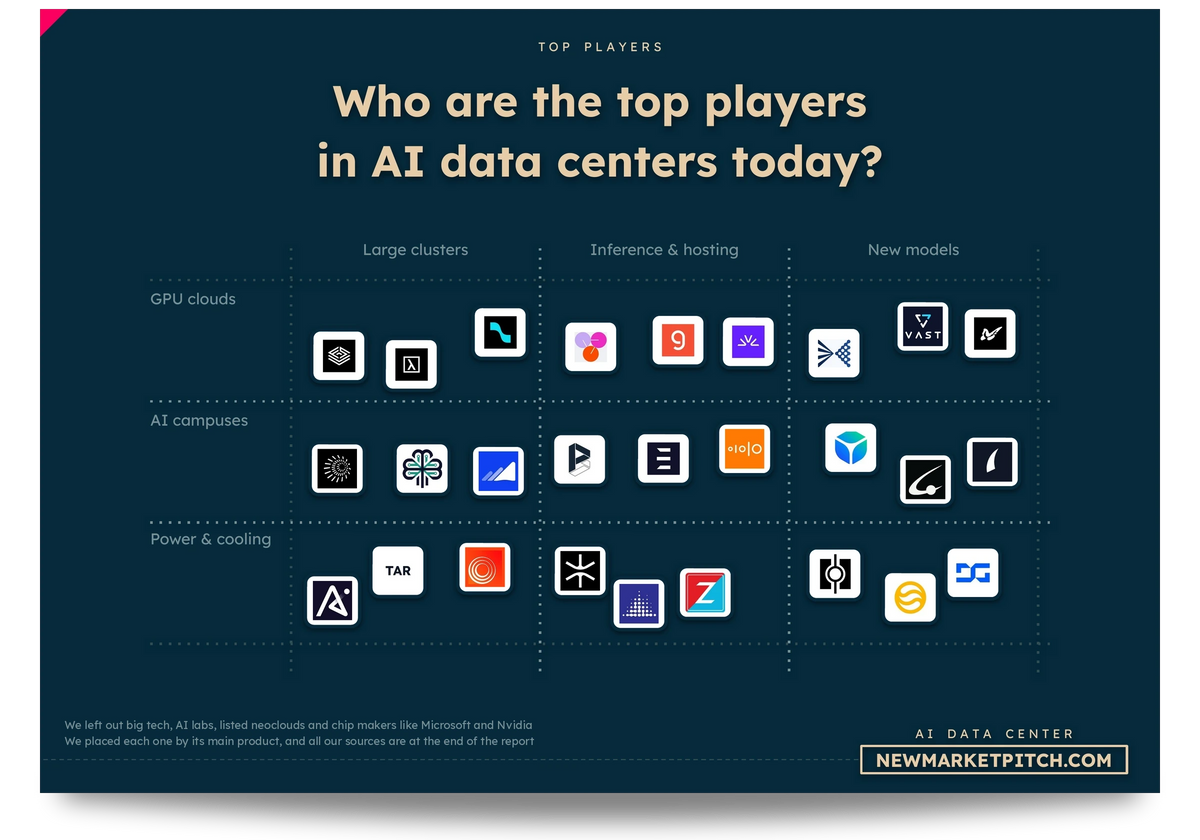
In our research about AI data centers, we turn what is vague and complex into simple, useful visuals. Market maps like this one show you at a glance where every startup stands.
Is Blackstone really the largest AI data center investor?
Blackstone has the strongest claim to being the world's largest financial investor in AI data centers today, with an existing portfolio that is far larger than most competitors' disclosed holdings.
Its position started taking shape before the generative AI boom. Blackstone acquired QTS Realty Trust for approximately $10 billion in 2021, gaining control of an established data center development business. In 2024, a Blackstone-led consortium agreed to acquire AirTrunk at an enterprise value exceeding A$24 billion, expanding its reach across Asia-Pacific.
The growth in operating scale has been substantial. According to Blackstone's mid-2026 investment perspectives, leased capacity at QTS had increased approximately fifteenfold since the acquisition. The firm also expected to invest or commit roughly $100 billion across its data center portfolio by the end of 2026.
Blackstone Real Estate Income Trust reported deploying approximately $3.3 billion, at its ownership share, into QTS data center developments during the second quarter of 2026. Those projects were fully pre-leased, predominantly to investment-grade customers.
Blackstone's $165 billion platform value includes debt-financed assets and construction projects, so it shouldn't be mistaken for the firm's own equity investment. Still, its leadership in dedicated data center ownership looks well established.
If you want more recent data on this point, please see our latest AI data center market report.
Has BlackRock become Blackstone's biggest AI data center rival?
BlackRock has become one of Blackstone's most serious rivals in AI data centers, particularly after the $40 billion acquisition of Aligned Data Centers through a consortium involving its Global Infrastructure Partners business.
The deal closed in July 2026 and included 51 data center campuses with more than 6.4 gigawatts of operational and planned capacity across the Americas. The consortium, which also included MGX and the Artificial Intelligence Infrastructure Partnership, committed another $5 billion to support expansion.
BlackRock had already strengthened its infrastructure business by acquiring Global Infrastructure Partners in October 2024. It also helped establish the AI Infrastructure Partnership alongside Microsoft and MGX, later joined by NVIDIA and xAI.
Blackstone still has the clearer advantage in disclosed global data center portfolio scale. The $40 billion Aligned valuation belongs to the entire acquisition consortium and includes debt. BlackRock's individual equity contribution hasn't been publicly separated from those of its partners.
BlackRock looks like Blackstone's strongest challenger in large-scale data center acquisitions.

In our market report about AI data centers, we always try to gather several sources and make estimates that make sense, so you can work with solid numbers.
Is Brookfield actually investing $100 billion in AI data centers?
Brookfield is one of the most ambitious AI infrastructure investors, but its $100 billion program represents planned investment capacity rather than $100 billion already spent.
The company launched the initiative in November 2025 alongside NVIDIA and the Kuwait Investment Authority. Its dedicated Brookfield Artificial Intelligence Infrastructure Fund targeted $10 billion in equity commitments and had secured approximately $5 billion in initial commitments at launch.
The difference between $5 billion and $100 billion is important. Brookfield intends to use fund equity, co-investments and financing to acquire or develop a much larger portfolio of assets. The overall program also covers electricity, land and computing infrastructure, so the entire amount cannot be assigned to data centers.
Brookfield already has substantial experience in renewable energy, power infrastructure and large development projects. Those capabilities could help it secure sites where electricity availability is the main obstacle to construction.
Compared with Blackstone's existing $165 billion platform or the completed Aligned acquisition, Brookfield's figures tell us more about future investment capacity than current ownership.
Why are sovereign wealth funds investing in AI data centers?
Sovereign-backed investors have become major financiers of AI data centers, with Abu Dhabi's MGX emerging as one of the most visible participants in large international projects.
MGX was named among Stargate's initial equity funders in January 2025, alongside SoftBank, OpenAI and Oracle. It subsequently participated in the consortium that completed the approximately $40 billion Aligned Data Centers acquisition in July 2026.
The two investments provide exposure to different parts of the market. Stargate is focused on developing new AI computing infrastructure, while Aligned already has an established data center business and a large pipeline of planned facilities.
Other sovereign institutions are participating through infrastructure managers. The Kuwait Investment Authority became a founding investment partner in Brookfield's AI infrastructure fund, while Singapore's Temasek has been involved in the wider digital infrastructure investment market.
Sovereign capital is particularly useful because these investors can commit money over long periods. Data centers can require years of land preparation, power development and construction before they generate their full expected income.
Individual sovereign commitments are often undisclosed, however. We cannot treat the full value of Stargate or Aligned as money invested by MGX.

Our document detailing everything you need to know about AI data center gets updated several times a month, so you always get the latest view of where things stand.
Is KKR one of the most active AI data center investors?
KKR is one of the most geographically diversified AI data center investors, with exposure to operating businesses across North America, Europe, Asia and the Middle East.
In its June 2026 investor presentation, KKR reported $43 billion in committed digital infrastructure capital across 26 investments, including co-investments and co-underwriting. That figure also covers fiber and wireless infrastructure, so it overstates the amount dedicated exclusively to data centers.
Its portfolio includes CyrusOne and Compass Datacenters in the Americas, Global Technical Realty in Europe, and investments involving ST Telemedia Global Data Centres, N×era and Gulf Data Hub.
KKR has continued putting money into these businesses rather than relying solely on earlier acquisitions. In January 2026, it announced another $1.5 billion commitment to Global Technical Realty, alongside approximately $400 million from Oak Hill Capital.
Electricity prices, available land, permitting rules and customer demand differ considerably between markets. By investing through several platforms, KKR avoids depending entirely on the economics of one country or one huge development.
Why is Blue Owl Capital becoming so important in AI data centers?
Blue Owl Capital has become a major AI data center financier by helping technology companies fund enormous facilities without having to own all the underlying real estate.
Its biggest example is Meta's Hyperion campus in Louisiana. In October 2025, Meta announced a joint venture with Blue Owl-managed funds covering approximately $27 billion in development costs for buildings, power, cooling and connectivity infrastructure.
Blue Owl-managed funds acquired an 80% ownership interest, with Meta retaining 20%. The funds contributed approximately $7 billion in cash to the joint venture, while Meta received a one-time distribution of roughly $3 billion.
The arrangement is unusual because Meta still manages construction and uses the completed facilities. It also signed operating leases and provided a residual value guarantee covering the first 16 years of operation, subject to certain conditions.
This allows Blue Owl to invest in infrastructure backed by a major technology company's long-term requirements. The structure combines real estate ownership, contractual income and institutional borrowing, including debt purchased by PIMCO and other investors.
Blue Owl's $27 billion headline represents total project development costs, rather than its own equity contribution. Even so, the approximately $7 billion initial cash contribution demonstrates substantial financing capacity.
If you want more recent data on this point, please see our latest AI data center market report.

In our report covering the AI data center market, we look at what the winners do differently, so you can learn from the best instead of guessing.
Is SoftBank really putting $500 billion into AI data centers?
SoftBank is a leading strategic investor in AI data centers, but the $500 billion associated with Stargate remains a multiyear investment ambition rather than money SoftBank has already deployed.
Stargate was announced in January 2025 with SoftBank, OpenAI, Oracle and MGX as initial equity funders. The initiative outlined plans to invest up to $500 billion over four years, including an initial $100 billion deployment ambition.
SoftBank was assigned financial leadership, while OpenAI took responsibility for operational direction. The partnership connects infrastructure financing with a major potential customer for AI computing capacity.
In January 2026, SoftBank and OpenAI each committed $500 million to SB Energy, providing $1 billion in combined equity. SB Energy was selected to develop and operate a 1.2-gigawatt data center site in Milam County, Texas.
SoftBank also completed its approximately $3.1 billion acquisition of DigitalBridge in September 2026. The acquisition gives it control of a major digital infrastructure investment manager with expertise across data centers, fiber and telecommunications assets.
These moves make SoftBank's position more substantial than the original Stargate announcement alone suggested. It now has direct equity investments, a large development partnership and an established infrastructure asset-management business. However, Stargate's $500 billion objective still cannot be used to rank SoftBank by actual capital deployed.
Is NVIDIA becoming a major AI data center investor?
NVIDIA is becoming an influential strategic investor in AI data centers, using direct investments and financing partnerships to support the computing infrastructure that runs on its chips.
The clearest example is CoreWeave. According to the company's SEC filings, NVIDIA purchased approximately $2 billion in newly issued CoreWeave shares in January 2026 at $87.20 per share.
NVIDIA has also joined major financial institutions in dedicated infrastructure initiatives. It became a founding investor in Brookfield's AI infrastructure fund and joined the AI Infrastructure Partnership involving BlackRock, Microsoft and MGX.
In August 2026, NVIDIA announced memorandums of understanding with Apollo, BlackRock, Blackstone, Brookfield, Goldman Sachs and KKR to develop financing platforms intended to mobilize more than $500 billion in third-party AI infrastructure capital over time.
That $500 billion represents a proposed financing opportunity rather than NVIDIA's committed equity. NVIDIA benefits when customers can afford to build and operate more AI computing capacity, so supporting financing can help expand the market for its GPUs.

Theory only gets you so far. In our research about AI data centers, we dig up the real signals from the field and show you the ones worth watching.
Are AI data centers being financed mostly with debt now, and is that risky?
Debt has become essential to financing large AI data centers, but heavy borrowing is also creating considerable risks for operators that depend on a small number of customers.
CoreWeave is a revealing example. The company announced a $2.3 billion financing facility in August 2023 and another $7.5 billion facility in May 2024, involving institutions such as Blackstone, Magnetar Capital, Coatue, BlackRock, Carlyle and DigitalBridge Credit.
By June 2026, CoreWeave's SEC filings reported approximately $13.6 billion outstanding under delayed-draw term loan facilities and another $16.6 billion in debt securities. Those two categories totaled roughly $30.2 billion.
A Reuters report in October 2026 highlighted growing investor concern around CoreWeave's borrowing, including approximately $50 billion in reported debt and a sharp increase in the cost of credit protection.
Customer concentration adds another layer of exposure. According to CoreWeave's filings, Microsoft represented approximately 67% of the company's 2025 revenue, compared with 62% in 2024.
Meta's Hyperion development uses a different financing model. Blue Owl-managed funds own most of the joint venture, while PIMCO and other institutional investors participate through debt financing. Meta's lease commitments and residual value guarantee provide contractual protections.
Blackstone's QTS portfolio offers another comparison. The firm reported that its second-quarter 2026 development investments were fully pre-leased, predominantly to investment-grade tenants.
These financing structures carry different risks. A lender financing equipment for an operator heavily dependent on one customer faces a different situation from an investor funding facilities already leased to established technology companies.
We don't have a reliable industry-wide breakdown proving that most AI data center financing now comes from debt. But the largest transactions show that borrowing has become central to funding the sector, while customer concentration and financing costs deserve closer attention.
If you want more recent data on this point, please see our latest AI data center market report.
Which AI data center investors have actually built successful businesses?
Macquarie Asset Management, Blackstone and KKR have some of the strongest records of building data center businesses, with Macquarie providing particularly clear evidence through its completed exits from AirTrunk and Aligned.
Macquarie and PSP Investments acquired majority ownership of AirTrunk in 2020, when the company operated five data centers with approximately 450 megawatts of capacity.
By the time a Blackstone-led consortium agreed to acquire AirTrunk in 2024, the business had grown to 11 sites and more than 1.8 gigawatts of capacity. That represents at least a fourfold increase over approximately four years. The acquisition valued AirTrunk at more than A$24 billion.
Macquarie subsequently sold Aligned Data Centers through the approximately $40 billion transaction completed in July 2026. Its annual report described helping Aligned expand from two data centers to more than 50 operational and planned locations.
Blackstone's QTS investment is following a similar development-led strategy, with leased capacity rising approximately fifteenfold since its 2021 acquisition. KKR has also expanded its exposure through operating platforms rather than relying only on financial investments.
We cannot calculate Macquarie's exact realized returns from enterprise valuations alone. But the growth of AirTrunk and Aligned, followed by two major exits, gives it one of the strongest demonstrated records in the sector.

In our market report about AI data centers, we don't want to repeat what boring consulting reports say. Instead, we show you the real and latest market signals that matter.
Which AI data center investors have committed the most money?
Blackstone, Brookfield, KKR and the BlackRock-MGX consortium are among the largest publicly disclosed financial investors in AI data centers, although their reported figures measure very different types of exposure.
Some represent the value of entire businesses, others cover committed investment capital, and several describe projects that may take years to complete.
| Investor or partnership | Disclosed amount | What the amount measures |
|---|---|---|
| Stargate partners | Up to $500B | Four-year investment ambition |
| Blackstone | Approximately $165B | Existing data center platform, including construction |
| Blackstone | Approximately $160B | Potential future development |
| Brookfield | Up to $100B | AI infrastructure investment program |
| KKR | $43B | Digital infrastructure commitments |
| BlackRock / MGX / AIP | Approximately $40B | Aligned acquisition enterprise value |
| Meta / Blue Owl | Approximately $27B | Hyperion total development costs |
| Blackstone | Over $25B | Pennsylvania digital and energy infrastructure plan |
| Brookfield AI fund | $10B target | Intended equity commitments |
| Aligned consortium | $5B | Additional growth capital |
| NVIDIA / CoreWeave | $2B | Direct equity investment |
Are private investors spending more on AI data centers than Microsoft, Amazon, Google and Meta?
Amazon, Microsoft, Alphabet and Meta remain the biggest drivers of AI infrastructure spending, even as private investors take ownership of more data center assets.
The four companies spent approximately $165 billion combined on capital expenditures during the April-June 2026 quarter. Amazon accounted for around $54.2 billion, Alphabet $44.9 billion, Microsoft $35.8 billion and Meta approximately $30 billion.
Their combined spending was about 87% higher than in the comparable quarter a year earlier. In three months, the four technology companies spent an amount roughly equal to the reported value of Blackstone's entire global data center platform.
However, hyperscaler capital expenditures include servers, networking hardware, conventional cloud infrastructure and other assets. They cannot all be classified as investments in AI data center property.
Meta's Hyperion partnership with Blue Owl demonstrates how technology companies can move construction costs and property ownership into separate investment vehicles while maintaining control over how the facilities are developed and used.
The hyperscalers remain the main force behind AI computing investment. Private infrastructure investors are becoming more important because they help finance that expansion.

Learning from others' mistakes is the cheapest lesson there is. In our document detailing everything you need to know about AI data center, we look at what broke startups before you, so you don't repeat it.
Are AI data center deals actually getting bigger?
AI data center deals have reached an entirely new scale, with individual acquisitions and development partnerships now regularly exceeding $20 billion.
Blackstone acquired QTS for approximately $10 billion in 2021. Three years later, its consortium agreed to buy AirTrunk for more than A$24 billion. The Aligned acquisition reached a $40 billion enterprise valuation in 2026.
Meta's $27 billion Hyperion partnership shows that enormous transactions are also happening through development financing rather than traditional acquisitions.
The 2025 US investment figures highlight how concentrated the market has become. S&P Global Market Intelligence reported $63.35 billion in total data center investment, with the approximately $40 billion Aligned transaction representing around 63% of that headline amount.
One transaction can therefore have an enormous impact on annual totals. KKR's 26 digital infrastructure investments and Blackstone's recurring QTS development commitments show that activity extends beyond a handful of megadeals, but the strongest evidence is for a sharp increase in individual deal sizes rather than a comparable jump in transaction counts.
Does electricity matter more than money for AI data center investors?
Access to electricity has become one of the biggest advantages an AI data center investor can secure, especially as new projects reach gigawatt-scale capacity.
The Aligned portfolio acquired by BlackRock, MGX and their partners contained more than 6.4 gigawatts of operational and planned capacity. SB Energy was selected to develop and operate a 1.2-gigawatt facility in Texas for OpenAI.
Projects this large require years of preparation involving power infrastructure, land, cooling systems and utility connections. Having enough capital is only one part of getting them built.
Blackstone has responded by investing across both digital infrastructure and energy. In July 2025, it announced plans to invest more than $25 billion in Pennsylvania digital and energy infrastructure, with the intention of helping catalyze another $60 billion in investment.
Brookfield's AI infrastructure program follows a similar approach. Its investment strategy covers power generation, land, data centers and computing equipment.
As AI computing requirements grow, securing usable electricity and delivering completed facilities on time could become a stronger advantage than simply offering more investment capital.
If you want more recent data on this point, please see our latest AI data center market report.

If you build or invest in the AI data center market, you need to know which business models pay off now and which ones are fading. That's why our report covering it has a whole section on it.
Can smaller AI data center investors still compete with Blackstone and BlackRock?
Smaller AI data center investors can still compete, particularly in regional development and specialized infrastructure, but matching Blackstone and BlackRock in large acquisitions has become extremely difficult.
The Aligned acquisition reached approximately $40 billion, while Blackstone reported a global data center platform worth around $165 billion. Few smaller investors can raise enough equity or financing to compete for entire platforms of that size.
However, valuable data center businesses often begin with much smaller portfolios. When Macquarie and PSP Investments invested in AirTrunk in 2020, the company operated five facilities with approximately 450 megawatts of capacity. Four years later, AirTrunk had expanded to more than 1.8 gigawatts and was acquired at an enterprise value exceeding A$24 billion.
The opportunity for smaller investors is to identify regions with unmet demand, secure land and electricity, and develop facilities that large customers want to lease.
KKR's investments across multiple regional platforms also show that data center demand is spread across different markets, each with its own power availability, development costs and regulations.
Smaller investors face a disadvantage when bidding for established global businesses, but they can still create valuable companies through development.
Who are the top AI data center investors overall?
Blackstone is currently the strongest overall AI data center investor among financial institutions, followed by BlackRock's Global Infrastructure Partners, MGX, Brookfield, KKR, Blue Owl Capital and SoftBank.
Blackstone has the clearest advantage in established portfolio scale. Its approximately $165 billion global platform, the growth of QTS and its acquisition of AirTrunk give it an unusually strong combination of existing assets and development activity.
BlackRock and MGX are among the strongest challengers following the completed $40 billion Aligned acquisition. Brookfield has one of the largest dedicated AI infrastructure investment ambitions, while KKR stands out for its international portfolio of operating businesses.
Blue Owl has become particularly important in financing hyperscaler-backed projects. Its partnership with Meta demonstrates how private investors can provide billions in equity and debt financing while the technology company continues using and managing the facilities.
SoftBank's role is more strategic. Its involvement in Stargate, investment in SB Energy and completed acquisition of DigitalBridge connect AI computing demand with established digital infrastructure investment capabilities.
NVIDIA also deserves a place among the influential investors, although its role is different from that of traditional infrastructure managers. Its direct equity investment in CoreWeave and financing partnerships with major financial institutions give it considerable influence over how AI computing capacity is funded.
Macquarie Asset Management remains one of the most important historical investors, having helped develop and sell both AirTrunk and Aligned. Its track record shows that building data center platforms can be just as valuable as acquiring them.
We cannot produce an exact ranking by cumulative equity invested because the necessary figures aren't consistently disclosed. But Blackstone has the strongest documented claim to leadership based on operating portfolio size, development activity and its record of large acquisitions.
The broader pattern is clear: AI data center investing is now dominated by institutions that can combine enormous financing capacity with real estate development, power infrastructure and long-term relationships with major technology customers.
If you want more recent data on this point, please see our latest AI data center market report.

In our research about AI data centers, we like to show you the big picture. We know your time is precious, so we make every page quick to read and packed with as much learning as possible per minute.
Sources and methodology
This analysis identifies the leading investors in AI data centers using disclosed investment activity, existing portfolio scale, development records and financing arrangements as of October 2026. We examined financial institutions, infrastructure managers, sovereign-backed investors, technology companies and credit providers involved in building or financing AI computing infrastructure.
We evaluated investors across six dimensions: existing investment scale, capital deployment, transaction activity, infrastructure development, operating track record and strategic influence. We prioritized completed acquisitions, disclosed capital contributions, development commitments, operating capacity growth and demonstrated platform expansion over investor reputation or announced ambitions alone.
We distinguished between enterprise valuations, assets under management, platform values, committed equity, debt financing, project development costs and prospective investment programs. These figures describe different types of financial exposure and cannot be added together or treated as equivalent measures of capital invested. Where an acquisition involved a consortium, we attributed the total transaction value to the consortium rather than assuming each participant individually invested that amount.
We also separated existing operating assets from facilities under construction and planned capacity. For investors such as Blackstone, Macquarie and KKR, we examined the development and expansion of portfolio companies alongside transaction values. For newer financing arrangements, including Brookfield's AI infrastructure program and Blue Owl's Hyperion partnership, we assessed the disclosed commitments and ownership structures rather than relying solely on headline project sizes.
Our final ranking reflects leadership across several dimensions rather than a mechanical ranking by announced dollar amounts. Blackstone ranks first because of its established platform scale, operating capacity growth and acquisition history. BlackRock and MGX stand out in large acquisitions, Brookfield in planned investment capacity, KKR in geographic diversification, Blue Owl in structured financing and SoftBank in strategic AI infrastructure investment. We did not assign precise numerical scores because disclosures are not sufficiently standardized to support a defensible quantitative ranking.
We used official corporate announcements, investor presentations, regulatory filings and original financial research to support the analysis. The sources cover the principal acquisitions, investment commitments, financing structures, infrastructure development records and capital expenditure figures discussed in the article.
Key sources include S&P Global Market Intelligence on US data center investment, Blackstone's 2026 investment perspectives, Blackstone's QTS acquisition announcement, Blackstone's AirTrunk investment overview, and Macquarie Asset Management's AirTrunk sale announcement.
For the Aligned acquisition and large infrastructure investments, we used MGX's Aligned acquisition completion announcement, Macquarie's Aligned transaction announcement, Brookfield's AI infrastructure program announcement, KKR's June 2026 investor presentation, and KKR's Global Technical Realty investment announcement.
For hyperscaler partnerships and strategic investments, sources include Meta's Hyperion partnership with Blue Owl Capital, OpenAI's Stargate announcement, OpenAI's SB Energy partnership announcement, SoftBank's DigitalBridge acquisition announcement, and NVIDIA's CoreWeave investment announcement.
For financing exposure and technology-company spending, we examined CoreWeave's June 2026 Form 10-Q, Microsoft's fiscal fourth-quarter 2026 earnings disclosures, and Amazon's second-quarter 2026 financial results.

When you build or invest in the AI data center market, you need clarity, not confusion. In our market report about AI data centers, we always try to put numbers on and quantify whatever is usually vague and confusing.
Written by the New Market Pitch teamWe track new markets so founders and investors can move faster. About us