Who are the top investors in AI inference?
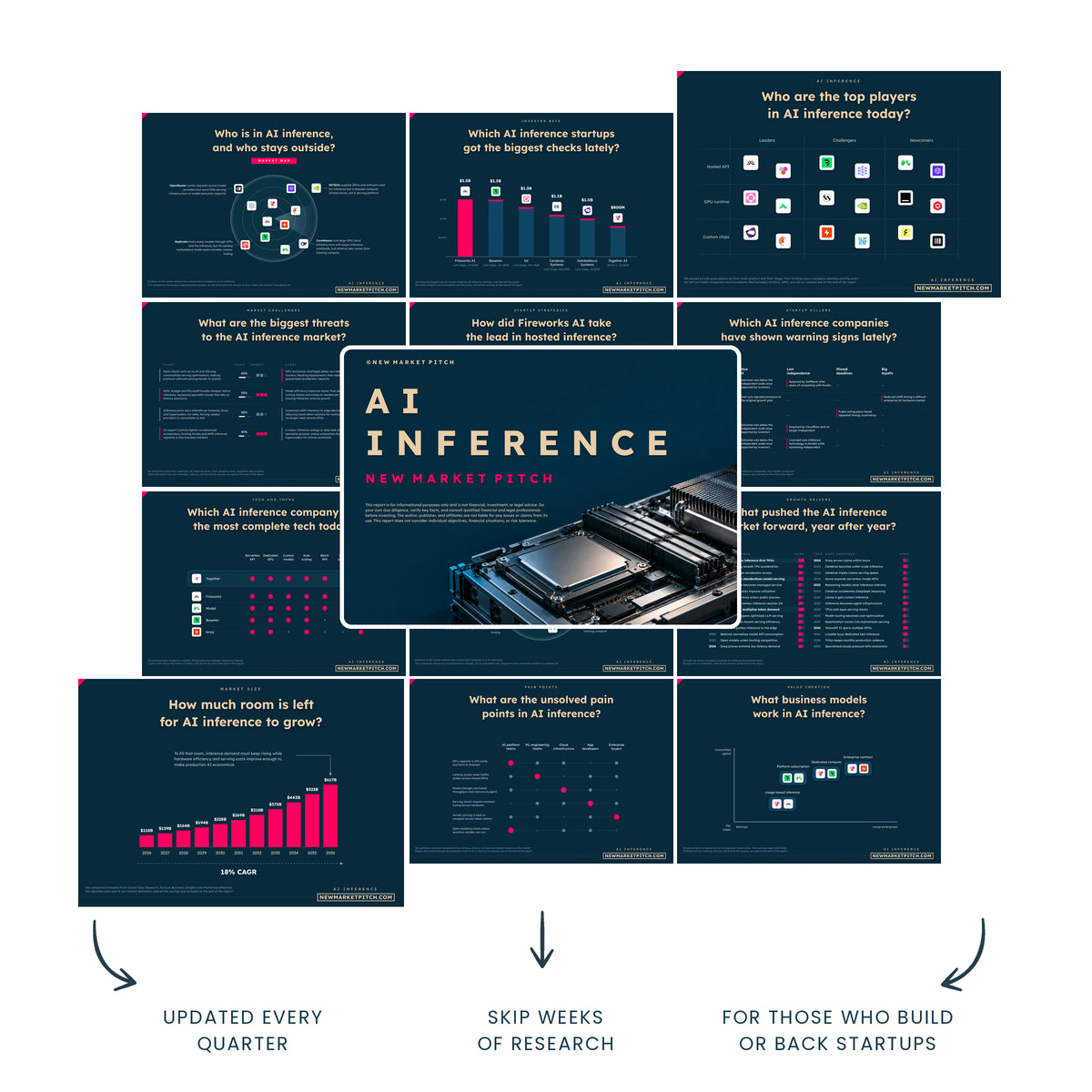
Whether you're building or investing in the AI inference market, our report covers everything you need to know: the players, the money, and what's coming next.
Summary
NVIDIA is the most active AI inference investor, with 12 equity rounds joined. AMD Ventures follows, while Spark Capital and Kindred Ventures are tied among the busiest traditional VCs. The companies that sell AI computing hardware now play a surprisingly large role in funding the software that runs models on it.
But NVIDIA usually joins rounds led by somebody else. Spark Capital, Accel and Andreessen Horowitz have much stronger records as named leads. Being present in a funding round and taking responsibility for it are different jobs.
That split runs through some of the best-known inference providers. Fireworks AI, Baseten and Together AI have attracted hardware companies alongside financial investors. Both groups can benefit when more businesses start serving AI models at scale, even if they bring different things to the financing.
NVIDIA has become busier recently, joining 9 rounds this year compared with 2 last year. AMD Ventures is also doing more deals. Their activity is hard to explain as ordinary portfolio diversification alone: inference software affects demand for the computing platforms they sell.
The famous VCs have not left the field. Andreessen Horowitz and Sequoia Capital have each been named as leads in 3 rounds we counted. Accel has also led core software and later-stage financing, while Spark Capital has kept supporting Baseten as it grows.
The earliest companies are still getting attention. Seed accounts for 31 of the 92 rounds with a known stage, and those deals involve both specialist funds and established VCs. Nobody has a monopoly on finding new inference technology.
Further along, the mix changes. NVIDIA has joined 5 Series B rounds and 4 Series D+ rounds. Investors backing a new runtime face different questions from those financing an established model-serving platform.
Look at the co-investors and another pattern appears. AMD Ventures and NVIDIA joined 3 rounds together, involving Fireworks AI, RadixArk and TensorMesh. Rival chipmakers can see value in the same execution software without agreeing on everything else.
Investor activity also comes in bursts. Salesforce Ventures has no named AI inference round this year, while Intel Capital has appeared in recent financings. An earlier investment says something about a firm's interests; it does not prove the firm is writing new checks now.
So there is a clear winner on activity, but no single winner on every measure. NVIDIA joins the most rounds. Traditional VCs often lead them. Early-stage specialists and repeat co-investors matter for different reasons.

Written by the New Market Pitch teamWe track new markets so founders and investors can move faster. About us

In our report covering the AI inference market, you will always find fresh funding data, taken straight from our own verified funding database.
Which VCs invest the most in AI inference right now?
NVIDIA leads AI inference investment activity with 12 joined rounds, followed by AMD Ventures with 6.
Neither is a conventional VC: both sell computing technology used to execute AI models. Spark Capital and Kindred Ventures are tied next with 4 rounds each. Spark Capital was named as lead in every round we found; Kindred Ventures led half its rounds. That gap shows that counting rounds does not tell you who sets the terms.
The portfolios also look different. NVIDIA has appeared in rounds for Fireworks AI, fal, Baseten and Together AI, while AMD Ventures has backed Cerebras Systems, Fireworks AI and RadixArk. Baseten focuses on serving models in production; RadixArk works on open execution infrastructure. Those investments put financial backers and hardware suppliers in some of the same companies for different reasons.
The table below ranks the 20 most active AI inference investors by the number of equity rounds they joined, with the rounds they led, their main stages, the startups they backed and the biggest round they joined.
If you want to go more into detail and get more data to understand what investors are betting on now, please check our AI inference report.
| # | Investor | Rounds | Led | Main stages | AI inference startups backed | Biggest round joined | Latest round |
|---|---|---|---|---|---|---|---|
| 1 | NVIDIA ▲ | 12 | 1Mostly follows (led 8% of its rounds) |
Series B 5Series D+ 4 | Fireworks AI, fal, Baseten, Together AI, DeepInfra + 4 more | $1.5BFireworks AI · 2026 | Nov 2026 |
| 2 | AMD Ventures ▲ | 6 | 2Mostly follows (led 33% of its rounds) |
Series A 2Seed 1 | Cerebras Systems, Fireworks AI, RadixArk, Wafer, Featherless.ai + 1 more | $1.0BCerebras Systems · 2026 | Sep 2026 |
| 3 | Spark Capital ▲ | 4 | 4Named as lead in every round found | Seed 1Series B 1 | Baseten, RadixArk | $1.5BBaseten · 2026 | Jun 2026 |
| 4 | Kindred Ventures | 4 | 2Leads half its rounds | Series A 3Seed 1 | fal, Parasail, Northflank | $32MParasail · 2026 | Apr 2026 |
| 5 | Accel | 3 | 3Named as lead in every round found | Seed 1Series A 1 | Modal, RadixArk, Simplismart | $750MModal · 2026 | Oct 2026 |
| 6 | Andreessen Horowitz | 3 | 3Named as lead in every round found | Seed 2Series B 1 | fal, Gimlet Labs, Inferact | $300MGimlet Labs · 2026 | Sep 2026 |
| 7 | Disruptive ▲ | 3 | 3Named as lead in every round found | Growth 2Series A 1 | Groq | $750MGroq · 2025 | Aug 2026 |
| 8 | Sequoia Capital | 3 | 3Named as lead in every round found | Series D+ 2Series B 1 | Fireworks AI, fal | $350Mfal · 2026 | Apr 2026 |
| 9 | IVP | 3 | 3Named as lead in every round found | Series B 1Series C 1 | Baseten | $300MBaseten · 2026 | Jan 2026 |
| 10 | General Catalyst ▲ | 3 | 2Usually leads (67% of its rounds) |
Series A 1Series B 1 | Modal, Together AI, Hyperbolic | $355MModal · 2026 | Oct 2026 |
| 11 | Intel Capital ▲ | 3 | 1Mostly follows (led 33% of its rounds) |
Series D+ 2Series A 1 | SambaNova Systems, TrueFoundry | $1.0BSambaNova Systems · 2026 | Jul 2026 |
| 12 | Salesforce Ventures | 3 | 1Mostly follows (led 33% of its rounds) |
Series A 1Series B 1 | fal, Together AI | $305MTogether AI · 2025 | Jul 2025 |
| 13 | Lux Capital | 2 | 2Named as lead in every round found | Seed 1Series B 1 | Modal, SkyPilot | $87MModal · 2025 | Jul 2026 |
| 14 | Touring Capital | 2 | 2Named as lead in every round found | Seed 1Series A 1 | Parasail, Infinity Artificial Intelligence Institute | $32MParasail · 2026 | Jul 2026 |
| 15 | Atreides Management | 2 | 2Named as lead in every round found | Series D+ 2 | Cerebras Systems, Fireworks AI | $1.5BFireworks AI · 2026 | Jul 2026 |
| 16 | Index Ventures | 2 | 2Named as lead in every round found | Series C 1Series D+ 1 | Fireworks AI | $1.5BFireworks AI · 2026 | Jul 2026 |
| 17 | Georges Harik | 2 | 2Named as lead in every round found | Series A 1Series B 1 | DeepInfra | $107MDeepInfra · 2026 | May 2026 |
| 18 | Airbus Ventures | 2 | 2Named as lead in every round found | Seed 1Series A 1 | Featherless.ai | $20MFeatherless.ai · 2026 | Apr 2026 |
| 19 | Lightspeed Venture Partners | 2 | 2Named as lead in every round found | Seed 1Series C 1 | Fireworks AI, Inferact | $250MFireworks AI · 2025 | Jan 2026 |
| 20 | Dawn Capital | 2 | 2Named as lead in every round found | Series A 2 | Runware, Doubleword | $50MRunware · 2025 | Dec 2025 |
No investors match this search.
Data from January 2024 through 12 November 2026, which is enough to show who is active today and who has been for years. Rounds: equity rounds in which the investor is named. Led: rounds it led or co-led. ▲ more rounds in 2026 so far than its 2025 pace, ▼ fewer.

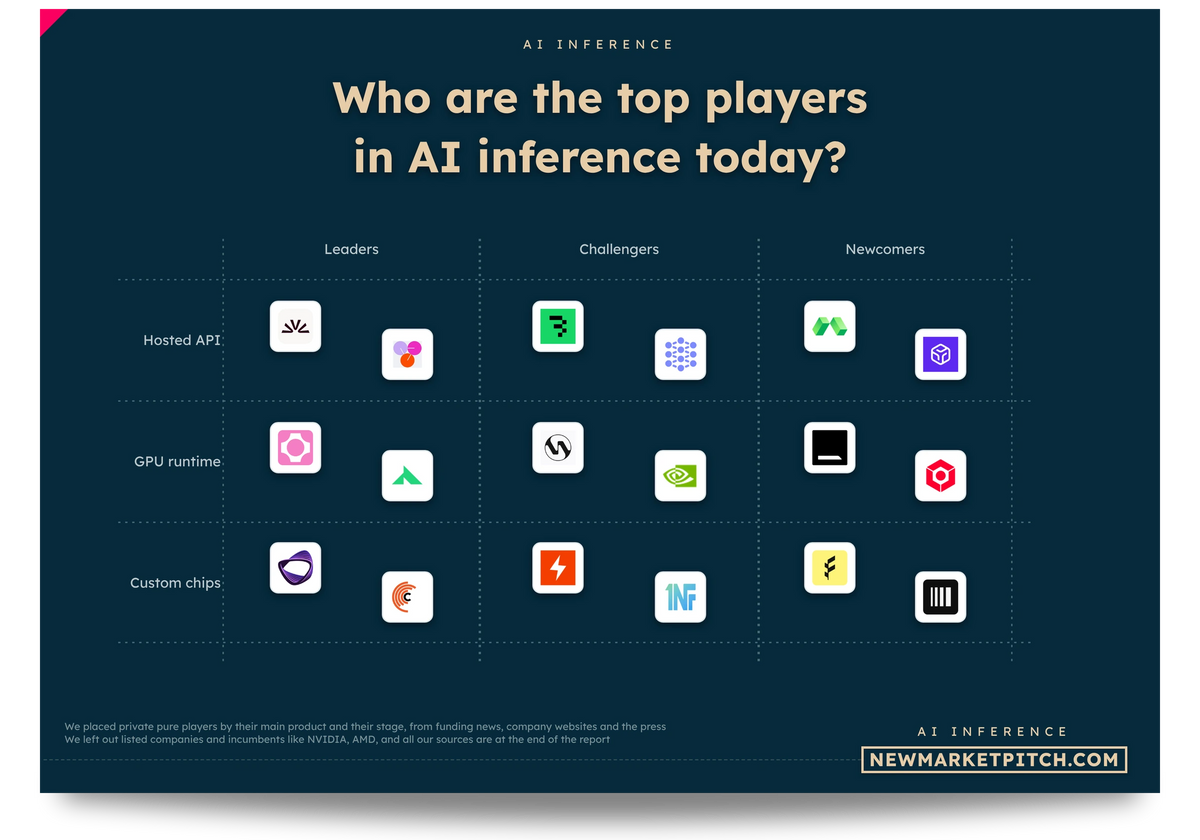
In our research about AI inference startups, we turn what is vague and complex into simple, useful visuals. Market maps like this one show you at a glance where every startup stands.
Are NVIDIA and AMD Ventures backing AI inference for the same reasons?
Not quite. NVIDIA and AMD Ventures both fund AI inference companies, but each has its own computing ecosystem to support.
NVIDIA already sells accelerators and software used by inference providers. NVIDIA's Dynamo announcement in March 2026 named Baseten, DeepInfra and Fireworks as companies in that software ecosystem. NVIDIA's financing activity also includes fal and Together AI. A startup can be a potential customer, technical partner and portfolio company at once. Still, none of those relationships proves that an investment bought a customer contract.
AMD Ventures has taken a wider view of execution architectures. Its published portfolio includes Cerebras, Fireworks AI and Featherless. AMD's disaggregated inference partnership with Cerebras, announced in July 2026, also shows that AMD is willing to cooperate with companies pursuing different computing designs. RadixArk's financing brought investors associated with both AMD and NVIDIA into an open-infrastructure business.
NVIDIA joins more rounds, while AMD Ventures has a smaller but visible set of bets. We cannot compare their personal check sizes because the public round totals describe all investors combined.
Do the busiest AI inference investors actually lead funding rounds?
Mostly not. NVIDIA joins more AI inference rounds than anyone else, but NVIDIA was named as lead in only 1.
Spark Capital was named as lead in every round we found, as were Accel, Andreessen Horowitz and Sequoia Capital. AMD Ventures led 2 rounds; Kindred Ventures led 2 as well. These investors are doing different things. Participating can secure a relationship with a promising platform, while a named lead typically helps set the financing terms.
Baseten shows how the roles can coexist. Its earlier financing was led by IVP and CapitalG, with NVIDIA participating. Its later $1.5B round, in June 2026, named Spark Capital alongside other leads. Both were important fundraising events for the same production inference provider, but they did not assign identical roles to every backer. Because announcements are better at naming leads than smaller participants, reported lead rates can look higher than they really are.
The table below shows how participation compares with named lead roles for selected investors.
| Investor | Rounds joined | Rounds led |
|---|---|---|
| NVIDIA | 12 | 1 |
| AMD Ventures | 6 | 2 |
| Spark Capital | 4 | 4 |
| Kindred Ventures | 4 | 2 |
| Accel | 3 | 3 |
| Andreessen Horowitz | 3 | 3 |
| Sequoia Capital | 3 | 3 |
| General Catalyst | 3 | 2 |
These are whole funding rounds, not the amounts invested by each firm.

In our market report about AI inference startups, we always try to gather several sources and make estimates that make sense, so you can work with solid numbers.
Are Andreessen Horowitz and Sequoia Capital still important AI inference investors?
Yes. Andreessen Horowitz and Sequoia Capital remain major AI inference deal leaders, with 3 rounds led each.
Andreessen Horowitz has backed Inferact, which builds around the vLLM model-serving engine, and Gimlet Labs, which works on running inference across different computing systems. The firms financing both companies are betting that better execution software can lower the cost and complexity of putting AI into production. Those are specific infrastructure products rather than general-purpose AI apps.
Sequoia Capital has appeared in rounds involving Fireworks AI and fal. Fireworks serves customized open models for business applications; fal focuses on media-generation inference, including image and video. Sequoia Capital and NVIDIA sometimes sit in the same rounds, but Sequoia Capital tends to lead while NVIDIA joins.
Neither VC is the busiest participant overall, and neither needs to be. Their reported lead roles show why an investor with fewer joined rounds can still matter when a startup is deciding who will anchor its next financing.
Is Spark Capital betting big on AI inference?
It is. Spark Capital keeps leading AI inference rounds, particularly at Baseten and RadixArk.
Baseten provides the infrastructure that lets businesses run AI models reliably in production. Its June 2026 funding announcement named Spark Capital among the leads and reported that revenue had grown 20x while inference volume grew 40x over the previous year. Those figures come from the company's own announcement; they explain why a serving platform can keep attracting investors after its first product works. Spark has remained involved through several financings.
RadixArk is a different kind of investment. It develops open infrastructure around SGLang, the software used to run models efficiently. RadixArk's launch financing named Spark Capital and Accel as co-leads. So Spark is backing both the tools that execute models and a business selling managed execution to customers.
Leading those rounds means more than simply joining them. Spark is willing to lead companies working on core inference technology, although those lead roles alone tell us nothing about its eventual returns.
Are specialist firms replacing the biggest VCs in AI inference?
No. Specialist funds and famous generalist VCs often back the same AI inference businesses.
RadixArk's seed financing was led by Accel and Spark Capital, while Inferact's financing brought Andreessen Horowitz together with Lightspeed Venture Partners. At Fireworks AI, Index Ventures and Atreides Management led a later, much larger round that also included strategic investors. The names change with the company and its stage, but the groups are frequently working side by side.
Specialized knowledge still helps. Touring Capital has backed Parasail, which optimizes model endpoints across computing suppliers. Lux Capital has supported Modal, whose software helps developers run inference and other compute tasks. Both work on the everyday problems of running AI: latency, workload scheduling and the cost of keeping servers busy.
We counted 174 named investors across the market. That breadth gives startups more potential backers, but it does not mean specialist funds have pushed the larger VCs out of inference financing.
Which AI inference investors are still investing this year?
NVIDIA is still the busiest AI inference backer this year, with 9 joined rounds.
AMD Ventures has also been active, with 5 rounds this year. Spark Capital, Accel and General Catalyst have each appeared in recent inference financings as well. Others have not appeared in any AI inference round this year: Salesforce Ventures and Dawn Capital have no named participation this year. That does not establish that they sold earlier stakes or stopped investing in AI altogether.
NVIDIA's current pace is striking beside its 2 rounds last year. This is consistent with its broader push into production inference software, including Dynamo and partnerships with companies building hosted model execution. Recent rounds at Fireworks AI, Baseten and Modal also show why investors are interested: providers are raising money to expand the systems customers use for running models. These are recorded participations during a year still in progress, not a forecast of its final tally.
The table below shows, year by year, how many rounds 12 of the most active AI inference investors joined, so it is easy to see who is still investing and who has slowed down.
If you want to go more into detail and see which investors are still writing checks and which have slowed down, please check our AI inference report.
| Investor | 2024 | 2025 | 2026* | Total |
|---|---|---|---|---|
| NVIDIA | 1 | 2 | 9 | 12 |
| AMD Ventures | 1 | 5 | 6 | |
| Spark Capital | 1 | 1 | 2 | 4 |
| Accel | 1 | 2 | 3 | |
| Andreessen Horowitz | 1 | 2 | 3 | |
| Disruptive | 1 | 2 | 3 | |
| General Catalyst | 1 | 2 | 3 | |
| Intel Capital | 1 | 2 | 3 | |
| Touring Capital | 2 | 2 | ||
| Kindred Ventures | 3 | 1 | 4 | |
| Sequoia Capital | 1 | 1 | 1 | 3 |
| IVP | 1 | 1 | 1 | 3 |
* 2026: January to 12 November. Darker cells mean more rounds that year. Data from January 2024 through 12 November 2026.

Our document detailing everything you need to know about AI inference gets updated several times a month, so you always get the latest view of where things stand.
Is Salesforce Ventures still investing in AI inference?
Salesforce Ventures has not joined any named AI inference equity round this year, though it backed the market earlier.
It is still associated with an established portfolio. Together AI's earlier funding included Salesforce Ventures, and the firm's AI fund update of October 2025 highlighted inference names such as Together AI and fal. Together AI serves open models for businesses; fal specializes in media-generation inference. Both fit Salesforce's wider interest in the infrastructure behind AI products.
An earlier portfolio holding does not tell us whether there has been a fresh financing. Salesforce's general announcements also cover model developers and AI applications, which should not automatically be counted as inference startups. And the absence of a named AI inference round this year does not show that Salesforce Ventures sold any of its positions.
For now, the evidence supports a narrow answer: Salesforce Ventures is an established backer but has not been named in an AI inference round this year.
Is Intel Capital still active in AI inference startups?
Yes. Intel Capital is still appearing in AI inference financings, including one involving SambaNova Systems.
Intel Capital joined 3 AI inference rounds, including 2 this year, across SambaNova Systems and TrueFoundry. Those companies approach inference from different directions. SambaNova sells model-execution services linked to custom hardware, while TrueFoundry develops software for deploying and serving models. A chipmaker's investment arm can therefore back execution businesses without confining itself to hardware companies.
SambaNova's February 2026 announcement described a new inference chip, an intended technical collaboration with Intel and strategic equity financing involving Intel Capital. That makes the financing more specific than a corporate logo appearing on a list of investors. It still does not prove customer demand or the outcome of the collaboration.
Intel Capital's presence also complicates the idea that AI inference investment is just a contest between NVIDIA and AMD Ventures. Companies running models need different kinds of computing systems, and several strategic investors want exposure to that work.
Do AI inference investors keep backing the same companies?
Often, yes. Several leading AI inference investors keep participating in new rounds for their existing portfolio companies.
IVP's 3 counted rounds all involve Baseten. Disruptive's 3 rounds all involve Groq. Spark Capital has appeared repeatedly through Baseten and RadixArk. NVIDIA looks different: its investments cover Fireworks AI, fal, Baseten, Together AI and DeepInfra, among others. An investor can rank highly by returning to a company or by backing a broader set of companies.
Those choices make sense at different moments. Baseten has raised successive financings while expanding its production serving business. Groq has financed growth of its dedicated inference cloud. An existing shareholder can join again when the next round arrives, while another fund may enter only once as the company gets bigger.
So repeated deal activity does not automatically mean a wide portfolio. Counting rounds and counting companies backed give two different pictures, which is why concentrated investors and broad strategic investors can both sit near the top.
Which AI inference investors back seed rounds, and which back growth rounds?
Seed is the busiest AI inference funding stage, with 31 of the 92 rounds whose stages are known.
Andreessen Horowitz and a16z CSX are tied at seed with 2 rounds each; there is no single seed leader. Kindred Ventures is the most active Series A investor, with 3 rounds, while NVIDIA is busiest at Series B with 5. Further along, NVIDIA leads Series D and later with 4 rounds. That is a clear change in who appears most often as inference companies move beyond their first product.
The work changes too. Inferact and RadixArk are building underlying execution technology, where early investors must judge whether developers will adopt the tools. Companies such as Baseten and Fireworks AI are already serving models in production and raise later rounds to expand capacity and win customers. Among the 23 Series C-or-later rounds, the investor mix reflects those scaling demands. All these counts refer to participation, not the size of any firm's personal check.
The table below shows, for 12 of the most active AI inference investors, how many rounds they joined at each stage, from seed to growth.
If you want to go more into detail and see where each investor places its bets, from seed to growth, please check our AI inference report.
| Investor | Seed | Series A | Series B | Series C | Series D+ | Growth |
|---|---|---|---|---|---|---|
| NVIDIA | 1 | · | 5 | 1 | 4 | · |
| AMD Ventures | 1 | 2 | 1 | · | 1 | · |
| Spark Capital | 1 | · | 1 | 1 | 1 | · |
| Kindred Ventures | 1 | 3 | · | · | · | · |
| Accel | 1 | 1 | · | · | 1 | · |
| Andreessen Horowitz | 2 | · | 1 | · | · | · |
| Disruptive | · | 1 | · | · | · | 2 |
| Sequoia Capital | · | · | 1 | · | 2 | · |
| IVP | · | · | 1 | 1 | 1 | · |
| General Catalyst | · | 1 | 1 | 1 | · | · |
| Intel Capital | · | 1 | · | · | 2 | · |
| Salesforce Ventures | · | 1 | 1 | 1 | · | · |
Most active at each stage, among all AI inference investors: Seed, Andreessen Horowitz and a16z CSX · Series A, Kindred Ventures · Series B, NVIDIA · Series C, no investor joined more than one round · Series D+, NVIDIA · Growth, Disruptive. Bigger dots mean more rounds. Data from January 2024 through 12 November 2026.

In our report covering the AI inference market, we look at what the winners do differently, so you can learn from the best instead of guessing.
Are AI inference seed rounds only for specialist venture firms?
No. Large generalist VCs are backing AI inference startups at seed, alongside specialists and corporate investors.
Andreessen Horowitz and a16z CSX are tied for the most seed-round appearances, with 2 each. Accel and Spark Capital have also been active in new inference infrastructure companies. NVIDIA and AMD Ventures have each joined a seed deal too. Early investment in this market is not reserved for people who run an inference cloud themselves.
The actual startups show what investors are buying into. Inferact works on the vLLM execution ecosystem and attracted Andreessen Horowitz and Lightspeed Venture Partners. RadixArk is building open infrastructure around SGLang, with Accel and Spark Capital leading its launch financing. Featherless.ai sells access to open-model inference and brought AMD Ventures and Airbus Ventures into a later Series A.
These businesses solve related but distinct problems. Their early backers need to understand the technology, but also how the tools will find users and develop into products worth paying for.
Which VCs back the most AI inference Series A rounds?
Kindred Ventures is the most active AI inference investor at Series A, with 3 rounds, more than at seed.
Kindred Ventures joined 4 rounds, including 3 Series A financings, and led 2. Kindred Ventures' AI inference companies include fal, Parasail and Northflank. These businesses help developers use, serve or coordinate AI models without building every part of the underlying infrastructure themselves. That gives Kindred a recognizable interest in the practical work of running models.
Parasail makes the approach concrete. Its April 2026 funding announcement named Kindred Ventures and Touring Capital as co-leads. Parasail is building optimized model endpoints that can use compute from different suppliers, a commercial challenge that goes beyond writing a faster model runtime.
There are other early-stage leaders. Andreessen Horowitz and a16z CSX share the seed participation lead. Kindred's distinct strength is its activity once young inference businesses are raising Series A, when technical promise has to become a product customers will use.
Does NVIDIA wait until AI inference startups are more established?
Mostly, yes. NVIDIA's AI inference investments lean toward companies raising later rounds, including 5 Series B and 4 Series D+ financings.
NVIDIA also joined a seed round, so this is a preference rather than an absolute rule. But the later-round pattern fits its business. As model-serving platforms win customers, they need to handle more requests, improve latency and buy access to computing capacity. NVIDIA's Dynamo announcement of March 2026 named Baseten, DeepInfra and Fireworks among providers in its inference software ecosystem.
That commercial overlap is relevant but should not be overstated. Joining a startup's round does not prove NVIDIA was its largest investor, led the financing or guaranteed a technical relationship. In AI inference, NVIDIA mostly joins as a non-lead participant, unlike firms such as Accel or Spark Capital that frequently take named lead roles.
The clearest finding is about where NVIDIA appears: often beside inference companies that have progressed beyond an initial product and are working to serve larger production workloads.

Learning from others' mistakes is the cheapest lesson there is. In our research about AI inference startups, we look at what broke startups before you, so you don't repeat it.
Is Groq attracting a different kind of AI inference investor?
Yes. Groq's AI inference financing has been unusually concentrated around Disruptive, a repeat lead investor.
Disruptive joined 3 AI inference rounds, all involving Groq, and was named as lead in every round we found. Disruptive is also the busiest growth-equity investor in AI inference, with 2 rounds. That differs from NVIDIA's broad portfolio of hosted-serving startups and from VCs spreading bets across multiple inference tools.
Groq combines custom processors with a commercial cloud that runs models for customers. Groq's June 2026 announcement describes raising capital to expand that inference cloud, and in August 2026 Groq closed another round led by Disruptive. In December 2025, Groq also signed a non-exclusive technology-licensing agreement with NVIDIA. That is why Groq counts as an inference-service company even though it also designs chips.
Groq's announcements do not say how much of each round Disruptive put in or what stake it holds. They do show Disruptive taking the public lead again and again in financing this inference company.
Do the largest AI inference rounds go to the most active investors?
No. The investors joining the most AI inference rounds are not necessarily leading the biggest ones.
Fireworks AI's $1.5B Series D+ included NVIDIA, Atreides Management and Index Ventures. Fireworks named Atreides Management, Index Ventures and TCV as leads. Baseten's $1.5B Series D+ named Spark Capital among the leaders, while Accel led Modal's $750M Series D+ financing. Each amount belongs to the entire round, not any one investor.
These examples show several ways to matter. NVIDIA can take a non-lead position in a major infrastructure business. Spark Capital has led financings in Baseten as that serving platform expanded. Atreides Management and Index Ventures appear less frequently overall but held prominent positions in Fireworks' financing. Accel has backed both early infrastructure work and a mature execution platform.
So the busiest AI inference investor and the lead of a giant round are often different firms.
Which AI inference investors most often invest together?
AMD Ventures and NVIDIA form the most frequent AI inference co-investor pair, with 3 shared rounds involving Fireworks AI, RadixArk and TensorMesh.
That pairing is unusual because AMD and NVIDIA compete in AI hardware. Their overlap suggests that an execution software company can be valuable to more than one computing ecosystem. NVIDIA and Sequoia Capital also shared 2 rounds, involving Fireworks AI and fal; they bring a hardware-platform investor together with a conventional VC. IVP and Spark Capital joined 2 rounds at Baseten, a much more focused repeat relationship.
Kindred Ventures also appears in repeated Northflank financings alongside Pebblebed, Tapestry VC and Uncorrelated Ventures. Shared rounds can reveal investors who repeatedly back the same company, but they do not prove a formal partnership or identical business motives.
The table below lists the pairs of AI inference investors named together in at least two equity rounds, with the startups they backed together.
If you want to go more into detail and see which investor networks back the same startups, please check our AI inference report.
| Investor pair | Rounds together | Startups backed together |
|---|---|---|
| AMD Ventures + NVIDIAFireworks AI, RadixArk, TensorMesh | 3 | Fireworks AI, RadixArk, TensorMesh |
| NVIDIA + Sequoia CapitalFireworks AI, fal | 2 | Fireworks AI, fal |
| IVP + Spark CapitalBaseten | 2 | Baseten |
| Kindred Ventures + PebblebedNorthflank | 2 | Northflank |
| Kindred Ventures + Tapestry VCNorthflank | 2 | Northflank |
| Kindred Ventures + Uncorrelated VenturesNorthflank | 2 | Northflank |
| Pebblebed + Tapestry VCNorthflank | 2 | Northflank |
| Pebblebed + Uncorrelated VenturesNorthflank | 2 | Northflank |
Pairs of investors named in the same equity round. Data from January 2024 through 12 November 2026.
Why do AMD Ventures and NVIDIA keep appearing in the same AI inference rounds?
Because useful AI inference execution software can work across rival computing platforms, AMD Ventures and NVIDIA sometimes back the same companies.
Their shared rounds involve Fireworks AI, RadixArk and TensorMesh. Fireworks operates a model-serving platform, while RadixArk builds software around open inference execution. Both can help customers run models more efficiently without requiring every customer to use the same hardware. Their financing overlap is real, but it does not prove the chipmakers have coordinated investment strategies.
The product announcements help explain the shared interest. NVIDIA is promoting its Dynamo software for efficient model serving. In July 2026, AMD announced a disaggregated inference collaboration with Cerebras, showing interest in execution designs outside its own hardware alone. RadixArk's financing brought investors connected to both platforms into one software company.
The companies still compete in accelerators. Investing in some of the same inference startups simply gives each a place in a growing software ecosystem.

If you build or invest in the AI inference market, you need to know which business models pay off now and which ones are fading. That's why our report covering it has a whole section on it.
Can smaller funds lead AI inference deals ahead of Accel and Sequoia?
Yes. Smaller funds can lead AI inference rounds by specializing in particular execution problems.
Touring Capital joined 2 rounds and was named as lead in every round we found, including a financing involving Parasail. Airbus Ventures joined 2 rounds and was named as lead in every round found; Featherless.ai is one of its recorded investments. Dawn Capital joined 2 rounds involving Runware and Doubleword, although we have no new current-year participation for the firm. Those firms are active in different niches, not all chasing the same model-serving product.
Parasail optimizes endpoints across computing suppliers, Featherless.ai serves open models, and Runware focuses on efficient image and media-generation inference. Each presents a different technical and commercial problem. A fund that understands one of those problems can help lead a company without matching Accel's or Sequoia Capital's name recognition.
The larger VCs still feature in important rounds. The practical question for a founder is which investor can lead the financing and understand the product, not which logo looks biggest.
So, who are the biggest investors in AI inference?
NVIDIA is the most active AI inference investor today, measured by equity rounds joined.
AMD Ventures is the next most frequent participant. Among conventional VCs, Spark Capital and Kindred Ventures are especially active, although Spark is far more often named as a lead. Andreessen Horowitz, Accel and Sequoia Capital have also taken important lead positions. These are distinct roles, and one leaderboard cannot capture all of them.
Looking at the companies makes the split easier to understand. Hardware investors appear beside firms that execute models in production. Venture firms lead rounds in tools such as RadixArk and in established platforms such as Baseten. Disruptive, meanwhile, concentrates its activity on Groq rather than spreading it across numerous inference companies.
So NVIDIA leads on frequency. Traditional VCs feature prominently when we ask who leads deals, and the early-stage answer changes again. The table below shows what we found.
| Question | Answer |
|---|---|
| Who participates in the most inference rounds? | NVIDIA is the clearest leader by repeated financing participation. It joined 9 AI inference rounds this year. Its repeated presence makes NVIDIA a major strategic participant. |
| Is NVIDIA also the dominant deal leader? | No, NVIDIA participates far more often than it leads. It was named as lead in 1 round. Its presence is different from setting the terms of a financing. |
| Has AMD become a serious inference backer? | Yes, AMD Ventures is another significant corporate inference investor. AMD Ventures joined 6 rounds in companies that run AI models. Its portfolio touches several approaches to running models efficiently. |
| Do conventional VCs still lead important deals? | Absolutely, conventional venture firms remain central to leading funding rounds. Accel led 3 AI inference rounds. Joining fewer rounds does not mean having less say. |
| Is Spark's activity broad or concentrated? | Spark Capital combines repeated investment with repeated lead roles. Its 4 rounds concern the companies Baseten and RadixArk. It has repeatedly supported a small group of companies. |
| Are early inference deals led by one firm? | No, the seed-stage lead is currently shared by investors. Andreessen Horowitz and a16z CSX joined 2 rounds each. Neither firm can claim exclusive leadership of early investing. |
| Is Kindred strongest at company formation? | Not exactly, Kindred Ventures stands out at Series A. It joined 3 rounds at the Series A stage. That is different from being the top seed investor. |
| Is NVIDIA's recent pace still increasing? | Yes, NVIDIA has become far more active in inference. It had joined 2 rounds in the previous year. NVIDIA is appearing in more AI inference financings now. |
| Do rival chip suppliers invest together? | They do, despite competing directly in the hardware market. AMD Ventures and NVIDIA appeared together in 3 rounds. Shared investment interests do not mean exclusive technical cooperation. |
| Can a one-company investor matter significantly? | Yes, concentrated financial backers can repeatedly take leadership roles. Disruptive joined 3 rounds, all involving Groq. Its relevance comes from persistent support for that company. |
| Are famous AI funds active every year? | No, a famous investor's earlier portfolio does not guarantee activity. Salesforce Ventures has no counted round in the current year. Its earlier investments still link it to inference businesses. |

In our document detailing everything you need to know about AI inference, we like to show you the big picture. We know your time is precious, so we make every page quick to read and packed with as much learning as possible per minute.
Our methodology
Our data runs through November 12, 2026. We systematically track equity rounds deal by deal from January 2024, a window long enough to show which investors are active now. AI inference means companies principally offering production execution of trained models or the runtimes, optimization and scheduling software that makes execution efficient. We include hosted endpoints, on-device execution and qualifying inference-cloud services, including companies with chips when a substantive paid inference service is central to the business. We exclude hardware-only vendors, undifferentiated GPU rental, model labs primarily selling their own models and generic AI applications. Every counted company meets our startup definition: an independent, growth-oriented technology company founded in 2000 or later, privately backed and never listed or listed within the last five years; recently acquired companies remain eligible under our acquisition rule. We include borderline companies when their execution product satisfies the definition rather than excluding them automatically.
We count the equity rounds an investor joined and, separately, the rounds it led; we do not claim to know its personal investment amount, which is rarely disclosed. IPOs and offerings after a listing are excluded because they are not private equity rounds an investor joins. We reconcile naming variants across company announcements and the press, merge repeated reports of the same financing and exclude vague labels such as "existing investors" or "angel investors" when no names are given. The current-year comparison begins in March, once there are three months of data; here it remains a year in progress. An equity round is counted once in a funding tracker but can be counted for every named participating investor in this article, so investor participation counts cannot be summed into a deal count.
Announcements name lead investors more reliably than smaller participants, so rounds that an investor joined without leading are undercounted and lead rates are an upper bound.
Rounds confirmed by a company announcement, a press article or a regulatory filing are counted in full. Where no article exists, a round is counted only when at least two recognised databases agree on its date (within one month) and amount (within 5%), and it is marked as low confidence; a round found in a single database stays in the company's history but is left out of totals. For companies that have raised more than $100M, every round counted is backed by an article.
We do not use investor lists from Crunchbase, PitchBook or similar commercial databases on their own. Such lists can add names not identified in an actual financing or mix debt and grants into equity histories. We counted 102 equity rounds, of which 95 had at least one named investor. The remaining rounds are still part of market financing history but cannot contribute to an investor ranking, so every participation count is a floor rather than a complete picture of private investing.
The most obvious objection is that a well-known specialist may rank below a broad strategic investor even when it is deeply influential. We deliberately rank by named equity rounds joined because this measures repeat, independently identifiable market participation rather than brand reputation, unverified check sizes or the size of an announced fund. We show reported leads and stage activity separately so that leadership is not mistaken for attendance, and we keep whole-round financing amounts separate from any investor's undisclosed contribution.
Key sources include NVIDIA's production inference software and named ecosystem providers, AMD Ventures' publicly listed AI investment portfolio, AMD and Cerebras inference collaboration, Baseten's later financing, leads and inference growth, Baseten's earlier financing and investor roles, Fireworks AI's later financing, leads and participation, Fireworks AI's earlier financing and investors, RadixArk's initial financing and infrastructure thesis, Gimlet Labs' inference platform and Series B investors, Counsel's announcement of Inferact's seed financing, Modal's Series C and product positioning, Modal's later financing and lead investor, fal's Series E and Series F announcements and respective leads, Salesforce Ventures' public investment portfolio discussion, Together AI's earlier financing and Salesforce Ventures participation, SambaNova's inference financing and Intel collaboration, Groq's inference-cloud financing and commercial expansion, Groq's subsequent financing and reported lead, Parasail's Series A and co-leads, Featherless.ai's Series A and corporate co-leads, DeepInfra's Series B and co-leads, Runware's own funding history and inference product, and Groq's licensing agreement with NVIDIA.

When you build or invest in the AI inference market, you need clarity, not confusion. In our report covering the AI inference market, we always try to put numbers on and quantify whatever is usually vague and confusing.
Written by the New Market Pitch teamWe track new markets so founders and investors can move faster. About us