How big is the AI voice agents market beyond call centers?
Whether you're building or investing in the AI voice agent market, our report covers everything you need to know: the players, the money, and what's coming next.
Summary
The AI voice agents market beyond call centers is already a substantial commercial opportunity, with healthcare leading adoption and restaurants, automotive systems and consumer applications opening additional markets. Its exact revenue remains unmeasured, but non-call-center applications could generate roughly $3 billion to $8 billion annually by 2030 under plausible adoption scenarios.
The dedicated global AI voice agents market is estimated at $3.5 billion in 2026, with a projected $35.2 billion by 2033. That is considerably smaller than the broader conversational AI and audio AI markets, which include technologies and products that overlap with voice agents. Adding those market estimates together would substantially exaggerate the opportunity.
Customer support remains the largest reported voice-agent application, but no reliable public breakdown establishes how much revenue comes from other industries. The distinction is especially difficult when restaurant ordering and medical scheduling use telephone-based technology for work that falls outside conventional contact centers.
Healthcare provides the strongest evidence of adoption beyond customer support. Microsoft reported more than 100,000 clinicians using Dragon Copilot in daily practice, while Abridge reported more than 150 enterprise health-system deployments. These are operational deployments across major healthcare organizations, although their associated voice-agent revenue is not separately disclosed.
Medical voice AI has attractive subscription economics. At $100 per clinician per month, 500,000 paying clinicians would represent $600 million in annual recurring revenue, and one million would represent $1.2 billion. Clinical documentation, medical-record integration and workflow automation provide reasons for hospitals to pay beyond basic speech transcription.
Restaurants offer another potential billion-dollar category, but adoption must spread much further. SoundHound's Five Guys deployment passed one million guest interactions, demonstrating real usage. At $500 per location per month, however, reaching $1.2 billion in annual software revenue would require 200,000 paying restaurants, far beyond the adoption demonstrated by individual chain deployments.
Automotive voice technology has the largest established distribution footprint, with Cerence reporting cumulative shipments in more than 525 million vehicles. That figure represents historical voice-technology installations, not 525 million autonomous agents or paying AI subscribers. The opportunity depends on whether manufacturers and drivers will pay extra for more capable assistants.
Consumer applications such as Duolingo's AI conversations show that voice can create value in language learning and education. Monetization is harder to isolate because voice features are frequently bundled into broader software subscriptions. The number of voice interactions could therefore grow considerably faster than standalone voice-agent revenue.
Infrastructure is already a meaningful business. ElevenLabs reported more than $500 million in company-wide ARR, and Vapi surpassed one billion cumulative calls. Yet usage does not guarantee profitability: SoundHound generated $168.9 million in 2025 revenue while consuming approximately $98.2 million in operating cash. Companies integrating voice into valuable industry workflows may retain stronger pricing power than providers selling interchangeable speech capabilities.
Applying the dedicated market's projected growth rate implies an overall voice-agent market near $13.1 billion in 2030. If applications outside call centers capture 25% to 60% of that spending, they would account for approximately $3.3 billion to $7.9 billion annually. Our conclusion is that a multibillion-dollar non-call-center market is credible, with healthcare supplying the clearest commercial foundation. The biggest uncertainty is how much voice AI becomes separately paid software rather than a standard feature inside existing products.

Written by the New Market Pitch teamWe track new markets so founders and investors can move faster. About us
Why are AI voice agents suddenly showing up everywhere?
AI voice agents are moving well beyond customer-service calls, with real deployments in hospitals, restaurants, cars and consumer apps. Healthcare and restaurant ordering are already proving that companies will pay for voice AI to do specific jobs.
Three changes have pushed the market forward. Real-time speech models now support more natural conversations, developers can build agents using ready-made APIs, and businesses can connect those agents to software that handles appointments, orders, records and payments.
The money entering the sector is substantial. ElevenLabs surpassed $500 million in annual recurring revenue during the first four months of 2026, compared with $350 million at the end of 2025. SoundHound AI generated $168.9 million in 2025 revenue, up 99% year over year. Vapi reported processing between 1 million and 5 million calls daily in May 2026.
These companies make money in different ways. ElevenLabs sells speech generation and conversational technology, SoundHound combines voice technology with enterprise applications, and Vapi provides infrastructure for developers building voice agents.
The interesting question is how much of this business comes from applications outside conventional call centers. That distinction is increasingly important as healthcare providers, restaurant operators and software companies begin using voice AI for work that previously had little to do with customer support.
How big is the AI voice agents market today?
The global AI voice agents market is worth approximately $3.5 billion in 2026, according to Grand View Research. That is the most useful starting point, although the wider market for voice-enabled software is considerably larger.
Grand View Research estimated the dedicated voice-agent market at $2.5 billion in 2025 and projects $35.2 billion by 2033, implying roughly 39% annual growth. Its definition focuses on autonomous agents that handle conversations and tasks such as customer support, lead qualification and payment reminders.
Other research categories produce much larger numbers. The same firm estimates the audio AI market at $34.2 billion and conversational AI at $17.7 billion in 2026.
Those markets overlap. Audio AI includes speech recognition, synthetic voices and other audio technologies. Conversational AI covers text chatbots alongside voice systems. Adding all three figures would count much of the same technology spending several times.
| Market | 2026 estimate | What it covers |
|---|---|---|
| AI voice agents | $3.5B | Autonomous voice conversations |
| Conversational AI | $17.7B | Voice and text assistants |
| Audio AI | $34.2B | Speech recognition, synthesis and audio intelligence |
| Voice-based AI companions | $6.3B | Personal and companion voice products |
| AI voice agents, 2033 forecast | $35.2B | Projected dedicated agent market |
| Conversational AI, 2033 forecast | $78.9B | Projected broader conversational market |
| Audio AI, 2033 forecast | $117.5B | Projected broader audio market |

Your time is limited. In our report covering the AI voice agent market, we put numbers on each part of the market, so you can see where it makes sense to focus.
How much AI voice agent revenue actually comes from outside call centers?
Nobody has published a reliable figure for how much of the AI voice-agent market comes from outside call centers. Customer support remains the largest reported application, but healthcare, restaurant ordering and embedded voice assistants are already generating commercial demand.
Grand View Research identifies customer-support automation as the leading application within its $2.5 billion estimate for 2025. However, the firm's published summary does not disclose enough segment-level revenue to calculate exactly how much remains for other applications.
The definition also gets messy around phone-based workflows. A restaurant taking delivery orders through an AI agent may use the same technology as a contact center, but the software is replacing restaurant ordering work. Medical appointment scheduling can look similar technically while serving a different budget and industry.
Clinical documentation presents an even clearer distinction. An AI assistant recording a patient consultation might involve sophisticated speech processing without handling a customer-service call at all.
We therefore need to separate dedicated autonomous voice agents from the much broader category of software that understands or produces speech. The commercial opportunity beyond call centers is already real, but assigning it an exact percentage of the total market would give readers more precision than the available financial disclosures support.
If you want more recent data on this point, please see our latest AI voice agents market report.
Is healthcare already the biggest market for AI voice agents outside customer support?
Healthcare has the strongest evidence of large-scale enterprise voice AI adoption outside customer support. Hospitals are deploying these systems across thousands of clinicians, although the industry has not disclosed enough revenue to prove that healthcare is already the largest non-call-center segment.
Microsoft reported in March 2026 that more than 100,000 clinicians were using Dragon Copilot in daily practice. Its earlier products had already built enormous distribution: Dragon Medical One was used by more than 600,000 clinicians worldwide, while Microsoft reported more than 3 million ambient patient encounters processed through DAX technology in a single month in early 2025.
Abridge has expanded through major healthcare organizations, including Mayo Clinic, Johns Hopkins and Northwell Health. The company reported more than 150 enterprise health-system deployments and projected support for 50 million clinical conversations in 2025.
The figures measure different things. Microsoft's 100,000 clinicians represent reported active users of a particular product, while Abridge's 50 million conversations were a projected volume rather than confirmed annual revenue.
Still, deployments across entire hospital networks provide much stronger commercial evidence than isolated pilots.
Healthcare voice AI also has unusually clear economics. If an assistant saves a clinician five minutes per patient encounter, as Microsoft has reported for ambient AI users, a physician seeing 20 patients could theoretically recover around 100 minutes daily. Some of that time can reduce administrative work, although it will not necessarily translate directly into billable appointments.
That is a fairly compelling reason for hospitals to buy voice technology, even when they already have conventional transcription tools. The software can remove paperwork from clinical workflows rather than simply produce a transcript.

In our research about AI voice agents, we always try to gather several sources and make estimates that make sense, so you can work with solid numbers.
How much money could AI medical voice assistants make?
AI medical voice assistants could become a billion-dollar annual software category with a relatively small share of the world's clinicians. The required number of paying users is much lower than in most consumer AI markets.
At $100 per clinician per month, 100,000 paying clinicians would generate $120 million in annual recurring revenue. At 500,000 clinicians, that rises to $600 million. One million paying clinicians would represent $1.2 billion annually.
These are revenue scenarios rather than observed market totals. Actual healthcare contracts can involve negotiated enterprise pricing, bundled software and institution-wide agreements.
Yet the scale is credible. Microsoft's Dragon Medical products already have access to hundreds of thousands of clinicians, while Abridge has secured major health-system customers.
The next opportunity involves connecting spoken conversations directly to medical workflows. Voice software can prepare structured notes, capture patient histories and help generate documentation needed for clinical records.
Abridge and Microsoft are competing to become part of the clinician's everyday workflow, where recurring software budgets and high switching costs can support businesses substantially larger than basic transcription services.
Can restaurants become a billion-dollar market for AI voice agents?
Restaurants could support more than $1 billion in annual voice-agent software spending, although the number of paying locations today remains well below what that would require.
SoundHound has established commercial deployments with Five Guys and Red Lobster. Five Guys' automated voice ordering system had handled more than 1 million guest interactions when the companies expanded their partnership in January 2025. In September 2025, Red Lobster announced plans to introduce AI-powered phone ordering across its locations.
The United States alone has more than 1 million restaurant and food-service locations, according to the National Restaurant Association.
We can test the market potential using simple subscription scenarios. If 100,000 locations paid $200 per month, annual revenue would reach $240 million. If 200,000 locations paid $500 monthly, the market would generate $1.2 billion.
These figures represent hypothetical software spending, excluding food sales, installation fees and any additional transaction charges.
Restaurant voice AI can also extend beyond telephone orders into drive-through ordering, kiosks, loyalty programs and automated upselling. Each new application increases the number of interactions that restaurants might automate.
The main obstacle is restaurant economics. Operators have tight margins, and introducing a voice agent often requires integration with point-of-sale systems, menus and ordering platforms. A successful deployment across one restaurant chain does not automatically translate into adoption across the industry's many independent operators.
The billion-dollar opportunity is plausible, but it needs hundreds of thousands of locations paying recurring fees. We have evidence of successful deployments, with considerably less evidence of adoption at that scale.
If you want more recent data on this point, please see our latest AI voice agents market report.

In our market report about AI voice agents, we don't want to repeat what boring consulting reports say. Instead, we show you the real and latest market signals that matter.
Is automotive voice AI already a bigger market than startup voice agents?
Automotive voice technology already reaches hundreds of millions of vehicles, giving it a distribution advantage that most AI voice-agent startups cannot match. However, much of that installed technology predates today's autonomous conversational agents.
Cerence reported that its technologies had shipped in more than 525 million automobiles cumulatively, including over 25 million new vehicles during fiscal 2025. The company estimated that its technologies appeared in approximately 52% of vehicles produced worldwide during that fiscal year.
Those figures show how widely voice interfaces are already distributed in cars. They do not establish that 525 million vehicles have autonomous agents or generate recurring AI subscriptions.
Traditional automotive voice providers make money through licensing, embedded software and manufacturer agreements. Newer systems add generative conversations, navigation assistance and integration with connected vehicle functions.
This creates several ways to make money, ranging from software included in a vehicle's purchase price to connected-service subscriptions and premium assistant features.
Automotive is particularly well suited to voice interaction because drivers need to perform tasks while keeping their attention on the road. Asking an assistant to navigate, adjust settings or retrieve information makes practical sense without requiring a screen.
The installed base is enormous. What remains unresolved is how much manufacturers and drivers will pay for newer AI capabilities, particularly when some of those features become standard equipment.
Can AI voice agents make real money in education?
Education is a promising consumer market for voice AI, especially language learning, but we still lack reliable figures showing how much revenue AI speaking agents generate on their own.
Duolingo offers one of the clearest examples with Video Call with Lily, which allows learners to practice conversations with an AI character. The product adapts interactions to language-learning goals instead of offering completely open-ended conversations.
The benefit is easy to understand. Language learners need speaking practice, but human tutoring can be expensive or difficult to schedule. A voice agent can offer repeated conversations at any time, with adjustable difficulty and immediate feedback.
Duolingo demonstrates how speech technology can become part of a mass-market subscription product. However, the company does not isolate enough revenue from Lily to calculate a standalone voice-agent business.
Consumer voice AI faces another complication. ChatGPT voice interactions, Gemini Live and other conversational tools are often included in broader AI subscriptions. Someone paying for a general AI assistant may use its voice features every day, but the subscription also covers text generation, reasoning and other tools.
Specialized applications may have more room to charge separately. Language learning, accessibility support and interactive training have clearer reasons for users to choose a dedicated voice experience.
For now, the consumer market offers strong evidence of product availability and a large potential audience. Enterprise healthcare provides clearer proof of large organizations deploying voice AI as part of paid operational software.

In our document detailing everything you need to know about AI voice agent, we like to show you the big picture. We know your time is precious, so we make every page quick to read and packed with as much learning as possible per minute.
Which industries are actually buying AI voice agents outside call centers?
Healthcare, restaurants and automotive systems currently have the clearest large-scale commercial evidence outside traditional call centers. Education and professional training are developing, while recruiting, accessibility and multilingual services could support more specialized markets.
The differences between these categories become obvious when we look at actual deployments rather than the number of companies offering demos.
| Application | Example companies | Commercial evidence |
|---|---|---|
| Clinical documentation | Microsoft, Abridge | Large hospital deployments |
| Medical workflow assistance | Dragon Copilot | More than 100,000 daily clinician users reported |
| Restaurant phone ordering | SoundHound, Five Guys | More than 1 million interactions reported |
| Restaurant chain ordering | SoundHound, Red Lobster | Multi-location rollout announced |
| Automotive assistants | Cerence | Technology shipped in 525M+ vehicles cumulatively |
| Language practice | Duolingo | AI conversation feature in paid products |
| Voice infrastructure | Vapi | More than 1B cumulative calls reported |
| AI speaking and synthesis | ElevenLabs | $500M+ company-wide ARR reported |
| Recruiting interviews | Specialized voice AI vendors | Early commercial deployments |
| Accessibility assistance | ElevenLabs and other providers | Commercial products and public initiatives |
Multilingual applications add another route into markets where typing or navigating complex interfaces is inconvenient.
ElevenLabs has expanded support for Indian languages and announced work with Indian public-sector institutions covering citizen services, skills development and accessibility. India recognizes 22 scheduled languages, and its population uses many additional regional languages.
Voice AI could also serve industries where workers spend much of their day away from a computer, including field services, logistics and transportation.
But supporting a language or announcing an industry-specific product tells us little about recurring revenue. We have much stronger evidence for hospital documentation and restaurant ordering than for these newer applications.
Successful deployments tend to address recurring tasks with measurable costs. Companies have stronger reasons to pay when voice AI reduces clinical paperwork, captures restaurant orders or helps drivers operate vehicle functions.
Could AI voice agents eventually do more business through apps than phone calls?
AI voice agents could become a common way to control software and complete tasks, but the strongest commercial evidence still comes from workflows involving calls, spoken documentation and other well-defined interactions.
Vapi illustrates the current infrastructure market. In May 2026, the company announced that its platform had processed more than 1 billion calls cumulatively, with enterprise customers including Amazon Ring, Intuit and New York Life.
A platform processing millions of conversations daily shows that businesses are willing to automate spoken interactions at scale. Yet calls remain the company's most visible measure of activity.
Outside telephony, the same underlying technology can receive instructions, retrieve information and execute actions through software integrations.
An employee might update records while working hands-free. A driver could interact with vehicle services. A clinician could turn a patient conversation into structured documentation.
Voice has limits, though. It works especially well when someone's hands or eyes are occupied, or when a conversation is naturally part of the task. For comparing dozens of options, reviewing spreadsheets or editing complex documents, screens are usually more practical.
As voice becomes another interface inside existing software, the number of interactions could grow much faster than the revenue attributed specifically to voice agents. That could make voice AI a massive technology category without making every voice feature a standalone business.
If you want more recent data on this point, please see our latest AI voice agents market report.

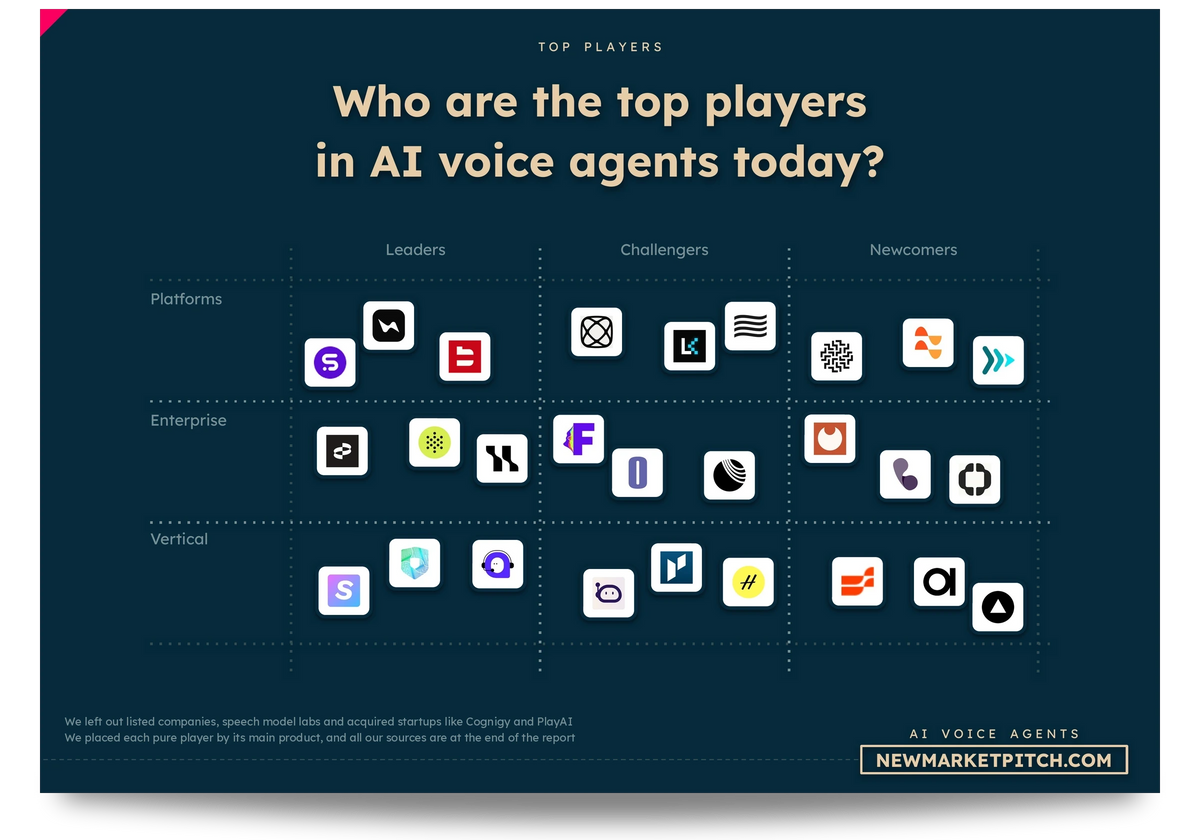
In our report covering the AI voice agent market, we turn what is vague and complex into simple, useful visuals. Market maps like this one show you at a glance where every startup stands.
How expensive is it to run an AI voice agent?
AI voice agents have become cheap enough to support many commercial applications, with published infrastructure prices now measured in cents per conversation minute. The full cost of running a reliable service can still be substantially higher.
Deepgram's published voice-agent API pricing offers a useful benchmark. Its standard pay-as-you-go tier is listed at $0.075 per minute after a promotional pricing period, while its advanced tier costs $0.163 per minute.
At the standard rate, 10,000 conversation minutes would cost approximately $750. A customer processing 100,000 minutes would pay $7,500. At the advanced rate, the same volumes would cost $1,630 and $16,300.
These prices represent specific API charges. Depending on the architecture, voice-agent providers may also pay for telecommunications, external language models, integrations, monitoring, security and human intervention.
The numbers explain why different industries can support very different business models.
A medical assistant that reduces expensive clinical paperwork could justify a comparatively high recurring subscription. Restaurant ordering agents have tighter cost limits. Consumer companions must provide enough regular value to keep people subscribing.
Falling model and speech-processing costs make more use cases economically viable. They also increase competition among providers whose main product is access to the underlying technology.
Will ElevenLabs and Vapi make more money than companies building specialized voice agents?
ElevenLabs and Vapi have strong positions in voice AI infrastructure, but specialized companies such as Abridge may ultimately have more pricing power in industries where software needs to handle much more than conversation.
ElevenLabs has already demonstrated major commercial scale, reporting more than $500 million in ARR by early 2026. Its business spans synthetic speech, voice agents and other audio applications.
Vapi focuses on developer infrastructure, helping companies build and orchestrate voice agents without assembling every underlying component themselves.
Abridge approaches the market differently. Its software fits into hospital workflows, produces clinical documentation and supports requirements that general-purpose voice infrastructure cannot solve on its own.
SoundHound combines these approaches through voice technology and industry-specific applications such as restaurant ordering.
There is an important accounting issue when comparing these companies. A medical voice application might pay an infrastructure provider for processing while charging hospitals separately for the completed service. The same underlying activity can therefore generate revenue for multiple vendors.
Competition also differs between the layers. Infrastructure vendors compete heavily on latency, model quality, reliability and price. Healthcare specialists must win hospital contracts, satisfy clinical requirements and integrate with existing medical software.
We cannot yet say which layer will capture the larger profit pool. But companies solving difficult industry workflows have a better chance of maintaining premium prices than those selling speech-processing capabilities that customers can easily replace.

Our research about AI voice agents gets updated several times a month, so you always get the latest view of where things stand.
Are AI voice agent companies actually profitable?
AI voice-agent companies are generating meaningful revenue, but the industry's financial results still offer limited proof of sustainable profitability. SoundHound, one of the clearest public examples, remains cash-consuming despite rapid growth.
SoundHound reported $168.9 million in revenue for 2025, up from $84.7 million in 2024.
Its GAAP gross margin declined from 48.9% to 42.4%, while operating activities consumed approximately $98.2 million in cash during 2025.
Those figures include the company's broader product mix and acquisitions, so they should not be read as the profitability of a pure voice-agent product. They nevertheless show that strong revenue growth does not automatically produce positive cash flow.
Private companies provide less financial detail. ElevenLabs' ARR shows substantial commercial demand, but ARR alone tells us nothing definitive about operating margins or free cash flow.
Profitability will depend partly on how providers charge customers. Per-minute pricing closely links revenue to infrastructure consumption, while subscriptions and workflow-based contracts can reward providers for the value of the completed task.
These models carry different risks. Usage-based providers are exposed to falling market prices, while application specialists must spend more on integrations, customer support and industry-specific requirements.
The sector has established that customers will pay for voice AI. What remains less proven is how many independent providers can turn that demand into consistently attractive profits.
If you want more recent data on this point, please see our latest AI voice agents market report.
Could Microsoft, Google and Amazon take over the AI voice agents market?
Microsoft, Google and Amazon are serious threats to independent AI voice-agent startups because they already control cloud infrastructure, enterprise software and major consumer distribution channels. Generic voice-agent products are particularly exposed.
Microsoft's healthcare business shows how powerful distribution can be. Dragon Copilot reaches clinicians through an established enterprise software ecosystem, with relationships and infrastructure that smaller companies would need years to build.
Google and Amazon have comparable strengths through cloud services, AI models, communication products and connected devices.
Still, specialist providers continue to win business. Gartner's July 2026 assessment of conversational AI platforms includes companies such as PolyAI, SoundHound, Kore.ai, Omilia and NiCE Cognigy alongside major technology vendors.
Large cloud providers can make basic speech recognition, voice generation and conversational models widely available. That puts pressure on startups charging premium prices for similar underlying functions.
The more defensible businesses are those that handle difficult workflows, integrate with industry software and maintain customer relationships that go beyond supplying a model.
A hospital buying clinical documentation software, for example, has requirements involving medical records, compliance and clinician workflows. The quality of the speech model is only one part of the purchasing decision.
Major technology companies are well positioned to capture a large share of the underlying infrastructure market. Whether they dominate specialized applications is much less certain.

In our market report about AI voice agents, you will always find fresh funding data, taken straight from our own verified funding database.
How big could the AI voice agents market outside call centers get by 2030?
AI voice agents outside call centers could generate several billion dollars in annual software revenue by 2030. A market of roughly $3 billion to $8 billion is a useful scenario range, although the available data cannot establish it as a reliable forecast.
Grand View Research estimates the dedicated AI voice-agent market at $3.5 billion in 2026 and projects approximately 39% annual growth. Applying that growth rate through 2030 implies an overall market of around $13.1 billion.
The calculation covers all AI voice-agent applications, including call centers.
If non-call-center applications account for 25% of spending in 2030, they would generate approximately $3.3 billion annually. At 40%, that becomes $5.2 billion. At 60%, it reaches $7.9 billion.
Those percentages are illustrative assumptions, since providers do not currently disclose enough data to establish the segment's exact share.
The broader opportunity could be larger when including clinical documentation, automotive licensing and voice-enabled consumer software. However, adding those categories risks counting revenue already included in healthcare software, automotive systems and general AI subscriptions.
Healthcare provides the clearest route toward substantial non-call-center software revenue. Restaurant ordering could follow as deployments spread across large chains and independent locations. Automotive already has extraordinary distribution, although agent-specific monetization is harder to isolate.
A multibillion-dollar non-call-center voice-agent market by 2030 is therefore credible. Claims of a much larger standalone market need clearer evidence that businesses and consumers will pay specifically for autonomous voice services.
How big is the AI voice agents market beyond call centers, really?
The AI voice agents market beyond call centers is already a real commercial category and could generate several billion dollars in annual revenue by 2030. Healthcare is its strongest proven enterprise application today, with restaurants and automotive technology offering two other major opportunities.
The evidence is unusually concrete in healthcare. Microsoft's Dragon Copilot has more than 100,000 reported daily clinician users, and Abridge has secured deployments across major health systems. These companies have turned voice technology into software that medical organizations use for everyday work.
Restaurants are earlier in their adoption curve, but SoundHound's commercial deployments show that automated ordering works beyond controlled demonstrations. The opportunity becomes particularly large if recurring subscriptions spread across hundreds of thousands of restaurant locations.
Automotive presents a different picture. Cerence's historical footprint of more than 525 million vehicles proves that voice interfaces can achieve enormous distribution, while the revenue potential of newer autonomous features remains less clear.
We estimate that the overall dedicated AI voice-agent market could reach roughly $13 billion by 2030 if Grand View Research's published growth projection holds. Non-call-center applications could represent several billion dollars of that spending, although no dependable segment-level revenue data allows us to establish their exact share.
The biggest unknown is how much new revenue voice AI will create as opposed to becoming a standard feature inside software people already buy.
Our conclusion is that voice AI has a substantial future beyond call centers, with healthcare already showing what large-scale adoption looks like. The industry has enough real deployments and revenue to support a multibillion-dollar opportunity. It still needs better financial disclosure, wider adoption outside its strongest early markets and clearer evidence of profitability before we can put a much larger number on the standalone market.
If you want more recent data on this point, please see our latest AI voice agents market report.

In our document detailing everything you need to know about AI voice agent, we look at what the winners do differently, so you can learn from the best instead of guessing.
Our methodology
This analysis examines the commercial scale of AI voice agents beyond conventional call centers, using the evidence available through October 2026. We assessed the dedicated market's size, the proportion potentially attributable to non-call-center applications, enterprise deployments in healthcare, restaurants and automotive, consumer adoption, infrastructure costs, company financial performance and the potential market by 2030.
Our approach was to investigate each dimension separately, collect recent commercial evidence, compare the findings and aggregate them into an overall assessment. We prioritized reported revenue, recurring usage, production deployments, enterprise adoption and published prices over product announcements or theoretical applications. Evidence from several companies and industries helped us judge which opportunities already have commercial foundations and which depend on broader future adoption.
For market sizing, we used Grand View Research's dedicated AI voice-agent estimates as our primary reference. We compared that category with its broader conversational AI and audio AI estimates to identify differences in definitions and avoid adding overlapping markets. The analysis distinguishes autonomous voice agents from speech recognition, synthetic audio, conventional voice assistants and general-purpose conversational software.
For commercial adoption, we treated reported daily users, processed calls, clinical encounters, restaurant interactions and cumulative vehicle installations as separate measurements. Microsoft's clinician adoption, Abridge's health-system deployments, SoundHound's restaurant ordering activity and Cerence's automotive footprint were evaluated according to what each figure actually establishes. We did not convert usage or installation totals directly into revenue without an explicit pricing assumption.
Our economic assessment combines company disclosures with published infrastructure pricing. ElevenLabs' ARR, Vapi's call volumes and SoundHound's audited financial results provide different perspectives on commercial traction, while Deepgram's per-minute rates help establish processing-cost benchmarks. We also considered the costs of integrations, telecommunications, compliance and service delivery when comparing infrastructure businesses with specialized applications.
The 2030 estimate is our own scenario analysis. We applied the published growth trajectory of the dedicated voice-agent market to its estimated 2026 value, producing approximately $13.1 billion in total annual market spending by 2030. We then tested hypothetical non-call-center shares of 25%, 40% and 60%, implying approximately $3.3 billion, $5.2 billion and $7.9 billion respectively. Those shares are assumptions used to examine possible outcomes, rather than measured market shares or forecasts published by Grand View Research.
Key market and financial sources include Grand View Research's AI voice agents market, Conversational AI Market and Audio AI Market, ElevenLabs' $500 million ARR announcement, SoundHound's 2025 Form 10-K, Vapi's Series B announcement and Deepgram's published pricing.
For healthcare, we used Microsoft's Dragon Copilot adoption disclosure, Microsoft's clinical workflow report, its product and time-savings announcement, Abridge's enterprise adoption report and Abridge's Series E disclosure.
Industry-specific and competitive references include SoundHound's Five Guys deployment, its Red Lobster partnership, the National Restaurant Association's 2025 industry report, Cerence's fiscal 2025 Form 10-K, Duolingo's explanation of AI Video Call, Vapi's enterprise deployment report and Gartner's 2026 assessment of conversational AI platforms.
Our conclusions reflect the combined findings across these dimensions. The analysis places greater weight on demonstrated spending and sustained operational use than on addressable-market calculations alone, while separating directly observed commercial activity from modeled expansion. This provides a basis for estimating the market beyond call centers without double-counting the wider voice AI ecosystem.

If you build or invest in the AI voice agent market, you need to know which business models pay off now and which ones are fading. That's why our report covering it has a whole section on it.
Written by the New Market Pitch teamWe track new markets so founders and investors can move faster. About us