What are the most valuable AI voice agent startups?
Whether you're building or investing in the AI voice agent market, our report covers everything you need to know: the players, the money, and what's coming next.
Summary
Sierra is the most valuable AI voice agent startup today, valued at $14.5B–$16.5B. Wonderful follows at $4.8B–$5.2B, ahead of Decagon at $4.5B. Sierra has built a substantial lead in a market where enterprise customer service is attracting the biggest valuations.
Sierra's premium is backed by remarkable revenue growth. Its estimated annual recurring revenue reached $400 million by October 2026, compared with $26 million at the end of 2024. At its current valuation, investors are paying roughly 36–41 times that annual revenue figure.
Eleven AI voice agent startups are valued at $1 billion or more, including Hippocratic AI, Parloa, LiveKit, Assort Health, HappyRobot, and ASAPP. Retell AI, valued at $640M–$1.1B, is close to joining them. Nine of those eleven billion-dollar companies are headquartered in the United States.
Investors are backing very different businesses under the same voice AI label. Sierra and Decagon automate enterprise customer interactions, LiveKit sells communications infrastructure, Hippocratic AI focuses on healthcare, and Wonderful is building a broader enterprise AI platform.
Capital is heavily concentrated at the top. Sierra, Wonderful, Parloa, Decagon, and Hippocratic AI have collectively raised at least $3.88 billion. Yet smaller companies can scale quickly too: Retell AI reported an $80 million annualized revenue run rate despite having announced only $4.6 million in funding.
Enterprise demand is growing much faster than customer service budgets. Gartner found that AI spending among service leaders increased 38% while overall budgets rose just 2%. The catch is that only 24% of surveyed leaders had demonstrated positive financial returns across their AI implementations.
The strongest valuations favor companies that can complete entire customer workflows rather than simply handle calls. Resolving a billing dispute, changing an account, or scheduling a medical appointment creates more value than generating a convincing voice response.
Healthcare is becoming one of the most valuable specialized markets. Hippocratic AI and Assort Health have reached billion-dollar valuations by targeting patient communication and administration, where integrations, safety requirements, and operational complexity make products harder to replace.
Voice infrastructure faces a different competitive challenge. LiveKit, Vapi, and Retell AI can benefit from thousands of applications built on their platforms, but falling AI costs and increasingly interchangeable components are likely to put pressure on prices.
The AI voice agents market has already produced serious businesses, but today's valuations assume much more growth. Sierra's revenue scale helps explain its lead; for the rest, the biggest question is whether impressive call volumes and rapid customer adoption will translate into recurring revenue, lasting margins, and measurable savings for businesses.

Written by the New Market Pitch teamWe track new markets so founders and investors can move faster. About us

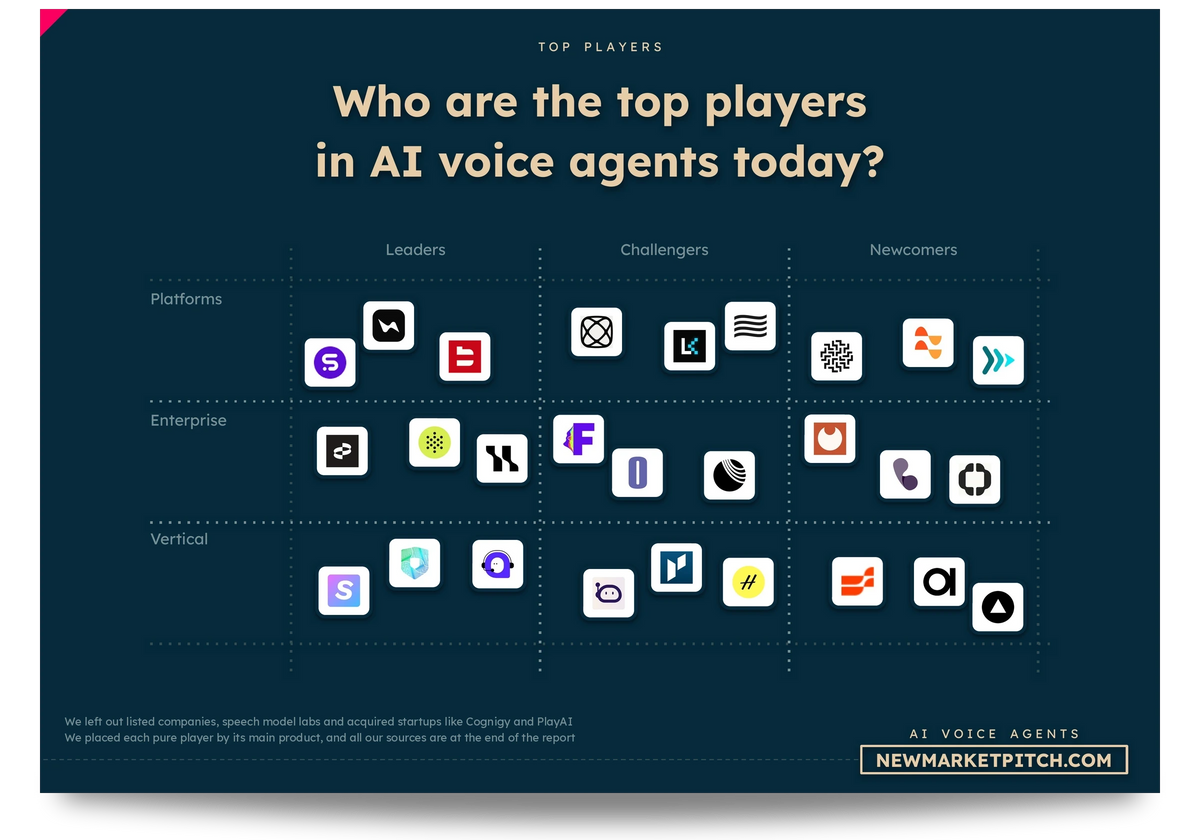
In our report covering the AI voice agent market, we turn what is vague and complex into simple, useful visuals. Market maps like this one show you at a glance where every startup stands.
Top startups in the AI voice agents market ranked by valuation
Here is an updated table that ranks the top startups in the AI voice agents market based on their latest reported or estimated valuations.
If you need to dig deeper and get more detailed data, please check our report covering the AI voice agents market.
| # | Startup Name | What They Do | Current Valuation ($) | Valuation Confidence Level | Valuation Type | Evidence Status | Total Funding ($) | Funding Confidence Level | Country |
|---|---|---|---|---|---|---|---|---|---|
| 1 | Sierra | Enterprise AI customer service agents | $14.5B–$16.5B | Strong Confidence | Implied Valuation from Raise | Estimated | $1.6B | Strong Confidence | United States |
| 2 | Wonderful | Enterprise AI agents and automation | $4.8B–$5.2B | Strong Confidence | Implied Valuation from Raise | Estimated | $836M | - | Israel |
| 3 | Decagon | AI customer support agents | $4.5B | Strong Confidence | Implied Valuation from Raise | Estimated | $481M | Full Confidence | United States |
| 4 | Hippocratic AI | Healthcare-focused conversational AI agents | $3.4B–$3.8B | Strong Confidence | Implied Valuation from Raise | Estimated | $404M+ | - | United States |
| 5 | Parloa | Enterprise conversational AI customer agents | $3B | Strong Confidence | Implied Valuation from Raise | Estimated | $562M+ | Strong Confidence | Germany |
| 6 | Listen Labs | AI-powered customer research interviews | $1.5B–$2.0B1 | Partial Confidence | Comparables-Based Estimate | Estimated | $96M | - | United States |
| 7 | LiveKit | Real-time voice AI infrastructure | $1.4B–$1.5B | Strong Confidence | Implied Valuation from Raise | Estimated | $221M | - | United States |
| 8 | Assort Health | AI patient communication and scheduling | $1.2B | Strong Confidence | Implied Valuation from Raise | Estimated | $222M | - | United States |
| 9 | HappyRobot | AI agents for enterprise operations | $1.2B | Strong Confidence | Implied Valuation from Raise | Estimated | ~$211M | - | United States |
| 10 | ASAPP | Enterprise AI customer service automation | $1.06B | Low Confidence | Implied Valuation from Raise | Estimated | $513M | - | United States |
| 11 | Avoca | AI agents for home services | $1B | Strong Confidence | Implied Valuation from Raise | Estimated | $125M+ | - | United States |
| 12 | Retell AI | AI voice agent development platform | $640M–$1.1B | Partial Confidence | Revenue or ARR Multiple Estimate | Estimated | $4.6M | Partial Confidence | United States |
| 13 | PolyAI | Enterprise conversational voice AI agents | $750M | Strong Confidence | Implied Valuation from Raise | Estimated | $204M | Strong Confidence | United Kingdom |
| 14 | Salient | AI loan servicing and collections | $500M–$700M | Partial Confidence | Revenue or ARR Multiple Estimate | Estimated | $75M | - | United States |
| 15 | Omilia | Enterprise conversational AI customer automation | $450M–$650M | Partial Confidence | Revenue or ARR Multiple Estimate | Estimated | $111M | - | Greece |
| 16 | Yellow.ai | Enterprise conversational AI automation platform | $500M–$600M2 | Strong Confidence | IPO or Listing Range Valuation | Implied | $103M | - | India |
| 17 | Vapi | Developer infrastructure for voice agents | $470M–$530M | Strong Confidence | Implied Valuation from Raise | Estimated | $72M | Strong Confidence | United States |
| 18 | Bland AI | Enterprise AI phone call automation | $462M | Strong Confidence | Implied Valuation from Raise | Estimated | $111M | Partial Confidence | United States |
| 19 | Giga | Enterprise customer support voice agents | $310M–$510M | Partial Confidence | Implied Valuation from Raise | Implied | $61M | Partial Confidence | United States |
| 20 | Liberate | Insurance-focused AI workflow agents | $300M–$450M | Partial Confidence | Implied Valuation from Raise | Implied | $72M | - | United States |
| 21 | Regal | AI-powered sales and contact centers | $280M–$420M | Partial Confidence | Comparables-Based Estimate | Estimated | $82M | Strong Confidence | United States |
| 22 | Replicant | Automated enterprise customer service conversations | $260M–$420M | Partial Confidence | Comparables-Based Estimate | Estimated | $112M | Strong Confidence | United States |
| 23 | AI Rudder | Multilingual enterprise voice AI agents | $200M–$300M | Partial Confidence | Comparables-Based Estimate | Estimated | ~$60M–$63M | - | Singapore |
| 24 | Lorikeet | AI customer service concierge agents | $190M–$290M | Partial Confidence | Implied Valuation from Raise | Implied | $49M | - | Australia |
| 25 | Slang AI | Restaurant and hospitality phone agents | $190M–$280M | Partial Confidence | Implied Valuation from Raise | Implied | $60M | - | United States |
| 26 | Ellipsis Health | Empathetic AI healthcare voice agents | $180M–$270M | Partial Confidence | Implied Valuation from Raise | Implied | $75M | - | United States |
| 27 | Hyro | Healthcare conversational AI automation | $185M–$250M | Partial Confidence | Implied Valuation from Raise | Implied | $95M | Strong Confidence | United States |
| 28 | Daily | Real-time voice AI infrastructure | $160M–$240M | Partial Confidence | Comparables-Based Estimate | Estimated | $62M | - | United States |
| 29 | Prosper AI | Healthcare administration voice AI agents | $150M–$250M | Partial Confidence | Implied Valuation from Raise | Implied | $35M | - | United States |
| 30 | IVRy | AI-powered business telephone automation | $170M–$220M | Partial Confidence | Comparables-Based Estimate | Estimated | $69M | - | Japan |
| 31 | Coval | AI voice agent testing infrastructure | $150M–$230M | Partial Confidence | Implied Valuation from Raise | Implied | $31M | - | United States |
| 32 | Sela | AI mortgage sales voice agents | $140M–$220M | Partial Confidence | Revenue or ARR Multiple Estimate | Estimated | $21M | - | United States |
| 33 | Beside | AI receptionist for small businesses | $135M–$210M | Partial Confidence | Implied Valuation from Raise | Implied | $32M | - | France |
| 34 | Newo | AI receptionists for small businesses | $130M–$210M | Partial Confidence | Implied Valuation from Raise | Implied | $32M | Partial Confidence | United States |
| 35 | Maki | AI-powered recruitment and candidate screening | $120M–$190M | Partial Confidence | Comparables-Based Estimate | Estimated | ~$40M | - | France |
| 36 | Acclaim | Voice AI for regulated enterprises | $150M | Partial Confidence | Announced Private Round Valuation | Observed | $34M | - | United Kingdom |
| 37 | Confido Health | AI healthcare administrative workflow agents | $110M–$190M | Partial Confidence | Implied Valuation from Raise | Implied | ~$26M | - | United States |
| 38 | Natter | AI-driven enterprise conversation intelligence | $115M–$185M | Partial Confidence | Implied Valuation from Raise | Implied | ~$24M | - | United States |
| 39 | Flip | Automated customer service phone calls | $115M–$175M | Partial Confidence | Revenue or ARR Multiple Estimate | Estimated | $28.5M | Partial Confidence | United States |
| 40 | fonio.ai | AI phone assistants for businesses | $140M | Strong Confidence | Implied Valuation from Raise | Estimated | $20M+ | - | Austria |
| 41 | WIZ.AI | Multilingual enterprise conversational voice agents | $90M–$180M | Partial Confidence | Implied Valuation from Raise | Implied | $50.5M–$56M | - | Singapore |
| 42 | Voiceflow | Collaborative conversational AI agent builder | $95M–$165M | Partial Confidence | Comparables-Based Estimate | Estimated | $38M | Partial Confidence | Canada |
| 43 | Presto Phoenix | AI drive-through ordering automation | $90M–$170M | Low Confidence | Comparables-Based Estimate | Estimated | $38M3 | - | United States |
| 44 | Alex | AI recruitment interviewing and screening | $95M–$155M | Partial Confidence | Implied Valuation from Raise | Implied | $20M | - | United States |
| 45 | Skit.ai | AI-powered debt collection conversations | $90M–$160M | Low Confidence | Revenue or ARR Multiple Estimate | Estimated | $28.1M | - | United States |
| 46 | GetVocal | Hybrid human-AI customer service agents | $96M–$144M | Partial Confidence | Comparables-Based Estimate | Estimated | ~$30M | - | Belgium |
| 47 | Synthflow AI | No-code enterprise AI phone agents | $95M–$145M | Partial Confidence | Comparables-Based Estimate | Estimated | $29.1M | Full Confidence | Germany |
| 48 | Tucuvi | Healthcare patient monitoring voice agents | $105M–$135M | Partial Confidence | Implied Valuation from Raise | Implied | ~$31.2M | - | Spain |
| 49 | Vocca | AI phone reception for healthcare | $105M–$135M | Partial Confidence | Implied Valuation from Raise | Implied | $25M | - | United States |
| 50 | Hello Patient | AI patient communication and scheduling | $90M–$125M | Partial Confidence | Implied Valuation from Raise | Estimated | $28.8M | - | United States |
| 51 | Gradient Labs | AI customer operations for finance | $85M–$105M | Strong Confidence | Implied Valuation from Raise | Implied | ~$30M | - | United Kingdom |
| 52 | NuPlay AI | Enterprise voice and chat agents | $75M–$115M4 | Partial Confidence | Implied Valuation from Raise | Implied | ~$42M | - | India |
| 53 | Gnani.ai | Enterprise multilingual voice AI agents | $87M–$100M | Strong Confidence | Implied Valuation from Raise | Estimated | $14M+ | - | India |
| 54 | Kea AI | Restaurant telephone ordering automation | $70M–$110M | Partial Confidence | Revenue or ARR Multiple Estimate | Estimated | $32.9M | - | United States |
| 55 | ConverseNow | Restaurant AI ordering voice agents | $65M–$115M | Low Confidence | Comparables-Based Estimate | Estimated | $28M | - | United States |
| 56 | Smallest.ai | Real-time enterprise voice AI infrastructure | $65M–$110M | Partial Confidence | Implied Valuation from Raise | Implied | $21M+ | - | United States |
| 57 | Elyos AI | AI receptionists for trade businesses | $65M–$105M | Partial Confidence | Implied Valuation from Raise | Implied | ~$16M | - | United Kingdom |
| 58 | Hi Auto | Restaurant drive-thru voice ordering automation | $70M–$100M | Partial Confidence | Implied Valuation from Raise | Implied | $23M | - | Israel |
| 59 | Toma | AI phone agents for dealerships | $65M–$105M | Partial Confidence | Comparables-Based Estimate | Estimated | ~$17.5M | - | United States |
| 60 | Hostie | AI restaurant reservations and communications | $60M–$100M | Partial Confidence | Implied Valuation from Raise | Implied | $16M | - | United States |
| 61 | SuperDial | Automates healthcare insurance phone calls | $65M–$95M | Partial Confidence | Implied Valuation from Raise | Implied | $20M+ | - | United States |
| 62 | telli | AI customer operations voice agents | $65M–$95M | Strong Confidence | Implied Valuation from Raise | Implied | $18.5M | - | Germany |
| 63 | Avaamo | Enterprise conversational AI automation platform | $55M–$95M | Low Confidence | Comparables-Based Estimate | Estimated | $23.5M | - | United States |
| 64 | Simple AI | Automated AI voice sales agents | $56M–$93M | Partial Confidence | Implied Valuation from Raise | Implied | $14M | - | United States |
| 65 | Palona AI | Multimodal AI agents for restaurants | $55M–$90M | Partial Confidence | Implied Valuation from Raise | Implied | $20M | - | United States |
| 66 | Phonely | Automated business phone conversations | $64M–$78M | Strong Confidence | Implied Valuation from Raise | Estimated | $19M | - | United Kingdom |
| 67 | Spara | Multichannel AI sales qualification agents | $50M–$90M | Partial Confidence | Comparables-Based Estimate | Estimated | $15M | - | United States |
| 68 | Attuned Intelligence | Supervised hospital call center AI | $52M–$78M | Partial Confidence | Implied Valuation from Raise | Implied | $13M | - | United States |
| 69 | Level3 AI | AI-powered omnichannel customer operations | $52M–$78M | Partial Confidence | Implied Valuation from Raise | Estimated | $13M | - | Singapore |
| 70 | Parakeet Health | AI-powered healthcare patient communications | $50M–$80M | Partial Confidence | Implied Valuation from Raise | Implied | $13M | - | United States |
| 71 | Arc | AI drive-through ordering automation | $45M–$70M | Partial Confidence | Implied Valuation from Raise | Implied | $10.8M | - | United States |
| 72 | Outbound AI | Healthcare revenue cycle voice automation | $35M–$70M | Low Confidence | Comparables-Based Estimate | Estimated | $23M | - | United States |
| 73 | VerbaFlo | AI leasing and resident communications | $28M–$48M | Partial Confidence | Implied Valuation from Raise | Implied | ~$9M | - | United Kingdom |
| 74 | Ringg AI | Multilingual enterprise voice agent platform | $28M–$46M | Partial Confidence | Implied Valuation from Raise | Implied | $15.5M | - | India |
| 75 | Cookiy AI | AI-powered consumer research interviews | $28M–$42M | Partial Confidence | Implied Valuation from Raise | Implied | $7M+ | - | United States |
| 76 | Leaping AI | Voice agents for contact centers | $25M–$45M | Low Confidence | Comparables-Based Estimate | Estimated | $4.7M | - | Germany |
| 77 | Bolna AI | Multilingual Indian AI voice infrastructure | $27M–$42M | Partial Confidence | Implied Valuation from Raise | Implied | $6.3M+ | - | India |
| 78 | Miravoice | AI-powered telephone research interviews | $25M–$38M | Partial Confidence | Implied Valuation from Raise | Implied | $6.3M | - | United States |
| 79 | HeyDiga | AI receptionists for local businesses | $24M–$36M | Partial Confidence | Implied Valuation from Raise | Implied | ~$7.6M | - | Spain |
| 80 | VoiceRun | Code-first enterprise voice agent infrastructure | $22M–$33M | Partial Confidence | Implied Valuation from Raise | Implied | $5.5M | - | United States |
| 81 | Synthio Labs | Clinical-grade pharmaceutical voice AI | $20M–$34M | Partial Confidence | Implied Valuation from Raise | Implied | $5M | - | India |
| 82 | Solda.AI | AI-powered outbound sales calls | $19M–$34M | Low Confidence | Comparables-Based Estimate | Estimated | ~$4.5M | - | Germany |
| 83 | nocall | AI automated business calling platform | $18M–$33M | Partial Confidence | Implied Valuation from Raise | Implied | ~$6.5M+ | - | Japan |
| 84 | Hamming AI | Voice agent testing and monitoring | $17M–$32M | Low Confidence | Comparables-Based Estimate | Estimated | $3.8M+ | - | United States |
| 85 | Phonic | Speech-to-speech voice agent infrastructure | $17M–$30M | Low Confidence | Comparables-Based Estimate | Estimated | $31.5M | - | United States |
| 86 | Loman AI | Restaurant phone ordering AI agents | $15M–$30M | Low Confidence | Comparables-Based Estimate | Estimated | $3.7M | - | United States |
| 87 | Flair Labs | Mortgage industry AI voice workers | $16M–$27M | Partial Confidence | Implied Valuation from Raise | Implied | ~$4.7M | - | United States |
| 88 | Sophiie AI | AI receptionists for service businesses | $19.5M | Partial Confidence | Implied Valuation from Raise | Estimated | $5M | - | Australia |
| 89 | Keplar | AI voice-based market research | $13M–$24M | Low Confidence | Comparables-Based Estimate | Estimated | $3.4M | - | United States |
| 90 | Talkie.ai | Healthcare patient communication voice agents | $12M–$24M | Low Confidence | Comparables-Based Estimate | Estimated | ~$5.1M | - | Poland |
| 91 | Arrowhead AI | AI voice agents for finance | $13M–$22M | Partial Confidence | Implied Valuation from Raise | Implied | $3M | - | India |
| 92 | Incept AI | Restaurant voice ordering automation | $12M–$21M | Low Confidence | Comparables-Based Estimate | Estimated | $3M | - | United States |
| 93 | Revox | Developer infrastructure for voice agents | $12M–$20M | Partial Confidence | Implied Valuation from Raise | Implied | $3M | - | United States |
| 94 | Goodcall | AI telephone receptionists for SMBs | $8M–$20M | Low Confidence | Proxy-Based Estimate | Estimated | $4M | Full Confidence | United States |
| 95 | Vox AI | Restaurant ordering voice automation | $5M–$15M | Low Confidence | Proxy-Based Estimate | Estimated | $10M | - | Netherlands |
| 96 | Reecall | Automated inbound customer phone calls | $3M–$12M | Low Confidence | Proxy-Based Estimate | Estimated | Undisclosed | - | France |
Which startups in the AI voice agents market have been acquired or gone public?
These startups no longer have a private-market valuation of their own, so we list them separately, using their acquisition price or their current market capitalization.
| # | Startup Name | What They Do | Current Valuation ($) | Valuation Confidence Level | Valuation Type | Evidence Status | Total Funding ($) | Funding Confidence Level | Country |
|---|---|---|---|---|---|---|---|---|---|
| 1 | Vida | Enterprise omnichannel AI agent platform | $16M | Full Confidence | Public Market Cap | Observed | $4M+ | - | United States |
- Salesforce acquisition agreed but not completed; price not disclosed.
- Indicative value from a proposed SPAC deal, not a completed listing.
- Excludes funding raised by the former Presto Automation.
- Price undisclosed; estimate based on past funding, not a sale price.

Our research about AI voice agents gets updated several times a month, so you always get the latest view of where things stand.
Which AI voice agent startups are worth the most today?
Sierra is currently the most valuable AI voice agent startup, with a valuation of $14.5B–$16.5B, followed by Wonderful at $4.8B–$5.2B and Decagon at $4.5B.
The difference between Sierra and the rest of the market is substantial. Decagon's $4.5B valuation is less than a third of the lower end of Sierra's range. Meanwhile, Hippocratic AI stands at $3.4B–$3.8B and Parloa at $3B, making up the rest of the top five.
Sierra's lead has grown alongside its business. The company raised $950 million in May 2026, with TechCrunch reporting a financing valuation above $15 billion. Sacra estimates that its annual recurring revenue reached $400 million by October 2026, compared with $26 million at the end of 2024. That is more than fifteenfold growth in less than two years.
There are also important differences between the leading companies. Sierra and Decagon focus on enterprise customer interactions, Wonderful is developing a broader enterprise AI operating system, Hippocratic AI specializes in healthcare conversations, and Parloa builds AI agents for customer experience operations.
The highest valuations are going to companies that can take responsibility for entire business processes. Simply answering a telephone call is becoming easier. Handling a customer request from beginning to end, across several business systems, remains considerably more valuable.
How many AI voice agent startups are worth more than $1 billion?
Eleven AI voice agent startups currently have valuations at or above $1 billion, with Retell AI sitting just outside that group because its range crosses the threshold.
The eleven are Sierra, Wonderful, Decagon, Hippocratic AI, Parloa, Listen Labs, LiveKit, Assort Health, HappyRobot, ASAPP, and Avoca. Retell AI's $640M–$1.1B valuation puts it within reach of joining that group.
Eight of the ten billion-dollar companies are headquartered in the United States. Germany's Parloa and Israel's Wonderful are the two exceptions.
What's interesting is how different their businesses are. LiveKit sells real-time communications infrastructure, Assort Health automates patient communications, HappyRobot works on enterprise operations, and Listen Labs uses AI interviews for customer research.
Listen Labs, estimated at $1.5B–$2.0B in our ranking, also became the subject of a definitive acquisition agreement announced by Salesforce in September 2026. The acquisition had not been reported as completed, and Salesforce did not disclose a purchase price.
That's already a substantial number of billion-dollar companies for such a young market. But a healthcare calling platform, a communications infrastructure business, and an enterprise customer service provider can have very different economics, even when their valuations look similar.

In our market report about AI voice agents, we look at what the winners do differently, so you can learn from the best instead of guessing.
Why are AI voice agent valuations increasing so quickly?
AI voice agent valuations are rising because businesses are spending much more on automation, even while their overall customer service budgets barely grow.
Gartner surveyed 199 customer service and support leaders in April and May 2026 and found that spending on AI had increased by 38%, compared with just 2% growth in overall service and support budgets. That is a nineteenfold difference in the two growth rates.
The money flowing into startups reflects the same shift. Sierra announced a $950 million financing in May 2026, Wonderful raised $550 million in September, and Parloa completed a $350 million round in January. Those three financings alone totaled $1.85 billion.
Parloa offers a particularly clear example of how quickly investors have repriced the market. Its January 2026 financing came only eight months after a May 2025 round, when the company had been valued at $1 billion. The later financing valued the company at $3 billion, a threefold increase.
There is a catch, though. Gartner's July 2026 research found that only 24% of surveyed service and support leaders had demonstrated positive financial returns across their AI use cases. Companies are moving quickly to adopt the technology, but successful deployments are still uneven.
Investors are betting that the early winners will capture a meaningful share of what businesses currently spend on customer support, scheduling, administration, and operational call centers. The adoption trend is real. Whether every billion-dollar valuation is justified by the savings customers eventually achieve is a separate question.
Is Sierra really worth so much more than Decagon and other AI voice startups?
Sierra's valuation premium is supported by much greater estimated revenue, although the price investors are paying still assumes years of strong growth.
Sacra estimates that Sierra's annual recurring revenue increased from $26 million at the end of 2024 to $130 million at the end of 2025 and approximately $400 million by October 2026. That is an unusually fast expansion for enterprise software.
Decagon is growing rapidly too. Sacra estimates that its annualized revenue reached $100 million in July 2026, up from $44 million at the end of 2025. The figures cover slightly different periods, but Sierra is operating at several times Decagon's reported revenue scale.
There is evidence of enterprise adoption beyond the revenue estimates. When Sierra announced its May 2026 financing, the company said more than 40% of Fortune 50 companies were already customers. Decagon, for its part, reportedly added more than 100 enterprise customers during 2025, including Avis Budget Group, Mercado Libre, and Deutsche Telekom.
At Sierra's current valuation range, the business is valued at roughly 36–41 times Sacra's latest estimated ARR. That is a demanding price for a company whose profitability and retention figures are not publicly established.
We consider Sierra's valuation lead understandable given its commercial scale. The risk is how much growth is already reflected in its price: increasing ARR from $26 million is very different from sustaining triple-digit growth after reaching hundreds of millions in annual revenue.

In our document detailing everything you need to know about AI voice agent, you will always find fresh funding data, taken straight from our own verified funding database.
Can Decagon catch Sierra in AI customer service?
Decagon is growing fast enough to challenge Sierra in enterprise AI customer service, but the reported revenue gap remains considerable.
According to Sacra, Decagon's annualized revenue increased from $44 million at the end of 2025 to $100 million by July 2026. That is approximately 127% growth in seven months. For a company founded in 2023, reaching a nine-figure revenue run rate represents meaningful commercial traction.
Its customer base has also broadened. Decagon reportedly added more than 100 global enterprise customers in 2025, and its customers include companies operating in travel, telecommunications, and online services.
Sierra has a larger commercial footprint, with approximately $400 million in estimated ARR by October 2026. It also claims relationships with more than 40% of Fortune 50 companies, indicating access to some of the world's largest customer service budgets.
Decagon's opportunity is to win organizations looking for AI agents that can resolve support requests directly inside their existing software. Success increasingly depends on handling refunds, subscriptions, account changes, and other actions, rather than producing convincing conversational responses.
The competition should remain intense. Decagon has proved that it can grow rapidly, but catching Sierra would require continued enterprise expansion and a much narrower revenue gap. Its current $4.5B valuation already reflects considerable confidence in that possibility.
Is Wonderful becoming a serious competitor to Sierra and Decagon?
Wonderful has quickly become a major enterprise AI company, although its strategy reaches beyond the customer service market targeted by Sierra and Decagon.
In September 2026, Wonderful announced a $550 million Series C at a $5 billion valuation. The company said it had expanded into more than 35 markets and employed approximately 650 people, following an earlier Series B in March.
That is a remarkable pace of international expansion for a company launched in 2025. Wonderful is attempting to build an operating system through which large businesses can deploy AI agents, automate workflows, and develop applications across different departments.
The approach differs from a narrowly focused voice customer service platform. Wonderful can potentially sell automation into several business functions, while Sierra and Decagon concentrate much more directly on customer interactions and related operational workflows.
Its international presence also creates an interesting distinction. Wonderful has prioritized deploying teams across numerous countries relatively early, whereas many enterprise software startups initially concentrate on a smaller number of major markets.
The company has clearly attracted investor support and built a large international organization. Its next challenge is turning that expansion into lasting customer relationships, recurring revenue, and profitable deployments.
Wonderful is already competing for serious enterprise automation budgets. Whether its broad strategy ultimately produces more revenue than specialized customer service platforms remains an open question.

Learning from others' mistakes is the cheapest lesson there is. In our report covering the AI voice agent market, we look at what broke startups before you, so you don't repeat it.
Which AI voice agent startups have raised the most money?
Sierra has raised the most funding among AI voice agent startups, with approximately $1.6 billion, followed by Wonderful with $836 million, Parloa with more than $562 million, ASAPP with approximately $513 million, Decagon with $481 million and Hippocratic AI with more than $404 million.
Sierra, Wonderful, Parloa, Decagon and Hippocratic AI, the five most valuable companies in the ranking, have raised at least $3.88 billion together. That is a striking concentration of capital in businesses competing to automate enterprise conversations and workflows.
The funding continues further down the ranking. Assort Health has raised $222 million, LiveKit approximately $221 million, HappyRobot around $211 million, and PolyAI $204 million.
The contrast with smaller companies is revealing. Retell AI has reported only $4.6 million in funding, while Vapi has raised $72 million and Bland AI $111 million. All three operate in markets where substantial usage can be generated without building the same large international sales organization as an enterprise-wide platform.
Funding also serves different purposes. Sierra and Wonderful are investing in enterprise sales, international operations, and broad product capabilities. Infrastructure businesses must invest in reliability and developer tools. Healthcare platforms face additional integration, security, testing, and clinical workflow requirements.
And money raised is not money earned. Large financing rounds allow companies to expand faster, but eventually the revenue and margins have to catch up.
Are AI voice agent startups growing faster than traditional software businesses?
Some AI voice agent startups are growing at extraordinary rates, although the available revenue figures don't establish that the whole sector outperforms traditional software.
Sierra's estimated ARR increased from $26 million at the end of 2024 to $130 million at the end of 2025, according to Sacra. Decagon's reported annualized revenue more than doubled from $44 million to $100 million between the end of 2025 and July 2026.
Retell AI offers another example. The company's own published milestones say it reached $40 million in annualized revenue in November 2025 and $80 million by September 2026. Sacra also estimates that Retell AI generated approximately $5.4 million in annualized revenue during 2024.
These three companies have grown much faster than the typical mature software business could sustain. Their relatively young age and smaller initial revenue bases help explain the unusually high percentages.
Retell AI has also published an interesting efficiency indicator. In an October 2026 OpenAI customer case study, the company reported $1.6 million in annual revenue run rate per employee, alongside more than 100 million monthly calls. Those are company-reported measures, but they suggest that a relatively lean organization can support substantial usage.
There are few comparable software businesses growing this quickly at the same early stage. Still, the real test will be whether these companies can sustain strong growth as their customer bases mature, rather than simply benefiting from the first wave of enterprise adoption.

Your time is limited. In our research about AI voice agents, we put numbers on each part of the market, so you can see where it makes sense to focus.
Why are AI voice infrastructure startups valued below enterprise AI agent platforms?
AI voice infrastructure startups generally command lower valuations than the largest enterprise agent platforms because they sell tools that other companies use to build products, rather than owning the complete customer workflow.
LiveKit, valued at $1.4B–$1.5B, is the clearest infrastructure success near the top of the ranking. Retell AI is valued at $640M–$1.1B, Vapi at $470M–$530M, and Daily at $160M–$240M. Smaller specialist companies, including VoiceRun, Revox, and Phonic, occupy lower valuation bands.
LiveKit announced a $100 million Series C in January 2026, led by Index Ventures. The company develops real-time audio and video infrastructure that developers can use to build conversational applications, including AI agents.
Vapi focuses on the development and orchestration of voice agents, while Retell AI offers tools for building, testing, deploying, and monitoring automated calling systems.
These businesses can benefit from the growth of many different applications. However, infrastructure customers may change providers, optimize their own systems, or combine components from competing suppliers.
Enterprise platforms such as Sierra and Decagon have an opportunity to earn revenue from the whole automated customer service process. They may also become deeply integrated into a customer's internal systems, creating switching costs that are harder to overcome.
The infrastructure market is already producing valuable companies. For now, though, investors are placing much bigger bets on businesses that own more of the final customer relationship.
Why is Vapi worth so much in the AI voice market?
Vapi's $470M–$530M valuation is supported by large-scale usage and major enterprise customers, including a particularly competitive deployment at Amazon Ring.
In May 2026, TechCrunch reported that Amazon Ring evaluated more than 40 voice AI providers before choosing Vapi. The company subsequently routed its inbound customer support calls through the platform.
That procurement process is a useful test of Vapi's technology. Winning against dozens of competitors for a real operational workload is far more convincing than another product demonstration.
Vapi also reported surpassing one billion cumulative calls and processing between one million and five million calls daily. Its developer platform had been used by more than one million developers, while the company said enterprise ARR had increased tenfold.
Cumulative calls include historical activity, and registered developers are not equivalent to paying customers. Still, the combination of enterprise deployment, developer adoption, and call volume points to a business operating at considerable scale.
Vapi's appeal is that customers retain control over how their agents are built, which models they use, and how their systems are connected. That can be attractive to businesses that don't want to adopt a fully managed enterprise customer service product.

In our market report about AI voice agents, we always try to gather several sources and make estimates that make sense, so you can work with solid numbers.
Could Retell AI become the next billion-dollar voice AI startup?
Retell AI is one of the strongest candidates for a billion-dollar valuation, supported by rapid revenue growth and unusually high reported usage.
Its valuation currently stands at $640M–$1.1B, meaning the upper end already exceeds the unicorn threshold.
Retell AI's own milestones indicate that annualized revenue reached $80 million by September 2026. An OpenAI customer case study published in October reported that the platform handled more than 100 million monthly calls, up from 30 million in early 2026, and served over 4,000 businesses.
That represents more than a threefold increase in monthly calls within the year. The same case study reported customer resolution rates above 80%, although individual customer results can vary significantly.
What makes Retell AI particularly interesting is its funding history. The company reports a $4.6 million seed round and has achieved substantial annualized revenue without the huge funding rounds raised by many of its larger competitors.
Commercially, Retell AI has already reached a scale that makes a billion-dollar valuation plausible. The next challenge is keeping that growth going while defending its margins against cheaper voice infrastructure and competing platforms.
Why are healthcare AI voice agent startups worth billions?
Healthcare AI voice agent startups can reach billion-dollar valuations because they automate expensive administrative processes while serving organizations with demanding safety and compliance requirements.
Hippocratic AI is valued at $3.4B–$3.8B, and Assort Health at $1.2B. Both are among the highest-valued specialized businesses in the market.
Hippocratic AI focuses on patient-facing conversations and has invested heavily in safety testing. According to its published safety documentation, the company has conducted more than 775,000 testing calls involving licensed clinicians and handled more than 180 million clinical patient calls.
Those are company-reported figures rather than independently verified clinical outcomes. Still, they show the scale of testing and operational activity involved when AI is used in healthcare.
Assort Health is pursuing a more administrative part of the market. In August 2026, it launched a referrals product that processes incoming referrals, identifies suitable providers, and helps schedule appointments. The company reported converting 79% of referrals into scheduled appointments through the product.
Healthcare customers need more than natural-sounding speech. Agents must exchange information with medical systems, protect patient data, handle unusual requests, and transfer conversations to staff when appropriate.
That complexity helps explain the high valuations. A voice agent that becomes part of a hospital's daily scheduling and patient communication systems can be much harder to replace than a general-purpose calling tool.

If you build or invest in the AI voice agent market, you need to know which business models pay off now and which ones are fading. That's why our report covering it has a whole section on it.
Which industries are producing the most valuable AI voice agent startups?
Enterprise customer service currently produces the highest AI voice agent valuations, but healthcare, financial services, logistics, hospitality, and local business automation are creating substantial companies of their own.
Sierra, Decagon, and Parloa illustrate the size of the enterprise customer service opportunity. Their products target companies that already spend heavily on contact centers and customer operations.
Healthcare has produced Hippocratic AI and Assort Health, while HappyRobot is developing enterprise operational agents. Avoca serves home service companies, and Listen Labs uses AI interviews for customer research.
Other industries have more specialized providers. Salient works on loan servicing and collections, Slang AI automates restaurant communications, Toma focuses on automotive dealerships, and SuperDial handles healthcare insurance calls.
The commercial opportunity differs across these markets. A large bank may pay for a complex enterprise deployment, while a restaurant is more likely to buy an affordable product that solves a small number of immediate problems.
The key question is whether the AI agent saves enough time, captures enough business, or reduces enough mistakes for customers to keep paying.
| Industry | Representative startups | Main customer problem |
|---|---|---|
| Enterprise customer service | Sierra, Decagon, Parloa | Handling support requests at scale |
| Healthcare | Hippocratic AI, Assort Health, Hyro | Patient access and administrative calls |
| Financial services | Salient, Gradient Labs, Skit.ai | Servicing, collections, customer operations |
| Logistics and operations | HappyRobot | Repetitive operational communications |
| Restaurants | Slang AI, Kea AI, Hostie | Ordering, reservations, missed calls |
| Home services | Avoca, Elyos AI | Booking, lead intake, customer calls |
| Automotive | Toma | Dealership scheduling and customer follow-up |
| Market research | Listen Labs, Cookiy AI | Automated customer interviews |
Are European AI voice agent startups catching up with American companies?
European AI voice agent startups are gaining ground, but the United States still dominates the largest valuations by a considerable margin.
Germany's Parloa is the strongest European example near the top of our ranking, valued at $3B. Its January 2026 financing raised $350 million, only eight months after a previous round that had valued the business at $1 billion.
The company is expanding in both Europe and the United States, where it competes for major enterprise customer service contracts.
The United Kingdom's PolyAI, valued at $750M, is another important European business. Germany also has Synthflow AI and telli, Austria has fonio.ai, while the United Kingdom includes Acclaim, Gradient Labs, and Phonely.
France, Spain, Belgium, Poland, and Italy have additional companies focused on recruitment, healthcare, customer service, and small-business communications.
Even with this diversity, American businesses account for nine of the eleven companies valued at $1 billion or more. Europe has produced credible competitors and several specialized companies, but far fewer startups have achieved the funding and valuation scale of Sierra or Decagon.
Parloa's rapid rise suggests that this gap can narrow. The next test is whether more European businesses can build large recurring revenue bases and win major international customers.

In our report covering the AI voice agent market, we don't want to repeat what boring consulting reports say. Instead, we show you the real and latest market signals that matter.
Are AI voice agents actually replacing human customer service workers?
AI voice agents are already taking over repetitive customer service tasks, but companies are still relying heavily on human agents for complicated or sensitive interactions.
In February 2026, Gartner reported that 91% of surveyed customer service leaders were under pressure from executives to implement AI. Yet more than 80% of organizations planned to expand human agents' responsibilities rather than simply eliminate their roles.
Customers themselves are also cautious. Gartner surveyed 3,566 customers in February and March 2026 and found that 87% wanted companies using generative AI for support to offer an option to contact a human agent. Half said AI made service interactions easier.
Bland AI offers evidence of how large automated operations have become. In June 2026, the company reported handling more than 3.5 million complex calls per week for businesses in healthcare, financial services, and other industries.
Retell AI reported more than 100 million monthly calls by September 2026. Together, those figures show that AI calling systems already handle substantial volumes of real business conversations.
But automated call volume does not translate directly into eliminated jobs. Some interactions would previously have gone unanswered, while others still require human intervention.
For now, the clearest change is that fewer human work hours are needed for many routine interactions. Customer service teams can handle more demand, while staff increasingly deal with exceptions, complicated cases, and customers who specifically want to speak with someone.
Could cheaper AI voice technology hurt startup valuations?
Cheaper AI voice technology is likely to put pressure on basic calling products, while making more sophisticated business automation affordable to a much larger customer base.
Speech recognition, language models, voice generation, and real-time communications are becoming easier to combine. Developers can now assemble systems that would have required much more specialized engineering only a few years ago.
Sacra's May 2026 analysis of Retell AI describes how falling model costs and lower speech-processing latency helped make developer-focused voice agent platforms commercially practical.
This has two consequences. More businesses can afford AI calling tools, but vendors also face more competitors offering similar underlying capabilities.
Consider a hypothetical business processing one million calling minutes per month. A reduction in platform cost from $0.20 to $0.10 per minute would cut its monthly bill from $200,000 to $100,000. That creates a strong incentive to renegotiate contracts or switch providers when products offer comparable performance.
Companies such as Vapi, Retell AI, and LiveKit must therefore compete on reliability, developer tools, integrations, and operational capabilities as well as price.
For enterprise platforms, the opportunity is somewhat different. A product that can complete insurance claims, resolve billing disputes, or schedule medical appointments may justify pricing based on successful outcomes instead of raw minutes.
Cheaper voice technology should expand the market considerably. But it will also make it harder to defend high margins on basic functionality that competitors can easily copy.

In our research about AI voice agents, we like to show you the big picture. We know your time is precious, so we make every page quick to read and packed with as much learning as possible per minute.
Which AI voice agent startups could become the next unicorns?
Retell AI and PolyAI are among the clearest candidates to establish valuations above $1 billion, while Vapi and Bland AI have demonstrated operating scale that could support substantial future increases.
Retell AI's $640M–$1.1B range already reaches the threshold. Its reported $80 million annualized revenue and more than 100 million monthly calls make it particularly interesting.
PolyAI, valued at $750M, is also close to unicorn territory and operates in enterprise conversational automation, where large customer contracts can support substantial recurring revenue.
Vapi has a $470M–$530M valuation and has reported more than one billion cumulative calls. Bland AI, valued at $462M, reported handling more than 3.5 million weekly calls and raising an additional $50 million in June 2026.
Other companies have more ground to cover. Salient serves financial institutions, Omilia offers enterprise conversational automation, and Giga focuses on customer support agents.
For all of them, the strongest drivers of future valuation growth would be sustained recurring revenue, expanding enterprise contracts, reliable automation outcomes, and customers continuing to use the products after initial deployments.
| Startup | Evidence to follow | What could support a higher valuation |
|---|---|---|
| Retell AI | Annualized revenue and call growth | New funding and sustained customer growth |
| PolyAI | Enterprise customer adoption | Larger recurring contracts |
| Vapi | Enterprise deployments and usage | Revenue growth and retention |
| Bland AI | Complex calls handled weekly | Profitable scaling and larger contracts |
| Salient | Financial servicing automation | Repeat deployments across major lenders |
| Omilia | Enterprise customer relationships | Expansion within existing accounts |
| Giga | Customer support deployments | Larger contracts and revenue disclosure |
| Yellow.ai | Proposed public-market transaction | Completion and verified financial performance |
Are AI voice agent startups overvalued today?
AI voice agent startups are not uniformly overvalued, but many of the highest valuations assume that today's rapid growth will continue for years and that AI automation will deliver substantial, lasting financial returns.
There is credible evidence behind the optimism. Sierra has expanded to hundreds of millions in estimated ARR, Decagon and Retell AI have demonstrated rapid revenue growth, and Vapi and Bland AI are processing large volumes of real calls.
Enterprise demand is also changing. Gartner's research shows AI spending growing far faster than overall customer service budgets, suggesting that businesses are redirecting existing spending toward automation.
The caution comes from actual returns. Only 24% of service and support leaders surveyed by Gartner had demonstrated positive financial returns across their AI implementations. That leaves a substantial gap between investment enthusiasm and proven economic benefits.
Valuations will also depend on how much of the customer relationship startups can control. Companies that handle complete business processes, maintain strong customer retention, and integrate deeply into enterprise systems should have a better chance of protecting their pricing.
Basic voice generation and simple calling automation will face greater competition as technology becomes cheaper.
Our conclusion is that the AI voice agent market has earned its first group of multibillion-dollar companies, but it is still too early to assume that all of today's high valuations will survive. The companies most likely to justify their prices are those turning rapid adoption into recurring revenue, measurable customer savings, and durable enterprise relationships.

When you build or invest in the AI voice agent market, you need clarity, not confusion. In our market report about AI voice agents, we always try to put numbers on and quantify whatever is usually vague and confusing.
Our methodology
We estimated current valuations for independent startups in the AI voice agents market, focusing on companies whose businesses center on voice AI, conversational automation, or the infrastructure needed to deploy AI agents. Established technology groups and their internal divisions were excluded.
Our analysis prioritizes recent financing rounds, company announcements, investor disclosures, acquisition agreements, revenue and ARR figures, and reputable financial reporting. Where a recent funding valuation was available, it generally carried the greatest weight. For companies without recent disclosed valuations, we considered revenue growth, comparable businesses, funding activity, customer adoption, and market conditions to establish a reasonable valuation range.
We distinguish between valuations established through completed financing rounds, values suggested by transactions, and estimates based on operating performance or comparable companies. Valuation ranges reflect the uncertainty around private businesses whose shares are not continuously traded. When a company's valuation is older, we consider subsequent commercial developments rather than assuming the original figure remains unchanged.
Revenue figures are treated separately from total funding. ARR and annualized revenue run rates are useful indicators of commercial scale, but they do not necessarily follow identical accounting definitions. Customer counts, call volumes, and company-reported operating milestones help assess adoption, while profitability, retention, and customer economics remain important when judging whether valuations are sustainable. Pending acquisitions are not treated as completed transactions.
Our assessment of enterprise demand and valuation risk also considers customer service AI spending, the financial returns businesses are achieving, and the changing cost of voice technology. The central question is whether companies can turn growing adoption into recurring revenue and durable positions within customer workflows.
A company can appear in this ranking even when its total funding is undisclosed: its position depends on its valuation, not on the capital it has raised.
Key sources include TechCrunch on Sierra's May 2026 financing, Sacra on Sierra's revenue and valuation, Sacra on Decagon's revenue growth, Wonderful's Series C announcement, Parloa's $350 million Series D announcement, EQT Ventures on Parloa's financing, and LiveKit's Series C announcement.
Additional company and industry sources include TechCrunch on Vapi and Amazon Ring, Vapi's financing announcement, Retell AI's company milestones, OpenAI's Retell AI customer case study, Sacra on Retell AI's growth and economics, Hippocratic AI's safety and testing information, Assort Health's company announcements, and Bland AI's Series C announcement.
For broader market conditions, we used Gartner's research on AI spending and customer service budgets, Gartner's research on customer service AI and financial returns, Gartner's survey on customer expectations for human support, Gartner's findings on executive pressure to adopt AI, and Salesforce's announcement of its agreement to acquire Listen Labs.

A good product starts with a real problem. In our document detailing everything you need to know about AI voice agent, we show you the ones customers still live with.
Written by the New Market Pitch teamWe track new markets so founders and investors can move faster. About us