Can AI voice agents make money as per-minute prices fall?
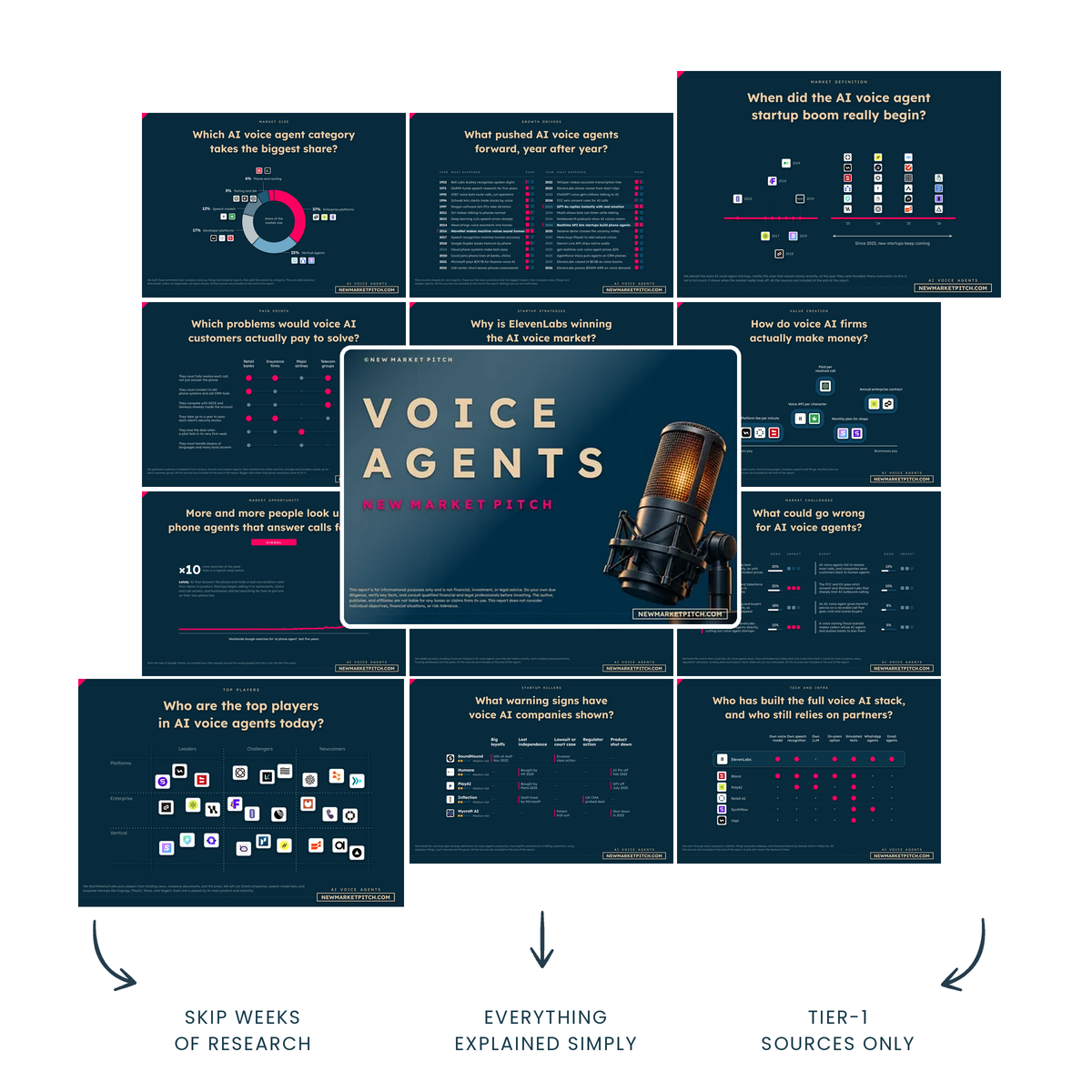
Whether you're building or investing in the AI voice agent market, our report covers everything you need to know: the players, the money, and what's coming next.
Summary
Yes, AI voice agents can make money as per-minute prices fall. But the companies most likely to build profitable businesses are those that resolve valuable customer problems, rather than simply resell increasingly cheap voice technology.
Published voice-agent prices already range from approximately $0.07 to more than $0.30 per minute. The advertised rates aren't always comparable: some bundle the complete conversation, while others charge separately for orchestration, language models, speech generation, and telephony. Falling technology costs are real, but so is the pressure to pass those savings to customers.
The financial sensitivity is enormous. At one million monthly minutes, a provider charging $0.15 with $0.09 in variable costs generates $60,000 in monthly gross profit. Cut the selling price to $0.10 and delivery costs to $0.08, and that profit drops to $20,000. Every cent retained per minute is worth $120,000 annually at that volume.
Commercial demand is no longer hypothetical. Retell AI reported reaching $50 million in annual recurring revenue during 2025, while enterprise deployments demonstrate growing interest in automating customer conversations. What remains much less visible is whether these companies are converting revenue growth into sustained operating profits.
Cheaper AI can also expand the market without making individual providers richer. Reducing the selling price from $0.15 to $0.10 requires 50% more billable minutes just to maintain revenue. If gross profit per minute also declines, usage needs to grow even faster to preserve total gross profit.
The strongest customer economics come from replacing expensive human handling, not merely producing cheap audio. In one illustrative scenario, a five-minute AI conversation costs $0.60 versus approximately $2.38 in occupied human labor. But an unsuccessful AI call can add costs if a human must subsequently handle the same request.
Resolution rates change the equation dramatically. Under a model where an AI attempt costs $0.48 and human fallback costs $3, the AI breaks even on direct handling costs at just a 16% success rate. A higher-quality agent charging $0.15 per minute can even be 34% cheaper per completed customer request than a weaker competitor charging $0.08.
That creates a potential pricing advantage for reliable providers. Buyers have reasons to pay more for completed appointments, resolved support cases, qualified sales leads, and fewer repeat calls. Outcome-based contracts can capture more of this value, although they expose providers to performance risk and disputes over what counts as success.
Small-business customers present a different challenge. An account generating $1,000 in monthly revenue at a 40% gross margin contributes only $400 before acquisition and onboarding expenses. Even a $5,000 implementation cost would take 12.5 months of gross profit to recover. Highly standardized, self-service products have a better chance than labor-intensive custom deployments.
Our conclusion is that the market will increasingly split between low-priced voice infrastructure and higher-value applications embedded in business operations. Revenue alone will not establish who is winning: gross margin, resolution performance, retention, deployment costs, and measurable customer outcomes will matter far more as the price of a voice minute keeps falling.

Written by the New Market Pitch teamWe track new markets so founders and investors can move faster. About us
Why are AI voice agent prices falling so fast?
AI voice agent prices are dropping because speech AI, language models, and realtime calling technology have become cheaper, while more companies are fighting to sell the same services.
OpenAI cut GPT-4o Realtime audio-token prices by 60% in December 2024, then announced another 20% reduction for its next-generation realtime model in August 2025. ElevenLabs also reduced Conversational AI pricing by approximately 50% for Creator and Pro customers in February 2025, bringing its advertised starting price to $0.10 per minute. Its newer ElevenAgents offering lists additional minutes at $0.08, excluding external language-model and telephony charges.
Meanwhile, businesses have more options than they did two years ago. Retell AI, Bland AI, Deepgram, and ElevenLabs offer ready-made voice-agent platforms, while developers can build their own systems using realtime models and telephone infrastructure.
Two pressures are colliding. It costs less to run an AI conversation, and customers have more alternatives when choosing a provider. Cheaper technology should help margins, but competition is pushing providers to pass much of those savings on to customers.
How much does an AI voice agent cost per minute today?
AI voice agents currently cost anywhere from around $0.07 to more than $0.30 per minute, depending on the provider, the models used, and what is included in the advertised price.
Retell AI advertises a $0.07–$0.31 per-minute range, with a $0.055 infrastructure component before additional voice and language-model charges. Bland AI advertises $0.14 per minute on its Start tier and $0.12 on Build, which also carries a $299 monthly platform fee. ElevenAgents lists additional standard minutes at $0.08, excluding external LLM and telephony costs. Deepgram publishes $0.075 per minute for its standard voice-agent tier.
The difference between bundled prices and infrastructure-only prices can be substantial. A platform charging $0.055 for orchestration may end up costing more than a bundled $0.12 service once the customer adds a voice model, a language model, and telephone connectivity.
We compared published self-service prices rather than negotiated enterprise contracts. These figures show what customers can buy at advertised rates, although they tell us little about what the providers themselves spend.
| Provider or component | Published price | What is included |
|---|---|---|
| Retell AI | $0.07–$0.31/min | Configured voice agent |
| Retell infrastructure | $0.055/min | Orchestration only |
| Bland AI Start | $0.14/min | Bundled voice-agent service |
| Bland AI Build | $0.12/min | Bundled service; $299/month extra |
| ElevenAgents | $0.08/min | Agent platform; external costs extra |
| Deepgram Standard | $0.075/min | Standard voice-agent tier |
| Deepgram Advanced | $0.163/min | Higher-tier agent configuration |
| Twilio US inbound local | $0.0085/min | Telephone connectivity only |
| Twilio US outbound local | $0.014/min | Telephone connectivity only |

A good product starts with a real problem. In our report covering the AI voice agent market, we show you the ones customers still live with.
Do cheaper AI models actually make voice agents more profitable?
Cheaper AI models can improve voice-agent margins, but providers only benefit if their own costs fall faster than the prices they charge customers.
Retell's published component pricing provides a useful example. Its infrastructure costs $0.055 per minute, a standard platform voice adds $0.015, a low-cost language model can add approximately $0.008, and representative US telephony adds $0.015. Together, these components produce a customer-facing price of approximately $0.093 per minute.
Choosing a language model costing $0.064 instead of $0.008 increases the total to approximately $0.149. That single decision makes the configured agent roughly 60% more expensive.
These are retail component prices rather than Retell's internal costs, so they cannot establish its gross margin. They do show how much model selection can change what a customer pays.
For a provider handling 10 million minutes monthly, reducing actual delivery costs by one cent per minute saves $100,000 each month. If competition also forces that provider to cut its selling price by two cents, gross profit falls by $100,000 despite the technology becoming cheaper.
The biggest beneficiaries will be companies that manage to keep some of the savings, through stronger products, better supplier terms, or lower operating costs.
If you want more recent data on this point, please see our latest AI voice agents market report.
How much profit can an AI voice agent make from one million minutes?
An AI voice agent business selling one million minutes monthly can generate anywhere from $10,000 to more than $100,000 in gross profit under reasonable pricing scenarios. The range is enormous because small differences in cost per minute become expensive at scale.
We modeled nine combinations of selling price and variable delivery cost. These are illustrative calculations, not reported financial results from individual providers.
At $0.15 in revenue and $0.09 in variable cost per minute, one million minutes generate $60,000 in monthly gross profit, giving the provider a 40% gross margin.
Reduce the selling price to $0.10 and delivery cost to $0.08, and gross profit falls to just $20,000. The provider still earns money on every minute, but it now needs three times the volume to generate the same monthly gross profit.
| Selling price/min | Cost/min | Gross margin | Monthly gross profit |
|---|---|---|---|
| $0.20 | $0.08 | 60% | $120,000 |
| $0.18 | $0.09 | 50% | $90,000 |
| $0.15 | $0.09 | 40% | $60,000 |
| $0.15 | $0.12 | 20% | $30,000 |
| $0.12 | $0.07 | 42% | $50,000 |
| $0.12 | $0.10 | 17% | $20,000 |
| $0.10 | $0.06 | 40% | $40,000 |
| $0.10 | $0.08 | 20% | $20,000 |
| $0.08 | $0.07 | 13% | $10,000 |
At this volume, every cent retained per minute represents $120,000 in annual gross profit.
The figures also exclude salaries, customer acquisition, engineering, security, and other operating expenses. A startup generating $20,000 in monthly gross profit could still be losing substantial money overall.

If you build or invest in the AI voice agent market, you need to know which business models pay off now and which ones are fading. That's why our report covering it has a whole section on it.
Are AI voice agent startups making real money yet?
Yes, some AI voice agent startups have already built businesses generating tens of millions of dollars in annualized revenue, although public evidence of sustained profitability remains limited.
Retell AI announced in January 2026 that its annual recurring revenue had passed $40 million. An April 2026 announcement reported that the company had reached $50 million ARR during 2025 and was handling more than 50 million real-time AI phone calls monthly.
The revenue figure is substantial for a specialist company selling a relatively new technology. It also suggests that businesses are willing to pay for dedicated voice-agent software rather than relying entirely on models from large AI laboratories.
Still, the figures need careful interpretation. Annual recurring revenue is an annualized measure based on recurring business, not the same as recognized annual revenue or profit. Similarly, 50 million calls cannot be translated into billable minutes without knowing their average duration and commercial terms.
At $50 million ARR, the implied monthly annualized revenue is approximately $4.17 million. If every dollar came from minutes sold at an average $0.12, it would correspond to around 34.7 million billable minutes monthly. This is only a way to illustrate scale, not a reconstruction of Retell's actual revenue mix.
Dedicated AI voice-agent businesses have achieved meaningful commercial traction. Whether their revenue translates into attractive operating profits is still much harder to verify.
Will cheaper AI voice agents attract enough new customers to offset lower prices?
Cheaper AI voice agents should bring more businesses into the market, but providers need very strong usage growth to make up for falling per-minute revenue.
Suppose a platform charges $0.15 per minute and later reduces its price to $0.10. It needs 50% more billable minutes just to maintain revenue. If its price falls to $0.075, usage must double.
That growth is possible in a market with many automated workflows, but not every customer will respond equally to cheaper prices.
A hospital handling appointment requests may already find automation worthwhile at $0.20 per minute because staffing is expensive and calls must be answered. A company running thousands of low-value sales qualification calls may be much more sensitive to whether an agent costs $0.15 or $0.05.
The same distinction applies at industry level. Imagine providers collectively selling one billion minutes a year at $0.15, with $0.10 in variable cost. They generate $50 million in gross profit. If prices fall to $0.10 and costs to $0.06, gross profit per minute drops from five cents to four cents. Total volume must rise by more than 25% for aggregate gross profit to increase.
There is still no comprehensive public dataset showing industry-wide paid minutes, average realized prices, and actual delivery costs over several years. Cheaper models and expanding adoption could create a much bigger market, but they have not yet proved that total industry profits are rising.
If you want more recent data on this point, please see our latest AI voice agents market report.

Learning from others' mistakes is the cheapest lesson there is. In our market report about AI voice agents, we look at what broke startups before you, so you don't repeat it.
Can AI voice agents really cost less than human call center workers?
AI voice agents are already much cheaper than human operators for many repetitive conversations, provided they can finish the task without needing a human to take over.
Consider a call center employee with a fully loaded cost of $20 per paid hour. That is approximately $0.33 per paid minute. If the employee spends 70% of paid time actively handling calls, the labor cost is about $0.48 per occupied minute.
A voice agent charging $0.12 per connected minute costs $0.60 for a five-minute conversation. The same amount of occupied human time costs approximately $2.38 under these assumptions.
That gap gives businesses room to save money even when AI agents remain relatively expensive compared with their underlying computing costs.
Klarna offers an example of businesses taking this seriously. After its earlier work with text-based customer service automation, the company deployed ElevenLabs voice agents for US customer support in February 2026. ElevenLabs reported that eligible queries handled by the system were resolved up to ten times faster.
The catch is that an unsuccessful AI conversation can add expense before a human employee has to handle the same request. Businesses therefore need to track completed resolutions and transferred calls rather than relying on the advertised price per minute.
How many calls must an AI voice agent resolve to save money?
An AI voice agent can save money even when it resolves fewer than half of incoming calls, although a weak resolution rate quickly eats into the savings.
We modeled an agent costing $0.12 per minute with an average four-minute conversation. Each attempted interaction costs $0.48. The alternative human interaction costs $3.00, and every unsuccessful AI call still requires that full human interaction.
At a 20% successful-resolution rate, expected handling cost is $2.88 per incoming request. That produces a saving of only 4%.
At 60%, expected cost drops to $1.68, saving 44%. At 90%, it falls to $0.78, saving 74%.
| Calls resolved by AI | Expected cost/call | Saving vs human |
|---|---|---|
| 10% | $3.18 | -6% |
| 20% | $2.88 | 4% |
| 30% | $2.58 | 14% |
| 40% | $2.28 | 24% |
| 50% | $1.98 | 34% |
| 60% | $1.68 | 44% |
| 70% | $1.38 | 54% |
| 80% | $1.08 | 64% |
| 90% | $0.78 | 74% |
The scenario excludes implementation costs, customer dissatisfaction, and extra work created by poor AI interactions. Actual call durations and fallback costs will also vary.
Under these specific assumptions, the AI agent breaks even on direct handling costs at a resolution rate of 16%. That's a surprisingly low threshold, and it helps explain why narrowly focused automation can make financial sense long before an agent becomes good enough to handle every conversation.

When you build or invest in the AI voice agent market, you need clarity, not confusion. In our document detailing everything you need to know about AI voice agent, we always try to put numbers on and quantify whatever is usually vague and confusing.
Would businesses pay more for an AI voice agent that actually works better?
Businesses have a strong financial reason to pay more for reliable AI voice agents because a higher per-minute price can still produce a cheaper completed interaction.
Take two hypothetical products handling four-minute calls. Agent A costs $0.08 per minute and fully resolves 50% of requests. Agent B costs $0.15 and resolves 80%. Every unresolved call requires a human interaction costing $3.
Agent A's expected cost per incoming request is $1.82. Agent B costs $1.20, despite being almost twice as expensive per minute.
That makes Agent B approximately 34% cheaper for the buyer.
The distinction becomes particularly important in healthcare appointments, financial-services support, payment collection, and sales qualification, where an unfinished conversation may create follow-up work or lost business.
Buyers can measure completion rates, transfer rates, repeat calls, successful bookings, and other concrete results. Providers able to show better performance have a stronger argument for charging more than competitors offering a cheaper voice minute.
There is not enough published head-to-head enterprise data to calculate a market-wide premium for better agents. But the economics are clear: a cheap conversation is not necessarily a cheap solution.
Can Retell AI and Bland AI survive competition from OpenAI and ElevenLabs?
Retell AI and Bland AI can survive competition from model providers, but their long-term advantage depends on how much useful software they build around the underlying voice technology.
OpenAI sells realtime models that developers can integrate directly. ElevenLabs combines its speech technology with a complete conversational-agent platform. Deepgram offers speech recognition, synthesis, and integrated agent services.
Businesses therefore have several ways to create a voice agent without purchasing a complete solution from an independent orchestration provider.
As seen above, public pricing already separates infrastructure, language-model, voice, and telephone costs. That makes it easier for technical customers to compare specialist platforms against systems assembled from individual suppliers.
For simpler applications, the competition could become particularly difficult. Basic voice generation, turn detection, scripted conversations, and call transcripts are available from several providers.
More demanding customers still need integrations with internal systems, reliable transfers to human workers, monitoring, evaluation, compliance controls, and operational support.
Both companies have been expanding in that direction. Retell offers enterprise deployment options, safety controls, and monitoring capabilities. Bland markets dedicated infrastructure and integrations for complex business environments.
Neither company is guaranteed a lasting advantage, especially when suppliers can move into the same product category. But businesses operating thousands of important calls may continue paying specialists that make deployment, reliability, and maintenance easier.
If you want more recent data on this point, please see our latest AI voice agents market report.

In our report covering the AI voice agent market, we look at what the winners do differently, so you can learn from the best instead of guessing.
Will AI voice agent platforms end up as low-margin infrastructure businesses?
Basic AI voice-agent platforms are heading toward tougher margins because customers can increasingly see what the underlying technology costs. More specialized providers have a better chance of maintaining premium prices.
The market already contains several competing pricing models. Some providers separate orchestration from model costs, others bundle everything into a minute rate, and others combine subscriptions with usage charges.
The pricing structure changes who carries the risk when underlying model costs rise or fall.
Transparent component pricing makes it easier for customers to identify the extra amount they are paying for orchestration. Bundled pricing gives providers more flexibility to optimize their suppliers, but it also exposes them if usage costs are higher than expected.
The same competitive pressure runs through the supply chain. Telephone services publish calling rates, speech providers advertise transcription and synthesis prices, and AI laboratories compete on realtime model performance and inference costs.
That's a difficult environment for companies whose main product is simply connecting these components.
Providers responsible for important business workflows have more room to defend their pricing. A system connected to scheduling software, customer databases, payment systems, and human support teams is harder to replace than a basic voice interface.
We expect the market to split between inexpensive commodity infrastructure and more valuable applications built around it.
Could AI voice agents make more money by charging for results instead of minutes?
Charging for completed tasks could let AI voice-agent companies earn substantially more than they do from minutes alone, especially in appointments, sales, and payment collection.
Consider a company receiving 20,000 appointment-related calls per month. At four minutes per call and $0.12 per minute, its voice-agent provider earns $9,600 monthly.
Now imagine a different agreement paying the provider $2 for every successfully completed appointment. If the agent completes 60% of incoming requests, revenue rises to $24,000 from 12,000 completed appointments.
Assuming $9,600 in variable delivery expenses, the provider retains $14,400 before onboarding, support, and fixed operating costs.
Of course, charging for results brings more risk. If the agent completes only 20% of requests, revenue falls to $8,000, below the assumed delivery expense.
There is also the question of what counts as success. A booked appointment may later be canceled, a qualified lead may never buy anything, and a debt-collection call may contribute to a payment without directly causing it.
Those disputes become harder to manage when the provider's entire bill depends on the outcome.
Still, outcome pricing gives strong voice-agent companies a way to capture more of the financial value they create. We expect it to be particularly attractive in workflows with clear, verifiable results, rather than becoming the default for every type of call.
If you want more recent data on this point, please see our latest AI voice agents market report.

Your time is limited. In our research about AI voice agents, we put numbers on each part of the market, so you can see where it makes sense to focus.
Can AI voice agent startups make money from small business customers?
Small businesses are an accessible market for AI voice agents, but low monthly spending makes them difficult to serve profitably when onboarding and support require substantial human work.
A customer using 10,000 minutes monthly at $0.10 generates $1,000 in usage revenue. At a hypothetical 40% gross margin, the provider has $400 left before customer acquisition, integration, and other operating expenses.
If onboarding costs $5,000, recovering that expense takes 12.5 months of gross profit, assuming the customer stays, usage remains stable, and no additional setup fee is collected.
This is why self-service deployment is especially important for smaller accounts. Providers need customers to configure numbers, prompts, integrations, and workflows without constant assistance from engineers.
Larger customers change the economics. A business consuming 100,000 minutes at the same price and margin generates $4,000 in monthly gross profit. But enterprise deployments may also involve longer sales cycles, custom integrations, security reviews, and support requirements.
The best small-business model is probably highly standardized: a product that works for a specific use case, requires little configuration, and can be purchased without a sales team.
Custom-built agents for customers spending only a few hundred dollars monthly look much harder to sustain unless providers charge separately for implementation.
Is AI voice agent revenue as valuable as regular SaaS revenue?
AI voice-agent revenue can be recurring and substantial, but it generally comes with more direct usage costs than traditional software subscriptions.
Every voice conversation consumes resources, including model inference, speech processing, and often telephone connectivity. If a customer doubles call volume, the provider usually incurs additional delivery expenses.
Many established SaaS products have much lower incremental costs when existing customers use the software more frequently.
Consider two companies each generating $50 million in annualized revenue. If the first earns a 30% gross margin, it retains $15 million in annualized gross profit. If the second earns an 80% margin, it retains $40 million.
The second has $25 million more available for engineering, customer acquisition, and other expenses, despite having identical revenue.
This difference can become particularly important as AI voice-agent prices continue falling. A vendor might report impressive growth in calls and customers while making little additional gross profit.
Subscription revenue can help by charging customers for administration, analytics, compliance, premium features, or dedicated deployments alongside usage. Yet the financial benefit depends on what customers actually buy and how expensive those features are to deliver.
Valuing voice-agent businesses as if all their reported recurring revenue carried conventional SaaS margins would be a mistake. Public financial disclosures are still too limited to establish which companies have achieved that combination.

In our market report about AI voice agents, we always try to gather several sources and make estimates that make sense, so you can work with solid numbers.
Which AI voice agent business model is most likely to win?
The strongest AI voice-agent business model is likely to combine efficient voice infrastructure with valuable business workflows, rather than depend on selling conversation minutes at a markup.
Several approaches are competing.
Speech technology providers can earn money from the underlying models and tools used by developers. Infrastructure platforms can sell realtime orchestration, telephony integrations, and enterprise controls. Specialized applications can charge businesses for handling appointments, answering support requests, collecting payments, or qualifying sales leads.
Each approach has different strengths.
Owning core speech technology can reduce dependence on outside suppliers, but developing competitive models requires investment. Selling general-purpose infrastructure offers broad distribution opportunities, although customers can compare prices easily. Building specialized applications requires more industry knowledge and integration work, but successful products can become deeply embedded in customer operations.
Vertical applications also have a clearer way to prove value. A medical practice can measure appointments booked, a dealership can count qualified enquiries, and a support operation can track issues resolved without staff intervention.
We would favor companies with repeatable deployments, strong resolution rates, low customer-support requirements, and direct access to important workflows. Those advantages offer more room to retain margin as the raw cost of speech continues falling.
If you want more recent data on this point, please see our latest AI voice agents market report.
Can AI voice agents make money as per-minute prices fall?
Yes. AI voice agents can make money as per-minute prices fall, and cheaper technology is making more types of automation financially attractive. But companies relying mainly on reselling voice minutes face a much tougher future than those helping businesses complete valuable work.
There is enough evidence to establish genuine commercial demand. Specialist providers have reached tens of millions of dollars in annualized revenue, major enterprises are deploying voice automation, and publicly available technology can already handle conversations at prices well below many human call-center cost scenarios.
The harder part is keeping the economics attractive. A one-cent change in gross profit per minute represents $120,000 annually for every million monthly minutes sold. As competitors continue cutting prices, small differences in delivery costs and customer retention can determine whether a startup becomes profitable or keeps burning cash.
Our calculations also show why the cheapest agent may not win. A system that costs almost twice as much per minute can still be substantially cheaper per completed customer request when it resolves more calls successfully.
The strongest commercial opportunity appears to be in reliable agents connected to real business processes, especially where customers can measure cost savings or additional revenue. Basic conversation infrastructure is becoming easier to replicate and harder to sell at a premium.
We still need better disclosure of actual gross margins, retention, and operating profits before calling the sector broadly profitable. For now, the conclusion is clear enough: falling per-minute prices are compatible with attractive AI voice-agent businesses, but they increasingly reward execution, specialization, and measurable results over simply providing cheap speech.

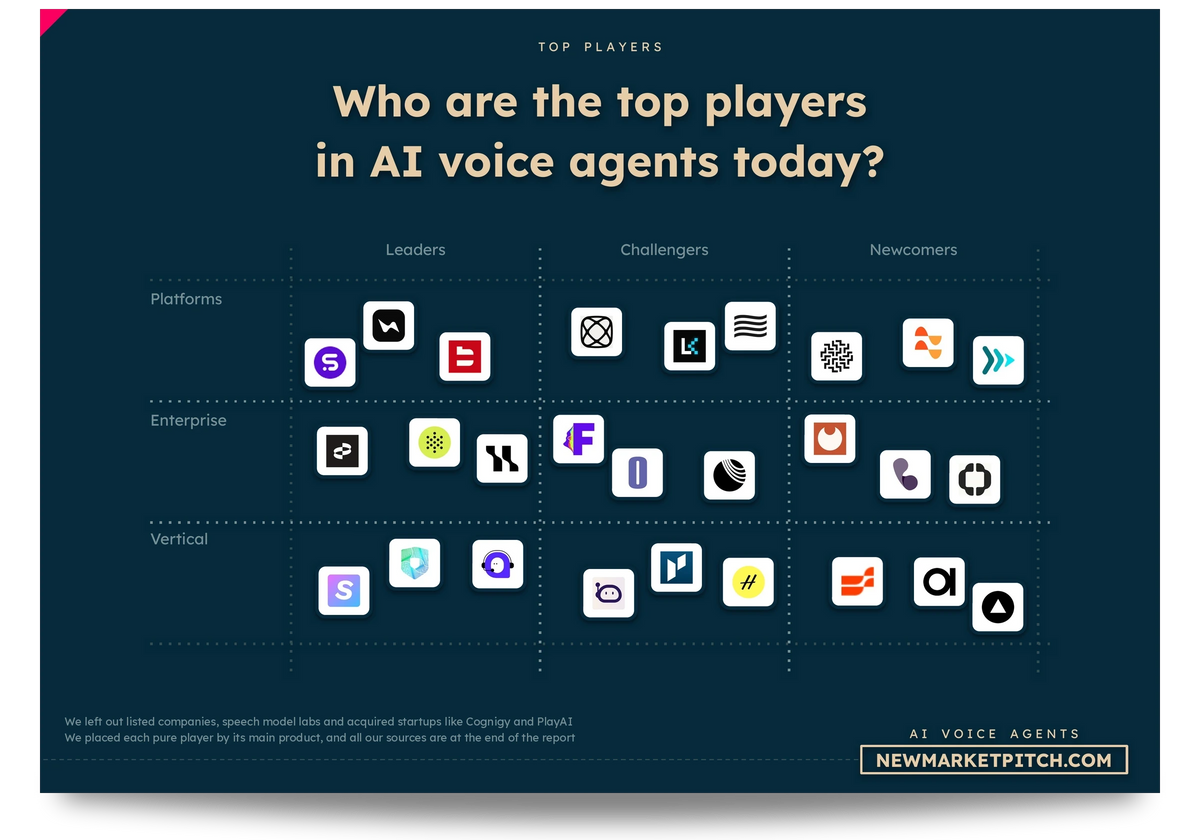
In our document detailing everything you need to know about AI voice agent, we turn what is vague and complex into simple, useful visuals. Market maps like this one show you at a glance where every startup stands.
Our methodology
This analysis addresses a question that has no straightforward answer in public financial disclosures: whether AI voice-agent businesses can become more profitable while the price of a conversation keeps falling. Rather than infer profitability from technology improvements or revenue announcements, we broke the question into distinct dimensions covering pricing, delivery economics, commercial adoption, resolution performance, competition, and business-model durability.
For each dimension, we collected recent, attributable evidence from official pricing pages, technology announcements, company disclosures, product documentation, and reported enterprise deployments. We compared these observations across providers and assembled the evidence into a broader assessment. The aim was to understand where falling costs create genuine economic advantages, where those savings are competed away, and where providers may retain pricing power.
Our pricing comparisons use publicly advertised self-service rates, not undisclosed enterprise contracts. We distinguish bundled voice-agent pricing from separately billed orchestration, language-model inference, speech services, and telephony. This matters for comparability: a low infrastructure rate does not necessarily produce the cheapest complete agent. Published customer prices also cannot be treated as evidence of a provider's internal production costs or gross margins.
We tested the economics with explicit financial scenarios rather than relying on headline per-minute prices. These include gross-profit calculations at one million monthly minutes, sensitivity to pricing and delivery-cost changes, the usage growth required to offset cheaper rates, and expected handling costs at different AI resolution rates. The scenarios hold specified assumptions constant to isolate the effects being examined. They are analytical illustrations, not estimates of any named company's financial performance.
Commercial traction and operating profitability were assessed separately. Company-reported annual recurring revenue provides an indication of commercial scale, while call volumes and deployment announcements help establish adoption. Neither reveals operating profit on its own. We also distinguish calls from billable minutes, recurring revenue from recognized revenue, and reported enterprise performance from independently audited results.
For competitive positioning, we compared the economics of general-purpose voice infrastructure with applications embedded in specific business workflows. We considered how pricing transparency, supplier dependence, deployment effort, integration requirements, customer support, and measurable task completion can influence a provider's ability to retain margin. Rather than assume that the cheapest supplier wins, we examined what a customer ultimately pays for a successfully completed interaction.
Key pricing and technology sources include OpenAI's December 2024 developer pricing announcement, OpenAI's GPT-Realtime launch, ElevenLabs' Conversational AI pricing reduction, Retell AI's pricing and component breakdown, Bland AI's published plans, Bland AI's billing documentation, Deepgram's pricing schedule, ElevenAgents pricing, and Twilio's US voice rates.
To assess adoption and operational performance, we also used Retell AI's commercial and integration disclosures, its official newsroom, ElevenLabs' Klarna deployment report, and Retell's enterprise case studies covering Everise and Anker. Technical positioning was additionally informed by Deepgram's Voice Agent API documentation. Firsthand company disclosures were prioritized for specific, checkable claims, while reported performance outcomes were treated as company-reported results.
The final assessment comes from comparing these dimensions together: how quickly selling prices are falling, whether actual delivery costs can fall faster, how much additional adoption cheaper technology can support, and whether higher resolution rates or deeper workflow integration allow providers to capture more value. This structured aggregation of recent evidence provides a more defensible answer than extrapolating from revenue growth, per-minute pricing, or model-cost reductions in isolation.

Our report covering the AI voice agent market gets updated several times a month, so you always get the latest view of where things stand.
Written by the New Market Pitch teamWe track new markets so founders and investors can move faster. About us