Which clinical decision support startups earn the most?
Whether you're building or investing in the clinical decision support market, our report covers everything you need to know: the players, the money, and what's coming next.
Summary
OpenEvidence earns the most among clinical decision support startups, with an estimated $300 million annualized revenue run-rate as of July 2026. HeartFlow ranks second with $176 million in FY2025 revenue, followed by Harrison.ai at an estimated $138 million in 2025.
OpenEvidence's lead comes from an unusual business model: physicians use its clinical assistant without a conventional subscription, while pharmaceutical advertisers pay to reach them. That has allowed the company to scale without relying primarily on hospital software purchasing cycles.
HeartFlow has the strongest audited annual revenue figure in the ranking. Its sales roughly doubled between 2023 and 2025, reaching $176 million, with 98% still coming from its established FFRCT diagnostic product.
The upper end of the ranking is less certain than the numbers suggest. Harrison.ai and DentalMonitoring rely on external revenue estimates, while OpenEvidence and Aidoc are measured by annualized run-rates rather than completed fiscal-year sales.
Eight startups have financial indicators exceeding $50 million. Medical imaging accounts for seven of the twenty revenue-ranked companies in our dedicated imaging category, although OpenEvidence alone has built a larger reported revenue business than any of them.
Dental AI has quietly become a meaningful commercial market. DentalMonitoring's estimated $91 million in revenue and Overjet's estimated $40.7 million show that orthodontic monitoring and dental image analysis can support businesses well beyond the pilot stage.
Clinical adoption is much broader than the financial ranking reveals. Glooko reports supporting 9,000 clinics, Proscia reaches more than 4,000 healthcare facilities, and Viz.ai has reached 2,000 US hospitals, but those footprints cannot be converted reliably into revenue.
High revenue still does not guarantee profitability. HeartFlow recorded approximately $64 million in operating losses in 2025, while SOPHiA GENETICS reported a $79 million net loss despite growing sales.
Growth is uneven, particularly in patient triage. Mediktor's revenue fell approximately 42% in 2025 following customer churn, showing that acquisitions and contract retention can quickly change the outlook even for established clinical AI products.
The competitive landscape is splitting. General-purpose AI assistants threaten clinical information and evidence-search products most directly, while specialized imaging, genomic analysis, and regulated diagnostic software retain stronger clinical and workflow barriers. For now, OpenEvidence leads on estimated revenue pace, and HeartFlow leads on audited annual revenue.

Written by the New Market Pitch teamWe track new markets so founders and investors can move faster. About us

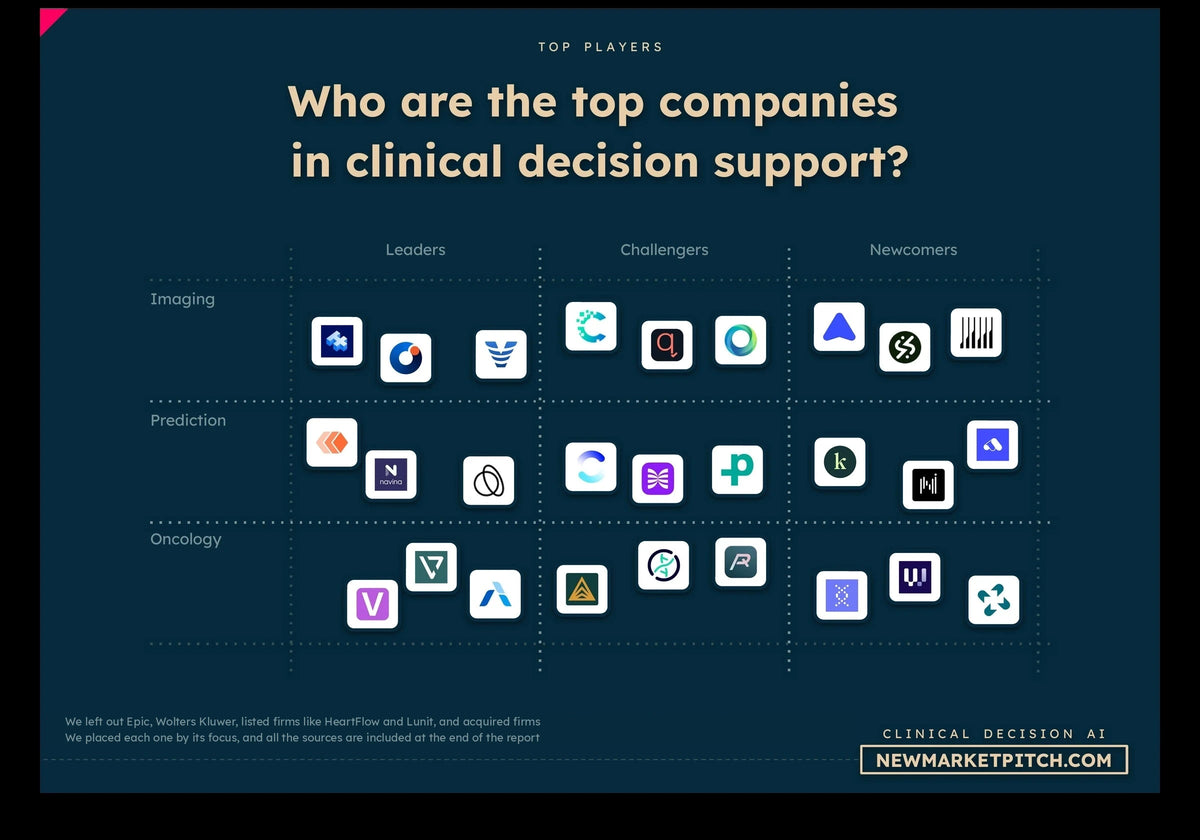
In our report covering the clinical decision support market, we turn what is vague and complex into simple, useful visuals. Market maps like this one show you at a glance where every startup stands.
The ranking of top startups in the clinical decision support market by revenue
Below is a table ranking the startups of this market by their current revenue scale. You can find our methodology at the end of this page.
If you want a deeper understanding of the market and its current dynamics, get our report on the clinical decision support market.
| Ranking | Company | Latest Metric | Metric Type | Freshness | Disclosed When | Source Quality | Confidence | Segment | Why This Ranking | Local Metric | Country |
|---|---|---|---|---|---|---|---|---|---|---|---|
| 1 | OpenEvidence | ~$300M | Revenue Run-Rate | Very Fresh · 3mo | Sep 18, 2026 | Third-Party Estimate | Medium | Clinical Evidence & Medication Guidance | The much larger and recent run-rate indicates significant scale, but it is an analyst estimate of annualized advertising revenue, not audited annual revenue. | us | |
| 2 | HeartFlow | $176M | Fiscal-Year Revenue | Fresh · 10mo | Mar 18, 2026 | Filed / Audited | High | Cardiac Decision Support | Audited whole-company revenue is more defensible than larger estimates at adjacent positions; its newer quarterly growth is not annualized into the main figure. | us | |
| 3 | Harrison.ai | ~$138M | Annual Revenue | Fresh · 10mo | Sep 2, 2026 | Third-Party Estimate | Low | Imaging Decision Support | Large estimated annual sales but no underlying filed accounts or founder-confirmed figure; ranks below filed HeartFlow results and above the smaller estimated vendors. | au | |
| 4 | DentalMonitoring | ~$91M | Annual Revenue | Aging · 22mo | Nov 24, 2025 | Third-Party Estimate | Low | Dental Decision Support | Reported sales are substantial, but the unverified 2024 estimate is less reliable for present scale than the younger and more direct figures above. | fr | |
| 5 | SOPHiA GENETICS | $77.3M | Fiscal-Year Revenue | Fresh · 10mo | Mar 3, 2026 | Filed / Audited | High | Genomic Decision Support | Audited AI-assisted genomic decision-platform revenue is stronger evidence than similar-sized estimates; listed since 2021. | ch | |
| 6 | Lunit | ~$58.5M | Fiscal-Year Revenue | Fresh · 10mo | Jun 2026 | Filed / Audited | High | Imaging Decision Support | Audited 2025 sales provide a stronger comparison than Aidoc run-rate and AMBOSS older results; includes acquired breast-risk software and research biomarker products. | KRW 83.1B | kr |
| 7 | Aidoc | >$60M | Revenue Run-Rate | Fresh · 16mo | Sep 11, 2025 | Credible Reported | Medium | Imaging Decision Support | An investor-confirmed recurring commercial run-rate is a stronger scale indicator than generic estimates, though it is 16 months old and is not booked fiscal revenue. | il | |
| 8 | AMBOSS | ~$67M | Fiscal-Year Revenue | Aging · 22mo | Filed / Audited | Medium | Clinical Evidence & Medication Guidance | Direct reported sales outweigh weaker nearby estimates; FY2024 is older and some sales come from medical education alongside clinician decision tools. | €62M | de | |
| 9 | Ada Health | ~$40M | Fiscal-Year Revenue | Aging · 22mo | Oct 27, 2025 | Filed / Audited | Medium | Clinical Triage & Symptom Assessment | Consolidated filings provide dependable company revenue even though it is older than the nearby 2025 figures; includes consumer symptom assessment and enterprise triage. | €37M | de |
| 10 | Overjet | ~$40.7M | Annual Revenue | Fresh · 10mo | Sep 10, 2026 | Third-Party Estimate | Low | Dental Decision Support | A recent estimate is close to the filed Ada amount, but lacks audited verification and therefore ranks below Ada. | us | |
| 11 | Caresyntax | ~$29.3M | Annual Revenue | Fresh · 10mo | Third-Party Estimate | Low | Surgical Decision Support | Reported sales represent surgery intelligence and other surgical workflow products; the external estimate is less reliable than the filed disclosures above. | us | ||
| 12 | VUNO | ~$24.5M | Fiscal-Year Revenue | Fresh · 10mo | Mar 2026 | Filed / Audited | High | Clinical Risk Alerts | Audited 2025 company revenue is more dependable than similar external estimates; listed since 2021. | KRW 34.8B | kr |
| 13 | Qure.ai | ~$21M | Fiscal-Year Revenue | Aging · 19mo | Filed / Audited | Medium | Imaging Decision Support | Indian financial disclosures provide a stronger basis than adjacent software estimates, but an older fiscal year and minority-investee reporting limit comparability. | INR 1.76B | in | |
| 14 | Scopio Labs | ~$21.9M | Annual Revenue | Aging · 28mo | Oct 5, 2026 | Third-Party Estimate | Low | Laboratory Diagnostic Support | The imaging-plus-microscopy business has a slightly larger estimated figure than Qure.ai, but the older unsourced amount is less useful for current revenue scale. | il | |
| 15 | Quibim | ~$18.8M | Annual Revenue | Fresh · 10mo | Sep 2, 2026 | Third-Party Estimate | Low | Imaging Decision Support | A relatively recent company-wide estimate, but its provenance is not independently verifiable and it covers imaging biomarker products beyond routine care. | es | |
| 16 | FIZE Medical | ~$17.1M | Annual Revenue | Fresh · 10mo | Third-Party Estimate | Low | Clinical Risk Alerts | Reported company revenue is below Quibim but above Covera, with a hybrid monitoring-device and predictive-care perimeter and no audited corroboration. | il | ||
| 17 | Covera Health | ~$15.8M | Annual Revenue | Aging · 28mo | Third-Party Estimate | Low | Imaging Decision Support | Revenue estimate is older and diagnostic quality analytics extend beyond bedside guidance; receives less weight than newer decision-support vendor figures. | us | ||
| 18 | Infermedica | ~$6.24M | Fiscal-Year Revenue | Fresh · 10mo | Filed / Audited | Medium | Clinical Triage & Symptom Assessment | The latest registered sales are smaller but more credible than large historical estimates; combines symptom assessment with provider-integrated triage software. | PLN 23.5M | pl | |
| 19 | Cleerly | ~$24.6M | Annual Revenue | Historical · 34mo | Third-Party Estimate | Low | Cardiac Decision Support | Despite exceeding Infermedica in nominal amount, the unverified 2023 estimate is too old to establish present-day relative commercial scale confidently. | us | ||
| 20 | Mediktor | ~$2.94M | Annual Revenue | Fresh · 10mo | May 15, 2026 | Credible Reported | High | Clinical Triage & Symptom Assessment | An investor report documents current recognized revenue and contraction after an acquisition; stronger evidence than scale proxies below despite smaller sales. | €2.6M | es |
| 21 | Glooko | 9,000 clinics | Locations | Fresh · 10mo | Jun 2026 | Company Disclosed | Low | Metabolic Treatment Support | A very broad clinical installation base is evidence of reach, not a turnover figure. | us | |
| 22 | Proscia | >4,000 hospitals and clinics | Locations | Very Fresh · 0mo | Company Disclosed | Low | Laboratory Diagnostic Support | Large indirect network scale includes customers and their served facilities; digital pathology viewing and research applications are not equivalent to paid clinical AI licenses. | us | ||
| 23 | RapidAI | >2,500 hospitals | Locations | Very Fresh · 0mo | Oct 27, 2026 | Company Disclosed | Low | Imaging Decision Support | Recent hospital presence is strong deployment evidence, but includes platform integrations and says nothing about subscription pricing or consolidated revenue. | us | |
| 24 | AZmed | >2,500 healthcare facilities | Locations | Very Fresh · 0mo | Oct 27, 2026 | Company Disclosed | Low | Imaging Decision Support | Reported deployment footprint is not equivalent to 2,500 paying customers and cannot be compared directly with RapidAI or recognized revenue. | fr | |
| 25 | Viz.ai | 2,000 hospitals | Locations | Very Fresh · 3mo | Jul 28, 2026 | Company Disclosed | Low | Clinical Risk Alerts | Broad hospital deployments and reported healthcare-business profitability establish traction, but no consolidated revenue amount is disclosed. | us | |
| 26 | InsightRX | >1,000 hospitals | Locations | Fresh · 10mo | Dec 4, 2025 | Company Disclosed | Low | Medication & Dosing Support | Specific hospital installations show real clinician workflow penetration; without revenue disclosure, the site count does not establish rank against financial figures. | us | |
| 27 | Navina | >20,000 users | Users | Very Fresh · 6mo | Apr 24, 2026 | Company Disclosed | Low | Clinical Risk Alerts | High active clinician usage establishes adoption but includes non-physician care-team users; commercial revenue cannot be inferred from those users. | il | |
| 28 | Ibex Medical Analytics | 2.4M slides analyzed per year | Transactions | Very Fresh · 1mo | Sep 9, 2026 | Company Disclosed | Low | Laboratory Diagnostic Support | Significant annual diagnostic throughput confirms routine use but is not sales volume or annual revenue. | il | |
| 29 | Brainomix | >300 hospitals | Locations | Aging · 19mo | Mar 20, 2025 | Company Disclosed | Low | Imaging Decision Support | Hospital deployment in stroke and lung imaging is concrete commercial scale, but the operating footprint is 19 months old and yields no revenue number. | gb | |
| 30 | Optellum | >250 clinical sites | Locations | Very Fresh · 4mo | Jun 4, 2026 | Company Disclosed | Low | Oncology Decision Support | Recent deployed site count is a stronger commercial indicator than undated users, but signed pricing and total revenue are not public. | gb | |
| 31 | Glass Health | >120,000 clinicians | Users | Very Fresh · 0mo | Company Disclosed | Low | Clinical Evidence & Medication Guidance | Substantial clinician adoption is verifiable but includes free users; does not imply more sales than providers with smaller but contracted hospital deployments. | us | ||
| 32 | Regard | >150 hospitals | Locations | Undated | Company Disclosed | Low | Clinical Risk Alerts | Hospital-level integration supports commercial adoption; exact period and paying-customer count are not specified. | us | ||
| 33 | Corti | >100,000 daily patient interactions | Transactions | Aging · 26mo | Aug 21, 2024 | Company Disclosed | Low | Clinical Risk Alerts | A large past interaction rate shows software activity but mixes clinical support with ambient documentation and predates the current period. | dk | |
| 34 | VieCure | ~30,000 patients under management | Users | Fresh · 9mo | Jan 2026 | Company Disclosed | Low | Oncology Decision Support | Managed patients show usage of AI-based oncology treatment planning, not software licenses or recognized company revenue. | us | |
| 35 | FeelBetter | >450,000 patients supported | Other Scale Signal | Undated | Company Disclosed | Low | Medication & Dosing Support | Patient reach shows substantial real-world clinical scale, but it is not a count of paying customers or a measure of revenue. | us | ||
| 36 | Etiometry | >50 hospital partners | Locations | Undated | Company Disclosed | Low | Clinical Risk Alerts | Named hospital-partner footprint indicates real deployment, but pricing, reporting date and payment status are not established. | us | ||
| 37 | xWave Technologies | >20 NHS Trusts | Locations | Very Fresh · 5mo | May 2026 | Credible Reported | Low | Imaging Decision Support | Contracted public health deployments demonstrate genuine commercial activity; disclosed tripling of ARR gives no absolute revenue base. | ie | |
| 38 | Telepatia | >25 hospitals | Locations | Very Fresh · 2mo | Aug 4, 2026 | Credible Reported | Low | Clinical Risk Alerts | Early enterprise installations are promising but a third-party profile gives no paid-contract values or independently verified hospital count. | br | |
| 39 | Mednition | ~3.99M emergency patient visits | Transactions | Very Fresh · 0mo | Company Disclosed | Low | Clinical Risk Alerts | Cumulative patient coverage is a product usage metric, not a billable visit figure. | us | ||
| NR | Atropos Health | Not disclosed | Other Scale Signal | Undated | Company Disclosed | Low | Clinical Evidence & Medication Guidance | Clinical question answering is established, but data network patient coverage is not a count of paying clients. | us | ||
| NR | CathWorks | Not disclosed | Other Scale Signal | Undated | Apr 20, 2026 | Company Disclosed | Low | Cardiac Decision Support | Acquired by Medtronic in 2026 for its FFRangio cardiac guidance product; no standalone revenue is public. | us | |
| NR | Artera AI | Not disclosed | Other Scale Signal | Undated | Company Disclosed | Low | Oncology Decision Support | Biopsy-based treatment-response predictions for prostate and breast cancer; no revenue is public. | us | ||
| NR | PathAI | Not disclosed | Other Scale Signal | Undated | Company Disclosed | Low | Laboratory Diagnostic Support | Clinical computational-pathology software is relevant, but no reliable consolidated revenue metric is public; research services also complicate the perimeter. | us |

Our research about clinical decision support tools gets updated several times a month, so you always get the latest view of where things stand.
Which clinical decision support startups make the most money today?
OpenEvidence currently ranks first among clinical decision support startups, ahead of HeartFlow, Harrison.ai, DentalMonitoring, and SOPHiA GENETICS.
The gap between these companies is substantial, and their financial figures tell different stories. OpenEvidence has an estimated ~$300M annualized revenue run-rate as of July 2026. HeartFlow reported $176M in audited FY2025 revenue, while Harrison.ai's estimated 2025 revenue was ~$138M. DentalMonitoring follows with an estimated ~$91M for 2024, and SOPHiA GENETICS reported $77.3M for FY2025.
The ranking covers several types of clinical decision support. OpenEvidence helps physicians find medical evidence and earns money primarily through pharmaceutical advertising. HeartFlow provides coronary diagnostic analyses, Harrison.ai develops medical imaging AI, DentalMonitoring focuses on orthodontic monitoring, and SOPHiA GENETICS helps interpret genomic and other medical data.
We identified 20 startups with usable financial revenue indicators, alongside 19 others with quantified evidence of clinical adoption. Four additional companies remain unranked because their revenue and available commercial-scale information do not support a comparable position.
The financial ranking is shown below. It keeps the original reporting periods and metric types visible because annualized run-rate, estimated annual revenue, and audited fiscal-year sales are not interchangeable.
| Rank | Startup | Revenue indicator | Metric and period |
|---|---|---|---|
| 1 | OpenEvidence | ~$300M | Revenue run-rate, Jul 2026 |
| 2 | HeartFlow | $176M | FY2025 revenue |
| 3 | Harrison.ai | ~$138M | Estimated 2025 revenue |
| 4 | DentalMonitoring | ~$91M | Estimated 2024 revenue |
| 5 | SOPHiA GENETICS | $77.3M | FY2025 revenue |
| 6 | Lunit | KRW 83.1B | FY2025 revenue |
| 7 | AMBOSS | €62M | FY2024 revenue |
| 8 | Aidoc | >$60M | Jun 2025 revenue run-rate |
| 9 | Ada Health | €37M | FY2024 revenue |
| 10 | Overjet | ~$40.7M | Estimated 2025 revenue |
| 11 | Caresyntax | ~$29.3M | Estimated 2025 revenue |
| 12 | VUNO | KRW 34.8B | FY2025 revenue |
| 13 | Qure.ai | INR 1.76B | FY2025 revenue, ended Mar 2025 |
| 14 | Scopio Labs | ~$21.9M | Estimated revenue, Jun 2024 |
| 15 | Quibim | ~$18.8M | Estimated 2025 revenue |
| 16 | FIZE Medical | ~$17.1M | Estimated 2025 revenue |
| 17 | Covera Health | ~$15.8M | Estimated revenue, Jun 2024 |
| 18 | Infermedica | PLN 23.5M | FY2025 revenue |
| 19 | Cleerly | ~$24.6M | Estimated 2023 revenue |
| 20 | Mediktor | €2.6M | 2025 revenue |
Why are clinical decision support AI startups making so much money now?
Clinical decision support AI startups are making serious money today because several have found ways to charge for work that doctors and healthcare organizations already do every day.
The clearest change is the arrival of AI assistants that can be used frequently without requiring hospitals to buy and deploy another traditional software system. OpenEvidence demonstrates this model. According to Sacra's September 2026 analysis, its clinical consultation volume reached approximately 20 million per month in January 2026, compared with roughly 3 million per month a year earlier. That is nearly seven times the activity in twelve months.
Specialized diagnostic AI has been growing through a different route. HeartFlow has commercialized coronary CT analysis since 2015, while Lunit, Aidoc, and other imaging companies sell software that fits into existing clinical workflows. Hospitals have to deal with the cost of implementing these products, but once integrated, they can become part of routine care.
Several companies are also expanding beyond their original products. Aidoc has moved from radiology-focused AI toward a broader clinical AI platform. OpenEvidence has added capabilities beyond medical literature search, including documentation and other physician workflows. SOPHiA GENETICS has expanded its data analysis platform across genomic and multimodal applications.

In our market report about clinical decision support tools, we look at what the winners do differently, so you can learn from the best instead of guessing.
How much revenue does OpenEvidence make?
OpenEvidence has the highest selected revenue indicator among clinical decision support startups, and its estimated annualized revenue has grown extraordinarily fast.
Sacra estimates that OpenEvidence reached $7.9M in annualized revenue at the end of 2024, $150M at the end of 2025, and roughly twice that level by July 2026. Across those nineteen months, its estimated revenue pace increased approximately 38-fold.
Much of the growth comes from a model that differs from traditional medical reference software. Physicians can use OpenEvidence without paying a conventional individual subscription, while pharmaceutical advertisers pay to reach verified medical professionals. This removes much of the friction associated with selling hospital software, since doctors can adopt the assistant without waiting for a hospital-wide purchasing decision, provided institutional policies permit its use.
Sacra reports gross margins around 90% and advertising prices that can exceed $1,000 per thousand impressions in certain placements. Its September 2026 analysis also estimated that OpenEvidence had monetized only around 5% of available advertising inventory.
That last figure deserves attention, although the remaining inventory should not be treated as guaranteed future sales. Pharmaceutical advertisers have spending limits, and expanding advertising density could affect the experience of physicians using the product. Maintaining physician trust becomes particularly important when medical information and pharmaceutical marketing appear within the same product environment.
OpenEvidence has nevertheless reached a remarkable commercial position. It has turned a widely used clinical assistant into a major advertising business without depending on hospitals to purchase a subscription for every doctor.
Is HeartFlow the largest clinical AI startup with audited revenue?
HeartFlow has the largest audited annual revenue figure in our clinical decision support startup ranking, with its FY2025 results showing a business that has grown consistently for several years.
HeartFlow's SEC filings give us a useful three-year record. Revenue increased from $87.2M in 2023 to $125.8M in 2024, then to $176M in 2025. We calculate growth of approximately 44% in 2024 and 40% in 2025, meaning sales roughly doubled over two years.
The company earns substantially all its revenue through usage-based fees when physicians request its FFRCT or Plaque Analysis products. These tools help clinicians assess coronary artery disease using information from CT examinations.
One particularly revealing detail in HeartFlow's 2025 Form 10-K is that FFRCT remained its commercial foundation, representing 98% of total revenue. Its newer Plaque Analysis product had not yet become a similarly large revenue contributor.
So HeartFlow's growth has largely come from selling more of an established diagnostic service, rather than rapidly adding unrelated products. That gives us a clearer explanation for its revenue trajectory than a series of product-launch announcements would.
The company also reported a 76.8% gross margin in 2025. Its business is already substantial, although high operating expenses mean that strong gross margins have not yet translated into operating profitability.

In our document detailing everything you need to know about clinical decision support, you will always find fresh funding data, taken straight from our own verified funding database.
How big is Harrison.ai compared with other medical imaging AI startups?
Harrison.ai ranks third overall and is one of the largest radiology AI startups in the ranking by estimated revenue.
Latka estimates Harrison.ai generated $137.7M in 2025 revenue, which we represent as ~$138M. That would put the company substantially ahead of most specialized imaging AI developers by reported commercial scale.
Harrison.ai's work focuses on applying AI to medical imaging, particularly through radiology applications. Its technology is designed to help clinicians identify abnormalities and prioritize findings across imaging examinations.
The size of the reported revenue figure is impressive, but its source needs attention. Latka provides an external estimate rather than audited company accounts, and the underlying financial records are not publicly available for us to verify.
For comparison, Lunit publishes audited consolidated financial statements, while Aidoc has a revenue run-rate confirmed in an investor report. Their smaller ranking positions should not be interpreted as proof that Harrison.ai has a correspondingly larger audited radiology software business.
Which clinical decision support startups have more than $50 million in revenue?
Eight clinical decision support startups have selected financial indicators above $50M, although only some of those figures represent completed annual revenue.
The group consists of OpenEvidence, HeartFlow, Harrison.ai, DentalMonitoring, SOPHiA GENETICS, Lunit, AMBOSS, and Aidoc.
HeartFlow, SOPHiA GENETICS, and Lunit have audited annual revenue above the threshold, while AMBOSS has reported €62M through German financial accounts. Harrison.ai and DentalMonitoring rely on external annual-revenue estimates, while OpenEvidence and Aidoc are represented by annualized run-rates.
Eight of the twenty financially ranked startups reach this threshold, while the remaining twelve sit below it on their selected financial indicators. There is already a clear upper tier, even though the gaps between companies cannot always be measured precisely.

Learning from others' mistakes is the cheapest lesson there is. In our report covering the clinical decision support market, we look at what broke startups before you, so you don't repeat it.
Are medical imaging AI startups making more money than general clinical AI assistants?
Medical imaging AI has produced more revenue-ranked startups than clinical evidence assistants, but OpenEvidence remains the highest-ranked individual company.
Seven financially ranked businesses fall into our dedicated imaging decision support category: Harrison.ai, Lunit, Aidoc, Qure.ai, Scopio Labs, Quibim, and Covera Health. Their products range from radiology interpretation to microscopy, medical imaging biomarkers, and diagnostic quality analysis.
Clinical evidence and medication guidance has two companies in the financial ranking: OpenEvidence and AMBOSS. The latter combines medical education with clinical reference software, making its revenue broader than clinician decision tools alone.
We can compare the number and type of commercially established businesses, but a precise category revenue total would be misleading. The selected financial indicators include different fiscal years, estimates, and annualized run-rates.
Imaging AI has developed a wider collection of measurable revenue businesses. Clinical evidence assistants, meanwhile, have produced the single highest-ranked startup through a very different way of making money.
Can dental AI startups really make tens of millions of dollars?
Dental AI is already a serious commercial niche, with DentalMonitoring and Overjet both appearing among the ten highest-ranked clinical decision support startups.
DentalMonitoring helps orthodontists monitor treatment progress remotely through patient imaging and AI-assisted analysis. Overjet works mainly with dental radiographs, helping dental professionals interpret images and communicate clinical findings.
There is a practical reason these products can attract paying customers. Dental professionals already rely heavily on images, and the software fits into procedures that generate revenue for practices. Orthodontic monitoring can also be used repeatedly throughout a treatment rather than only during a single examination.
The two companies have different commercial models. DentalMonitoring is tied closely to ongoing orthodontic care, while Overjet is built around dental imaging and analysis, including applications involving insurers.
Both revenue indicators come from Latka estimates, so we should avoid treating their exact amounts as audited facts. Still, their places in the ranking show how far dental AI has moved commercially.

Your time is limited. In our research about clinical decision support tools, we put numbers on each part of the market, so you can see where it makes sense to focus.
How much money does SOPHiA GENETICS make from clinical AI?
SOPHiA GENETICS is one of the largest clinical decision support startups with audited financial reporting, and its genomic AI platform is continuing to grow.
Its 2025 Form 20-F reports revenue growth of 19%, up from $65.2M in 2024. The company also completed more than 391,000 analyses through its SOPHiA DDM platform in 2025, according to its annual report.
Those figures give us two ways to assess the business. Revenue shows what customers paid, while analysis volume gives a more direct indication of platform activity. We cannot simply divide one by the other to infer the price of every clinical analysis because the business includes different services, applications, and commercial arrangements.
SOPHiA GENETICS has expanded from genomic interpretation toward broader multimodal data analysis, including applications for oncology and biopharmaceutical research.
The company has shown that complicated diagnostic data can support a meaningful software business. It also reported a substantial net loss for 2025, so its financial statements make clear that revenue growth and profitability remain separate questions.
Are Lunit and Aidoc becoming major medical imaging AI businesses?
Lunit and Aidoc are already major commercial medical imaging AI startups, with financial evidence that goes beyond announcements about pilots and hospital partnerships.
Lunit's 2026 business report shows FY2025 consolidated revenue of KRW 83.1B, equivalent to approximately $58.5M. That was up from KRW 54.2B in 2024, meaning revenue grew about 53% in the reporting currency.
The company sells imaging AI technology and has expanded into oncology-related products through acquisitions, including breast-risk software and biomarker applications. Consequently, its consolidated revenue covers a wider business than one diagnostic AI algorithm.
Aidoc's position is supported by the Venture Capital Opportunities Fund's June 2025 annual report. The investor stated that Aidoc had exceeded US$60M in annualized revenue and was growing at 50% year over year.
Aidoc's move into broader clinical AI is especially interesting because the company began with a strong focus on identifying findings in radiology images. It now aims to connect more AI applications across the healthcare workflow.
We have two credible commercial stories here: Lunit's audited sales growth and Aidoc's investor-confirmed recurring revenue pace. The difference in reporting format limits a precise side-by-side financial comparison, but both have crossed the threshold where clinical AI becomes a meaningful software business.

In our market report about clinical decision support tools, we always try to gather several sources and make estimates that make sense, so you can work with solid numbers.
How much revenue do AMBOSS and Ada Health generate?
AMBOSS and Ada Health are two of the larger European clinical decision support startups with reported financial accounts, although they make money from different healthcare needs.
AMBOSS recorded €62M in FY2024 revenue according to German financial accounts. Its platform combines medical education, clinical reference information, and tools used by doctors in their daily work.
Ada Health reported €37M in FY2024 consolidated revenue. Its main focus is symptom assessment and triage, with technology used across consumer health and enterprise healthcare applications.
AMBOSS serves medical students as well as practicing clinicians, whereas Ada Health works on symptom assessment that can occur before a patient even sees a doctor. Their revenue figures therefore cover different kinds of healthcare activity.
Are surgical AI and hospital risk prediction startups making real money?
Surgical AI and clinical risk prediction startups have started generating meaningful revenue, but the best available figures show a much smaller commercial tier than the market's top five.
Caresyntax ranks eleventh with an estimated ~$29.3M in 2025 annual revenue. Its software brings together surgical data and analytics to help hospitals evaluate procedures, performance, and operating-room workflows.
VUNO follows in twelfth place with KRW 34.8B in audited FY2025 revenue, approximately $24.5M. The company develops medical AI systems, including tools used for clinical monitoring and identifying patients at risk of deterioration.
FIZE Medical ranks sixteenth with estimated 2025 revenue of ~$17.1M. Its technology combines patient monitoring with predictive clinical information, making it different from a purely software-based hospital alert platform.
The three businesses show how clinical decision support increasingly overlaps with monitoring devices, operating-room technology, and hospital analytics. Caresyntax and FIZE Medical, though, still depend on estimates rather than audited disclosures.

If you build or invest in the clinical decision support market, you need to know which business models pay off now and which ones are fading. That's why our report covering it has a whole section on it.
Which smaller clinical decision support startups are already earning revenue?
Qure.ai, Scopio Labs, Quibim, FIZE Medical, Covera Health, Infermedica, Cleerly, and Mediktor complete the revenue-ranked group, covering a wide range of diagnostic and patient-care applications.
Qure.ai has one of the stronger financial records within this group. A Fractal Group financial disclosure reports INR 1.76B for its fiscal year ended March 2025. The company develops AI for medical imaging, including chest X-rays and CT examinations.
Scopio Labs works on digital microscopy, while Quibim develops medical imaging biomarkers. Covera Health focuses on diagnostic quality and analytics, and Cleerly develops coronary imaging analysis technology.
Their revenue estimates should be read with care. For example, Cleerly's selected figure comes from 2023, which makes it less informative about current sales than a newer filed financial statement. That is why the company appears below Infermedica despite having a larger nominal historical figure.
Among patient assessment businesses, Infermedica reported PLN 23.5M in FY2025 revenue through Polish financial records. Its software supports symptom assessment and clinical triage.
Are patient triage AI startups still growing?
Patient triage AI startups have produced real revenue, but Mediktor's recent results show how easily growth can reverse when customer contracts are lost.
The clearest evidence comes from MTIP Fund II's investor report published in May 2026. Mediktor's revenue fell from €4.5M in 2024 to €2.6M in 2025, a decline of approximately 42%.
The report linked the difficult year largely to customer churn following the Sensely acquisition. Mediktor subsequently introduced a new AI Medical Agent in September 2025 and set a revenue target of €2.9M for 2026, with €1.7M visible through renewed contracts when the investor report was prepared.
The target suggests management expected some recovery, but it should not be confused with completed sales.
Ada Health and Infermedica demonstrate that symptom assessment and triage can sustain larger businesses, while Mediktor illustrates the pressure that customer retention and acquisitions can put on results.
Clinical triage clearly has commercial demand. What we cannot conclude is that every company operating in the category is growing quickly today.

In our report covering the clinical decision support market, we don't want to repeat what boring consulting reports say. Instead, we show you the real and latest market signals that matter.
Which clinical decision support startups are used in the most hospitals?
Glooko, Proscia, RapidAI, AZmed, and Viz.ai have some of the largest reported healthcare deployment footprints among the operationally ranked clinical decision support startups.
Glooko reported supporting 9,000 clinics in 2025 through its diabetes management technology. Proscia reported a network reaching more than 4,000 hospitals and clinics, while RapidAI and AZmed each reported deployment footprints above 2,500 healthcare institutions.
Viz.ai announced in July 2026 that its technology had reached 2,000 US hospitals, ten years after the company's founding.
These are meaningful adoption numbers. But a clinic supported through a technology platform, a hospital using an AI application, and a facility reached through a partner network do not necessarily represent equivalent commercial contracts.
We kept the operational indicators in their ranking order below. They provide evidence of scale where dependable revenue figures are unavailable, without assuming that the companies earn more than startups with published financial results.
| Overall rank | Startup | Selected commercial indicator |
|---|---|---|
| 21 | Glooko | 9,000 clinics, Dec 2025 |
| 22 | Proscia | >4,000 hospitals and clinics, Oct 2026 |
| 23 | RapidAI | >2,500 hospitals, Oct 2026 |
| 24 | AZmed | >2,500 healthcare facilities, Oct 2026 |
| 25 | Viz.ai | 2,000 hospitals, Jul 2026 |
| 26 | InsightRX | >1,000 hospitals, Dec 2025 |
| 27 | Navina | >20,000 users, Apr 2026 |
| 28 | Ibex Medical Analytics | 2.4M slides analyzed per year, Sep 2026 |
| 29 | Brainomix | >300 hospitals, Mar 2025 |
| 30 | Optellum | >250 clinical sites, Jun 2026 |
| 31 | Glass Health | >120,000 clinicians, Oct 2026 |
| 32 | Regard | >150 hospitals, period undisclosed |
| 33 | Corti | >100,000 daily patient interactions, Aug 2024 |
| 34 | VieCure | ~30,000 patients under management, Jan 2026 |
| 35 | FeelBetter | >450,000 patients supported, period undisclosed |
| 36 | Etiometry | >50 hospital partners, period undisclosed |
| 37 | xWave Technologies | >20 NHS Trusts, May 2026 |
| 38 | Telepatia | >25 hospitals, Aug 2026 |
| 39 | Mednition | ~3.99M cumulative emergency patient visits, through Oct 2026 |
Are doctors actually using AI clinical decision support tools every day?
Doctors are already using clinical AI tools at considerable scale, although the available usage figures vary widely in what they measure.
Glass Health says more than 120,000 clinicians use its diagnostic reasoning platform. Navina reported more than 20,000 clinician and care-team users across over 1,300 clinics in April 2026. These figures show substantial professional adoption, even though the number of paying users within those totals is not disclosed.
There are also companies measuring clinical activity rather than individual users. Ibex Medical Analytics reported processing 2.4 million pathology slides annually as of September 2026. Corti previously reported supporting over 100,000 patient interactions per day, while Mednition's KATE AI had evaluated approximately 3.99 million emergency department visits cumulatively by October 2026.
Clinician counts show how widely a tool has spread among professionals, while examinations and patient interactions reveal activity in clinical workflows. The number of paying users, and the revenue generated from that activity, remains less clear.

In our research about clinical decision support tools, we like to show you the big picture. We know your time is precious, so we make every page quick to read and packed with as much learning as possible per minute.
Are the highest-revenue clinical AI startups profitable?
High-revenue clinical AI startups are not necessarily profitable, and HeartFlow's financial statements make the distinction especially clear.
In FY2025, HeartFlow generated $135.2M in gross profit but recorded $199.3M in operating expenses. Its operating loss was approximately $64.1M, according to its SEC filing.
The business had strong gross margins, but research, development, sales, and administrative spending still exceeded the gross profit generated from diagnostic services.
SOPHiA GENETICS also reported a net loss of $79.0M in 2025, despite revenue growing 19%. Its financial disclosures describe continued spending on product development, commercial expansion, and regulatory work.
OpenEvidence has been reported as operating with high gross margins and around cash-flow breakeven, but that information does not offer the same independently audited profitability detail as the public companies' financial statements.
We can identify successful revenue generators. A reliable profitability ranking, though, would require much more consistent disclosure of operating income, net income, and cash flow.
Can ChatGPT replace clinical decision support startups?
ChatGPT and other general-purpose AI assistants are becoming serious competitors to clinical evidence startups, particularly where the product mainly helps doctors search, summarize, and understand medical information.
The competition has become more direct. Sacra's September 2026 analysis examined OpenEvidence against ChatGPT for Clinicians, traditional reference products, and other physician-facing applications.
OpenEvidence's position is based on its medical focus, professional user base, and growing distribution among physicians. But general-purpose AI companies have access to large engineering budgets, broad consumer adoption, and the ability to add medical features to existing products.
For a doctor looking up a guideline or asking about a medication, competing AI assistants may increasingly serve similar purposes. That creates pressure to improve answer quality, coverage, speed, and integration with clinical work.
Specialized diagnostic companies are harder to compare directly. HeartFlow's coronary CT analysis, Lunit's imaging products, and SOPHiA GENETICS' genomic applications involve clinical data, validation, and workflows beyond ordinary text-based question answering.
So the competitive threat is strongest where the product is a clinical information assistant. For imaging and genomic AI, general-purpose models may become part of the technology, but replacing complete clinical products is a much more demanding task.

When you build or invest in the clinical decision support market, you need clarity, not confusion. In our market report about clinical decision support tools, we always try to put numbers on and quantify whatever is usually vague and confusing.
Does FDA regulation make clinical decision support startups harder to grow?
FDA regulation can make clinical decision support startups harder to launch and expand, especially when their software provides patient-specific diagnostic information rather than general medical reference material.
The FDA updated its Clinical Decision Support Software guidance in January 2026, clarifying which software functions may fall outside the medical-device definition and which remain subject to medical-device regulation.
The distinction depends on the software's intended use and specific capabilities. A tool helping clinicians review medical literature may face different requirements from software interpreting medical images or generating diagnostic outputs.
This affects product development, clinical validation, marketing claims, and sometimes the time needed to reach customers. Regulated products can require evidence that a simpler clinical information assistant does not need to produce.
The other side is that clinical validation and regulatory authorization can help companies win trust from hospitals and physicians. For specialist diagnostic applications, years of clinical testing and integration can also make a product harder for competitors to replicate.
Regulation has shaped the commercial paths of companies in this ranking, but it does not determine revenue by itself. Distribution, clinical usefulness, reimbursement, and customer spending remain just as important.
Which clinical decision support startups have been acquired or still keep revenue private?
Atropos Health, CathWorks, Artera AI, and PathAI remain unranked because we could not establish sufficiently comparable revenue or quantified commercial-scale figures.
They are nevertheless relevant businesses. Atropos Health develops technology for generating clinical evidence from healthcare data. Artera AI focuses on predicting treatment response in oncology. PathAI develops computational pathology software and related technology.
CathWorks is a particularly important acquisition case. Medtronic completed its acquisition in April 2026 for a stated $585M, with potential additional earn-out payments. CathWorks develops FFRangio, which uses AI and computational techniques to assess coronary physiology.
The acquisition followed a strategic partnership announced in 2022, so it extended an established commercial relationship rather than introducing CathWorks' technology to Medtronic for the first time.
CathWorks remains eligible within the recent-acquisition window, presented as part of Medtronic. But the $585M transaction value cannot be used as revenue, and Medtronic has not published a standalone sales figure that would justify assigning CathWorks a financial rank.
The same caution applies to the other unranked businesses. Their technology, customers, or investor backing may be important, but those facts do not establish a defensible position against companies with financial disclosures.

A good product starts with a real problem. In our document detailing everything you need to know about clinical decision support, we show you the ones customers still live with.
Which clinical decision support startups are actually winning the revenue race?
OpenEvidence is currently winning the clinical decision support startup revenue ranking, with HeartFlow and Harrison.ai taking second and third place. DentalMonitoring and SOPHiA GENETICS complete the leading five.
The more interesting result is how differently the winners make their money.
OpenEvidence has grown rapidly by monetizing a large physician audience through advertising. HeartFlow has built a usage-driven diagnostic business with several years of documented revenue growth. Harrison.ai represents the scale that medical imaging software may reach, although its financial estimate is less independently verifiable. DentalMonitoring has developed a substantial orthodontic technology business, and SOPHiA GENETICS has established a significant genomic analysis platform.
There is also a broad second tier of companies generating tens of millions of dollars, particularly in imaging, dentistry, clinical evidence, surgery, and patient triage.
Beyond them, startups such as Glooko, Proscia, RapidAI, and Viz.ai show widespread clinical adoption without publishing enough financial information for a dependable revenue comparison.
We see a market with a small number of clear commercial leaders and a much larger group of companies already being used in healthcare. The strongest revenue growth currently belongs to businesses that have solved distribution and monetization, whether through physician advertising, reimbursed diagnostic use, or specialist software contracts.
For now, OpenEvidence holds first place. HeartFlow offers the strongest audited annual revenue evidence among the ranked startups. Those two conclusions give us the clearest picture of who is making serious money in clinical decision support today.
Our methodology
We ranked clinical decision support startups by their most defensible available revenue indicators, covering clinical evidence assistants, diagnostic imaging AI, genomic analysis, dental AI, surgical analytics, patient monitoring, and triage software. The objective was to compare commercial scale while distinguishing recognized sales from estimates and operational adoption.
We applied a consistent startup definition: companies founded in 2000 or later that have never been publicly listed or first listed within the previous five years, and that remain independent rather than operating as divisions of established groups. Companies acquired within the past three years remain eligible and are identified with their acquirers, as in the case of CathWorks and Medtronic.
We prioritized audited financial statements, regulatory filings, official company accounts, investor reports, and attributable financial estimates. Where several metrics were available, we assessed their relevance, reporting period, source reliability, and business scope. Figures covering consolidated businesses or multiple product lines remain identified as such.
The first twenty positions use financial indicators, including annual revenue, estimated revenue, and annualized run-rates. Those metrics are kept separate rather than treated as identical accounting measures. The subsequent nineteen positions use quantified operational adoption, including hospitals, clinics, clinical users, examinations, and patient interactions. These operational indicators establish deployment scale but are not converted into estimated revenue.
We retained historical figures where they offered stronger financial evidence than newer operational announcements. We also distinguished transaction value and contract announcements from recognized sales, and avoided treating projected revenue or future commercial targets as completed results. Financial and operational rankings should therefore be read with their metric types and reporting periods in mind.
Key financial sources include Sacra's OpenEvidence company analysis, HeartFlow's FY2025 Form 10-K, SOPHiA GENETICS' FY2025 Form 20-F, Lunit's 2026 business report, Venture Capital Opportunities Fund's Aidoc disclosure, Fractal Group's financial information on Qure.ai, and MTIP Fund II's Mediktor investor report. We also used corporate financial accounts and attributable estimates from Latka where audited figures were unavailable.
For clinical adoption, principal sources include Glooko's global diabetes report, Proscia's company disclosures, RapidAI and AZmed's partnership announcement, Viz.ai's hospital deployment update, Navina's clinician adoption announcement, InsightRX's customer-site update, and Optellum's clinical deployment report.
Regulatory and acquisition context comes from the FDA's January 2026 Clinical Decision Support Software guidance and Medtronic's April 2026 CathWorks acquisition announcement. These sources help distinguish regulated diagnostic applications from general clinical information tools and establish how recent acquisitions are treated in the ranking.

In our report covering the clinical decision support market, we try to remove everything that could confuse you, especially if you're investing or building in this market.
Written by the New Market Pitch teamWe track new markets so founders and investors can move faster. About us