Who are the top construction robot startups on real sites?
Whether you're building or investing in the construction robotics market, our report covers everything you need to know: the players, the money, and what's coming next.
Summary
Dusty Robotics, Advanced Construction Robotics and Monumental are the top construction robot startups working on real sites, followed by Civ Robotics, Built Robotics, Rugged Robotics, Canvas and Okibo. The leaders have moved beyond demonstrations into actual construction projects, although each specializes in a different trade.
Dusty Robotics has the strongest commercial record in automated building layout, with hundreds of North American projects and major customers including Mortenson and JE Dunn. One Alston Construction case study reported 12 times more layout output per person-hour, showing why contractors are adopting robots for precision and coordination.
Advanced Construction Robotics has some of the best evidence for automating physically demanding construction work. Its TyBOT completed 669,142 rebar ties on Arkansas's I-30 Crossing project, while a separate Florida bridge project cut reinforcement work from a budgeted 14 shifts to seven.
Monumental is emerging as the leading private contender in robotic bricklaying. The Amsterdam company reports more than 40 delivered projects, walls built for over 100 homes and a fleet exceeding 100 robots. Its subcontracting model means builders purchase finished masonry rather than robotic equipment.
Outdoor infrastructure may be one of the easiest construction markets to automate at scale. Civ Robotics reports more than 10 million marked coordinates across projects associated with roughly 20 GW of renewable-energy capacity, while Built Robotics has accumulated over 50,000 operating hours across its autonomous construction equipment history.
Rugged Robotics is becoming a serious competitor in indoor layout. Its documented deployments include major data centers, a government building and a repeat program covering more than 20 warehouses. Canvas and Okibo are tackling drywall finishing, where real contractor projects show promising productivity gains but published deployment totals remain smaller or less complete.
Contractor interest is growing faster than permanent adoption. A 2026 BuiltWorlds survey found 79% of respondents had used jobsite robotics to some degree, up from 29% in its 2025 survey, but the share reporting pilots or trials also rose from 12% to 32%. Many companies are still testing whether robots deserve a permanent place in their operations.
The productivity improvements can be dramatic within individual trades. Reported results include 53% fewer crew-hours on an Advanced Construction Robotics bridge project, 60% less layout time in a Rugged Robotics case study and up to fivefold productivity in selected Okibo finishing activities. Those gains shouldn't be confused with equivalent reductions in total construction costs or building schedules.
Commercial success is also taking several forms. Advanced Construction Robotics sells equipment, Rugged provides managed layout services, and Monumental operates as a masonry subcontractor. Robot sales alone are therefore a weak measure of adoption; repeat contracts, equipment utilization and profitable project delivery are more revealing.
Our conclusion is that specialized construction robots are already commercially useful, but there is no universal winner. Dusty leads in documented commercial layout, Advanced Construction Robotics has unusually strong measured evidence for heavy construction tasks, and Monumental is advancing physical building automation. The next test is whether these companies can sustain their productivity gains across hundreds of sites while proving that the economics work.

Written by the New Market Pitch teamWe track new markets so founders and investors can move faster. About us

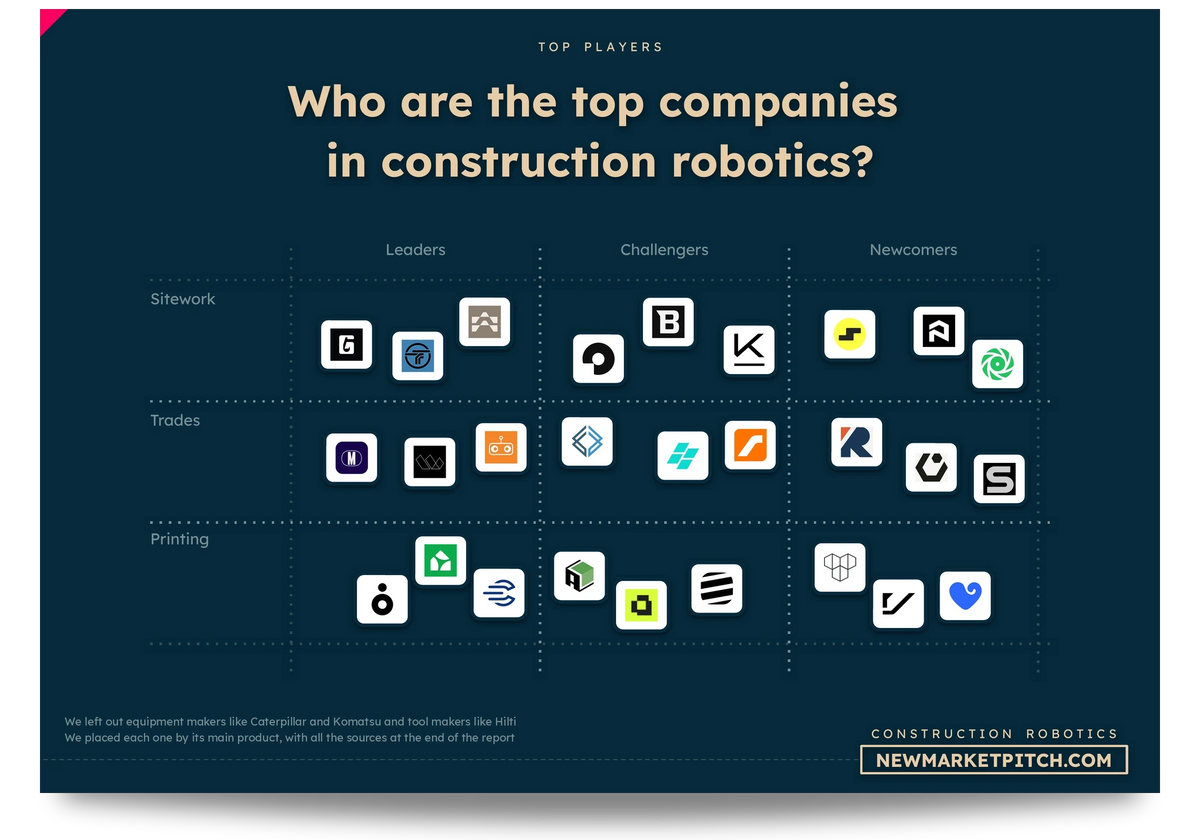
In our report covering the construction robotics market, we turn what is vague and complex into simple, useful visuals. Market maps like this one show you at a glance where every startup stands.
Which construction robot startups are actually working on real sites?
Dusty Robotics, Advanced Construction Robotics and Monumental are currently among the strongest construction robot startups with proven work on active jobsites. Civ Robotics, Built Robotics, Rugged Robotics, Canvas and Okibo are also serious contenders, although their robots do very different jobs and their commercial track records vary considerably.
Dusty Robotics prints building layouts directly onto construction floors. Advanced Construction Robotics uses robots to tie and place reinforcing steel on bridges. Monumental operates fleets of autonomous bricklaying robots. Built Robotics automates solar-foundation installation, while Canvas and Okibo handle parts of drywall finishing.
The distinction matters because some machines have already worked across hundreds of construction projects, while others have completed only a handful of buildings. A robot printing coordinates can also be deployed much more frequently than one physically constructing walls.
We therefore count real-site work when a robot performs useful work on an actual construction project, rather than in a laboratory or demonstration facility. We give particular weight to named contractor deployments, repeated customer use, completed work and measured productivity.
By those measures, Dusty leads in commercial layout, Advanced Construction Robotics has some of the strongest evidence for physical construction automation, and Monumental is emerging as a leader in robotic masonry. No single company dominates every category.
Are construction companies finally using robots at scale?
Construction companies are adopting jobsite robots much faster now, although a large share of that growth still comes from trials rather than everyday use.
BuiltWorlds' 2026 Annual Equipment & Robotics Benchmarking Report found that 79% of surveyed general and specialty contractors had used jobsite robotics to some degree, compared with 29% in its 2025 survey. That's a 50-percentage-point increase in one year, although differences in the survey samples may affect the comparison.
The share of respondents reporting robotics pilots or trials also climbed from 12% to 32%. More contractors are giving robots a chance, but the figures don't establish that most construction companies have made robots part of their normal operations.
Accuracy is also proving more attractive than simple labor replacement. The BuiltWorlds findings identified improved precision as a leading motivation, cited by 75% of surveyed contractors, ahead of reduced manual effort at 63% and improved safety at 56%.
That helps explain why Dusty Robotics, Civ Robotics and Rugged Robotics are getting traction. Their systems help contractors mark complicated sites more accurately, reduce mistakes and avoid spending hours transferring digital plans into physical measurements.
Construction robotics is now a serious purchasing category for major contractors. Whether that translates into large, permanently operating robot fleets across the industry remains a much tougher question.

Our research about construction robots gets updated several times a month, so you always get the latest view of where things stand.
Is Dusty Robotics the most successful construction robot startup?
Dusty Robotics has one of the strongest commercial track records in construction robotics, particularly for automated layout in commercial buildings, healthcare facilities and data centers.
Its FieldPrinter takes information from digital construction models and prints the locations of walls, equipment and building systems directly onto floors. Contractors can then install those elements without repeatedly measuring and marking positions by hand.
Dusty reports that its robots have worked on hundreds of North American construction projects. Its customer references include Mortenson, JE Dunn, Alston Construction and other major builders, giving it considerably more evidence of repeated jobsite use than most young robotics companies.
On a $1 billion Mortenson data-center development covering 700,000 square feet, Dusty's technology coordinated layout information across five trades. The economic opportunity here goes beyond making surveying faster: when several trades work from the same precise layout, contractors can reduce conflicts between systems before installation.
A June 2026 case study published by the Association for Advancing Automation provides a more concrete productivity comparison. Alston Construction reported completing automated layout 12 times faster per person-hour, printing 15% more information and spending only one-third of the usual time on site.
Dusty's broader customer references also include a reported 3,000 hours of layout labor saved on one project and six weeks saved on another. These are customer-specific results rather than independently measured averages, but they show that the company is solving problems beyond one carefully selected demonstration.
For commercial building layout, Dusty currently has a particularly convincing combination of customers, deployment breadth and measurable results. Its main limitation is that it automates positioning and coordination rather than physically installing building components.
If you want more recent data on this point, please see our latest construction robotics market report.
Can Advanced Construction Robotics really replace manual construction work?
Advanced Construction Robotics has already demonstrated that robots can perform large volumes of physically demanding bridge-construction work, with several projects showing substantial labor and schedule savings.
Its TyBOT automatically identifies and ties intersections in reinforcing-steel grids. IronBOT handles the placement of reinforcing bars, allowing contractors to automate successive stages of the reinforcement process.
On the I-30 Crossing project in Little Rock, Arkansas, Advanced Construction Robotics reported 669,142 automated ties between September 2023 and April 2024. Across 553 active production hours, the company reported an active tying rate of 1,275 ties per hour. The project involved the Kiewit-Massman joint venture and rebar contractor D.T. Read Steel.
Another project, the Koppel Bridge in Pennsylvania, reported 34% fewer customer crew-hours and a 32% reduction in work duration compared with its conventional-work budget. The project recorded 111,645 automated ties across 99 active production hours.
The Port St. Lucie bridge project in Florida provides another useful comparison. A five-person crew using TyBOT and IronBOT completed reinforcement work in seven shifts against a 14-shift conventional budget. IronBOT placed 130,952 pounds of reinforcing steel, representing approximately 90% of the reported horizontal-rebar scope.
These projects fit into a broader deployment history. Advanced Construction Robotics has published field results from bridges in Arkansas, Florida, West Virginia, Pennsylvania and North Carolina. On the Oakvale Bridge in West Virginia, for example, the company reported 53% fewer customer crew-hours.
We're seeing repeated automation of the same physical trade under different site conditions, with productivity measured in actual ties, labor hours and completed shifts. That makes Advanced Construction Robotics one of the most convincing contenders for leadership in heavy construction robotics.

In our market report about construction robots, we look at what the winners do differently, so you can learn from the best instead of guessing.
Is Monumental already building houses with autonomous robots?
Monumental's bricklaying robots have already worked on more than 100 homes, making the Amsterdam startup one of the strongest contenders in autonomous building construction.
Founded in 2021, Monumental reports more than 40 delivered projects, over 20 customers and a fleet exceeding 100 robots. Its work includes residential walls, a school, a community center, a hotel and canal infrastructure.
The company uses coordinated fleets of compact robots to transport materials, apply mortar and lay bricks. Rather than selling machines to builders, Monumental operates as a masonry subcontractor and sells completed construction work.
That approach is helping Monumental expand beyond pilot projects. In July 2026, the company announced a $32 million Series B led by Khosla Ventures, bringing its total funding above $60 million. Its stated plan was to expand its European fleet and begin entering the United States.
The operating figures are more interesting than the financing. With at least 100 robots across more than 40 delivered projects, Monumental has built a substantial fleet relative to most early construction robotics companies. Its published figures also cover more than one building type, which reduces the likelihood that the technology works only under narrowly controlled conditions.
There is one important limitation: the company has built walls for more than 100 homes, rather than constructing 100 complete houses autonomously. Foundations, roofs, utilities and the remaining construction trades still depend on other workers.
Monumental nevertheless has a stronger commercial record than most autonomous bricklaying ventures. Its next test will be whether it can maintain reliable production and attractive costs as the fleet expands into new countries.
If you want more recent data on this point, please see our latest construction robotics market report.
Has Built Robotics proved autonomous heavy equipment works?
Built Robotics has proved that autonomous heavy construction equipment can operate repeatedly on real infrastructure projects, and its move into solar-foundation installation gives it a particularly practical market.
Built originally developed autonomous systems for earthmoving and trenching. It later concentrated on utility-scale solar construction, where thousands of nearly identical foundation piles must be installed across large sites.
Its RPD 35 automates surveying, pile distribution, pile driving and production-data collection. The machine can carry up to 224 piles, while the accompanying RPS 25 helps stabilize them during installation.
Built reports more than 50,000 hours of operation, over 40 completed projects and 5 GW of infrastructure capacity associated with its work. These company-wide figures include its earlier generations of construction automation, so they should not all be attributed to the current piling equipment.
The company's expansion has also become more specialized. Its published development timeline moved from trenching in 2020 to automated pile driving in 2023, followed by a pile-kitting robot concept in 2026.
Utility-scale solar construction offers repetitive tasks, large working areas and high equipment utilization, which are unusually favorable conditions for autonomous machinery.
Built's approach is less adaptable to small building projects, where space is constrained and tasks change frequently. On solar farms, however, highly repetitive foundation work gives autonomous equipment a real chance to outperform conventional processes.
Among startups building large autonomous construction machines, Built remains one of the strongest names.

In our document detailing everything you need to know about construction robotics, you will always find fresh funding data, taken straight from our own verified funding database.
Can Civ Robotics and Rugged Robotics catch Dusty Robotics?
Civ Robotics and Rugged Robotics are credible competitors to Dusty Robotics, with Civ especially strong in outdoor infrastructure layout and Rugged gaining traction in complex commercial buildings.
Civ Robotics reports more than 10 million marked coordinates across renewable-energy and construction projects, with work associated with approximately 20 GW of solar and renewable-energy capacity across five continents.
Its CivDot robots mark the positions of piles and other infrastructure features. According to Civ's published specifications, a conventional surveying crew typically marks around 200–450 points per day, while one CivDot operator can mark 1,000–5,000, depending on spacing and required accuracy.
Those figures suggest a potential improvement ranging from several times to more than ten times conventional daily output under favorable conditions. Actual productivity depends heavily on the project.
Rugged Robotics focuses more on indoor commercial construction. On a Hensel Phelps hyperscale data center exceeding 250,000 square feet, Rugged reported more than 750 hours of layout work saved and framing installation accelerated by over 15%.
Its Suffolk Construction case study at the Mesquite Government Center reported a 60% reduction in layout time and 75% less rework. Another Rugged project with Brogoitti Construction reduced a planned eight-week layout and installation schedule to under two weeks.
More recently, Rugged has also documented a repeatable layout program spanning more than 20 active warehouses. That is particularly useful evidence because it shows the same robotic service being deployed across a network of operational facilities rather than at one isolated jobsite.
Dusty still has a stronger publicly documented claim to broad commercial-building adoption. Civ, meanwhile, has substantial evidence from outdoor projects, and Rugged is building an increasingly convincing record in commercial and industrial facilities.
| Company | Main job | Reported field evidence | Best market |
|---|---|---|---|
| Dusty Robotics | Indoor floor printing | Hundreds of projects | Commercial buildings |
| Civ Robotics | Outdoor survey marking | 10M+ coordinates | Solar and infrastructure |
| Rugged Robotics | Automated indoor layout | Major contractor projects and 20+ warehouses | Data centers and industrial facilities |
| Advanced Construction Robotics | Rebar tying and placement | Multiple bridge projects | Bridges |
| Built Robotics | Autonomous piling | 40+ historical projects | Solar foundations |
| Monumental | Robotic bricklaying | 40+ projects | Residential and commercial masonry |
| Canvas | Robotic drywall finishing | Named building projects | Interior construction |
| Okibo | Robotic sanding and finishing | Contractor deployments | Drywall and surface finishing |
If you want more recent data on this point, please see our latest construction robotics market report.
Are Canvas and Okibo actually using robots to finish buildings?
Canvas and Okibo have both put drywall-finishing robots to work on real construction sites, although neither has publicly demonstrated the same breadth of deployments as the leading layout robotics companies.
Canvas develops robots that automate drywall-finishing tasks, including the application and sanding of finishing materials. Its documented work includes San Francisco International Airport's Harvey Milk Terminal 1 and the UCSF Wayne and Gladys Valley Center for Vision.
Okibo has concentrated on autonomous surface-finishing robots capable of handling sanding, painting and plastering activities.
One of Okibo's stronger field references comes from its work with Performance Contracting at a King of Prussia project in Pennsylvania. In July 2025, the company reported surface-sanding production more than 300% higher than conventional methods, with certain activities achieving up to fivefold productivity.
The relationship subsequently developed beyond that individual project. In March 2026, Okibo announced an initial four-robot deployment through a southern U.S. partner, alongside an agreement outlining potential expansion to ten robots. In April, the company announced a broader national partnership with Performance Contracting.
Contractor interest is starting to become repeat business. Still, announced equipment commitments need to be distinguished from verified completed operating hours.
Canvas has recognizable completed project references, while Okibo has recently provided more detail about fleet expansion and contractor relationships. The available information isn't yet strong enough to establish which company has the larger continuously operating commercial fleet.

Learning from others' mistakes is the cheapest lesson there is. In our report covering the construction robotics market, we look at what broke startups before you, so you don't repeat it.
Why haven't bricklaying robots become as common as layout robots?
Bricklaying robots are much harder to deploy repeatedly than layout robots because they must physically construct a wall while dealing with material handling, mortar application, alignment and constantly changing site conditions.
Dusty and Rugged largely need to navigate floors and print accurate instructions. Monumental must coordinate brick movement, positioning and installation, while larger systems such as FBR's Hadrian X must manipulate heavy masonry blocks with considerable precision.
FBR's American demonstration program shows how far that technology has progressed. In December 2024, the Australian company announced that Hadrian X had completed the external walls of nine code-compliant homes in Florida through a program with CRH Ventures.
One home's walls were completed in a single day with three people on site. FBR reported that all nine structures had been independently verified against the relevant building standards.
That's an impressive engineering result. But Monumental's record of more than 40 projects with paying customers provides stronger evidence of repeat commercial delivery.
The comparison also needs a corporate distinction: FBR is publicly listed, whereas Monumental is a private startup. FBR belongs in the competitive discussion but should not be placed in a private-startup ranking without explanation.
The gap between these two masonry approaches captures the wider problem facing construction robotics. Completing a complicated task once is achievable; performing it economically across many unrelated buildings is considerably harder.
How much time are construction robots actually saving?
Construction robots are already saving substantial labor hours on selected tasks, with some real projects reporting productivity gains of several hundred percent. The gains are most convincing when measured against a specific construction activity rather than the overall building schedule.
We compared reported project outcomes across bridge reinforcement, automated layout and drywall finishing. Advanced Construction Robotics recorded a 50% reduction in shifts at Port St. Lucie, while its Koppel Bridge project reported 34% fewer customer crew-hours.
Dusty's Alston Construction case study measured 12 times the layout output per person-hour. Rugged's data-center work saved more than 750 hours, and Okibo's drywall-finishing work with Performance Contracting delivered severalfold increases in selected sanding activities.
The figures measure different things. A 50% reduction in rebar-installation shifts doesn't mean the entire bridge was built twice as fast. Likewise, increasing sanding productivity fivefold doesn't cut a building's total construction schedule by 80%.
We also need to account for setup, robot supervision, maintenance and material preparation. Most published case studies don't provide enough financial information to calculate the full cost savings independently.
The clearest finding is that robots can sharply improve productivity for repetitive, well-defined construction tasks. The evidence for large reductions in total project costs is much more limited.
| Project | Reported improvement | Measured activity |
|---|---|---|
| ACR: Port St. Lucie | 50% fewer shifts | Bridge reinforcement |
| ACR: Koppel Bridge | 34% fewer crew-hours | Bridge reinforcement |
| ACR: Oakvale Bridge | 53% fewer crew-hours | Bridge reinforcement |
| Dusty: Alston Construction | 12× productivity per person-hour | Building layout |
| Rugged: Hensel Phelps | 750+ hours saved | Data-center layout |
| Rugged: Suffolk | 60% less layout time | Government building |
| Rugged: Brogoitti | 8 weeks reduced to under 2 | Layout and installation |
| Okibo: Performance Contracting | Up to 5× productivity | Selected finishing tasks |

Your time is limited. In our research about construction robots, we put numbers on each part of the market, so you can see where it makes sense to focus.
Are contractors buying construction robots or just renting them for trials?
Construction contractors have begun making longer-term commitments to robotics, but buying machines outright is only one route to commercial adoption.
Advanced Construction Robotics has reported commercially sold TyBOT units operating on bridge projects in South Carolina and Virginia. Customer ownership is an important development because contractors generally need confidence that the equipment can be used across multiple projects.
Other startups are making adoption easier by keeping ownership and operational responsibility themselves.
Rugged Robotics provides a managed layout service that includes equipment, operators and preparation of digital construction information. Its Hensel Phelps case study specifically describes a contractor that wanted automation without assigning its own staff to manage and troubleshoot robots.
Monumental goes further by selling masonry work as a subcontractor. Builders receive finished walls without purchasing or maintaining robotic equipment.
Okibo is building relationships through specialist construction contractors, while Dusty's customer case studies include repeat project use and integration into existing building workflows.
These arrangements make direct robot sales a poor standalone measure of commercial success. A startup can generate repeat revenue with a relatively small fleet, while a company selling many machines may still struggle if customers rarely use them.
For now, the strongest evidence of adoption comes from contractors returning to the same technology on additional projects. That behavior is more convincing than the announcement of another trial.
Can construction robot startups actually make money?
Construction robot startups have demonstrated that contractors will pay for automated construction work, but we still don't have enough reliable financial information to identify which companies are consistently profitable.
Dusty Robotics sells technology that helps contractors complete an existing budgeted task. Rugged Robotics offers layout as a managed service. Monumental sells completed masonry work, while Built Robotics provides automated piling through project-based arrangements.
Advanced Construction Robotics combines equipment sales with robot-assisted construction services.
Each model has different economics. Equipment sales can bring in large upfront payments, but contractors must be willing to own and maintain the machines. A service model lowers the purchasing barrier, although the startup then bears more responsibility for equipment utilization, repairs, mobilization and project execution.
Consider Monumental's fleet of more than 100 robots. The company needs enough masonry projects to keep those machines productive while covering operators, maintenance, transportation and supervision. Having a large fleet is valuable only when enough of that equipment is working and generating revenue.
For Dusty and Rugged, installation accuracy and reduced rework can strengthen the sales argument, but contractor case studies alone don't tell us how much the robotics providers retain after their own operating costs.
None of the leading private companies publicly discloses enough standardized revenue, gross-margin, operating-profit and fleet-utilization information for a dependable profitability ranking.
That remains one of the biggest gaps in construction robotics research. We can identify companies delivering real work and attracting customers; the financial winners are considerably harder to establish.
If you want more recent data on this point, please see our latest construction robotics market report.

In our market report about construction robots, we always try to gather several sources and make estimates that make sense, so you can work with solid numbers.
Will construction robots replace construction workers?
Construction robots are currently replacing specific repetitive activities rather than entire construction crews, and the strongest commercial deployments still depend on people working alongside the machines.
TyBOT automates rebar tying, but workers remain responsible for other reinforcement activities. Dusty's FieldPrinter marks where equipment should be installed, while human teams perform the installation. Canvas and Okibo automate parts of finishing work without taking over the complete interior construction process.
Monumental's autonomous bricklaying system performs a larger share of a physical trade, but its robots still operate within projects requiring human builders for foundations, structural systems, roofing, utilities and other activities.
The near-term change is more likely to be fewer labor hours for certain tasks, safer working conditions and greater output from existing crews.
That also helps explain why specialized robots are making progress before general-purpose humanoid construction robots. A machine dedicated to marking floors or tying steel has a narrow job, clear performance requirements and an established place in the project schedule.
A general-purpose robot would need to move between trades, handle different materials and adapt to frequent changes in the site.
Construction workers are likely to work with more robots over the next several years, especially on large commercial and infrastructure projects. The evidence for robots replacing whole construction crews remains weak.
Which construction robot startups have the most convincing deployment records?
Dusty Robotics, Advanced Construction Robotics and Monumental have the most convincing overall combination of field deployments, customer evidence and useful construction output, although each leads a different type of work.
Dusty's strength comes from its broad commercial-building customer base. Advanced Construction Robotics has particularly detailed production records showing how many reinforcing-steel ties its machines completed and how many labor hours contractors saved.
Monumental stands out for its fleet size and growing number of completed masonry projects. Its expansion toward the United States gives it considerable potential, provided the company can reproduce its European delivery performance.
Civ Robotics deserves special recognition for the sheer volume of field positions it has marked. Built Robotics has accumulated extensive operating hours, while Rugged Robotics now offers several strong project comparisons and evidence of repeat industrial deployment.
Canvas and Okibo remain important companies to watch, although their publicly available deployment totals are less complete.
| Startup | Strongest evidence | Current judgment |
|---|---|---|
| Dusty Robotics | Hundreds of projects; major construction customers | Strongest commercial layout record |
| Advanced Construction Robotics | Repeated bridge work; measured physical output | Strongest rebar automation evidence |
| Monumental | 40+ projects; 100+ robots | Leading private bricklaying contender |
| Civ Robotics | 10M+ marked coordinates | Major outdoor-layout specialist |
| Built Robotics | 50,000+ operating hours across its history | Established autonomous heavy-equipment contender |
| Rugged Robotics | Named projects and repeat multi-site work | Strong commercial-layout challenger |
| Canvas | Recognizable airport and healthcare projects | Established drywall-finishing specialist |
| Okibo | Contractor deployments and fleet commitments | Growing finishing robotics contender |
| FBR | Nine code-compliant demonstration homes | Strong technical proof; publicly listed competitor |

If you build or invest in the construction robotics market, you need to know which business models pay off now and which ones are fading. That's why our report covering it has a whole section on it.
Who are the top construction robot startups on real sites?
Dusty Robotics, Advanced Construction Robotics and Monumental are our top three construction robot startups based on publicly documented real-site work, followed by Civ Robotics, Built Robotics, Rugged Robotics, Canvas and Okibo.
Dusty has the strongest case in automated building layout, where it has worked with major contractors across hundreds of projects. Advanced Construction Robotics stands out for physically demanding construction work, with extensive production records from real bridge sites. Monumental looks particularly promising in masonry, having built walls for more than 100 homes and expanded its fleet beyond 100 robots.
Civ Robotics has achieved substantial outdoor deployment volume, and Built Robotics has years of autonomous heavy-equipment experience. Rugged Robotics is becoming an important competitor in commercial layout, while Canvas and Okibo are proving that robots can take over parts of drywall finishing.
The most striking finding from comparing these companies is how much real construction activity is already being automated by highly specialized machines. Yet there is still no convincing overall winner across all construction trades, and publicly available profitability figures remain too limited to establish which startup has the strongest business economics.
For now, Dusty looks like the most commercially established layout specialist, Advanced Construction Robotics has some of the best evidence for automating demanding physical work, and Monumental offers one of the strongest growth stories in actual building construction.
The next major milestone will be sustained commercial use across hundreds of sites, with enough operating and financial evidence to show that robotic construction works economically without relying on carefully selected projects. The leading startups have already proved that their machines can do useful work. The race now is to make that work repeatable at much larger scale.
If you want more recent data on this point, please see our latest construction robotics market report.
Our methodology
This analysis identifies the leading private construction robotics startups through documented work on actual construction sites. We assessed five dimensions: real-world deployment, measurable construction productivity, repeatability across projects, contractor adoption and commercial maturity. For each dimension, we gathered recent project records, contractor case studies, company operating disclosures and industry research, then combined the findings to assess which companies have established the strongest field presence.
We counted real-site deployment when robots performed useful work on an identifiable construction project. We gave greater weight to completed assignments, named contractor relationships, repeat deployments and measurable production than to laboratory demonstrations, announced partnerships or planned fleet expansions. Historical operating records were retained where they established a meaningful deployment history, while more recent evidence helped assess whether commercial activity was continuing.
We evaluated productivity within each construction trade before comparing companies. Automated rebar ties, survey coordinates, operating hours, completed masonry projects and drywall-finishing output measure different forms of activity and cannot be combined into one production ranking. We therefore examined each metric's underlying task, measurement period and comparison baseline, distinguishing reported improvements in specific activities from gains in overall project schedules or costs.
Commercial adoption was assessed across equipment sales, managed robotic services and subcontracted construction work. We considered repeat customer relationships, identifiable project delivery, deployed fleets and operating history rather than treating machine sales as the only indicator of success. We assessed profitability separately because field deployment and productivity results do not establish revenue quality, gross margins or operating profitability. The ranking focuses on private startups, with publicly listed FBR included as a technical comparison.
For industry adoption, we used BuiltWorlds' 2026 contractor benchmarking findings. For automated layout, key sources included Dusty Robotics' Mortenson project, the Association for Advancing Automation's Alston Construction study, Dusty's contractor case studies, Civ Robotics' deployment records and Rugged Robotics' Hensel Phelps data-center case study and commercial project records.
For physical construction automation, we examined Advanced Construction Robotics' project-level records from I-30 Crossing, Port St. Lucie, Oakvale Bridge and other bridge case studies, including Koppel Bridge, alongside its commercial equipment deployment records. We also used Monumental's operating and project disclosures, its July 2026 financing and expansion announcement, and Built Robotics' historical operating milestones.
For finishing robotics, we examined Canvas' documented technology and project references, Okibo's Performance Contracting field results and its contractor partnership updates. For robotic masonry benchmarks, we used FBR's nine-home Florida demonstration results and its single-shift wall construction record. Together, these sources support an assessment built from current field evidence, project-level results and repeated commercial execution rather than robot demonstrations or funding totals alone.

In our report covering the construction robotics market, we don't want to repeat what boring consulting reports say. Instead, we show you the real and latest market signals that matter.
Written by the New Market Pitch teamWe track new markets so founders and investors can move faster. About us