Is the construction robotics market big or still pilots?
Whether you're building or investing in the construction robotics market, our report covers everything you need to know: the players, the money, and what's coming next.
Summary
The construction robotics market is already worth approximately $1.8 billion annually, but most autonomous robots designed to transform building sites are still in early commercial deployment. The industry has moved beyond pilots in several specialized applications, while widespread adoption remains years away.
The headline market size is somewhat misleading. It includes established products such as remotely operated demolition robots, alongside newer autonomous excavation, bricklaying and drywall-finishing technologies. Revenue from the older equipment categories makes the emerging autonomous market appear more mature than it really is.
Bridge reinforcement offers unusually strong evidence of commercial adoption. Advanced Construction Robotics' TyBOT completed 669,142 rebar ties on a single Arkansas infrastructure project, and experienced contractors have progressed from using the machines to purchasing them outright.
The productivity gains can be substantial without translating into equally large cost savings. TyBOT case studies reported labor-hour reductions of 34% to 37%, while an HP SitePrint project reduced layout time from 136 hours to 35 but delivered approximately 15% total cost savings once equipment expenses were included.
Building layout may be one of the most scalable early applications. Valley Interior Systems used HP SitePrint across 18 projects covering approximately 2 million square feet, demonstrating that a relatively portable robot can find repeat work across different construction sites.
Equipment ownership provides a stronger indication of commercial confidence than a successful demonstration. Contractors purchasing TyBOT machines are accepting the financial risk of keeping them productive, while newer suppliers such as Built Robotics use per-task pricing to reduce customers' upfront commitments.
Autonomous excavation is entering a more demanding commercial phase. Bedrock Robotics announced deployments with three contractors in August 2026, but disclosed fleet sizes, recurring revenue and annual utilization remain too limited to establish how large that business has become.
Solar construction offers a particularly favorable operating environment. Built Robotics' autonomous pile-driving system targets large solar farms, where thousands of similar installation tasks create longer working runs than most bespoke building projects. The missing evidence is annual commercial volume rather than technical capability.
Robotic bricklaying remains earlier in commercialization. FBR's Hadrian X has demonstrated hundreds of blocks laid at high speed, but successful test structures and milestone payments do not yet establish repeatable profitability across ordinary construction projects.
The biggest commercial constraint is often utilization rather than robot speed. A machine can complete work quickly and still spend considerable time being transported, prepared, repositioned or waiting for other trades. Without annual operating data, spectacular project-level productivity claims reveal relatively little about equipment returns.
Grand View Research forecasts a $6.1 billion construction robotics market by 2033, around 3.4 times its 2026 estimate. That is plausible for the broad equipment category, particularly as JLG, ABB and established construction machinery suppliers expand their involvement. The real test is whether autonomous robots become equipment contractors use continuously across projects, rather than specialist machines brought in for occasional jobs.

Written by the New Market Pitch teamWe track new markets so founders and investors can move faster. About us

Your time is limited. In our report covering the construction robotics market, we put numbers on each part of the market, so you can see where it makes sense to focus.
Is construction robotics finally becoming a real market?
Construction robotics is already doing paid work on real building sites, but most contractors still use robots for a handful of specialized jobs rather than everyday construction.
The commercial progress has become harder to dismiss. In January 2026, JLG, part of Oshkosh Corporation, acquired Canvas's drywall-finishing robotics technology. In August, Bedrock Robotics announced autonomous excavation operations with Sundt Construction, Champion Site Prep and Zachry Construction. Advanced Construction Robotics also reported contractor-owned TyBOT machines operating on bridge projects.
These developments mark different stages of adoption. JLG is bringing robotic technology into an established equipment business. Bedrock is moving autonomous excavators onto active construction sites. TyBOT has reached the point where contractors with experience using the machines are buying them outright.
The pressure to automate is substantial. Associated Builders and Contractors estimated that the US construction industry needed 349,000 additional workers in 2026 to meet expected demand.
Yet robots remain unusual on ordinary building sites. Contractors are finding specific jobs worth automating, particularly those involving thousands of repeated movements, while most construction work still relies on conventional machinery and human crews.
How big is the construction robotics market today?
The global construction robotics market is worth roughly $1.8 billion a year under a broad industry definition, although autonomous robots working directly on construction sites account for a much smaller, undisclosed portion.
Grand View Research estimated the market at $1.6 billion in 2025 and $1.8 billion in 2026, with a forecast of $6.1 billion by 2033. Its definition covers demolition equipment, robotic arms, material-handling systems, exoskeletons and newer autonomous construction machines.
That broad definition explains why the market is already substantial. Companies such as Brokk and Husqvarna have sold remotely operated demolition equipment for years. Those sales belong in construction robotics even when the machines are controlled by humans rather than operating autonomously.
Grand View Research estimates that material handling represented 33.2% of construction robotics revenue in 2025, equivalent to approximately $531 million. Robotic arms represented 69.3% by equipment type, or roughly $1.11 billion. The two figures describe different ways of dividing the same market and overlap.
For comparison, Grand View Research places the industrial robotics market at $41.9 billion in 2026. Construction robotics would therefore represent about 4.3% of its size, subject to differences between the market definitions.
We can put a number on the broad equipment industry. The same cannot yet be done convincingly for autonomous excavation, robotic bricklaying, automated drywall finishing and other newer jobsite technologies because suppliers rarely publish their revenue.
| Market measurement | Latest estimate | What it measures |
|---|---|---|
| Construction robotics, 2025 | $1.6B | Broad global revenue |
| Construction robotics, 2026 | $1.8B | Broad global revenue |
| Construction robotics, 2033 | $6.1B | Forecast revenue |
| Material-handling share, 2025 | 33.2% | Construction robot functions |
| Material-handling revenue, 2025 | ~$531M | Derived market revenue |
| Robotic-arm share, 2025 | 69.3% | Equipment category |
| North American share, 2025 | 31.6% | Regional revenue |
| Industrial robotics, 2026 | $41.9B | Comparison market |
| Construction/industrial ratio | ~4.3% | Broad revenue comparison |

In our research about construction robots, we always try to gather several sources and make estimates that make sense, so you can work with solid numbers.
Why do construction robotics market estimates seem so high when there are so few robots on building sites?
Construction robotics estimates include established machines that have been sold for years, which makes the market look considerably larger than the emerging autonomous jobsite business.
Brokk and Husqvarna supply remotely operated demolition robots for work involving concrete removal, industrial demolition and hazardous environments. These machines already have commercial customers and established equipment-replacement needs.
Newer products are at very different stages. FBR's Hadrian X has demonstrated automated masonry. Bedrock is introducing autonomous excavation on customer projects. Canvas developed a robot for selected drywall-finishing tasks before its technology was acquired by JLG.
There is also factory-based construction automation. Industrial robots can assemble timber components or prefabricated building elements inside controlled production facilities, where operating conditions are closer to manufacturing than to a changing construction site.
These machines all contribute to the construction automation industry, but they tell us very different things about how much autonomy contractors are actually using.
For the emerging market, paid deployments, repeat customers, equipment purchases and machine utilization deserve at least as much attention as reported revenue. Otherwise, established demolition-equipment sales can make experimental construction technologies appear more commercially mature than they are.
If you want more recent data on this point, please see our latest construction robotics market report.
Are construction robots really being used on commercial projects?
Construction robots are already completing measurable work for contractors, particularly in bridge reinforcement, building layout and specialized earthworks.
One of the clearest examples comes from Advanced Construction Robotics. On the I-30 Crossing project in Little Rock, Arkansas, TyBOT completed 669,142 rebar ties between September 2023 and April 2024. According to the company's case study, the machine recorded 553 active production hours while working with Kiewit-Massman and D.T. Read Steel.
On a bridge project in Port St. Lucie, Florida, TyBOT and IronBOT worked with Shelby Erectors. The published comparison showed 349 customer crew-hours using automation versus 554 budgeted hours without it. The installation also took seven shifts instead of the 14 originally budgeted.
Construction layout provides another example. HP's SitePrint has been used on hospitals, data centers, industrial facilities and commercial buildings. Valley Interior Systems reported deploying it across 18 projects covering approximately 2 million square feet.
These are completed construction tasks with measured output. The remaining question is how widely this activity is spreading beyond the contractors and applications already comfortable with the technology.

In our market report about construction robots, we don't want to repeat what boring consulting reports say. Instead, we show you the real and latest market signals that matter.
Which construction robots are actually selling beyond the pilot stage?
Demolition, building layout and bridge-deck reinforcement have the strongest evidence of repeated commercial use, while robotic masonry and autonomous excavation have fewer publicly verified deployments.
Demolition robots already operate within an established equipment market. Layout robots can be moved between projects and work from digital building plans. Rebar-tying machines are particularly useful on bridge decks, where hundreds of thousands of nearly identical connections must be completed.
The deployment figures show how uneven the industry remains. A public specialist deployment database recorded 58 TyBOT project deployments involving 25 organizations through September 2026. HP has documented repeat SitePrint usage by independent construction customers. Bedrock's August 2026 autonomous excavation announcement identified three contractor partners.
These figures measure different things, and public databases cannot capture every deployment. Still, there is a clear gap between applications with years of customer use and those just beginning to operate commercially.
| Application | Representative companies | Commercial position |
|---|---|---|
| Robotic demolition | Brokk, Husqvarna | Established equipment sales |
| Interior layout | HP SitePrint, Dusty Robotics | Repeat commercial use |
| Bridge rebar tying | Advanced Construction Robotics | Repeat use and equipment sales |
| Drywall finishing | Canvas / JLG | Commercial, limited scale |
| Solar pile driving | Built Robotics | Commercial service offering |
| Autonomous excavation | Bedrock Robotics | Early production deployments |
| Robotic masonry | FBR Hadrian X | Demonstration and early sales development |
| Automated rebar placement | IronBOT | Limited commercial use |
| Robotic prefabrication | ABB, AUAR | Specialized early production |
Are contractors actually buying construction robots or just renting them?
Some contractors now buy construction robots outright, especially for repetitive work they expect to perform on many projects. Renting and pay-per-task services remain common for newer systems.
Advanced Construction Robotics initially focused on deploying TyBOT through service arrangements. It later introduced direct equipment sales, and its 2026 updates describe contractor-owned machines working on bridge projects in South Carolina and Virginia.
D.T. Read Steel committed to purchasing two TyBOT machines for delivery during 2025 after gaining experience with the equipment on major infrastructure projects. That's a useful indicator of customer confidence because the contractor took on ownership and utilization risk.
Other suppliers have chosen to keep the machines under their own commercial control. Built Robotics offers its RPD 35 autonomous solar pile-driving technology through project-specific per-pile pricing. HP SitePrint uses a pay-as-you-go model covering maintenance, software, consumables and support.
The difference comes down largely to how often a contractor can use the machine. Buying becomes attractive when a company expects a steady pipeline of suitable work. Usage-based services make more sense when robots are expensive, projects are irregular or contractors want to test the economics without committing capital.
If you want more recent data on this point, please see our latest construction robotics market report.

In our document detailing everything you need to know about construction robotics, we like to show you the big picture. We know your time is precious, so we make every page quick to read and packed with as much learning as possible per minute.
Do construction robots save enough money to be worth it?
Construction robots can cut labor time by more than 30% on suitable tasks, but the savings on the overall job can be much smaller once equipment costs are included.
On the I-30 Crossing project, Advanced Construction Robotics reported that TyBOT reduced customer crew-hours from 1,528 to 1,013, a 34% reduction compared with the nonrobotic budget. The reinforcement work took 13 shifts rather than 19.
At Port St. Lucie, customer crew-hours fell 37%, while the installation schedule was reduced by half. Both figures come from supplier case studies, so they are useful operational evidence rather than independent industry benchmarks.
HP's SitePrint offers a revealing comparison. On a Norwegian school project, the company reported a reduction in layout time from 136 hours to 35. That is nearly four times faster. Yet total reported cost savings were approximately 15% after allowing for equipment and usage costs.
A task becoming dramatically faster doesn't necessarily make the whole construction project dramatically cheaper. Robot rental, setup, supervision and supporting work absorb some of the productivity gain.
The best economics appear where a robot can repeat the same task for long periods with little interruption.
Is autonomous excavation ready for real construction sites?
Autonomous excavation is now working on active US construction projects, although Bedrock Robotics has only recently reached this stage of commercial deployment.
In August 2026, Bedrock announced that excavators equipped with its autonomous technology were performing work without operators inside the machines. The company named Sundt Construction, Champion Site Prep and Zachry Construction as partners.
The projects included a Nevada water-treatment facility, large earthmoving operations in Texas and a civil sitework project involving approximately 1.2 million cubic yards of earthmoving.
These jobs expose autonomous equipment to actual construction schedules, ground conditions and contractor requirements. That's a much tougher test than running a machine around a controlled demonstration site.
Still, Bedrock has not disclosed enough comparable data on fleet size, recurring revenue or long-term utilization to demonstrate a large established business.
The contrast with specialized automation is useful. Built Robotics concentrates on repetitive solar pile driving, whereas Bedrock is taking on more varied excavation tasks. Bedrock's addressable opportunity could eventually be broader, but the commercial evidence is currently earlier.

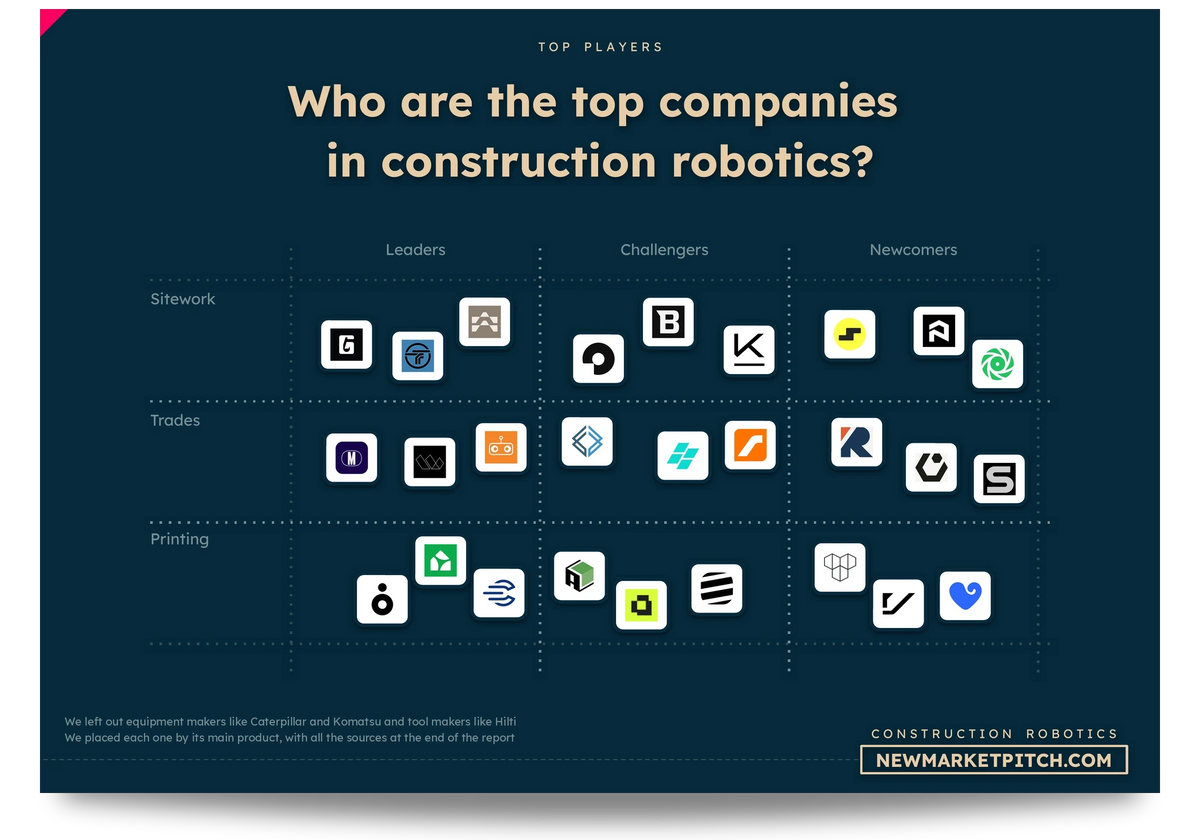
In our report covering the construction robotics market, we turn what is vague and complex into simple, useful visuals. Market maps like this one show you at a glance where every startup stands.
Why could solar farms become one of the biggest markets for construction robots?
Solar farms are particularly attractive for construction robots because they require thousands of similar installation tasks across large sites.
Built Robotics developed its RPD 35 for utility-scale solar farms of 100 MW or more. The system can carry up to 224 piles and combines surveying, pile distribution, pile driving and installation documentation.
Built advertises productivity of up to five times conventional pile-driving methods. That's a maximum supplier claim rather than a verified industry average, but the advantage is easy to understand: the robot can repeat a standardized installation process across a large project.
The commercial model also fits the work. Built prices the service by installed pile, giving contractors a direct comparison with the cost of conventional pile-driving crews and machinery.
Large solar installations provide longer uninterrupted runs than many bespoke building sites, potentially allowing better use of expensive automated equipment.
The remaining uncertainty is commercial volume. Built has not published a standardized annual figure for installed piles or product revenue that would let us independently calculate the scale of its solar construction robotics business.
If you want more recent data on this point, please see our latest construction robotics market report.
Are construction layout robots already a successful business?
Robotic construction layout is one of the more commercially convincing applications because contractors can use the same equipment repeatedly across different building projects.
HP SitePrint reads digital plans and prints markings directly onto floors. Contractors use it for walls, mechanical and electrical systems, structural components and equipment placement.
Valley Interior Systems reported increasing wall-layout productivity from roughly 25–35 linear feet per hour to approximately 300 feet per hour. The contractor also documented SitePrint usage across 18 projects covering around 2 million square feet.
HP's examples extend to larger and more specialized facilities. Its case studies include an approximately 800,000-square-foot hyperscale data-center project and a separate 120,000-square-foot data hall with around 4,500 anchor locations.
These projects help explain why robotic layout has found customers sooner than more complicated construction tasks. A relatively compact machine can move between sites, use existing digital plans and reduce a labor-intensive measurement process.
HP does not disclose standalone SitePrint revenue, so we cannot yet call it a large business by sales. Its published customer activity does, however, show repeat commercial use.

Our research about construction robots gets updated several times a month, so you always get the latest view of where things stand.
Can construction robots cope with messy, unpredictable building sites?
Construction robots still struggle with the full complexity of building sites, which is why most commercially useful machines concentrate on clearly defined tasks.
TyBOT works on prepared reinforcement areas. SitePrint follows digital floor plans. Built's pile-driving system operates within organized solar construction zones. Each machine has a specific job and operating environment.
A general building site is less predictable. Ground conditions change, materials arrive at different times, workers move between areas, and one trade may have to finish before another can begin.
The operating requirements of commercial robots reflect these constraints. Built requires defined work zones and supporting equipment. IronBOT uses a robot supervisor and still needs manual help with some rebar-handling activities. Canvas automates selected drywall spraying and sanding operations but does not complete every stage of drywall installation.
The companies finding commercial customers have generally reduced the range of tasks their robots must handle. That makes performance easier to measure and equipment reliability easier to manage.
Is robotic bricklaying still mostly demonstrations?
Robotic bricklaying remains much closer to early commercialization than to a mature equipment market, despite major technical progress from FBR's Hadrian X.
In February 2024, FBR reported that Hadrian X built a 54-square-meter test structure in Perth using 751 blocks at an effective rate of 330 blocks per hour.
The company subsequently completed US site acceptance testing in Fort Myers, Florida, with 697 blocks laid in another test structure. That milestone triggered a $600,000 payment from CRH Ventures and enabled the next demonstration stage.
The results demonstrate that automated masonry can achieve substantial physical output. They tell us much less about profitability across repeated commercial building projects.
Bricklaying performance also depends on material delivery, site access, wall geometry, structural requirements and coordination with other trades. Fast block placement alone doesn't settle those costs.
For now, FBR's public milestones provide better evidence of technical progress than of broad commercial adoption. Consistent paid deployments and disclosed revenue would make the investment case much stronger.
If you want more recent data on this point, please see our latest construction robotics market report.

In our market report about construction robots, you will always find fresh funding data, taken straight from our own verified funding database.
Are Caterpillar, JLG and ABB getting serious about construction robotics?
Major industrial manufacturers are already involved in construction robotics, though their strategies range from acquiring technology to supplying machinery and factory automation.
JLG's acquisition of Canvas technology in January 2026 is particularly notable. Canvas developed robotic drywall-finishing systems using mobile platforms and robotic arms, and JLG already has an established construction equipment business and customer network.
Built Robotics takes a different approach. Its RPD 35 uses a Caterpillar 335-based platform, while the associated stabilizer uses a Caterpillar 325-based platform. It builds autonomous construction systems around proven heavy-equipment designs.
ABB has also entered construction automation through its partnership with AUAR, announced in 2024, supporting robotic microfactories that produce timber housing components.
These examples show construction robotics moving into familiar equipment and manufacturing systems. That could make future adoption easier, since contractors already depend on established machinery suppliers for servicing and support.
However, JLG's acquisition price and acquired robotics revenue were not disclosed. The commercial involvement of major manufacturers is clear; its contribution to their overall sales is much harder to measure.
Could construction labor shortages force contractors to adopt robots?
Construction labor shortages give contractors a strong reason to automate repetitive work, but robots currently address only a small part of the industry's workforce needs.
Associated Builders and Contractors estimated that US construction needed 349,000 additional workers in 2026 and would need another 456,000 in 2027 to meet anticipated demand.
These figures reflect the industry's wider recruitment and workforce challenges. The number of workers needed is enormous compared with the publicly documented installed base of autonomous construction robots.
The types of work being automated also differ. TyBOT reduces the labor needed for rebar tying. SitePrint speeds up layout. Canvas mechanizes selected finishing tasks. A contractor still needs crews for the many other activities involved in completing a building.
Indeed, the Port St. Lucie reinforcement case study reported the same crew size with automation but a much shorter project duration.
Robotics can help contractors complete more work with available staff. That's already valuable, especially when specialist labor is difficult to find. Replacing entire construction crews remains far beyond what the current generation of commercial machines can accomplish.

In our document detailing everything you need to know about construction robotics, we look at what the winners do differently, so you can learn from the best instead of guessing.
Why aren't construction robots spreading faster?
Construction robots are spreading slowly because a machine can be highly productive while working and still spend too much of a project waiting, moving or being prepared.
The I-30 Crossing case study reported 553 active production hours for TyBOT against 1,167 total equipment hours. At Port St. Lucie, TyBOT recorded 35 active production hours against 70 total equipment hours.
Those ratios require care. The figures do not necessarily represent avoidable downtime, since construction schedules include preparation, repositioning and coordination with crews. But they show how machine productivity depends on far more than operating speed.
Heavy equipment must be transported between jobs, prepared on site and operated within the sequence of other construction activities. A robot that works quickly for a few days can still struggle to earn enough revenue if the next suitable project is weeks away.
The problem is less severe for compact layout systems that can move between buildings. Large solar installations also offer substantial repeated work in one place.
Annual utilization is therefore one of the most important missing metrics. Without knowing how many hours or completed tasks a robot produces across an entire year, we cannot reliably judge its commercial economics from a successful project demonstration.
Are construction robotics companies getting repeat customers?
Construction robotics companies are beginning to build repeat customer relationships, although public evidence is still concentrated among a relatively small number of contractors.
D.T. Read Steel used TyBOT on major bridge projects before committing to purchase two units for delivery in 2025. The contractor had already gained direct experience with the technology, making the purchase especially relevant.
Shelby Erectors provides another example. Public deployment records identify 15 TyBOT deployments and two IronBOT deployments associated with the company, suggesting use across multiple jobs.
In building layout, Valley Interior Systems reported using HP SitePrint across 18 projects rather than treating it as a single trial.
Contractors seem more willing to use robots when the technology fits a type of work they perform frequently. That creates an opportunity for repeat deployment, whether through direct equipment ownership or a service provider.
We still lack standardized retention figures, annual customer spending and fleet utilization across the industry. The evidence establishes repeat use in selected niches, but isn't sufficient to calculate industry-wide customer loyalty.

If you build or invest in the construction robotics market, you need to know which business models pay off now and which ones are fading. That's why our report covering it has a whole section on it.
Can construction robotics companies make recurring revenue?
Construction robotics companies can generate recurring revenue through equipment services, usage fees and maintenance, although hardware economics still play a major role.
HP SitePrint offers usage-based arrangements that incorporate support, maintenance, software and consumables. Built Robotics charges customers on a project-specific per-pile basis. Advanced Construction Robotics combines machine sales with robot-as-a-service offerings.
These approaches create very different businesses. Equipment sales bring revenue when a machine is delivered. Service providers must keep robots working to earn money over time, while also covering maintenance, transportation, staffing and equipment depreciation.
A broader robotics comparison helps explain the attraction of recurring models. The International Federation of Robotics reported that the global professional service robotics fleet operated under robot-as-a-service models grew 31% in 2024. That growth figure covers multiple sectors and should not be interpreted as a construction-specific rate.
Construction robotics suppliers have clear ways to charge customers repeatedly, but the industry does not disclose enough financial information to estimate the share of revenue coming from services, subscriptions or usage fees.
For now, these businesses should be judged partly like equipment manufacturers and equipment-service companies, with particular attention to machine utilization and operating costs.
Can construction robotics really become a $6 billion market?
Construction robotics could reach $6 billion in annual revenue within the next decade, although doing so would require sustained growth across both established machinery and newer autonomous applications.
Grand View Research forecasts an increase from $1.8 billion in 2026 to $6.1 billion in 2033. That represents about 19% compound annual growth and an expansion of roughly 3.4 times in seven years.
The starting point includes established demolition robots and other specialized machinery. Future growth could also come from wider adoption of layout automation, robotic reinforcement, solar piling, autonomous earthworks and factory-based construction systems.
The forecast has some support from recent commercial developments. JLG has acquired drywall robotics technology, contractors are beginning to purchase TyBOT equipment, and Bedrock has announced autonomous excavators on production sites.
Nevertheless, the public numbers still leave a large gap between demonstrated deployments and the fleet volumes that would support several billion dollars in yearly sales.
We view $6 billion as a plausible broad-market scenario rather than an established trajectory. The key test will be whether companies start disclosing repeat equipment orders, growing deployed fleets and reliable revenue, rather than continuing to rely mainly on project announcements.
If you want more recent data on this point, please see our latest construction robotics market report.

When you build or invest in the construction robotics market, you need clarity, not confusion. In our research about construction robots, we always try to put numbers on and quantify whatever is usually vague and confusing.
Is the construction robotics market big or still mostly pilots?
Construction robotics is already a billion-dollar market, but the autonomous machines expected to transform building sites are mostly in early commercial deployment rather than widespread use.
The broad market is worth approximately $1.8 billion annually, helped by established categories such as robotic demolition. Newer technologies have reached very different stages of maturity.
Building layout and bridge reinforcement have the strongest evidence of repeat commercial use. Contractors are deploying systems across multiple projects and, in some cases, purchasing equipment outright. Solar pile driving is a promising specialized application, while autonomous excavation has begun working on real customer sites. Robotic bricklaying remains much earlier in commercialization.
The industry has made genuine progress beyond demonstration videos. What remains limited is the number of companies reporting large fleets, substantial recurring revenue and sustained utilization across many independent customers.
Our conclusion is that construction robotics already works as a specialized equipment and service market. The much bigger opportunity, making autonomous robots a normal part of construction, has barely begun to scale. The next few years will depend on contractors treating robots as standard machinery they use repeatedly, rather than special technology brought in for selected projects.
Our methodology
This analysis examines whether construction robotics has developed into a substantial commercial market or remains concentrated in pilots and early deployments. We assessed the industry across market size, commercial adoption, contractor purchasing behavior, completed project work, productivity, operating economics, technological maturity and growth potential.
For each dimension, we collected recent evidence from equipment manufacturers, robotics developers, construction contractors, published project case studies, industry associations and market research providers. We aggregated relevant developments across companies and applications, compared their commercial significance, and assessed whether the resulting evidence supported conclusions about repeatable adoption rather than isolated technical achievements.
For market sizing, we used Grand View Research's published construction robotics estimates and examined the scope of the underlying categories. The broad definition includes remotely operated demolition machinery, robotic arms, material-handling equipment, exoskeletons and emerging autonomous systems. We therefore distinguish the reported $1.8 billion market from the narrower autonomous jobsite market, for which comparable standalone revenue disclosures remain limited. The $6.1 billion estimate for 2033 is treated as a forecast rather than an observed commercial outcome.
Commercial maturity was assessed through documented project deployments, repeat customer activity, contractor-owned machines, equipment sales and operating models. We distinguished demonstrations and acceptance tests from customer projects, repeat usage and outright purchases. Advanced Construction Robotics' project records, HP SitePrint customer studies, Bedrock Robotics' deployment announcements, Built Robotics' commercial offering and FBR's Hadrian X milestones provided evidence across these different stages.
We also compared the economics of actual projects where the data permitted it. The I-30 Crossing and Port St. Lucie case studies supplied rebar-tying output, customer crew-hours, installation schedules and machine operating time. HP's SitePrint customer studies provided layout productivity, repeat deployment and cost comparisons. We treated supplier-reported productivity as project-specific evidence and distinguished task-level improvements from total cost savings, especially where equipment fees, preparation, supervision or machine utilization affected the result.
To examine broader adoption drivers, we used Associated Builders and Contractors' workforce-demand estimates and the International Federation of Robotics' professional service robotics statistics. The latter provides context for robot-as-a-service adoption across industries, rather than a construction-specific growth rate. We also considered industrial involvement through JLG's acquisition of Canvas technology and ABB's partnership with AUAR, alongside the different roles played by established equipment manufacturers and specialist robotics companies.
Our conclusions reflect the combined evidence across these dimensions. Repeated deployments, measurable production output and contractor purchasing commitments received more weight than stand-alone demonstrations. We also considered deployment breadth, equipment utilization and available financial disclosures before assessing the industry's potential to scale.
Key sources for market sizing and industry context include Grand View Research's Construction Robots Market report, Associated Builders and Contractors' 2026 workforce estimate, and the International Federation of Robotics' World Robotics 2025 Service Robots executive summary.
For commercial deployments and productivity, we used Advanced Construction Robotics' project case studies, its Port St. Lucie bridge results, company announcements covering customer adoption and equipment sales, HP SitePrint's customer case studies, the Valley Interior Systems case study, the Betonmast layout productivity and cost comparison, and Bedrock Robotics' August 2026 autonomous excavation announcement.
For equipment commercialization and technical development, we referenced Built Robotics' autonomous solar piling documentation, its RPD 35 technical specifications, FBR's Hadrian X factory acceptance testing, FBR's US site acceptance testing, JLG's acquisition of Canvas robotics technology, ABB's robotics partnership with AUAR, and Husqvarna Group's demolition robotics portfolio announcement.

A good product starts with a real problem. In our market report about construction robots, we show you the ones customers still live with.
Written by the New Market Pitch teamWe track new markets so founders and investors can move faster. About us