What are the most valuable construction robotics startups?
Whether you're building or investing in the construction robotics market, our report covers everything you need to know: the players, the money, and what's coming next.
Summary
Bedrock Robotics is the most valuable construction robotics startup at $4.1 billion, followed by ICON at $1.3 billion to $1.5 billion and Gravis Robotics at $950 million to $1.1 billion. TerraFirma, valued at $670 million to $1.2 billion, completes the top group.
Only two of the 64 construction robotics startups in our ranking are clearly valued above $1 billion. Gravis Robotics and TerraFirma are also near unicorn territory, while most companies remain valued below $500 million.
Autonomous heavy equipment is attracting the largest investments. Bedrock, Gravis, and TerraFirma are developing technology that can automate excavators and other conventional machinery, giving them access to existing construction fleets without requiring contractors to change how entire buildings are designed.
Bedrock's $600 million Series C in October 2026 is the standout financing event. Its valuation reached $4.1 billion after the company began deploying autonomous excavators on commercial construction projects, although its eventual fleet economics remain a major test.
Robotic building construction has a different valuation profile. ICON remains a billion-dollar company, but its experience shows how difficult it can be to turn successful 3D-printing projects into repeatable, profitable housing production.
Some smaller specialists have more visible operating scale than their valuations suggest. Monumental reports over 100 bricklaying robots working across European jobsites, while August Robotics has commercialized automated drilling technology with DEWALT.
Solar installation is becoming another promising category. Planted Solar, valued at $212 million to $398 million, and Charge Robotics, at $140 million to $240 million, are targeting repetitive installation work where productivity can be measured in panels installed and megawatts completed.
The construction labor shortage gives these technologies a commercial reason to exist. In the 2026 AGC/NCCER workforce survey, 87% of respondents had hourly craft openings, and 42% reported project delays related to worker shortages.
Still, investment is running ahead of widespread deployment. A company can demonstrate autonomous equipment on several projects without yet proving that it can profitably operate hundreds of machines across different sites and conditions.
Among potential future unicorns, Reframe Systems, EarthGrid, AIM Intelligent Machines, and Planted Solar are particularly interesting. Their opportunities range from automated housing factories and underground excavation to construction machinery and utility-scale solar installation.
The next phase of construction robotics will be decided by commercial performance rather than fundraising alone. Fleet utilization, repeat customer orders, installation productivity, maintenance costs, and operating margins will determine which startups can grow into their valuations.

Written by the New Market Pitch teamWe track new markets so founders and investors can move faster. About us

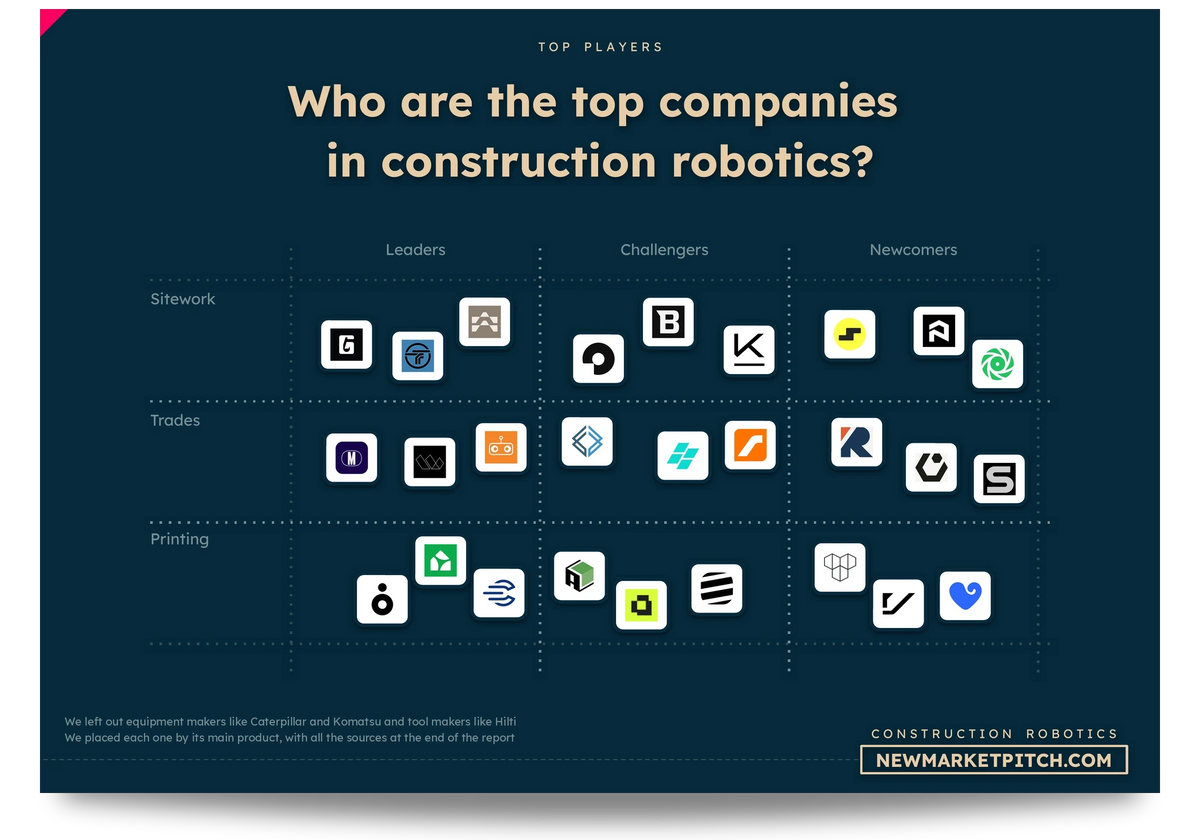
In our report covering the construction robotics market, we turn what is vague and complex into simple, useful visuals. Market maps like this one show you at a glance where every startup stands.
Top startups in the construction robotics market ranked by valuation
Here is an updated table that ranks the top startups in the construction robotics market based on their latest reported or estimated valuations.
If you need to dig deeper and get more detailed data, please check our report covering the construction robotics market.
| # | Startup | Valuation | Confidence | Valuation basis | Last round | Total funding |
|---|---|---|---|---|---|---|
| 1 | Bedrock RoboticsAutonomous heavy construction equipment | $4.1B | Full | Announced private round valuation | $600MSeries C · Oct 2026 | $950Mvalued at 4.3× this |
| 2 | ICONRobotic 3D printing for buildings | $1.3B–$1.5B | Strong | Implied valuation from raise | $200MSeries D · Oct 2026 | $692Mvalued at 2.0× this |
| 3 | Gravis RoboticsAutonomous excavators and heavy machinery | $950M–$1.1B | Strong | Implied valuation from raise | $200MSeries A · Aug 2026 | $227Mvalued at 4.5× this |
| 4 | TerraFirmaAutonomous heavy construction machinery | $670M–$1.2B | Partial | Implied valuation from raise | $115MSeries A · Jul 2026 | $115Mvalued at 8.3× this |
| 5 | Reframe SystemsRobotic microfactory homebuilding systems | $267M–$500M | Partial | Implied valuation from raise | $40MGrowth equity · Aug 2026 | $66Mvalued at 5.8× this |
| 6 | EarthGridRobotic underground utility tunnel excavation | $290M–$440M | Partial | Implied valuation from raise | $53MSeries A · Aug 2026 | $83M+valued at 4.4× this |
| 7 | Built RoboticsAutonomous excavator retrofit systems | $230M–$430Mas of Oct 2026 | Partial | Comparables-based estimate | $64MSeries C · Apr 2022 | $112Mvalued at 2.9× this |
| 8 | AIM Intelligent MachinesAutonomous excavator retrofit technology | $250M–$400M | Partial | Implied valuation from raise | $50MSeries A · Jun 2025 | $50M+valued at 6.5× this |
| 9 | Planted SolarAutonomous utility-scale solar installation | $212M–$398M | Partial | Implied valuation from raise | $32MSeries B · Sep 2026 | $65Mvalued at 4.7× this |
| 10 | XpannerAutonomous construction equipment retrofit systems | $150M–$250M | Strong | Revenue or ARR multiple estimate | $18MSeries B bridge · May 2026 | $38Mvalued at 5.3× this |
| 11 | Charge RoboticsAutomated solar farm assembly | $140M–$240M | Partial | Implied valuation from raise | $22MSeries B · Jul 2026 | $39M+valued at 4.9× this |
| 12 | GrittAI robotics for infrastructure construction | $130M–$217M | Partial | Implied valuation from raise | $26MSeries A · Jul 2026 | $32Mvalued at 5.4× this |
| 13 | Cuby TechnologiesAutomated modular homebuilding factories | $115M–$210M | Partial | Implied valuation from raise | $17MSeries B · Aug 2025 | $23M+valued at 7.1× this |
| 14 | MonumentalAutonomous robotic bricklaying systems | $125M–$192M | Partial | Implied valuation from raise | $32MSeries B · Jul 2026 | $57Mvalued at 2.8× this |
| 15 | MechasysRobotic construction layout projection systems | $115M–$192M | Partial | Implied valuation from raise | $17MSeries A · Aug 2025 | $18M+valued at 8.7× this |
| 16 | Dusty RoboticsRobotic floor layout printing | $125M–$155M | Strong | Implied valuation from raise | $20MSeries B2 · May 2026 | $89Mvalued at 1.6× this |
| 17 | All3Robotic housing design and assembly | $100M–$165M | Strong | Implied valuation from raise | UndisclosedGrowth equity · Sep 2026 | $25M+valued at 5.3× this |
| 18 | August RoboticsAutonomous drilling and layout robots | $110M–$140M | Strong | Implied valuation from raise | $30MSeries B · May 2026 | $34M+valued at 3.7× this |
| 19 | KEWAZORobotic lifting for industrial construction | $85M–$133M | Partial | Implied valuation from raise | $16MSeries A extension · Mar 2026 | $32M+valued at 3.4× this |
| 20 | OriginGeneral-purpose interior construction robots | $80M–$133M | Partial | Implied valuation from raise | $20MOct 2026 | $20Mvalued at 5.3× this |
| 21 | Apis CorMobile robotic concrete 3D printing | $65M–$125M | Low | Comparables-based estimate | $921KRegulation CF · Mar 2025 | $5.9M+valued at 16.1× this |
| 22 | Promise RoboticsAutomated prefabricated home manufacturing | $55M–$105M | Low | Comparables-based estimate | $15MSeries A · Oct 2023 | $25Mvalued at 3.2× this |
| 23 | Legend RobotRobotic plastering and finishing systems | $55M–$95M | Partial | Comparables-based estimate | ~$10MSeries A+ · May 2023 | $28Mvalued at 2.7× this |
| 24 | Intelligent CityAutomated mass timber building manufacturing | $50M–$100M | Low | Comparables-based estimate | $2.3MSeed / equity · Dec 2019 | $17Mvalued at 4.4× this |
| 25 | Kind Designs3D-printed coastal protection systems | $70M | Full | Announced private round valuation | $10MPre-Series A · Jul 2026 | $20Mvalued at 3.5× this |
| 26 | WEIBUILDRobotic plastering and rebar processing | $55M–$83M | Partial | Comparables-based estimate | ~$17MSeries A extension · Aug 2024 | ~$31Mvalued at 2.2× this |
| 27 | Partner RoboticsIntelligent construction robots | $47M–$78M | Partial | Implied valuation from raise | $1.4MSeries A · Nov 2025 | $4.2M+valued at 14.9× this |
| 28 | COBODLarge-scale concrete 3D printers | $35M–$80M | Low | Comparables-based estimate | UndisclosedStrategic equity · Oct 2022 | $1.7M+valued at 33.8× this |
| 29 | Automated Architecture (AUAR)Robotic timber housing microfactories | $35M–$65M | Partial | Implied valuation from raise | ~$6.9MEarly VC · Jun 2025 | $10M+valued at 4.9× this |
| 30 | Raise RoboticsAutomated construction layout installation | $37M–$63M | Partial | Comparables-based estimate | $7.8MSeed · Jul 2025 | $10Mvalued at 5.0× this |
| 31 | Branch TechnologyRobotic architectural 3D printing | $35M–$60M | Partial | Comparables-based estimate | UndisclosedOther · Jan 2025 | $18M+valued at 2.6× this |
| 32 | Civ RoboticsAutonomous construction surveying robots | $32M–$55M | Partial | Implied valuation from raise | $7.5MSeries A · Jul 2025 | $13Mvalued at 3.3× this |
| 33 | Hyperion RoboticsRobotic concrete infrastructure manufacturing | $30M–$55M | Partial | Implied valuation from raise | $7.4MGrowth · Jul 2026 | $11Mvalued at 3.9× this |
| 34 | Luminous RoboticsAutonomous solar panel installation robots | $25M–$55M | Low | Proxy-based estimate | $3.5M+valued at 11.4× this | |
| 35 | Advanced Construction RoboticsRebar tying and placement robots | $20M–$55M | Low | Proxy-based estimate | UndisclosedVC round · Jul 2021 | Undisclosed |
| 36 | Toggle RoboticsRobotic rebar prefabrication systems | $25M–$45M | Partial | Comparables-based estimate | $3MSeries A extension · Feb 2023 | $15Mvalued at 2.4× this |
| 37 | OkiboAutonomous wall finishing and painting | $22M–$48M | Low | Comparables-based estimate | $7.8MGrowth equity · Mar 2024 | $7.8M+valued at 4.5× this |
| 38 | PaintJetAutonomous industrial painting and coating | $22M–$44M | Low | Comparables-based estimate | $10MSeries A · Dec 2023 | $15Mvalued at 2.2× this |
| 39 | Suzhou Fangshi TechnologyIntelligent construction automation robots | $26M–$39M | Low | Implied valuation from raise | UndisclosedSeries A Follow-on · Aug 2026 | ~$14Mvalued at 2.3× this |
| 40 | Phoenix BoringTrenchless underground utility installation | $23M–$38M | Partial | Implied valuation from raise | $5MPrivate equity Offering · Feb 2026 | $5Mvalued at 6.1× this |
| 41 | CyBe ConstructionRobotic concrete 3D printing systems | $15M–$45M | Low | Comparables-based estimate | UndisclosedSeed · Jan 2013 | Undisclosed |
| 42 | GoLe RoboticsAutonomous construction material transport | $20M–$40M | Partial | Comparables-based estimate | UndisclosedSeries A / pre-Series A · 2024 | $5.1Mvalued at 5.9× this |
| 43 | AeditiveRobotic concrete component manufacturing | $15M–$35M | Low | Comparables-based estimate | $1.7MSeed · Oct 2021 | $9M+valued at 2.8× this |
| 44 | Cosmic RoboticsAutonomous solar panel installation | $18M–$32M | Partial | Implied valuation from raise | $125KSeed · Sep 2026 | $4.1M+valued at 6.1× this |
| 45 | SitegeistAutomated concrete repair and renovation | $19M–$31M | Partial | Implied valuation from raise | ~$4.8MPre-Seed · Feb 2026 | $4.8Mvalued at 5.3× this |
| 46 | Rugged RoboticsRobotic construction layout marking | $12M–$30M | Low | Proxy-based estimate | $9.4MSeries A · Mar 2022 | $12Mvalued at 1.8× this |
| 47 | Alquist 3DConcrete 3D-printed home construction | $12M–$30M | Low | Proxy-based estimate | $1MSeed · Jan 2022 | $1Mvalued at 21.0× this |
| 48 | SkyMulRobotic rebar tying and inspection | $9M–$25M | Low | Proxy-based estimate | Undisclosed | |
| 49 | Black Buffalo 3DConcrete construction printing systems | $9M–$23M | Low | Comparables-based estimate | $250KSeries A · Jul 2022 | $250K+valued at 64.0× this |
| 50 | Flo MobilityAutonomous construction material handling | $10M–$20M | Partial | Implied valuation from raise | $2.5MPre-Series A · May 2026 | $2.9M+valued at 5.2× this |
| 51 | TvastaRobotic concrete 3D printing solutions | $10M–$20M | Partial | Revenue or ARR multiple estimate | UndisclosedCorporate minority investment · Apr 2025 | $411Kvalued at 36.5× this |
| 52 | SQ4DRobotic concrete building printing | $8M–$22M | Low | Proxy-based estimate | $25MJun 2025 | $25Mvalued at 0.6× this |
| 53 | Spacer RoboticsAutonomous construction and space robots | $10M–$16M | Partial | Implied valuation from raise | UndisclosedSeed · Jul 2026 | $2.5Mvalued at 5.2× this |
| 54 | XTreeELarge-scale robotic concrete 3D printing | $7M–$17M | Low | Comparables-based estimate | UndisclosedCorporate Minority · Mar 2021 | ~$2Mvalued at 6.0× this |
| 55 | Buildroid AIAI-orchestrated construction robot fleets | $8M–$12M | Strong | Implied valuation from raise | $2MSeed · Nov 2025 | $2Mvalued at 5.0× this |
| 56 | Robotiz3dAutomated road inspection and repair | $5M–$11M | Low | Comparables-based estimate | ~$250KSeed · Dec 2024 | $250K+valued at 32.0× this |
| 57 | VerticoIndustrial robotic concrete printing systems | $5M–$11M | Low | Proxy-based estimate | ~$1.1Mvalued at 7.3× this | |
| 58 | KOBOTSRobotic construction cutting tools | $5M–$8M | Low | Comparables-based estimate | $1.1MGrowth equity · May 2024 | $2.5Mvalued at 2.6× this |
| 59 | Les CompanionsCollaborative robotic construction painting | $4M–$9M | Low | Active raise valuationEstimated | ~$640KCrowdfunding / seed · 2025 | ~$640Kvalued at 10.2× this |
| 60 | Q-BotRobotic underfloor insulation installation | $6M1 | Full | Announced private round valuation | UndisclosedEquity Allotment · Sep 2026 | $6.9Mvalued at 0.9× this |
| 61 | Pace RoboticsAutonomous wall painting and finishing | $3M–$9M | Low | Proxy-based estimate | $181KSeed · May 2023 | $251Kvalued at 23.9× this |
| 62 | SteerAutonomous construction equipment systems | $2M–$8M | Low | Proxy-based estimate | Undisclosed | |
| 63 | Finish RoboticsAutonomous painting and coating robots | $2M–$5M | Low | Proxy-based estimate | $100KSeed · Nov 2023 | $605Kvalued at 5.8× this |
| 64 | Cyphra AutonomyAutonomous construction material hauling | $1M–$4M | Low | Proxy-based estimate | Undisclosed |
No startups match this search.
- Converted from a £4.7M post-money valuation, rounded.

Our research about construction robots gets updated several times a month, so you always get the latest view of where things stand.
Which construction robotics startups are worth the most today?
Bedrock Robotics currently leads the construction robotics market with a $4.1B valuation, followed by ICON at $1.3B–$1.5B and Gravis Robotics at $950M–$1.1B. The three companies represent different approaches to automation: autonomous heavy equipment, robotic building construction, and intelligent earthmoving machinery.
Our ranking of 64 construction robotics startups reveals a market in which valuations are concentrated at the top, but the technology attracting capital is far from uniform. TerraFirma, valued at $670M–$1.2B, is another major contender in autonomous construction machinery. Reframe Systems, at $267M–$500M, represents a different model based on robotics-enabled housing microfactories.
The gap between Bedrock and the rest is especially pronounced. Bedrock Robotics' $4.1B valuation is more than twice ICON's upper valuation estimate, despite ICON having spent considerably longer developing construction 3D-printing technology.
Construction robotics is increasingly being valued as an opportunity to automate entire categories of work, particularly those involving expensive machinery, skilled labor shortages, and large infrastructure budgets.
That does not mean the highest-valued companies already generate the most revenue. Private valuations reflect expectations about future market share, technical capabilities, and commercial expansion, not necessarily current earnings.
How many construction robotics startups have reached unicorn status?
Construction robotics currently has two startups clearly valued above $1 billion in our ranking, with another two whose valuation ranges cross that threshold. Bedrock Robotics stands at $4.1B and ICON at $1.3B–$1.5B. Gravis Robotics, valued at $950M–$1.1B, and TerraFirma, at $670M–$1.2B, sit close to or within unicorn territory.
The industry remains relatively young compared with enterprise software or financial technology. Many construction robotics businesses are still building their first large commercial fleets, while others have demonstrated their technology but have not yet established substantial recurring revenue.
There is a clear concentration of billion-dollar potential in autonomous heavy machinery. Bedrock, Gravis, and TerraFirma are all developing systems that could automate work traditionally performed with human-operated construction equipment.
ICON is the main exception among the largest companies, pursuing robotic building fabrication instead.
For now, construction robotics has a small group of established or potential unicorns, rather than dozens of billion-dollar businesses spread across different trades.

In our market report about construction robots, we look at what the winners do differently, so you can learn from the best instead of guessing.
Why has Bedrock Robotics become the most valuable construction robotics startup?
Bedrock Robotics has reached a $4.1B valuation because investors are betting that its autonomous equipment technology can scale across existing construction machinery fleets rather than requiring contractors to purchase entirely new types of machines.
The decisive commercial development occurred in August 2026, when Bedrock announced autonomous excavation on active projects involving Sundt Construction, Champion Site Prep, and Zachry Construction Corporation. The projects included a Nevada water-treatment facility and major earthmoving sites in Texas, including a 1.2-million-cubic-yard civil construction project.
That was a big step: its excavators were moving beyond controlled demonstrations and carrying out work on paying customers' construction sites.
On October 26, 2026, Bedrock announced a $600 million Series C led by CapitalG and Emergence Capital, establishing its $4.1B post-money valuation. The funding announcement also described an expanding customer base and plans to deploy more autonomous machines.
Two things explain the excitement. First, the underlying construction equipment market is enormous, and retrofit technology offers a way to address machinery already owned by contractors. Second, successful autonomy could increase equipment utilization and reduce the constraints imposed by operator availability.
The harder part comes next: turning a handful of commercial deployments into hundreds or thousands of machines operating consistently across different projects.
Bedrock has reached a meaningful commercial milestone, but its valuation already assumes a much larger business.
Is Bedrock Robotics worth more than ICON because autonomous equipment has better potential?
Bedrock Robotics' $4.1B valuation exceeds ICON's $1.3B–$1.5B largely because the investment opportunity behind autonomous heavy machinery differs from the economics of robotic homebuilding. That valuation gap does not prove that Bedrock already has a larger business.
ICON has spent years developing concrete 3D-printing systems and delivering projects, including homes in the Wolf Ranch development near Austin, Texas. Its technology changes how parts of buildings are manufactured, especially concrete walls.
Bedrock's approach instead targets conventional construction equipment already used for excavation and earthmoving. Contractors can potentially adopt its technology without abandoning their existing construction methods or redesigning the buildings they deliver.
The commercial difference is substantial. Automating an excavator can address a familiar task within an established workflow. Robotic homebuilding often requires coordination across architecture, structural engineering, permits, material supply, finishing trades, and construction schedules.
ICON's experience also illustrates the capital intensity of bringing a new construction method to market. In January 2025, the company disclosed plans to eliminate 114 positions, according to a Texas workforce filing reported by FOX 7 Austin.
The valuation gap suggests that investors currently see greater scalability in flexible equipment autonomy than in a construction process that depends on wider changes in building delivery.
Both models can succeed, but Bedrock has a more straightforward route into machinery contractors already use every day.

In our document detailing everything you need to know about construction robotics, you will always find fresh funding data, taken straight from our own verified funding database.
Can Gravis Robotics challenge Bedrock Robotics in autonomous construction?
Gravis Robotics is one of Bedrock Robotics' closest major competitors in autonomous earthmoving, with a $950M–$1.1B valuation against Bedrock's $4.1B. Its technology and industrial relationships give it a credible route into the market, although the valuation difference remains substantial.
In March 2026, Hitachi Construction Machinery demonstrated Gravis technology at CONEXPO-CON/AGG using a ZX135US-7 excavator. The system combined a sensor-equipped retrofit package with an interface allowing operators to teach the excavator a task before autonomous execution.
That relationship gives Gravis an interesting advantage. Established equipment manufacturers already have distribution networks, service infrastructure, and long-standing contractor relationships. A robotics startup working with one of them can potentially reach customers much faster.
In August 2026, Gravis announced a $200 million Series A investment from SoftBank, one of the largest financing events in construction autonomy. The company said the capital would support deployment of autonomous heavy machinery across international construction sites.
Bedrock, Gravis, and Built Robotics illustrate three routes into this market: highly financed autonomous equipment platforms, manufacturer-linked autonomous control systems, and established retrofit solutions.
Gravis has a credible path to becoming a serious alternative to Bedrock, but the next competitive test will be much more practical than a fundraising announcement: how many customer machines are operating commercially, how often they run, and how much it costs to support them.
Are autonomous excavator startups attracting more money than other construction robots?
Autonomous heavy-equipment startups currently command the largest individual valuations in construction robotics, although funding is also flowing into solar installation, building fabrication, and specialized jobsite automation.
Bedrock Robotics, Gravis Robotics, TerraFirma, Built Robotics, and AIM Intelligent Machines all concentrate on heavy equipment or construction machinery autonomy. Among other approaches, EarthGrid develops robotic underground excavation, while Xpanner offers equipment retrofit technology.
The funding pattern supports this concentration. Gravis announced its $200 million Series A in August 2026, while TerraFirma disclosed $115 million in Series A financing in July, led by Kleiner Perkins. Bedrock's October financing added a further $600 million to the category.
These transactions are considerably larger than many recent rounds for specialized construction tasks. Monumental announced $32 million for robotic bricklaying, Planted Solar raised $31.8 million for autonomous solar deployment, and August Robotics completed a $30 million Series B.
Heavy equipment autonomy is expensive to develop. It demands engineering teams, safety systems, field testing, and substantial deployment support.
But the commercial upside is also larger. A single autonomous control platform could eventually operate across multiple equipment models and jobsite applications.
That combination of a large potential market and expensive product development helps explain why autonomous machinery companies are receiving such enormous rounds.

Learning from others' mistakes is the cheapest lesson there is. In our report covering the construction robotics market, we look at what broke startups before you, so you don't repeat it.
Which construction robotics startups have raised the most funding?
Construction robotics funding is dominated by a relatively small number of companies, particularly Bedrock Robotics, ICON, Gravis Robotics, TerraFirma, and Built Robotics.
Bedrock's newly announced $600 million Series C brings its cumulative funding to $950M, while ICON has accumulated $692M in reported financing. Gravis has raised $227M, TerraFirma $115M, and Built Robotics $112M.
Capital also flows into smaller specialists. Dusty Robotics has raised $89M, Monumental $57M, KEWAZO $32M+, and Toggle Robotics $15M.
The companies raising the largest amounts are frequently developing platforms that require substantial upfront expenditure before they can support extensive commercial deployments.
Having hundreds of millions available can become a competitive advantage. These startups can sustain longer development cycles, manufacture equipment, subsidize early deployments, and absorb setbacks that might be impossible for a smaller competitor to withstand.
Here are several of the most important recent financing events.
| Startup | Announced financing event | Date | Main application |
|---|---|---|---|
| Bedrock Robotics | $600M Series C | October 2026 | Autonomous excavation |
| Gravis Robotics | $200M Series A | August 2026 | Heavy machinery autonomy |
| TerraFirma | $115M Series A | July 2026 | Autonomous equipment |
| Reframe Systems | $40M | August 2026 | Housing microfactories |
| Monumental | $32M Series B | July 2026 | Robotic bricklaying |
| Planted Solar | $32M Series B | September 2026 | Solar installation |
| August Robotics | $30M Series B | May 2026 | Drilling and layout |
Are construction robotics startup valuations rising faster than the industry is adopting robots?
Construction robotics valuations are advancing faster than broad industry adoption, even though commercial deployments are becoming more credible. High private valuations currently reflect the expectation of widespread automation rather than proof that robots have already transformed ordinary construction sites.
The distinction becomes clearer when we examine contractor behavior.
The Associated General Contractors of America's 2026 business outlook found that 61% of surveyed firms were using artificial intelligence or planning increased investment, compared with 44% in the preceding survey. However, the documented uses were concentrated in office administration, estimating, and design.
That tells us contractors are getting more comfortable with AI. It tells us considerably less about whether they are ready to deploy autonomous machines.
Meanwhile, companies such as Bedrock, Monumental, and August Robotics have reported operational progress. Bedrock has excavators working on commercial infrastructure projects, Monumental reports a fleet exceeding 100 bricklaying robots, and August Robotics has commercialized automated drilling technology with DEWALT.
Construction robotics is moving beyond isolated prototypes. But deployments like these are still far from becoming standard practice across the industry.
Investors are financing a future in which automation is routine. Contractors, understandably, are making the transition one project and one task at a time.

Your time is limited. In our research about construction robots, we put numbers on each part of the market, so you can see where it makes sense to focus.
Are construction robots finally solving the labor shortage?
Construction robots are beginning to address specific labor constraints, but they are nowhere near eliminating the industry's shortage of skilled workers.
The Associated General Contractors of America and NCCER reported in their September 2026 workforce survey that 87% of responding firms had openings for hourly craft positions. Among companies with craft openings, 88% said hiring was as difficult or more difficult than a year earlier.
The same survey found that 42% of firms had experienced project delays because of shortages among their own workers or subcontractors.
It's easy to see the appeal of automation under those conditions. An excavator robot potentially reduces dependence on specialized operators, an automated drilling system can accelerate repetitive installation work, and a bricklaying robot can help contractors deliver masonry with smaller crews.
However, these technologies do not replace the full range of judgment and physical skills involved in construction.
Even when a robot performs one activity autonomously, workers are still needed for setup, supervision, inspections, maintenance, materials handling, and related trades.
The more immediate economic opportunity is higher output from teams that already struggle to hire enough workers.
And that is a pretty compelling selling point. Reducing project delays and getting more work done with the same crew can deliver value long before fully autonomous construction becomes practical.
| Labor indicator | 2025 AGC/NCCER survey | 2026 AGC/NCCER survey |
|---|---|---|
| Hiring difficulty | 92% of firms reported difficulty filling open positions | 88% of firms with craft openings reported hiring was as hard or harder than a year earlier |
| Worker qualifications | 57% cited insufficient candidate skills or qualifications | 50% reported available candidates lacked needed qualifications |
| Delays caused by labor shortages | 45% | 42% |
| Survey respondents | Nearly 1,400 firms | Approximately 1,830 firms |
| Interpretation | Severe hiring constraints | Labor pressures remained widespread despite softer market conditions |
Is construction 3D printing still one of the most valuable robotics markets?
Robotic construction 3D printing remains an important investment category, but its valuations show that the industry is increasingly distinguishing between ambitious building technology and proven repeatable economics.
ICON, valued at $1.3B–$1.5B, is the most valuable construction-printing company in our ranking. Its business is based on large-scale robotic printing technology for residential and other building applications.
Further down the market, Apis Cor stands at $65M–$125M, COBOD at $35M–$80M, Branch Technology at $35M–$60M, CyBe Construction at $15M–$45M, and XTreeE at $7M–$17M.
These companies are not interchangeable. Some develop machines used to print buildings, while others emphasize specialized components, architectural structures, or printing services.
The main commercial problem is familiar: printing walls does not eliminate the cost of foundations, roofing, mechanical systems, interior finishes, or site preparation.
A faster wall-building process is valuable, but its contribution to total project economics depends on how much labor and time that stage actually represents.
ICON's 2025 workforce reduction underlines the difficulty of commercializing an ambitious housing system, even after considerable fundraising and project activity.
Construction 3D printing has demonstrated that buildings can be made differently. Whether it can consistently make them cheaper at scale remains a much harder question.

In our market report about construction robots, we always try to gather several sources and make estimates that make sense, so you can work with solid numbers.
Are robotic homebuilding startups becoming serious competitors to traditional construction?
Robotic homebuilding startups are increasingly capable of automating meaningful parts of residential construction, but traditional builders still retain advantages in financing, permitting, subcontractor coordination, and proven delivery capacity.
The companies pursuing automated housing do not all follow the same strategy.
ICON develops concrete printing systems that manufacture building structures on-site. Reframe Systems, valued at $267M–$500M, uses robotics-enabled microfactories to produce housing components. Cuby Technologies, at $115M–$210M, focuses on automated modular manufacturing, while All3, at $100M–$165M, develops robotic housing design and assembly.
Promise Robotics, valued at $55M–$105M, and Automated Architecture (AUAR), at $35M–$65M, also pursue factory-oriented approaches.
Factory automation has one obvious appeal compared with putting robots on open construction sites: the working environment is much more predictable. Machines can repeat the same operations under controlled conditions, with more consistent materials handling and fewer interruptions from weather or changing site layouts.
However, factory economics depend heavily on utilization. A highly automated production facility becomes expensive if housing orders are insufficient to keep it operating near capacity.
Reframe Systems' $40 million financing in August 2026 shows that investors still see considerable potential in this model.
The strongest opportunity may be in producing standardized components and housing systems at repeatable volumes, rather than attempting to replace every activity performed by conventional residential contractors.
Why are investors financing robots that build solar farms?
Solar construction robotics is attracting capital because utility-scale projects combine repetitive installation work, large development pipelines, and growing pressure to deliver electricity capacity quickly.
Several startups are attacking different parts of the installation process.
Planted Solar, valued at $212M–$398M, combines automated installation technology with a redesigned solar array system. Charge Robotics, at $140M–$240M, focuses on automated solar farm assembly, while Gritt, at $130M–$217M, develops robotics for infrastructure installation.
Luminous Robotics, valued at $25M–$55M, and Cosmic Robotics, at $18M–$32M, pursue additional installation automation approaches.
Planted's September 2026 operating update offers a concrete measure of progress. The company reported installing more than 10 MW during 2025 and targeting 100 MW during 2026. That would represent a tenfold increase if achieved.
It also disclosed a 28 MW project serving a data-center customer, with field construction completed in under three months.
Gritt offers another example. In July 2026, the company reported that its equipment-mounted systems could help an eight-person crew increase output from roughly 800 solar panels per day to 3,000–4,000 under its stated operating conditions.
Those are company-reported productivity figures, and actual performance will vary by project.
Still, solar construction has an advantage over some other robotics categories: results are relatively easy to measure. Contractors can compare panels installed per day, megawatts completed, labor requirements, and construction schedules.
If robots consistently improve those numbers, the sales argument becomes much easier.

If you build or invest in the construction robotics market, you need to know which business models pay off now and which ones are fading. That's why our report covering it has a whole section on it.
Which construction robotics startups have the strongest evidence of commercial traction?
Bedrock Robotics, Monumental, Planted Solar, and August Robotics currently offer some of the clearest publicly described examples of commercial activity, although their deployments are quite different.
Bedrock reported autonomous excavation at active infrastructure sites involving three established construction contractors in August 2026.
Monumental stated in July 2026 that it was operating more than 100 robots laying bricks across European construction sites. That's a substantial milestone in an industry where many companies are still moving from pilots into regular jobsite work.
Planted Solar reported completed solar projects, including the 11 MW Bowes Solar installation in Illinois, alongside its expected expansion in deployment capacity.
August Robotics provides another form of commercial validation through its collaboration with DEWALT on autonomous drilling technology.
In July 2026, DEWALT announced the commercial launch of its DALE downward-drilling robot, developed with August Robotics. The companies reported that the technology had contributed to construction schedule reductions across 26 major projects.
These deployments show real progress, but operating on several projects and making money from each one are different achievements. For most of these businesses, detailed profitability and machine-level costs remain private.
Even so, construction robotics has clearly moved beyond a market defined entirely by demonstrations. A growing number of startups now have machines performing actual work for commercial customers.
| Startup | Publicly reported operational activity | Scale or milestone | Commercial question |
|---|---|---|---|
| Bedrock Robotics | Autonomous excavation on active infrastructure sites | Three named contractor deployments in August 2026 | Fleet-wide operating costs |
| Monumental | Robotic masonry across European jobsites | More than 100 robots reported in July 2026 | Utilization and revenue per robot |
| Planted Solar | Completed solar projects | More than 10 MW installed in 2025 | Profitability as installations expand |
| August Robotics | Commercial robotic drilling with DEWALT | Reported applications across 26 major projects | Customer-level financial returns |
| Gritt | Equipment-mounted solar installation robotics | More than seven reported jobsites | Consistency of productivity gains |
| ICON | Completed 3D-printed building projects | Wolf Ranch residential development | Project-level profitability |
| Gravis Robotics | Manufacturer-linked autonomous excavator demonstrations | Hitachi partnership at CONEXPO 2026 | Scale of commercial deployments |
Can smaller construction robotics startups compete with billion-dollar companies?
Smaller construction robotics startups can compete by automating narrowly defined tasks, but competing directly with the largest autonomous machinery platforms would require substantially greater financing.
Dusty Robotics, valued at $125M–$155M, illustrates the specialist approach through automated floor layout printing. Instead of attempting to automate entire construction sites, its technology transfers digital plans onto physical floors.
Similarly, Mechasys, valued at $115M–$192M, develops robotic layout projection, while Raise Robotics, at $37M–$63M, focuses on automated construction installation tasks.
These products address specific problems contractors already understand: layout accuracy, labor requirements, and the cost of installation mistakes.
Other startups concentrate on finishing or materials work. Okibo, valued at $22M–$48M, develops wall-finishing robotics, and PaintJet, at $22M–$44M, focuses on industrial painting and coating.
Smaller companies may actually have an advantage when the task is repetitive, easy to price, and can be integrated without restructuring the entire construction process.
The disadvantage emerges when substantial hardware manufacturing, technical support, or nationwide service coverage becomes necessary.
There is room for specialized robotics businesses alongside major autonomy platforms. A billion-dollar excavator startup has little reason to dominate robotic painting or construction layout, and a smaller competitor can build a worthwhile business by doing one job extremely well.

In our report covering the construction robotics market, we don't want to repeat what boring consulting reports say. Instead, we show you the real and latest market signals that matter.
Why do some construction robotics startups have valuations below the money they have raised?
A construction robotics startup can be worth less than its cumulative funding because capital raised is a historical financing total, not the company's present market value.
Q-Bot is one example in our ranking. The UK company, which develops robotic underfloor insulation technology, has a $6M valuation against $6.9M in reported cumulative financing, after years of capital-intensive product development. SQ4D shows a wider gap, with an estimated $8M–$22M valuation against $25M raised.
That does not automatically mean investors lost exactly the difference. Funding may have been received over many years, used for development and operations, or structured through equity, grants, and convertible instruments.
Construction robotics businesses are particularly exposed to this situation because hardware development often requires years of engineering and field deployment before generating substantial revenue.
A company can spend millions developing useful technology without creating an equally valuable business.
The reverse can also happen. A startup may reach a billion-dollar valuation while having raised considerably less capital because investors expect its technology to eventually serve a huge market.
Cumulative funding is useful for understanding financial backing and development capacity. It should never be confused with what the company is currently worth.
Does the United States dominate construction robotics startup valuations?
The United States dominates the highest-valued construction robotics startups, but Europe and Asia remain meaningful centers of technical development and specialized automation.
Bedrock Robotics and ICON occupy the first two positions in our ranking, while other major US businesses include TerraFirma, Reframe Systems, EarthGrid, AIM Intelligent Machines, Planted Solar, and Built Robotics.
Switzerland contributes Gravis Robotics and the United Kingdom All3, demonstrating that European companies can compete in advanced autonomy and robotic building systems.
The Netherlands is particularly active in construction automation, with Monumental developing robotic bricklaying and CyBe Construction and Vertico working on concrete printing technologies. Nearby Denmark is home to COBOD, another important construction 3D-printing business.
Germany contributes KEWAZO, Aeditive, and Sitegeist, representing material lifting, automated concrete manufacturing, and robotic renovation.
China also has several specialists, including Legend Robot, WEIBUILD, Partner Robotics, and Suzhou Fangshi Technology.
What distinguishes the US market is the combination of large construction and infrastructure markets, significant venture financing capacity, and access to major equipment fleets.
European and Asian companies can develop competitive technologies, particularly in specialized manufacturing and finishing tasks, without attracting the same private valuations.
The industry's geography looks much more concentrated when measured by company value than when examined through the range of robotic applications being developed.

In our research about construction robots, we like to show you the big picture. We know your time is precious, so we make every page quick to read and packed with as much learning as possible per minute.
Are construction robotics valuations justified by the size of the construction industry?
Construction robotics valuations are supported by an enormous potential customer industry, but the total value of construction spending considerably overstates the revenue opportunity available to robot manufacturers.
Construction projects include land, materials, equipment, labor, engineering, finance, and many services that robotics companies cannot directly monetize.
We should instead examine which specific costs automation can reduce or which activities it can perform more efficiently.
For Bedrock Robotics and Gravis Robotics, relevant spending includes earthmoving equipment operations, operator labor, fleet utilization, and construction productivity.
For Dusty Robotics and Mechasys, the economic opportunity lies in layout work, accuracy, and avoiding rework.
For Planted Solar and Gritt, the addressable activity is tied to solar installation and the efficiency of project delivery.
These opportunities can be substantial without approaching the full value of their respective construction markets.
A simple illustration helps explain the valuation challenge. A $1 billion robotics business valued at ten times annual revenue would need approximately $100 million in annual revenue to support that multiple. At five times revenue, it would require $200 million.
These are illustrative valuation scenarios, rather than the actual revenue multiples of particular startups.
Companies commanding billion-dollar valuations will eventually need substantial equipment sales, recurring software revenue, service income, or construction work delivered at scale.
The overall construction market is certainly big enough to support large robotics businesses. The difficult part is capturing enough of that spending while delivering savings that contractors are willing to pay for.
Which construction robotics startups could become the next unicorns?
TerraFirma and Gravis Robotics are the most immediate construction robotics unicorn candidates by valuation range, with Gravis already sitting at the $1 billion boundary.
TerraFirma is valued at $670M–$1.2B, placing it within reach of an unambiguous billion-dollar valuation if its next financing supports the upper portion of that range.
Its July 2026 Series A, led by Kleiner Perkins, gives it substantial financial backing for continued development of autonomous construction machinery.
Below this group, Reframe Systems and EarthGrid represent potential future candidates from different construction applications. Reframe Systems stands at $267M–$500M, while EarthGrid is valued at $290M–$440M.
Their routes to $1 billion would depend on very different results.
Reframe would need to demonstrate that robotics-enabled housing microfactories can be deployed and utilized economically across multiple markets. EarthGrid would need to establish scalable commercial demand for its underground excavation technology.
AIM Intelligent Machines, valued at $250M–$400M, and Planted Solar, at $212M–$398M, offer other credible possibilities.
Planted's reported installation expansion and contracted demand are particularly interesting because they offer a way to track customer adoption through completed projects rather than simply new financing.
The next construction robotics unicorns will probably emerge from companies that turn expensive development programs into repeatable commercial activity. A clever robot helps, obviously. But customers ordering more of them is what really changes a company's value.

When you build or invest in the construction robotics market, you need clarity, not confusion. In our market report about construction robots, we always try to put numbers on and quantify whatever is usually vague and confusing.
What could cause construction robotics startup valuations to fall?
Construction robotics valuations could decline sharply if commercial adoption grows more slowly than investors expect, particularly among companies financing expensive hardware development with limited recurring revenue.
The first risk is that pilot projects fail to become large fleets. A robot that performs effectively at one construction site may require significant adaptation for different ground conditions, layouts, weather, equipment models, and safety requirements.
The second risk is weak customer economics. Contractors will evaluate robotics based on total operating costs, including equipment financing, maintenance, insurance, integration, support, and human supervision.
A third risk concerns production and deployment capacity. Even if customers want more robots, manufacturers must build and service them reliably.
These problems differ by category. Autonomous excavation requires exceptionally robust safety and control systems. Robotic homebuilding depends on construction integration and project volume. Specialized finishing robots may face lower technical barriers but more intense competition and narrower contract values.
ICON's workforce reduction in 2025 shows how even highly financed construction technology companies can face restructuring as they move from development toward sustainable commercial operations.
A valuation decline also does not necessarily mean a business is failing. A startup might continue growing revenue while investors reduce the multiple they are willing to pay.
The biggest downside belongs to companies whose valuations already assume rapid adoption, broad scalability, and attractive margins before those results have been achieved.
Are construction robotics startups really worth their current valuations?
Construction robotics startup valuations are partly justified by measurable commercial progress and a persistent labor shortage, but the highest figures still depend heavily on future execution rather than established financial performance.
Bedrock Robotics leads at $4.1B, ahead of ICON at $1.3B–$1.5B and Gravis Robotics at $950M–$1.1B. These valuations reflect genuine technological opportunities, yet the companies have very different commercial maturity and capital requirements.
The strongest supporting evidence comes from actual deployments. Bedrock has autonomous excavators working on customer infrastructure projects. Monumental reports more than 100 robots performing masonry. Planted Solar has delivered commercial solar installations, while August Robotics has brought automated drilling technology into the market with DEWALT.
The underlying customer problem is also well documented. AGC and NCCER surveys show persistent shortages of qualified construction workers, while major infrastructure and data-center projects are adding pressure to project delivery.
What remains difficult to establish across much of the industry is whether construction robotics companies can generate enough recurring revenue and operating profit to sustain their valuations.
The highest valuations increasingly favor technologies capable of operating across existing equipment fleets or repeating standardized tasks at scale.
That preference makes sense. Such businesses may face fewer adoption obstacles than technologies requiring contractors to redesign entire construction processes.
Construction robotics is becoming a real commercial industry, with machines completing useful work on active projects. But investors are already assigning multibillion-dollar values to market positions that have not yet been secured.
The next decisive phase will be measured less by individual robot demonstrations and more by deployed fleet sizes, customer retention, repeat purchases, equipment utilization, and profitable operations.
Those numbers will eventually tell us which startups deserve their billion-dollar valuations and which got there a little too early.

A good product starts with a real problem. In our document detailing everything you need to know about construction robotics, we show you the ones customers still live with.
Our methodology
This analysis examines the most valuable private startups in the construction robotics market as of November 2026. Our ranking covers 64 companies developing robotics and autonomous systems for construction equipment, excavation, building fabrication, housing production, solar installation, layout, drilling, masonry, and other construction activities.
We compare company valuations, cumulative funding, major financing rounds, geographic distribution, and commercial activity. Valuations are expressed in US dollars. Where an announced financing establishes a clear company valuation, we use that transaction as the primary reference. Other companies are presented with valuation ranges based on available financing information and comparable businesses. These ranges should not be interpreted as completed transactions at every price within them.
Our assessment of commercial traction focuses on reported customer deployments, operating robot fleets, completed projects, installation volumes, equipment partnerships, and repeatable construction tasks. We distinguish these activities from broader industry adoption and from financial performance, since a successful deployment does not automatically establish profitability.
We also use construction workforce surveys to evaluate demand for automation, particularly hiring difficulties and project delays. For the financial comparisons, cumulative funding refers to capital raised across financing events, while valuation represents the company's estimated equity value or the value established in a financing transaction.
A company can appear in this ranking even when its total funding is undisclosed: its position depends on its valuation, not on the capital it has raised.
Key sources include Bloomberg on Bedrock Robotics' October 2026 financing and valuation, TechCrunch on Bedrock's commercial excavation deployments, Gravis Robotics' Series A announcement, Kleiner Perkins on TerraFirma's financing and autonomous machinery strategy, and HousingWire on Reframe Systems' financing.
Additional sources include Monumental's financing and operating fleet announcement, August Robotics and DEWALT on commercial robotic drilling, the AGC/NCCER 2026 construction workforce survey, AGC's 2026 construction hiring and business outlook, and FOX 7 Austin's reporting on ICON's workforce reduction.

In our report covering the construction robotics market, we try to remove everything that could confuse you, especially if you're investing or building in this market.
Written by the New Market Pitch teamWe track new markets so founders and investors can move faster. About us