How big is the industrial robot market outside China?
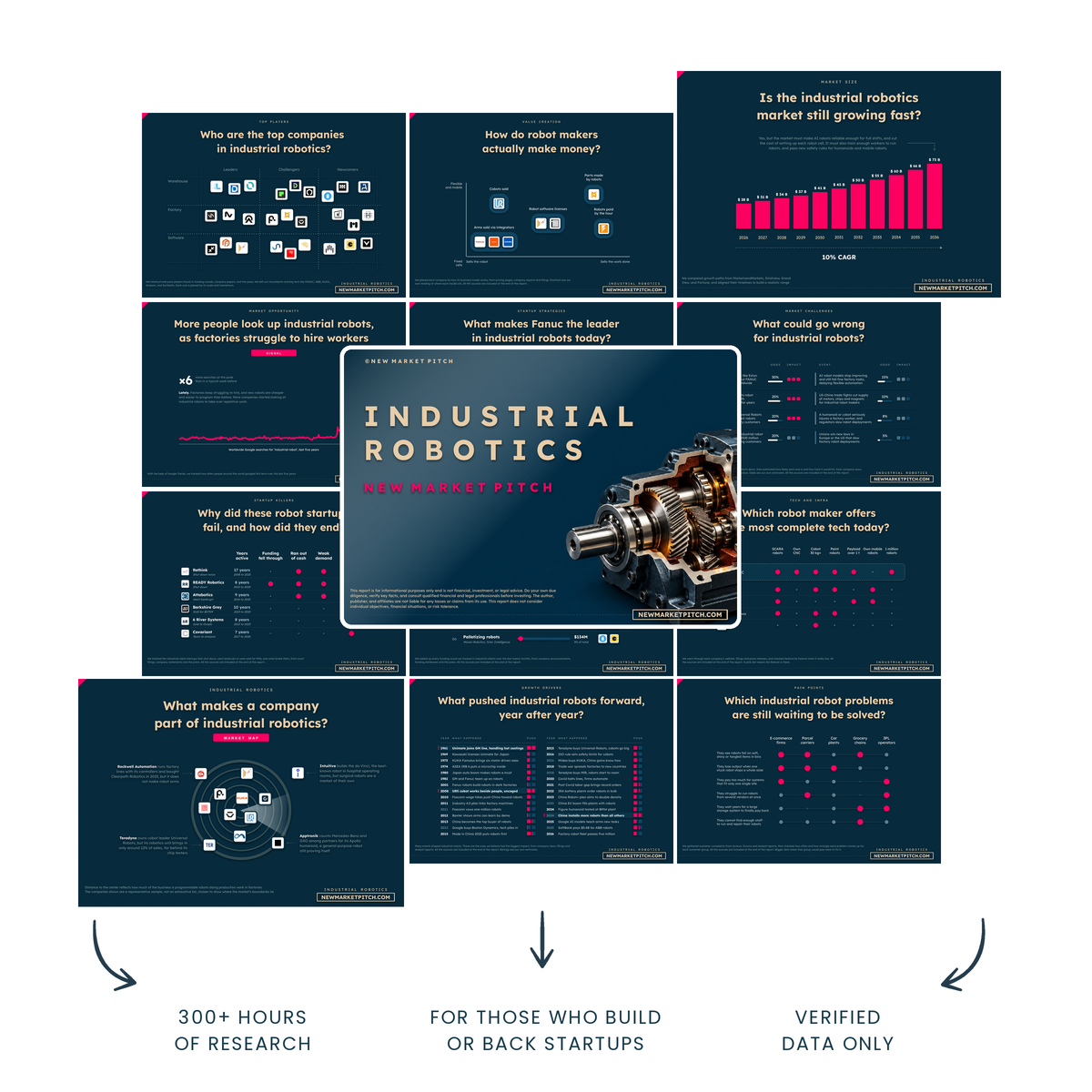
Whether you're building or investing in the industrial robotics market, our report covers everything you need to know: the players, the money, and what's coming next.
Summary
The industrial robot market outside China is worth approximately $7 billion annually in robot equipment sales, with around 249,000 new installations in 2025. Our pricing sensitivity puts the market between $5 billion and $10 billion, excluding integration, software, maintenance and other automation spending.
China accounted for roughly 97% of the worldwide increase in industrial robot installations in 2025. Global installations rose 11% to 603,000, but demand outside China grew less than 1%. Almost the entire industry's latest volume increase came from one country.
The non-China market is heavily concentrated. The United States, Japan, South Korea and Germany purchased approximately 129,000 robots in 2025, accounting for 52% of installations outside China. Weakness in one of these economies can cancel out substantial growth across several smaller markets.
The United States became the world's second-largest industrial robot market, with installations rising 12% to approximately 38,500. But Japan's 19% decline removed more than 8,000 annual installations, roughly twice the additional volume generated by the American rebound.
Europe remains a major source of weakness. EU installations fell 11% in 2025, while Germany, Italy, France and Spain all contracted. India grew 15% and Brazil 38%, but their combined annual demand is still smaller than Germany's.
The installed base tells a different story from annual equipment sales. Approximately 2.64 million industrial robots were already operating outside China at the end of 2024, creating a substantial continuing market for replacement machines, servicing, spare parts and upgrades.
Automotive production remains a major customer, but growth opportunities are spreading into food processing, metalworking, machinery and electronics. In the United States, food-industry robot installations rose 30% in 2025 even as automotive demand remained nearly unchanged.
Collaborative robots have become a meaningful category, reaching approximately 66,000 global installations in 2025. Yet their 7% growth was slower than the overall industrial robot market's 11%, challenging the assumption that easier-to-deploy robots are automatically driving faster adoption.
Chinese manufacturers supplied 55% of industrial robots installed in China in 2025, equivalent to roughly 195,000 machines. Their domestic scale creates a potential competitive threat overseas, particularly if Japanese and European suppliers face stronger price competition in markets that are barely growing.
AI-enabled robotics, reshoring and new manufacturing investment could support the next expansion, but the installation figures do not yet show a broad demand surge. At 5% annual growth, non-China installations would reach approximately 303,000 in 2029, representing an estimated $8.4 billion in annual equipment sales at our illustrative average price.
The opportunity is substantial for emerging suppliers, although achieving scale will be difficult. Capturing just 1% of current non-China installations requires selling about 2,500 robots annually. The market's size is proven; the unresolved question is whether new applications and recovering factory investment can return it to consistent growth.

Written by the New Market Pitch teamWe track new markets so founders and investors can move faster. About us

In our report covering the industrial robotics market, we always try to gather several sources and make estimates that make sense, so you can work with solid numbers.
Is China now responsible for almost all industrial robot market growth?
China accounted for roughly 97% of the worldwide increase in industrial robot installations in 2025, leaving the market outside China almost flat.
The International Federation of Robotics (IFR) reported 603,000 installations worldwide in 2025, up 11% from approximately 542,000 in 2024. China alone installed 354,000 robots, compared with 295,000 the previous year.
Subtracting China from both totals gives us approximately 249,000 installations outside China in 2025, against 247,000 in 2024. That's growth of less than 1%, compared with approximately 20% inside China.
The difference is striking. Worldwide installations increased by about 61,000 units, and China accounted for approximately 59,000 of those additional installations. Nearly the entire global increase came from one country.
It puts the industry's record year in a different light. The worldwide market reached its highest installation volume ever, but factories outside China collectively bought almost exactly the same number of robots as the year before.
If you want more recent data on this point, please see our latest industrial robotics market report.
How big is the industrial robot market outside China in dollars?
The industrial robot equipment market outside China is worth roughly $7 billion annually under our central pricing calculation, with a plausible sensitivity range of approximately $5 billion to $10 billion.
The IFR reported a global industrial robot installation market value of $16.7 billion in January 2026. Using that figure alongside the latest 603,000 annual installations gives an illustrative average of approximately $27,700 per robot. Applying the same average to the 249,000 installations outside China produces $6.9 billion.
There's an important qualification here. The IFR's market-value figure and the latest installation count do not necessarily cover identical reporting periods, and robot prices differ considerably by country and application. A small collaborative robot and a high-payload automotive welding robot can have very different prices.
To test the estimate, we calculated revenue using several equipment prices. At $20,000 per robot, the non-China market would generate approximately $5 billion. At $40,000, it would reach $10 billion.
These figures cover robot equipment, rather than complete automation projects. Factories also spend money on grippers, vision systems, safety equipment, integration, software and maintenance. Including those services and components would produce a larger market, but we cannot reliably calculate that total from installation counts alone.
| Assumed revenue per robot | Outside-China annual revenue |
|---|---|
| $20,000 | $5.0B |
| $25,000 | $6.2B |
| $27,700 | $6.9B |
| $30,000 | $7.5B |
| $35,000 | $8.7B |
| $40,000 | $10.0B |
| $45,000 | $11.2B |

In our research about industrial robots, we don't want to repeat what boring consulting reports say. Instead, we show you the real and latest market signals that matter.
Is the industrial robot market outside China still growing?
The industrial robot market outside China has barely grown over the past year, and the latest recovery is concentrated in a few countries.
Our calculation from the IFR's World Robotics 2026 report shows non-China installations increasing by approximately 2,000 units between 2024 and 2025. That follows a difficult 2024, when European installations declined 8% and installations in the Americas fell 10%.
The slowdown becomes clearer when we look at individual markets. Japan's purchases fell 19% in 2025, Germany's declined 8%, and Italy's dropped 11%. Meanwhile, the United States grew 12% and India 15%.
These countries are moving in opposite directions, leaving the broader non-China market almost unchanged.
There is some historical perspective worth keeping. Worldwide industrial robot installations more than doubled over the previous decade, so the recent weakness comes after years of factory automation investment.
The market is struggling to generate additional annual demand. Existing manufacturers continue purchasing robots, but growth in the United States, India and smaller emerging markets has not been enough to offset the declines elsewhere.
If you want more recent data on this point, please see our latest industrial robotics market report.
Which countries buy the most industrial robots outside China?
The United States, Japan, South Korea and Germany currently buy more than half of all industrial robots installed outside China.
Together, these four countries installed approximately 129,000 robots in 2025, representing around 52% of the non-China market.
The United States moved into second place worldwide, behind China, after installing almost 38,500 units. Japan followed with 36,219, South Korea installed 30,000, and Germany purchased fewer than 25,000.
Adding India brings the five-country total to approximately 140,000 units, or 56% of non-China installations.
The remaining demand is spread across markets including Italy, Taiwan, Mexico, Singapore, France, Brazil, Canada and Spain. Many of these countries purchase only a few thousand robots annually.
For suppliers, this concentration can be painful. A slowdown in Japanese automotive production or German factory investment can outweigh substantial percentage growth in smaller countries.
| Country | 2025 installations | Annual change |
|---|---|---|
| United States | ~38,500 | +12% |
| Japan | 36,219 | -19% |
| South Korea | ~30,000 | -1% |
| Germany | ~24,800 | -8% |
| India | ~10,500 | +15% |
| Italy | ~7,800 | -11% |
| Taiwan | ~5,700 | -3% |
| Mexico | ~5,200 | -7% |
| Singapore | ~4,600 | +26% |
| Brazil | ~4,300 | +38% |

In our market report about industrial robots, we like to show you the big picture. We know your time is precious, so we make every page quick to read and packed with as much learning as possible per minute.
Has the United States become the strongest industrial robot market outside China?
The United States is now the largest industrial robot market outside China, and its 2025 rebound was one of the strongest among established manufacturing economies.
American factories installed approximately 38,500 robots in 2025, up 12%. This was the third-highest annual total recorded in the country's industrial robotics statistics.
The recovery also reached beyond car factories. According to the IFR's US market update, automotive manufacturers installed approximately 13,500 robots, almost unchanged from the previous year. Food-industry robot installations, meanwhile, jumped 30%.
Food production now ranks alongside metal and machinery and electrical-electronics, with each of those sectors installing around 3,000 robots annually.
That's encouraging because the US industrial robot market has historically relied heavily on automotive investment. More demand from food processors and other manufacturers could make future growth less dependent on vehicle-production cycles.
Still, the American recovery added only around 4,000 installations compared with 2024, while Japan lost more than 8,000.
The United States is gaining ground, but its recovery hasn't been large enough to lift the broader non-China market.
Why is Europe's industrial robot market shrinking?
Europe's industrial robot market is shrinking mainly because manufacturers in its largest industrial economies are buying fewer machines, particularly in Germany, Italy and France.
European factories installed approximately 85,000 robots in 2024, down 8% from the previous year. The European Union subsequently recorded around 60,500 installations in 2025, an 11% decline from approximately 67,800 in 2024.
Germany remains Europe's largest market, accounting for 41% of EU installations. Yet German robot purchases fell another 8% in 2025 to fewer than 25,000 units.
Italy, the second-largest European market, declined 11% to approximately 7,800 installations. France fell 8% to almost 4,500, while Spain dropped 15% to around 4,300.
The weakness is too widespread to explain through one country's automotive troubles.
Europe had also been coming off relatively strong investment years. Germany installed 26,982 robots in 2024, its second-highest annual volume at the time, despite the decline from 2023.
The latest numbers point to a slowdown in new factory investment. Europe's large existing industrial base still needs automation, but manufacturers are committing less money to additional robotic equipment.
If you want more recent data on this point, please see our latest industrial robotics market report.

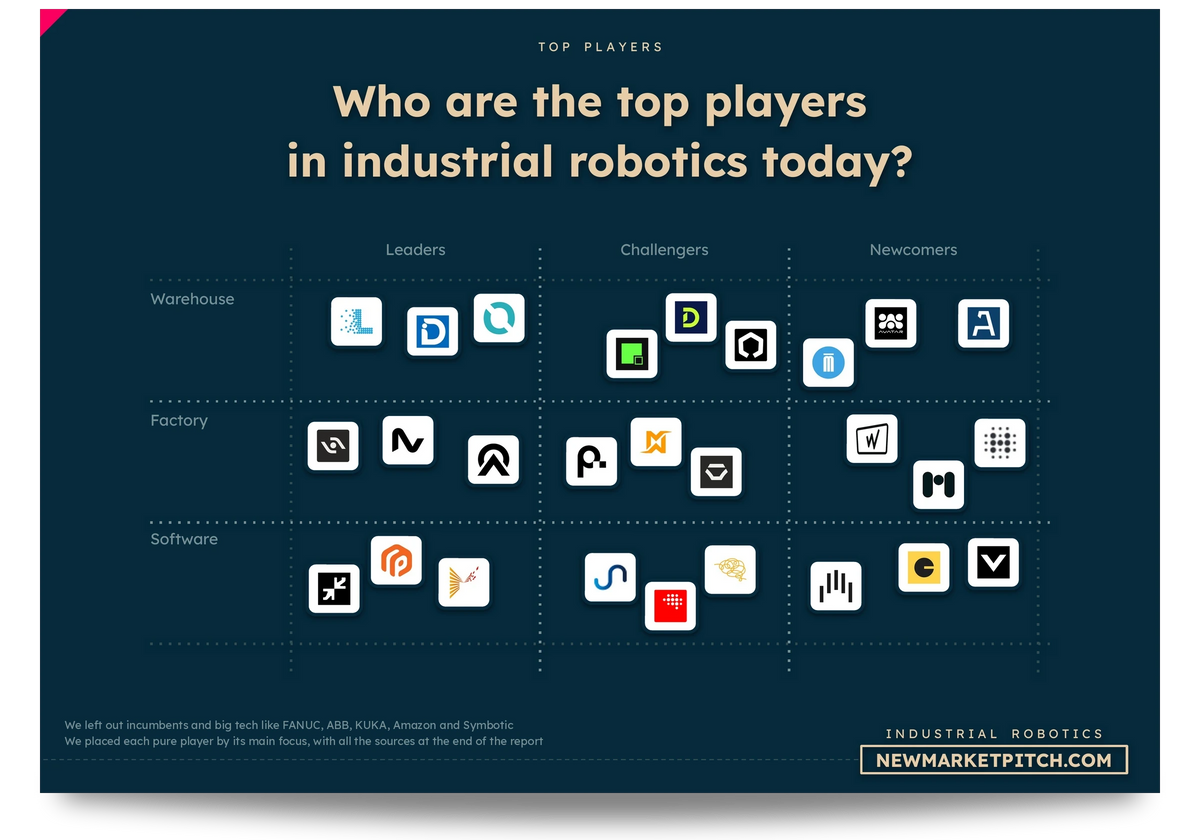
In our document detailing everything you need to know about industrial robotics, we turn what is vague and complex into simple, useful visuals. Market maps like this one show you at a glance where every startup stands.
Can India become a major industrial robot market?
India is already one of the fastest-growing industrial robot markets, although its annual purchases remain less than one-third of Japan's.
Indian factories installed almost 10,500 robots in 2025, up 15% from around 9,100 in 2024. The IFR calculates that annual installations grew at an average rate of 27% between 2020 and 2025.
That growth rate stands out against the stagnation in mature markets. South Korea's annual installations have remained close to 31,000 units since 2019, while Japan and Germany have recently recorded declines.
Automotive production remains central to India's expansion. The industry accounted for approximately 45% of Indian robot installations in 2024, supported by vehicle manufacturing and investments in automotive supply chains.
India also benefits from a relatively low starting level of automation. That leaves considerable room for deployment as manufacturing output expands and factories move toward more automated production.
Yet the country's market remains small in global terms. Even doubling India's installation volume to 21,000 units would leave it below Germany's current annual total.
India could become one of the largest contributors to non-China robot growth over the next several years. Replacing the volume lost in established manufacturing markets will take several more years of expansion at its recent pace.
Are Japan and South Korea losing their importance in industrial robotics?
Japan and South Korea remain essential industrial robotics markets, but neither is generating much new installation growth today.
Japan installed 36,219 robots in 2025, down 19% from approximately 44,500 in 2024. This pushed the country from second to third place in the global ranking, behind the United States.
South Korea's market was considerably steadier, with around 30,000 installations, down 1%. The IFR notes that annual purchases have remained close to 31,000 since 2019.
Together, the two countries accounted for approximately 66,000 installations in 2025, or 27% of demand outside China.
South Korea also illustrates what happens when factory automation becomes widespread. Its robot density reached approximately 1,220 industrial robots per 10,000 manufacturing employees in 2024, compared with 449 in Germany and 446 in Japan.
At such high levels, continued investment often involves upgrading production lines, replacing older machines and automating more complicated tasks. Growth can slow even while factories remain highly automated.
The IFR expects new automotive investments to support South Korean robot demand in 2027 and 2028. For Japan, it expects only a modest recovery in the short to medium term.
Both countries will remain important customers and major centers of robot manufacturing. Their domestic installation figures, however, offer little evidence of a new purchasing boom.

Our report covering the industrial robotics market gets updated several times a month, so you always get the latest view of where things stand.
How many industrial robots are already operating outside China?
Factories outside China had approximately 2.64 million industrial robots operating at the end of 2024, representing about 57% of the world's installed fleet.
The IFR counted 4.664 million operational industrial robots worldwide at that point. China's installed fleet stood at approximately 2.027 million, leaving 2.637 million machines operating elsewhere.
That's much larger than the roughly 249,000 new installations recorded outside China in 2025.
Millions of installed robots need servicing, spare parts, software support and eventual replacement. So even when annual equipment purchases slow, the existing fleet supports a substantial continuing business.
The global operational fleet subsequently reached 5.079 million robots in 2025, up 9%. However, the IFR's public summary does not provide a precise corresponding figure for China's operational fleet, so we cannot calculate an equally reliable non-China installed-base total for that year.
Robot density also varies enormously between countries. The United States had 307 robots per 10,000 manufacturing employees, compared with South Korea's 1,220. Such differences partly reflect the industries each country produces, but they also show how unevenly automation has spread.
The large operating fleet gives established suppliers a service and replacement business that a startup selling its first few hundred robots cannot immediately replicate.
Is automotive manufacturing still driving industrial robot sales outside China?
Automotive manufacturing remains one of the biggest customers for industrial robots outside China, but food production, electronics and machinery are becoming increasingly important sources of demand.
The United States offers a useful comparison. Automotive manufacturers purchased around 13,500 robots in 2025, representing roughly 35% of American installations. Food manufacturers, by contrast, increased their robot purchases by 30%, although their annual volume was still only about 3,000 units.
India is more dependent on automotive production, with the industry accounting for approximately 45% of installations in 2024. Germany's automotive sector also remains its largest robot customer, although the IFR reports that its share of total installations is declining.
Globally, industrial robot installations grew by 10% in both automotive and electronics in 2025, while the metal and machinery sector expanded by 22%.
There is growth beyond traditional car factories, although those global industry figures also include China.
Automotive projects can make annual robot demand volatile. A new vehicle platform or production facility can generate large equipment orders, while a delayed factory investment can remove thousands of installations from a year's total.
For the non-China market to grow consistently, demand from food processing, general manufacturing, electronics and smaller factories will need to become a bigger part of annual purchasing.

In our research about industrial robots, you will always find fresh funding data, taken straight from our own verified funding database.
Are collaborative robots finally becoming a big market?
Collaborative robots are already an established industrial robotics category, but their latest growth rate was slower than that of conventional industrial robots.
The IFR recorded approximately 66,000 collaborative robot installations worldwide in 2025, representing 11% of all industrial robot installations. Cobot installations grew 7%, compared with 11% for the overall market.
According to the IFR, this was the first time since it began tracking collaborative robots that their growth rate fell below that of industrial robotics as a whole.
Companies including Universal Robots, FANUC, ABB, Doosan Robotics and Techman Robot sell cobots for applications such as machine tending, assembly, packaging and inspection.
Their appeal is straightforward. Cobots can be easier to program and deploy than some traditional industrial robot systems, making them attractive to manufacturers that need flexibility or have limited automation expertise.
However, costs can rise quickly when a deployment requires specialized grippers, computer vision, safety equipment and integration work. The business case depends on the complete application rather than the robot arm's advertised price.
The global cobot figure also includes China. We cannot determine the exact size of the non-China cobot market without a geographic breakdown.
Cobots are expanding the range of tasks that factories can automate, but their latest installation figures don't support expectations of an immediate surge in the broader market.
Is AI already changing how many industrial robots factories buy?
AI is attracting serious investment from industrial robotics manufacturers and their buyers, but we cannot yet see a broad AI-driven increase in robot installations outside China.
One of the biggest recent transactions was SoftBank's agreement in October 2025 to acquire ABB's robotics business for $5.375 billion.
ABB's robotics business generated approximately $2.279 billion in revenue in 2024, putting the announced acquisition price at about 2.36 times annual sales.
SoftBank linked the transaction to its physical AI strategy, combining industrial robotics expertise with its wider AI investments. The deal is notable because it involves an established industrial robotics business with existing customers and revenue.
Meanwhile, FANUC, Universal Robots, Yaskawa and other manufacturers are working on more flexible robot programming, vision-based control and automated handling of variable tasks.
Newer companies such as RobCo are also trying to make industrial automation easier to deploy and adapt to different production processes.
The commercial question is whether those improvements generate more equipment orders. AI could make robots useful in factories where traditional automation was too expensive or difficult to configure.
So far, that potential hasn't translated into a clear market-wide increase in purchases outside China. The stronger proof will come when factories start deploying these systems repeatedly across production sites rather than testing individual applications.
If you want more recent data on this point, please see our latest industrial robotics market report.

In our market report about industrial robots, we look at what the winners do differently, so you can learn from the best instead of guessing.
Are Chinese robot manufacturers taking market share from Japanese and European companies?
Chinese robot manufacturers have become the largest supplier group in their domestic market, creating a growing competitive challenge for Japanese and European robotics companies.
The IFR reported that Chinese manufacturers supplied approximately 195,000 of the 354,000 industrial robots installed in China in 2025. That represents 55% of Chinese demand.
Domestic manufacturers had captured 57% in 2024, after holding roughly 28% over much of the preceding decade.
Their market share slipped slightly in 2025, but their installation volume still increased by approximately 15%. Chinese suppliers are selling far more robots than they did a few years ago.
Foreign manufacturers supplied the remaining approximately 159,000 installations in China. That volume alone is equivalent to almost two-thirds of all robot installations outside China.
For FANUC, Yaskawa, ABB, KUKA and Kawasaki Robotics, China remains a substantial customer market, even as local competitors win more business.
The concern is what happens if Chinese manufacturers expand their overseas sales while established markets remain flat. Suppliers from Japan and Europe could face stronger price competition without much additional market growth to absorb it.
We shouldn't assume that Chinese brands already control a comparable share of sales outside China. The available figures establish their growing strength at home, while a reliable global comparison by manufacturer would require company-level shipment data.
Could new factories and reshoring revive industrial robot sales outside China?
New manufacturing investment could lift industrial robot demand outside China, but the latest installation figures show that reshoring has yet to produce a broad recovery.
The IFR identifies manufacturing relocation, supply-chain resilience and industrial policies as factors supporting future automation demand.
The strongest recent country-level examples are the United States and India. American robot installations increased 12% in 2025, while Indian installations rose 15%. Canada also grew 5%, continuing a period of expansion that averaged approximately 9% annually between 2020 and 2025.
Brazil provides a more unusual example. Industrial robot installations jumped 38% to approximately 4,300 units, with automotive installations rising 212% to nearly 2,100.
The IFR suggested that investments by Chinese automotive manufacturers were probably behind much of Brazil's increase. Chinese industrial expansion overseas can itself create robotics demand in other countries.
Elsewhere, the picture is weaker. Mexico recorded its third consecutive annual decline, falling 7% to fewer than 5,200 installations. Germany and Italy also continued to contract.
New factory announcements can take years to become actual robot installations, and the timing differs across industries.
The opportunity is real, particularly in countries attracting automotive, electronics and advanced manufacturing projects. So far, though, the recovery remains too concentrated to change the direction of the wider non-China market.

If you build or invest in the industrial robotics market, you need to know which business models pay off now and which ones are fading. That's why our report covering it has a whole section on it.
How big could the industrial robot market outside China become by 2029?
The industrial robot market outside China could reach approximately 300,000 annual installations by 2029 if growth recovers to 5% per year.
The IFR expects worldwide installations to increase from 603,000 in 2025 to approximately 806,000 in 2029. That is a substantial global expansion, although the forecast does not tell us exactly how much will happen outside China.
We therefore calculated several scenarios starting with the current non-China installation volume of approximately 249,000 units.
At 3% annual growth, installations reach roughly 280,000 by 2029. At 5%, they reach 303,000. An 8% growth rate would produce approximately 339,000 installations.
For comparison, continuing at the recent growth rate of less than 1% would leave the market close to its current size.
Our central scenario of 303,000 installations implies approximately $8.4 billion in annual robot equipment revenue using the illustrative $27,700 average price. That would represent an additional $1.5 billion compared with the current $6.9 billion calculation.
Achieving this level would require several things to improve together: a recovery in European and Japanese investment, sustained growth in India and the United States, and broader adoption by manufacturers outside automotive.
The scenarios below are our calculations rather than published IFR regional forecasts.
| Annual growth outside China | 2029 installations | Estimated equipment revenue |
|---|---|---|
| -2% | ~230,000 | $6.4B |
| 0% | ~249,000 | $6.9B |
| 2% | ~270,000 | $7.5B |
| 3% | ~280,000 | $7.8B |
| 5% | ~303,000 | $8.4B |
| 7% | ~326,000 | $9.0B |
| 8% | ~339,000 | $9.4B |
Is the industrial robot market outside China big enough for new robotics startups?
The industrial robot market outside China is large enough to build a substantial company, but startups need to sell thousands of systems annually to become major equipment suppliers.
At roughly 249,000 annual installations, capturing 1% of the non-China market means selling approximately 2,500 robots per year.
Assuming equipment revenue of $30,000 per robot, that would generate about $75 million in annual sales.
A company aiming for $100 million from robot equipment alone would need to sell approximately 3,333 units annually at that price. Reaching $500 million would require almost 16,700 units, equivalent to nearly 7% of current installations outside China.
Those volumes are demanding for a young hardware company, especially when selling industrial robots involves engineering support, customer qualification, installation and long purchasing cycles.
RobCo provides an interesting recent example. The company reported selling more than 1,000 robots while expanding internationally and reaching a reported $1 billion valuation in 2026.
That's meaningful commercial traction for an emerging robotics supplier. Yet 1,000 robots would still represent less than 0.5% of annual non-China installations.
Startups can generate additional revenue by selling integrated automation systems, software, service contracts and industry-specific applications. Those business models also face integration and delivery challenges that pure equipment sales may avoid.
The opportunity is substantial, but market share will be difficult to win from manufacturers with established customer relationships, distribution networks and years of industrial operating experience.
If you want more recent data on this point, please see our latest industrial robotics market report.

When you build or invest in the industrial robotics market, you need clarity, not confusion. In our report covering the industrial robotics market, we always try to put numbers on and quantify whatever is usually vague and confusing.
How big is the industrial robot market outside China, really?
The industrial robot market outside China is already a large, roughly $7 billion annual equipment market, but its growth has almost stalled while China drives nearly all new global demand.
Our calculations from the latest IFR figures put non-China installations at approximately 249,000 units annually. That represents 41% of worldwide demand, with roughly half concentrated in the United States, Japan, South Korea and Germany.
The market also has a much larger operating footprint than annual sales suggest. Approximately 2.64 million industrial robots were already working outside China at the end of 2024, creating continued demand for servicing, upgrades and replacement equipment.
The problem is growth. China accounted for roughly 97% of the net increase in worldwide installations in 2025. Stronger purchases in the United States, India and Brazil were largely offset by weaker demand in Japan and several European countries.
We expect the next meaningful expansion to depend on more factories adopting automation beyond automotive production, lower deployment costs and a recovery in industrial investment. AI-enabled robotics could help, although its impact on total installations is still difficult to measure.
A return to approximately 300,000 annual installations by 2029 would put non-China demand back on a healthier growth path.
Until then, the clearest conclusion is that the world outside China remains a substantial market for industrial robots, but nearly all the industry's recent volume growth has come from China. The size of the opportunity is already proven. The next question is how quickly the rest of the world can start growing again.
Sources and methodology
This analysis measures the size, growth and commercial prospects of the industrial robot market outside China using annual installations, estimated equipment revenue and the existing operational robot fleet. We examine geographic concentration, end-user industries, manufacturer competition, collaborative robots, AI-enabled automation and future market expansion to distinguish broad-based growth from developments concentrated in individual countries or applications.
Our primary statistical source is the International Federation of Robotics (IFR), particularly its World Robotics 2026 findings, World Robotics 2025 release and World Robotics 2025 Industrial Robots Executive Summary. These publications provide the historical installation figures, operational stock, country comparisons and industry breakdowns used throughout the article.
We reconstruct non-China demand by subtracting China's annual installations from the worldwide totals. The resulting estimates are approximately 247,000 installations in 2024 and 249,000 in 2025. We apply the same method to calculate China's contribution to global installation growth, which is approximately 59,000 of the worldwide increase of 61,000 robots, or 97%. These are our calculations based on IFR data, rather than separately published IFR market estimates.
For revenue, we use the IFR's $16.7 billion global industrial robot installation market benchmark, published in its Top 5 Global Robotics Trends 2026 report, alongside the latest installation volume to develop an illustrative average equipment price of approximately $27,700. Because the benchmark and installation count may refer to different reporting periods, this is a pricing assumption rather than a directly observed non-China sales figure. We test alternative prices between $20,000 and $45,000 per robot and exclude integration, peripheral equipment, software and services from our core revenue estimate.
To assess geographic demand, we compare absolute installation changes, annual growth rates and each country's contribution to non-China demand. The country-level analysis draws on IFR reporting covering the United States, India, China, Europe's automotive industry and international robot-density comparisons. We keep Europe-wide figures separate from European Union statistics and distinguish new annual installations from the cumulative operational fleet.
For technology adoption and competitive developments, we aggregate recent evidence from the IFR's AI in Robotics position paper, its September 2026 President's Report and World Robotics 2026 industry commentary. We also use SoftBank's original ABB Robotics acquisition announcement, ABB's Q3 2025 results and RobCo's company announcement for specific corporate transactions, financial figures and commercial developments. Company announcements are assessed as evidence of individual business progress, rather than proof of market-wide adoption.
Across each dimension, we identify the most recent measurable developments, aggregate comparable observations and assess their combined implications. This is particularly important when different parts of the market move in opposite directions: strong growth in the United States or India can coexist with stagnation across the rest of the non-China market, while investment in AI robotics does not necessarily produce higher annual installation volumes.
Finally, our 2029 estimates are scenario calculations rather than published IFR forecasts for the market outside China. We compound the 2025 non-China installation base of approximately 249,000 units at annual rates from -2% to 8% over four years and apply the illustrative $27,700 equipment price to each result. We compare these scenarios with the IFR's worldwide 2029 forecast of approximately 806,000 installations, while keeping the regional projections explicitly separate from the federation's published outlook.

A good product starts with a real problem. In our research about industrial robots, we show you the ones customers still live with.
Written by the New Market Pitch teamWe track new markets so founders and investors can move faster. About us