Can construction robots make money in a low-margin trade?
Whether you're building or investing in the construction robotics market, our report covers everything you need to know: the players, the money, and what's coming next.
Summary
Yes, construction robots can make money in a low-margin trade. Specialized machines that perform repetitive, expensive tasks across multiple projects have the strongest business case, although profitability among the robotics manufacturers themselves remains largely unproven.
Thin contractor margins make automation surprisingly attractive when the savings are reliable. On a hypothetical $20 million project earning a 3% net margin, cutting $200,000 in costs increases profit by 33%. The same amount wasted on poorly utilized equipment destroys one-third of the original profit.
Commercial demand is no longer limited to demonstrations. Dusty Robotics reports more than 300 million square feet of automated layout, Built Robotics has a three-year deployment agreement with Blattner covering dozens of machines, and Advanced Construction Robotics has moved into direct TyBOT equipment sales.
The robots finding customers generally assist existing crews rather than replace entire trades. Automated layout, drywall finishing, rebar tying, and solar pile driving work because contractors can measure improvements without redesigning their entire workforce.
Some productivity gains are substantial. Alston Construction reported 12 times the layout productivity per person-hour using Dusty Robotics, while Advanced Construction Robotics helped reduce a planned 14-day bridge reinforcement installation to seven days. These are project-specific outcomes, not industry-wide averages.
Utilization determines whether the savings survive contact with actual project schedules. At an illustrative $18,000 monthly leasing and support cost, a machine saving $1,200 per productive day needs 15 working days just to break even. At eight days and $1,000 in daily savings, the contractor loses $10,000.
Equipment ownership creates a second profitability problem for robotics suppliers. Machines continue depreciating when weather, inspections, material shortages, or scheduling delays leave them idle. A successful deployment can therefore make money for the contractor while producing weak returns for the company supplying the robot.
Renting and selling distribute that risk differently. Usage-based and leasing models reduce contractors' initial commitments but leave manufacturers financing and maintaining the equipment. Direct sales recover cash sooner and transfer more utilization risk to the customer, at the cost of less recurring equipment revenue.
Solar farms, bridges, and large commercial projects currently offer the clearest economics because they repeat the same tasks at scale. Smaller projects can work too, but usually only when a contractor has enough projects to keep the same machine busy. Recurring software revenue helps, though these remain businesses with real hardware and service costs.
The strongest construction robotics companies are likely to be specialists with repeat customers, dependable fleet utilization, and limited field-support requirements. Adoption is increasingly well documented; manufacturer operating margins are not. Until suppliers disclose more financial information, commercial traction is a stronger conclusion than proven profitability.

Written by the New Market Pitch teamWe track new markets so founders and investors can move faster. About us
Why are construction companies paying for robots now?
Construction companies are increasingly willing to pay for robots because labor shortages and expensive project delays are becoming harder to manage, especially on large, repetitive jobs.
The Associated General Contractors of America's 2025 workforce survey found that 92% of hiring construction firms struggled to fill positions, while 45% reported project delays caused by labor shortages. McKinsey's research found that construction labor productivity improved only 10% between 2000 and 2022, compared with 50% across the overall economy and 90% in manufacturing.
Construction robots have also become more practical. Dusty Robotics now reports more than 300 million square feet of automated building layout, up from the 200 million square feet previously reported. Built Robotics secured a three-year agreement with Blattner in September 2025 to deploy dozens of autonomous machines on American solar projects. Advanced Construction Robotics has moved beyond service deployments into selling its TyBOT rebar-tying machines directly to contractors.
These companies are finding customers willing to use robotics repeatedly. However, we still have much less evidence about how much money the robot manufacturers keep after paying for equipment, maintenance, and field support.
Can construction robots really make money when contractors have such thin margins?
Yes, construction robots can make money even in low-margin trades, provided they save contractors substantially more than they cost. Thin margins can actually make useful automation more attractive because relatively small cost reductions can increase profits considerably.
Construction Financial Management Association benchmarks show that profitability varies substantially between general contractors and specialty trades. Specialty contractors often achieve higher margins, so treating the entire industry as a uniform 2% or 3% margin business would be misleading.
Consider a contractor delivering a $20 million project with a hypothetical 3% net margin. Its profit would be $600,000. If robotics reduced total project costs by $200,000 without changing revenue, profit would rise to $800,000, an increase of 33%. Conversely, spending $200,000 on robotics without generating equivalent savings would eliminate one-third of the original profit.
That's why contractors can be both enthusiastic about automation and extremely difficult customers. They have strong reasons to buy equipment that reliably improves their economics, but very little patience for machines whose benefits are difficult to measure. The selling price must leave enough savings for the contractor while covering the manufacturer's own costs.
If you want more recent data on this point, please see our latest construction robotics market report.

A good product starts with a real problem. In our report covering the construction robotics market, we show you the ones customers still live with.
Which construction robots are actually being used on real projects?
Construction robots are already working on commercial buildings, bridges, solar farms, and drywall projects, although the strongest deployments still involve specialized tasks rather than fully autonomous construction.
Dusty Robotics has established one of the largest reported footprints in automated layout, with more than 300 million square feet printed using its FieldPrinter platform. The latest FieldPrinter 2 can reproduce coordinated building models on floors at a stated accuracy of one-sixteenth of an inch, operated by one person.
Advanced Construction Robotics has demonstrated rebar installation on bridge projects and moved into direct TyBOT sales. Canvas has deployed drywall-finishing robots on commercial construction sites, while Built Robotics has expanded its solar construction deployments through a multi-year agreement with Blattner.
The maturity of these businesses varies, and their reported achievements measure different things. Dusty reports cumulative layout area, Built reports equipment deployment agreements, and other companies emphasize project-level productivity. We can see genuine commercial activity, but those metrics cannot be used to rank the companies by profitability.
| Company | Robotic task | Commercial evidence | Business approach |
|---|---|---|---|
| Dusty Robotics | Automated building layout | More than 300M sq. ft. of reported layout | Usage-based platform |
| Built Robotics | Autonomous solar pile driving | Three-year Blattner agreement covering dozens of robots | Equipment and deployment agreements |
| Advanced Construction Robotics | Rebar tying and placement | Multiple bridge projects and direct TyBOT sales | Robot-as-a-service and sales |
| Canvas | Drywall spraying and sanding | Commercial projects with major contractors | Equipment leasing |
| Hilti | Overhead drilling and layout | Jaibot deployed in commercial construction | Equipment-led offering |
| Construction robotics | Robotic bricklaying | SAM deployed on masonry projects | Specialized equipment |
| FBR | Automated block and brick laying | Hadrian demonstrations and commercial development | Robotics and construction services |
| Okibo | Robotic wall finishing | Commercially oriented finishing deployments | Specialized robotic services |
Do construction robots have to replace workers to be worth buying?
No. Construction robots already create measurable value by helping existing crews complete more work, and this approach has proved much easier to commercialize than replacing entire trades.
Dusty Robotics' FieldPrinter works with a single operator, but electricians, plumbers, and drywall crews still install the building systems. The robot speeds up layout and transfers coordinated digital plans directly onto the floor, reducing the need for workers to measure and mark everything manually.
Canvas uses a similar approach. Its drywall-finishing robots are operated by trained workers and automate spraying and sanding rather than installing entire wall systems. The company reported that its 1200CX could shorten the application-and-sanding portion of finishing from five days to two.
Advanced Construction Robotics also keeps workers involved. IronBOT transports and positions reinforcing steel, while TyBOT ties intersections. Crews continue supervising operations, preparing materials, and handling work outside the robots' scope.
The commercial preference is pretty clear: machines that make existing crews more productive are easier to sell. Full workforce replacement would require substantially more autonomy, flexibility, and reliability than these specialized tasks demand.

If you build or invest in the construction robotics market, you need to know which business models pay off now and which ones are fading. That's why our report covering it has a whole section on it.
How much faster are construction robots than human crews?
Construction robots have achieved productivity improvements ranging from roughly twofold to more than tenfold on selected tasks, although the results depend heavily on the job and what is being measured.
In a June 2026 case study published by the Association for Advancing Automation, Alston Construction reported that Dusty Robotics enabled layout work at 12 times the productivity per person-hour, with approximately one-third of the normal on-site time. The contractor also reported printing 15% more layout information.
At a Silicon Valley life sciences project, Truebeck Construction used Dusty's platform to lay out approximately 90,000 square feet across five floors in fewer than ten days. The contractor reported finding two or three model errors per floor before installation began.
Advanced Construction Robotics reported another kind of gain on Florida's Port St. Lucie West Boulevard Bridge. Its combination of IronBOT and TyBOT reduced a planned 14-day rebar installation to seven days. Across 6.5 production shifts, the machines placed 147,032 pounds of reinforcing steel and completed 58,068 ties.
These examples show that substantial productivity gains are possible, but they measure different outcomes. Alston reported productivity per labor-hour, Truebeck reported elapsed layout time, and Advanced Construction Robotics reported a shorter installation schedule.
The biggest improvements often involve work that would otherwise delay other trades. Saving seven days on a bridge reinforcement task can be worth considerably more than the wages saved if those seven days also bring forward the next stage of construction.
Of course, that only works if the accelerated activity actually affects the overall completion date. Contractors will pay much more readily for a robot that removes a critical bottleneck than for one that simply makes an already well-staffed operation faster.
Are construction robots worth buying for smaller projects?
Construction robots currently make more sense on large or repetitive projects, where setup, transport, and training costs can be spread across enough work. Smaller contractors face a tougher calculation unless they can use the same machine regularly.
Major commercial buildings, bridges, and solar installations provide the clearest examples.
Mortenson selected Dusty Robotics for a $1 billion data-center development involving two buildings totaling 700,000 square feet and five coordinated trades. Advanced Construction Robotics has worked on major bridge projects, including North Carolina's Alligator River Bridge, whose replacement project includes more than 745,000 square feet of deck area. Built Robotics concentrates on solar installations that require thousands of repeated pile placements.
These projects offer both scale and relatively predictable tasks. Repeating one operation thousands of times creates a more dependable opportunity than moving equipment between small jobs with different requirements.
However, project size is only part of the equation. A regional contractor running several projects simultaneously might keep a robot busy throughout the year, while a much larger contractor could struggle to justify a specialized machine used on only one project.
For robotics suppliers, the critical measure is the amount of paid work each machine performs over its useful life.

Learning from others' mistakes is the cheapest lesson there is. In our market report about construction robots, we look at what broke startups before you, so you don't repeat it.
Can construction robots pay for themselves at current leasing prices?
Construction robots can pay for themselves at leasing prices in the five figures per month, but only when contractors keep them working and capture enough daily savings.
Published industry listings have placed Canvas 1200CX leasing around $12,500–$15,000 per month, although these are indicative historical terms rather than a confirmed current price for every customer.
Using $15,000 as an illustrative monthly lease, adding $3,000 for operating support, and assuming 20 productive working days produces a cost of $900 per working day.
If a robot saves 24 fully burdened labor-hours daily at $60 per hour, the contractor avoids $1,440 in labor costs. That leaves $540 in daily net savings, or $10,800 across 20 productive days, before considering other benefits or expenses.
The economics change quickly when utilization falls. A contractor getting only ten productive days from the same monthly lease may lose money unless the robot also prevents expensive rework or project delays.
The comparison below uses the same $18,000 monthly fixed cost throughout. These are illustrative scenarios rather than reported financial results from Canvas or another robotics company.
| Illustrative scenario | Productive days/month | Daily savings | Monthly net benefit |
|---|---|---|---|
| Low utilization | 8 | $1,000 | -$10,000 |
| Moderate utilization | 12 | $1,200 | -$3,600 |
| Break-even utilization | 15 | $1,200 | $0 |
| Full schedule, modest savings | 20 | $1,000 | $2,000 |
| Full schedule, strong savings | 20 | $1,500 | $12,000 |
| High utilization | 22 | $1,500 | $15,000 |
| High-value deployment | 22 | $2,000 | $26,000 |
The attractive case is clear, but so is the danger: a contractor can have a genuinely productive robot and still lose money on the lease if the machine spends too many days waiting for work.
If you want more recent data on this point, please see our latest construction robotics market report.
Should construction robotics companies rent robots or sell them?
Both models can work, but renting construction robots makes more sense for contractors testing a new technology, while buying equipment becomes attractive when they have enough recurring work to justify ownership.
Dusty Robotics uses a usage-based commercial structure combining platform access, equipment, training, and support. Customers can associate robotic layout costs with specific projects without committing to a large standalone equipment purchase.
Advanced Construction Robotics offers IronBOT through a robot-as-a-service model and has expanded TyBOT into direct sales. Its first commercially sold TyBOT units were reported operating in South Carolina and Virginia.
That combination gives us a useful view of how the market is developing. Contractors can begin with a service arrangement, learn how much work the machine actually performs, and eventually consider buying it if utilization justifies the investment.
For suppliers, the choice involves a trade-off. Renting generates recurring revenue but requires the robotics company to finance equipment, maintain it, move it between sites, and absorb idle periods. Selling provides cash sooner and transfers much of the utilization risk to customers, although recurring revenue then depends on maintenance, software, and replacement components.
Established equipment manufacturers and specialized robotics startups will probably continue using different combinations of these models. There is little reason to expect one pricing structure to dominate every construction task.

When you build or invest in the construction robotics market, you need clarity, not confusion. In our document detailing everything you need to know about construction robotics, we always try to put numbers on and quantify whatever is usually vague and confusing.
Can construction robotics companies survive when their machines sit idle?
Idle equipment can quickly destroy construction robotics profitability, particularly for companies that own expensive machines and charge customers only when they are deployed.
Consider an illustrative robotic fleet with equipment costing $250,000 per machine, depreciated over five years. Straight-line depreciation alone amounts to approximately $4,167 per month, before financing, insurance, repairs, transportation, and technical support.
Assuming 260 potentially billable working days per year, 80% billable utilization produces 208 paid days annually. At 40%, that falls to 104 days. Revenue from usage-based pricing would be halved if daily rates remained unchanged, while most ownership costs would continue.
Construction creates additional complications. Weather, inspections, material shortages, permit issues, and delays involving other contractors can leave equipment waiting even when customers originally planned to use it.
A company working with several repeat contractors can move equipment between projects and reduce idle periods. A startup supporting isolated deployments across distant locations faces higher transport costs and more unpredictable scheduling.
Fleet utilization may be the most revealing number construction robotics companies could disclose. Many report faster task completion or customer deployments, but fewer publish the percentage of time their machines are generating revenue.
Without that information, even impressive productivity results tell us surprisingly little about whether the overall business makes money.
If you want more recent data on this point, please see our latest construction robotics market report.
Why are solar farms and bridges becoming big markets for construction robots?
Solar farms and bridges are especially attractive for construction robotics because they involve thousands of similar operations, creating enough repetitive work to make automation worthwhile.
Built Robotics provides one of the clearest examples. After initially developing autonomous excavator systems, the company shifted more of its attention toward solar construction and introduced its RPD 35 robotic pile driver. The machine combines surveying, pile handling, installation, and data collection.
In September 2025, Blattner, a subsidiary of Quanta Services, signed a three-year agreement to deploy dozens of Built Robotics machines across American solar projects. The companies had already worked together on five previous projects.
Built went from individual deployments to a customer committing to a fleet of machines across multiple projects. The deal covers pile driving, surveying, material handling, drilling, and trenching applications, although its financial value has not been disclosed.
Bridge construction presents a similar opportunity. Advanced Construction Robotics reports that IronBOT can place more than 5,000 pounds of reinforcing steel per hour, while TyBOT automates tying operations across large decks.
In both markets, the combination of repetitive work, large contractors, and measurable output makes the sales argument relatively straightforward. It also helps suppliers focus on a narrower range of machines rather than redesigning their technology for every building site.

In our report covering the construction robotics market, we look at what the winners do differently, so you can learn from the best instead of guessing.
Are construction robotics startups profitable yet?
Some construction robotics startups have built real commercial businesses, but there is insufficient public financial evidence to conclude that most are profitable today.
The available numbers largely describe customer adoption, productivity, and equipment deployments rather than company earnings. Dusty Robotics reports more than 300 million square feet of cumulative automated layout. Built Robotics has secured a three-year equipment deployment agreement with Blattner. Advanced Construction Robotics has expanded from field services into direct machine sales.
Each achievement shows that contractors are willing to use these systems commercially. Yet none reveals how much operating profit the supplier earns.
We should also be careful with the financial figures attached to construction projects. Mortenson's $1 billion data-center development describes the value of the construction project, not revenue earned by Dusty Robotics. Likewise, Built's agreement covering dozens of machines provides evidence of demand but no publicly disclosed contract value or profit margin.
Robotics companies rarely publish the details needed to establish profitability: revenue per machine, fleet depreciation, customer acquisition costs, service expenses, and operating income.
For now, repeat commercial adoption is much better documented than manufacturer profitability. That leaves a substantial gap between the industry's growing customer base and what investors can verify about its financial returns.
Could construction robots become high-margin software businesses?
Construction robotics companies can earn recurring software revenue, but most will remain hardware-and-service businesses with physical operating costs. The potential for attractive margins depends on the mix of revenue and how efficiently the machines are supported.
Dusty Robotics is particularly interesting because its FieldPrint platform connects coordinated building models with physical layout. Its latest FieldPrinter 2 combines an autonomous printing robot with tracking equipment, a cloud portal, AutoCAD integration, and an iPad application.
The platform creates opportunities for repeat business beyond the machine itself. Contractors using the same digital workflow across multiple projects can avoid rebuilding their processes each time. Dusty also has room to sell the value of coordinated building information alongside robotic execution.
Nevertheless, every deployment involves real equipment. Machines require maintenance, batteries, consumables, support, and operators. Heavy-equipment suppliers such as Built Robotics and Advanced Construction Robotics face even greater mechanical and transportation requirements.
Companies that improve robot reliability and reduce support requirements should capture a larger share of revenue as profit. But assigning software-as-a-service margins to the entire construction robotics sector would be premature. There is a limit to how much a recurring software fee can change the economics of a machine that still needs moving, repairing, and servicing in the field.
If you want more recent data on this point, please see our latest construction robotics market report.

Your time is limited. In our research about construction robots, we put numbers on each part of the market, so you can see where it makes sense to focus.
Why is scaling a construction robotics company so difficult?
Construction robotics companies struggle to scale because every new deployment can introduce equipment costs, site-specific requirements, training, and technical support. The challenge becomes especially serious when robots must adapt to different construction methods.
Consider the variety of work involved. Dusty Robotics needs reliable digital building models and properly prepared layout areas. Built Robotics operates in large outdoor construction environments involving heavy machinery. Canvas works within drywall finishing, where wall conditions, access, and finishing requirements can vary considerably.
Even successful customers need preparation. Truebeck's deployment of Dusty Robotics relied on coordinated digital models from several trades. Built's solar applications benefit from standardized installation patterns. Those workflows help the machines deliver repeatable results.
There is also a warning from the wider construction technology industry. Katerra raised roughly $2 billion pursuing factory-based and vertically integrated building production before filing for bankruptcy in 2021. Katerra was not a specialist construction robotics manufacturer, but its collapse showed how quickly capital spending and operational complexity can overwhelm an ambitious construction technology business.
Construction robots also compete with established equipment. Manual layout teams already use lasers and digital measurement tools, rebar crews use powered tying equipment, and drywall contractors use mechanical sprayers and sanding systems. Robotic alternatives must deliver enough additional value to justify their purchase or lease.
The easier path appears to be specializing in tasks where automation is consistently better than existing methods. Trying to automate too many unrelated activities increases technical complexity before the company has proved that its core product can generate attractive margins.
Which construction robot business models have the best chance of making money?
Specialized robots performing the same expensive task across many projects currently have the strongest business case. Automated layout, solar pile driving, and bridge rebar work stand out because their productivity can be measured and customers have reasons to deploy them repeatedly.
Dusty Robotics benefits from serving several trades through a shared layout workflow. Its rapidly growing cumulative deployment area suggests the technology fits a recurring need across commercial construction.
Built Robotics has developed a different advantage by concentrating on utility-scale solar projects and securing multi-year commitments from a large contractor. Advanced Construction Robotics offers customers a combination of service-based deployment and equipment ownership for repetitive bridge work.
Canvas could also build an attractive business in drywall finishing, especially where projects provide enough suitable wall area to keep machines working. By comparison, whole-building automation platforms have to solve more complicated problems involving materials, construction methods, capital requirements, and project execution.
The business models differ substantially in their costs and risks.
| Business model | Customer benefit | Main advantage | Main risk |
|---|---|---|---|
| Usage-based layout robotics | Faster, more accurate layout | Repeat usage across trades | Utilization and pricing |
| Solar construction automation | Repeated pile installation | Large projects and standardized tasks | Energy-project cycles |
| Bridge rebar robotics | Faster placement and tying | High-volume measurable work | Project concentration |
| Drywall-finishing leases | Reduced labor and finishing time | Repeat work within a specific trade | Variable site conditions |
| Robotic equipment sales | Contractor-owned productivity | Faster cash recovery for suppliers | Less recurring revenue |
| Heavy-equipment autonomy retrofits | More automated existing equipment | Existing machinery can be reused | Integration and maintenance |
| Whole-building automation | Potential savings across several trades | Large addressable project value | Capital intensity and complexity |
| Robot-operated contracting | Completed construction work | Control over deployment and pricing | Contractor-level execution risk |
Our preference is for businesses that can repeat a narrowly defined operation across many customers without constantly redesigning the robot or sending large support teams to each site. A smaller machine with dependable utilization may be a much better business than an impressive multipurpose system that spends half its life being transported, configured, or repaired.
If you want more recent data on this point, please see our latest construction robotics market report.

In our market report about construction robots, we always try to gather several sources and make estimates that make sense, so you can work with solid numbers.
Can construction robots make money in a low-margin trade?
Yes. Construction robots can make money in low-margin trades, and the strongest specialized applications are already finding repeat commercial customers. We are much more confident in the customer economics than in claims that construction robotics manufacturers are consistently profitable.
The clearest evidence comes from companies selling measurable productivity improvements. Dusty Robotics has surpassed 300 million square feet of reported automated layout. Built Robotics has turned previous solar deployments into a multi-year fleet agreement with Blattner. Advanced Construction Robotics has expanded into direct equipment sales after demonstrating its machines on bridge projects.
Contractors are increasingly willing to pay for robotics where the machines save labor, reduce errors, or shorten costly operations. Those achievements represent real commercial progress.
The unresolved question concerns the suppliers' own margins. Expensive equipment, unpredictable utilization, site preparation, and support costs can absorb much of the revenue. A robot might produce excellent savings for a contractor while delivering poor returns to the company that owns and maintains it.
The most promising companies automate narrow, high-volume tasks, work with repeat customers, and keep their machines productive across multiple projects. That gives suppliers the best chance of recovering their costs and earning recurring revenue.
Construction robotics is already a credible commercial market. What has yet to be demonstrated broadly is that its leading startups can consistently turn growing deployments into attractive operating profits.
Our methodology
This analysis examines whether construction robots can generate sustainable profits in an industry where contractors often operate with thin margins. We assessed the question from both sides of the transaction: whether robots create enough financial value for contractors to justify their cost, and whether suppliers can retain enough revenue to cover equipment, maintenance, deployment, and support expenses.
Our research follows a structured aggregation of recent commercial and economic evidence. For each dimension, we identified recent industry data, manufacturer disclosures, contractor experiences, deployment agreements, and equipment-pricing information. We compared those observations where meaningful, assessed their financial implications, and combined the findings to determine which business models have the strongest commercial foundations.
We established the demand context using the Associated General Contractors of America's workforce surveys, McKinsey's construction productivity research, and financial benchmarking from the Construction Financial Management Association. These sources help distinguish broad economic pressures from the specific economics of individual robotics applications. We did not assume that all construction trades operate at the same margins or face identical automation opportunities.
To assess commercial maturity, we examined evidence of actual deployments, repeat customer relationships, equipment sales, and longer-term agreements. Dusty Robotics' cumulative layout activity, Built Robotics' agreement with Blattner, Advanced Construction Robotics' bridge deployments and TyBOT sales, and commercial activity reported by Canvas, Hilti, construction robotics, FBR, and Okibo were considered within their respective markets. We kept cumulative deployment area, equipment commitments, and completed project results separate rather than treating them as directly comparable measures of success.
We evaluated productivity using contractor-reported outcomes and documented project examples, including Alston Construction's robotic layout case study, Mortenson's data-center deployment, and Advanced Construction Robotics' Port St. Lucie bridge project. We distinguished labor-hour productivity, task completion time, scheduling improvements, and reduced rework. Project-specific results were used to demonstrate achievable performance, not to estimate an industry-wide productivity average.
Our financial scenarios test how contractor economics change with different leasing costs, productive working days, daily savings, and equipment utilization. The $18,000 monthly operating-cost example, the $250,000 robot depreciation scenario, and the resulting break-even calculations are illustrative models, not disclosed financial results from individual robotics manufacturers. We assessed the relationship between utilization and fixed costs because idle equipment can materially change the profitability of both customer deployments and supplier-owned fleets.
For business-model comparisons, we considered usage-based robotics, equipment leasing, direct equipment sales, software-supported deployments, autonomy retrofits, and robot-operated contracting. We evaluated how each arrangement distributes capital requirements, utilization risk, operating responsibility, recurring revenue, and customer value. We placed greater weight on repeat commercial activity and measurable project outcomes than on technical demonstrations alone, while keeping evidence of customer adoption distinct from evidence of manufacturer profitability.
Key sources used for this analysis include: AGC's 2025 construction workforce survey, AGC's 2026 workforce survey, McKinsey's construction productivity research, Construction Financial Management Association benchmarks, Dusty Robotics' FieldPrinter platform, FieldPrinter technical specifications, Blattner's commercial agreement with Built Robotics, the Association for Advancing Automation's Alston Construction case study, its Mortenson data-center case study, Advanced Construction Robotics' Port St. Lucie bridge deployment, and its TyBOT and IronBOT commercial expansion report.
Additional company and technology context comes from Canvas, Hilti's Jaibot documentation, construction robotics, Okibo, and FBR's investor updates. Our final assessment reflects the combined evidence on commercial adoption, task-level productivity, contractor savings, utilization requirements, and supplier cost structures, with reported operating results distinguished from modeled financial outcomes.

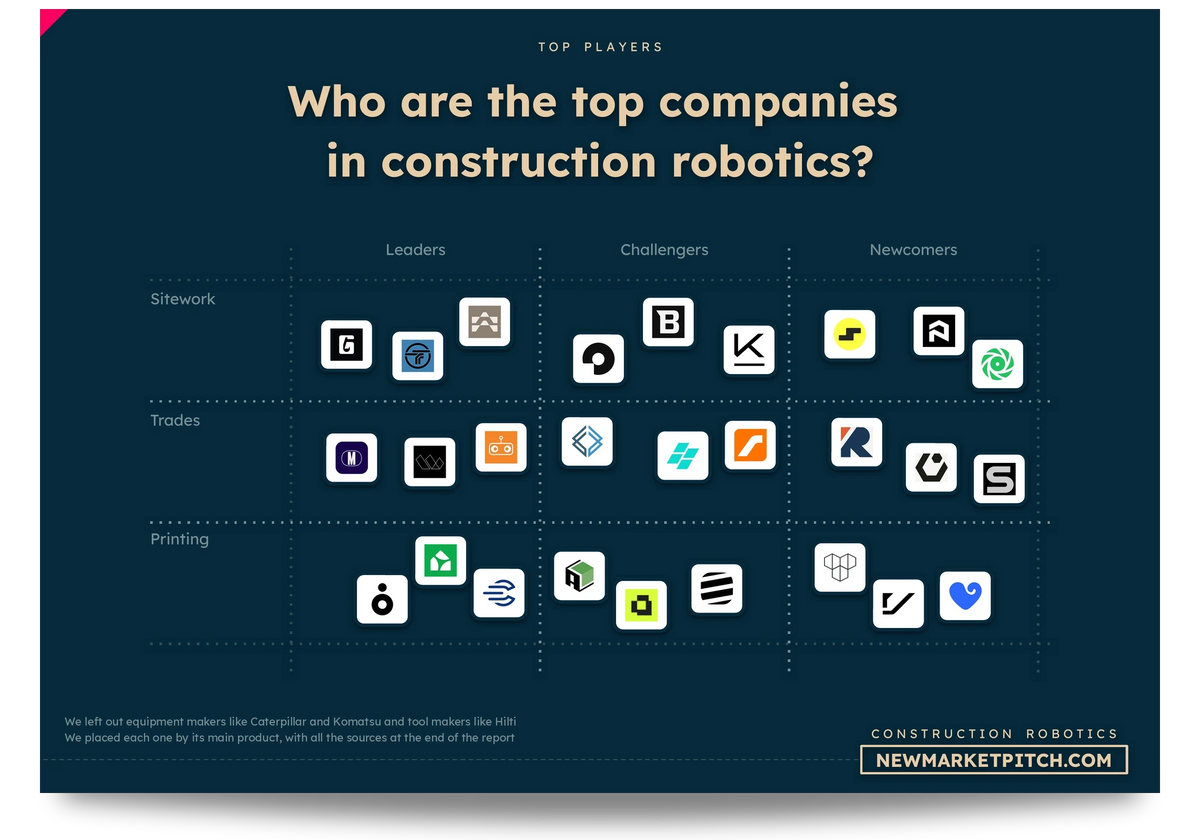
In our document detailing everything you need to know about construction robotics, we turn what is vague and complex into simple, useful visuals. Market maps like this one show you at a glance where every startup stands.
Written by the New Market Pitch teamWe track new markets so founders and investors can move faster. About us