What are the top construction robotics startups by revenue?
Whether you're building or investing in the construction robotics market, our report covers everything you need to know: the players, the money, and what's coming next.
Summary
Polyuse is the top construction robotics startup by revenue, followed by Reframe Systems, COBOD International, WASP, ICON, Q-Bot and Hyperion Robotics. Polyuse reported more than JPY 1.5B in FY2025 sales, making it the largest company in our ranking based on identifiable annual revenue.
The seven companies have very different financial evidence. Polyuse, COBOD, WASP and Hyperion report fiscal-year revenue, Reframe has an estimated annualized run-rate, ICON reports cumulative contract awards, and Q-Bot has disclosed cumulative installation sales. Their positions are useful for comparing commercial scale, but the figures are not interchangeable.
Polyuse stands out for its business model as much as its revenue. The Japanese company sells construction-scale concrete printers and earns additional income from preparing project-specific printing data, keeping it involved after equipment has been delivered.
Reframe Systems shows how integrated construction can produce substantial revenue from relatively few projects. Its estimated $15M annualized run-rate comes from a business that delivers entire homes, although just ten had been completed cumulatively by August 2026, far below its microfactory's advertised production capacity.
Construction 3D printing has produced some of the clearest financial disclosures, but growth has been inconsistent. COBOD's revenue fell 63.1% in 2025, while WASP's sales declined for two consecutive years. WASP nevertheless remained profitable, unlike COBOD.
ICON and Q-Bot illustrate why financial figures require careful interpretation. ICON's more than $370M in cumulative government contract awards establishes a large contracted pipeline, while Q-Bot's £11.6M in cumulative insulation-installation sales establishes real customer spending. Neither figure reveals current annual revenue.
No startup in our ranking has established more than $100M in verified annual revenue. Mature specialists such as Brokk and Aquajet operate at a substantially larger financial scale, showing how much ground newer construction robotics businesses still have to cover.
Some of the largest operations have no public revenue figures at all. Dusty Robotics has printed more than 300M square feet of construction layout, while Monumental reported a fleet exceeding 100 bricklaying robots and work on more than 40 projects by July 2026.
Solar construction and autonomous excavation are emerging as serious commercial applications. Terabase Energy has installed more than 100 MW using its construction automation system, and Bedrock Robotics has deployed autonomous excavators on active infrastructure projects. Their contract values and robotics revenue remain undisclosed.
The next leaders may emerge from companies that operate robots as a service rather than simply selling machines. Repeat construction work, strong equipment utilization and profitable project delivery will ultimately matter more than funding rounds, robot counts or impressive demonstration projects.

Written by the New Market Pitch teamWe track new markets so founders and investors can move faster. About us

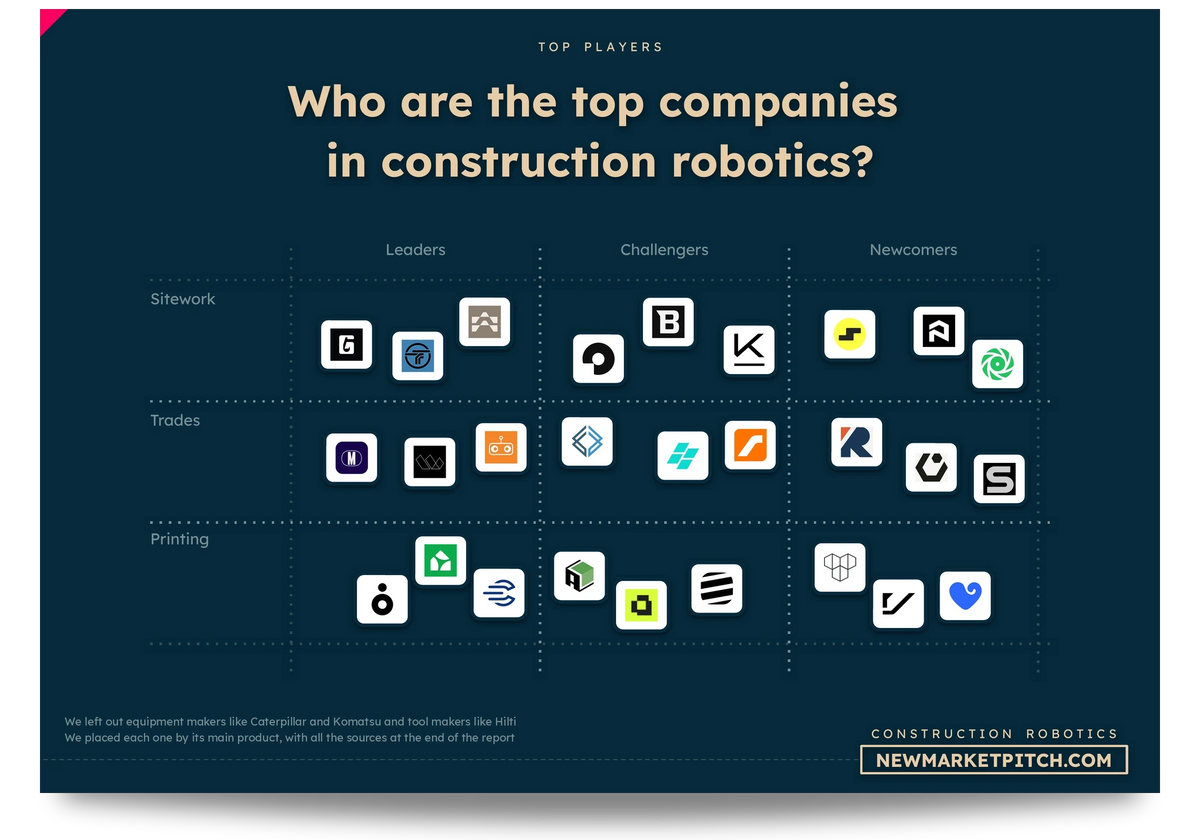
In our report covering the construction robotics market, we turn what is vague and complex into simple, useful visuals. Market maps like this one show you at a glance where every startup stands.
The ranking of top startups in the construction robotics market by revenue
Below is a table ranking the startups of this market by their current revenue scale. You can find our methodology at the end of this page.
If you want a deeper understanding of the market and its current dynamics, get our report on the construction robotics market.
| Ranking | Company | Latest Metric | Metric Type | Freshness | Disclosed When | Source Quality | Confidence | Segment | Why This Ranking | Local Metric | Country |
|---|---|---|---|---|---|---|---|---|---|---|---|
| 1 | Polyuse | >$10M | Fiscal-Year Revenue | Fresh · 7mo | Jun 1, 2026 | Company Disclosed | Medium | Construction 3D Printing | A direct recent company-wide sales claim outranks newer projections and cumulative contract awards; the fiscal-year boundary is inferred from the Japanese business calendar. | >JPY 1.5B | jp |
| 2 | Reframe Systems | ~$15M | Revenue Run-Rate | Very Fresh · 2mo | 2026 | Third-Party Estimate | Low | Robotic Prefabrication | The estimated run-rate is above Polyuse in dollars but is less reliable, and includes completed-home sales and conventional design-build work beyond robotic fabrication. | us | |
| 3 | COBOD International | ~$5.03M | Fiscal-Year Revenue | Fresh · 10mo | 2026 | Filed / Audited | High | Construction 3D Printing | Ranks below the larger Reframe estimate by amount, but its recent filed turnover is more reliable and confined to a robot manufacturer. FY2025 revenue declined from FY2024. | DKK 33.1M | dk |
| 4 | WASP | ~$4.76M | Fiscal-Year Revenue | Fresh · 10mo | Jul 8, 2026 | Filed / Audited | Medium | Construction 3D Printing | Reported FY2025 turnover is close to COBOD but lower; it covers WASP printers used in many sectors, not only construction-scale systems. | €4.21M | it |
| 5 | ICON | >$370M | Bookings | Very Fresh · 0mo | Oct 13, 2026 | Company Disclosed | Low | Construction 3D Printing | Cumulative multi-year government contract awards signal major commercial demand, but are neither recognized annual revenue nor entirely pure construction work; placed below current verified sales. | us | |
| 6 | Q-Bot | ~$14.7M | Cumulative Sales | Aging · 27mo | Jul 30, 2024 | Company Disclosed | Low | Robotic Installation | Cumulative UK installation revenue is proven commercial activity, but spans multiple years and includes partner installations; it cannot be compared directly with FY2025 sales. | £11.6M | gb |
| 7 | Hyperion Robotics | ~$569K | Fiscal-Year Revenue | Fresh · 16mo | Filed / Audited | Medium | Construction 3D Printing | The company has verified company-wide FY2025 turnover, but at a smaller scale than the recognized sales and substantial contract activity of the companies above. | €504K | fi | |
| 8 | Dusty Robotics | >300M sq ft printed | Other Scale Signal | Very Fresh · 6mo | Jul 30, 2026 | Company Disclosed | Low | Robotic Layout | A very large deployed layout fleet and cumulative work area indicate commercialization, but the square footage cannot be converted to sales; position relative to other nonfinancial rows is indicative. | us | |
| 9 | Fangshi Robotics | >500 projects | Other Scale Signal | Undated | Company Disclosed | Low | Robotic Finishing | The company reports hundreds of deployed construction projects, a strong scale signal, but no revenue figure. The cumulative project count cannot establish annual sales. | cn | ||
| 10 | Monumental | >100 robots | Other Scale Signal | Very Fresh · 3mo | Jul 18, 2026 | Company Disclosed | Low | Robotic Bricklaying | The deployed fleet across more than 40 projects is unusually tangible evidence of scale, although the number of robots is not recognized revenue. | nl | |
| 11 | Terabase Energy | >100 MW installed | Other Scale Signal | Fresh · 7mo | Mar 19, 2026 | Company Disclosed | Low | Robotic Solar Installation | A significant installed-capacity signal, but output is only part of a company also selling solar design and engineering software; revenues are not separated. | us | |
| 12 | Xpanner | >55 job sites | Other Scale Signal | Very Fresh · 2mo | Aug 2026 | Company Disclosed | Low | Robotic Installation | Site deployments indicate real contractor adoption, though the number of paying sites and hardware revenue is not disclosed. | us | |
| 13 | Civ Robotics | >20 GW project capacity | Other Scale Signal | Fresh · 13mo | Sep 2025 | Company Disclosed | Low | Robotic Layout | Robotic staking on large solar-construction projects demonstrates reach, but project capacity is not the value of the company contracts. | us | |
| 14 | Okibo | >3M sq ft finished | Other Scale Signal | Undated | Company Disclosed | Low | Robotic Finishing | The cumulative treated area suggests sustained commercial building work, yet its period and revenue per project are undisclosed. | il | ||
| 15 | Planted Solar | >10 MW installed | Other Scale Signal | Fresh · 10mo | Sep 15, 2026 | Company Disclosed | Low | Robotic Solar Installation | Realized 2025 installed capacity is preferable to its much larger projected 2026 deployments and 20 GW project pipeline, which are not revenue. | us | |
| 16 | Bedrock Robotics | 15 contractor partners | Other Scale Signal | Very Fresh · 2mo | Aug 17, 2026 | Company Disclosed | Low | Autonomous Earthmoving | The fifteen partners and first paid operator-free excavation projects make traction credible, but partners cannot be treated as paying customers or revenue. | us | |
| 17 | CyBe Construction | >35 countries sold into | Other Scale Signal | Historical · 34mo | 2023 | Credible Reported | Low | Construction 3D Printing | International printer sales confirm a commercial footprint. A €8M FY2023 sales target was not confirmed as realized, so the forecast is not reported as revenue. | nl | |
| 18 | Advanced Construction Robotics | 669K rebar ties | Other Scale Signal | Aging · 22mo | 2026 | Company Disclosed | Low | Robotic Rebar | Automated work completed on a named highway project is credible, but is one jobsite total rather than the entire fleet or company sales. | us | |
| 19 | Teleo | 12 deployments | Other Scale Signal | Very Fresh · 0mo | 2026 | Third-Party Estimate | Low | Autonomous Earthmoving | Site installations signal traction but include construction and mining uses, so the commercial perimeter is uncertain; now part of Havoc following a 2026 purchase. | us | |
| 20 | Automated Architecture (AUAR) | 2 microfactories | Other Scale Signal | Fresh · 10mo | 2026 | Company Disclosed | Low | Robotic Prefabrication | Two operating customer factories demonstrate paid-market readiness, but the count cannot establish recurring manufacturing or licensing revenue. | gb | |
| 21 | Origin | 2 pilot contractors | Other Scale Signal | Very Fresh · 0mo | Oct 15, 2026 | Company Disclosed | Low | Robotic Finishing | Active contractor pilots are newer but materially weaker evidence of revenue than paid deployments and completed production elsewhere in the ranking. | us | |
| 22 | Infravision | >3,000 miles installed | Other Scale Signal | Undated | Company Disclosed | Low | Robotic Infrastructure Installation | Substantial high-voltage-line stringing deployments demonstrate field use; distance traveled by drones does not represent company turnover and the date is not stated. | us | ||
| 23 | Mechasys | 9 deployments | Other Scale Signal | Undated | Third-Party Estimate | Low | Robotic Layout | Publicly documented deployments are narrower than a company-wide installed base; robotic drilling capabilities are newer and revenue remains undisclosed. | ca | ||
| 24 | Pronto | >100 trucks contracted | Other Scale Signal | Aging · 20mo | Feb 24, 2025 | Company Disclosed | Low | Autonomous Earthmoving | A contracted fleet is meaningful off-road automation scale, but largely relates to quarries and mining rather than construction-site excavation; no contract revenue is published. | us | |
| NR | Built Robotics | Not disclosed | Other Scale Signal | Undated | Credible Reported | Low | Autonomous Earthmoving | Commercial robotic pile-driving and equipment autonomy deployments are documented, but no consolidated sales or verified fleet sales are available. | us | ||
| NR | Canvas | Not disclosed | Other Scale Signal | Undated | Jan 6, 2026 | Credible Reported | Low | Robotic Finishing | Robotic drywall-finishing technology was sold to JLG in 2026; no current standalone Canvas revenue figure is available. | us |

Our research about construction robots gets updated several times a month, so you always get the latest view of where things stand.
Which construction robotics startups make the most revenue today?
Polyuse ranks first among construction robotics startups by revenue, followed by Reframe Systems, COBOD International, WASP, ICON, Q-Bot and Hyperion Robotics.
The Japanese company Polyuse reported more than JPY 1.5B in fiscal-year sales for FY2025, ended March 2026. Reframe Systems follows with an estimated ~$15M annualized revenue run-rate in August 2026, while COBOD International recorded DKK 33.1M in FY2025 revenue. WASP reported €4.21M for the same year.
The ranking becomes less straightforward after those four companies. ICON has secured more than $370M in cumulative government contract awards, but those are bookings rather than recognized revenue. Q-Bot disclosed £11.6M in cumulative UK insulation-installation sales through July 2024. Hyperion Robotics recorded €504K in fiscal-year revenue for the year ended June 2025.
These seven startups have financial indicators we can identify and assess. Another 17 ranked startups have measurable commercial activity, ranging from deployed robots to completed projects, but no comparable revenue disclosure. Built Robotics and Canvas remain unranked because their standalone revenue is unavailable.
| Rank | Startup | Financial figure | Metric and period |
|---|---|---|---|
| 1 | Polyuse | >JPY 1.5B | Fiscal-year revenue, FY2025 ended Mar 2026 |
| 2 | Reframe Systems | ~$15M | Estimated revenue run-rate, Aug 2026 |
| 3 | COBOD International | DKK 33.1M | Fiscal-year revenue, FY2025 |
| 4 | WASP | €4.21M | Fiscal-year revenue, FY2025 |
| 5 | ICON | >$370M | Cumulative government contract awards, through Oct 2026 |
| 6 | Q-Bot | £11.6M | Cumulative UK installation sales, through Jul 2024 |
| 7 | Hyperion Robotics | €504K | Fiscal-year revenue, year ended Jun 2025 |
How much revenue does Polyuse make?
Polyuse is currently the highest-ranked construction robotics startup, with more than JPY 1.5B in fiscal-year revenue for FY2025, ended March 2026.
The figure comes from a presentation by Polyuse's leadership published by Industry Co-Creation in June 2026. The company develops construction-scale concrete 3D printers and works with customers on infrastructure projects.
Its business extends beyond selling machines. Polyuse's leadership explained that the company also generates revenue from preparing project-specific printing data after equipment has been sold. That gives it another opportunity to earn money whenever customers start new construction projects.
It's a useful model in construction 3D printing, where manufacturers can otherwise depend heavily on occasional equipment purchases.
The revenue figure is company-disclosed rather than independently verified through publicly available audited accounts. Still, we have a direct fiscal-year sales claim, a defined commercial model and evidence that customers continue using the company's technology after purchasing equipment.

In our market report about construction robots, we look at what the winners do differently, so you can learn from the best instead of guessing.
Is Reframe Systems already making $15 million a year?
Reframe Systems reached an estimated ~$15M annualized revenue run-rate in August 2026, although that figure does not mean it has already recorded $15M in a completed fiscal year.
According to Sacra, the American startup delivered its first commercial home in late 2024, completed seven units during 2025 and had delivered ten homes cumulatively by August 2026.
Reframe's revenue model explains why relatively few completed homes can produce millions in annualized sales. An accessory dwelling unit can generate around $275,000 in contract revenue, a triple-decker unit around $400,000, and a developer-sold home can approach $789,000.
The company handles design, factory fabrication, transportation, site assembly and completion. That gives Reframe a much broader revenue base than a startup that only sells robotic equipment.
Its Massachusetts microfactory, FAB1, was designed for annual production of up to 500 multifamily units or 250 single-family homes. That capacity is far ahead of the company's demonstrated output, however. Reframe's own 2026 delivery target was 48 units, compared with seven completed during 2025.
Reframe is moving from individual projects toward factory production, but utilization remains the big challenge. The ~$15M figure is still a third-party estimate, and the next test is whether completed deliveries catch up with the factory's advertised capacity.
Is COBOD International still growing its construction 3D printing business?
COBOD International is one of the largest revenue-generating construction robotics startups in our ranking, but its sales have fallen sharply rather than continued growing.
Danish statutory financial records show DKK 33.1M in FY2025 revenue, compared with DKK 89.8M in 2024. That's a decline of approximately 63.1% in one year.
The longer history makes the slowdown harder to dismiss as an isolated fluctuation. COBOD recorded DKK 83.5M in 2021, DKK 116.8M in 2022, DKK 80.8M in 2023 and DKK 89.8M in 2024.
Its strongest year in that five-year period was 2022. Sales in 2025 were roughly 72% below that peak.
Profitability also deteriorated. COBOD reported a FY2025 net loss of approximately DKK 39.4M, compared with a small net profit in 2024.
COBOD has spent years developing and commercializing large-scale building printers, yet its revenue remains volatile.
There is clearly a market for the equipment. The harder question is whether customers will buy enough new printers each year to support steady growth and cover the manufacturer's operating costs.

In our document detailing everything you need to know about construction robotics, you will always find fresh funding data, taken straight from our own verified funding database.
How much money does WASP make from 3D printing?
WASP reported €4.21M in FY2025 revenue, placing the Italian 3D printing company fourth among construction robotics startups in our ranking.
Italian company-register data shows revenue of approximately €5.31M in 2023 and €5.11M in 2024. Sales then fell to €4.21M in 2025, a cumulative decline of approximately 20.7% over two years.
WASP remained profitable, reporting around €411,455 in FY2025 net profit. Its financial position looks considerably healthier than COBOD's, despite the recent revenue decline.
The two companies also sell different mixes of equipment. WASP manufactures printing systems for construction, design and other industrial applications, so its consolidated turnover includes activities beyond building-scale robotics.
We cannot isolate construction-printing revenue from its reported total. The €4.21M figure nevertheless establishes that WASP operates a revenue-generating manufacturing business, even as its recent sales have declined.
Is ICON making hundreds of millions from construction robots?
ICON has accumulated more than $370M in government contract awards, but its annual construction robotics revenue has not been disclosed at anything close to that amount.
In October 2026, the Austin-based startup announced a $200M Series D financing round, alongside more than 270 completed 3D-printed buildings and cumulative government contract awards exceeding $370M.
ICON also said it was on pace for fourfold revenue growth in 2026. Without the starting revenue figure, though, that percentage cannot tell us whether sales increased from $5M to $20M or from $25M to $100M.
Its commercial activities cover several areas, including printed housing, military construction, robotics manufacturing and government-funded development work. Revenue from those projects may be recognized over different periods and may include engineering or development services.
The company has clearly won large contracts. Its next financial milestone would be disclosing how much of that contracted work has become recognized annual revenue.
For now, ICON's contract awards demonstrate commercial demand on a scale that few construction robotics startups can match, while leaving its actual annual sales difficult to measure.

Learning from others' mistakes is the cheapest lesson there is. In our report covering the construction robotics market, we look at what broke startups before you, so you don't repeat it.
Is Q-Bot a real revenue-generating construction robotics company?
Q-Bot has already generated substantial sales from real construction work, with £11.6M in cumulative UK insulation-installation revenue reported through July 2024.
The British startup uses robotic equipment to install insulation beneath existing floors, reaching spaces that are difficult and disruptive to access manually.
An EMV Capital investor announcement connected the cumulative revenue to nearly 5,000 installations. Dividing £11.6M by approximately 5,000 jobs gives an indicative £2,320 in installation revenue per project.
That's our calculation from the reported figures, rather than a company-disclosed average price. The cumulative sales also include installations delivered through commercial partners.
Q-Bot's business is quite different from construction printer manufacturing. Instead of waiting for customers to buy a large robot, the company enables contractors to deliver a repeatable building-improvement service.
Customers have paid for thousands of installations. What remains unknown is the current annual sales rate, because £11.6M represents activity accumulated over multiple years.
Which construction 3D printing startups are actually making money?
Construction 3D printing currently has the clearest revenue evidence in construction robotics, with Polyuse, COBOD International, WASP and Hyperion Robotics all reporting fiscal-year sales.
Their reported figures cover very different commercial scales.
Polyuse disclosed more than JPY 1.5B for FY2025 ended March 2026. COBOD International recorded DKK 33.1M for calendar FY2025, while WASP reported €4.21M. Hyperion Robotics, the Finnish company developing robotic concrete manufacturing systems, recorded €504K for its fiscal year ended June 2025.
ICON adds substantial contract activity, while CyBe Construction has documented international equipment sales without a confirmed revenue figure.
Among these businesses, the reported sales cover different combinations of printers, services, software, materials and project work. That limits the precision of direct comparisons between their underlying robotics businesses.
Still, construction 3D printing has produced more identifiable financial disclosures than robotic bricklaying, layout or autonomous excavation in our ranking.
The weaker results of COBOD and WASP also show that the category's commercial development has been uneven. Construction 3D printing is an established revenue-generating activity for several startups, but there's little evidence of continuous growth across the whole group.

Your time is limited. In our research about construction robots, we put numbers on each part of the market, so you can see where it makes sense to focus.
Are any construction robotics startups making more than $100 million a year?
No construction robotics startup in our ranking has publicly established more than $100M in verified annual revenue.
Some headline numbers may suggest otherwise, particularly ICON's cumulative contract awards. But those awards cover multiple projects and periods, while Reframe Systems' estimated ~$15M reflects annualized activity rather than a completed fiscal year.
A robot manufacturer may have equipment operating in dozens of countries but sell relatively few new machines in a particular year. A construction automation provider may participate in a billion-dollar infrastructure project while receiving only a small fraction of the project's spending.
We found credible evidence of construction robotics companies making millions in annual revenue, but nothing in the eligible ranking that establishes a nine-figure annual revenue business.
That's still a substantial commercial gap between today's construction robotics startups and established industrial equipment manufacturers.
Which construction robotics startups have deployed the most robots?
Dusty Robotics and Monumental have some of the largest documented active robot deployments among construction robotics startups, even though neither discloses comparable annual revenue.
Dusty reported at least 125 robots active on construction sites in 2026, along with more than 300 million square feet of printed layout and over 500 jobsite implementations.
Monumental reported a fleet exceeding 100 bricklaying robots in July 2026. Its announcement also documented more than 40 projects and over 100 completed structures.
Those figures represent substantial field activity. The businesses, however, automate different tasks: Dusty prints layouts from digital plans, while Monumental operates robots that lay physical bricks on active construction sites.
Other startups report scale through projects or installed infrastructure rather than robot counts. Fangshi Robotics has completed hundreds of construction jobs, while Terabase Energy and Civ Robotics report activity tied to utility-scale solar construction.
Machine counts tell us how widely automation has spread, but reveal little about revenue without utilization, customer contracts and pricing data.
| Rank | Startup | Reported commercial scale | Period |
|---|---|---|---|
| 8 | Dusty Robotics | >300M sq ft printed | As of Apr 2026 |
| 9 | Fangshi Robotics | >500 projects | Cumulative, undated |
| 10 | Monumental | >100 robots | As of Jul 2026 |
| 11 | Terabase Energy | >100 MW installed | As of Mar 2026 |
| 12 | Xpanner | >55 job sites | As of Aug 2026 |
| 13 | Civ Robotics | >20 GW project capacity | As of Sep 2025 |
| 14 | Okibo | >3M sq ft finished | Cumulative, undated |
| 15 | Planted Solar | >10 MW installed | 2025 |
| 16 | Bedrock Robotics | 15 contractor partners | As of Aug 2026 |
| 17 | CyBe Construction | >35 countries sold into | As of 2023 |
| 18 | Advanced Construction Robotics | 669K rebar ties | One bridge project, as of 2024 |
| 19 | Teleo | 12 deployments | As of 2026 |
| 20 | Automated Architecture (AUAR) | 2 microfactories | As of Dec 2025 |
| 21 | Origin | 2 pilot contractors | As of Oct 2026 |
| 22 | Infravision | >3,000 miles installed | Cumulative, undated |
| 23 | Mechasys | 9 deployments | Undated |
| 24 | Pronto | >100 trucks contracted | As of Feb 2025 |

In our market report about construction robots, we always try to gather several sources and make estimates that make sense, so you can work with solid numbers.
Is Dusty Robotics one of the biggest construction robotics startups?
Dusty Robotics is already operating at a substantial scale in automated construction layout, although its revenue remains private.
The company's FieldPrinter robots take digital construction plans and print accurate markings directly onto building floors. This allows multiple trades to work from coordinated physical layouts instead of repeatedly measuring and marking the same spaces.
Dusty has published particularly useful productivity evidence from data-center projects.
On a Mortenson project involving two data centers and approximately 700,000 square feet of construction, Dusty's system enabled five trades to be laid out in one day rather than five separate days.
Another documented project with Align reported a 98% reduction in layout labor and 784 person-hours saved.
That's a compelling argument for robotic layout. Errors and repeated manual measurements can delay several trades at once, and even modest improvements can save contractors a lot of time.
Civ Robotics and Mechasys operate in related areas but with different applications. Civ reported autonomous staking across solar projects representing more than 20 GW of capacity by September 2025. Mechasys has nine documented deployments of its projection-based layout systems.
Civ's figure describes the capacity of projects served, while Mechasys' count covers documented installations rather than a complete commercial fleet.
Dusty's reported activity is particularly extensive, but we still cannot calculate its annual sales from total printed square footage.
Is Monumental turning robotic bricklaying into a large business?
Monumental has developed one of the most convincing commercial robotic bricklaying operations, with more than 100 robots working on real construction sites.
The Amsterdam startup announced a $32M Series B led by Khosla Ventures in July 2026. By then, it had completed work on more than 40 projects and contributed to over 100 structures.
An important detail is how Monumental sells its service. The company operates its own robots as a masonry subcontractor instead of requiring builders to purchase the machines.
That allows contractors to buy completed brickwork through a familiar commercial arrangement. Monumental handles the robotics, operations and equipment maintenance.
Its technology has been used on residential buildings and other structures in the Netherlands, with expansion activities in the United Kingdom and plans to enter the United States.
The company has also described producing around 30 robots per quarter at its Amsterdam workshop. That suggests a manufacturing operation capable of expanding the fleet, although workshop output should not be confused with customer demand or paid utilization.
Monumental has proved it can repeatedly complete building work with robots. Its undisclosed revenue and profit per project are now the biggest unknowns in judging the business's financial scale.

If you build or invest in the construction robotics market, you need to know which business models pay off now and which ones are fading. That's why our report covering it has a whole section on it.
Are solar construction robots becoming a major business?
Terabase Energy and Planted Solar have demonstrated that robots can already perform meaningful work on commercial solar installations, although their actual robotics revenue remains undisclosed.
Terabase reported more than 100 MW of installed capacity involving its Terafab construction automation system as of March 2026.
The system helps automate assembly and installation processes for large solar projects, where thousands of similar components must be positioned and connected.
Planted Solar reported more than 10 MW installed during 2025. In September 2026, the company announced a $31.8M financing round intended to expand its robotic fleet and support the launch of its next-generation Sage robot.
The commercial appeal is easy to understand. Solar farms involve repetitive construction work over large areas, making them better suited to standardized machines than many customized building projects.
Yet the companies' reported megawatts measure project output rather than revenue.
Both businesses are performing real installations. The size of their contracts, the share attributable specifically to robotics and the profitability of those installations remain undisclosed.
Are robotic finishing startups already making money?
Robotic finishing startups have reached real construction sites, but public revenue figures are still scarce across the category.
Fangshi Robotics reports more than 500 completed projects and over 15 million square meters of construction work. Okibo has disclosed more than 3 million square feet of robot-finished surfaces across over 100 projects.
That repeated activity is more convincing than a single prototype demonstration.
Origin is at an earlier stage. The San Francisco startup emerged from stealth in October 2026 with $20M in funding and active pilots involving two major US drywall contractors.
Its OG-1 robot applies compound, sands and primes walls. Origin has said it plans to expand the same robotic platform into other interior trades, including drywall installation and drilling.
The newer approach contrasts with specialized finishing robots designed around one narrower application. A machine capable of handling several construction tasks could achieve better utilization if contractors can deploy it across different phases of work.
For now, completed work tells us more than financial results. Fangshi and Okibo have meaningful project histories; Origin has early customer deployments and a broader technology ambition.

In our report covering the construction robotics market, we don't want to repeat what boring consulting reports say. Instead, we show you the real and latest market signals that matter.
Can Bedrock Robotics become a major construction robotics business?
Bedrock Robotics has moved autonomous excavation into real infrastructure projects, making it one of the more promising newer construction robotics startups despite having no disclosed revenue figure.
In August 2026, the company announced excavators operating autonomously on active customer sites, including a Nevada water-treatment project with Sundt Construction, major earthmoving work in Texas with Champion Site Prep and a civil construction project with Zachry Construction.
Bedrock reported 15 contractor partners across 23 US states.
The named projects are particularly useful evidence. They demonstrate that autonomous equipment is being used in actual construction work, where productivity and reliability can be judged against conventional excavator operations.
The company still needs to show how much contractors pay and whether its autonomy systems can maintain high utilization without excessive remote support or maintenance costs.
Other startups are targeting related heavy-equipment applications. Teleo, now part of Havoc following a 2026 acquisition, has 12 documented deployments involving supervised equipment autonomy.
Pronto reported an agreement covering more than 100 autonomous haul trucks for Heidelberg Materials in February 2025. Those machines mainly serve quarrying and materials operations rather than conventional building sites.
Bedrock's construction-focused customer projects stand out in this group. Teleo and Pronto demonstrate that off-road autonomy has commercial applications beyond construction, but neither company's deployment figures establish annual revenue.
Are construction robotics startups selling machines or construction services?
Construction robotics startups make money through several different models, and the companies with the largest reported financial figures do not all sell robots directly.
Polyuse, COBOD International and WASP manufacture construction-printing equipment, although they differ in their service and software activities.
Reframe Systems generates revenue through completed housing projects and design-build contracts. ICON combines construction systems with project work and government contracts. Q-Bot enables installation services using its robots.
Among companies without reported revenue, Dusty Robotics sells access to automated layout capabilities, while Monumental operates robotic bricklaying as a subcontractor.
The difference affects the revenue a company can recognize from a single customer.
A robotic equipment manufacturer records sales associated with machines and related services. A vertically integrated builder can recognize revenue from an entire completed home, including materials and conventional construction activities.
That means a $10M construction-services business may have a very different robotics manufacturing operation from a $10M robot manufacturer.
It also changes the growth challenge. Hardware manufacturers need equipment demand and manufacturing capacity, while service providers need enough crews, sites and robot utilization to deliver projects profitably.

In our research about construction robots, we like to show you the big picture. We know your time is precious, so we make every page quick to read and packed with as much learning as possible per minute.
Why aren't construction robotics startups generating more revenue yet?
Construction robotics startups have made real commercial progress, but large, repeatable annual revenue remains uncommon because construction projects are difficult to standardize and equipment demand can be uneven.
COBOD's financial history gives us one concrete example. Its sales peaked in 2022 and declined sharply by 2025, despite years of international construction-printing activity.
Integrated homebuilding has different constraints. Reframe must manage permitting, manufacturing, transportation, site preparation and completed housing delivery before the corresponding project revenue is recognized.
Robotic subcontractors face the problem of keeping machines busy across different customers and locations. A construction robot may work efficiently on one project but sit idle while the next site is prepared.
Autonomous earthmoving adds another layer of complexity. Systems must operate reliably around changing terrain, equipment, workers and construction schedules.
Some of these problems will become easier as deployments increase, but current evidence doesn't support treating all construction robotics applications as equally ready for mass adoption.
Startups with repeatable tasks, large project volumes and clear customer savings are in the best position to turn working robots into substantial recurring sales.
Are construction robotics startups catching up with established manufacturers?
Construction robotics startups are becoming more capable, but established specialist manufacturers still provide examples of much larger verified annual revenue.
Brokk, an established robotic demolition manufacturer owned by Lifco, recorded SEK 724M in FY2025 turnover according to Swedish financial records.
Aquajet Systems, another mature Lifco-owned business specializing in robotic hydrodemolition, recorded SEK 204M for the same year.
Both companies are outside our startup ranking because of their founding histories and corporate ownership.
Their results provide a useful financial comparison. Brokk alone recorded annual turnover several times greater than the verified fiscal-year sales of most young construction robotics manufacturers.
Robotic demolition has well-established industrial uses and customer purchasing patterns. Many newer construction robotics startups are still developing the sales and service models that could support similarly consistent demand.

When you build or invest in the construction robotics market, you need clarity, not confusion. In our market report about construction robots, we always try to put numbers on and quantify whatever is usually vague and confusing.
Will acquisitions change who wins in construction robotics?
Acquisitions are already bringing construction robotics technology into major equipment manufacturers, although the financial benefits are still difficult to measure.
In January 2026, JLG Industries, part of Oshkosh Corporation, announced the acquisition of Canvas's core robotic drywall-finishing technology and associated team.
Canvas had developed automated interior finishing systems using construction access platforms. JLG plans to integrate that technology into broader equipment and autonomy development.
The acquisition gives Canvas's technology access to a larger industrial organization with established manufacturing, distribution and customer relationships.
Canvas remains unranked because no reliable standalone revenue figure has been disclosed. It stays within our startup coverage following the recent transaction.
Teleo is another recent acquisition example. Its autonomy technology is now part of Havoc, but its standalone commercial revenue remains unavailable.
Built Robotics also remains unranked despite documented activity in robotic construction equipment and pile-driving automation.
Construction robotics startups can become strategically valuable before disclosing significant annual sales. Acquirers may benefit from their technology even when the acquired business's financial scale is unclear.
Which construction robotics startups look most likely to grow next?
Construction robotics startups with repeat customers, working machines and a clear way to charge for their work have the strongest evidence of commercial potential today.
Polyuse has demonstrated a substantial fiscal-year revenue base. Reframe Systems has a growing integrated housing business, although its factory production needs to catch up with capacity.
ICON has major awarded contracts and a broader construction technology platform, giving it substantial commercial opportunities if those contracts translate into recognized sales.
Among companies without financial disclosures, Dusty Robotics has established widespread use of automated layout, and Monumental has built a significant robot-enabled masonry operation.
Terabase Energy has demonstrated utility-scale solar installation automation, while Bedrock Robotics has begun deploying autonomous excavators on named infrastructure projects.
We wouldn't assume that the company with the most funding or largest fleet will automatically generate the most revenue.
The real commercial tests are repeat purchases, paid utilization, completed project volumes and the ability to operate equipment profitably across different customer sites.
The strongest candidates already have customers and working deployments, even if their financial reporting remains incomplete.

A good product starts with a real problem. In our document detailing everything you need to know about construction robotics, we show you the ones customers still live with.
What are the top construction robotics startups by revenue right now?
Polyuse is the top construction robotics startup by revenue in our ranking, followed in order by Reframe Systems, COBOD International, WASP, ICON, Q-Bot and Hyperion Robotics.
The ranking shows how young this market remains financially. Seven startups have identifiable financial indicators, but those figures include annual sales, estimated run-rate, cumulative bookings and cumulative installation revenue. Another 17 ranked startups have operating evidence without comparable financial disclosures.
Construction 3D printing, despite producing several of the clearest financial disclosures, has not enjoyed uninterrupted growth. The declines reported by two established startups in that category are a reminder that technology adoption doesn't necessarily produce predictable equipment sales.
Meanwhile, robotic layout, bricklaying, solar installation and autonomous excavation are producing more evidence from real construction sites.
The industry's commercial activity is much easier to prove than its total revenue. Polyuse holds the top position on the available financial evidence, and the next major milestone will be a broader group of startups demonstrating substantial, repeatable annual sales.
Our methodology
We ranked construction robotics startups by the strongest available evidence of current revenue scale as of November 2026. The analysis covers companies developing robotic systems for building construction, concrete printing, masonry, interior finishing, layout, earthmoving, infrastructure installation and related construction activities.
We used one startup definition throughout: companies founded in 2000 or later that remain independent, or first went public within the past five years. Businesses acquired within the previous three years remain eligible and are identified with their acquirers. Established manufacturers and long-standing subsidiaries are excluded from the startup ranking.
We reviewed public disclosures from the previous ten years, prioritizing statutory accounts, annual reports, regulatory filings, company announcements, management statements, investor materials and credible independent financial reporting. We selected one principal indicator per company based on relevance to revenue, source reliability and recency.
Recognized annual revenue received priority where available. We also considered trailing revenue, ARR, annualized run-rates, cumulative sales and bookings, but kept these measures clearly distinguished. For companies without usable financial disclosures, we used commercial activity such as deployed robots, completed projects, installed capacity and construction work performed. We did not estimate revenue by multiplying equipment counts or project volumes by assumed prices.
The ranking includes businesses with different revenue models, from equipment manufacturers to robotic subcontractors and integrated homebuilders. Reported turnover may include conventional construction, materials, engineering services or non-construction printing applications. We identify those differences where they affect comparisons. The first seven positions use financial indicators, while positions 8 through 24 use operational evidence and should not be interpreted as a strict revenue ranking.
Key financial sources include Industry Co-Creation's presentation on Polyuse's FY2025 sales, Sacra's analysis of Reframe Systems, COBOD International's Danish financial records, WASP's Italian company-register records, ICON's October 2026 financing and contracts announcement, EMV Capital's Q-Bot investment announcement, and Hyperion Robotics' Finnish company accounts.
For commercial deployments, we used Dusty Robotics' construction productivity reports, Monumental's Series B announcement, Fangshi Robotics' operating figures, Terabase Energy's Terafab information, Civ Robotics' solar deployment figures, Okibo's project figures, and Planted Solar's financing and installation announcement.
Additional sources include Bedrock Robotics' autonomous excavation announcement, Advanced Construction Robotics' bridge project, Origin's launch announcement, Automated Architecture's 2025 review, and JLG's acquisition of Canvas technology. For comparisons with mature manufacturers, we used Brokk's financial records and Aquajet Systems' financial records.

In our report covering the construction robotics market, we try to remove everything that could confuse you, especially if you're investing or building in this market.
Written by the New Market Pitch teamWe track new markets so founders and investors can move faster. About us