Which FinTech startups still have the strongest growth engines?
Building a startup or looking for your next investment in FinTech? Our report gives you the full picture.
Summary
Stripe, Revolut, Airwallex and Ramp have the strongest FinTech growth engines today, with Stripe still leading overall because it combines exceptional scale with several additional products that can keep increasing the value of each customer.
The interesting split is between growth power and growth intensity. Stripe and Revolut are adding more absolute business, while Airwallex and Ramp are expanding faster from smaller, but already substantial, bases.
Cross-selling has become just as important as acquiring new customers. The strongest companies can win a customer through one product and then expand into billing, cards, treasury, foreign exchange, procurement, lending, fraud tools or other financial workflows.
Revolut stands out because consumer FinTech has otherwise lost ground to business infrastructure. Its customer base is still growing rapidly, but the stronger evidence is that more users are making Revolut their primary account and using several products rather than treating it as a secondary card.
Airwallex has one of the clearest international growth engines in the sector. Its expansion is supported by regulatory infrastructure, local licenses and a product stack that lets the company follow customers across countries instead of repeatedly starting from zero.
Ramp's growth is increasingly about becoming a finance operating system rather than simply selling corporate cards. Its move into larger enterprises and deeper workflows makes the business more durable than an interchange-only model.
Checkout.com's recovery looks real because payment volume, net revenue, U.S. expansion and profitability are improving together. The company is no longer simply trying to regain lost growth; it has a credible new geographic engine.
Mercury and Plaid show two different ways a second act can emerge. Mercury is widening beyond technology startups into mainstream business banking, while Plaid is trying to turn its connectivity network into infrastructure for payments, fraud detection, identity and credit decisions.
Interest rates and lending risk still separate the strongest models from more cyclical FinTech businesses. Stripe, Checkout.com, Airwallex and Plaid can grow substantially without having to expand a large credit book alongside revenue.
The broader pattern is that private FinTech growth has shifted toward platforms that sit inside recurring business workflows. Payments, spend management, banking infrastructure and financial data become stronger businesses when customer activity itself creates more transactions and more opportunities to sell additional products.
Stripe remains the best overall growth engine, but its lead is less comfortable than it once was. Revolut has built a huge consumer platform, while Airwallex and Ramp are growing quickly enough that another few years at anything close to their current pace could materially change the ranking.

Written by the New Market Pitch teamWe track new markets so founders and investors can move faster. About us

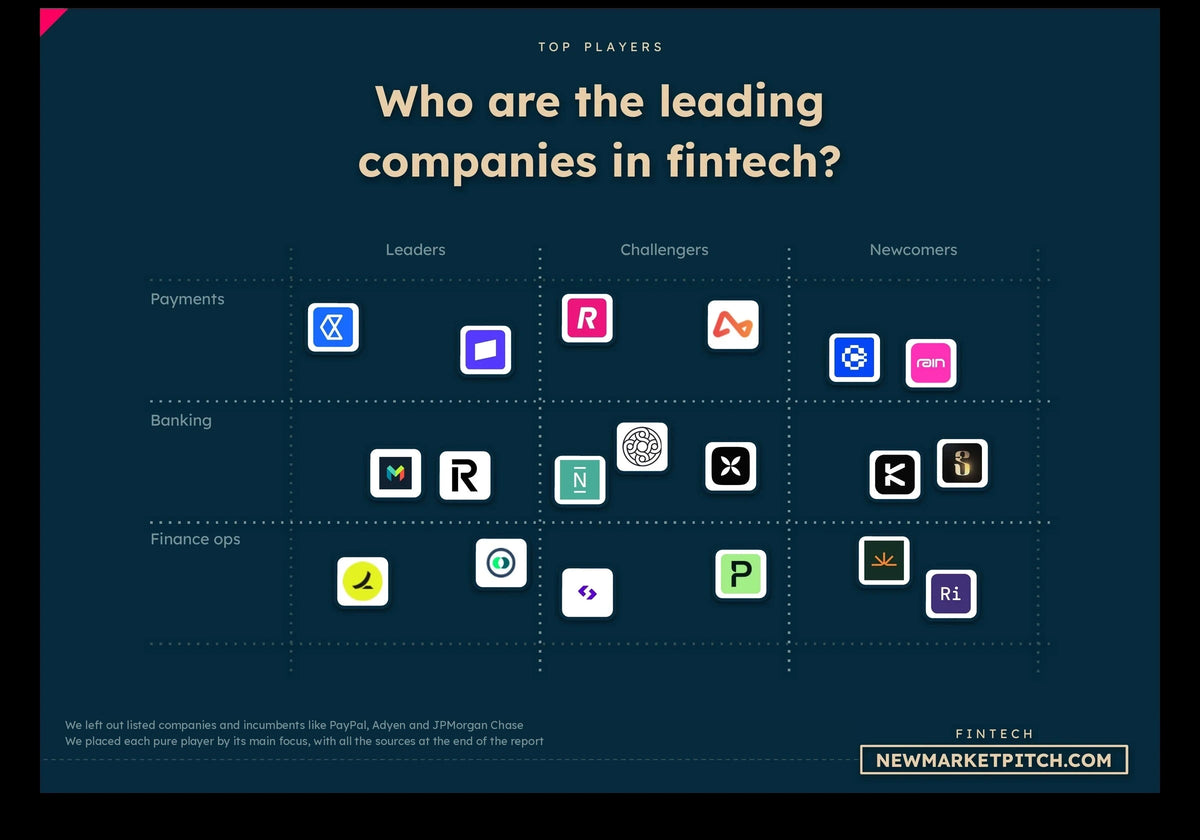
In our report covering the fintech market, we turn what is vague and complex into simple, useful visuals. Market maps like this one show you at a glance where every startup stands.
What do we actually mean by a strong FinTech growth engine today?
A strong FinTech growth engine today is a business that can keep adding customers, transactions and revenue per customer at the same time, without needing perfect market conditions to make the numbers work.
That definition rules out a simple ranking by revenue growth. A small company can double from a tiny base. A lender can temporarily grow quickly by extending much more credit. A neobank can get an earnings boost when interest rates rise. None of those things necessarily creates a durable growth machine.
The companies we care about here have several ways to compound.
Stripe can win a merchant through payments and later sell billing, tax, fraud prevention or issuing. Revolut can acquire someone with a free account and gradually add subscriptions, cards, foreign exchange, investing and credit. Airwallex can follow the same company into more countries and more financial products. Ramp can start with a corporate card and move into expenses, bill payments, procurement, travel and treasury.
That gives us a tougher test than “who is growing fastest?” We want to know which FinTech companies still have several large sources of growth left after already reaching meaningful scale.
Which private FinTech companies are still growing unusually fast?
Airwallex and Ramp currently have the most aggressive growth profiles among large private FinTech companies, while Stripe and Revolut are adding far more absolute business because they are already much larger.
Stripe's platform processed $1.9 trillion in 2025, 34% more than the previous year. Revolut increased revenue 46% to about $6 billion. Airwallex reached roughly $1.2 billion of annualized revenue after growing revenue around 80% over the previous year. Ramp has publicly confirmed annualized revenue above $1 billion, while reporting around its latest financing put the run rate above $1.5 billion.
The next group is smaller but still moving quickly. Checkout.com has reached $750 million of annualized net revenue, up 28%. Mercury has reached $650 million of annualized revenue. Plaid passed $500 million of ARR after revenue growth reaccelerated to almost 40%. Payhawk recently crossed $100 million of ARR while payment volume grew 95%.
The gap between percentage growth and actual growth is important. Adding 40% on $500 million creates roughly $200 million of additional annualized revenue. Adding 34% to $1.4 trillion of payments produces almost half a trillion dollars of additional transaction volume.
So we should not crown one company simply because its percentage is higher. Right now, Stripe and Revolut have the greatest growth power, while Airwallex and Ramp have the highest growth intensity at billion-dollar scale.
| Company | Current scale | Recent growth | What is driving it |
|---|---|---|---|
| Stripe | $1.9T payment volume | Volume +34% | Merchant growth and software cross-sell |
| Revolut | ~$6B revenue | Revenue +46% | Customers and more products per customer |
| Airwallex | ~$1.2B annualized revenue | Revenue around +80% | International expansion and multi-product adoption |
| Ramp | $1B+ disclosed annualized revenue | Run rate reported above $1.5B | Customer growth and deeper finance workflows |
| Checkout.com | $750M annualized net revenue | +28% | Enterprise payments and U.S. expansion |
| Mercury | $650M annualized revenue | Transaction volume +59% | Business banking and broader customer mix |
| Plaid | $500M+ ARR | Revenue nearly +40% | Data network plus newer products |
| Payhawk | $100M+ ARR | Payment volume +95% | European spend management and automation |

Our research about fintech companies gets updated several times a month, so you always get the latest view of where things stand.
Is Stripe still growing fast enough to be the FinTech leader?
Yes. Stripe is still the strongest overall FinTech growth engine because 34% payment-volume growth from a $1.9 trillion base is enormous, and payments are no longer the company's only serious source of expansion.
Stripe added roughly $500 billion of payment volume in a single year. Across two years, businesses running on Stripe added around $900 billion of annual transaction volume.
Very few FinTech companies ever reach that scale. Almost none continue growing above 30% once they get there.
Stripe also has a second engine that is becoming large enough to change the story. The company's Revenue suite, which includes Billing, Tax and Invoicing, is heading toward a $1 billion annual run rate. Stripe already serves more than five million businesses directly or through platforms, so it can distribute new financial products into an unusually large installed base.
The customer mix gives Stripe another advantage. According to its latest annual update, the platform powers 90% of the Dow Jones Industrial Average and 80% of the Nasdaq 100 while continuing to pick up newly created technology companies.
That gives Stripe exposure to both ends of the market: giant companies processing huge existing volumes and younger companies whose transaction volumes can compound for years.
Stripe is no longer the fastest private FinTech by percentage growth. It does not need to be. At its current scale, another year of growth anywhere near the recent rate would add more economic activity than many large FinTech companies process altogether.
If you want more recent data on this point, please see our latest FinTech market report.
Does Revolut have the strongest consumer FinTech engine now?
Revolut currently has the strongest consumer FinTech growth engine because it is still adding users quickly while getting existing customers to use the app for more of their financial lives.
Revolut ended 2025 with 68.3 million retail customers, up 30%, but that figure is already dated. The company now says it has more than 80 million customers and is adding roughly one million every 17 days.
The deeper number is primary-bank adoption. Revolut reported a 45% increase in customers using it as their main account, faster than overall customer growth.
That is a much better sign than app downloads.
Revenue increased 46% to approximately $6 billion, and the company now has 11 separate product lines generating more than £100 million each. Subscriptions, payments, foreign exchange, wealth products and business banking are all meaningful businesses rather than side experiments.
Customer balances also rose 66% to about $67.5 billion during 2025.
The latest expansion into regulated banking strengthens that model. Revolut has recently received additional banking approvals in France and Colombia as it pushes toward a much wider global footprint.
The growth loop is increasingly clear. Revolut attracts users with a simple account, convinces more of them to use it as their main bank, holds more of their money and then sells several financial products through the same interface.
Among private consumer FinTech companies, nobody else currently combines this customer velocity, product breadth and revenue scale.

In our market report about fintech companies, we look at what the winners do differently, so you can learn from the best instead of guessing.
Is Revolut's growth still being inflated by high interest rates?
Revolut's growth now looks much broader than an interest-rate trade because fee-based businesses are expanding faster than the interest line itself.
Interest income undoubtedly helped. Large customer balances became much more valuable when rates rose, and Revolut benefited from that like other banks and neobanks.
But interest income represented only about 22% of 2025 turnover. Fee-based activities generated roughly three-quarters of revenue.
Several of the faster-growing businesses have little connection to deposit yields. Card-payment revenue increased 45%, subscriptions 67% and foreign exchange 43%. Business customers increased 33%.
Interest income, by comparison, grew around 23%.
That difference tells us where most of the acceleration actually came from.
Lower rates could still take some profit out of the model, especially if Revolut continues accumulating deposits. They would not erase the underlying customer engine. Today, Revolut increasingly makes money because customers transact and buy more products, rather than simply because cash sitting in accounts earns a high yield.
Is Airwallex growing faster than the biggest FinTech companies?
Airwallex is currently growing faster than Stripe and Revolut in percentage terms, and it has already become large enough for that growth to be meaningful.
Airwallex reached about $1.2 billion of annualized revenue and $266 billion of annualized transaction volume by the end of 2025. More recently, the company described revenue as having grown around 80% year over year when it announced its latest funding.
Its regional growth shows why the engine still has room.
APAC revenue increased 85% during 2025. In Singapore, revenue increased 107% for a second consecutive year of triple-digit growth. Airwallex now serves more than 200,000 companies and holds roughly 80 licenses across North America, Europe, the Middle East and Asia-Pacific.
The geographic spread is doing real work here. Airwallex can enter a market with cross-border payments and foreign exchange, then add accounts, cards, billing, payment acceptance and expense management.
Many customers consequently use several products.
Airwallex is therefore hard to compare with a standard payments processor. The company is using payments as the entry point into a much broader financial operating system for companies that do business across borders.
The next test is whether growth stays exceptional as the revenue base moves well beyond $1 billion. For now, the evidence still says yes.
If you want more recent data on this point, please see our latest FinTech market report.

In our document detailing everything you need to know about fintech, you will always find fresh funding data, taken straight from our own verified funding database.
Is Ramp still growing fast enough to justify all the excitement?
Ramp is still one of the fastest-growing large FinTech startups, and its latest numbers show that the company has plenty of room left inside the U.S. business market.
Ramp now serves more than 70,000 companies and processes more than $100 billion of annualized purchases across cards and accounts payable.
The company publicly says annualized revenue is above $1 billion. Around its latest financing, Bloomberg reporting cited by TechCrunch put the figure above $1.5 billion.
The path into larger companies has become especially important. Ramp said its enterprise customer base grew 133% during 2025, and customers now include companies such as Shopify and CBRE rather than mainly startups and smaller businesses.
Ramp is also getting more useful after the card sale.
A company can adopt Ramp for corporate cards, then add expense management, bill payments, procurement, travel, treasury and bookkeeping automation. The more of those workflows Ramp controls, the less its future depends on card interchange alone.
AI fits naturally into that setup. Ramp already sees the transactions, invoices, accounting categories, approval chains and spending policies. Its AI products therefore automate workflows that customers are already running inside Ramp.
That is much more useful than dropping a chatbot next to a financial dashboard.
Ramp's biggest question is no longer whether it can grow quickly. It can. The harder question is whether a company now valued at $44 billion can keep expanding fast enough for several more years. Operationally, though, Ramp still belongs in the top group.
Has Checkout.com really regained its growth engine?
Checkout.com has clearly recovered: it is growing payment volume, net revenue and profit at the same time, with the U.S. now becoming a major new source of expansion.
Checkout.com recently disclosed $750 million of annualized net revenue, 28% higher than a year earlier. It expects roughly $480 billion of payment volume across the full year and approximately $150 million of adjusted EBITDA.
The U.S. business has become the most interesting part of the story. Processing volume there has increased more than 120% this year, and the country now represents 20% of Checkout.com's total volume versus 15% previously.
The customer base is also broader than it was during the company's earlier hypergrowth period. Checkout.com now serves more than 1,700 enterprise merchants, including Microsoft, Spotify, Uber, eBay and Sony.
That reduces the importance of any one merchant or one category of ecommerce.
Checkout.com's recovery therefore looks substantially healthier than a simple volume rebound. The business is adding large merchants, expanding geographically and producing stronger margins at the same time.
Among the major private payments companies, Checkout.com now deserves to be discussed much closer to Stripe and Airwallex than its post-2022 reputation would suggest.

Learning from others' mistakes is the cheapest lesson there is. In our report covering the fintech market, we look at what broke startups before you, so you don't repeat it.
Is Mercury becoming a real business bank rather than a startup bank?
Mercury is quickly moving beyond the startup niche, and that broadening customer base may be its most important growth development right now.
Mercury reached $650 million of annualized revenue and processed $248 billion of transactions in 2025, up 59% from $156 billion the previous year.
The company now serves more than 300,000 customers.
More revealingly, 73% of new customers are coming from outside the AI and technology-startup category. Mercury increasingly serves ecommerce companies, professional-services firms and other conventional businesses.
New business formation is helping as well. Mercury said its applications increased 2.5 times year over year during the first quarter, compared with an 18% increase in U.S. business applications overall.
That is a large gap. Some of it comes from the current startup boom around AI, but Mercury appears to be gaining share at the same time.
Existing customers can now use cards, payments, invoicing and other financial tools alongside the core bank account. Mercury has also applied for a national bank charter, which could eventually give it more control over the infrastructure underneath the product.
Mercury is still much smaller than Stripe, Revolut or Airwallex. Yet 59% transaction growth from a quarter-trillion-dollar base makes it too large to dismiss as an early-stage challenger.
If you want more recent data on this point, please see our latest FinTech market report.
Has Plaid found a second act after bank linking?
Plaid has found a credible second growth engine, and the company now looks much less dependent on the simple bank-linking product that made it famous.
Plaid passed $500 million of ARR in late 2025 while revenue grew almost 40%. It also added roughly 1,800 enterprise customers during the year.
The more interesting work is happening outside basic connectivity.
Plaid has expanded into payments, fraud detection, identity and credit underwriting. This year it also introduced financial foundation models trained on activity across the Plaid network.
Some early product results are striking. Plaid says its new LendScore 2 model produces 42% greater predictive power than traditional cash-flow data alone, while LendScore Arc increased approvals for subprime borrowers by 20% in early testing. A new fraud model caught up to 41% more fraud at the same false-positive rate.
We should treat vendor testing cautiously, but these products show where Plaid is going.
Plaid already sits between consumers' bank accounts and thousands of financial applications. If it can use that position to help companies decide whether to approve a payment, trust an identity or extend credit, the amount it can earn from each connection increases considerably.
Today's Plaid is a broader infrastructure business than the company that struggled when consumer FinTech activity slowed after 2021.

Your time is limited. In our research about fintech companies, we put numbers on each part of the market, so you can see where it makes sense to focus.
Is Payhawk big enough to matter in this ranking?
Payhawk is still far smaller than the leaders, but its recent growth is strong enough to make it one of the most interesting FinTech companies below the billion-dollar revenue tier.
Payhawk recently passed $100 million of ARR.
Payment volume increased 95% year over year, while net new business grew 159%. The company produced that growth with a sales team that was 10% smaller.
ARR per employee rose 75% to around $238,000.
Those figures suggest that Payhawk is becoming more efficient while it scales, which is harder than simply adding salespeople and buying growth.
The product is also widening. Like Ramp, Payhawk started with cards and expenses and has moved into accounts payable, procurement, travel and broader financial operations.
Its AI push is worth watching for the same reason. Payhawk says automated systems now resolve 76% of support requests, so at least part of the AI story can be measured through operating efficiency rather than marketing claims.
We should not put Payhawk beside Ramp on absolute scale. The gap remains huge.
But among European FinTech challengers, a company above $100 million of ARR with payment volume almost doubling deserves attention.
Are the best FinTech companies still finding lots of new customers, or mostly selling more to old ones?
The strongest FinTech companies currently do both, but cross-selling is becoming the difference between a good growth business and a truly powerful one.
Customer acquisition eventually becomes harder and more expensive. Selling a second or third product to somebody who already trusts the platform changes the economics.
Stripe has perhaps the clearest version of this. Payments bring a merchant onto the platform, after which Billing, Tax, Invoicing, Radar, Issuing and other products can deepen the relationship.
Revolut does something similar with consumers. New users can gradually become subscription customers, card users, investors, borrowers or primary-bank customers.
Airwallex extends accounts, foreign exchange, cards and payment acceptance to the same business. Ramp layers accounts payable, procurement and travel onto corporate-card relationships. Mercury adds cards and invoicing around the business account. Plaid can move from connectivity into fraud, payments and lending decisions.
This is why recent customer counts alone tell us less than they used to.
The companies with the strongest engines today have turned their installed customer bases into distribution channels for the next product.
| Company | New-customer growth | Ability to cross-sell | Geographic headroom | Overall strength |
|---|---|---|---|---|
| Stripe | Very strong | Exceptional | Very strong | Exceptional |
| Revolut | Exceptional | Exceptional | Exceptional | Exceptional |
| Airwallex | Very strong | Very strong | Exceptional | Exceptional |
| Ramp | Exceptional | Exceptional | Still mostly U.S. | Exceptional |
| Checkout.com | Strong | Improving | Very strong | Very strong |
| Mercury | Very strong | Strong | Mostly U.S. | Very strong |
| Plaid | Strong | Rapidly improving | Strong | Very strong |
| Payhawk | Strong | Strong | Europe-led | Strong |
If you want more recent data on this point, please see our latest FinTech market report.

In our market report about fintech companies, we always try to gather several sources and make estimates that make sense, so you can work with solid numbers.
Which FinTech startups have the most room to grow internationally?
Airwallex and Revolut currently have the strongest international expansion engines, while Checkout.com has a particularly attractive U.S. opportunity that is already showing up in the numbers.
Airwallex has built regulatory infrastructure across dozens of markets and now holds about 80 licenses. More than 200,000 companies use the platform across a global network.
That makes international growth repeatable rather than theoretical.
Revolut is approaching the same problem from consumer banking. As seen above, it already has more than 80 million customers, but the company is still adding banking licenses and entering major new markets. Its recent approvals in France and Colombia show that the geographic rollout is still moving.
Checkout.com has a different opportunity. The U.S. is already the world's biggest card market, yet it only recently became one of the company's main growth drivers. Processing there is currently growing more than 120%.
Stripe is already broadly international, so opening another country changes the story less dramatically.
Ramp and Mercury remain heavily U.S.-focused. That limits their current addressable market relative to Airwallex or Revolut, although it leaves international expansion as a possible second chapter later.
Today, Airwallex has the clearest proof that it can enter new markets repeatedly and still grow at very high rates once it gets there.
Which FinTech growth engines are least exposed to lending risk and falling rates?
Stripe, Checkout.com, Airwallex and Plaid have the cleanest growth profiles because they can expand without putting an equally large amount of credit onto their own balance sheets.
A lender can grow rapidly by making more loans, but every new dollar of lending also creates funding needs and credit risk.
Payments and infrastructure companies work differently.
Stripe earns from transactions and software. Checkout.com processes merchant payments. Airwallex monetizes cross-border financial activity and software. Plaid earns from data, payments and decision tools.
Their revenue can rise dramatically without their loan books having to rise with it.
Ramp and Mercury sit somewhere in the middle because cards, balances and treasury products matter to their economics. Revolut has also expanded credit, although its loan book remains small beside its deposit base and its revenue is spread across many fee businesses.
That difference becomes more important if rates keep falling or the credit cycle weakens.
Companies that grew mainly because idle cash suddenly generated attractive interest income will have a tougher comparison. The leaders in this ranking have other engines already running.

If you build or invest in the fintech market, you need to know which business models pay off now and which ones are fading. That's why our report covering it has a whole section on it.
Is private FinTech growth shifting from consumer apps to business infrastructure?
Yes. Most of the strongest private FinTech growth today is happening in software and financial infrastructure sold to businesses, with Revolut standing out as the major consumer exception.
Look at the leading private names.
Stripe processes and manages business revenue. Airwallex handles international financial operations. Ramp manages company spending. Checkout.com processes enterprise payments. Mercury runs business banking. Plaid provides the data and decision infrastructure underneath financial products.
There is a simple economic reason for this concentration.
One consumer can generate card spending, subscriptions, investing, lending and deposits. A company can generate all of that plus payroll, invoices, supplier payments, procurement, foreign exchange, treasury, software subscriptions and payment acceptance.
A growing company also produces more financial activity almost automatically.
That creates a powerful relationship between the customer's growth and the FinTech provider's growth. Stripe merchants sell more. Ramp customers spend more. Airwallex customers enter new countries. Mercury customers raise money, hire people and pay more suppliers.
The biggest private FinTech winners increasingly resemble financial operating systems for businesses rather than single-purpose financial apps.
Which FinTech startups could still be growing hard five years from now?
Stripe, Revolut and Airwallex have the clearest long-term growth engines today, while Ramp has enough momentum to join them if it successfully becomes much more than a corporate-card company.
Stripe has the most proven model. Online commerce can keep growing, customers can expand internationally and Stripe still has more software to sell into an enormous merchant base.
Revolut has a similarly broad opportunity in consumer finance. Its remaining growth can come from new countries, new customers, more primary-bank relationships and more products per customer.
Airwallex still has geographic white space and a relatively young product stack. Global businesses continue to struggle with fragmented banking, foreign exchange and payment infrastructure, giving Airwallex a large problem to keep attacking.
Ramp could become just as important in corporate finance. Its current trajectory suggests that possibility, but its business is still more geographically concentrated and its valuation already assumes years of strong execution.
Checkout.com has a huge payments opportunity, especially in the U.S., though enterprise payments remain brutally competitive.
Mercury can become a much larger business bank if its expansion outside startups continues. Plaid can create another large chapter if credit, fraud and payments become as central to the company as connectivity once was.
We can be much more confident about Stripe's five-year engine than Payhawk's, for example. The evidence simply has not matured equally across every company.

Theory only gets you so far. In our report covering the fintech market, we dig up the real signals from the field and show you the ones worth watching.
So which FinTech startups have the strongest growth engines right now?
Stripe, Revolut, Airwallex and Ramp form the clear top group today: Stripe has the strongest overall compounding engine, Revolut the strongest consumer engine, Airwallex the strongest cross-border engine and Ramp the fastest-moving U.S. financial-operations platform.
Checkout.com belongs directly behind them. Its recent $750 million annualized net-revenue figure, U.S. acceleration and return to strong profitability make the comeback difficult to dismiss.
Mercury is the most convincing smaller business-banking challenger. Plaid has successfully restarted growth by moving beyond basic account connectivity. Payhawk is the smallest company in our ranking, but its recent combination of payment growth and improving efficiency gives it a credible place on the list.
The common feature is no longer simply fast customer acquisition. These companies can make an existing customer worth more over time through additional transactions, products, markets or workflows.
Stripe still wins overall.
Stripe is already compounding from a scale nobody else in private FinTech currently matches. Revolut is closer than it used to be because its consumer base and product breadth are becoming enormous. Airwallex and Ramp are growing faster from smaller bases and could narrow the gap if they keep anything close to their present trajectories.
The broader FinTech market does not need to be booming for these companies to keep growing. That is precisely what makes their engines stronger than the rest.
| Rank | FinTech | Our current judgment | Why it ranks here |
|---|---|---|---|
| 1 | Stripe | Strongest overall | Unmatched scale plus payments and software compounding together |
| 2 | Revolut | Strongest consumer engine | Rapid customer growth and unusually broad monetization |
| 3 | Airwallex | Strongest international challenger | Very high growth with large geographic headroom |
| 4 | Ramp | Strongest U.S. B2B challenger | Fast expansion across customers, spend and finance workflows |
| 5 | Checkout.com | Strongest payments comeback | Growth, U.S. expansion and profitability now reinforce each other |
| 6 | Mercury | Strongest emerging business bank | Fast transaction growth and a much broader customer base |
| 7 | Plaid | Strongest infrastructure reacceleration | New credit, fraud and payment products are widening the engine |
| 8 | Payhawk | Strongest smaller European challenger | Rapid payment growth with improving operating efficiency |
If you want more recent data on this point, please see our latest FinTech market report.
Our methodology
This analysis asks which private FinTech companies still have the strongest growth engines as of October 7, 2026. Because “growth engine” is not a reported financial metric, we broke the question into the factors that make growth durable: current scale, recent growth, customer momentum, deeper monetization of existing customers, product expansion, geographic headroom and exposure to external drivers such as interest rates or credit growth.
We did not rank the companies from one standardized ratio. A payments processor, neobank, spend-management platform and financial-data network reveal their momentum through different operating measures, so we used the figures that best describe each business: revenue or ARR, payment and transaction volumes, customer growth, product adoption, regional expansion and operating efficiency.
Percentage growth and absolute growth were considered together. That is important here because 80% growth from a smaller base and 34% growth from a $1.9 trillion payment base describe very different kinds of momentum. We gave more weight to companies that are still expanding quickly after reaching meaningful scale.
We also separated structural growth from temporary financial tailwinds. Revenue produced by new customers, additional products, geographic expansion and higher transaction activity received more weight than growth that could depend heavily on deposit yields, rapid balance-sheet expansion or an unusually favorable credit environment.
Cross-selling was treated as a major part of the analysis because several of the strongest companies now use their first product mainly as an entry point. Stripe can move merchants from payments into Billing, Tax, Invoicing or Issuing; Revolut can deepen a basic account into subscriptions, wealth and banking; Airwallex, Ramp, Mercury and Plaid have similar opportunities inside business finance and infrastructure.
The final ranking is a structured judgment rather than a mechanical score. We put the most weight on evidence that a company can keep compounding through several independent channels after already reaching substantial scale, while adjusting our confidence when the operating history or disclosed evidence was thinner.
Key sources include Stripe's 2025 update and 2025 annual letter; Revolut's 2025 results, annual report, French banking-license update and Colombia banking-license announcement; Airwallex's latest global operating figures, Singapore and APAC growth update and Series F announcement; Ramp's $1 billion annualized-revenue milestone, current operating-scale page and enterprise expansion update.
We also used Checkout.com's latest financial update and U.S. growth update; Mercury's 2025 annual letter and Series D update; Plaid's 2025 shareholder letter and Fall 2026 product release; and Payhawk's $100 million ARR announcement.
We prioritized direct company disclosures, annual reports, regulatory announcements and operating updates when they contained specific, checkable figures. Secondary reporting was used only where a material number had not been formally disclosed by the company itself.

In our research about fintech companies, we don't want to repeat what boring consulting reports say. Instead, we show you the real and latest market signals that matter.
Written by the New Market Pitch teamWe track new markets so founders and investors can move faster. About us