What are the most valuable FinTech startups?
Whether you're building or investing in the FinTech market, our report covers everything you need to know: the players, the money, and what's coming next.
Summary
Revolut is the most valuable FinTech startup in our ranking, at $115.0B, followed by Ant Group at $103.0B and Ramp at $60.0B. These three companies represent very different parts of financial technology: digital banking, digital payments and financial services, and corporate finance software.
Cryptocurrency and prediction markets have become an unusually large part of the top tier. Five of the eight highest-ranked companies operate in these categories: Binance, Ripple, Kraken, Kalshi, and Polymarket. Investors are clearly willing to pay substantial premiums for businesses operating at the intersection of finance, digital assets, and new trading models.
FinTech investment is recovering, but the market is becoming more selective. Global investment reached $116 billion in 2025, up 21.5% from 2024, even as the number of deals fell to an eight-year low. The average investment per reported transaction increased by approximately 42%, showing how much capital is concentrating in fewer, larger deals.
Our ranking includes 86 startups valued at $1 billion or more, with several more potentially crossing the unicorn threshold. Digital banking, payments, lending, insurance, wealth management, and cryptocurrency infrastructure have all produced billion-dollar businesses, and many are staying private for longer.
Revolut has a particularly strong financial foundation for its valuation. Revenue reached $4.0 billion in 2024, profit before tax increased to $1.4 billion, and its customer base surpassed 65 million. Its international expansion and growing business banking operation give it opportunities well beyond consumer banking.
Ramp's $60 billion valuation is a more aggressive bet on future growth. The company has passed $2 billion in annualized revenue and reached 85,000 business customers, but its valuation represents roughly 30 times its revenue run rate. That's an exceptionally demanding multiple, even for a fast-growing software company.
Prediction markets are becoming a serious part of the financial industry. Kalshi reported an annualized trading volume above $1 trillion in October 2026, while Polymarket has established a major blockchain-based alternative. The real opportunity is expanding beyond elections and major sporting events into financial, economic, and institutional markets.
Business-focused FinTech companies are also generating substantial revenue. Ramp has passed $2 billion in annualized revenue, while Airwallex reached $1.3 billion in March 2026. Both demonstrate how corporate cards, international payments, business accounts, and financial software can become much larger businesses once customers start using several products together.
Stablecoins could reshape international payments, but traditional payment companies are unlikely to disappear. Visa's adjusted stablecoin transaction volume reached approximately $10.2 trillion, yet businesses still need compliance, fraud protection, currency conversion, local banking connections, and reconciliation. That leaves plenty of room for companies such as Airwallex, Checkout.com, Ripple, and Fireblocks.
The geography of valuable FinTech companies is expanding. The United States and United Kingdom remain dominant, but China, Germany, Brazil, Mexico, India, Canada, Saudi Arabia, and the United Arab Emirates have all produced multibillion-dollar businesses. The next generation of major FinTech companies could come from markets where traditional financial services remain expensive or difficult to access.
Ultimately, the biggest valuations belong to companies combining scale with strong customer relationships and the ability to sell additional financial services. Revenue growth, profitability, credit risk, regulation, and the capital required to support operations will determine which of today's highly valued startups can justify their prices over the long term.

Written by the New Market Pitch teamWe track new markets so founders and investors can move faster. About us

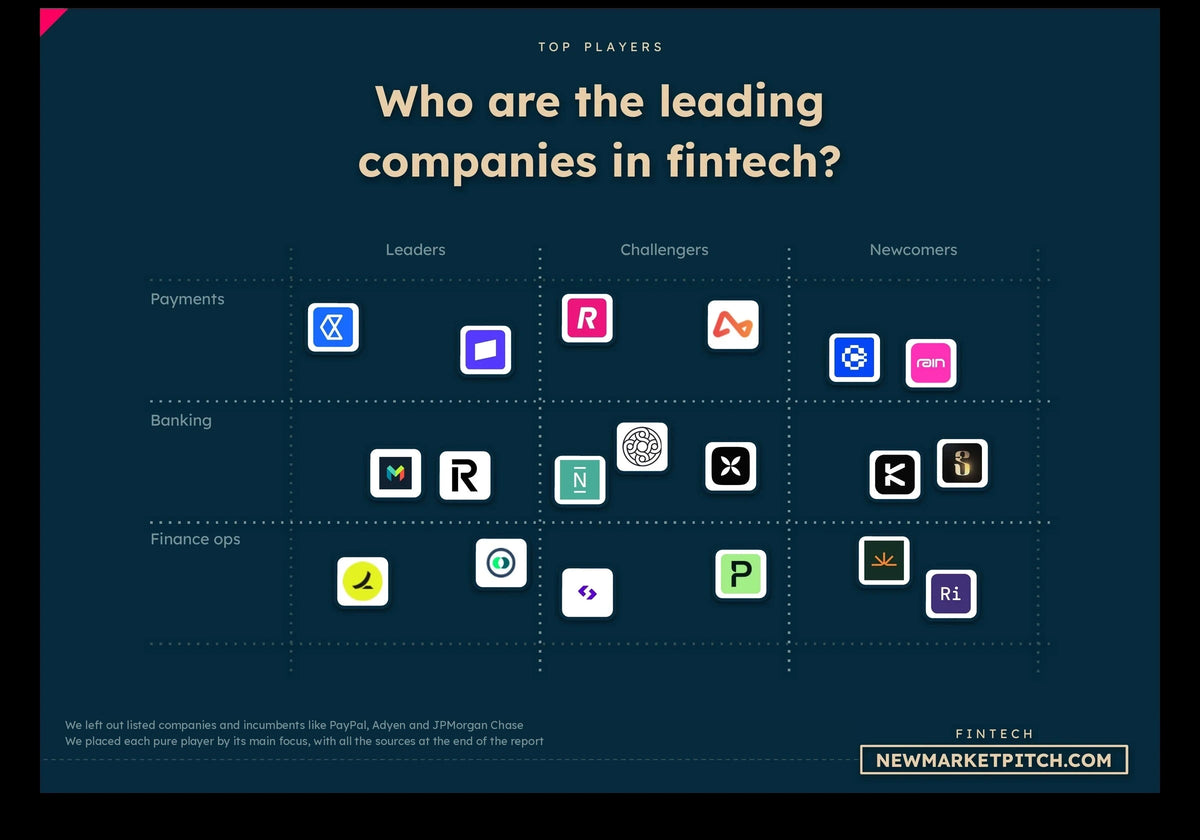
In our report covering the fintech market, we turn what is vague and complex into simple, useful visuals. Market maps like this one show you at a glance where every startup stands.
Top startups in the FinTech market ranked by valuation
Here is an updated table that ranks the top startups in the FinTech market based on their latest reported or estimated valuations.
If you need to dig deeper and get more detailed data, please check our report covering the FinTech market.
| # | Startup Name | What They Do | Current Valuation ($) | Valuation Confidence Level | Valuation Type | Evidence Status | Total Funding ($) | Funding Confidence Level | Country |
|---|---|---|---|---|---|---|---|---|---|
| 1 | Revolut | Global digital banking and payments | $115.0B | Strong Confidence | Implied Valuation from Raise | Estimated | ~$2.9B | - | United Kingdom |
| 2 | Ant Group | Digital payments and financial services | $103.0B | Low Confidence | Implied Valuation from Raise | Estimated | $20.6B | - | China |
| 3 | Ramp | Corporate cards and expense automation | $60.0B | Full Confidence | Announced Private Round Valuation | Observed | $2.9B | Strong Confidence | United States |
| 4 | Kalshi | Regulated prediction markets exchange | $40.0B | Strong Confidence | Announced Private Round Valuation | Observed | $2.8B | Partial Confidence | United States |
| 5 | Ripple | Blockchain payments and digital assets | $40.0B | Partial Confidence | Announced Private Round Valuation | Observed | $793M | Strong Confidence | United States |
| 6 | Binance | Global cryptocurrency trading exchange | $28.0B–$42.0B | Partial Confidence | Comparables-Based Estimate | Estimated | $2.0B | - | United Arab Emirates |
| 7 | Kraken | Cryptocurrency exchange and trading infrastructure | $21.0B | Strong Confidence | Implied Valuation from Raise | Estimated | $1.07B | Partial Confidence | United States |
| 8 | Polymarket | Blockchain-based prediction trading markets | $21.0B | Strong Confidence | Active Raise Valuation | Estimated | ~$3.1B | - | United States |
| 9 | Devoted Health | Medicare Advantage insurance and care | $12.0B–$18.0B | Partial Confidence | Implied Valuation from Raise | Implied | $3.0B | - | United States |
| 10 | Trade Republic | Digital investing and savings platform | ~$14.7B | Strong Confidence | Announced Private Round Valuation | Observed | ~$1.1B | - | Germany |
| 11 | Checkout.com | Global enterprise payment processing | $11.0B–$14.0B | Strong Confidence | Revenue or ARR Multiple Estimate | Estimated | $1.8B | - | United Kingdom |
| 12 | Toss | Korean digital financial super-app | $10.0B–$14.0B | Partial Confidence | IPO or Listing Range Valuation | Estimated | ~$1.7B | - | South Korea |
| 13 | Monzo | Digital banking and financial services | $10.6B–$13.3B | Partial Confidence | Active Raise Valuation | Estimated | $1.8B | Strong Confidence | United Kingdom |
| 14 | Airwallex | Global business payments infrastructure | $11.0B | Strong Confidence | Implied Valuation from Raise | Estimated | $1.7B | Strong Confidence | Singapore |
| 15 | Bilt Rewards | Housing payments and loyalty rewards | $10.75B | Partial Confidence | Announced Private Round Valuation | Observed | $850M | - | United States |
| 16 | Wealthsimple | Digital investing and banking services | $9.8B | Strong Confidence | Announced Private Round Valuation | Observed | $1.3B | Strong Confidence | Canada |
| 17 | Plaid | Financial account connectivity infrastructure | $7.5B–$8.5B | Strong Confidence | Comparables-Based Estimate | Estimated | $1.3B | Full Confidence | United States |
| 18 | iCapital | Alternative investment technology infrastructure | $7.5B+ | Strong Confidence | Implied Valuation from Raise | Estimated | $1.5B | Partial Confidence | United States |
| 19 | Qonto | Business banking and finance management | $6.0B–$9.0B | Partial Confidence | Comparables-Based Estimate | Estimated | ~$710M | - | France |
| 20 | Upgrade | Consumer lending and digital banking | $7.0B–$7.8B | Strong Confidence | Implied Valuation from Raise | Estimated | $712M | Full Confidence | United States |
| 21 | Fireblocks | Institutional digital asset custody infrastructure | $5.0B–$9.0B | Partial Confidence | Comparables-Based Estimate | Estimated | $1.0B | - | United States |
| 22 | Alan | Digital health insurance platform | $6.0B–$7.0B | Strong Confidence | Implied Valuation from Raise | Estimated | $1.4B | Partial Confidence | France |
| 23 | CloudWalk | AI-powered merchant payments and banking | $5.0B–$8.0B | Partial Confidence | Revenue or ARR Multiple Estimate | Estimated | $3.5B | - | Brazil |
| 24 | Razorpay | Digital payments and merchant banking | $5.8B–$7.2B | Partial Confidence | IPO or Listing Range Valuation | Estimated | ~$742M | - | India |
| 25 | Tabby | Buy-now-pay-later and financial services | $6.5B | Full Confidence | Announced Private Round Valuation | Observed | $837M | Strong Confidence | Saudi Arabia |
| 26 | SumUp | Merchant payment terminals and software | $4.5B–$7.0B | Partial Confidence | Revenue or ARR Multiple Estimate | Estimated | ~$3.6B | - | United Kingdom |
| 27 | Mercury | Banking and financial software for businesses | $5.0B–$5.6B | Strong Confidence | Implied Valuation from Raise | Estimated | $652M | Partial Confidence | United States |
| 28 | Coalition | Cyber insurance and risk prevention | $4.7B–$5.5B | Strong Confidence | Implied Valuation from Raise | Implied | $1.1B | - | United States |
| 29 | Bitpanda | Cryptocurrency and investment brokerage | $4.2B–$5.8B | Partial Confidence | IPO or Listing Range Valuation | Estimated | ~$550M | - | Austria |
| 30 | Blockchain.com | Cryptocurrency wallets and trading | $4.0B–$6.0B | Partial Confidence | IPO or Listing Range Valuation | Estimated | ~$540M | - | United Kingdom |
| 31 | Plata | Digital banking and consumer lending | $4.7B–$5.3B | Strong Confidence | Implied Valuation from Raise | Estimated | $815M | Full Confidence | Mexico |
| 32 | Carta | Equity management and fund administration | $4.0B–$6.0B | Partial Confidence | Revenue or ARR Multiple Estimate | Estimated | $965M | - | United States |
| 33 | Rapyd | Global payments and embedded finance | $3.8B–$5.5B | Partial Confidence | Comparables-Based Estimate | Estimated | ~$1.3B | - | United Kingdom |
| 34 | CRED | Credit payments and financial services | $4.3B–$4.8B | Strong Confidence | Active Raise Valuation | Estimated | $1.4B | Partial Confidence | India |
| 35 | CRED | Credit payments and financial services | $4.3B–$4.8B | Strong Confidence | Active Raise Valuation | Estimated | $1.4B | Partial Confidence | India |
| 36 | FNZ | Wealth management technology infrastructure | $3.0B–$6.0B | Low Confidence | Revenue or ARR Multiple Estimate | Estimated | $4.0B | Partial Confidence | United Kingdom |
| 37 | Anchorage Digital | Institutional digital asset banking | $4.0B–$4.6B | Strong Confidence | Implied Valuation from Raise | Estimated | ~$587M | - | United States |
| 38 | OPay | African digital payments and banking | $4.0B–$4.4B | Strong Confidence | IPO or Listing Range Valuation | Implied | ~$570M | - | Nigeria |
| 39 | OakNorth | Digital lending for growing businesses | $3.2B–$4.8B | Partial Confidence | Revenue or ARR Multiple Estimate | Estimated | ~$991M | - | United Kingdom |
| 40 | Addepar | Investment portfolio analytics software | $3.3B–$4.5B | Partial Confidence | Revenue or ARR Multiple Estimate | Estimated | ~$790M | - | United States |
| 41 | MoonPay | Cryptocurrency payments and wallet infrastructure | $3.9B | Strong Confidence | Implied Valuation from Raise | Implied | $655M | - | United States |
| 42 | Ledger | Cryptocurrency hardware wallets and custody | $3.0B–$4.5B | Partial Confidence | Comparables-Based Estimate | Estimated | ~$577M | - | France |
| 43 | N26 | European mobile banking platform | $3.0B–$4.5B | Partial Confidence | Revenue or ARR Multiple Estimate | Estimated | ~$1.8B | - | Germany |
| 44 | DMI Finance | Digital consumer lending and financing | $3.0B–$4.2B | Partial Confidence | Comparables-Based Estimate | Estimated | $1.1B | Partial Confidence | India |
| 45 | Mollie | European payments processing platform | $2.5B–$4.5B | Partial Confidence | Revenue or ARR Multiple Estimate | Estimated | ~$931M | - | Netherlands |
| 46 | Tipalti | Accounts payable and payments automation | $2.8B–$4.2B | Partial Confidence | Revenue or ARR Multiple Estimate | Estimated | $550M+ | - | United States |
| 47 | Creditas | Secured consumer lending in Brazil | $3.0B–$3.8B | Strong Confidence | Implied Valuation from Raise | Estimated | $1.1B | - | Brazil |
| 48 | Cross River Bank | Banking infrastructure for fintech platforms | $3.0B–$3.5B | Strong Confidence | Implied Valuation from Raise | Estimated | $1.1B | - | United States |
| 49 | Ualá | Latin American digital banking platform | $3.2B | Full Confidence | Announced Private Round Valuation | Observed | $1.1B | Full Confidence | Argentina |
| 50 | DriveWealth | Brokerage infrastructure and fractional investing | $2.4B–$3.8B | Partial Confidence | Comparables-Based Estimate | Estimated | $528M | - | United States |
| 51 | Zepz | International digital money transfer services | $2.5B–$3.7B | Partial Confidence | Revenue or ARR Multiple Estimate | Estimated | $944M | Partial Confidence | United Kingdom |
| 52 | Capital on Tap | Business credit cards and financing | $2.2B–$3.6B | Low Confidence | Comparables-Based Estimate | Estimated | $4.4B1 | - | United Kingdom |
| 53 | Clip | Mexican merchant payments and lending | $2.3B–$3.0B | Partial Confidence | Implied Valuation from Raise | Implied | $983M | Strong Confidence | Mexico |
| 54 | WeLab | Asian digital banking and lending | $1.8B–$3.4B | Low Confidence | Comparables-Based Estimate | Estimated | ~$1.38B1 | - | Hong Kong |
| 55 | GoodLeap | Residential solar and improvement financing | $1.5B–$3.5B | Low Confidence | Revenue or ARR Multiple Estimate | Estimated | $2.0B | - | United States |
| 56 | Atome Financial | Consumer lending and installment payments | $2.48B | Strong Confidence | Acquisition Value | Implied | ~$1.0B | - | Singapore |
| 57 | Tyme Group | Emerging-market digital banking platform | $2.0B–$2.8B | Partial Confidence | Comparables-Based Estimate | Estimated | $565M | Partial Confidence | Singapore |
| 58 | Vestwell | Retirement and savings technology infrastructure | $2.0B–$2.7B | Strong Confidence | Implied Valuation from Raise | Implied | $623M | Strong Confidence | United States |
| 59 | Starling Bank | Digital consumer and business banking | $2.1B–$2.5B | Strong Confidence | Comparables-Based Estimate | Estimated | ~$1.1B | - | United Kingdom |
| 60 | Teya | Merchant payments and business software | $1.6B–$3.0B | Low Confidence | Comparables-Based Estimate | Estimated | ~$1.1B | - | United Kingdom |
| 61 | ACKO | Digital insurance and underwriting | $2.0B–$2.5B | Partial Confidence | IPO or Listing Range Valuation | Estimated | ~$450M | - | India |
| 62 | Thought Machine | Cloud-native core banking infrastructure | $1.7B–$2.7B | Partial Confidence | Revenue or ARR Multiple Estimate | Estimated | ~$610M | - | United Kingdom |
| 63 | CAIS | Alternative investments distribution platform | $2.0B–$2.3B | Strong Confidence | Implied Valuation from Raise | Estimated | ~$600M | - | United States |
| 64 | Zopa | Digital bank and consumer lending | $1.7B–$2.6B | Partial Confidence | Revenue or ARR Multiple Estimate | Estimated | ~$1.05B | - | United Kingdom |
| 65 | bolttech | Embedded insurance distribution infrastructure | $2.1B | Partial Confidence | Announced Private Round Valuation | Observed | $640M | Full Confidence | Singapore |
| 66 | Greenlight | Family banking and financial education | $1.5B–$2.6B | Low Confidence | Comparables-Based Estimate | Estimated | ~$553M | - | United States |
| 67 | Acorns | Automated investing and savings | $1.5B–$2.5B | Low Confidence | Comparables-Based Estimate | Estimated | ~$436M | - | United States |
| 68 | ClearBank | Banking clearing and embedded infrastructure | $1.5B–$2.5B | Partial Confidence | Revenue or ARR Multiple Estimate | Estimated | ~$650M | - | United Kingdom |
| 69 | inKind | Restaurant financing and payment platform | $1.5B–$2.5B | Partial Confidence | Revenue or ARR Multiple Estimate | Estimated | ~$1.2B1 | - | United States |
| 70 | Scalable Capital | Digital brokerage and wealth management | $1.5B–$2.1B | Partial Confidence | Comparables-Based Estimate | Estimated | ~$556M | - | Germany |
| 71 | Neo Financial | Canadian digital banking and credit | $1.2B–$2.2B | Partial Confidence | Revenue or ARR Multiple Estimate | Estimated | $343M | Partial Confidence | Canada |
| 72 | BharatPe | Merchant payments and lending | $1.4B–$1.9B | Partial Confidence | Active Raise Valuation | Estimated | ~$879M | - | India |
| 73 | Neon | Brazilian digital banking and credit | $1.3B–$2.0B | Partial Confidence | Comparables-Based Estimate | Estimated | ~$729M | - | Brazil |
| 74 | Pie Insurance | Small business workers compensation insurance | $1.1B–$2.2B | Low Confidence | Comparables-Based Estimate | Estimated | ~$620M | - | United States |
| 75 | Collective Health | Employer healthcare benefits administration | $1.1B–$2.1B | Low Confidence | Comparables-Based Estimate | Estimated | $714M | - | United States |
| 76 | KreditBee | Digital consumer and business lending | $1.4B–$1.8B | Strong Confidence | Implied Valuation from Raise | Estimated | $694M | Full Confidence | India |
| 77 | Paxos | Regulated stablecoin and blockchain infrastructure | $1.1B–$2.1B | Low Confidence | Comparables-Based Estimate | Estimated | ~$540M | - | United States |
| 78 | Xendit | Southeast Asian payment infrastructure platform | $1.1B–$1.9B | Low Confidence | Comparables-Based Estimate | Estimated | ~$585M | - | Indonesia |
| 79 | Micro Connect | Small business revenue financing infrastructure | $1.0B–$1.8B | Low Confidence | Comparables-Based Estimate | Estimated | ~$653M | - | Hong Kong |
| 80 | Navi | Digital lending payments and insurance | $1.3B–$1.5B | Strong Confidence | Active Raise Valuation | Estimated | ~$100M2 | - | India |
| 81 | Satispay | Mobile payments and financial services | $1.2B–$1.6B | Partial Confidence | Active Raise Valuation | Estimated | ~$530M | - | Italy |
| 82 | Viva Wallet | European merchant payment acceptance platform | $1.0B–$1.8B | Low Confidence | Comparables-Based Estimate | Estimated | ~$176M | - | Greece |
| 83 | Ajaib | Indonesian digital investment brokerage | $1.3B–$1.5B | Strong Confidence | Implied Valuation from Raise | Implied | $500M+ | - | Indonesia |
| 84 | Allica Bank | Digital banking for SMEs | $1.1B–$1.3B | Strong Confidence | Implied Valuation from Raise | Estimated | $476M | Strong Confidence | United Kingdom |
| 85 | Avant | Consumer loans and credit cards | $700M–$1.5B | Low Confidence | Comparables-Based Estimate | Estimated | ~$2.5B | - | United States |
| 86 | Sygnum | Regulated digital asset banking | $1.0B+ | Partial Confidence | Announced Private Round Valuation | Observed | ~$250M | - | Switzerland |
| 87 | Tamara | Middle Eastern installment payment services | $1.0B | Partial Confidence | Announced Private Round Valuation | Observed | ~$3.7B1 | - | Saudi Arabia |
| 88 | KOHO | Canadian digital banking and credit | $900M–$1.1B | Strong Confidence | Implied Valuation from Raise | Estimated | ~$400M | - | Canada |
| 89 | Varo Bank | American mobile-first digital bank | $700M–$1.3B | Partial Confidence | Revenue or ARR Multiple Estimate | Estimated | $1.2B | Strong Confidence | United States |
| 90 | Clearcover | Digital automotive insurance platform | $700M–$1.2B | Partial Confidence | Comparables-Based Estimate | Estimated | $610M | - | United States |
| 91 | Lunar | Nordic digital consumer and business bank | $700M–$1.2B | Partial Confidence | Implied Valuation from Raise | Implied | ~$650M | - | Denmark |
| 92 | C2FO | Working capital and early payments | $600M–$1.1B | Low Confidence | Comparables-Based Estimate | Estimated | ~$580M | - | United States |
| 93 | Mission Lane | Consumer credit cards and lending | $500M–$1.1B | Low Confidence | Comparables-Based Estimate | Estimated | Undisclosed | - | United States |
| 94 | wefox | Digital insurance distribution technology | $300M–$900M | Low Confidence | Proxy-Based Estimate | Estimated | ~$1.4B | - | Switzerland |
| 95 | Atom Bank | UK digital savings and lending | $450M–$650M | Partial Confidence | Comparables-Based Estimate | Estimated | ~$800M | - | United Kingdom |
| 96 | Gravie | Employer health benefits and insurance | $320M–$440M | Partial Confidence | Comparables-Based Estimate | Estimated | ~$583M | - | United States |
| 97 | Bolt Financial | One-click ecommerce checkout | $200M–$400M | Partial Confidence | Active Raise Valuation | Estimated | ~$1.0B | - | United States |
Which startups in the FinTech market have been acquired or gone public?
These startups no longer have a private-market valuation of their own, so we list them separately, using their acquisition price or their current market capitalization.
| # | Startup Name | What They Do | Current Valuation ($) | Valuation Confidence Level | Valuation Type | Evidence Status | Total Funding ($) | Funding Confidence Level | Country |
|---|---|---|---|---|---|---|---|---|---|
| 1 | Altruist | Wealth management technology and custody | $4.0B–$4.6B | Strong Confidence | Acquisition Value | Estimated | $602M | Full Confidence | United States |
| 2 | Solaris | Embedded banking and financial infrastructure | $450M–$650M | Partial Confidence | Proxy-Based Estimate | Estimated | ~$750M | - | Germany |
- Includes debt or lending facilities, not only equity.
- Prosus investment only; founder capital is not fully known.

Our research about fintech companies gets updated several times a month, so you always get the latest view of where things stand.
Which FinTech startups are worth the most today?
Revolut currently leads our FinTech startup valuation ranking at $115.0B, followed by Ant Group at $103.0B and Ramp at $60.0B. Kalshi and Ripple come next at $40.0B each.
The three businesses have very different models. Revolut combines digital banking, payments, savings, and investing. Ramp sells corporate cards and financial software to businesses. Kalshi operates a regulated exchange where people trade contracts linked to real-world events.
The rest of the top eight is equally interesting. Binance is valued at $28.0B–$42.0B, Kraken at $21.0B, and Polymarket at $21.0B. Five of the eight highest-ranked companies therefore operate in cryptocurrency or prediction markets.
Traditional financial technology remains well represented. Trade Republic, Checkout.com, Toss, Monzo, and Airwallex occupy positions ten through fourteen, with valuations ranging from approximately $10 billion to $15 billion.
The gap between the leaders and the rest of the market is substantial. Revolut is already valued at almost twice Ramp, while Kalshi has moved ahead of several established cryptocurrency exchanges and payment businesses.
Are FinTech startup valuations rising again?
FinTech valuations are recovering, but investors are putting more money into fewer companies rather than financing startups as aggressively as they did in 2021.
According to KPMG's Pulse of Fintech report, worldwide FinTech investment reached $116 billion in 2025, up from $95.5 billion in 2024. That's an increase of 21.5%. Over the same period, the number of deals fell from 5,533 to 4,719, reaching an eight-year low.
We calculated the average investment per reported deal using those figures. It increased from approximately $17.3 million to $24.6 million, a jump of about 42% in a single year. KPMG includes acquisitions and private equity alongside venture funding, so this shouldn't be confused with the average startup funding round. Still, the trend is clear: more capital is going into fewer transactions.
The composition of investment also changed. Venture capital reached $56.7 billion, while mergers and acquisitions accounted for $55.4 billion. Both helped drive the recovery.
Companies such as Ramp, Kalshi, and Airwallex have benefited from investors' willingness to back established platforms with strong growth. Smaller businesses and companies with weaker financial positions face a tougher environment.
This is a very different recovery from the previous funding boom. Investors still pay extraordinary prices for certain FinTech companies, but they're much less willing to spread capital across the entire industry.

In our market report about fintech companies, we look at what the winners do differently, so you can learn from the best instead of guessing.
How many FinTech unicorns are there?
Our FinTech valuation ranking includes 86 unique startups valued at $1 billion or more, with several additional companies whose estimates cross the unicorn threshold.
A unicorn is generally a privately held startup valued at $1 billion or more. The distinction becomes less straightforward when a company's valuation is expressed as a range.
For example, Allica Bank is valued at $1.1B–$1.3B and Ajaib at $1.3B–$1.5B. Both sit entirely above the unicorn threshold. KOHO, at $900M–$1.1B, and Avant, at $700M–$1.5B, could also be worth more than $1 billion, although their valuation ranges extend below that level.
The upper end of the market is much more concentrated. Revolut, Ant Group, Ramp, Kalshi, Ripple, Binance, Kraken, Polymarket, Devoted Health, Trade Republic, Checkout.com, Toss, Monzo, and Airwallex are the fourteen highest-ranked businesses, with valuations reaching into the tens of billions of dollars.
FinTech has matured considerably. Digital banking, payments, lending, wealth management, insurance, and cryptocurrency infrastructure have all produced valuable private companies.
Many of these businesses are also choosing to stay private for longer. They can now raise substantial amounts of capital and provide liquidity to shareholders without necessarily listing on a stock exchange.
Is Revolut really worth more than $100 billion?
Revolut's $115.0B valuation is ambitious, but its global customer base, revenue growth, and profitability give the company a strong financial foundation.
Revolut's November 2025 announcement provides a useful starting point. The company completed an employee share sale at a $75 billion valuation, after surpassing 65 million customers worldwide.
Its 2024 revenue reached $4.0 billion, up 72%, while profit before tax increased 149% to $1.4 billion. Revolut Business also reached $1 billion in annualized revenue during 2025.
Those figures help explain why investors are so interested in the company. Revolut already generates billions in revenue and substantial profits while continuing to expand internationally.
The question is whether its growth, profitability, and international banking ambitions can justify a valuation significantly above its earlier share sale. At more than $100 billion, expectations are certainly high.
The comparison with other digital banks is striking. Monzo is valued at $10.6B–$13.3B, N26 at $3.0B–$4.5B, and Starling Bank at $2.1B–$2.5B. Revolut operates at a much larger international scale and offers a broader mix of financial products.
We think Revolut has a credible claim to a valuation above $100 billion. Few private FinTech companies combine its customer scale, revenue, profitability, and product range.

In our document detailing everything you need to know about fintech, you will always find fresh funding data, taken straight from our own verified funding database.
Why is Ramp worth $60 billion?
Ramp has reached a $60.0B valuation because its corporate finance software is growing extremely quickly, and the company has already passed $2 billion in annualized revenue.
In October 2026, Ramp's co-CEOs Eric Glyman and Karim Atiyeh announced that 85,000 businesses were using the platform. The company had also become cash-flow positive and reported saving customers more than $1 billion per month.
Customer growth has been remarkable. Ramp reported serving more than 70,000 businesses in June, compared with 85,000 in October. That's an increase of at least 21% in approximately four months.
Ramp has gradually expanded beyond corporate cards and expense reports. Its products now cover procurement, bill payments, financial accounting, cash management, and automated finance workflows.
The strategy makes sense. Once a company uses Ramp to manage corporate spending, it can add other financial services without having to replace the original customer relationship. That creates plenty of opportunities to increase revenue from existing customers.
Still, the valuation is demanding. At $60.0B and more than $2 billion in annualized revenue, Ramp trades at roughly 30 times its revenue run rate. That's an exceptionally high multiple for a financial technology company.
The price assumes Ramp will continue gaining customers, increase the number of products used by each business, and eventually generate substantial profits. Its current growth supports that ambition, but there's little room for a prolonged slowdown.
Are Kalshi and Polymarket becoming bigger than traditional FinTech startups?
Kalshi and Polymarket are now valued alongside some of the world's largest FinTech companies. Kalshi's latest operating figures show just how far prediction markets have moved beyond their early niche.
Kalshi is valued at $40.0B, while Polymarket sits at $21.0B. Their products allow users to trade contracts based on the outcomes of events, including elections, economic indicators, sporting competitions, and financial markets.
Kalshi's growth has been extraordinary. In May 2026, the company reported that annualized trading volume had increased from $52 billion to $178 billion in six months.
By October, Kalshi reported annualized trading volume above $1 trillion across its expanding range of markets. That's more than five times its May run rate, although the later figure includes additional financial products.
The company is also attracting institutional customers. According to its October announcement, around 500 institutional entities were active on the platform in September, with institutions other than market makers accounting for approximately 25% of exchange trading volume.
These numbers give Kalshi a much stronger case than a business relying primarily on political betting. Its expansion into commodities, crypto, and perpetual futures suggests that management wants to build a broader financial exchange.
Polymarket follows a different blockchain-based approach, with digital-asset infrastructure playing a larger role in its trading system.
Both businesses still face regulatory and commercial uncertainties. Trading volume can fluctuate sharply around major events, and transaction activity shouldn't be mistaken for revenue. Kalshi's move into additional financial markets is particularly important because it could reduce dependence on temporary spikes in activity.

Learning from others' mistakes is the cheapest lesson there is. In our report covering the fintech market, we look at what broke startups before you, so you don't repeat it.
Are cryptocurrency startups still worth tens of billions of dollars?
Cryptocurrency remains one of the most valuable parts of FinTech, with Binance, Ripple, and Kraken all valued at more than $20 billion.
Binance is valued at $28.0B–$42.0B, Ripple at $40.0B, and Kraken at $21.0B. Their business models differ considerably. Binance and Kraken operate trading exchanges, while Ripple focuses on blockchain payments and digital-asset infrastructure.
Further down the ranking, Fireblocks is valued at $5.0B–$9.0B, Anchorage Digital at $4.0B–$4.6B, Blockchain.com at $4.0B–$6.0B, MoonPay at $3.9B, and Ledger at $3.0B–$4.5B.
The investment figures help explain why this category remains valuable. KPMG reported $19.1 billion invested globally in digital assets during 2025, compared with $11.2 billion in 2024, an increase of approximately 71%.
That was still below the $32.2 billion recorded in 2021. Investment has recovered strongly without returning to the previous cycle's peak.
There's also a growing difference between the economics of crypto companies. Exchanges depend heavily on trading activity and fees, while custody providers and institutional infrastructure companies can benefit from financial institutions adopting digital assets.
That distinction will become increasingly important. A company providing custody or settlement infrastructure may have steadier customer relationships than an exchange whose revenue rises and falls with speculative activity.
Could stablecoins replace traditional payment startups?
Stablecoins are becoming serious payment infrastructure, especially for international transfers, but they're still far from replacing the full range of services offered by established payment companies.
Visa's research illustrates both the opportunity and the limits. Its stablecoin dashboard reported approximately $33 trillion in total transaction volume over twelve months. Once automated transfers, internal movements, and other activity were adjusted for, the figure fell to approximately $10.2 trillion.
That's still enormous, and adjusted volume was growing 63% year over year. But a substantial portion involved financial transfers and exchange activity rather than everyday purchases.
Visa also reported that deposits and withdrawals involving centralized exchanges represented 36% of adjusted stablecoin transaction volume during 2025.
For companies such as Airwallex, Checkout.com, Rapyd, and Xendit, the pressure is most obvious in cross-border payments. Stablecoins can reduce reliance on traditional intermediaries and potentially make settlement faster.
However, businesses still need fraud protection, regulatory compliance, local bank connections, currency conversion, refunds, and reconciliation.
Ripple, Fireblocks, Anchorage Digital, and Paxos are more directly exposed to the growth of blockchain-based financial infrastructure.
The likely outcome is a payments industry where stablecoins become part of the underlying technology, while customer-facing providers continue handling the complicated financial services surrounding each transaction.

Your time is limited. In our research about fintech companies, we put numbers on each part of the market, so you can see where it makes sense to focus.
Which FinTech startups make the most money from business customers?
Ramp and Airwallex are two of the clearest examples of private FinTech companies generating more than $1 billion in annualized revenue from business-focused financial services.
Ramp passed $2 billion in annualized revenue during 2026. Airwallex reached $1.3 billion in March 2026, representing 74% year-over-year growth.
The two companies sell quite different products. Ramp started with corporate spending and has expanded into broader finance automation. Airwallex focuses on international payments, business accounts, corporate cards, and embedded financial services.
Airwallex reported that more than 90% of its revenue came from customers using multiple products. That helps explain its ability to expand revenue quickly: existing business customers are adopting additional financial services.
Both companies also report substantial financial activity flowing through their platforms. Airwallex reached $287 billion in annualized transaction volume in March 2026, more than doubling from the previous year.
We should be careful when comparing different volume measures, since card spending, payments processed, and account transfers can represent different economic activities. Revenue is the stronger basis for comparison here.
| Indicator | Ramp | Airwallex |
|---|---|---|
| Reported annualized revenue | More than $2B | $1.3B |
| Reporting period | 2026 | March 2026 |
| Growth evidence | Rapid customer growth | Revenue up 74% YoY |
| Business reach | 85,000 customers | More than 676,000 businesses reached directly or through platforms |
| Profitability evidence | Positive cash flow | Reported EBITDA profitability |
| Main products | Cards, expenses, procurement, finance automation | Payments, accounts, cards, embedded finance |
| Main growth opportunity | Selling more finance software to existing companies | Expanding international business services |
| Main valuation risk | Very high revenue multiple | Sustaining growth across multiple markets |
Are digital banks worth more than payment startups?
Digital banks can command enormous valuations, but being a bank doesn't automatically make a FinTech company more valuable than a payment processor.
Revolut is the standout example, with a valuation of $115.0B. Yet other digital banks operate at much lower levels. Monzo is valued at $10.6B–$13.3B, N26 at $3.0B–$4.5B, and Zopa at $1.7B–$2.6B.
Compare those figures with Checkout.com at $11.0B–$14.0B and Airwallex at $11.0B. Large payment businesses can reach valuations comparable to major digital banks without operating the same kind of consumer deposit and lending business.
Monzo's latest annual report provides a useful example of what a successful digital bank looks like financially. Revenue reached £1.7 billion in its 2026 financial year, up 39%, while customer deposits increased 55% to £25.7 billion.
The company also reported £172.6 million in adjusted profit before tax and 15.2 million customers.
Those results show that digital banking can become a profitable business at scale. However, banks also face capital requirements, regulatory obligations, and potential credit losses when they lend money.
Payment processors face their own challenges, particularly competition over transaction fees, but their financial models can be less dependent on credit risk.
Ultimately, valuation depends on what a company earns from each customer, how quickly it grows, and how much capital it needs to support that growth.

In our market report about fintech companies, we always try to gather several sources and make estimates that make sense, so you can work with solid numbers.
Can Trade Republic and Wealthsimple become real competitors to traditional banks?
Trade Republic and Wealthsimple are already competing with traditional banks for savings and investment customers, and their expansion into everyday financial services makes that competition increasingly direct.
Trade Republic is valued at approximately $14.7B, while Wealthsimple is valued at $9.8B. Both have moved beyond simple stock-trading applications to offer a wider range of financial products.
Wealthsimple's October 2025 financing announcement revealed that assets under administration had doubled from CAD $50 billion to CAD $100 billion in approximately one year. It also reported profitability during both 2024 and 2025.
More recently, the company disclosed that new chequing account openings exceeded new investment account openings for the first time during the second quarter of 2026.
That's an interesting change in customer behavior. Wealthsimple originally built its reputation around investing, but customers are increasingly using it for everyday financial activities.
Trade Republic has followed a related strategy by combining investing with cash balances, card services, and savings products.
Scalable Capital, valued at $1.5B–$2.1B, is another European company operating in the same broad market.
The opportunity is substantial because investment platforms can attract long-term customer assets. However, assets held for customers don't necessarily translate into equally large revenues, and brokerage earnings can fluctuate with trading activity and market conditions.
These companies are already serious competitors in investing and savings. Becoming customers' main bank for everyday spending, borrowing, and financial management is the next challenge.
Why are FinTech infrastructure companies worth billions when most people have never heard of them?
FinTech infrastructure companies can reach multibillion-dollar valuations because banks, investment firms, and financial applications rely on their technology for essential operations.
Plaid, valued at $7.5B–$8.5B, provides financial account connectivity. iCapital, at more than $7.5B, supports alternative investments. FNZ, at $3.0B–$6.0B, supplies wealth-management infrastructure, while Thought Machine, at $1.7B–$2.7B, develops core banking software.
These companies generally have far fewer direct consumer relationships than digital banking applications. Their value comes from the financial institutions and platforms that use their products.
Plaid offers a particularly useful example of how valuations can change over time. In February 2026, TechCrunch reported an employee share transaction at an $8 billion valuation, up 31% from a $6.1 billion transaction in April 2025.
Even after that recovery, Plaid remained approximately 40% below its $13.4 billion valuation from 2021.
The company's experience reflects a broader change in how investors value financial software. Plaid continued operating an important financial connectivity platform, but the extraordinary multiples of 2021 proved difficult to maintain.
For infrastructure companies, customer retention and long-term contracts can be especially valuable. Replacing systems that handle financial data, investment operations, or banking transactions is often expensive and complicated.
That's why relatively unfamiliar companies such as iCapital and FNZ can attract valuations comparable to much better-known consumer FinTech brands.

If you build or invest in the fintech market, you need to know which business models pay off now and which ones are fading. That's why our report covering it has a whole section on it.
Why do the United States and United Kingdom have so many valuable FinTech startups?
American and British FinTech startups dominate the highest valuation brackets because both countries combine large financial industries, experienced investors, and strong access to growth capital.
The United States is especially prominent. Ramp, Kalshi, Ripple, Kraken, Polymarket, Devoted Health, Plaid, and Fireblocks are among the major American companies in our ranking.
The United Kingdom contributes Revolut, Checkout.com, Monzo, SumUp, Rapyd, Starling Bank, and several other valuable platforms.
KPMG reported that the Americas attracted $66.5 billion in FinTech investment during 2025, representing approximately 57% of the global total. The United States alone accounted for $56.6 billion, or nearly half of worldwide investment.
Europe, the Middle East, and Africa collectively attracted $29.2 billion, while Asia-Pacific received $9.3 billion.
These differences are substantial. American companies have access to a large domestic financial market and investors capable of supporting repeated funding rounds. British FinTech startups benefit from London's financial expertise and often build products intended for international customers.
The geographic picture is gradually becoming more diverse, though. Trade Republic in Germany, Wealthsimple in Canada, Razorpay in India, CloudWalk in Brazil, and Tabby in Saudi Arabia have all reached multibillion-dollar valuations.
The United States remains the strongest funding market, but successful FinTech businesses can now reach meaningful scale in several regions.
Can Indian FinTech startups catch up with Revolut and Ramp?
India has produced several valuable FinTech startups, but even its largest private companies remain far below Revolut's $115.0B and Ramp's $60.0B valuations.
Razorpay, valued at $5.8B–$7.2B, is one of the country's major payment infrastructure businesses. CRED is valued at $4.3B–$4.8B, DMI Finance at $3.0B–$4.2B, and ACKO at $2.0B–$2.5B.
BharatPe, KreditBee, and Navi also belong to India's billion-dollar FinTech category, with business models spanning merchant finance, consumer credit, and digital financial services.
India has an important structural advantage: its Unified Payments Interface has made digital payments widely accessible. This creates an enormous base of consumers and merchants who can use additional financial products.
But payment volume alone can be misleading. India's payment infrastructure is designed to make transfers inexpensive, which puts pressure on companies to find other ways to earn revenue.
Razorpay can generate revenue through merchant services and payment infrastructure. CRED has to monetize consumer relationships through financial products, while DMI Finance and KreditBee depend more directly on lending economics.
The differences become especially important when interest rates, credit losses, and competition change.
India clearly has the population, digital adoption, and financial demand to support much larger FinTech companies. Reaching the valuation levels of global leaders will require businesses that generate substantially more revenue and profit per customer, rather than simply processing more transactions.

Theory only gets you so far. In our report covering the fintech market, we dig up the real signals from the field and show you the ones worth watching.
Are Latin American FinTech startups catching up with Europe?
Latin American FinTech companies have become serious competitors in digital banking and payments, although their current private valuations remain below those of Europe's biggest startups.
Brazil has several notable companies. CloudWalk is valued at $5.0B–$8.0B, Creditas at $3.0B–$3.8B, and Neon at $1.3B–$2.0B.
Mexico's Plata is valued at $4.7B–$5.3B, while Clip sits at $2.3B–$3.0B. Argentina's Ualá has reached a $3.2B valuation.
Together, these companies demonstrate how widely financial technology has spread across Latin America. They address merchant payments, consumer credit, business financing, and digital banking.
Their markets offer substantial room for growth because traditional financial services can be expensive or difficult to access. At the same time, companies face different economic pressures from their European counterparts, particularly inflation, credit risk, currency fluctuations, and funding costs.
CloudWalk's merchant payment business, for instance, has different financial characteristics from Creditas's secured lending model. One depends heavily on merchant transaction activity, while the other must manage borrowers, loan collateral, and credit losses.
We can see these differences more clearly by comparing selected Latin American and European businesses by activity.
| Startup | Country | Main activity |
|---|---|---|
| CloudWalk | Brazil | Merchant payments and banking |
| Plata | Mexico | Digital banking and lending |
| Creditas | Brazil | Secured consumer lending |
| Ualá | Argentina | Digital banking |
| Clip | Mexico | Merchant payments and lending |
| Neon | Brazil | Digital banking and credit |
| Trade Republic | Germany | Investing and savings |
| Qonto | France | Business banking |
| N26 | Germany | Digital consumer banking |
| Scalable Capital | Germany | Investing and wealth management |
Why are some insurance startups worth billions while others struggle?
Insurance startups receive very different valuations because investors care increasingly about claims, profitability, and the cost of acquiring customers, rather than simply how much insurance they sell.
Devoted Health, valued at $12.0B–$18.0B, and Alan, at $6.0B–$7.0B, are among the highest-valued insurance-related businesses in our FinTech ranking.
Coalition, valued at $4.7B–$5.5B, concentrates on cyber insurance and risk prevention. bolttech, at $2.1B, focuses on insurance distribution infrastructure.
Their businesses differ in an important way. An insurance company that underwrites policies must manage claims and reserves, while a company primarily distributing insurance products may earn fees without taking on the same underwriting exposure.
The gap is visible further down the ranking. Pie Insurance is valued at $1.1B–$2.2B, Collective Health at $1.1B–$2.1B, Clearcover at $700M–$1.2B, and wefox at $300M–$900M.
Some of these companies have raised substantial amounts of money without maintaining equally high valuations. That can happen when profitability takes longer than expected, financing becomes more expensive, or investors reassess the risks of the business model.
The insurance industry offers enormous opportunities for technology companies, but generating premium revenue is only the beginning. Claims performance, retention, pricing, and operating costs ultimately determine whether growth creates lasting value.

In our research about fintech companies, we don't want to repeat what boring consulting reports say. Instead, we show you the real and latest market signals that matter.
Does raising more funding make a FinTech startup more valuable?
FinTech startups can raise billions without being worth more than the money they've received, especially when their funding includes debt facilities rather than ordinary equity investment.
Capital on Tap is an example. Its reported funding reaches $4.4B, while its estimated valuation is $2.2B–$3.6B. The financing total is higher than the valuation range because it includes lending facilities used to finance credit activity.
Tamara presents a similar situation. Its valuation is $1.0B, compared with approximately $3.7B in reported funding, which also includes debt facilities.
These comparisons shouldn't be interpreted as straightforward investment losses. Debt capital that supports lending operations is economically different from investors purchasing ownership in a startup.
Other companies show why the relationship deserves attention. GoodLeap has reported $2.0B in funding against a $1.5B–$3.5B valuation range. FNZ has reported $4.0B in funding against a $3.0B–$6.0B range.
The amount of money a business has raised tells us something about its financing needs and investor history. Its current valuation depends on the economic value of the business and the ownership claims being priced.
A lending company may need large credit facilities to operate. A financial software company with attractive margins may be able to grow with considerably less capital.
This is why comparing cumulative funding totals across different FinTech business models can produce misleading conclusions.
Are FinTech startups choosing acquisitions instead of IPOs?
Acquisitions have become an important exit route for FinTech startups, especially when established financial institutions want to acquire technology, customers, or capabilities they would otherwise have to build themselves.
A major recent example is Capital One's acquisition of Brex, completed in April 2026. Brex developed corporate cards and financial management software, making it a natural strategic addition to Capital One's business payments activities.
Our separate category of acquired or public companies includes Altruist, with an estimated acquisition value of $4.0B–$4.6B, and Solaris at $450M–$650M. These are treated separately from independent private startups. Atome Financial stays in the private ranking at $2.48B because its signed acquisition had not closed by November 2026.
Acquisitions can offer shareholders liquidity and give the acquired business access to a larger financial institution's customers, funding, and infrastructure.
Public listings offer a different route. Companies can raise capital from public investors and provide shareholders with a more liquid market, but their valuations then become subject to daily trading.
Several private FinTech companies have estimated values connected with potential listings, including Toss at $10.0B–$14.0B, Razorpay at $5.8B–$7.2B, Bitpanda at $4.2B–$5.8B, and Blockchain.com at $4.0B–$6.0B.
An estimated IPO valuation range doesn't mean that a public listing has already happened.
At the same time, companies such as Ramp and Kalshi continue attracting substantial private investment. For businesses capable of securing that capital, remaining private can still be attractive.
Which FinTech startups will be worth the most in the coming years?
Revolut, Ant Group, Ramp, and Kalshi currently have the strongest positions in our FinTech valuation ranking, but the next major valuation gains could come from several different types of financial businesses.
Revolut's opportunity comes from its large international customer base and expanding range of financial services. Ramp has demonstrated unusually fast revenue growth in corporate finance software. Kalshi is attempting to turn prediction markets into a much broader exchange business.
Other companies have different ways to grow. Airwallex can expand its international business finance products, Trade Republic and Wealthsimple can capture more savings and investment activity, and infrastructure providers such as Plaid and Fireblocks can benefit as financial institutions adopt more digital services.
The biggest risk varies by category. Digital lenders must manage credit losses. Banks face regulatory and capital requirements. Payment processors compete on pricing, while cryptocurrency and prediction-market businesses face changing trading volumes and regulatory conditions.
Our research points to a clear conclusion: FinTech can still produce extraordinarily valuable startups, but future valuations will depend much more heavily on proven revenue growth, profitability, and the economic value of customer relationships.
Revolut remains the highest-ranked company today at $115.0B. Ramp and Kalshi are among the clearest examples of newer financial business models attracting exceptional valuations.
The wider market remains attractive, although investors are becoming far more selective about which companies deserve those prices.
Our methodology
This analysis examines the FinTech market and ranks independent startups according to their current private-market valuations. We cover digital banking, payments, lending, wealth management, insurance technology, cryptocurrency infrastructure, financial software, and other businesses whose core activities involve financial services.
We reviewed completed funding rounds, company announcements, regulatory filings, annual reports, investor materials, revenue and ARR disclosures, operating metrics, comparable transactions, and reporting from established financial publications. Recent completed financing rounds and employee share transactions provide the clearest pricing points. When a recent transaction does not establish a current price, we estimate a valuation range using financial performance, growth, customer metrics, comparable companies, and market conditions. This explains why some companies have a single valuation figure while others are presented as a range.
We considered revenue growth, profitability, customer acquisition, transaction volumes, assets under management, financing structures, and the capital required to operate each business. We also distinguished company valuations from cumulative funding, debt facilities, payment volumes, trading volumes, and assets held on behalf of customers, since these measure very different aspects of a FinTech business.
Companies that have been acquired or gone public are treated separately, using acquisition values or public-market capitalization rather than independent private-market valuations. Our focus remains on the most relevant current valuation for each business, rather than simply repeating an older financing figure.
A company can appear in this ranking even when its total funding is undisclosed: its position depends on its valuation, not on the capital it has raised.
Key sources used for this analysis include KPMG's Pulse of Fintech reports for global investment trends; company announcements and financial reports from Revolut, Ramp, Kalshi, Airwallex, Monzo, and Wealthsimple; Visa's stablecoin dashboard; TechCrunch's reporting on Plaid's employee share transaction; and financial reporting on Capital One's acquisition of Brex. We also considered company disclosures, regulatory information, and financial publications covering the broader digital banking, payments, lending, cryptocurrency, and insurance industries.
Written by the New Market Pitch teamWe track new markets so founders and investors can move faster. About us