What are the top FinTech startups by total funding raised?
Everything we know about the FinTech market, in one place. Get our report whether you build or invest.
Summary
Ant Group is the best-funded FinTech startup in our ranking, with $18.5B raised, followed by Ramp at $5.0B and Kalshi at $3.7B. Devoted Health ($3.2B) and FNZ ($3.0B) complete the top five, while the ten largest companies have attracted approximately $42.5B combined.
Ant Group is an extraordinary outlier. Its $18.5B represents 43.5% of the top ten's cumulative funding, reflecting the scale of China's digital financial ecosystem and a financing history that stretches back much further than those of most companies competing for the top positions.
The composition of the ranking is unusually diverse. Payments platforms, corporate financial software, prediction markets, digital banks, insurance providers, cryptocurrency exchanges and wealth management infrastructure all feature among the largest funding recipients. FinTech has become a much broader investment category than digital banking and payment processing alone.
Ramp and Kalshi are particularly interesting because of the size of their latest financing rounds. Ramp secured $1.85B in October 2026, while Kalshi attracted $1.0B during the same month. Both transactions show how much capital investors are willing to commit to established platforms operating in relatively new or rapidly expanding financial categories.
FinTech investment has also recovered in headline terms. KPMG recorded $103.1B in global FinTech investment during H1 2026, compared with $50.5B in H1 2025. However, the number of transactions fell, and acquisitions accounted for most of the money, so the recovery has been much more concentrated than the headline figure suggests.
Payments remain one of the biggest destinations for investment. Ant Group, Checkout.com, Airwallex and Rapyd illustrate the capital requirements of building large-scale payment infrastructure, while Ramp has demonstrated that corporate financial management software can attract even larger commitments than several established payment processors.
Prediction markets have emerged as another major funding category. Kalshi and Polymarket have collectively raised $5.6B, putting them ahead of many established financial technology businesses. Their ability to attract traditional institutional investors is particularly notable, although regulatory access and sustained trading liquidity will determine how far these platforms can grow.
Digital banking and insurance continue producing heavily financed companies across multiple regions. Monzo, Revolut and N26 have collectively raised $4.7B, while Devoted Health, wefox and Alan illustrate the substantial capital available to technology-driven insurance businesses.
The geographical distribution is becoming more interesting too. The United States, China and the United Kingdom dominate the largest individual funding stories, but India, Brazil, Mexico, Saudi Arabia and Southeast Asia have also produced companies with hundreds of millions or even billions of dollars in financing.
Funding frequency does not necessarily translate into a larger capital base. Monzo has completed 15 rounds and Airwallex 14, compared with 13 for Ramp, yet Ramp has raised almost three times as much as either company. The size and timing of individual transactions matter far more than the number of rounds alone.
Our conclusion is that the FinTech funding market is recovering, but the money is flowing disproportionately towards companies that have already established substantial operations, strong market positions or access to large financial ecosystems. The next challenge for these businesses is turning exceptional fundraising histories into durable revenue, profitability and customer relationships.

Written by the New Market Pitch teamWe track new markets so founders and investors can move faster. About us

In our report covering the fintech market, you will always find fresh funding data, taken straight from our own verified funding database.
Top startups in the FinTech market ranked by total funding raised
Here is an updated table that ranks the top startups in the FinTech market based on the total amount of funding they have raised to date.
The table also includes the total number of funding rounds, the date and size of the latest round, the financing type (e.g. Series A, equity financing), key investors, the startup’s current status (active, IPO, acquired, or shut down), and a confidence score based on the data collected (we excluded startups with very low data confidence, to make sure everything is reliable).
If you need to dig deeper and get more detailed data, please check our report covering the FinTech market.
| # | Startup | What They Do | Total Raised ($) | Total Rounds | Last Round Date | Last Round Amount ($) | Last Round Type | Key Investors | Current Stage | Confidence | Country |
|---|---|---|---|---|---|---|---|---|---|---|---|
| 1 | Ant Group | Digital payments and financial services | $18.5B1 | 4 | July 2023 | Undisclosed | Private Equity | Undisclosed | Active | Partial | China |
| 2 | Ramp | Corporate cards and expense management | $5.0B | 13 | October 2026 | $1.85B | Series F Extension | Dragoneer, Thrive Capital, Founders Fund | Active | Partial | United States |
| 3 | Kalshi | Regulated prediction market exchange | $3.7B | 9 | October 2026 | $1.0B | Series G | Wellington Management, Sequoia Capital | Active | Strong | United States |
| 4 | Devoted Health | Medicare Advantage health insurer | $3.2B | 9 | October 2026 | $555M | Series G | Advent, Temasek, GIC | Active | Strong | United States |
| 5 | FNZ | Wealth management technology platform | $3.0B | 6 | September 2026 | $450M | Equity Investment | CPP Investments, Generation Investment Management, Motive Partners | Active | Strong | United Kingdom |
| 6 | Binance | Cryptocurrency exchange and financial infrastructure | $2.0B | 3 | March 2025 | $2.0B | Strategic Equity | MGX | Active | Partial | United Arab Emirates |
| 7 | Polymarket | Blockchain-based prediction markets | $1.9B | 7 | March 2026 | $600M | Strategic Equity | Intercontinental Exchange | Active | Partial | United States |
| 8 | Checkout.com | Global online payment processing platform | $1.8B | 4 | January 2022 | $1.0B | Series D | Qatar Investment Authority, Dragoneer, Tiger Global | Active | Full | United Kingdom |
| 9 | Airwallex | Global payments and financial infrastructure | $1.7B | 14 | June 2026 | $320M | Series H | Addition, Baillie Gifford, QED Investors | Active | Strong | Singapore |
| 10 | Monzo | Digital consumer and business bank | $1.7B | 15 | May 2024 | $190M | Series I extension | CapitalG, Hedosophia | Active | Strong | United Kingdom |
| 11 | Revolut | Digital banking and financial services | $1.6B | 5+ | July 2021 | $800M | Series E | SoftBank Vision Fund 2, Tiger Global | Active | Partial | United Kingdom |
| 12 | iCapital | Alternative investment technology infrastructure | $1.5B | 4 | July 2025 | $820M | Growth Equity | T. Rowe Price, SurgoCap Partners, State Street | Active | Partial | United States |
| 13 | Wealthsimple | Digital investing and financial management | $1.5B | 10 | October 2026 | ~$215M | Growth Equity | GIC, Power Corporation, ICONIQ | Active | Partial | Canada |
| 14 | wefox | Digital insurance distribution platform | $1.5B | 7 | July 2025 | ~$89M | Equity Recapitalization | Undisclosed | Active | Strong | Switzerland |
| 15 | CRED | Credit-card payments and rewards platform | $1.4B | 8 | June 2026 | $500M | Series H | Meta | Active | Strong | India |
| 16 | N26 | Mobile-first European digital bank | $1.4B | 6 | October 2021 | $900M | Series E | Third Point Ventures, Coatue, Dragoneer | Active | Partial | Germany |
| 17 | NYDIG | Institutional Bitcoin financial infrastructure | $1.4B | 5 | December 2021 | $1.0B | Growth Equity | WestCap, Bessemer Venture Partners, FinTech Collective | Active | Strong | United States |
| 18 | Plaid | Financial data connectivity infrastructure | $1.3B | 6+ | April 2025 | $575M | Growth Equity | Franklin Templeton, Fidelity, NEA | Active | Partial | United States |
| 19 | Rapyd | Global payment infrastructure and APIs | $1.3B | 7 | March 2025 | $500M | Series F | Altimeter Capital, Target Global, General Catalyst | Active | Strong | United Kingdom |
| 20 | Alan | Digital health insurance and services | $1.2B | 9 | June 2026 | $550M | Series G | Prosus, Ontario Teachers' Pension Plan, Index Ventures | Active | Strong | France |
| 21 | Toss | Digital banking and financial super-app | $1.2B | 10 | December 2022 | $405M | Series G | Goodwater Capital, Altos Ventures, Bond Capital | Active | Partial | South Korea |
| 22 | Varo Bank | Mobile-first consumer digital bank | $1.2B | 9 | February 2026 | $124M | Series G | Warburg Pincus | Active | Strong | United States |
| 23 | Carta | Equity management and fund administration | $1.1B | 11 | August 2021 | $500M | Series G | Silver Lake, Launchbay Capital | Active | Strong | United States |
| 24 | Trade Republic | Digital brokerage and investment platform | $1.1B | 5 | June 2022 | $268M | Series C extension | Ontario Teachers' Pension Plan, Sequoia Capital, Accel | Active | Strong | Germany |
| 25 | Ualá | Digital banking and payment services | $1.1B | 7 | March 2026 | $197M | Series F | Allianz X, Tencent, Stone Ridge Holdings Group | Active | Strong | Argentina |
| 26 | Teya | Merchant payments and business management | $1.1B | 4 | November 2021 | $370M | Growth Equity | Accel, FJ Labs, Valor Capital Group | Active | Partial | United Kingdom |
| 27 | Kraken | Cryptocurrency trading and custody exchange | $1.07B | 8 | September 2026 | $100M | Series E | Nasdaq Ventures | Active | Partial | United States |
| 28 | Fireblocks | Digital asset custody and infrastructure | $1.0B | 6 | January 2022 | $550M | Series E | D1 Capital Partners, Coatue, Sequoia Capital | Active | Full | United States |
| 29 | Clip | Merchant payments and POS platform | $990M | 10 | June 2026 | $500M | Series F | Undisclosed | Active | Partial | Mexico |
| 30 | Creditas | Secured consumer lending platform | $987M | 12 | December 2025 | $108M | Series G | Undisclosed | Active | Strong | Brazil |
| 31 | Zopa | Digital banking and consumer lending | $976M | 12 | December 2024 | ~$85M | Growth Equity | A.P. Moller Holding, Augmentum Fintech, Silverstripe | Active | Partial | United Kingdom |
| 32 | Starling Bank | Digital personal and business banking | $964M | 9 | April 2022 | ~$170M | Growth Equity | Fidelity, Goldman Sachs, Qatar Investment Authority | Active | Strong | United Kingdom |
| 33 | Bolt Financial | One-click checkout and payment solutions | $963M | 10 | January 2022 | $355M | Series E | BlackRock, H.I.G. Growth, Invus Opportunities | Active | Partial | United States |
| 34 | Mollie | Online payments for European businesses | $931M | 3 | June 2021 | $800M | Series C | Blackstone Growth, EQT Growth, General Atlantic | Active | Full | Netherlands |
| 35 | OakNorth | Digital banking and business lending | $928M | 6 | February 2019 | ~$440M | Series E | SoftBank Vision Fund, Clermont Group | Active | Partial | United Kingdom |
| 36 | Atom Bank | Digital banking and business lending | $900M | 11 | November 2025 | $2M | Late VC | Crowdcube | Active | Partial | United Kingdom |
| 37 | WeLab | Digital banking and consumer lending | $885M | 8 | January 2026 | Undisclosed | Series D | Allianz X | Active | Partial | Hong Kong |
| 38 | Zepz | International digital remittance services | $878M | 7 | October 2024 | $267M | Series F | Accel, IFC, LeapFrog Investments | Active | Strong | United Kingdom |
| 39 | Neon | Digital banking for Brazilian consumers | $852M | 6+ | July 2025 | $129M | Series E extension | BBVA, DEG, General Atlantic | Active | Partial | Brazil |
| 40 | Acorns | Automated investing and savings platform | $839M | 11 | March 2023 | $292M | Series G | Undisclosed | Active | Partial | United States |
| 41 | Tabby | Buy-now-pay-later and consumer financial services | $837M | 10 | September 2026 | $233M | Series F | Blue Pool Capital, HongShan, Wellington Management | Active | Full | Saudi Arabia |
| 42 | Cross River Bank | Embedded banking and lending infrastructure | $825M | 5 | March 2026 | $50M | Common Equity | T. Rowe Price | Active | Strong | United States |
| 43 | Plata | Digital banking and consumer credit | $815M | 3 | April 2026 | $405M | Series C | Bicycle Capital, Qatar Investment Authority, BTG Pactual | Active | Strong | Mexico |
| 44 | Bilt Rewards | Rent payments and loyalty rewards | $813M | 7 | July 2025 | $250M | Growth Equity | General Catalyst, GID, United Wholesale Mortgage | Active | Strong | United States |
| 45 | Ripple | Blockchain payments and crypto infrastructure | $791M | 6 | November 2025 | $500M | Strategic Equity | Fortress Investment Group, Citadel Securities, Pantera Capital | Active | Partial | United States |
| 46 | Coalition | Cyber insurance and security platform | $770M | 7 | March 2025 | Undisclosed | Strategic Equity | Mitsui Sumitomo Insurance | Active | Strong | United States |
| 47 | Upgrade | Consumer lending and banking products | $752M | 7 | October 2025 | $165M | Series G | Neuberger Berman, LuminArx, DST Global | Active | Partial | United States |
| 48 | Addepar | Wealth management software and analytics | $744M | 8 | May 2025 | $230M | Series G | Vitruvian Partners, WestCap, 8VC | Active | Strong | United States |
| 49 | Razorpay | Business payments and financial infrastructure | $742M | 7 | December 2021 | $375M | Series F | Lone Pine Capital, Alkeon Capital, TCV | Active | Strong | India |
| 50 | bolttech | Embedded insurance and protection marketplace | $740M | 8 | June 2025 | $147M | Series C | Sumitomo Corporation, Iberis Capital | Active | Partial | Singapore |
| 51 | Collective Health | Employer health benefits administration platform | $714M | 6 | May 2021 | $280M | Series F | Health Care Service Corporation, DFJ Growth, NEA | Active | Full | United States |
| 52 | Navi | Digital loans and financial services | ~$708M | 7 | August 2026 | ~$100M | Growth Equity | Prosus | Active | Partial | India |
| 53 | Qonto | Digital financial management for businesses | $707M | 6 | April 2022 | $5M | Equity Investment | Undisclosed | Active | Strong | France |
| 54 | Solaris | Embedded banking and finance infrastructure | ~$700M | 9 | February 2025 | Undisclosed | Series G | SBI Group, Boerse Stuttgart Group | Active | Partial | Germany |
| 55 | BharatPe | Merchant payments and business lending | $696M | 7 | August 2021 | $370M | Series E | Tiger Global, Dragoneer, Coatue | Active | Strong | India |
| 56 | MoonPay | Cryptocurrency payments infrastructure | $655M | 2 | June 2026 | $100M | Series B | Tiger Global, Coatue, Thrive Capital | Active | Partial | United States |
| 57 | Avant | Consumer lending and credit products | $654M | 6 | October 2021 | Undisclosed | Growth Equity | Pamlico Capital | Active | Strong | United States |
| 58 | Mercury | Business banking and financial software | ~$646M2 | 5 | May 2026 | $200M | Series D | TCV, Andreessen Horowitz, Sequoia Capital | Active | Strong | United States |
| 59 | Thought Machine | Cloud-native core banking software | $642M | 9 | May 2026 | ~$12M | Series E / Strategic | Canadian Imperial Bank of Commerce | Active | Partial | United Kingdom |
| 60 | Maya | Digital banking and payment services | ~$626M3 | 4 | April 2022 | $210M | Growth Equity | SIG Venture Capital, EDBI, First Pacific | Active | Partial | Philippines |
| 61 | KreditBee | Digital consumer lending platform | ~$623M | 8 | April 2026 | $220M | Series E | Motilal Oswal Alternates, Hornbill Capital, Dragon Fund | Active | Partial | India |
| 62 | Vestwell | Workplace retirement and savings infrastructure | $623M | 6 | February 2026 | $385M | Series E | Blue Owl Capital, Sixth Street Growth, HarbourVest | Active | Strong | United States |
| 63 | Pie Insurance | Digital workers compensation insurance | $621M | 6 | September 2022 | $315M | Series D | Centerbridge Partners, Allianz X, White Mountains | Active | Full | United States |
| 64 | Clearcover | Digital auto insurance provider | $610M | 10 | October 2025 | $25M | Series E extension | American Family Ventures, OMERS Ventures | Active | Strong | United States |
| 65 | Altruist | Wealth management and advisor technology | $602M | 7 | April 2025 | $152M | Series F | GIC, ICONIQ Growth, Salesforce Ventures | Active | Strong | United States |
| 66 | Blockchain.com | Cryptocurrency wallet and exchange | $600M | 6 | November 2023 | $110M | Series E | Kingsway Capital, Lakestar, Lightspeed Venture Partners | Active | Strong | United Kingdom |
| 67 | Ledger | Cryptocurrency hardware wallets and security | ~$595M | 6 | March 2023 | $108M | Series C extension | True Global Ventures, Digital Finance Group, VaynerFund | Active | Partial | France |
| 68 | Micro Connect | Revenue-sharing financing for small businesses | $588M | 4 | November 2024 | Undisclosed | Strategic Equity | Jane Street Capital | Active | Strong | China |
| 69 | Anchorage Digital | Institutional digital asset custody | $587M | 6 | February 2026 | $100M | Growth Equity | Tether | Active | Strong | United States |
| 70 | CAIS | Alternative investments platform for advisors | $576M | 9 | July 2026 | $170M | Series D | Vista Equity Partners, Carlyle, Royal Bank of Canada | Active | Strong | United States |
| 71 | OPay | Mobile payments and digital banking | $570M | 3 | August 2021 | $400M | Series C | SoftBank Vision Fund 2, Sequoia China, Source Code Capital | Active | Partial | Nigeria |
| 72 | C2FO | Supply-chain working capital marketplace | $569M | 10 | April 2025 | $30M | Series I | IFC, Mithril Capital, Union Square Ventures | Active | Partial | United States |
| 73 | Tyme Group | Digital banking for emerging markets | $567M | 6 | December 2024 | $250M | Series D | Nubank, M&G Catalyst, African Rainbow Capital | Active | Strong | Singapore |
| 74 | Greenlight | Family banking and children's debit cards | $557M | 5 | April 2021 | $260M | Series D | Andreessen Horowitz, Wellington Management, Goodwater Capital | Active | Strong | United States |
| 75 | Scalable Capital | Digital brokerage and investment management | $556M | 8 | June 2025 | ~$175M | Series F | Sofina, Noteus Partners, Balderton Capital | Active | Strong | Germany |
| 76 | Tamara | Buy-now-pay-later shopping and payments | $556M | 4 | December 2023 | $340M | Series C | SNB Capital, Sanabil Investments, Checkout.com | Active | Strong | Saudi Arabia |
| 77 | Tipalti | Automated payables and global payouts | $550M+ | 7 | December 2021 | $270M | Series F | G Squared, Durable Capital Partners, Zeev Ventures | Active | Strong | United States |
| 78 | Gravie | Employer health insurance benefits platform | $543M | 12 | June 2026 | $50M | Series G extension | General Atlantic, Aberdare Ventures, FirstMark | Active | Partial | United States |
| 79 | Paxos | Regulated stablecoin and blockchain infrastructure | $535M | 4 | April 2021 | $300M | Series D | Oak HC/FT, WestCap, PayPal Ventures | Active | Strong | United States |
| 80 | Lunar | Nordic digital banking services | ~$530M | 8 | January 2026 | ~$54M | Growth Equity | 100A, Heartland, Orbit Alliance | Active | Partial | Denmark |
| 81 | DriveWealth | Brokerage-as-a-service platform | $528M | 3 | August 2021 | $450M | Series D | Insight Partners, Accel, Greyhound Capital | Active | Full | United States |
| 82 | ClearBank | Banking-as-a-service and clearing infrastructure | $517M | 4 | March 2022 | $230M | Growth Equity | Apax Digital, PPF Group, CFFI Ventures | Active | Partial | United Kingdom |
| 83 | Ajaib | Indonesian digital investment platform | $515M | 6 | August 2026 | $270M | Series C | SBI Holdings | Active | Strong | Indonesia |
| 84 | Xendit | Southeast Asian payment processing infrastructure | $515M | 5 | May 2022 | $300M | Series D | Coatue, Insight Partners, Accel | Active | Partial | Indonesia |
| 85 | Bitpanda | Digital assets and investment platform | $497M | 5 | August 2021 | $263M | Series C | Valar Ventures, Alan Howard, REDO Ventures | Active | Strong | Austria |
| 86 | Satispay | Mobile payments for merchants and consumers | $493M | 6+ | November 2024 | ~$64M | Growth Equity | Addition, Greyhound Capital, Lightrock | Active | Partial | Italy |
| 87 | ACKO | Digital insurance and embedded coverage | $458M | 8 | July 2025 | Undisclosed | Late-stage Investment | Undisclosed | Active | Partial | India |
| 88 | Allica Bank | Digital banking for established businesses | $425M | 3 | February 2026 | $155M | Series D | Ventura Capital, TCV, Blue Owl Capital | Active | Full | United Kingdom |
| 89 | Mission Lane | Consumer credit cards and credit-building | ~$375M | 3 | February 2024 | $25M | Series C | QED Investors, Invus, Nigel Morris | Active | Low | United States |
| 90 | Neo Financial | Canadian digital banking and credit cards | $359M | 5 | February 2026 | $50M | Series D extension | AIMCo, Northleaf Capital Partners | Active | Partial | Canada |
| 91 | CloudWalk | Merchant payments and financial services | $345M | 4 | November 2021 | $150M | Series C | Coatue, DST Global, A*STAR | Active | Partial | Brazil |
| 92 | KOHO | Canadian spending savings and credit tools | ~$340M | 8 | October 2024 | ~$95M | Series E | Drive Capital, Portage Ventures, BDC Capital | Active | Partial | Canada |
| 93 | SumUp | Merchant payments and POS technology | ~$310M | 1+ | December 2023 | ~$310M | Growth Equity | Sixth Street Growth, Bain Capital Tech Opportunities, Fin Capital | Active | Low | United Kingdom |
| 94 | inKind | Restaurant financing through prepaid dining credits | $231M | 3 | February 2026 | $225M | Growth Equity | Alpha Wave Global, Magnetar, PEAK6 | Active | Partial | United States |
| 95 | Atome Financial | Buy now pay later platform | $225M | 3 | May 2026 | $149M | Late-stage VC | Advance.ai | Active | Partial | Singapore |
| 96 | Sygnum | Regulated digital asset banking services | $188M4 | 5 | January 2025 | $58M | Strategic Growth | Fulgur Ventures | Active | Partial | Switzerland |
| 97 | Viva Wallet | Cloud-based merchant payment processing | $181M | 4 | April 2021 | ~$72M | Growth Equity | Tencent, EBRD, Breyer Capital | Active | Partial | Greece |
- Minimum: 2015 and 2023 equity investments have undisclosed amounts.
- Includes secondary sales of undisclosed size.
- Parent-company funding includes commitments that may not be fully paid out.
- Minimum: two more equity investments have undisclosed amounts.

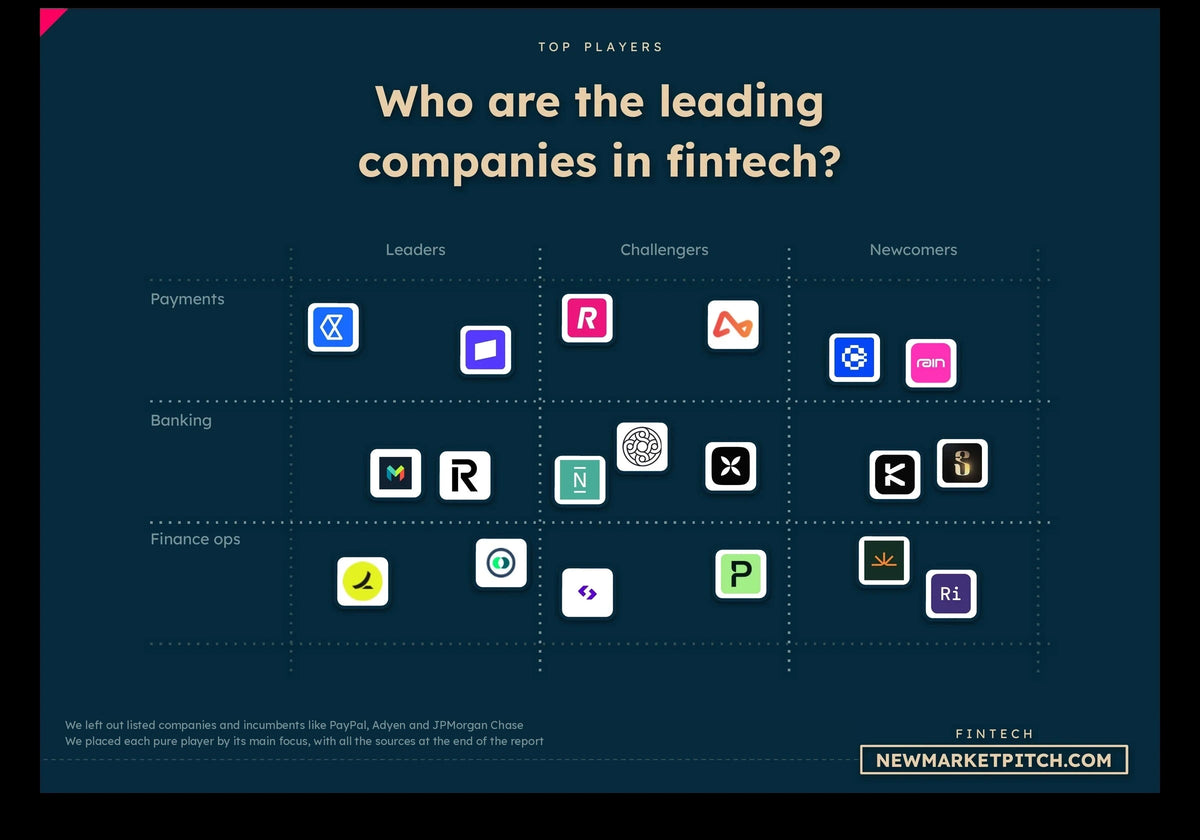
In our research about fintech companies, we turn what is vague and complex into simple, useful visuals. Market maps like this one show you at a glance where every startup stands.
Which FinTech startups have raised the most funding?
Ant Group leads our FinTech startup funding ranking with $18.5B raised, followed by Ramp at $5.0B and Kalshi at $3.7B. The difference between the first two companies alone is $13.5B, reflecting the exceptional scale of Ant Group's historical financing.
The rest of the top ten includes Devoted Health ($3.2B), FNZ ($3.0B), Binance ($2.0B), Polymarket ($1.9B), Checkout.com ($1.8B), Airwallex ($1.7B) and Monzo ($1.7B).
The ten companies have raised approximately $42.5B combined. Ant Group accounts for around 43.5% of that amount, while the other nine companies collectively represent approximately $24.0B.
What makes this ranking interesting is the variety of businesses attracting such large investments. The leading group includes payments platforms, corporate financial software, prediction markets, healthcare insurance, wealth management infrastructure, cryptocurrency exchanges and digital banks.
Ramp's $5.0B is particularly notable because it exceeds the combined funding of Checkout.com and Airwallex. Kalshi's $3.7B also puts a prediction market exchange ahead of several much older financial technology businesses.
| Rank | Startup | Total raised |
|---|---|---|
| 1 | Ant Group | $18.5B |
| 2 | Ramp | $5.0B |
| 3 | Kalshi | $3.7B |
| 4 | Devoted Health | $3.2B |
| 5 | FNZ | $3.0B |
| 6 | Binance | $2.0B |
| 7 | Polymarket | $1.9B |
| 8 | Checkout.com | $1.8B |
| 9 | Airwallex | $1.7B |
| 10 | Monzo | $1.7B |
How much funding has Ant Group raised?
Ant Group has raised $18.5B across four financing rounds, putting the Chinese financial services company comfortably ahead of every other FinTech startup in our ranking.
Its financing history includes two equity investments in 2015 and 2023 whose individual amounts were not disclosed. The latest publicly reported transaction was a private equity investment in July 2023.
The scale of Ant Group's funding becomes clearer when compared with the next-largest companies. Its $18.5B is 3.7 times Ramp's $5.0B, five times Kalshi's $3.7B, and more than six times FNZ's $3.0B.
Ant Group's position reflects the exceptional capital requirements and expansion ambitions associated with building a large financial ecosystem in China. Its business spans digital payments and financial services, giving it a much broader historical financing base than many specialized FinTech startups.
There is also an important difference between its position and that of newer companies. Ramp, Kalshi and Devoted Health have all completed substantial financing transactions during the latest reporting period, whereas Ant Group's latest publicly reported round dates to 2023.
Ant Group remains the clear historical funding leader, although much of the recent fundraising activity is coming from other businesses.

Your time is limited. In our market report about fintech companies, we put numbers on each part of the market, so you can see where it makes sense to focus.
Which FinTech startups have raised the biggest funding rounds recently?
Ramp, Kalshi and Devoted Health have attracted three of the largest recent investments in our ranking, with $1.85B, $1.0B and $555M respectively. Their transactions illustrate how much capital investors are willing to commit to established financial technology businesses.
Ramp's October 2026 Series F extension is particularly large, representing approximately 37% of its $5.0B cumulative funding. Dragoneer, Thrive Capital and Founders Fund are among its key investors.
Kalshi's $1.0B Series G in October 2026 represents approximately 27% of its $3.7B total. Wellington Management and Sequoia Capital co-led the transaction.
Devoted Health secured $555M in Series G primary funding in October 2026. Advent led the financing, with Temasek and GIC among the participating investors.
Other significant recent transactions include FNZ's $450M equity investment in September 2026, Polymarket's $600M strategic equity investment in March 2026, and Airwallex's $320M Series H in June 2026.
These amounts are particularly interesting when compared with the companies' cumulative funding. A single late-stage transaction can represent a substantial portion of a startup's entire financing history.
| Startup | Latest round | Amount | Date |
|---|---|---|---|
| Ramp | Series F Extension | $1.85B | October 2026 |
| Kalshi | Series G | $1.0B | October 2026 |
| Polymarket | Strategic Equity | $600M | March 2026 |
| Devoted Health | Series G | $555M | October 2026 |
| CRED | Series H | $500M | June 2026 |
| Clip | Series F | $500M | June 2026 |
| FNZ | Equity Investment | $450M | September 2026 |
| Plata | Series C | $405M | April 2026 |
| Vestwell | Series E | $385M | February 2026 |
| Airwallex | Series H | $320M | June 2026 |
Is FinTech funding recovering in 2026?
FinTech investment has recovered substantially in 2026, although most of the improvement is concentrated in large transactions involving established businesses.
KPMG's August 2026 Pulse of Fintech report recorded $103.1B in global FinTech investment during the first half of the year, compared with $72.2B in the second half of 2025 and $50.5B in the first half of 2025.
Deal volume moved in the opposite direction. KPMG counted 2,100 transactions in H1 2026, compared with 2,501 in H2 2025. The ten largest transactions alone represented approximately 62% of total investment during the first half.
The composition of that $103.1B also deserves attention. It included venture capital, private equity and acquisitions. M&A accounted for $67.9B, while venture capital represented $31.5B. Consequently, the headline recovery should not be interpreted as $103.1B of new equity raised by startups.
Our company-level research shows a similar concentration among large private businesses. Ramp's $1.85B round, Kalshi's $1.0B financing and Devoted Health's $555M investment illustrate the amounts that established companies can now attract.
First Citizens Bank's October 2026 Future of Fintech report also estimated that US FinTech funding was on pace to increase by 42% during the year. Yet only 15% of FinTech investors had completed three or more deals.
Investors are putting more money into selected companies, while many other startups continue to face a difficult fundraising environment.

In our document detailing everything you need to know about fintech, we always try to gather several sources and make estimates that make sense, so you can work with solid numbers.
What types of FinTech startups attract the most funding?
Payments, digital banking, insurance, wealth management and cryptocurrency infrastructure account for much of the historical funding accumulated by FinTech startups, but prediction markets and specialized financial software have also become major destinations for investment.
Ant Group's $18.5B is the outstanding example of payments and financial services attracting exceptional capital. Ramp's $5.0B shows the scale that corporate financial management software can reach, while Checkout.com ($1.8B), Airwallex ($1.7B) and Rapyd ($1.3B) demonstrate the strength of global payments infrastructure.
Digital banking has produced another large group of funded companies. Monzo has raised $1.7B, Revolut $1.6B, N26 $1.4B, Toss $1.2B and Varo Bank $1.2B.
Insurance is also heavily represented. Devoted Health has accumulated $3.2B, wefox $1.5B, Alan $1.2B and Coalition $770M.
Meanwhile, Kalshi and Polymarket have collectively attracted $5.6B for prediction market infrastructure. FNZ has raised $3.0B for wealth management technology.
The variety is striking. Investors are backing businesses that process payments, provide banking services, manage investments, underwrite insurance and develop entirely new financial markets.
KPMG's H1 2026 research provides a broader perspective: payments attracted $44.2B in global investment, digital assets $11.1B and insurtech $3.7B. These figures include VC, PE and M&A, so they describe sector-wide investment rather than cumulative startup equity funding.
Is Ramp becoming one of the biggest FinTech companies in the world?
Ramp has become one of the most heavily funded corporate FinTech startups, with $5.0B raised across 13 rounds and a $1.85B Series F extension in October 2026.
The company provides corporate cards, expense management and financial operations software. Its product addresses a large recurring business expense: managing how companies spend, approve, monitor and reconcile money.
That latest transaction alone represents more than a third of Ramp's cumulative financing.
The comparison with other payment and financial software companies is revealing. Ramp has raised more than Checkout.com ($1.8B), Airwallex ($1.7B), Plaid ($1.3B) and Razorpay ($742M).
Those businesses address different parts of the financial workflow. Checkout.com focuses on online payment processing, Airwallex on global business payments, Plaid on financial data connectivity, and Razorpay on business payments and financial infrastructure.
Ramp's funding history suggests that investors see substantial potential in controlling the financial operations layer inside businesses, rather than competing exclusively in payment processing.
Its fundraising position is already exceptional. Whether it can turn that capital advantage into comparable leadership in revenue, profitability and customer adoption is a separate question.

Our report covering the fintech market gets updated several times a month, so you always get the latest view of where things stand.
Why is Kalshi attracting so much investment?
Kalshi has raised $3.7B across nine financing rounds, making the regulated prediction market exchange one of the most heavily funded businesses in the entire FinTech industry.
Its latest $1.0B Series G in October 2026 was co-led by Wellington Management and Sequoia Capital. The financing came as the company continued expanding its financial exchange model beyond its original event-contract categories.
The scale is remarkable when compared with established cryptocurrency infrastructure businesses. Fireblocks has raised $1.0B, Blockchain.com $600M, Anchorage Digital $587M and Paxos $535M. Together, these four companies account for $2.722B, approximately $978M less than Kalshi alone.
Kalshi's business model is different from a conventional payment application. It operates an exchange where users trade contracts linked to the outcomes of real-world events.
That creates several potential sources of growth, including trading activity, liquidity, institutional participation and the expansion of available markets. Regulatory permissions and the ability to maintain reliable market liquidity remain central to its long-term prospects.
The company's October financing demonstrates substantial investor conviction. It does not, by itself, prove that prediction markets will reach the scale of traditional securities or derivatives exchanges.
How much funding has Polymarket raised?
Polymarket has raised $1.9B across seven financing rounds, making it one of the largest privately financed prediction market businesses.
Its March 2026 strategic equity investment of $600M came from Intercontinental Exchange, the owner of the New York Stock Exchange. The transaction represents approximately 32% of Polymarket's cumulative funding.
The investment is particularly interesting because it connects a blockchain-based prediction market with one of the world's largest traditional financial market operators.
Polymarket's business model relies on users trading contracts linked to real-world outcomes. Its blockchain infrastructure supports trading and settlement, while the range of markets helps attract users interested in political, economic, sporting and other events.
Its $1.9B funding total places it ahead of Checkout.com ($1.8B), Airwallex ($1.7B) and Kraken ($1.07B).
Kalshi remains ahead with $3.7B. Together, the two prediction market businesses have raised $5.6B, making this one of the most heavily financed emerging categories within FinTech.
The next challenge is converting that financing into sustained trading activity, institutional participation and a business that can operate across different regulatory environments.

In our research about fintech companies, we look at what the winners do differently, so you can learn from the best instead of guessing.
Which FinTech payments startups have raised the most money?
Checkout.com leads the specialized global payment processors in our ranking with $1.8B raised, closely followed by Airwallex at $1.7B and Rapyd at $1.3B.
These three companies have accumulated $4.8B combined. Their products address international commerce, merchant payments and financial infrastructure, giving them access to large markets with recurring transaction activity.
Airwallex has been particularly active lately. Its June 2026 Series H brought in $320M, with Addition leading the round and Baillie Gifford and QED Investors among the participants.
Checkout.com's last publicly reported round was a $1.0B Series D in January 2022, backed by investors including Dragoneer, GIC, Qatar Investment Authority and Tiger Global.
Rapyd completed its latest publicly reported $500M Series F in March 2025, with Altimeter Capital, Target Global and General Catalyst among its investors.
Other notable FinTech businesses in the payments and financial infrastructure space include Teya ($1.1B), Mollie ($931M), Razorpay ($742M), bolttech ($740M), and Satispay ($493M). Bolttech focuses specifically on embedded insurance, illustrating how closely related financial technology categories can overlap.
Payment infrastructure remains an attractive area because businesses need reliable ways to accept payments, transfer money across borders and manage financial operations. The strongest platforms can serve merchants across multiple countries, creating opportunities for substantial transaction volumes.
The financing histories also show that large payment businesses can continue attracting capital long after their initial expansion. Airwallex's Series H is a good example of investors continuing to back an established platform as it enters another phase of growth.
Which digital banks have raised the most funding?
Monzo leads the digital banks in our ranking with $1.7B raised, narrowly ahead of Revolut at $1.6B and N26 at $1.4B.
The three companies have collectively attracted $4.7B. Their funding histories also show how differently digital banks can build their capital bases.
Monzo has completed 15 funding rounds, compared with more than five for Revolut and six for N26. Its latest publicly reported transaction was a $190M Series I extension in May 2024.
Revolut's latest publicly reported financing was an $800M Series E in July 2021, while N26's last reported round was a $900M Series E in October 2021.
More recent activity is visible elsewhere in the sector. Varo Bank raised $124M in February 2026, Ualá secured $197M in March 2026, and Allica Bank completed a $155M Series D in February 2026.
The differences in timing do not automatically indicate differences in financial performance. A digital bank may rely on existing capital, generate internal cash or choose to raise funds only when it needs to finance a specific expansion.
Nevertheless, the funding histories show that digital banking remains one of the most important areas of FinTech investment, with substantial companies operating across Europe, North America, Latin America and Asia.

Theory only gets you so far. In our market report about fintech companies, we dig up the real signals from the field and show you the ones worth watching.
Are FinTech insurance startups raising billions?
Insurance technology has produced several billion-dollar funding recipients, with Devoted Health leading this group at $3.2B, followed by wefox at $1.5B and Alan at $1.2B.
These companies represent very different business models.
Devoted Health operates in Medicare Advantage insurance, where technology is combined with healthcare delivery and insurance underwriting. Wefox focuses on digital insurance distribution, while Alan combines health insurance with digital services.
Devoted Health's October 2026 financing included $555M of Series G primary equity. The company announced the investment as part of a $1.18B transaction that also included a $622M shareholder tender offer. The distinction is important: the secondary component does not represent new equity capital going into the business.
Alan secured $550M through a Series G in June 2026, while wefox completed an approximately $89M equity recapitalization in July 2025.
Other substantial insurance-related businesses include Coalition ($770M), Pie Insurance ($621M), Clearcover ($610M), Gravie ($543M) and ACKO ($458M).
The funding differences reflect the range of capital requirements within insurance. A company taking underwriting risk faces different financial obligations from a business primarily selling software or distributing policies.
Insurance technology has therefore become a major FinTech funding category, particularly where companies combine technology with regulated financial products and substantial operating infrastructure.
How much funding have crypto and blockchain FinTech startups raised?
Binance leads the cryptocurrency-related companies in our ranking with $2.0B raised, followed by NYDIG at $1.4B and Kraken at $1.07B.
Fireblocks has accumulated $1.0B, while Ripple has raised $791M, Blockchain.com $600M, Ledger approximately $595M, Anchorage Digital $587M and Paxos $535M.
These nine businesses represent approximately $8.6B in cumulative funding.
Their activities cover several distinct parts of the digital asset ecosystem. Binance and Kraken operate cryptocurrency exchanges, NYDIG focuses on institutional Bitcoin infrastructure, Fireblocks provides digital asset custody and security technology, and Paxos develops regulated blockchain and stablecoin infrastructure.
The largest individual recent transaction was Binance's $2.0B strategic equity investment from MGX in March 2025. It was the company's first institutional investment.
More recent financing has continued elsewhere in the sector. Kraken received $100M through a Series E in September 2026, while Anchorage Digital secured $100M in growth equity in February 2026, with Tether among its investors.
KPMG recorded $11.1B in global digital asset investment across 467 transactions in H1 2026. This compares with $21.9B for the whole of 2025.
Digital asset infrastructure continues attracting institutional capital, although the financing environment is increasingly focused on businesses capable of supporting regulated financial activity rather than speculative cryptocurrency applications alone.

In our document detailing everything you need to know about fintech, we don't want to repeat what boring consulting reports say. Instead, we show you the real and latest market signals that matter.
Which wealth management FinTech startups have raised the most?
FNZ leads wealth management technology companies with $3.0B raised, followed by iCapital at $1.5B, Addepar at $744M, Altruist at $602M and CAIS at $576M.
The five businesses have collectively attracted approximately $6.4B.
FNZ's position is particularly significant. Its September 2026 equity investment brought in another $450M from existing institutional shareholders, including CPP Investments, Generation Investment Management, La Caisse and Motive Partners.
iCapital's latest publicly reported $820M growth equity investment in July 2025 was also substantial. Its investor group included T. Rowe Price, SurgoCap Partners and State Street.
These businesses address different needs within wealth management. FNZ provides infrastructure for financial institutions, iCapital and CAIS support access to alternative investments, Addepar develops portfolio analytics and reporting software, and Altruist serves financial advisers.
Their customers are often banks, asset managers and investment advisers rather than individual retail investors.
This creates a different growth opportunity from consumer banking applications. A wealth management technology provider can become embedded in the operational systems of large financial institutions, creating long-term commercial relationships and complex integration requirements.
The funding accumulated by these companies shows that institutional financial infrastructure remains one of the most attractive areas of FinTech investment.
Which FinTech startups in India have raised the most money?
CRED leads Indian FinTech companies in our ranking with $1.4B raised, followed by Razorpay at $742M, Navi at approximately $708M, BharatPe at $696M and KreditBee at approximately $623M.
These five companies have attracted approximately $4.2B combined.
CRED focuses on credit-card payments and rewards, Razorpay and BharatPe serve merchant payment and financing needs, while Navi and KreditBee operate in digital lending and consumer financial services.
The latest financing activity has been particularly interesting. CRED completed its Series H financing in June 2026, with Meta joining as a minority investor. The round amounted to $500M.
Navi raised approximately $100M in August 2026, with Prosus among its key investors. KreditBee secured $220M through a Series E in April 2026.
Razorpay's most recent financing remains its $375M Series F from December 2021, while BharatPe's latest round was a $370M Series E in August 2021.
The differences reveal how broad India's FinTech ecosystem has become. Some companies focus on consumer financial relationships, others on merchant payments, and others on lending.
The concentration of funding across five separate businesses is more significant than any individual headline round: India has developed several major FinTech platforms with substantial institutional backing.

Learning from others' mistakes is the cheapest lesson there is. In our report covering the fintech market, we look at what broke startups before you, so you don't repeat it.
Is Latin America producing billion-dollar FinTech startups?
Latin America has produced several heavily financed FinTech startups, led by Ualá with $1.1B raised, followed by Clip at $990M, Creditas at $987M, Neon at $852M and Plata at $815M.
These five companies have accumulated approximately $4.7B.
Their businesses cover digital banking, merchant payments, consumer lending and financial services. Ualá operates across Latin America, Clip focuses on merchant payments in Mexico, Creditas specializes in secured consumer lending in Brazil, and Neon provides digital banking services.
Recent financing has been particularly visible in Mexico and Argentina. Plata completed a $405M Series C in April 2026, led by Bicycle Capital, with Qatar Investment Authority and BTG Pactual among the investors. Clip raised $500M through a Series F in June 2026, while Ualá secured $197M in March 2026 through a round led by Allianz X.
The regional funding environment has also improved in value terms. FinTech Global's first-half 2026 research estimated that Latin American FinTech companies raised approximately $1.6B across 51 deals, compared with $749.7M across 52 deals in the corresponding period of 2025.
The amount invested more than doubled even though the number of transactions barely changed.
That is a substantial improvement, but it also suggests that the recovery is being driven by larger commitments to selected businesses rather than a broad increase in the number of funded startups.
Which Saudi FinTech startups have raised the most money?
Tabby leads the Saudi buy-now-pay-later companies in our ranking with $837M raised, followed by Tamara at $556M.
Tabby completed a $233M Series F in September 2026, led by existing investor Blue Pool Capital, with HongShan and Wellington Management among the participants.
The company also reported that it had been profitable since 2023, processed more than $18B in annualized transaction volume and served 25 million registered users through approximately 70,000 business partners.
These figures provide a useful indication of the scale Tabby has reached. Its latest transaction represents approximately 28% of its cumulative funding.
Tamara's latest publicly reported round was a $340M Series C in December 2023, with SNB Capital, Sanabil Investments and Checkout.com among its investors.
The two companies have collectively attracted approximately $1.4B, making buy-now-pay-later one of the most heavily financed financial technology categories in Saudi Arabia.
Their next challenge is expanding into broader financial services while maintaining responsible lending and attractive unit economics. Tabby has already started moving in that direction by expanding beyond installment payments into additional financial products.

If you build or invest in the fintech market, you need to know which business models pay off now and which ones are fading. That's why our report covering it has a whole section on it.
Which FinTech startups have raised the most funding in Southeast Asia?
Airwallex leads the Singapore-based companies in our ranking with $1.7B raised, followed by bolttech at $740M and Tyme Group at $567M.
In Indonesia, Ajaib and Xendit have each secured $515M, while Maya has accumulated approximately $626M in parent-company financing in the Philippines.
These six Southeast Asian companies represent approximately $4.7B in cumulative financing. Toss has also raised $1.2B, but it is based in South Korea and therefore belongs to the broader East Asian FinTech market rather than Southeast Asia.
The companies' products are quite different. Airwallex and Xendit provide payments infrastructure, bolttech focuses on embedded insurance, Tyme Group develops digital banking services, Ajaib provides digital investment services, and Maya offers digital banking and payments.
Recent fundraising also varies. Airwallex completed a $320M Series H in June 2026, while Ajaib secured $270M through a Series C in August 2026. Tyme Group's latest publicly reported round was a $250M Series D in December 2024.
The regional picture is encouraging because capital has reached businesses serving different parts of the financial system. Southeast Asia has produced major payment platforms, consumer finance applications and digital banks, each targeting distinct local markets.
Which countries have the biggest FinTech funding ecosystems?
The United States, China and the United Kingdom stand out in our ranking, although each has a different funding profile.
China has the largest individual funding recipient in Ant Group, with $18.5B raised. Another Chinese company, Micro Connect, has raised $588M, while Hong Kong's WeLab has raised $885M.
The United States has several major companies across different categories, including Ramp ($5.0B), Kalshi ($3.7B), Devoted Health ($3.2B), Polymarket ($1.9B), iCapital ($1.5B) and Kraken ($1.07B).
The United Kingdom has an especially strong group of financial infrastructure and banking businesses, including FNZ ($3.0B), Checkout.com ($1.8B), Monzo ($1.7B), Revolut ($1.6B) and Rapyd ($1.3B).
Germany is represented by N26 ($1.4B), Trade Republic ($1.1B) and Scalable Capital ($556M). India has CRED ($1.4B), Razorpay ($742M), Navi (approximately $708M), BharatPe ($696M) and KreditBee (approximately $623M).
These differences show why country comparisons require care. China has an exceptional historical funding leader, while the United States and United Kingdom have several heavily funded businesses spread across different FinTech categories.
KPMG's H1 2026 research offers a broader geographical comparison, recording $80.8B of global FinTech investment in the United States, $11.3B in EMEA and $4.6B in ASPAC. Those figures include acquisitions and private equity, so they should not be confused with the cumulative equity funding of startups.

In our market report about fintech companies, we like to show you the big picture. We know your time is precious, so we make every page quick to read and packed with as much learning as possible per minute.
Who are the biggest investors in FinTech startups?
Sequoia Capital, Dragoneer, Coatue, General Catalyst, GIC and several large institutional investment groups appear repeatedly among the major investors backing heavily funded FinTech startups.
Sequoia Capital is associated with Kalshi, Trade Republic, Fireblocks and Mercury. Its involvement across prediction markets, digital investing, cryptocurrency infrastructure and business banking shows just how broad its FinTech exposure has become.
Dragoneer appears among the key investors in Ramp, Checkout.com and N26. Thrive Capital and Founders Fund are also important names in Ramp's latest financing.
Coatue has backed companies including N26, Fireblocks, BharatPe and CloudWalk. General Catalyst appears among the investors in Rapyd, Bilt Rewards and Gravie.
Large institutional investors are equally important. Temasek and GIC have participated in Devoted Health's financing, CPP Investments is associated with FNZ, and Intercontinental Exchange made a $600M investment in Polymarket.
The investor base is therefore a combination of traditional venture capital firms, sovereign wealth funds, pension investors, financial institutions and strategic corporate investors.
We should distinguish between an investor appearing in a company's key investor group and the actual amount it has contributed. Public announcements rarely disclose the precise allocation of every participant in a financing round.
Nevertheless, the recurring names reveal how much overlap exists between the investment networks supporting major FinTech businesses.
Which FinTech startups have completed the most funding rounds?
Monzo leads our ranking in financing frequency with 15 funding rounds, followed by Airwallex with 14 and Ramp with 13.
Creditas, Zopa and Gravie have each completed 12 rounds, while Carta, Atom Bank and Acorns have recorded 11.
The differences become clearer when we compare these round counts with cumulative funding. Ramp has raised $5.0B across 13 rounds, while Monzo has raised $1.7B across 15. Airwallex has also raised $1.7B, but through 14 rounds.
This means Ramp has accumulated substantially more capital despite completing fewer financing events than Monzo and Airwallex.
The simple average funding per round is approximately $385M for Ramp, compared with $113M for Monzo and $121M for Airwallex. These are historical averages, not representative round sizes, because individual transactions can be dramatically different.
The comparison also highlights why funding frequency alone can be misleading. A startup that raises repeatedly may be financing a long expansion period, while another can attract a similar amount through fewer, much larger transactions.
The cumulative amount, timing, investor participation and use of capital are all important when assessing how a FinTech company has financed its growth.
Do pending deals change a FinTech startup's place in the funding ranking?
A pending deal or an outside stake doesn't erase a startup's funding history, and it doesn't always end its independence either.
Avant, still an independent company, has raised $654M across six financing rounds. Its latest publicly reported investment was a growth equity transaction in October 2021, with Pamlico Capital among its key investors.
Atome Financial has raised $225M across three rounds. Its latest publicly reported financing was a $149M late-stage venture transaction in May 2026, with Advance.ai among its investors. An acquisition of the company has been signed, but closing is expected by the third quarter of 2027, so it remains independent for now.
The two businesses operate in different areas of consumer finance. Avant focuses on consumer lending and credit products, while Atome Financial provides buy-now-pay-later services.
Both companies are therefore classified as active startups in the ranking.
This distinction also applies more broadly to FinTech businesses that eventually go public or become part of larger financial groups. The money they raised while operating as startups remains part of their funding history.
For that reason, historical funding and current ownership should always be considered separately.
What does the FinTech startup funding market look like now?
FinTech remains one of the largest destinations for private technology investment, but the companies attracting the most money are increasingly established businesses with substantial operations and proven demand.
Ant Group's $18.5B remains the largest cumulative funding figure in our ranking. Ramp, Kalshi, Devoted Health and FNZ demonstrate how much capital can still be raised by businesses operating in corporate financial software, prediction markets, healthcare insurance and wealth management infrastructure.
Payments and digital banking continue to account for a substantial number of heavily financed startups. At the same time, prediction markets, digital assets and specialized insurance platforms have developed into major investment categories.
The geographical picture has also become broader. China has Ant Group, the United States has a large collection of highly funded businesses, the United Kingdom has several major financial infrastructure companies, and India, Mexico, Brazil, Saudi Arabia and Southeast Asia have produced significant regional platforms.
The most important development is the concentration of investment. KPMG recorded $103.1B in global FinTech investment during H1 2026, while deal volume fell to 2,100 transactions. First Citizens Bank also highlighted how a relatively small group of investors continues to account for a significant share of new financing.
Our conclusion is that FinTech is experiencing a meaningful recovery in investment value, but access to capital remains highly selective. Companies with established products, large markets and substantial expansion opportunities are attracting the biggest commitments.
The next phase will depend on what these startups do with the money. Their ability to convert financing into profitable operations, recurring revenue and lasting customer relationships will ultimately determine which of today's largest funding recipients become the industry's most successful businesses.
Our methodology
This analysis ranks startups across the FinTech market according to their cumulative equity funding. We focus on companies whose core business is financial technology, including payments, digital banking, insurance, wealth management, cryptocurrency infrastructure, lending and financial software. Companies that subsequently went public or were acquired remain eligible because their historical startup financing is still relevant.
For each company, we examined individual financing rounds, including their dates, amounts, round types and key investors. We counted equity financing and excluded debt, grants and other non-equity capital. Particular attention was given to financing announcements and the distinction between primary investment and other transaction structures.
Our research draws on company and investor announcements, regulatory filings, reputable financial publications and specialist industry research. We also used KPMG's Pulse of Fintech H1 2026 research, First Citizens Bank's Future of Fintech report and FinTech Global's first-half 2026 analysis to assess broader investment trends, regional activity and sector performance.
Where financing figures differed between sources, we prioritized direct company and investor disclosures, regulatory documents and authoritative financial reporting. Historical transactions were included alongside recent rounds to give a consistent picture of cumulative funding rather than focusing only on the latest fundraising headlines.
Written by the New Market Pitch teamWe track new markets so founders and investors can move faster. About us