Grid-scale battery storage: what’s funding like now?
Whether you're building or investing in the grid-scale battery storage market, our report covers everything you need to know: the players, the money, and what's coming next.
Summary
Grid-scale battery storage funding is stronger in dollar terms in 2026, but the market is becoming narrower. Recorded capital increased 13.4% to $2.92 billion over the latest 12 months, even as financing transactions fell from 35 to 33 and the number of funded companies declined from 34 to 30.
The biggest change is the size of the checks. Median disclosed financing jumped from $13.8 million to $31 million, while transactions exceeding $50 million increased from seven to 13. Investors are committing more capital to fewer businesses.
That growth does not extend to smaller rounds. Funding from transactions of $50 million or less slipped from $253.83 million to $245.52 million. Remove only the deals above $100 million, however, and remaining capital is up 51.8%, showing that the $50 million to $100 million segment strengthened considerably.
For startups entering the market, conditions look tougher. Median first financing fell from $11.6 million to $2 million, and the median Seed round dropped from approximately $7.5 million to $2 million. New companies are still getting funded, but generally with smaller initial checks.
Previously financed companies are having a very different experience. Follow-on capital increased from approximately $1.41 billion to $2.19 billion, while median follow-on size climbed from $13.85 million to $43 million. Manufacturing expansion and commercial deployment are absorbing much larger commitments.
Form Energy's $750 million Series G was the largest transaction, representing 25.7% of recorded capital. But funding growth does not depend entirely on that deal: removing the largest transaction from each comparison period still leaves an increase, and the top three deals accounted for a smaller share of capital than a year earlier.
The technology mix has changed sharply. Battery Cells & Modules increased from three to ten transactions, while Containerized BESS Systems fell from ten to just one. Asset Ownership & Operation also doubled its transaction count, reflecting the growing financial importance of deployed storage infrastructure.
The headline figures combine different types of financing. Conventional company equity rounds sit alongside project-level tax equity and infrastructure commitments, including some announced maximum amounts. The $2.92 billion total therefore measures recorded financing activity, not pure venture-capital investment or necessarily fully deployed cash.
The United States gained substantial ground. North American transactions doubled from seven to 14, all involving US-headquartered businesses, and the region captured 71.6% of recorded capital. Europe attracted less funding despite a relatively stable deal count, while Asia-Pacific financing activity contracted sharply.
Grid-scale battery storage is increasingly capable of financing large factories and operating power assets, but that does not mean the entire startup ecosystem is accelerating. The market is becoming more commercially mature and somewhat less concentrated among its very largest deals, while early-stage financing remains much less generous.

Written by the New Market Pitch teamWe track new markets so founders and investors can move faster. About us

In our report covering the grid-scale battery storage market, you will always find fresh funding data, taken straight from our own verified funding database.
All funding deals in the grid-scale battery storage market over the last 24 months
Below is the table listing all the deals. You can find our methodology at the end of this page.
If you want a deeper understanding of the market and its current dynamics, get our report covering the grid-scale battery storage market.
| Company | Category | Date | Stage | Deal size | What they do | Region | Lead investors | Country | Rank |
|---|---|---|---|---|---|---|---|---|---|
| SMT Energy | Asset Ownership & Operation | September 2026 | Growth Equity | $268M | Develops, owns and operates distributed and utility-scale battery energy storage projects supporting US electricity grids. | North America | Not disclosed | United States | |
| Tavion | Asset Ownership & Operation | September 2026 | Series A | $38.9M | Develops, owns and operates utility-scale battery storage parks across European electricity markets. | Europe | Leitmotif; Oberon Capital | Sweden | |
| Certain Energy | Battery Cells & Modules | August 2026 | Series A | $11.6M | Develops manganese-based flow batteries for long-duration grid electricity storage. | Europe | British Business Bank | United Kingdom | |
| Form Energy | Containerized BESS Systems | August 2026 | Series D+ | $750M | Manufactures iron-air battery systems providing approximately 100 hours of multi-day electricity storage for power grids. | North America | T. Rowe Price | United States | |
| Ore Energy | Battery Cells & Modules | August 2026 | Series A | $43M | Develops iron-air batteries capable of storing renewable electricity for up to 100 hours for grid-scale supply. | Europe | Plural; HV Capital | Netherlands | |
| Frontier Power USA | Project Development | July 2026 | Unknown | $263M | Develops, finances, constructs and operates utility-scale long-duration battery storage projects in the United States. | North America | Cerberus Capital Management | United States | |
| Rivus Batteries | Battery Cells & Modules | July 2026 | Seed | $2.3M | Develops organic flow-battery electrolytes and modular stationary battery systems for large-scale electricity storage and grid services. | Europe | Turbine Capital | Sweden | |
| Xingchen New Energy | BESS System Integration | July 2026 | Series A | $73M | Develops and manufactures hybrid vanadium-flow and lithium-ion battery storage systems for grid-connected projects. | Asia-Pacific | Not disclosed | China | |
| Eclipse | Market Trading & Optimization | June 2026 | Series A | ≈$23.1M | Develops and optimizes utility-scale battery storage assets through its Flowstream electricity trading and optimization platform. | Europe | BNP Paribas; Noria | France | |
| Volt Harbor | BESS System Integration | May 2026 | Seed | $2M | Develops modular, software-defined battery storage systems integrating batteries, power electronics and controls for grid and high-power infrastructure applications. | North America | MFV Partners | United States | |
| Spearmint Energy | Asset Ownership & Operation | May 2026 | Unknown | $96M | Develops, owns, operates and optimizes standalone utility-scale battery storage assets supplying grid-balancing services. | North America | Not disclosed | United States | |
| CMBlu Energy AG | Battery Cells & Modules | April 2026 | Series C | ≈$58.7M | Develops and manufactures proprietary organic SolidFlow batteries for multi-hour, large-scale electricity storage. | Europe | Not disclosed | Germany | |
| Tavion | Asset Ownership & Operation | April 2026 | Seed | ≈$8.5M | Develops, owns and operates utility-scale battery storage parks providing flexibility to European electricity grids. | Europe | Not disclosed | Sweden | |
| EnerVenue | Battery Cells & Modules | March 2026 | Series B | $300M | Develops and commercializes aqueous metal-hydrogen battery cells and systems for long-duration stationary and utility-scale storage. | North America | Full Vision Capital | United States | |
| Entrix | Market Trading & Optimization | March 2026 | Growth Equity | $50M | Operates an AI-driven trading and optimization platform for grid-connected battery energy storage assets. | Europe | Junction Growth Investors; Korys; BNP Paribas (Solar Impulse Venture Fund) | Germany | |
| Sinergy Flow S.r.l. | Battery Cells & Modules | February 2026 | Seed | $8.3M | Develops sulfur-based redox flow battery technology for long-duration, utility-scale electricity storage. | Europe | CDP Venture Capital SGR | Italy | |
| Capalo AI Oy | Market Trading & Optimization | February 2026 | Series A | $13M | Optimizes and trades grid-scale battery storage capacity across electricity markets using an AI-powered virtual power plant. | Europe | Heartcore Capital | Finland | |
| Powerline | Energy Management Software | February 2026 | Seed | $7M | Provides AI-powered software for monitoring, benchmarking, simulating and improving grid-scale battery portfolio performance. | North America | MaC Venture Capital | United States | |
| Meine Electric | Battery Cells & Modules | January 2026 | Seed | $750K | Develops rechargeable iron-air batteries for long-duration grid and utility-scale renewable energy storage. | Asia-Pacific | Antler; Rebalance; Venture Catalysts | India | |
| terralayr AG | Asset Ownership & Operation | January 2026 | Growth Equity | $130M | Develops, owns and operates grid-scale BESS assets and commercializes their flexibility through its LAYR platform. | Europe | Eurazeo | Switzerland | |
| Liminal Energy | Project Development | January 2026 | Growth Equity | $200M | Develops utility-scale stand-alone battery storage projects in the US. | North America | NGP Energy Capital Management | United States | |
| RelyEZ Energy Storage Technology Co., Ltd. (远信储能) | BESS System Integration | January 2026 | Series B | Not Disclosed | Develops and integrates utility-scale battery storage systems, energy management software, and storage asset services. | Asia-Pacific | Cowin Capital | China | |
| FION Energy | BESS System Integration | December 2025 | Seed | $1.6M | Develops and integrates grid-connected industrial battery systems with AI-driven dispatch and operational management. | Europe | HTGF; Norrsken Evolve | Germany | |
| Kodiaq Technologies | Battery Cells & Modules | December 2025 | Seed | $1.1M | Develops metal-free organic electrolytes for long-duration flow batteries used in large-scale electricity storage. | Europe | Not disclosed | United Kingdom | |
| Hachiko | Market Trading & Optimization | December 2025 | Seed | $1.7M | Provides battery portfolio-management and optimization software for commercial, industrial, and distributed grid-connected storage assets. | Asia-Pacific | Archangel Ventures | Australia | |
| EQORE | BESS System Integration | November 2025 | Seed | $1.7M | Installs and operates grid-connected industrial battery systems with automated controls for electricity-cost optimization and local grid support. | North America | Not disclosed | United States | |
| Quino Energy | Battery Cells & Modules | November 2025 | Series A | $10M | Develops water-based organic flow-battery electrolytes and technology for commercial and grid-scale long-duration electricity storage. | North America | Atri Energy Transition | United States | |
| Flux XII | Battery Cells & Modules | November 2025 | Seed | $4M | Develops organic electrolytes, membranes, and battery modules for long-duration grid-scale flow-battery storage. | North America | The Grantham Foundation for the Protection of the Environment | United States | |
| Peregrine Energy Solutions LLC | Project Development | October 2025 | Growth Equity | $130M | Develops, finances, and operates utility-scale battery-storage projects serving US electricity grids. | North America | Not disclosed | United States | |
| Return | Asset Ownership & Operation | October 2025 | Growth Equity | $348M | Develops, owns, and leases grid-scale battery-storage capacity to energy companies and electricity traders. | Europe | Not disclosed | Netherlands | |
| enspired | Market Trading & Optimization | October 2025 | Series B | $17M | Provides automated electricity-market trading and revenue optimization for grid-scale battery storage assets. | Europe | Future Energy Ventures | Austria | |
| Unbound Potential AG | Battery Cells & Modules | September 2025 | Seed | $7.5M | Develops membrane-free redox-flow battery technology for long-duration, stationary grid electricity storage. | Europe | Founderful; Kvanted | Switzerland | |
| suena energy | Market Trading & Optimization | September 2025 | Series A | $9.5M | Provides automated algorithmic trading and dispatch optimization for battery energy storage systems in electricity and balancing markets. | Europe | Eneco Ventures | Germany | |
| XL Batteries | Battery Cells & Modules | September 2025 | Seed | $7.5M | Develops organic-electrolyte flow batteries for long-duration electricity storage and grid-scale power applications. | North America | Not disclosed | United States | |
| Fidra Energy | Project Development | September 2025 | Growth Equity | Up To $603M | Develops and operates utility-scale battery storage projects, including large standalone grid-connected BESS facilities. | Europe | Not disclosed | United Kingdom | |
| LKA Pacific Pte. Ltd. (EVO Power group) | BESS System Integration | September 2025 | Growth Equity | $20M | Owns a battery storage integration and development platform supplying turnkey BESS solutions through EVO Power. | Asia-Pacific | Mirae Asset Venture Investment | Australia | |
| Offgrid Energy Labs | Battery Cells & Modules | September 2025 | Series A | $15M | Develops zinc-bromine battery technology for stationary, long-duration electricity storage, including utility-scale applications. | Asia-Pacific | Archean Chemical Industries Limited | India | |
| Palmer Energy Technology Limited | BESS System Integration | August 2025 | Series A | $6.8M | Designs and manufactures stationary battery energy storage systems for grid services, transport depots and industrial facilities. | Europe | FirstGroup Energy Limited; Barclays Climate Ventures; University of Oxford | United Kingdom | |
| Eelpower Energy Limited | Asset Ownership & Operation | August 2025 | Growth Equity | Up To $675M | Develops, owns and operates grid-scale battery storage assets providing flexibility and balancing services in the UK electricity market. | Europe | Equitix | United Kingdom | |
| Robestec (Shanghai Ronghe Yuan Energy Storage Co., Ltd.; 融和元储) | BESS System Integration | August 2025 | Series B | >$13.9M | Develops, integrates and delivers large-scale battery energy storage systems and associated asset-management technology. | Asia-Pacific | Not disclosed | China | |
| BM2Solar | Project Development | July 2025 | Series A | $2.4M | Develops and deploys battery storage systems at existing solar power plants, enabling grid-connected energy shifting and flexibility services. | Europe | Axon Partners Group | Portugal | |
| Zhonghai Energy Storage Technology (Beijing) Co., Ltd. (中海储能科技(北京)有限公司) | BESS System Integration | May 2025 | Seed | >$13.8M | Develops iron-chromium flow-battery stacks and integrated long-duration storage systems for large grid-connected installations. | Asia-Pacific | Ant Group | China | |
| VFlowTech Pte. Ltd. | Containerized BESS Systems | May 2025 | Series A | $20.5M | Manufactures modular vanadium redox-flow battery systems for long-duration electricity storage and grid balancing. | Asia-Pacific | Granite Asia | Singapore | |
| Hunan Yinfeng New Energy Co., Ltd. (湖南省银峰新能源有限公司) | Containerized BESS Systems | May 2025 | Series A | Not Disclosed | Develops and manufactures vanadium redox-flow battery stacks, electrolytes, and containerized long-duration storage systems. | Asia-Pacific | Not disclosed | China | |
| Spearmint Energy | Asset Ownership & Operation | April 2025 | Unknown | $98M | Develops, finances, owns and operates utility-scale battery energy storage systems supporting electricity grid reliability. | North America | Not disclosed | United States | |
| Hachiko | Market Trading & Optimization | March 2025 | Seed | $630K | Develops optimization software for portfolios of grid-connected distributed battery storage assets participating in electricity markets. | Asia-Pacific | Twynam Funds Management | Australia | |
| Capalo AI Oy | Market Trading & Optimization | March 2025 | Seed | $4.1M | Provides AI-powered battery trading, dispatch optimization and virtual power plant services for grid-connected energy storage. | Europe | VentureFriends; PROfounders | Finland | |
| AmpereHour Energy | BESS System Integration | March 2025 | Series A | $5M | Designs and integrates battery energy storage systems with control technology for grid and renewable-energy applications. | Asia-Pacific | Avaana Capital; UC Impower | India | |
| Ambos Energy | Project Development | March 2025 | Seed | $10.8M | Develops and plans to operate large standalone battery storage facilities providing grid flexibility in Europe. | Europe | Not disclosed | France | |
| Moonwatt | Containerized BESS Systems | March 2025 | Seed | $8.3M | Develops sodium-ion battery energy storage systems specifically for grid-connected solar power plants. | Europe | daphni; LEA Partners | Netherlands | |
| Scale Energy | Project Development | February 2025 | Seed | $2.1M | Develops and operates distributed industrial battery storage systems that provide grid-balancing and electricity-market services. | Europe | Climentum Capital | Germany | |
| Lion Storage Netherlands B.V. (Mufasa project; now Return group) | Project Development | February 2025 | Growth Equity | $64M | Develops utility-scale battery storage projects, including the 350 MW Project Mufasa in the Netherlands. | Europe | Not disclosed | Netherlands | |
| Tyba | Market Trading & Optimization | February 2025 | Series A | $13.9M | Provides forecasting, automated electricity-market bidding and dispatch optimization software for grid-scale battery assets. | North America | Energize Capital | United States | |
| Cactos Oy | BESS System Integration | January 2025 | Unknown | $7.3M | Designs, manufactures, integrates and operates intelligent battery storage systems that participate in electricity markets and grid balancing. | Europe | Union Square Ventures | Finland | |
| green flexibility | Project Development | January 2025 | Growth Equity | $411M | Develops, builds and operates utility-scale battery storage facilities for electricity-grid flexibility. | Europe | Not disclosed | Germany | |
| Moment Energy | Containerized BESS Systems | January 2025 | Series A | $15M | Manufactures stationary battery energy storage systems using repurposed electric-vehicle batteries for commercial and grid-scale applications. | North America | Amazon Climate Pledge Fund; Voyager Ventures | Canada | |
| Suqian Times Energy Storage Technology Co., Ltd. (宿迁时代储能科技有限公司) | Containerized BESS Systems | December 2024 | Series A | Not Disclosed | Develops and manufactures aqueous organic flow-battery systems for grid-scale electricity storage. | Asia-Pacific | Beijing Green Energy Fund | China | |
| Jolt Energy Storage Technologies, LLC | Containerized BESS Systems | December 2024 | Series A | $4M | Develops organic-electrolyte flow batteries intended to provide long-duration electricity storage for power grids. | North America | Not disclosed | United States | |
| Skip Technology, Inc. | Containerized BESS Systems | November 2024 | Unknown | $5M | Develops hydrogen-bromine flow-battery systems for long-duration utility-scale and distributed electricity storage. | North America | Puyallup Tribal Enterprises | United States | |
| Beijing Xinhuachu Technology Co., Ltd. (北京鑫华储科技有限公司) | Containerized BESS Systems | November 2024 | Seed | Not Disclosed | Develops zinc-nickel and zinc-nickel-air flow-battery systems for long-duration storage and distribution-grid applications. | Asia-Pacific | Not disclosed | China | |
| Flower | Market Trading & Optimization | October 2024 | Series A | $21.7M | Develops grid-scale battery assets and provides automated optimization and electricity-market trading for flexible energy capacity. | Europe | Northzone | Sweden | |
| Zhonghai Energy Storage Technology (Beijing) Co., Ltd. (中海储能科技(北京)有限公司) | BESS System Integration | October 2024 | Unknown | Not Disclosed | Develops and manufactures iron-chromium flow-battery technology and systems for large-scale electricity storage. | Asia-Pacific | Not disclosed | China | |
| terralayr AG | Asset Ownership & Operation | October 2024 | Seed | $67.3M | Develops and operates grid-scale battery assets and aggregates battery capacity through a flexibility-as-a-service platform. | Europe | Not disclosed | Switzerland | |
| Form Energy | Containerized BESS Systems | October 2024 | Series D+ | $405M | Develops and manufactures iron-air battery systems designed to deliver approximately 100 hours of grid-scale electricity storage. | North America | T. Rowe Price | United States | |
| Energy Storage Industries – Asia Pacific (ESI) | Containerized BESS Systems | September 2024 | Growth Equity | $27.6M | Manufactures and assembles containerized iron-flow battery systems for long-duration grid-scale energy storage. | Asia-Pacific | Not disclosed | Australia |

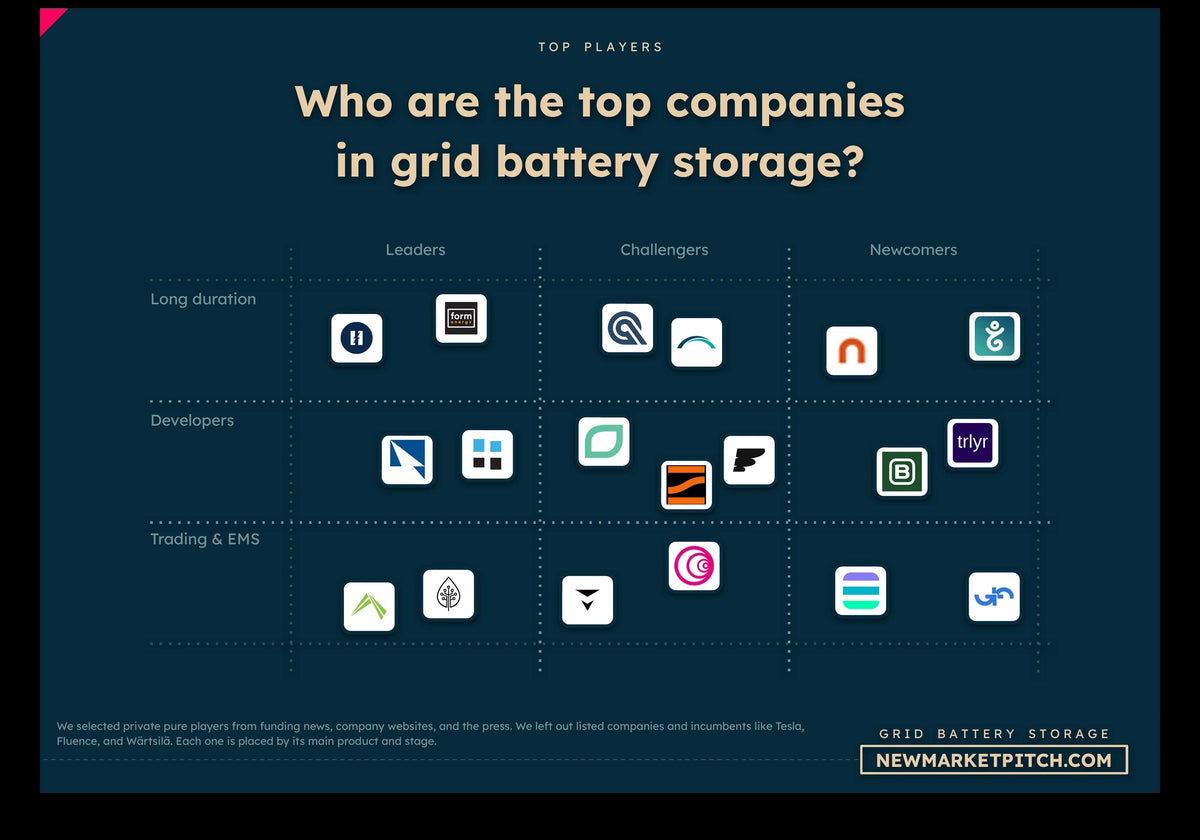
In our research about grid batteries, we turn what is vague and complex into simple, useful visuals. Market maps like this one show you at a glance where every startup stands.
Is the grid-scale battery storage funding market healthier than a year ago?
Grid-scale battery storage funding is getting bigger, but fewer companies are benefiting. Investors are putting more money into larger transactions, while the number of businesses securing financing has declined.
Over the latest 12 months, we recorded $2.92 billion across 33 financings, compared with $2.58 billion across 35 transactions in the previous year. That represents a 13.4% increase in capital despite a 5.7% decline in deal count. The number of funded companies fell even faster, from 34 to 30.
The typical financing became considerably larger. Median disclosed round size increased from $13.8 million to $31 million, while 13 transactions exceeded $50 million, compared with seven previously.
Companies such as Form Energy, EnerVenue and Plus Power illustrate the market's capacity to support expensive manufacturing projects and large storage assets, although their financing structures differ substantially.
For younger businesses seeking their first investment, conditions look less encouraging. Initial financings became smaller, even while the overall market recorded much larger checks.
| Funding metric | Latest 12M | Previous 12M | Change |
|---|---|---|---|
| Recorded capital | $2.922B | $2.577B | +13.4% |
| Total deals | 33 | 35 | −5.7% |
| Funded companies | 30 | 34 | −11.8% |
| Median disclosed round | $31.0M | $13.8M | +124.6% |
| Average disclosed round | $91.32M | $83.13M | +9.8% |
| Deals above $50M | 13 | 7 | +85.7% |
| First-financing deals | 9 | 10 | −10.0% |
| Follow-on deals | 24 | 25 | −4.0% |
The average figures use transactions with disclosed amounts, rather than dividing recorded capital by every deal, including undisclosed financings.
Would battery storage funding still be growing without the biggest rounds?
Battery storage funding growth survives the removal of the largest deals, but disappears once we exclude every financing above $50 million.
The difference is striking. Total recorded capital increased 13.4%, yet funding from rounds of $50 million or less declined from $253.83 million to $245.52 million.
If we exclude only rounds above $100 million, however, the market looks considerably stronger. Remaining capital increased from $483.13 million to $733.22 million, up 51.8%.
The improvement was concentrated in the $50 million to $100 million range, while the smaller financing market remained broadly flat.
Removing the single largest transaction from each period still leaves approximately $2.17 billion in current capital versus $1.90 billion previously. The increase also survives excluding each period's three biggest deals.
Substantial financing commitments have become more common. Smaller startups cannot necessarily expect the same benefit.

Your time is limited. In our market report about grid batteries, we put numbers on each part of the market, so you can see where it makes sense to focus.
Are more battery storage companies getting funded now?
Fewer grid-scale battery storage companies are securing financing today, and that decline is one of the clearest signs of a narrower market.
Our research identified 30 distinct funded businesses during the latest period, down from 34 in the preceding year. Meanwhile, companies completing multiple transactions increased from one to three.
Repeat financings need some interpretation. Plus Power, for example, secured separate tax equity investments for two different battery projects on the same date. These transactions funded different assets rather than representing successive venture rounds.
More capital reached a smaller population of businesses. That can be consistent with a growing storage industry, particularly when individual manufacturing facilities and power projects require hundreds of millions of dollars.
For startup founders, though, a larger funding total does not mean investors are backing more companies.
Are battery storage investors writing bigger checks across the board?
Battery storage investors are writing much bigger checks for selected companies, but early-stage financing has moved in the opposite direction.
The median disclosed round more than doubled, yet median Seed financing fell from approximately $7.5 million to $2 million. Seed deal count even increased slightly, from ten to 11, while total Seed capital declined from $122 million to $38.9 million.
Series A looks different. The number of transactions fell from 12 to seven, but the median Series A round increased from $11.7 million to $23.1 million.
Investors are still funding new ideas with relatively small checks, while committing much larger sums to the companies they choose to support at the next stage.
The number of transactions exceeding $100 million also increased from four to seven. These large financings account for nearly three-quarters of the latest period's recorded capital.
| Financing indicator | Latest 12M | Previous 12M |
|---|---|---|
| Median Seed round | ~$2.0M | ~$7.5M |
| Median Series A round | $23.1M | $11.7M |
| Median overall round | $31.0M | $13.8M |
| Deals above $50M | 13 | 7 |
| Deals above $100M | 7 | 4 |
| Share of deals above $50M | 39.4% | 20.0% |
| Capital excluding deals above $50M | $245.52M | $253.83M |
| Capital excluding deals above $100M | $733.22M | $483.13M |

In our document detailing everything you need to know about grid-scale battery storage, we always try to gather several sources and make estimates that make sense, so you can work with solid numbers.
Is Form Energy responsible for most of the battery storage funding growth?
Form Energy is the biggest individual name in the latest funding period, but the wider market would still show growth without its $750 million round when we compare both periods excluding their largest transactions.
The American iron-air battery developer announced its Series G financing in August 2026, led by T. Rowe Price. The transaction brought its cumulative equity funding above $2 billion and accounted for 25.7% of the current period's recorded capital.
The financing supports a particularly expensive stage of development: expanding manufacturing capacity and deploying commercial iron-air systems designed to deliver electricity for up to 100 hours.
There is also a useful comparison with Form Energy's earlier $405 million Series F, announced in October 2024. Both transactions involved substantial institutional backing, including T. Rowe Price and GE Vernova.
Form Energy's progress matters because long-duration storage manufacturers need more than working technology. They must establish reliable production, manufacture systems at scale and deliver installations that utilities can actually operate.
Still, the latest funding increase extends beyond one company. The three largest deals accounted for 47.8% of recorded capital, down from 65.5% in the previous period.
The market remains dominated by expensive financings, but the money is spread across a somewhat wider group of large transactions than before.
Are new battery storage startups having a harder time raising money?
New battery storage startups are still getting funded, but their first checks are considerably smaller than a year ago.
The median recorded first financing dropped from $11.6 million to just $2 million. First-financing transactions also declined slightly, from ten to nine.
The decline becomes more visible when we compare the capital involved. First financings represented approximately $727.6 million in the latest period, versus $1.17 billion previously.
Some caution is warranted because the figures include unusually large initial financing events and one inconsistent classification: Frontier Power USA has two transactions marked as first financings. The second should not automatically count as another new company's entry into the market.
Even with those qualifications, the smaller median is difficult to ignore.
Young companies are still finding investors, but the financing environment appears less generous at the point of entry. The bigger money is being committed further along the development process.

Our report covering the grid-scale battery storage market gets updated several times a month, so you always get the latest view of where things stand.
Are established battery storage companies taking a bigger share of the money?
Previously funded battery storage companies are receiving much larger financing commitments, making follow-on funding one of the strongest parts of the market.
Follow-on capital increased from approximately $1.41 billion to $2.19 billion, even though transaction count remained virtually unchanged at 25 versus 24.
Median follow-on size rose from $13.85 million to $43 million.
EnerVenue offers a clear example. In March 2026, the company announced a $300 million Series B extension led by Full Vision Capital. The financing was intended to accelerate its move from technology development toward high-volume manufacturing of lithium-free metal-hydrogen batteries.
Form Energy's $750 million round shows a similar appetite for funding industrial expansion, though it is further along in the financing sequence.
These companies face expensive challenges that cannot be solved with small venture checks. They need factories, production processes, supply chains and commercial installations.
Investors are willing to finance those requirements for selected businesses. That doesn't mean every previously funded company is successfully raising its next round.
Are investors abandoning early-stage battery storage startups?
Investors have not abandoned early-stage battery storage companies, but fewer Series A deals and much smaller Seed checks point to a tougher progression through the funding pipeline.
Seed and Series A together accounted for 54.5% of the latest transactions, compared with 62.9% previously.
The later-stage share increased from 25.7% to 30.3%. Five transactions in the latest period carried unknown-stage classifications, compared with four previously, often because project financing does not fit conventional venture terminology.
For companies developing new chemistries, control software or storage systems, an early investment may be enough to build prototypes and conduct testing. Manufacturing and commercial deployment typically demand much greater commitments.
The US Department of Energy's long-duration energy storage programs highlight the technical and institutional obstacles that companies must overcome before achieving widespread deployment.
Our financing figures are consistent with investors making larger commitments around these expensive later steps. However, they do not establish which exact technical, customer or revenue milestones investors required.
| Funding stage | Latest deals | Previous deals | Latest capital |
|---|---|---|---|
| Seed | 11 | 10 | $38.9M |
| Series A | 7 | 12 | $212.6M |
| Series B | 3 | 1 | $317.0M |
| Series C | 1 | 0 | $58.7M |
| Series D+ | 1 | 1 | $750.0M |
| Growth Equity | 5 | 7 | $926.0M |
| Unknown | 5 | 4 | $619.0M |
| Total | 33 | 35 | $2.922B |
The stage totals reconcile to approximately $2.922 billion after rounding. They reflect the dataset's stage labels, including infrastructure transactions whose economic structure differs from a conventional venture round.

In our research about grid batteries, we look at what the winners do differently, so you can learn from the best instead of guessing.
Which battery storage technologies are attracting the most funding?
Battery Cells & Modules attracted the clearest increase in investor attention, with deal count jumping from three to ten.
The category's share of total transactions rose from 8.6% to 30.3%, making it the biggest winner in terms of funding breadth.
And this wasn't simply the result of one enormous round. Multiple businesses secured financing across the category.
EnerVenue's $300 million financing contributed substantially to its recorded capital. The company's metal-hydrogen technology is designed for stationary storage applications where operating life, durability and manufacturing economics are central considerations.
The International Energy Agency has documented the industry's heavy dependence on lithium-ion batteries, especially lithium iron phosphate systems. That commercial dominance creates a challenging environment for alternatives, which must demonstrate compelling technical and economic advantages.
Investors are nonetheless continuing to fund different battery chemistries and manufacturing approaches.
Whether all those financed approaches can compete successfully at industrial scale remains an open question.
Why are investors putting more money into battery storage assets?
Investors are financing more companies that own and operate grid-scale battery assets, reflecting the growing importance of storage as electricity infrastructure.
Asset Ownership & Operation doubled from four to eight financing transactions, while recorded capital exceeded $1 billion during the latest period.
The change comes as battery deployment accelerates in the United States. According to the US Energy Information Administration's August 2026 figures, utility-scale battery capacity reached nearly 52 gigawatts by the end of June, after adding 8.3 gigawatts in the first half of the year.
More installed capacity creates opportunities for businesses that own storage facilities, sell electricity-market services and manage operating assets.
Plus Power illustrates the financial model. In November 2025, it announced $160 million in tax equity investments from Morgan Stanley for two New England projects: $95 million for Cranberry Point in Massachusetts and $65 million for Cross Town in Maine.
These transactions are distinct from conventional startup funding because investors are financing identifiable electricity infrastructure.
Asset ownership is becoming a more important part of the funding mix, alongside venture-backed storage technologies. The distinction is essential when comparing the size and quality of financing activity.

In our market report about grid batteries, we don't want to repeat what boring consulting reports say. Instead, we show you the real and latest market signals that matter.
Is funding drying up for containerized battery storage systems?
Containerized BESS Systems experienced a dramatic decline in financing activity, despite recording more capital than in the previous period.
Deal count collapsed from ten to one. The remaining transaction was Form Energy's $750 million round.
So this category looks stronger in dollars, but the number of financing events has almost disappeared.
The contrast with Battery Cells & Modules is particularly revealing. One category gained seven deals; the other lost nine.
There is some classification sensitivity here because battery manufacturers can develop both individual storage components and integrated systems. Still, the change in recorded transaction activity is too large to overlook.
Project Development also weakened, falling from six to two financings. By comparison, Trading & Optimization maintained five transactions while attracting more than twice as much capital.
Investors are concentrating on different parts of the storage value chain rather than increasing funding uniformly across every business model.
Are battery trading and optimization startups getting more attention?
Battery trading and optimization companies are attracting larger financing commitments, even though no more transactions were recorded than a year earlier.
The category maintained five deals in both periods, while recorded capital more than doubled.
Storage operators must decide when to charge, when to sell electricity and which grid services offer attractive returns. The economics can change sharply between markets and even between different operating hours.
In Europe, ENTSO-E's December 2025 analysis highlighted the importance of market design, revenue visibility and investment frameworks for utility-scale storage.
Those issues directly affect the value of software and optimization services that help storage operators earn revenue from their assets.
The US market has its own regulatory foundation, including Federal Energy Regulatory Commission Order No. 841, which established requirements for storage participation in wholesale electricity markets.
Financing has strengthened for optimization businesses, although the unchanged deal count gives us little reason to claim that a wave of new trading startups has emerged.

Learning from others' mistakes is the cheapest lesson there is. In our document detailing everything you need to know about grid-scale battery storage, we look at what broke startups before you, so you don't repeat it.
Why is the US attracting so much more battery storage funding?
The United States has become the dominant destination for recorded grid-scale battery storage capital in our latest comparison.
North American deal count doubled from seven to 14, while funding increased from approximately $548 million to $2.09 billion. All 14 current-period transactions involved US-headquartered businesses.
North America's share of global recorded capital reached 71.6%, compared with 21.3% previously.
The deployment backdrop helps explain the interest. In February 2026, the US Energy Information Administration reported that developers planned to add 24 gigawatts of utility-scale battery storage during the year, compared with roughly 15 gigawatts installed in 2025.
Form Energy's manufacturing expansion and Plus Power's project-level transactions are two examples of companies raising substantial capital in this environment.
Europe's position is more mixed. The number of transactions barely changed, from 16 to 15, but recorded capital dropped from $1.91 billion to $755 million. Large previous-period platform commitments explain much of the difference.
Asia-Pacific showed a more direct loss of financing breadth, with transactions falling from 12 to four.
The US advantage is visible in both deal count and capital, although several large financings amplify the size of its dollar lead.
Are corporate investors taking over battery storage funding?
Corporate investors remain important in battery storage, but their participation increased only modestly over the latest year.
We identified ten transactions involving named strategic investors, compared with nine previously. The participation rate rose from 25.7% to 30.3%.
GE Vernova's involvement with Form Energy illustrates why these relationships can matter. Industrial investors may contribute relevant market knowledge or commercial relationships alongside capital, although each transaction needs to be assessed individually.
The overall increase of one transaction is too small to establish a major change in investor preferences.
Meanwhile, the number of distinct disclosed lead-investor names increased slightly from 27 to 29. That suggests the market has maintained a reasonably broad group of named financing leaders, although complete syndicate records are unavailable.
The evidence supports continued participation from both financial and strategic investors, with no clear sign that corporate capital has displaced traditional institutional funding.

If you build or invest in the grid-scale battery storage market, you need to know which business models pay off now and which ones are fading. That's why our report covering it has a whole section on it.
Do battery storage companies need to prove more before investors fund them?
Battery storage investors appear willing to commit much larger amounts when companies reach expensive manufacturing or deployment stages, but we cannot establish a universal new funding threshold.
Form Energy's latest financing is connected to expanding iron-air battery manufacturing and commercial deployment. EnerVenue's Series B extension supports its transition toward high-volume production.
Plus Power's financings are different again: they are tied to specific battery installations rather than the development of an unproven product.
These large funding commitments increasingly support identifiable industrial or infrastructure requirements.
Yet we have no reliable market-wide breakdown showing whether investors demanded more revenue, more customers, better technical performance or stronger contracts than they did a year ago.
The median age of funded companies remained approximately four years in both periods. That weakens the idea that investors simply shifted toward much older businesses.
Large funding amounts are closely associated with expensive commercial activities. The evidence does not justify claiming that every startup must now demonstrate the same level of maturity.
Is grid-scale battery storage moving from R&D to commercialization?
Grid-scale battery storage is showing more signs of commercial maturity, with substantial financing going toward manufacturing and deployed assets while new technology development continues.
The distinction is visible in the types of businesses raising money.
Form Energy is expanding production of iron-air storage technology. EnerVenue is financing industrial manufacturing. Plus Power is funding individual electricity-storage assets.
Meanwhile, Seed transactions still represented one-third of all current deals. Younger technology companies remain an important part of the market.
The wider electricity-storage industry is also moving quickly. The International Energy Agency has identified battery storage as one of the fastest-growing technologies in the energy system, while US installation data shows how rapidly physical capacity is expanding.
Commercialization is becoming more financially important as companies move into large factories and operating projects.
However, the available financing records do not consistently classify use of funds. We cannot calculate an exact market-wide shift from research spending toward manufacturing, sales or deployment.

In our research about grid batteries, we like to show you the big picture. We know your time is precious, so we make every page quick to read and packed with as much learning as possible per minute.
Is battery storage funding becoming less dependent on a few giant deals?
Battery storage funding is less dependent on the three or five largest financings than it was a year ago, although very large transactions still account for almost all recorded capital.
The top three deals represented 47.8% of the latest period's funding, compared with 65.5% previously. The top five accounted for 66%, down from 85.1%.
This improvement occurred while the overall number of deals declined.
There were more transactions above $50 million, giving the market a somewhat broader upper tier of substantial funding recipients.
Yet those transactions still accounted for 91.6% of all recorded capital.
Another important complication is the structure of the deals themselves. Some financings are conventional company equity rounds; others are project tax equity or commitments expressed as maximum available amounts.
For example, the earlier period includes up-to-$675 million and up-to-$603 million commitments associated with Eelpower and Fidra Energy.
Treating conditional commitments as equivalent to fully funded corporate equity can exaggerate the apparent strength of individual periods.
Large-deal concentration became less extreme, but the market remains overwhelmingly driven by major financing events.
What really changed in grid-scale battery storage funding over the last 12 months?
Grid-scale battery storage funding became stronger for large projects and selected established companies, while funding breadth and smaller early-stage rounds weakened. The market is showing more signs of maturity, but growth is uneven.
The biggest change is that larger financial commitments reached fewer businesses. Recorded capital increased 13.4%, while unique funded companies fell 11.8%. The headline improvement therefore says relatively little about how easy it is for a typical startup to raise money.
The second change is the shift toward larger tickets. Financings above $50 million became much more common, while capital below that threshold declined slightly. Existing funded companies received much larger follow-on checks, whereas median initial financing dropped sharply.
The third change is where investors are placing their bets. Battery Cells & Modules and Asset Ownership & Operation both gained transaction breadth. Containerized BESS Systems lost most of its deal activity, despite Form Energy's exceptionally large round.
North America also gained substantial ground. US companies attracted twice as many transactions as in the previous year and accounted for more than 70% of recorded capital.
Finally, industrial scale increasingly shapes the largest financing announcements. Manufacturing expansion, operational storage assets and commercial deployment all require funding far beyond the level associated with initial product development.
The biggest mistake would be to interpret the 13.4% rise in recorded capital as evidence that the entire battery storage startup ecosystem is accelerating.
Today's grid-scale battery storage market is increasingly capable of financing large industrial ambitions. Whether it can support a broader generation of young companies just as effectively is much less clear.

When you build or invest in the grid-scale battery storage market, you need clarity, not confusion. In our market report about grid batteries, we always try to put numbers on and quantify whatever is usually vague and confusing.
Our methodology
This analysis examines how financing in the grid-scale battery storage market changed across two consecutive 12-month periods: 23 September 2025 to 22 September 2026, compared with 23 September 2024 to 22 September 2025. Our objective was to distinguish genuine changes in funding breadth, round sizes, company participation and financing structures from movements driven by exceptionally large transactions.
We tracked 84 grid-scale battery storage deals, including 68 transactions within the two comparison periods. The latest period comprises 33 financings involving 30 distinct companies, versus 35 financings involving 34 companies previously. Transactions were assigned to periods according to their recorded financing dates, and market categories followed our own classification.
We measured total recorded capital, disclosed round sizes, financing stages, first and follow-on activity, transaction concentration, business-model categories, company geography and named investor participation. Average and median round sizes use disclosed financing amounts; undisclosed transactions remain in deal-count metrics but do not contribute monetary values. The stage breakdown reconciles to approximately $2.922 billion in the latest period after rounding.
Importantly, our funding totals are not restricted to primary corporate equity. The database includes conventional venture and growth-equity rounds, project-level tax equity, infrastructure financing and announced platform commitments. We report these together as recorded financing activity while distinguishing their economic structures in the analysis. Some announced commitments represent maximum available amounts rather than funds already drawn, and project financing should not be interpreted as equivalent to an investment directly into a startup's corporate equity.
To assess whether financing growth was broadly distributed, we compared capital with and without transactions above $50 million and $100 million and tested the effect of excluding each period's largest deals. We also examined concentration among the three and five largest transactions, first versus follow-on financing, stage distribution and distinct funded-company counts. First-financing classifications were retained as recorded, with inconsistencies identified where they could affect interpretation.
We supplemented the funding records with primary company announcements, including Form Energy's $750 million Series G, its earlier $405 million Series F, EnerVenue's $300 million Series B extension, and Plus Power's project financing disclosures. These sources helped distinguish industrial manufacturing investments from financing tied to operating electricity-storage assets.
For industry and regulatory context, we drew on the US Energy Information Administration's battery-capacity statistics, its 2026 capacity-addition outlook, the International Energy Agency's Batteries and Secure Energy Transitions report, ENTSO-E's analysis of energy-storage market design, FERC Order No. 841, and the US Department of Energy's long-duration storage program.
Our conclusions give the greatest weight to patterns supported by several measurable indicators: changes in capital, deal count, financing size, company breadth and concentration. Company announcements and electricity-market research provide additional evidence about commercialization and deployment, while the distinction between corporate equity and project financing remains central to interpreting the market's apparent growth.

A good product starts with a real problem. In our document detailing everything you need to know about grid-scale battery storage, we show you the ones customers still live with.
Written by the New Market Pitch teamWe track new markets so founders and investors can move faster. About us