What are the funding trends in grid-scale battery storage?
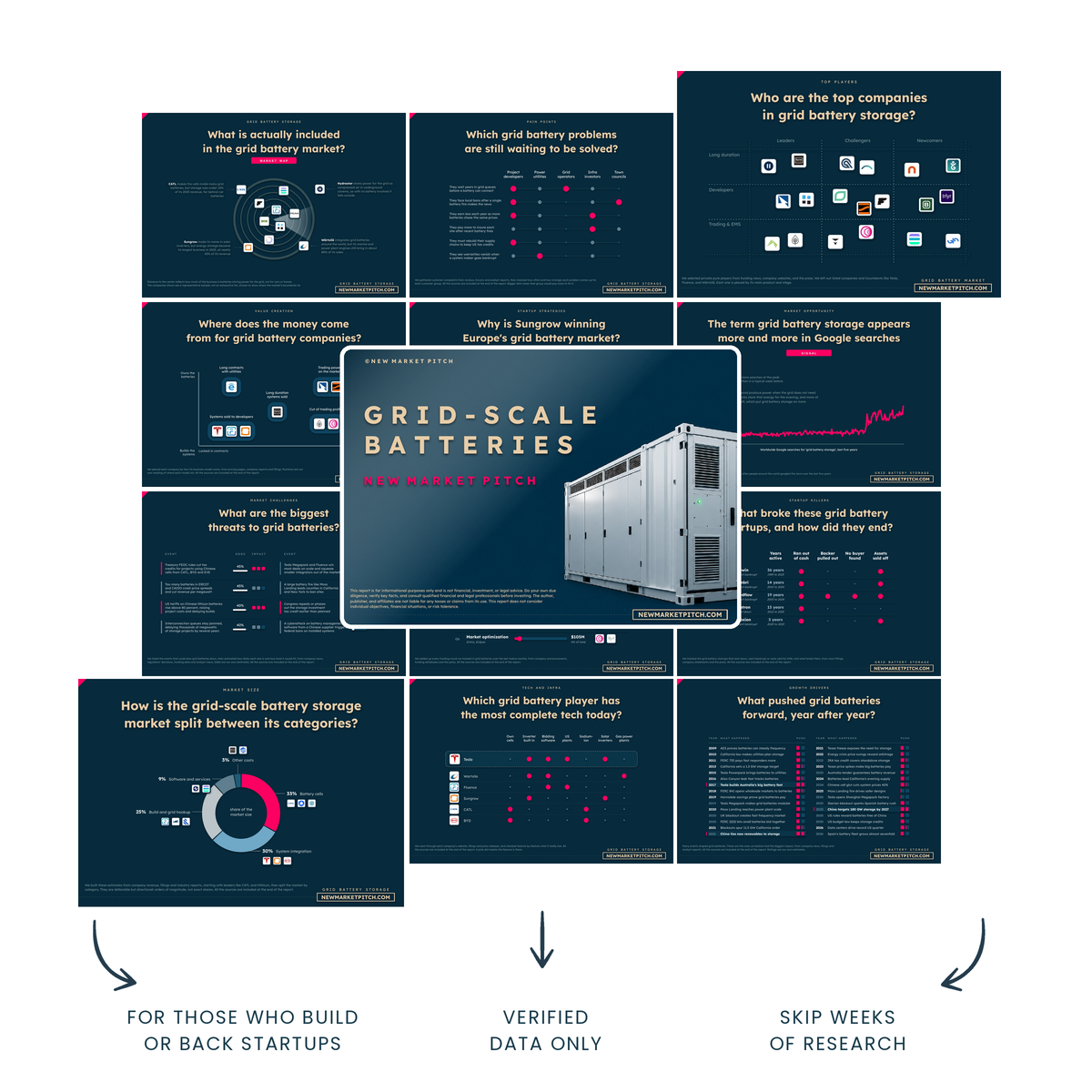
Whether you're building or investing in the grid-scale battery storage market, our report covers everything you need to know: the players, the money, and what's coming next.
Summary
Grid-scale battery storage funding is surging in 2026, but fewer companies are raising money. Through September 22, quantified financing reached $2.15 billion, up 189.8% from the same period in 2025, while deal volume fell from 26 to 21. The biggest change is the size of the checks going to established manufacturers and storage infrastructure businesses.
The median financing jumped from $9.5 million to $40.95 million, more than quadrupling in a year. Eight rounds exceeded $50 million, compared with just three in 2025, and five topped $100 million.
The boom survives the removal of the largest transactions, but looks much less dramatic. Excluding rounds above $50 million leaves 24.2% funding growth, compared with the headline 189.8%. Interestingly, the top five deals represented a slightly smaller share of funding than last year, at 79.7% versus 82.8%.
Smaller financings are becoming scarcer. Deals between $5 million and $20 million fell from 12 to five, while only three companies received their first recorded financing, compared with nine in 2025. Follow-on rounds accounted for 18 of the year's 21 transactions.
Battery manufacturing has recovered in deal activity. Battery Cells & Modules recorded seven financings versus three a year earlier, although EnerVenue's $300 million round represented 70.6% of that category's funding. Form Energy's separate $750 million round was the largest financing overall.
Storage asset ownership is emerging as a durable fundraising category. Its deal count has increased in three consecutive comparable periods, from one in 2024 to three in 2025 and five in 2026. Investors are financing businesses that can own and operate revenue-generating electricity infrastructure.
Not every segment is benefiting. Project Development fell from six deals to one, while BESS System Integration dropped from six to three. The shift favors battery technologies and operating assets over some intermediary activities, although recorded fundraising cannot establish whether underlying demand has weakened.
North America captured 78.5% of quantified funding through just seven transactions, largely because of Form Energy, EnerVenue and Frontier Power USA. Europe completed more deals, with 11, but attracted considerably less capital.
Strategic corporate investors are becoming more visible. They participated in 38.1% of recorded 2026 deals, up from 26.9% in 2025, with companies connected to industrial equipment, energy infrastructure and battery technologies appearing alongside financial investors.
The $2.15 billion raised already exceeds the full-year quantified totals for both 2024 and 2025. However, comparisons depend on excluding undrawn maximum commitments: two large European arrangements announced in 2025 carried ceilings totaling $1.28 billion that were not counted as funded cash.
The next test is commercial execution. Investors are putting unprecedented amounts into manufacturing capacity and storage assets, but the longer-term significance depends on how much of that financing becomes operating factories, deployed batteries and sustainable project revenue.

Written by the New Market Pitch teamWe track new markets so founders and investors can move faster. About us

In our report covering the grid-scale battery storage market, you will always find fresh funding data, taken straight from our own verified funding database.
All funding deals in the grid-scale battery storage market over the last years
Below is the table listing all the deals. You can find our methodology at the end of this page.
If you want a deeper understanding of the market and its current dynamics, get our report covering the grid-scale battery storage market.
| Company | Category | Date | Stage | Deal size | What they do | Region | Lead investors | Country | Rank |
|---|---|---|---|---|---|---|---|---|---|
| SMT Energy | Asset Ownership & Operation | September 2026 | Growth Equity | $268M | Develops, owns and operates distributed and utility-scale battery energy storage projects supporting US electricity grids. | North America | Not disclosed | United States | |
| Tavion | Asset Ownership & Operation | September 2026 | Series A | $38.9M | Develops, owns and operates utility-scale battery storage parks across European electricity markets. | Europe | Leitmotif; Oberon Capital | Sweden | |
| Certain Energy | Battery Cells & Modules | August 2026 | Series A | $11.6M | Develops manganese-based flow batteries for long-duration grid electricity storage. | Europe | British Business Bank | United Kingdom | |
| Form Energy | Containerized BESS Systems | August 2026 | Series D+ | $750M | Manufactures iron-air battery systems providing approximately 100 hours of multi-day electricity storage for power grids. | North America | T. Rowe Price | United States | |
| Ore Energy | Battery Cells & Modules | August 2026 | Series A | $43M | Develops iron-air batteries capable of storing renewable electricity for up to 100 hours for grid-scale supply. | Europe | Plural; HV Capital | Netherlands | |
| Frontier Power USA | Project Development | July 2026 | Unknown | $263M | Develops, finances, constructs and operates utility-scale long-duration battery storage projects in the United States. | North America | Cerberus Capital Management | United States | |
| Rivus Batteries | Battery Cells & Modules | July 2026 | Seed | $2.3M | Develops organic flow-battery electrolytes and modular stationary battery systems for large-scale electricity storage and grid services. | Europe | Turbine Capital | Sweden | |
| Xingchen New Energy | BESS System Integration | July 2026 | Series A | $73M | Develops and manufactures hybrid vanadium-flow and lithium-ion battery storage systems for grid-connected projects. | Asia-Pacific | Not disclosed | China | |
| Eclipse | Market Trading & Optimization | June 2026 | Series A | ≈$23.1M | Develops and optimizes utility-scale battery storage assets through its Flowstream electricity trading and optimization platform. | Europe | BNP Paribas; Noria | France | |
| Volt Harbor | BESS System Integration | May 2026 | Seed | $2M | Develops modular, software-defined battery storage systems integrating batteries, power electronics and controls for grid and high-power infrastructure applications. | North America | MFV Partners | United States | |
| Spearmint Energy | Asset Ownership & Operation | May 2026 | Unknown | $96M | Develops, owns, operates and optimizes standalone utility-scale battery storage assets supplying grid-balancing services. | North America | Not disclosed | United States | |
| CMBlu Energy AG | Battery Cells & Modules | April 2026 | Series C | ≈$58.7M | Develops and manufactures proprietary organic SolidFlow batteries for multi-hour, large-scale electricity storage. | Europe | Not disclosed | Germany | |
| Tavion | Asset Ownership & Operation | April 2026 | Seed | ≈$8.5M | Develops, owns and operates utility-scale battery storage parks providing flexibility to European electricity grids. | Europe | Not disclosed | Sweden | |
| EnerVenue | Battery Cells & Modules | March 2026 | Series B | $300M | Develops and commercializes aqueous metal-hydrogen battery cells and systems for long-duration stationary and utility-scale storage. | North America | Full Vision Capital | United States | |
| Entrix | Market Trading & Optimization | March 2026 | Growth Equity | $50M | Operates an AI-driven trading and optimization platform for grid-connected battery energy storage assets. | Europe | Junction Growth Investors; Korys; BNP Paribas (Solar Impulse Venture Fund) | Germany | |
| Sinergy Flow S.r.l. | Battery Cells & Modules | February 2026 | Seed | $8.3M | Develops sulfur-based redox flow battery technology for long-duration, utility-scale electricity storage. | Europe | CDP Venture Capital SGR | Italy | |
| Capalo AI Oy | Market Trading & Optimization | February 2026 | Series A | $13M | Optimizes and trades grid-scale battery storage capacity across electricity markets using an AI-powered virtual power plant. | Europe | Heartcore Capital | Finland | |
| Powerline | Energy Management Software | February 2026 | Seed | $7M | Provides AI-powered software for monitoring, benchmarking, simulating and improving grid-scale battery portfolio performance. | North America | MaC Venture Capital | United States | |
| Meine Electric | Battery Cells & Modules | January 2026 | Seed | $750K | Develops rechargeable iron-air batteries for long-duration grid and utility-scale renewable energy storage. | Asia-Pacific | Antler; Rebalance; Venture Catalysts | India | |
| terralayr AG | Asset Ownership & Operation | January 2026 | Growth Equity | $130M | Develops, owns and operates grid-scale BESS assets and commercializes their flexibility through its LAYR platform. | Europe | Eurazeo | Switzerland | |
| Liminal Energy | Project Development | January 2026 | Growth Equity | $200M | Develops utility-scale stand-alone battery storage projects in the US. | North America | NGP Energy Capital Management | United States | |
| RelyEZ Energy Storage Technology Co., Ltd. (远信储能) | BESS System Integration | January 2026 | Series B | Not Disclosed | Develops and integrates utility-scale battery storage systems, energy management software, and storage asset services. | Asia-Pacific | Cowin Capital | China | |
| FION Energy | BESS System Integration | December 2025 | Seed | $1.6M | Develops and integrates grid-connected industrial battery systems with AI-driven dispatch and operational management. | Europe | HTGF; Norrsken Evolve | Germany | |
| Kodiaq Technologies | Battery Cells & Modules | December 2025 | Seed | $1.1M | Develops metal-free organic electrolytes for long-duration flow batteries used in large-scale electricity storage. | Europe | Not disclosed | United Kingdom | |
| Hachiko | Market Trading & Optimization | December 2025 | Seed | $1.7M | Provides battery portfolio-management and optimization software for commercial, industrial, and distributed grid-connected storage assets. | Asia-Pacific | Archangel Ventures | Australia | |
| EQORE | BESS System Integration | November 2025 | Seed | $1.7M | Installs and operates grid-connected industrial battery systems with automated controls for electricity-cost optimization and local grid support. | North America | Not disclosed | United States | |
| Quino Energy | Battery Cells & Modules | November 2025 | Series A | $10M | Develops water-based organic flow-battery electrolytes and technology for commercial and grid-scale long-duration electricity storage. | North America | Atri Energy Transition | United States | |
| Flux XII | Battery Cells & Modules | November 2025 | Seed | $4M | Develops organic electrolytes, membranes, and battery modules for long-duration grid-scale flow-battery storage. | North America | The Grantham Foundation for the Protection of the Environment | United States | |
| Peregrine Energy Solutions LLC | Project Development | October 2025 | Growth Equity | $130M | Develops, finances, and operates utility-scale battery-storage projects serving US electricity grids. | North America | Not disclosed | United States | |
| Return | Asset Ownership & Operation | October 2025 | Growth Equity | $348M | Develops, owns, and leases grid-scale battery-storage capacity to energy companies and electricity traders. | Europe | Not disclosed | Netherlands | |
| enspired | Market Trading & Optimization | October 2025 | Series B | $17M | Provides automated electricity-market trading and revenue optimization for grid-scale battery storage assets. | Europe | Future Energy Ventures | Austria | |
| Unbound Potential AG | Battery Cells & Modules | September 2025 | Seed | $7.5M | Develops membrane-free redox-flow battery technology for long-duration, stationary grid electricity storage. | Europe | Founderful; Kvanted | Switzerland | |
| suena energy | Market Trading & Optimization | September 2025 | Series A | $9.5M | Provides automated algorithmic trading and dispatch optimization for battery energy storage systems in electricity and balancing markets. | Europe | Eneco Ventures | Germany | |
| XL Batteries | Battery Cells & Modules | September 2025 | Seed | $7.5M | Develops organic-electrolyte flow batteries for long-duration electricity storage and grid-scale power applications. | North America | Not disclosed | United States | |
| Fidra Energy | Project Development | September 2025 | Growth Equity | Up To $603M | Develops and operates utility-scale battery storage projects, including large standalone grid-connected BESS facilities. | Europe | Not disclosed | United Kingdom | |
| LKA Pacific Pte. Ltd. (EVO Power group) | BESS System Integration | September 2025 | Growth Equity | $20M | Owns a battery storage integration and development platform supplying turnkey BESS solutions through EVO Power. | Asia-Pacific | Mirae Asset Venture Investment | Australia | |
| Offgrid Energy Labs | Battery Cells & Modules | September 2025 | Series A | $15M | Develops zinc-bromine battery technology for stationary, long-duration electricity storage, including utility-scale applications. | Asia-Pacific | Archean Chemical Industries Limited | India | |
| Palmer Energy Technology Limited | BESS System Integration | August 2025 | Series A | $6.8M | Designs and manufactures stationary battery energy storage systems for grid services, transport depots and industrial facilities. | Europe | FirstGroup Energy Limited; Barclays Climate Ventures; University of Oxford | United Kingdom | |
| Eelpower Energy Limited | Asset Ownership & Operation | August 2025 | Growth Equity | Up To $675M | Develops, owns and operates grid-scale battery storage assets providing flexibility and balancing services in the UK electricity market. | Europe | Equitix | United Kingdom | |
| Robestec (Shanghai Ronghe Yuan Energy Storage Co., Ltd.; 融和元储) | BESS System Integration | August 2025 | Series B | >$13.9M | Develops, integrates and delivers large-scale battery energy storage systems and associated asset-management technology. | Asia-Pacific | Not disclosed | China | |
| BM2Solar | Project Development | July 2025 | Series A | $2.4M | Develops and deploys battery storage systems at existing solar power plants, enabling grid-connected energy shifting and flexibility services. | Europe | Axon Partners Group | Portugal | |
| Zhonghai Energy Storage Technology (Beijing) Co., Ltd. (中海储能科技(北京)有限公司) | BESS System Integration | May 2025 | Seed | >$13.8M | Develops iron-chromium flow-battery stacks and integrated long-duration storage systems for large grid-connected installations. | Asia-Pacific | Ant Group | China | |
| VFlowTech Pte. Ltd. | Containerized BESS Systems | May 2025 | Series A | $20.5M | Manufactures modular vanadium redox-flow battery systems for long-duration electricity storage and grid balancing. | Asia-Pacific | Granite Asia | Singapore | |
| Hunan Yinfeng New Energy Co., Ltd. (湖南省银峰新能源有限公司) | Containerized BESS Systems | May 2025 | Series A | Not Disclosed | Develops and manufactures vanadium redox-flow battery stacks, electrolytes, and containerized long-duration storage systems. | Asia-Pacific | Not disclosed | China | |
| Spearmint Energy | Asset Ownership & Operation | April 2025 | Unknown | $98M | Develops, finances, owns and operates utility-scale battery energy storage systems supporting electricity grid reliability. | North America | Not disclosed | United States | |
| Hachiko | Market Trading & Optimization | March 2025 | Seed | $630K | Develops optimization software for portfolios of grid-connected distributed battery storage assets participating in electricity markets. | Asia-Pacific | Twynam Funds Management | Australia | |
| Capalo AI Oy | Market Trading & Optimization | March 2025 | Seed | $4.1M | Provides AI-powered battery trading, dispatch optimization and virtual power plant services for grid-connected energy storage. | Europe | VentureFriends; PROfounders | Finland | |
| AmpereHour Energy | BESS System Integration | March 2025 | Series A | $5M | Designs and integrates battery energy storage systems with control technology for grid and renewable-energy applications. | Asia-Pacific | Avaana Capital; UC Impower | India | |
| Ambos Energy | Project Development | March 2025 | Seed | $10.8M | Develops and plans to operate large standalone battery storage facilities providing grid flexibility in Europe. | Europe | Not disclosed | France | |
| Moonwatt | Containerized BESS Systems | March 2025 | Seed | $8.3M | Develops sodium-ion battery energy storage systems specifically for grid-connected solar power plants. | Europe | daphni; LEA Partners | Netherlands | |
| Scale Energy | Project Development | February 2025 | Seed | $2.1M | Develops and operates distributed industrial battery storage systems that provide grid-balancing and electricity-market services. | Europe | Climentum Capital | Germany | |
| Lion Storage Netherlands B.V. (Mufasa project; now Return group) | Project Development | February 2025 | Growth Equity | $64M | Develops utility-scale battery storage projects, including the 350 MW Project Mufasa in the Netherlands. | Europe | Not disclosed | Netherlands | |
| Tyba | Market Trading & Optimization | February 2025 | Series A | $13.9M | Provides forecasting, automated electricity-market bidding and dispatch optimization software for grid-scale battery assets. | North America | Energize Capital | United States | |
| Cactos Oy | BESS System Integration | January 2025 | Unknown | $7.3M | Designs, manufactures, integrates and operates intelligent battery storage systems that participate in electricity markets and grid balancing. | Europe | Union Square Ventures | Finland | |
| green flexibility | Project Development | January 2025 | Growth Equity | $411M | Develops, builds and operates utility-scale battery storage facilities for electricity-grid flexibility. | Europe | Not disclosed | Germany | |
| Moment Energy | Containerized BESS Systems | January 2025 | Series A | $15M | Manufactures stationary battery energy storage systems using repurposed electric-vehicle batteries for commercial and grid-scale applications. | North America | Amazon Climate Pledge Fund; Voyager Ventures | Canada | |
| Suqian Times Energy Storage Technology Co., Ltd. (宿迁时代储能科技有限公司) | Containerized BESS Systems | December 2024 | Series A | Not Disclosed | Develops and manufactures aqueous organic flow-battery systems for grid-scale electricity storage. | Asia-Pacific | Beijing Green Energy Fund | China | |
| Jolt Energy Storage Technologies, LLC | Containerized BESS Systems | December 2024 | Series A | $4M | Develops organic-electrolyte flow batteries intended to provide long-duration electricity storage for power grids. | North America | Not disclosed | United States | |
| Skip Technology, Inc. | Containerized BESS Systems | November 2024 | Unknown | $5M | Develops hydrogen-bromine flow-battery systems for long-duration utility-scale and distributed electricity storage. | North America | Puyallup Tribal Enterprises | United States | |
| Beijing Xinhuachu Technology Co., Ltd. (北京鑫华储科技有限公司) | Containerized BESS Systems | November 2024 | Seed | Not Disclosed | Develops zinc-nickel and zinc-nickel-air flow-battery systems for long-duration storage and distribution-grid applications. | Asia-Pacific | Not disclosed | China | |
| Flower | Market Trading & Optimization | October 2024 | Series A | $21.7M | Develops grid-scale battery assets and provides automated optimization and electricity-market trading for flexible energy capacity. | Europe | Northzone | Sweden | |
| Zhonghai Energy Storage Technology (Beijing) Co., Ltd. (中海储能科技(北京)有限公司) | BESS System Integration | October 2024 | Unknown | Not Disclosed | Develops and manufactures iron-chromium flow-battery technology and systems for large-scale electricity storage. | Asia-Pacific | Not disclosed | China | |
| terralayr AG | Asset Ownership & Operation | October 2024 | Seed | $67.3M | Develops and operates grid-scale battery assets and aggregates battery capacity through a flexibility-as-a-service platform. | Europe | Not disclosed | Switzerland | |
| Form Energy | Containerized BESS Systems | October 2024 | Series D+ | $405M | Develops and manufactures iron-air battery systems designed to deliver approximately 100 hours of grid-scale electricity storage. | North America | T. Rowe Price | United States | |
| Energy Storage Industries – Asia Pacific (ESI) | Containerized BESS Systems | September 2024 | Growth Equity | $27.6M | Manufactures and assembles containerized iron-flow battery systems for long-duration grid-scale energy storage. | Asia-Pacific | Not disclosed | Australia | |
| Allegro Energy | Battery Cells & Modules | September 2024 | Series A | $11.7M | Develops water-based redox flow battery technology for long-duration grid and renewable-energy storage. | Asia-Pacific | The Grantham Foundation | Australia | |
| Flower | Market Trading & Optimization | August 2024 | Series A | $27.5M | Operates a software-based flexibility and trading platform that optimizes grid-connected batteries and develops grid-scale storage projects. | Europe | Northzone | Sweden | |
| Peak Energy | Containerized BESS Systems | July 2024 | Series A | $55M | Develops and manufactures sodium-ion battery storage systems designed for utility-scale electricity grids. | North America | Xora Innovation | United States | |
| e-Zinc | Battery Cells & Modules | June 2024 | Series A | $31M | Develops rechargeable zinc-air battery technology for long-duration grid and renewable electricity storage. | North America | Evok Innovations | Canada | |
| Libattion | BESS System Integration | June 2024 | Series A | $15M | Manufactures modular stationary battery storage racks and containerized systems using repurposed electric-vehicle battery cells. | Europe | A&G Energy Transition Tech Fund | Switzerland | |
| EnerVenue | Battery Cells & Modules | June 2024 | Series B | $308.1M | Manufactures nickel-hydrogen batteries and long-duration energy storage systems for utility and commercial electricity applications. | North America | Not disclosed | United States | |
| Ore Energy | Battery Cells & Modules | May 2024 | Seed | $10.9M | Develops iron-air batteries designed to store renewable electricity for multiple days at utility scale. | Europe | Not disclosed | Netherlands | |
| Standard Energy Co., Ltd. (스탠다드에너지) | Battery Cells & Modules | May 2024 | Unknown | $18.3M | Develops and manufactures vanadium-ion batteries and battery energy storage systems for stationary electricity applications. | Asia-Pacific | LB Investment | South Korea | |
| enspired | Market Trading & Optimization | May 2024 | Series B | $27.6M | Provides automated power-market trading and revenue optimization for grid-connected battery storage and other flexible electricity assets. | Europe | Zouk Capital | Austria | |
| Terra One | Project Development | April 2024 | Seed | $7.5M | Develops and finances grid-connected battery storage projects and operates proprietary software to optimize their electricity-market participation. | Europe | PT1 | Germany | |
| AQUABATTERY | Battery Cells & Modules | April 2024 | Seed | $6.4M | Develops saltwater-based electrochemical flow batteries for long-duration renewable electricity storage. | Europe | EIT InnoEnergy | Netherlands | |
| AVESS Energy | Containerized BESS Systems | April 2024 | Series A | $660K | Develops and manufactures vanadium redox flow battery storage systems for utilities, energy infrastructure and industrial power applications. | Asia-Pacific | Not disclosed | Australia | |
| Lightshift Energy | Project Development | March 2024 | Growth Equity | $20M | Develops, finances, owns and operates utility-scale battery storage projects for electric utilities and large electricity users. | North America | Not disclosed | United States | |
| LiNa Energy Ltd | Battery Cells & Modules | March 2024 | Seed | ≈$3.4M | Develops solid-state sodium battery cells for long-duration stationary electricity storage and grid-scale applications. | Europe | Jacob Wolff-Petersen | United Kingdom | |
| Cactos Fleet Finland LP | Asset Ownership & Operation | January 2024 | Unknown | >$28.4M | Owns and operates a portfolio of distributed battery storage systems aggregated to provide grid-balancing services and participate in electricity markets. | Europe | OP Finland Infrastructure LP; Finnish Climate Fund | Finland | |
| NineDot Energy | Project Development | January 2024 | Growth Equity | $225M | Develops, builds and operates grid-connected community-scale battery storage projects that support electricity-grid reliability and balancing. | North America | Manulife Investment Management | United States |

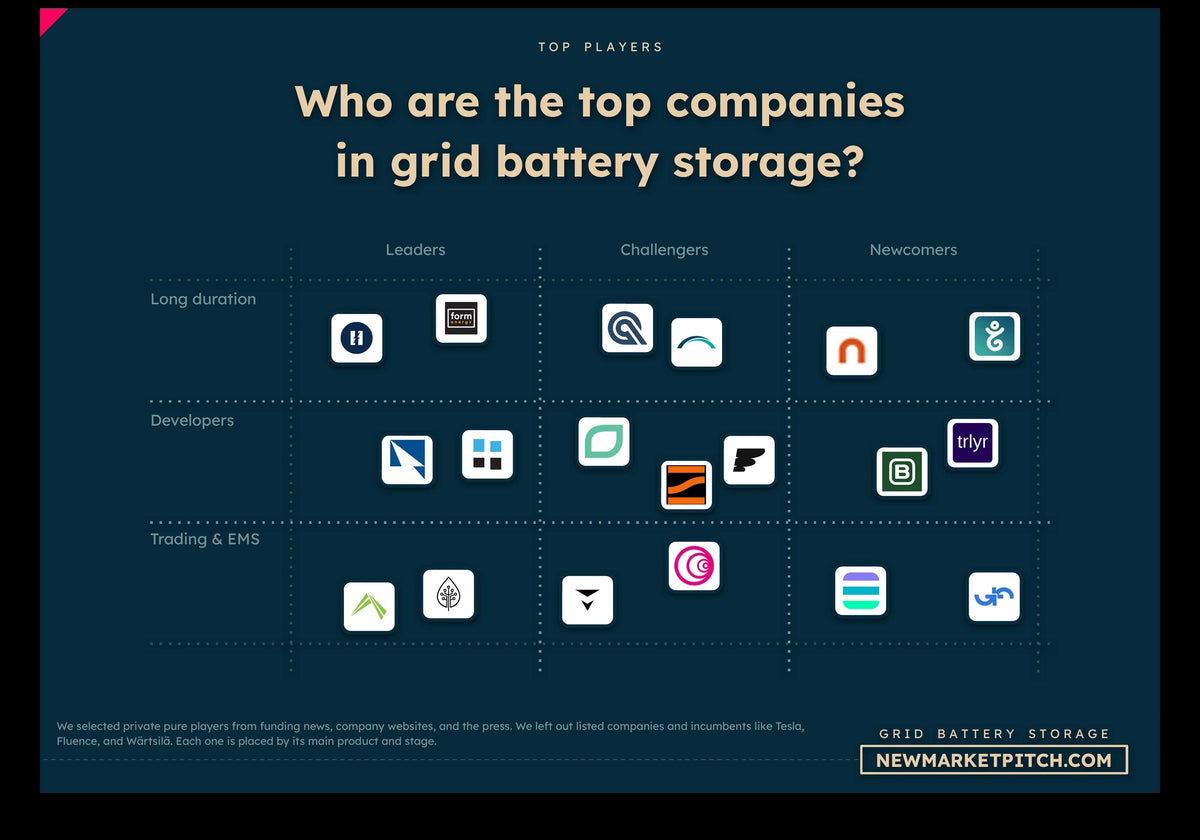
In our research about grid batteries, we turn what is vague and complex into simple, useful visuals. Market maps like this one show you at a glance where every startup stands.
Is grid-scale battery storage funding actually booming in 2026?
Grid-scale battery storage funding is up sharply in 2026, but fewer companies are getting funded than last year.
We recorded $2.15 billion in financing through September 22, compared with $740.83 million during the same period in 2025. That's a 189.8% increase. Yet the number of deals fell from 26 to 21, and the number of funded companies dropped from 26 to 20.
The real change is the size of the checks. The median financing jumped from $9.5 million to $40.95 million, more than quadrupling in a year. The average reached $107.36 million, compared with $35.28 million previously.
The 2024 comparison tells a similar story. That year saw 16 deals and $768.06 million in funding over the same period, with a median round of $18.3 million. The market has had years with fewer deals before, but the size of 2026's typical financing stands out.
These figures include certain infrastructure-equity investments alongside conventional venture rounds. We also separated fixed financing amounts from maximum commitments that might never be fully drawn. That distinction becomes particularly important when comparing this year's totals with 2025.
| Metric | 2026 YTD | 2025 YTD | 2024 YTD |
|---|---|---|---|
| Funding deals | 21 | 26 | 16 |
| Funded companies | 20 | 26 | 16 |
| Quantified capital | $2,147.14M | $740.83M | $768.06M |
| Median round | $40.95M | $9.50M | $18.30M |
| Average quantified round | $107.36M | $35.28M | $51.20M |
| Largest round | $750M | $411M | $308.15M |
| Rounds above $50M | 8 | 3 | 3 |
| Rounds above $100M | 5 | 1 | 2 |
| First-financing share | 14.3% | 34.6% | 12.5% |
Would battery storage funding still be growing without the biggest deals?
Yes, battery storage funding is still growing after removing the biggest rounds, although the increase becomes much smaller.
Excluding financings above $50 million leaves $208.44 million in 2026, versus $167.83 million in 2025. That's 24.2% growth, compared with 189.8% when all quantified rounds are included.
Removing only rounds above $100 million produces a similar result: $436.14 million this year versus $329.83 million last year, up 32.2%.
We also calculated how much capital went to the largest recipients. The top five financings accounted for 79.7% of all quantified funding in 2026. Interestingly, that's slightly less concentrated than in 2025, when the top five represented 82.8%.
Eight financings exceeded $50 million in 2026, compared with three a year earlier. So more companies are securing very large amounts, even though fewer companies are raising overall.
The smaller-deal market has grown in dollars, too. But the strongest growth is happening among companies able to raise tens or hundreds of millions at once.

Your time is limited. In our market report about grid batteries, we put numbers on each part of the market, so you can see where it makes sense to focus.
Which battery storage companies are raising the most money?
Form Energy is the biggest battery storage fundraising winner in 2026, with several other established manufacturers and infrastructure businesses also securing nine-figure financings.
Form Energy announced a $750 million Series G led by T. Rowe Price. The company makes iron-air batteries designed to store electricity for multiple days, and the capital is intended to expand manufacturing and support commercial deployment.
EnerVenue raised $300 million through an extension of its Series B, led by Full Vision Capital. Frontier Power USA closed approximately $263 million backed by Cerberus Capital Management, Eos Energy Enterprises and Hudson Bay Capital Management. Its financing supports the development of storage projects, including the 800 MWh Blanquilla project.
European battery-storage operator terralayr also secured $130 million in growth capital.
SMT Energy announced a partnership worth up to $268 million with Climate Adaptive Infrastructure. That amount is a maximum equity commitment rather than a confirmed fully funded cash investment, which is why we treat it separately from quantified financing.
The companies have different business models. Form Energy and EnerVenue are scaling battery technology, while Frontier Power and SMT Energy are financing storage infrastructure. All require large amounts of capital to expand beyond the early stages of development.
| Company | 2026 financing | Main business |
|---|---|---|
| Form Energy | $750M | Long-duration battery manufacturing |
| EnerVenue | $300M | Battery technology and manufacturing |
| Frontier Power USA | $263M | Storage project development |
| terralayr | $130M | Storage asset ownership and operation |
| SMT Energy | Up to $268M | Storage development and asset ownership |
SMT Energy's figure is shown for context but is excluded from the quantified-capital ranking because it represents a commitment ceiling.
Are smaller battery storage startups getting left behind?
Smaller battery storage financings have become noticeably less common, especially in the $5 million to $20 million range.
We counted just eight quantified rounds below $20 million in 2026, compared with 16 in 2025. Deals between $5 million and $20 million fell from 12 to five.
This middle range deserves attention because it can finance the expensive period between developing a working battery technology and building a larger commercial operation.
A $10 million round might be enough for engineering development, certifications, pilot installations or a small manufacturing expansion. It generally cannot finance the kind of industrial scale-up Form Energy and EnerVenue are pursuing.
Meanwhile, the number of financings above $50 million rose from three to eight.
We can't establish from these figures alone whether smaller companies faced more rejections, postponed fundraising or found other ways to finance themselves. What we can establish is that the recorded market completed substantially fewer moderate-sized rounds.

In our document detailing everything you need to know about grid-scale battery storage, we always try to gather several sources and make estimates that make sense, so you can work with solid numbers.
Why are battery storage companies suddenly raising hundreds of millions?
Battery storage companies are raising much larger amounts because manufacturing and deploying grid-scale batteries requires serious infrastructure investment, and commercial demand is growing.
Form Energy offers a concrete example. Its latest equity round supports the expansion of iron-air battery manufacturing and commercial deployments. The company also announced a separate $270 million credit facility to finance working capital and production growth.
That credit facility is debt, so we don't add it to the equity funding total. But it shows how much financing an industrial battery business can need.
There's also a substantial demand backdrop. The U.S. Energy Information Administration projected in February 2026 that developers would add 24 GW of utility-scale battery storage capacity during the year, compared with 15 GW added in 2025. Texas, California and Arizona accounted for approximately 80% of the planned additions.
Globally, the International Energy Agency reported that 108 GW of new battery capacity was deployed in 2025, up 40% from 2024. Falling battery costs, expanding renewable generation and growing demand for grid flexibility are helping storage become a mainstream electricity infrastructure category.
Those trends don't explain every investment decision, but they provide context for the size of the latest rounds. Building factories and developing utility-scale storage projects takes hundreds of millions, sometimes before the assets start generating revenue.
Is battery manufacturing becoming the hottest part of grid storage?
Battery manufacturing has made a strong comeback in fundraising activity, although one company accounts for most of its dollar growth.
Battery Cells & Modules recorded seven deals in 2026, compared with just three in 2025. Its share of all funding transactions rose from 11.5% to 33.3%, making it the busiest category in our current sample.
Funding increased from $30 million to $424.64 million. EnerVenue alone contributed $300 million, or approximately 70.6% of the category's quantified total. The other six recorded rounds accounted for $124.64 million in quantified financing.
Form Energy's $750 million round is classified separately under Containerized BESS Systems in our database, rather than Battery Cells & Modules. The categories reflect each financing's assigned primary business category, even when the companies operate across several parts of the battery value chain.
The historical comparison is useful here: battery cells also recorded seven deals in 2024. The current recovery brings the number of financings back to that level, but at much larger dollar amounts.
There's a commercial reason investors continue exploring alternative battery technologies. The IEA's 2026 electricity analysis describes expanding utility-scale storage installations and growing demand for batteries with longer discharge durations. Technologies designed for different durations, operating conditions and cost structures have opportunities to serve different parts of that demand.
The recovery in deal activity is broader than EnerVenue, although that one financing still dominates the category's dollar growth.

Our report covering the grid-scale battery storage market gets updated several times a month, so you always get the latest view of where things stand.
Are investors getting more interested in owning battery storage assets?
Yes, companies that own and operate battery storage assets are attracting more funding, and this is one of the clearest multi-year trends in the market.
Asset Ownership & Operation recorded one financing in 2024, three in 2025 and five in 2026. Its share of deals increased from 11.5% last year to 23.8% this year.
Quantified funding reached $541.4 million, compared with $109.6 million in the previous comparable period.
The appeal comes from the way storage businesses can make money. Once batteries are operating, their owners can generate revenue through electricity trading, grid-balancing services and other energy-market arrangements. Investors can evaluate potential cash flows from physical assets rather than relying entirely on future technology sales.
SMT Energy shows how this can work. Its partnership with Climate Adaptive Infrastructure is intended to finance a portfolio of U.S. storage projects using a combination of corporate equity, project-level debt and other capital sources. Its maximum $268 million commitment is not treated as fully invested cash in our quantified totals.
The IEA has also highlighted growing utility-scale battery deployment, while warning that grid connections, permitting delays and uncertain revenue streams remain obstacles.
Asset ownership's steady increase in deal count is particularly interesting because it has continued across all three comparable periods, unlike several other categories where activity has fluctuated.
Which battery storage businesses are losing investors?
Battery storage project developers and system integrators are receiving fewer recorded financings in 2026, while manufacturers and asset owners are taking a larger share.
Project Development fell from six deals in 2025 to just one this year. BESS System Integration dropped from six deals to three.
The project-development decline is striking because this category previously attracted some very large commitments. Eelpower's 2025 arrangement was worth up to $675 million, and Fidra's was worth up to $603 million. Neither maximum was included in our quantified-capital baseline.
That makes the reduction in deal count easier to establish than a decline in actual investment dollars.
Containerized BESS Systems shows the opposite pattern. Its deal count dropped from four to one, yet quantified funding reached $750 million because of Form Energy. Looking only at dollars would suggest explosive growth in a category with just one recorded financing.
Market Trading & Optimization remained comparatively stable, with three deals in 2026 against four in 2025. Its funding increased from $28.13 million to $86.1 million.
The categories below are mutually exclusive primary classifications. Together, the seven categories account for all 21 recorded 2026 deals and $2,147.14 million in quantified financing.
| Category | Deals 2026 | Deals 2025 | Deals 2024 | 2026 capital |
|---|---|---|---|---|
| Battery Cells & Modules | 7 | 3 | 7 | $424.64M |
| Asset Ownership & Operation | 5 | 3 | 1 | $541.40M |
| Market Trading & Optimization | 3 | 4 | 2 | $86.10M |
| BESS System Integration | 3 | 6 | 1 | $75.00M |
| Project Development | 1 | 6 | 3 | $263.00M |
| Containerized BESS Systems | 1 | 4 | 2 | $750.00M |
| Energy Management Software | 1 | 0 | 0 | $7.00M |
| Total | 21 | 26 | 16 | $2,147.14M |
The decline in project-development and system-integration fundraising is clear in the deal counts. Whether it reflects weaker investor demand, different financing structures or a temporary gap between large transactions is harder to determine.

In our research about grid batteries, we look at what the winners do differently, so you can learn from the best instead of guessing.
Are early-stage battery storage startups having a harder time raising money?
Early-stage battery storage startups are getting fewer rounds than last year, while later-stage companies are holding up much better.
Seed and Series A financings declined from 17 to 12. Their combined share of the market fell from 65.4% to 57.1%, below the 62.5% recorded in 2024.
Seed rounds decreased from eight to six, while Series A dropped from nine to six.
Later-stage deal volume, meanwhile, stayed at seven in both 2025 and 2026. Its market share increased because fewer early-stage financings took place.
We also examined company ages. The median funded business was four years old in 2026, compared with three years in 2025. Seed-funded companies were older on average by this measure, with a median age of 3.5 years versus 1.5 years previously. However, Series A recipients were younger, so the age data doesn't show a uniform trend toward later fundraising.
Early-stage activity has contracted, while established companies continue securing large amounts of money. That's the clearest split in the current financing market.
Are battery storage investors abandoning new startups for existing winners?
Battery storage investors are putting much more money into companies they've already financed, and first-time funding recipients have become less common.
Only three companies received their first recorded financing in 2026, compared with nine in 2025. Follow-on rounds accounted for 18 of the year's 21 transactions.
Those follow-ons represented approximately $1.87 billion in quantified funding. First financings accounted for $273.5 million.
The longer history prevents us from calling this a permanent retreat from new businesses.
In 2024, first financings accounted for just 12.5% of recorded deals, compared with 14.3% in 2026. The unusually high 34.6% share in 2025 may have represented a temporary increase in newly financed companies.
Our first-financing classification is based on identifiable funding history rather than exhaustive records of every earlier investment. Some businesses may have obtained capital through sources that weren't publicly reported.
Still, the amount going into follow-on rounds is striking. Most of the money is reaching businesses that have already passed at least one fundraising milestone.

In our market report about grid batteries, we don't want to repeat what boring consulting reports say. Instead, we show you the real and latest market signals that matter.
Is North America taking over battery storage funding?
North America now attracts most of the recorded grid-scale battery storage funding, although European companies still complete more deals.
North American businesses secured approximately $1.69 billion in 2026, or 78.5% of quantified capital. The region accounted for seven transactions.
Europe recorded 11 financings, representing 52.4% of the market, but attracted $387.39 million. Asia-Pacific accounted for three deals and $73.75 million in quantified funding.
The American funding advantage is closely tied to Form Energy, EnerVenue and Frontier Power USA, all of which completed exceptionally large rounds.
Europe's position looks different when measured by activity rather than dollar totals. Its deal share declined by only 1.5 percentage points from 2025, despite a sharp decrease in its share of measured capital.
Asia-Pacific's deal count fell from eight to three, a more noticeable decline. Some financing amounts in the region were also undisclosed, which limits the reliability of capital comparisons.
The unusual European commitments recorded in 2025 also affect the apparent regional shift. Including their maximum announced values would produce a very different comparison, even though it wouldn't represent confirmed funded cash.
For now, North America is where the largest battery storage financings are concentrated, while Europe continues to support more individual transactions.
Are corporate investors becoming more active in battery storage?
Corporate investors are appearing in a larger share of grid-scale battery storage deals, particularly around industrial battery technologies.
We identified named strategic investors in eight of 21 financings in 2026, compared with seven of 26 in 2025. Their participation rate increased from 26.9% to 38.1%.
GE Vernova participated in Form Energy's financing. Samsung Ventures and STRABAG were among the investors associated with CMBlu, while Centrica and Ceres Power appeared at Certain Energy. LG Technology Ventures was also recorded at Powerline.
These investors have business interests connected to power generation, industrial equipment, battery manufacturing or energy infrastructure. They have commercial reasons to follow storage technology beyond the potential financial return.
The broader lead-investor picture has also changed. T. Rowe Price, Full Vision Capital, Cerberus Capital Management and Heartcore Capital were among the prominent investors in recorded 2026 transactions.
Sixteen deals disclosed a lead investor in both 2025 and 2026, even though the total number of transactions declined. The number of identifiable lead-backed deals therefore remained stable.
A corporate investment alone doesn't establish a customer relationship or commercial agreement. But the growing proportion of deals involving industrial investors is worth watching, particularly as battery companies move into manufacturing and deployment.

Learning from others' mistakes is the cheapest lesson there is. In our document detailing everything you need to know about grid-scale battery storage, we look at what broke startups before you, so you don't repeat it.
Has 2026 already broken the battery storage funding record?
Grid-scale battery storage has already surpassed the previous two full-year totals in quantified funding, even though the current comparison ends in September.
The $2.15 billion recorded in 2026 is equivalent to 151.6% of the $1.42 billion raised throughout 2025. It also exceeds the $1.30 billion recorded across all of 2024.
Deal volume is less impressive. The market recorded 21 transactions during the current partial year, compared with 37 throughout 2025 and 25 throughout 2024.
There is also an accounting issue that affects the size of the funding record.
Eelpower and Fidra announced arrangements with maximum values of $675 million and $603 million in 2025. Adding those two ceilings to the quantified 2025 comparable-period total would produce approximately $2.02 billion, much closer to 2026's $2.15 billion.
That wouldn't be a fair comparison of funded cash, since maximum commitments aren't necessarily fully deployed. It does show how much the apparent record depends on the financing instruments included.
The current year has clearly been exceptional for the size of recorded transactions. A claim that almost three times as much cash has actually entered the industry would go beyond what the available figures establish.
Is battery storage funding becoming a winner-takes-most market?
Battery storage funding is favoring established companies capable of building factories, financing assets and deploying projects at scale. But the concentration figures tell a more complicated story.
The median financing has more than quadrupled, large rounds have become much more common, and follow-on recipients account for most of the money raised. Smaller financings and first-time funding recipients are both less common.
Yet the five largest rounds accounted for 79.7% of quantified capital, slightly below last year's 82.8%. Asset ownership is also attracting funding across a growing number of businesses. The market is becoming more selective without becoming more concentrated by every measure.
The biggest divide is between companies financing early battery development and those already raising industrial-scale capital. Form Energy and EnerVenue illustrate just how large that gap has become.

If you build or invest in the grid-scale battery storage market, you need to know which business models pay off now and which ones are fading. That's why our report covering it has a whole section on it.
What is actually changing in funding?
The biggest development is the move toward financing industrial businesses and operating electricity infrastructure. Battery manufacturers and asset owners are raising much larger amounts, while smaller technology rounds and first-time financings have lost ground.
That shift could accelerate commercial deployment, but the amount raised is only one part of the story. The next useful measures will be factories brought into production, megawatt-hours of batteries commissioned and revenue generated by operating storage assets.
2026 has established a new benchmark for the size of quantified battery storage financings. Whether it also marks a lasting change in the industry's commercial scale remains to be seen.
Our methodology
We analyzed global private-company fundraising in the grid-scale battery storage market across three directly comparable year-to-date periods: January 1–September 22, 2026; January 1–September 22, 2025; and January 1–September 22, 2024. Full-year 2024 and 2025 figures were used separately to assess whether the current funding total had exceeded previous annual benchmarks.
The analysis is based on funding transactions collected and classified in our market database, supported by company announcements, investor disclosures and official energy-sector publications. For each period, we aggregated deal counts, funded companies, financing sizes, stages, business categories, funding histories, investor participation and geography. We then examined the individual financings driving changes in those aggregates.
We retained companies directly involved in grid-scale battery storage and excluded adjacent energy-storage markets. Our financing scope includes conventional equity rounds, equity-like infrastructure investments and certain project-level equity financings. Debt and credit facilities were excluded from quantified equity funding. Maximum commitments, lower bounds and undisclosed amounts were distinguished from fixed or reliably estimated transaction values rather than automatically treated as invested capital.
We consolidated duplicate reports of the same financing, including the earlier Frontier Power USA commitment incorporated into its subsequent capitalization. Extensions and additional closes were assessed individually to avoid double counting. We also accounted for EnerVenue's cumulative 2024 disclosure and the maximum commitments announced by Eelpower and Fidra in 2025, which can materially change apparent funding growth if treated as fully deployed capital.
To assess concentration, we compared total quantified funding with totals excluding rounds above $50 million and $100 million, calculated the share of capital captured by the five largest transactions and examined median financing sizes. Average round sizes are based on transactions with quantified amounts. Each deal was assigned one primary business category, allowing category totals to reconcile with the overall deal and capital figures. First-financing classifications reflect identifiable historical funding records.
Investor participation was counted where named investors or lead-investor roles were identifiable in the available records. We did not attribute the entire round amount to an individual investor simply because that investor led or participated in the transaction. Geographic comparisons use the recorded company regions, while corporate-investor participation reflects identified strategic investors rather than assumed commercial relationships.
Key transaction sources include Form Energy's $750 million Series G announcement, Form Energy's separate credit facility disclosure, EnerVenue's $300 million Series B extension, Frontier Power USA's financing announcement, SMT Energy's equity partnership disclosure, Capalo AI's Series A announcement and CMBlu Energy's Series C announcement.
For market conditions and deployment trends, we used the U.S. Energy Information Administration's 2026 capacity outlook, the International Energy Agency's Electricity 2026 report, its analysis of power-system flexibility and grid constraints, the IEA's Global Energy Review 2026 on battery storage and its Batteries and Secure Energy Transitions report. These sources provide context for manufacturing demand, battery deployment, grid integration and asset economics, while the funding comparisons themselves come from our classified transaction database.

In our research about grid batteries, we like to show you the big picture. We know your time is precious, so we make every page quick to read and packed with as much learning as possible per minute.
Written by the New Market Pitch teamWe track new markets so founders and investors can move faster. About us