Who are the top grid battery startups vs Tesla and Fluence?
Whether you're building or investing in the grid-scale battery storage market, our report covers everything you need to know: the players, the money, and what's coming next.
Summary
FlexGen, Energy Vault, Eos Energy, Peak Energy and Form Energy are the top grid battery challengers to Tesla and Fluence. FlexGen leads in independent integration and software, Energy Vault has substantial completed projects, Eos is scaling zinc-battery manufacturing, Peak is emerging in sodium-ion storage, and Form Energy is building a market for 100-hour iron-air batteries.
Tesla remains in another league on volume. It deployed 46.7 GWh of energy storage in 2025 and 36 GWh during the first nine months of 2026, while Fluence had completed 19.3 GWh cumulatively by June 2026. No emerging U.S. challenger matches that combination of scale and delivery experience.
The market is becoming less concentrated even as Chinese manufacturers strengthen their position. The three largest integrators' combined global share fell from 36% to 30%, but Chinese suppliers captured 76% of the 2025 market. Startups face a much broader competitive field than Tesla and Fluence alone.
FlexGen has the strongest immediate claim to challenging Fluence. Following its acquisition of Powin assets, it supports more than 25 GWh of battery systems, although that figure includes contracted capacity and inherited projects rather than exclusively completed FlexGen installations.
Energy Vault offers a different kind of commercial proof. It has deployed more than 2 GWh since 2022, with substantial projects in Nevada, Australia and Texas, and is increasingly moving into storage ownership to earn recurring revenue from operating facilities.
Peak Energy has one of the largest prospective positions in sodium-ion storage, with more than 6 GWh of customer commitments. Its passive-cooling architecture could reduce lifetime operating costs, but the real test begins when its planned 2027 deliveries reach commercial scale.
Form Energy has the most distinctive technology proposition. Its 100-hour iron-air batteries address multi-day electricity shortages, and approximately 80 GWh of projects are under agreement. That future volume is extraordinary, but it should not be confused with operating capacity.
Eos is further along commercially than many alternative-chemistry manufacturers. Revenue reached $68.8 million in the second quarter of 2026, up 351%, with a $807 million backlog. A negative 71% gross margin shows how much manufacturing improvement is still required.
Invinity is advancing vanadium flow batteries for long-duration cycling, but remains a specialist at a much smaller scale. Its 77.2 MWh of reported 2026 orders contrasts with a proposed 1.5 GWh Swiss project, illustrating the distance between current sales and future ambitions.
The most credible challengers are not necessarily trying to replace lithium-ion batteries everywhere. FlexGen competes through supplier-independent software, Peak through lower-maintenance sodium-ion systems, Form through multi-day duration, and Eos through domestically manufactured zinc batteries.
Our conclusion is that FlexGen is the strongest direct challenger to Fluence, while Peak Energy and Form Energy have the greatest potential to reshape specific battery markets. Tesla, Fluence and major Asian manufacturers should retain the bulk of conventional storage volumes for now. The next leaders will be decided by commissioned projects, lifetime economics and manufacturing profitability, not the largest announced contracts.

Written by the New Market Pitch teamWe track new markets so founders and investors can move faster. About us

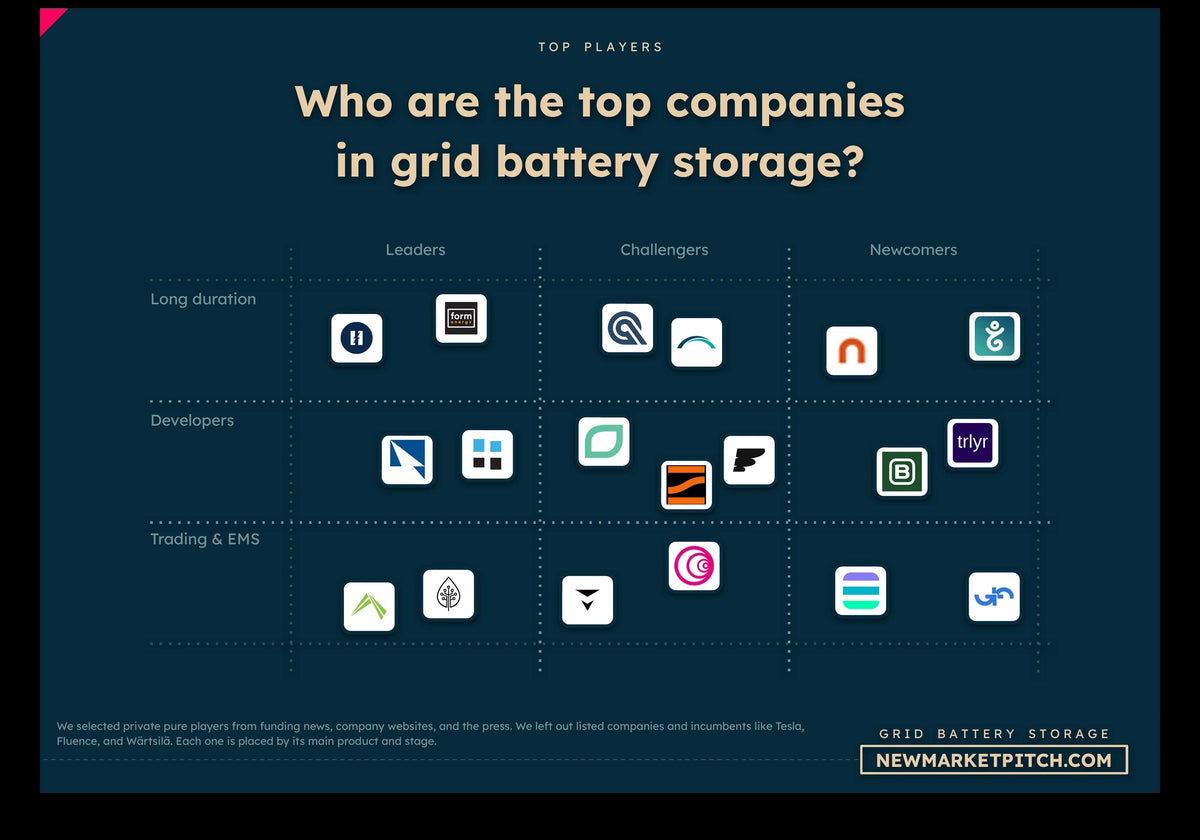
In our report covering the grid-scale battery storage market, we turn what is vague and complex into simple, useful visuals. Market maps like this one show you at a glance where every startup stands.
Are grid battery startups actually catching Tesla and Fluence?
Grid battery startups are starting to win serious utility contracts, but Tesla and Fluence still have a considerable lead in completed installations. FlexGen, Energy Vault, Peak Energy, Form Energy and Eos Energy are among the strongest challengers, although they are competing for different parts of the market.
The competition has become much tougher. Tesla deployed 46.7 GWh of energy storage in 2025 and another 36 GWh during the first nine months of 2026. Fluence reported 19.3 GWh of cumulative completed installations by June 2026. Meanwhile, Wood Mackenzie's global integrator rankings showed Chinese suppliers capturing 76% of the market in 2025, with Sungrow and BYD putting additional pressure on Western competitors.
Yet the market is becoming less concentrated among individual suppliers. The combined share of the three largest battery integrators fell from 36% in 2024 to 30% in 2025. That creates room for smaller suppliers, especially when customers want batteries manufactured in the United States, independent operating software or storage that can deliver electricity for much longer than the usual four hours.
Among the emerging companies, FlexGen is already managing a substantial battery fleet, Energy Vault has completed commercial projects, and Eos is generating meaningful manufacturing revenue. Peak Energy and Form Energy have secured much larger future commitments than their current installations would suggest. Those differences are important when deciding who actually belongs among the leaders.
How much bigger is Tesla than the leading grid battery startups?
Tesla is still far ahead of emerging grid battery companies in deployment volume, and its latest figures suggest that the gap is growing. The company reported 13.7 GWh of energy storage deployments in the third quarter of 2026 alone, bringing its nine-month total to 36 GWh.
To put that into perspective, a typical 100 MW battery designed to discharge for four hours stores 400 MWh. Tesla's nine-month deployment volume equals the energy capacity of approximately 90 such projects. Its reported figures include stationary storage products beyond individual Megapack projects, but the scale remains striking.
Fluence is also considerably bigger than most emerging competitors. Its cumulative completed installations increased from 17.8 GWh in September 2025 to 19.3 GWh in June 2026. That represents another 1.5 GWh over nine months, compared with Tesla's 36 GWh deployed over the first nine months of 2026. The reporting periods overlap but are not identical.
The gap becomes harder to measure when examining startups. FlexGen supports more than 25 GWh of completed or contracted systems, including assets inherited through its acquisition of Powin technology. Energy Vault reports more than 2 GWh deployed since 2022, while Eos had a contracted backlog representing 3.4 GWh at midyear.
These figures describe different activities. Tesla reports energy storage products deployed, Fluence reports completed projects, FlexGen includes supported and contracted systems, and Eos reports future orders. We therefore cannot rank them by simply putting their headline GWh figures side by side.
For now, Tesla is the clear volume leader in this comparison. Among younger companies, FlexGen has the strongest claim to a large supported fleet, while the alternative-chemistry manufacturers remain much earlier in their commercial development.

Our research about grid batteries gets updated several times a month, so you always get the latest view of where things stand.
Is Fluence still ahead of the grid battery startups?
Fluence remains ahead of independent grid battery startups in completed installations and established customer relationships, but its recent financial results show why customers might consider alternatives.
The company generated approximately $650 million in revenue during its fiscal third quarter of 2026, compared with $603 million a year earlier. Yet its gross margin dropped from 14.8% to 5.1%, and it recorded a $44.3 million net loss.
Demand was considerably stronger than the profitability figures suggest. Quarterly orders exceeded $1.44 billion, nearly three times the $509 million recorded one year earlier. The company's contracted backlog reached approximately $6.4 billion, its highest reported level. Fluence nevertheless cut its annual revenue guidance midpoint from $3.4 billion to $3 billion because of manufacturing and delivery delays.
The operating business remains substantial. At the end of June, Fluence had 6.3 GW of service assets under management and 22.8 GW of digital assets under management. These figures cover different services and cannot be added together, but they show how far the company has expanded beyond simply selling battery containers.
Orders are growing much faster than Fluence's ability to convert them into profitable deliveries. That gives competitors an opening if they can bring systems online reliably, give customers greater freedom over battery suppliers or offer better economics over the life of a project.
Still, Fluence has a large installed customer base, an established operating platform and billions of dollars in contracts. No emerging U.S. challenger has demonstrated the same combination at comparable scale.
If you want more recent data on this point, please see our latest grid-scale battery storage market report.
Which grid battery startups have actually delivered commercial projects?
FlexGen and Energy Vault have the clearest record of managing or delivering substantial commercial battery systems among the independent challengers. Eos has a growing manufacturing business, while Form Energy, Peak Energy and Invinity are at different stages of turning customer commitments into operating installations.
We reviewed each company's reported deployments, orders and operating assets. The distinction between completed projects and future deliveries changes the comparison considerably.
| Company | What the evidence shows | Commercial position |
|---|---|---|
| Tesla | 46.7 GWh deployed in 2025 | Large-scale incumbent |
| Fluence | 19.3 GWh cumulatively deployed | Large-scale incumbent |
| FlexGen | More than 25 GWh supported or contracted | Major software and integration challenger |
| Energy Vault | More than 2 GWh deployed since 2022 | Established project developer and integrator |
| Eos Energy | $807M backlog representing 3.4 GWh | Growing battery manufacturer |
| Peak Energy | More than 6 GWh in announced customer commitments | Emerging sodium-ion supplier |
| Form Energy | Approximately 80 GWh under agreement | Multi-day storage contender |
| Invinity Energy | 77.2 MWh in reported 2026 orders through September | Specialist flow-battery supplier |
The largest future commitments belong to Form Energy and Peak Energy, but these companies have much less operating experience than Tesla, Fluence or FlexGen.
Eos sits somewhere between those groups. Its batteries are already operating and its factory is generating meaningful revenue, although production costs remain high. Energy Vault has more completed grid-scale projects, but much of its recent growth strategy also depends on assets that are still being developed.

In our market report about grid batteries, we look at what the winners do differently, so you can learn from the best instead of guessing.
Can FlexGen really compete with Fluence?
FlexGen is already a serious alternative to Fluence for battery integration, operational software and long-term asset management. Its strongest advantage is that customers can use its HybridOS platform across batteries from different suppliers.
The company's position changed dramatically when it acquired key technology and assets from bankrupt battery integrator Powin in August 2025. FlexGen gained access to a larger installed fleet and the opportunity to support projects originally supplied by another manufacturer.
That acquisition explains much of its recent expansion. FlexGen now reports more than 100 completed battery projects across ten U.S. electricity markets and more than 25 GWh of completed or contracted capacity. The company has also reported 98% availability across its HybridOS-managed fleet in 2025, although the figure comes from FlexGen's own reporting rather than a standardized industry comparison.
New installations demonstrate that it continues to win business beyond the acquired assets. In September 2026, FlexGen announced operations at SMT Energy's 160 MW Houston IV battery project in Texas. Its agreement with Lightshift Energy covers 16 projects across PJM and ISO New England, including six completed facilities representing more than 25 MW and 85 MWh.
The software business is particularly interesting. Fluence manages 22.8 GW of digital assets, while Tesla combines its batteries with Autobidder for automated electricity-market participation. FlexGen offers customers another route: keeping an independent operating platform even when the underlying batteries come from several manufacturers.
Powin's collapse also provides a warning. The former integrator had built a substantial commercial presence before filing for Chapter 11 protection in June 2025. Battery projects involve expensive equipment, long warranties and considerable working-capital requirements, making profitability harder than order growth alone might suggest.
We rank FlexGen as the strongest direct startup challenger to Fluence's integration and services business. Its software independence and expanded supported fleet provide a genuine commercial position, although its manufacturing scale remains far below Tesla's.
If you want more recent data on this point, please see our latest grid-scale battery storage market report.
Has Energy Vault become a real grid battery competitor?
Energy Vault has become a credible commercial battery developer, with more than 2 GWh reportedly deployed since 2022. The company originally attracted attention for gravity-based energy storage, but conventional battery projects now represent much of its visible commercial activity.
Its completed portfolio includes Reid Gardner in Nevada at 220 MW and 440 MWh, the New England Battery in Australia at 200 MW and 400 MWh, and Cross Trails in Texas at 57 MW and 114 MWh. These three projects alone represent 954 MWh of storage capacity.
The company has also developed the Calistoga Resiliency Center in California, which combines batteries and hydrogen-based infrastructure to provide extended backup electricity. That project serves a different purpose from batteries designed primarily to shift electricity between daytime and evening hours.
Energy Vault is increasingly moving toward owning storage facilities. Its Asset Vault strategy targets more than 1.5 GW of projects, supported by a $300 million preferred-equity agreement announced with OIC. The aim is to earn recurring revenue from operating assets rather than depend entirely on selling and building systems for customers.
This changes the comparison with Tesla and Fluence. Energy Vault competes for battery supply and integration work, but it is also becoming an infrastructure owner, which brings additional financing requirements and exposure to electricity-market revenues.
The company has enough completed projects to be taken seriously today. Its next test is whether it can turn its development pipeline into a profitable portfolio of operating facilities.

In our document detailing everything you need to know about grid-scale battery storage, you will always find fresh funding data, taken straight from our own verified funding database.
Could Peak Energy's sodium-ion batteries challenge Tesla Megapack?
Peak Energy is one of the most promising U.S. sodium-ion battery startups, with customer commitments that could make it a meaningful competitor to lithium-ion storage. However, it has yet to prove its economics across a large fleet of operating projects.
Its appeal comes from a simple idea: stationary batteries do not need the same energy density as electric-vehicle batteries. Peak is developing sodium-ion systems designed for grid applications, with passive cooling and reduced maintenance requirements.
The company delivered a grid-scale sodium-ion pilot system in 2025 and subsequently announced several major agreements. Its partnership with Jupiter Power covers up to 4.75 GWh of storage, including approximately 720 MWh intended for delivery in 2027. Energy Vault signed a separate 1.5 GWh supply agreement, while RWE Americas agreed to test the technology.
Taken together, the Jupiter Power and Energy Vault agreements represent up to 6.25 GWh of planned capacity. That would be a substantial commercial position for a young battery manufacturer, although much of the volume remains dependent on future production and project execution.
Peak announced Sacramento as the location of a proposed factory with annual production capacity of up to 4 GWh. Shipments are expected to begin in 2027. The company also established a partnership with General Motors to work on next-generation sodium-ion cells.
The difficult part comes next. Lithium iron phosphate batteries benefit from huge global manufacturing volumes and years of operational experience. Peak must demonstrate that its cooling savings, maintenance profile and domestic sourcing can offset any disadvantages in installed costs and energy density.
Peak could become a major competitor in standard grid storage if its promised economics hold up. We would still rank it behind companies with large completed fleets until its upcoming deliveries are operating successfully.
If you want more recent data on this point, please see our latest grid-scale battery storage market report.
Can Form Energy beat Tesla at storing electricity for several days?
Form Energy has one of the strongest chances of leading multi-day grid storage because its iron-air batteries are designed to discharge electricity for approximately 100 hours. Tesla's conventional lithium-ion systems generally target much shorter discharge periods.
This difference becomes important when electricity demand stays high for several days or wind and solar generation remain weak over an extended period. Batteries designed for daily charging and discharging become expensive when projects need vastly more energy capacity relative to their power output.
Form's announced projects illustrate that distinction. Its proposed installation with Xcel Energy in Minnesota would deliver 300 MW of power and store 30 GWh of electricity, supporting a Google data center development. A conventional four-hour battery system delivering the same 300 MW would store only 1.2 GWh.
Form also signed a 12 GWh capacity agreement with Crusoe in March 2026, with deliveries intended to begin in 2027. The company now reports approximately 800 MW and 80 GWh of projects under agreement.
We should be careful with that last number. The agreements demonstrate substantial customer interest, but the full 80 GWh has not been deployed. Form has installed commercial demonstration equipment and reported extensive testing involving thousands of cells and hundreds of modules. It still needs to show that full-scale projects can be manufactured, commissioned and maintained at acceptable cost.
Unlike Peak, Form does not need to win the standard four-hour battery market to become important. Its opportunity lies in the growing need for multi-day electricity supply, particularly as data centers and electricity networks seek reliable power through extended shortages.
Form is currently our strongest pick among startups focused specifically on multi-day storage. The technology has a credible commercial purpose, unusually large customer commitments and a manufacturing operation that is beginning to move beyond laboratory development.

Learning from others' mistakes is the cheapest lesson there is. In our report covering the grid-scale battery storage market, we look at what broke startups before you, so you don't repeat it.
Is Eos Energy finally selling enough zinc batteries to matter?
Eos Energy has become a meaningful commercial battery manufacturer, with revenue growing much faster than most emerging storage companies. Profitability, however, remains a major problem.
Its second-quarter 2026 revenue reached $68.8 million, up 351% from a year earlier. Battery cube deliveries increased 207%, while the company's first-half revenue exceeded its entire 2025 revenue. That is a considerable change from its earlier manufacturing stage.
The backlog also expanded. Eos reported $807 million in contracted orders at the end of June, representing approximately 3.4 GWh, up 25% from the previous quarter. The company added four new customers and received additional orders from two existing customers.
Manufacturing capacity is expanding alongside demand. Eos brought a second production line into commercial operation at its Thorn Hill facility in Pennsylvania and reported an initial 10% improvement in battery cycle time compared with its first line.
Yet the financial results remain difficult. Eos recorded a $48.8 million gross loss on $68.8 million of quarterly revenue, corresponding to a negative 71% gross margin. Around $55 million of that quarter's revenue also came from one project connected to its Frontier Power USA financing arrangement, representing roughly 80% of quarterly sales. That concentration makes the headline growth less diversified than it first appears.
The next stage is converting its 3.4 GWh backlog into repeatable production across several customers while bringing manufacturing costs down.
Eos has stronger evidence of industrial sales than many alternative-battery startups. Its revenue growth is impressive, but we would not call the business economically proven until gross margins improve substantially.
If you want more recent data on this point, please see our latest grid-scale battery storage market report.
Are vanadium flow batteries becoming serious competition for Tesla?
Vanadium flow batteries are gaining customers in long-duration storage, although companies such as Invinity Energy Systems remain much smaller than mainstream lithium-ion suppliers. Their strongest appeal is long operating life and the ability to handle frequent charge-discharge cycles.
Invinity offers a useful example of genuine progress at limited scale. In May 2026, it completed delivery of a 20.7 MWh battery system for the Copwood project in the United Kingdom, which was awaiting grid connection and commissioning at the time.
Customer orders are growing. Invinity reported 34.2 MWh of orders in the first half of 2026, compared with 11.7 MWh in the same period of 2025, an increase of roughly 192%. An additional 43 MWh order from Dairyland Power Cooperative brought reported orders through September to 77.2 MWh.
The company is also pursuing much larger installations, including a proposed 1.5 GWh project at the Laufenburg Technology Centre in Switzerland, with a possible expansion to 2.1 GWh.
The contrast between these figures is striking. Invinity's reported orders through September represent less than one-fifth of a typical 400 MWh utility battery project. Its proposed Swiss installation, if completed, would be nearly twenty times larger than that order volume.
For now, vanadium flow batteries have a credible niche in long-life storage, but the industry still needs more completed projects and larger manufacturing volumes. Invinity deserves attention as a specialist rather than as a near-term replacement for Tesla or Fluence.

Your time is limited. In our research about grid batteries, we put numbers on each part of the market, so you can see where it makes sense to focus.
Are lithium-ion batteries becoming too cheap for grid battery startups?
Lithium-ion batteries are making life increasingly difficult for startups that want to compete on price alone. Chinese manufacturing scale, established supply chains and intense competition are pushing suppliers to improve costs and delivery speed.
Wood Mackenzie's latest integrator research shows how competitive the industry has become. Tesla and Sungrow led global shipments in 2025, with BYD moving into third place. Chinese companies accounted for 76% of the global battery integrator market, while the top three suppliers collectively held only 30%.
That combination tells us something important. A handful of major suppliers still dominate volumes, but there is no single company controlling the market. Competition is spread across several established manufacturers with the capacity to supply large utility projects.
The picture also changes when considering U.S. manufacturing requirements. Federal clean-energy sourcing rules have increased the importance of where battery components are produced and which companies control their supply chains. Eos manufactures zinc batteries in Pennsylvania, Form Energy is building iron-air manufacturing capacity in West Virginia, and Peak is developing a sodium-ion facility in California.
Tesla already manufactures Megapack systems in the United States, so American production alone cannot distinguish a startup from Tesla. It can, however, help companies compete with imported battery systems when buyers are concerned about sourcing requirements, tariffs or supply security.
The more promising path for emerging companies is to offer a concrete economic advantage. Peak is trying to reduce cooling and maintenance costs, Form is targeting much longer discharge periods, and Eos is building a domestic manufacturing alternative for long-duration applications.
We expect competition in ordinary lithium-ion projects to remain particularly difficult. Startups have a better chance when their technology solves a cost or operating problem that established systems handle poorly.
Which grid battery startups are best positioned to grow?
FlexGen, Energy Vault, Peak Energy, Form Energy and Eos Energy are the clearest emerging contenders, but their chances of becoming major competitors depend on different milestones. Completed projects and operating revenue deserve more weight than factory announcements or capacity reservations.
We compared commercial traction with the next hurdle each company needs to overcome. That produces a more useful picture than ranking every company by its largest announced contract.
| Company | Where it looks strongest | What we need to see next |
|---|---|---|
| FlexGen | Integration, HybridOS and fleet management | Profitable growth in services and new projects |
| Energy Vault | Completed projects and storage ownership | More financed projects entering operation |
| Peak Energy | Sodium-ion systems for mainstream grid storage | Large customer deliveries at competitive cost |
| Form Energy | Iron-air batteries for 100-hour storage | GWh-scale projects commissioned successfully |
| Eos Energy | U.S.-made zinc batteries and revenue growth | Manufacturing margins turning positive |
| Invinity Energy | Vanadium flow batteries for long-duration cycling | Large orders becoming completed installations |
| ESS Tech | Iron-flow experience and sodium-ion development | Evidence of a sustained commercial turnaround |
The distinction between near-term and longer-term prospects is particularly important.
FlexGen already operates in a large commercial market, while Energy Vault has completed enough projects to demonstrate meaningful delivery experience. Eos is generating substantial revenue but still losing money at the gross-profit level.
Peak and Form could eventually become more disruptive because their technologies address problems that existing lithium-ion systems do not always solve economically. Their current commercial commitments are impressive, but future orders carry more risk than completed installations.
We would also keep established companies such as Sungrow, BYD, CATL and Canadian Solar's e-STORAGE in the competitive picture. Canadian Solar reported 7.8 GWh of storage shipments in 2025 and a contracted e-STORAGE backlog worth $3.5 billion by June 2026. These companies are more immediate hardware competitors to Tesla and Fluence than most early-stage battery startups.
If you want more recent data on this point, please see our latest grid-scale battery storage market report.

In our market report about grid batteries, we always try to gather several sources and make estimates that make sense, so you can work with solid numbers.
Will grid battery startups eventually beat Tesla and Fluence?
Grid battery startups are unlikely to overtake Tesla and Fluence across the entire utility-scale storage market soon, but several already have a credible path to leadership in specific parts of the industry.
Tesla remains the strongest benchmark for battery deployment volume, while Fluence has an established business spanning installations, integration, software and services. Both benefit from operating experience that younger companies will need years to reproduce.
FlexGen is currently the strongest direct challenger in integration and battery management software. Its large supported fleet and ability to work across equipment suppliers give it a position that would be difficult for a new entrant to build quickly.
Energy Vault comes next among companies with substantial completed projects, although its growing interest in owning batteries makes its business model different from Fluence's. Eos has a promising manufacturing business, but its losses make the next stage of production particularly important.
Among emerging battery technologies, Peak Energy is a leading sodium-ion contender for conventional grid storage. Form Energy has greater potential to create a distinct multi-day market because its 100-hour iron-air batteries can address electricity shortages that would be expensive to cover with standard four-hour systems.
We therefore see three especially important challengers: FlexGen for commercial integration and software, Peak Energy for sodium-ion battery systems, and Form Energy for multi-day storage. Eos and Energy Vault also belong among the leading contenders, supported by manufacturing revenue and completed projects respectively.
The most likely outcome is that Tesla, Fluence and major Asian manufacturers retain much of the high-volume battery business while younger companies win more specialized opportunities. Whether those opportunities eventually become large enough to challenge the incumbents will depend on actual deployments, lifetime costs and manufacturing profitability, rather than the size of announced contracts.
Our methodology
This analysis identifies which grid battery startups are best positioned to challenge Tesla and Fluence, using commercial deployments, operating fleets, customer agreements, financial performance, manufacturing progress and technological differentiation. The assessment reflects developments reported through October 12, 2026, with particular attention to company and industry disclosures from 2025 and 2026.
We used a structured aggregation of recent evidence across six dimensions: commercial scale, delivery execution, customer traction, battery technology, manufacturing economics and growth potential. For each dimension, we gathered fresh company and market data, assessed individual developments, compared the evidence across competitors and drew conclusions from the combined results. Completed installations and demonstrated operating performance received greater weight than announced projects or future production targets.
We kept reported capacity figures in their proper categories. Tesla's deployed storage products, Fluence's substantially completed projects, FlexGen's supported or contracted systems, Energy Vault's completed portfolio and manufacturers' future orders are different measures. Tesla's figures also include stationary storage products beyond Megapack. We did not treat a contracted GWh as equivalent to a commissioned GWh, or directly compare GW of software-managed assets with GWh of physical storage installations.
We also separated conventional lithium-ion integration from alternative battery manufacturing and long-duration storage. FlexGen's competitive position depends heavily on its equipment-independent operating software and service footprint. Energy Vault's increasingly asset-owning model adds a different source of revenue and risk. Peak Energy, Form Energy, Eos and Invinity were evaluated against the applications their battery chemistries are designed to serve, rather than assuming every supplier must compete in the same four-hour storage market.
Financial performance helped distinguish industrial growth from economic success. We examined revenue conversion, gross margins, customer concentration, order backlogs and manufacturing ramp-ups wherever disclosed. Similarly, we treated multi-year supply commitments, capacity reservations and proposed factories as indicators of future opportunity, subject to manufacturing, financing and commissioning risk.
For the wider competitive context, we used Wood Mackenzie's 2026 global integrator market-share research and its comprehensive integrator assessment, alongside company-reported operating metrics. Wood Mackenzie's market-share study measures AC-based energy-storage system shipments, while its comprehensive ranking evaluates integrators across operating, technical and financial criteria. These sources helped establish the competitive landscape without treating market share as the only measure of capability.
Key sources include Tesla's 2025 energy storage deployment results, Tesla's third-quarter 2026 deployment announcement, Fluence's fiscal third-quarter 2026 results, Wood Mackenzie's 2025 global market-share findings and Wood Mackenzie's comprehensive integrator ranking.
For the leading challengers, we used FlexGen's Powin acquisition disclosure, FlexGen's 2025 review and 2026 outlook, Energy Vault's completed project documentation, Energy Vault's financial and strategic update, Peak Energy's Jupiter Power agreement and Peak Energy's Sacramento manufacturing announcement.
Additional primary disclosures include Form Energy's project and technology milestones, Form Energy's Crusoe agreement, Eos Energy's second-quarter 2026 financial results, Invinity's 2026 interim results, Invinity's Dairyland Power order and Canadian Solar's second-quarter 2026 results.
The conclusions reflect a comparison of recent commercial evidence and the feasibility of future expansion. Company disclosures establish reported performance and announced commitments; they do not independently guarantee future production, project completion, lifetime operating costs or profitability. We therefore assigned the strongest competitive positions to companies with demonstrated activity while identifying the specific milestones that could allow emerging technologies to gain market share.

If you build or invest in the grid-scale battery storage market, you need to know which business models pay off now and which ones are fading. That's why our report covering it has a whole section on it.
Written by the New Market Pitch teamWe track new markets so founders and investors can move faster. About us