How big is the grid battery market with AI data centers?
Whether you're building or investing in the grid-scale battery storage market, our report covers everything you need to know: the players, the money, and what's coming next.
Summary
The global grid battery market already represents approximately $25 billion to $50 billion in annual utility-scale infrastructure investment, and AI data centers could add $4 billion to $24 billion in cumulative battery investment by 2030 under our adoption scenarios. AI is becoming an important source of demand, but renewable energy integration and wider grid needs still drive most installations.
Battery deployment is accelerating before AI's full impact becomes visible. Worldwide installations reached 108 GW in 2025, up 40%, with approximately 87 GW coming from utility-scale projects. The market's existing momentum gives suppliers a substantial business even without dedicated data center spending.
Computing electricity demand is growing much faster than grid infrastructure in some regions. The IEA expects global data center consumption to rise from 415 TWh in 2024 to 945 TWh by 2030, but this additional electricity demand cannot be converted directly into battery sales. Storage becomes valuable where power availability, demand peaks and grid constraints intersect.
The strongest opportunity may be helping data centers secure usable grid capacity rather than simply providing emergency backup. A battery can reduce a facility's peak imports for several hours, potentially avoiding costly upgrades. That advantage largely disappears when a computing campus operates at maximum demand continuously and has no opportunity to recharge.
Storage duration changes the economics dramatically. A 100 MW data center requires 400 MWh for four hours of battery operation, while a 1 GW campus needs 4 GWh. At $150/kWh, the larger four-hour system would cost approximately $600 million, making batteries attractive for short interruptions but expensive as a substitute for continuous generation.
Battery prices have fallen far enough to unlock new applications. BloombergNEF measured stationary battery pack prices at $70/kWh in 2025, down 45% in one year. Complete installed systems cost more, but cheaper packs make peak management, grid support and some dedicated data center installations increasingly viable.
Our AI-related scenarios imply 10–40 GW of four-hour storage installed by 2030, equivalent to 40–160 GWh and $4 billion to $24 billion in cumulative investment. This is an illustrative adoption range, not a confirmed forecast: there is no comprehensive global dataset attributing grid battery spending specifically to AI data centers.
The geographic split is revealing. China accounted for roughly 60% of global battery additions in 2025 and dominates manufacturing, while the United States presents some of the clearest AI-related opportunities because large computing campuses are expanding in regions with constrained electricity infrastructure. The biggest battery market and the most attractive AI-specific projects may not be in the same country.
Google and Microsoft show two different commercial routes. Google's Meitner Energy Center combines computing infrastructure with new generation and storage, while Microsoft's Dublin project uses existing data center UPS batteries to provide grid services. One approach creates new storage demand; the other extracts more economic value from equipment already installed for reliability.
The overall utility-scale battery market could reach $70 billion to $150 billion in annual investment by 2030 under scenarios involving 175–250 GW of yearly additions, four-hour average duration and installed costs of $100–$150/kWh. Falling prices may cause physical deployment to grow faster than revenue, so market expansion cannot be judged by gigawatts alone.
The most attractive AI battery projects will likely be those with access to constrained electricity markets, suitable grid connections and long-term agreements with computing customers. Data centers place an unusually high value on reliable power, but that value will translate into battery revenue only where storage solves a real operational or economic problem.

Written by the New Market Pitch teamWe track new markets so founders and investors can move faster. About us
Is AI turning grid batteries into a much bigger market?
AI data centers are giving grid batteries a major new source of demand, although renewable energy remains the bigger reason battery installations are growing so fast.
According to the International Energy Agency's Global Energy Review 2026, worldwide battery storage installations reached 108 GW in 2025, up 40% from 2024. Around 80% of those additions were utility-scale projects. Global installations have more than doubled since 2023, when approximately 42 GW came online.
AI data centers are creating another wave of electricity demand. The IEA expects worldwide data center consumption to increase from approximately 415 TWh in 2024 to 945 TWh by 2030. That additional demand is concentrated in regions already facing pressure on electricity networks, particularly the United States.
Batteries can help data centers manage expensive electricity peaks, support backup systems and make better use of renewable generation. They can also reduce the amount of grid capacity needed during certain hours.
Two businesses are increasingly overlapping: the established market for storing electricity on power grids and the newer market for delivering reliable power to large computing facilities. The second is creating additional opportunities, but its precise contribution to battery sales remains difficult to measure.
How big is the global grid battery market today?
The global grid battery market already represents roughly $25 billion to $50 billion in annual utility-scale infrastructure investment, based on recent installations and representative system costs.
The IEA reported approximately 87 GW of new utility-scale battery capacity in 2025. Most installations still have around two hours of storage, although four-hour projects are becoming more common. At two to four hours, that annual deployment represents approximately 174–348 GWh of energy capacity.
Applying a reference installed cost of $150/kWh produces an investment range of $26 billion to $52 billion. The IEA used approximately $150/kWh as a global benchmark for utility-scale battery project costs in 2024. Since prices have continued falling, the calculation gives us an approximate market size rather than audited 2025 spending.
We also need to separate utility-scale battery systems from residential batteries, commercial storage and data center uninterruptible power supplies. All involve battery technology, but they are different markets with different prices and operating requirements.
Grid batteries have already reached substantial commercial scale before counting any additional AI-related opportunity.
| Market measurement | Recent scale | What it tells us |
|---|---|---|
| Global battery installations, 2023 | 42 GW | Earlier deployment baseline |
| Global battery installations, 2024 | Approximately 77 GW | Strong acceleration |
| Global battery installations, 2025 | 108 GW | New annual record |
| Utility-scale additions, 2025 | Approximately 87 GW | Main grid-storage market |
| Residential and commercial additions, 2025 | Approximately 21 GW | Smaller but substantial segment |
| Estimated utility-scale energy additions | 174–348 GWh | Assuming 2–4 hours |
| Estimated annual utility-scale investment | $26B–$52B | At $150/kWh |
| U.S. operating utility-scale capacity, June 2026 | Nearly 52 GW | Installed power capacity |

Your time is limited. In our report covering the grid-scale battery storage market, we put numbers on each part of the market, so you can see where it makes sense to focus.
How much electricity will AI data centers need by 2030?
AI data centers are becoming one of the fastest-growing sources of electricity demand, with global data center consumption expected to more than double by 2030.
The IEA's Energy and AI report projects 945 TWh of annual data center electricity consumption by 2030, compared with 415 TWh in 2024. The additional 530 TWh represents roughly 60 GW of continuous average power demand.
That is a huge amount of electricity. For comparison, a 1 GW power plant operating continuously at full output would generate approximately 8.8 TWh annually. Supplying another 530 TWh would require the equivalent annual output of around 60 such plants, although real power plants operate at different capacity factors.
The growth is particularly concentrated in the United States. The IEA's Global Energy Review 2026 found that data centers accounted for about half of the country's electricity-demand growth in 2025. Texas, Virginia and other large computing hubs face the challenge of connecting facilities whose power requirements can reach hundreds of megawatts or several gigawatts.
However, total electricity consumption doesn't tell us how many batteries data centers will need. A battery becomes valuable when electricity demand, available generation and grid capacity don't match at a particular time.
That's why AI data centers can create demand for battery storage even when there is enough electricity generation across the wider network.
Can grid batteries actually power an AI data center?
Grid batteries can power an AI data center for several hours, but using them as the main electricity source for continuous operation quickly becomes expensive.
A 100 MW data center needs 400 MWh of usable battery storage to operate for four hours without another power source. A much larger 1 GW computing campus requires 4 GWh for the same period.
At an illustrative installed cost of $150/kWh, a 4 GWh battery system costs approximately $600 million. Extending the duration to 24 hours raises energy capacity to 24 GWh and the indicative cost to $3.6 billion. These calculations exclude extra capacity for losses, degradation and operating reserves.
Batteries are attractive alongside solar, wind, natural gas and nuclear generation. A battery can supply electricity immediately when demand jumps or generation temporarily falls. It then needs another electricity source to recharge.
For a large computing campus, batteries are especially useful when they can avoid expensive grid upgrades or reduce electricity purchases during peak-price periods. Running an entire data center from batteries for several days is a much more demanding proposition.

In our research about grid batteries, we always try to gather several sources and make estimates that make sense, so you can work with solid numbers.
How much battery storage could AI data centers create by 2030?
AI data centers could support 10–40 GW of dedicated or closely associated battery installations worldwide by 2030 under plausible adoption scenarios, representing $4 billion to $24 billion in cumulative investment.
We arrive at that range by testing different deployment levels rather than assuming that every new data center will purchase batteries.
If computing infrastructure creates demand for 10 GW of four-hour battery systems, the industry would need to install 40 GWh of storage. At $100–$150/kWh, that represents $4 billion to $6 billion of investment.
At 40 GW, the requirement increases to 160 GWh and $16 billion to $24 billion. These calculations cover cumulative installations through 2030, rather than annual sales.
The range is meaningful, but it needs to be read correctly. There is currently no comprehensive public dataset measuring the share of battery installations purchased specifically for AI data centers. Some facilities use dedicated on-site systems, others contract with grid-connected projects, and some benefit from storage developed for the wider electricity network.
We therefore treat these figures as adoption scenarios, not confirmed forecasts. The $4 billion to $24 billion range illustrates how large the direct opportunity could become if data center operators increasingly adopt four-hour storage.
| AI-related adoption scenario | Battery power | Energy capacity | Cumulative investment |
|---|---|---|---|
| Limited adoption | 5 GW | 20 GWh | $2B–$3B |
| Modest adoption | 10 GW | 40 GWh | $4B–$6B |
| Intermediate adoption | 15 GW | 60 GWh | $6B–$9B |
| Significant adoption | 20 GW | 80 GWh | $8B–$12B |
| Broad adoption | 25 GW | 100 GWh | $10B–$15B |
| Accelerated adoption | 30 GW | 120 GWh | $12B–$18B |
| High adoption | 40 GW | 160 GWh | $16B–$24B |
If you want more recent data on this point, please see our latest grid-scale battery storage market report.
Are Google and Microsoft actually buying batteries for AI data centers?
Google and Microsoft are already integrating batteries into their data center power infrastructure, making the commercial opportunity much more concrete than a few years ago.
Google's relationship with Intersect is one of the clearest examples. In December 2024, Google, Intersect Power and TPG Rise Climate announced a partnership targeting $20 billion of clean energy infrastructure investment by the end of the decade.
Google subsequently acquired Intersect in March 2026. A particularly interesting project is the Meitner Energy Center in Texas, announced in June 2026. The site combines a Google data center with more than 1 GW of wind, solar and battery storage systems, supplemented by gas generation for reliability.
That project shows how a large technology company can develop computing infrastructure alongside dedicated electricity supply. The batteries form part of a wider system designed to bring new power and data center capacity online together.
Microsoft is taking another approach. At its Dublin data center, battery-based uninterruptible power supply equipment developed with Eaton can also provide services to the electricity grid through an arrangement involving Enel X.
Google's project involves developing new energy infrastructure, while Microsoft's model uses equipment already needed for backup reliability.
Both approaches create business opportunities for battery suppliers, although Google's $20 billion infrastructure partnership cannot be counted entirely as battery spending.

In our market report about grid batteries, we don't want to repeat what boring consulting reports say. Instead, we show you the real and latest market signals that matter.
Is the United States becoming the biggest AI grid battery market?
The United States is currently the most visible market for batteries linked to AI data center expansion, although China remains much larger in overall battery installations.
According to the U.S. Energy Information Administration, operating utility-scale battery capacity reached 43.6 GW at the end of 2025 and nearly 52 GW by June 2026. Operators installed another 8.3 GW during the first six months of 2026.
The EIA also reported plans for approximately 14 GW of additional installations during the second half of the year and 54 GW over the following two and a half years. These are developer-reported plans, so actual completion dates may change.
Texas is especially interesting because several trends are happening simultaneously. Large data centers are expanding, wind and solar generation are growing, and electricity prices can vary sharply between hours. The combination creates more opportunities for batteries to shift electricity and provide capacity during periods of high demand.
California remains a huge battery market for somewhat different reasons, particularly solar integration and evening electricity demand. AI shouldn't receive all the credit for America's storage boom.
We see the strongest AI-related opportunity in regions where new computing demand is arriving faster than local electricity infrastructure can expand.
If you want more recent data on this point, please see our latest grid-scale battery storage market report.
Is China still ahead of the United States in grid batteries?
China is still far ahead of the United States in total grid battery deployment, and its manufacturing advantage is helping drive down storage costs worldwide.
The IEA estimates that China accounted for approximately 60% of global battery storage additions in 2025. Applied to worldwide installations of 108 GW, that represents around 65 GW of new capacity.
For comparison, the United States added approximately 15 GW of utility-scale storage during the same year. The figures cover slightly different market categories, but China's lead remains substantial.
China's advantage extends into the battery supply chain. According to the IEA, lithium-iron phosphate batteries represented approximately 90% of global stationary storage installations in 2025, compared with less than 50% five years earlier.
BloombergNEF estimated that Chinese production of battery cells for stationary storage reached approximately 557 GWh in 2025, more than twice the volume installed globally during the year. That manufacturing surplus helps explain intense supplier competition and falling prices.
The United States may offer particularly attractive projects linked to AI data centers, but the worldwide battery market remains heavily influenced by Chinese manufacturing capacity, costs and domestic installations.

In our document detailing everything you need to know about grid-scale battery storage, we like to show you the big picture. We know your time is precious, so we make every page quick to read and packed with as much learning as possible per minute.
Have battery prices fallen enough to make AI data center storage affordable?
Battery prices have fallen dramatically, making large storage systems much more realistic for data centers that need several hours of flexible power.
BloombergNEF's December 2025 battery survey found that stationary storage battery pack prices averaged just $70/kWh, down 45% from the previous year. Across all lithium-ion applications, the average was $108/kWh, down 8%.
The difference between these figures comes from the battery application and chemistry. Stationary systems increasingly use low-cost lithium-iron phosphate batteries and benefit from intense competition among Chinese manufacturers.
There is one catch: the $70/kWh benchmark measures battery packs, while data center operators must pay for complete installed systems, including inverters, transformers, controls and construction.
For example, 400 MWh of battery packs would cost approximately $28 million at the BloombergNEF average. A complete project costing $100–$150/kWh would require $40 million to $60 million.
The price decline is making new applications economically attractive. BloombergNEF's 2026 analysis also found that battery storage project costs reached record lows in 2025 while costs for several other clean energy technologies increased.
For AI data centers, lower battery costs widen the range of situations where storage can compete with expensive grid upgrades, peak electricity purchases or additional backup infrastructure.
Can grid batteries help AI data centers connect to the grid faster?
Batteries can help some AI data centers connect sooner by reducing peak electricity demand, but the benefit depends heavily on how the facility operates.
Imagine a data center that occasionally requires 100 MW but can normally run at 80 MW. A battery delivering 20 MW for four hours supplies 80 MWh of energy and allows the facility to keep grid imports at 80 MW during that period.
That can be valuable where a utility can accommodate an 80 MW connection but would need major upgrades to serve 100 MW.
The problem becomes harder when a computing campus runs close to maximum electricity demand around the clock. Batteries need time and available electricity to recharge. If the facility continuously draws 100 MW, reducing its connection limit to 80 MW would create a persistent energy shortage that short-duration storage cannot solve.
The wider U.S. grid also has a serious interconnection backlog. Lawrence Berkeley National Laboratory's 2026 queue analysis found approximately 749 GW of proposed storage projects waiting for grid connections at the end of 2025, alongside 1,312 GW of proposed electricity generation.
The storage queue was about 17% smaller than the previous year, but it remains enormous compared with actual installed capacity. Many projects in these queues will never be completed.
Batteries can help reduce specific grid constraints, particularly at sites with variable electricity demand. They still need suitable connections, permits and a reliable source of electricity.

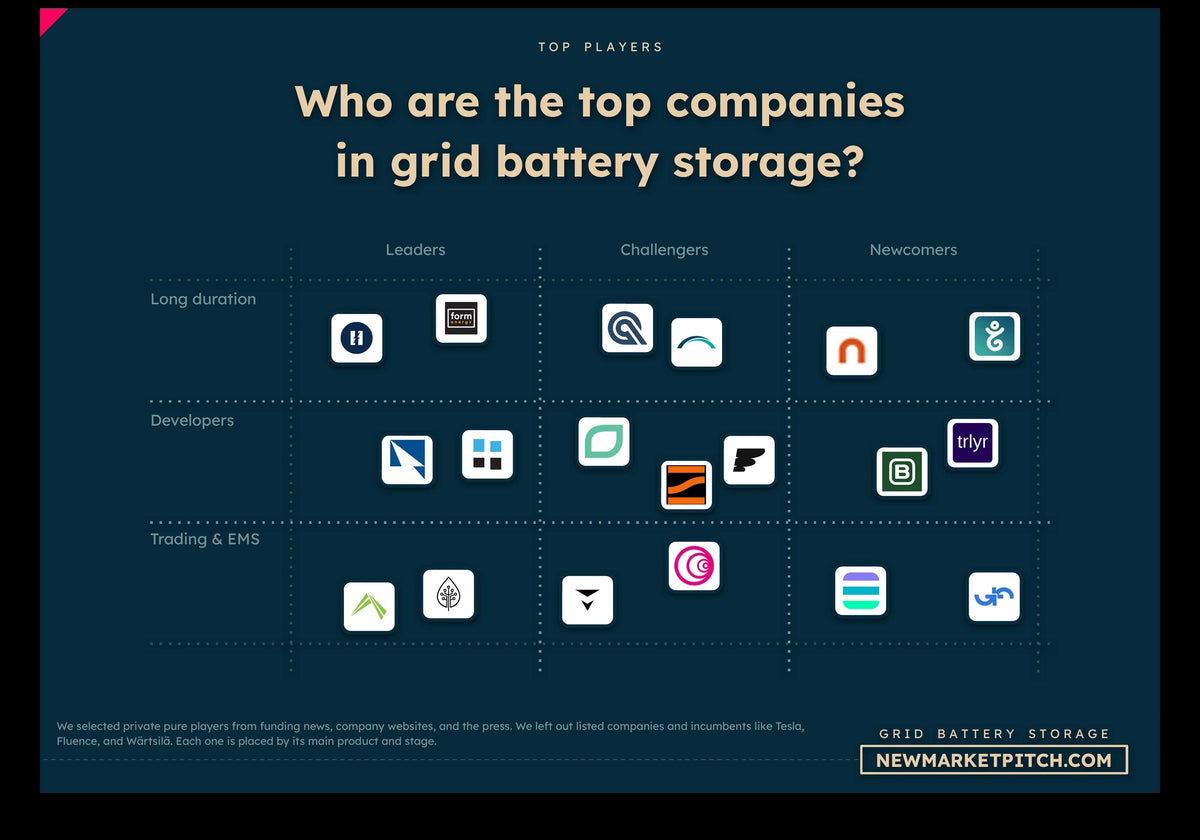
In our report covering the grid-scale battery storage market, we turn what is vague and complex into simple, useful visuals. Market maps like this one show you at a glance where every startup stands.
Will AI data centers need four-hour batteries or longer storage?
Four-hour lithium-ion batteries are currently the most obvious commercial option for managing electricity peaks at AI data centers, while longer-duration systems become more attractive when power shortages last much longer.
Most utility-scale batteries still have around two hours of storage, according to the IEA, but an increasing share can operate for four hours or more.
Data centers have several different requirements. A sudden electrical interruption might require battery support for only seconds or minutes. Managing afternoon electricity demand could require two to four hours. Protecting a facility against an extended grid outage could require a much larger system.
For a 100 MW computing facility, four hours of usable backup energy requires 400 MWh. Eight hours requires 800 MWh, and 24 hours requires 2,400 MWh.
Those differences shape the market for technology suppliers. Lithium-ion is already manufactured at enormous scale and works well for frequent short-duration charging and discharging. Flow batteries, iron-air batteries and other longer-duration technologies are pursuing applications where storing electricity for much longer periods becomes valuable.
Data centers also have a substantial market for short-duration backup equipment. The IEA reported that additions of battery-based uninterruptible power supply capacity, primarily serving data centers, rose 30% to 45 GW in 2025.
UPS equipment usually operates for minutes rather than hours. One gigawatt of UPS capacity with ten minutes of usable storage represents approximately 0.17 GWh, while 1 GW of four-hour grid batteries contains 4 GWh.
That leaves two distinct commercial opportunities: selling new large-scale energy storage systems and making existing data center backup equipment more useful to electricity networks.
Could batteries become cheaper than gas power plants for AI data centers?
Batteries are becoming very competitive with gas peaking plants for short periods of high electricity demand, but gas generation remains more suitable for supplying continuous power over long periods.
A battery can respond almost instantly, requires no fuel during discharge and can recharge when electricity is cheap. Those advantages are especially useful when a data center needs to reduce grid imports for a few hours.
Gas turbines provide a different service. As long as fuel is available, they can continue generating electricity after a battery would have exhausted its stored energy.
BloombergNEF's February 2026 energy cost analysis showed battery storage costs falling to record lows in 2025. That strengthens the case for storage where a project mainly needs short-duration flexibility.
Google's Meitner project offers a practical example of combining technologies rather than choosing one. Wind, solar and battery systems provide a large share of the site's power infrastructure, while gas generation contributes additional reliability.
There is also growing competition from nuclear power. Google's October 2026 agreement with Constellation Energy covers planned upgrades across 11 existing reactors to add approximately 890 MW of output, showing how major technology companies are seeking more continuous electricity supply alongside renewable energy.
For battery suppliers, the strongest opportunity is to handle peaks, fluctuations and short gaps in generation. Gas and nuclear projects address the separate challenge of delivering dependable electricity over much longer periods.
If you want more recent data on this point, please see our latest grid-scale battery storage market report.

Our research about grid batteries gets updated several times a month, so you always get the latest view of where things stand.
Which battery companies could benefit most from AI data center growth?
Tesla, Fluence, CATL, BYD, Sungrow and Eaton are among the companies best positioned to benefit from growing data center battery demand because they already supply the equipment needed for large energy-storage or backup-power projects.
Tesla and Fluence sell integrated utility-scale battery systems, including their control software and related services. Their customers include developers and utilities that could also serve data center electricity requirements.
CATL and BYD operate at enormous manufacturing scale and supply lithium-iron phosphate battery technology, which dominates stationary storage. Sungrow combines battery systems with inverters and other electrical equipment needed to connect storage to power networks.
Eaton has a different advantage. The company already sells critical power infrastructure for data centers, including UPS systems, and has demonstrated that this equipment can also support grid services through its work with Microsoft.
These business models capture different portions of the opportunity. A battery cell manufacturer benefits from higher battery demand, while a system integrator may capture revenue from hardware, controls, installation and maintenance. An established data center equipment supplier may benefit without selling a conventional four-hour grid battery.
For now, the public financial disclosures of these companies do not provide enough detail to calculate their revenue specifically attributable to AI-related grid storage.
We would favor suppliers with proven large-scale deployments, reliable equipment and established service capabilities over companies whose AI data center exposure consists mainly of product announcements.
Could AI data centers make grid battery projects more profitable?
AI data centers could make some battery projects more profitable by giving developers access to large customers willing to sign long-term electricity and reliability agreements.
Traditional grid batteries often make money by charging when electricity prices are low and selling electricity when prices rise. They can also earn revenue by providing frequency control, reserve capacity and other grid services.
Those revenues can be unpredictable. A storage developer may earn strong returns when there are relatively few competing batteries, only to see the opportunity shrink as more storage enters the same electricity market.
Data centers create another potential source of income. A computing operator may pay for guaranteed capacity during peak hours, backup availability or a service that reduces its connection requirements.
Google's relationship with Intersect illustrates the broader attraction of developing electricity infrastructure around an identifiable, large customer. Microsoft's UPS arrangements show how data center equipment can generate additional revenue from grid services.
Still, a long-term customer agreement doesn't guarantee a high return. The price of the contract, battery cost, operating requirements and financing expenses all matter.
As battery installations multiply, competition may also reduce electricity-price differences that support merchant storage profits. AI demand could create new revenue opportunities in constrained locations, but batteries built far away from those constraints may see little benefit.

In our market report about grid batteries, you will always find fresh funding data, taken straight from our own verified funding database.
Could the grid battery market exceed $100 billion a year by 2030?
The global grid battery market could exceed $100 billion in annual investment by 2030, although reaching that level depends on how quickly installations grow, how long batteries can discharge and how far prices fall.
We can start with approximately 87 GW of utility-scale additions in 2025. If installations double to around 175 GW annually by 2030 and average storage duration reaches four hours, the market would install approximately 700 GWh in a single year.
At $100–$150/kWh, that represents $70 billion to $105 billion of annual infrastructure investment.
A stronger scenario of 250 GW of annual installations, also averaging four hours, would create 1,000 GWh of demand. The corresponding investment range would be $100 billion to $150 billion.
These are our calculated scenarios rather than published market forecasts. The assumptions matter because installed power capacity and total battery energy capacity can grow at different speeds.
If manufacturers keep cutting prices, battery shipments may rise much faster than industry revenue. Longer storage durations could offset part of that pressure by increasing the number of kilowatt-hours sold per project.
AI data centers strengthen the growth case, particularly in regions facing new electricity constraints. The global market's longer-term size will still depend heavily on renewable generation, electricity demand, grid reliability and battery economics across all customer groups.
If you want more recent data on this point, please see our latest grid-scale battery storage market report.
What could stop the AI grid battery market from getting much bigger?
The biggest threat to AI-related grid battery growth is that data center electricity demand could expand without creating as much dedicated battery demand as expected.
Several outcomes could produce that result. AI computing could become more energy efficient, data center construction could slow, or operators could secure reliable electricity through generation and transmission projects that require less storage.
The IEA's Energy and AI analysis considers different electricity-demand scenarios because computing efficiency, AI adoption and infrastructure construction remain uncertain.
Even when electricity demand grows, battery projects face practical limits. Grid connections take time, local electricity markets may not reward storage adequately, and some sites need continuous generation more urgently than short-duration flexibility.
The growth of large nuclear, gas and renewable power agreements also shows that technology companies are using several approaches to solve their electricity problems.
Battery demand will depend less on the total number of announced AI data centers than on how those facilities obtain electricity, how much flexibility they need and whether battery storage is the cheapest practical solution.

In our document detailing everything you need to know about grid-scale battery storage, we look at what the winners do differently, so you can learn from the best instead of guessing.
So how big is the grid battery market with AI data centers?
The global grid battery market is already worth tens of billions of dollars annually, and AI data centers are adding a credible new growth opportunity that could represent several billion dollars of cumulative storage investment by 2030. But renewable energy integration and wider electricity-grid needs still account for most of the market.
Our estimate puts recent annual utility-scale battery infrastructure investment at approximately $25 billion to $50 billion, based on 2025 deployment volumes and representative installed costs. Worldwide battery additions reached 108 GW that year, with China contributing around 60%.
AI is adding demand in a particularly useful part of the market. The IEA expects global data center electricity consumption to reach approximately 945 TWh by 2030, up from 415 TWh in 2024. Major technology companies are already responding by combining computing campuses with new generation, batteries and grid-support equipment.
Under our adoption scenarios, 10–40 GW of four-hour battery storage associated with data centers by 2030 would represent approximately $4 billion to $24 billion in cumulative investment. These figures remain illustrative because there is no reliable global breakdown of storage sales attributable specifically to AI.
Looking at the wider industry, annual utility-scale battery investment could reach $70 billion to $150 billion by 2030 under scenarios involving 175–250 GW of yearly installations, four-hour average duration and installed costs of $100–$150/kWh.
AI data centers are becoming an important additional customer for grid batteries, especially in the United States, where computing demand is rising quickly and electricity connections are increasingly difficult to secure. However, the battery market is already much larger than this particular application.
What makes AI especially interesting is the possibility of long-term contracts with customers that place a very high value on reliable electricity. For storage developers with access to the right locations and grid connections, those customers could become some of the most attractive buyers in the industry.
If you want more recent data on this point, please see our latest grid-scale battery storage market report.
Our methodology
This analysis estimates the existing scale of the global grid battery market and examines how AI data centers could affect battery investment through 2030. We structured the research around recent deployment figures, data center electricity requirements, installed storage costs, documented commercial projects, regional infrastructure constraints and the economics of different storage applications.
For each dimension, we identified the most recent relevant evidence, aggregated findings from independent sources, compared what those findings revealed and drew conclusions from the combined results. This approach allows us to assess the market's existing commercial scale separately from the additional opportunity potentially associated with AI computing.
We define the core grid battery market primarily through utility-scale energy storage installations. Residential batteries, commercial storage and data center uninterruptible power supplies are discussed separately because their operating requirements, storage durations and system economics differ. Global deployment figures come principally from the International Energy Agency's Global Energy Review 2026 and related battery storage statistics.
Our estimated $25 billion to $50 billion annual utility-scale investment range is calculated from approximately 87 GW of 2025 installations, assumed storage durations of two to four hours and a reference installed cost of $150/kWh. That cost benchmark comes from the IEA's utility-scale battery project analysis. It is a representative calculation, rather than a reported worldwide revenue total, and actual system costs vary considerably across markets and projects.
We assessed the effect of AI using the IEA's Energy and AI electricity-demand projections, including the increase from 415 TWh in 2024 to 945 TWh by 2030. We then examined how different operating conditions affect the usefulness of storage: peak shaving, grid connection limits, backup requirements, renewable generation and the need to recharge batteries. Electricity consumption alone is not treated as a direct measure of battery demand.
Our AI-specific investment range is built from explicit deployment scenarios. We tested 5–40 GW of four-hour battery installations at $100–$150/kWh, producing cumulative investment scenarios of $2 billion to $24 billion. The central discussion focuses on 10–40 GW, equivalent to $4 billion to $24 billion. These are calculated adoption scenarios through 2030, not confirmed project pipelines or published market forecasts.
For the wider industry's 2030 potential, we modeled 175–250 GW of annual utility-scale installations, four-hour average duration and installed costs of $100–$150/kWh. This produces approximately $70 billion to $150 billion in annual investment. The calculations explicitly separate power capacity, measured in GW, from energy capacity, measured in GWh, because system duration directly affects both installation costs and market value.
We examined actual commercial adoption through Google's Intersect and Meitner energy infrastructure developments and Microsoft's grid-interactive data center UPS work with Eaton. Regional comparisons incorporate U.S. Energy Information Administration deployment data, Lawrence Berkeley National Laboratory's interconnection queue analysis and the IEA's assessment of China's battery installations and manufacturing position. BloombergNEF's battery pricing research provides additional evidence on cost reductions and their commercial implications.
We distinguished battery pack prices from complete installed project costs, cumulative infrastructure investment from annual spending, and dedicated AI-related storage from batteries serving the wider grid. Supplier positioning was assessed through existing manufacturing scale, project deployment capabilities, system integration and established data center relationships rather than attributing unreported AI storage revenue to individual companies.
Key sources used for this analysis include: IEA's Global Energy Review 2026 on battery storage, IEA's global battery storage additions data, IEA's Energy and AI electricity-demand analysis, IEA's assessment of energy supply for AI, IEA's Electricity 2026 flexibility analysis, and IEA's utility-scale battery project cost data.
Additional sources include: U.S. EIA's battery storage capacity analysis, Lawrence Berkeley National Laboratory's Queued Up: 2026 Edition, BloombergNEF's December 2025 lithium-ion battery price survey, BloombergNEF's battery pricing analysis, and BloombergNEF's analysis of battery storage project costs.
For commercial adoption and data center infrastructure, we used Google's Meitner Energy Center announcement, Alphabet's June 2026 investor presentation, Microsoft's report on data center batteries supporting the Irish electricity grid, Eaton's collaboration with Microsoft on grid-interactive UPS systems, and Google's announcement on supporting existing U.S. nuclear plants.

If you build or invest in the grid-scale battery storage market, you need to know which business models pay off now and which ones are fading. That's why our report covering it has a whole section on it.
Written by the New Market Pitch teamWe track new markets so founders and investors can move faster. About us