What are the most valuable grid-scale battery storage startups?
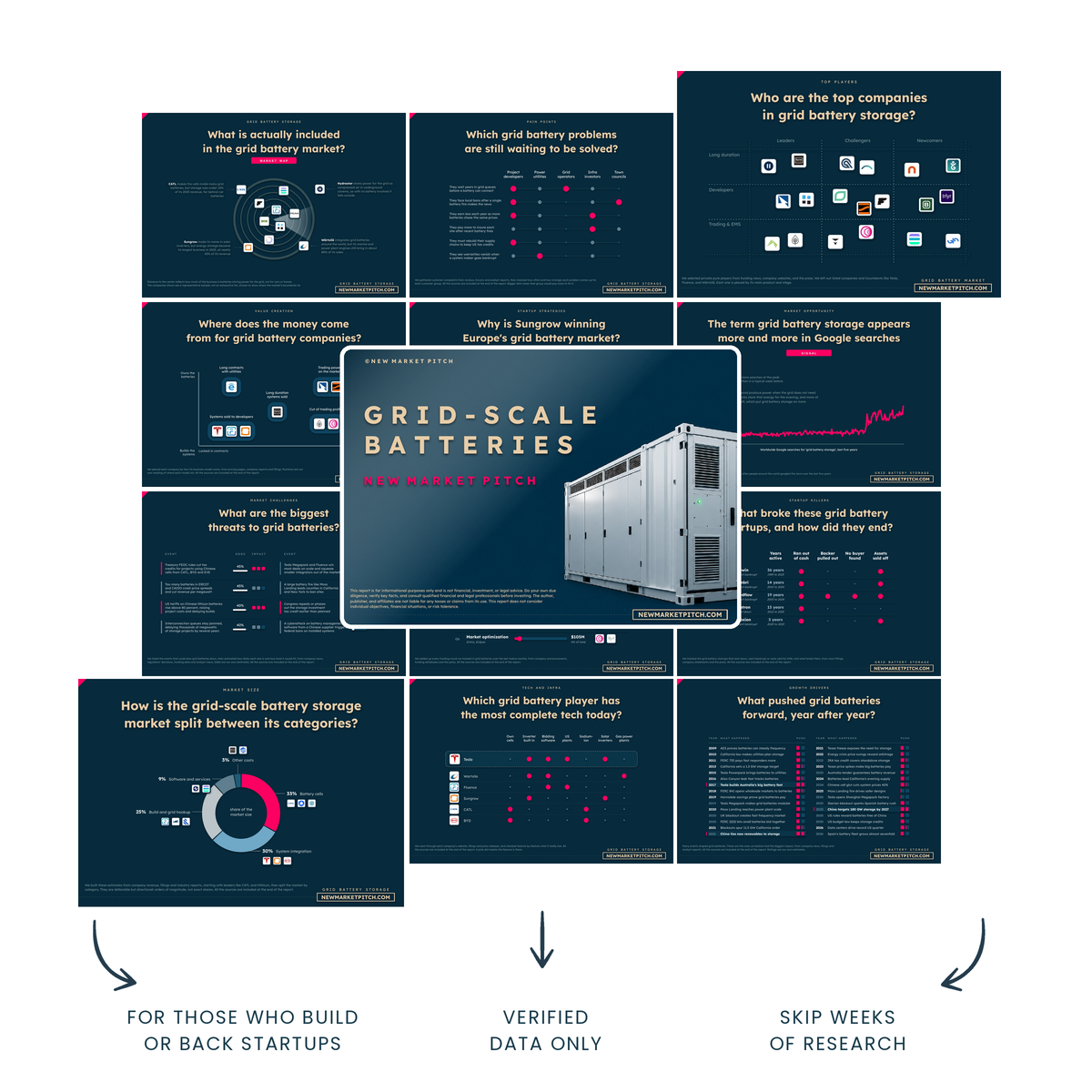
Whether you're building or investing in the grid-scale battery storage market, our report covers everything you need to know: the players, the money, and what's coming next.
Summary
Hithium is the most valuable private grid-scale battery storage startup today, valued at $3.0B–$4.5B, followed by Form Energy at $2.3B–$2.7B and Plus Power at $1.4B–$2.4B. The three leaders represent different business models: industrial battery manufacturing, multiday storage technology, and grid-connected battery infrastructure.
Seven private grid-scale battery storage startups have valuation ranges entirely above $1 billion. Five more, GIGA Storage, Green Flexibility, NineDot Energy, GridStor and Fidra Energy, have ranges that cross the threshold, bringing the number of potential unicorns to twelve.
Hithium has the strongest manufacturing-scale advantage among the leaders. Its cumulative shipments exceeded 200 GWh in October 2026, doubling from 100 GWh in approximately 14 months, while Form Energy is still commercializing its 100-hour iron-air battery technology.
Infrastructure developers are becoming just as important as battery manufacturers in the valuation rankings. Plus Power, Return, and Jupiter Power have built billion-dollar businesses around grid connections, project financing, electricity trading, and storage operations rather than proprietary battery chemistry.
Brookfield's July 2026 agreement to acquire Aypa Power for $3 billion in equity value is one of the clearest benchmarks for the sector. It shows that an established battery development platform can command a multibillion-dollar valuation without manufacturing its own batteries.
US storage deployment is expanding quickly. Operational utility-scale battery capacity reached nearly 52 GW by June 2026, while average installation duration increased from 2.8 to 3.5 hours year over year, indicating that developers are building larger energy reservoirs alongside additional power capacity.
Long-duration technologies are attracting substantial investment, but their commercial maturity varies widely. Form Energy leads the multiday category, CMBlu Energy is developing organic flow batteries, and Peak Energy is scaling sodium-ion systems, while conventional lithium-ion still dominates industrial shipment volumes.
Funding totals can be deceptive. Plus Power and Jupiter Power have each attracted approximately $3 billion in financing, much of it tied to projects and debt, whereas Form Energy's more than $2 billion raised consists of corporate equity financing.
European startups are gaining ground through infrastructure development and long-term electricity contracts. Return leads the region at $1.2B–$2.2B, and its 200 MW/800 MWh Sirius project demonstrates how contracted battery capacity can support institutional financing.
Cheaper batteries are creating winners and losers. Developers can build projects at lower costs, manufacturers face tighter pricing pressure, and operators may see electricity-trading revenues decline when competing storage capacity enters the same market.
The next stage of valuation growth will depend on commercial execution. Hithium must defend manufacturing margins, Form Energy must prove multiday storage economics at scale, and infrastructure developers must turn financed pipelines into operating assets that generate dependable cash flows.

Written by the New Market Pitch teamWe track new markets so founders and investors can move faster. About us

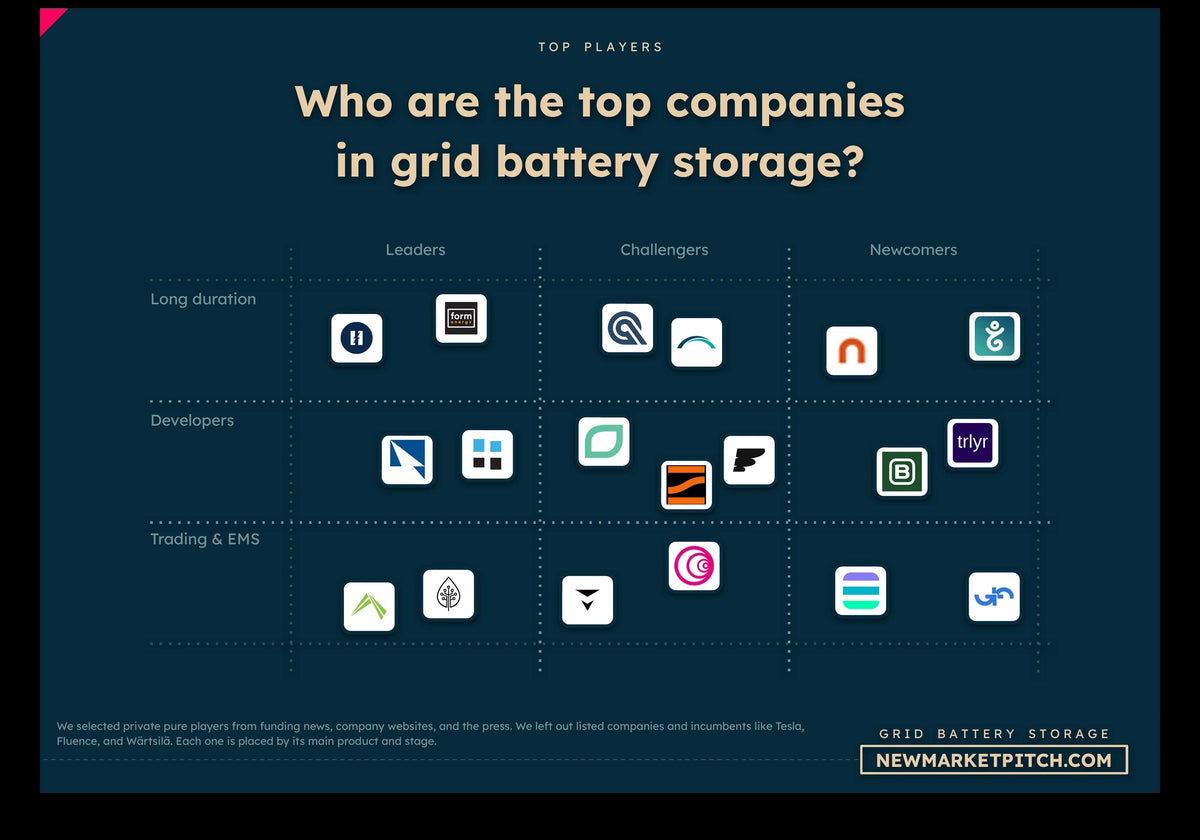
In our report covering the grid-scale battery storage market, we turn what is vague and complex into simple, useful visuals. Market maps like this one show you at a glance where every startup stands.
Top startups in the grid-scale battery storage market ranked by valuation
Here is an updated table that ranks the top startups in the grid-scale battery storage market based on their latest reported or estimated valuations.
If you need to dig deeper and get more detailed data, please check our report covering the grid-scale battery storage market.
| # | Startup Name | What They Do | Current Valuation ($) | Valuation Confidence Level | Valuation Type | Evidence Status | Total Funding ($) | Funding Confidence Level | Country |
|---|---|---|---|---|---|---|---|---|---|
| 1 | Hithium | Utility-scale lithium battery systems | $3.0B–$4.5B | Partial Confidence | Comparables-Based Estimate | Estimated | $899M1 | - | China |
| 2 | Form Energy | Multiday iron-air storage batteries | $2.3B–$2.7B | Strong Confidence | Implied Valuation from Raise | Estimated | $2B+ | Strong Confidence | United States |
| 3 | Plus Power | Standalone grid battery facilities | $1.4B–$2.4B | Low Confidence | Comparables-Based Estimate | Estimated | $3.0B21 | - | United States |
| 4 | Return | European grid-scale battery infrastructure | $1.2B–$2.2B | Partial Confidence | Implied Valuation from Raise | Implied | $350M1 | - | Netherlands |
| 5 | EnerVenue | Metal-hydrogen long-duration batteries | $1.2B–$1.8B | Partial Confidence | Implied Valuation from Raise | Implied | $745M | Partial Confidence | United States |
| 6 | Jupiter Power | Utility-scale battery project developer | $1.0B–$1.8B | Low Confidence | Comparables-Based Estimate | Estimated | $3.0B21 | - | United States |
| 7 | GIGA Storage | Large European battery projects | $850M–$1.5B | Partial Confidence | Comparables-Based Estimate | Estimated | $300M21 | - | Netherlands |
| 8 | CMBlu Energy | Organic flow battery systems | $1.16B+ | Strong Confidence | Implied Valuation from Raise | Estimated | $165M | Partial Confidence | Germany |
| 9 | Green Flexibility | German utility-scale battery infrastructure | $650M–$1.2B | Partial Confidence | Comparables-Based Estimate | Estimated | $460M1 | - | Germany |
| 10 | NineDot Energy | New York distributed battery projects | $650M–$1.1B | Low Confidence | Comparables-Based Estimate | Estimated | $225M+1 | - | United States |
| 11 | GridStor | Utility-scale battery project developer | $600M–$1.1B | Low Confidence | Comparables-Based Estimate | Estimated | Undisclosed | - | United States |
| 12 | Fidra Energy | UK battery storage facilities developer | $550M–$1.1B | Partial Confidence | Comparables-Based Estimate | Estimated | $600M21 | - | United Kingdom |
| 13 | Peak Energy | Sodium-ion grid battery systems | $720M–$900M | Partial Confidence | Implied Valuation from Raise | Implied | $173M | Strong Confidence | United States |
| 14 | terralayr | Batteries and virtual storage platform | $650M–$950M | Partial Confidence | Implied Valuation from Raise | Implied | $400M2 | - | Switzerland |
| 15 | Field | European battery development and optimization | $550M–$900M | Partial Confidence | Comparables-Based Estimate | Estimated | $650M21 | - | United Kingdom |
| 16 | Convergent Energy and Power | Distributed and utility storage | $450M–$850M | Low Confidence | Comparables-Based Estimate | Estimated | Undisclosed | - | United States |
| 17 | Spearmint Energy | Battery asset development and trading | $400M–$800M | Low Confidence | Comparables-Based Estimate | Estimated | $484M21 | - | United States |
| 18 | Peregrine Energy Solutions | US utility-scale battery project developer | $450M–$750M | Partial Confidence | Comparables-Based Estimate | Estimated | $130M+1 | - | United States |
| 19 | JDEnergy | Modular grid-scale battery systems | $450M–$700M | Partial Confidence | Comparables-Based Estimate | Estimated | $142M | - | China |
| 20 | Pulse Clean Energy | UK battery storage developer and operator | $350M–$650M | Low Confidence | Comparables-Based Estimate | Estimated | $292M2 | - | United Kingdom |
| 21 | FlexGen | Battery integration and software | $400M–$600M | Partial Confidence | Comparables-Based Estimate | Estimated | $276M | Partial Confidence | United States |
| 22 | Ingrid Capacity | Nordic battery development and optimization | $390M–$580M | Partial Confidence | Comparables-Based Estimate | Estimated | $108M | - | Sweden |
| 23 | ECO STOR | German grid-scale storage systems | $320M–$580M | Low Confidence | Comparables-Based Estimate | Estimated | $11M1 | - | Germany |
| 24 | Weijing Energy Storage | Flow battery systems manufacturer | $330M–$495M | Low Confidence | Comparables-Based Estimate | Estimated | Undisclosed | - | China |
| 25 | Frontier Power USA | US long-duration battery project developer | $310M–$450M | Partial Confidence | Implied Valuation from Raise | Implied | $263M+ | - | United States |
| 26 | SERMATEC | Utility battery systems and optimization | $250M–$450M | Low Confidence | Comparables-Based Estimate | Estimated | $15M1 | - | China |
| 27 | NGEN | European battery developer and operator | $250M–$450M | Partial Confidence | Comparables-Based Estimate | Estimated | $81M2 | - | Slovenia |
| 28 | Alsym Energy | Non-lithium stationary battery chemistry | $300M–$390M | Partial Confidence | Implied Valuation from Raise | Implied | $110M | - | United States |
| 29 | Flower | Grid flexibility and battery optimization | $270M–$410M | Partial Confidence | Comparables-Based Estimate | Estimated | $162M | - | Sweden |
| 30 | Entrix | AI-powered battery trading and optimization | $250M–$400M | Partial Confidence | Implied Valuation from Raise | Implied | $50M1 | - | Germany |
| 31 | Moment Energy | Repurposed EV battery storage systems | $280M–$350M | Strong Confidence | Implied Valuation from Raise | Implied | $100M+1 | - | Canada |
| 32 | Dalian Rongke Power | Vanadium flow battery systems | $180M–$420M | Low Confidence | Comparables-Based Estimate | Estimated | Undisclosed | - | China |
| 33 | ROBESTEC | Integrated utility-scale battery systems | $220M–$290M | Strong Confidence | Comparables-Based Estimate | Estimated | $22M1 | - | China |
| 34 | MW Storage | European battery development and financing | $140M–$300M | Low Confidence | Proxy-Based Estimate | Estimated | Undisclosed | - | Switzerland |
| 35 | Tavion | Grid-scale battery park developer and operator | $150M–$230M | Partial Confidence | Implied Valuation from Raise | Implied | $78M2 | - | Germany |
| 36 | Cactos | Integrated battery storage and optimization | $145M–$200M | Strong Confidence | Comparables-Based Estimate | Estimated | $54M2 | - | Finland |
| 37 | GoodEnough Energy | Industrial battery storage systems manufacturer | $90M–$230M | Low Confidence | Proxy-Based Estimate | Estimated | $49M3 | - | India |
| 38 | enspired | Automated electricity trading and optimization | $140M–$175M | Strong Confidence | Comparables-Based Estimate | Estimated | $53M | - | Austria |
| 39 | iwell | Smart commercial battery storage systems | $120M–$180M | Partial Confidence | Comparables-Based Estimate | Estimated | $31M1 | - | Netherlands |
| 40 | H2 Inc. | Industrial vanadium flow battery systems | $115M–$170M | Partial Confidence | Implied Valuation from Raise | Implied | $77M | - | South Korea |
| 41 | e-Zinc | Long-duration zinc-air energy storage | $115M–$165M | Partial Confidence | Implied Valuation from Raise | Implied | $56M | Partial Confidence | Canada |
| 42 | VFlowTech | Vanadium flow battery storage systems | $110M–$150M | Partial Confidence | Implied Valuation from Raise | Implied | $34M | Strong Confidence | Singapore |
| 43 | Actuate Energy | European battery infrastructure investor | $70M–$170M | Low Confidence | Proxy-Based Estimate | Estimated | Undisclosed | - | Spain |
| 44 | On.Energy | Battery storage integration and operations | $80M–$150M | Partial Confidence | Comparables-Based Estimate | Estimated | $263M21 | - | United States |
| 45 | Voltfang | Second-life industrial battery storage systems | $85M–$135M | Partial Confidence | Implied Valuation from Raise | Implied | $50M2 | - | Germany |
| 46 | B2U Storage Solutions | Second-life grid battery project developer | $85M–$125M | Partial Confidence | Comparables-Based Estimate | Estimated | $22M1 | - | United States |
| 47 | Elestor | Hydrogen-bromine long-duration flow batteries | $75M–$135M | Low Confidence | Comparables-Based Estimate | Estimated | $30M | Partial Confidence | Netherlands |
| 48 | Relectrify | Inverter-free battery control and storage | $65M–$115M | Partial Confidence | Comparables-Based Estimate | Estimated | $28M2 | - | Australia |
| 49 | XL Batteries | Organic long-duration flow batteries | $65M–$95M | Partial Confidence | Implied Valuation from Raise | Implied | $7.5M+ | Partial Confidence | United States |
| 50 | Arenko | Grid battery management software platform | $55M–$100M | Partial Confidence | Implied Valuation from Raise | Implied | $12M–$28M | - | United Kingdom |
| 51 | Certain Energy | Manganese flow batteries for grids | $55M–$85M | Strong Confidence | Implied Valuation from Raise | Implied | $20M1 | - | United Kingdom |
| 52 | Quino Energy | Organic electrolyte flow battery technology | $55M–$80M | Strong Confidence | Implied Valuation from Raise | Implied | $16M | Strong Confidence | United States |
| 53 | Capalo AI | AI battery trading optimization platform | $48M–$65M | Strong Confidence | Comparables-Based Estimate | Estimated | $18M | - | Finland |
| 54 | LiNa Energy | Solid-state sodium battery technology | $40M–$65M | Partial Confidence | Implied Valuation from Raise | Implied | $26M | - | United Kingdom |
| 55 | Connected Energy | Second-life EV battery storage systems | $30M–$65M | Low Confidence | Comparables-Based Estimate | Estimated | $30M1 | - | United Kingdom |
| 56 | Inlyte Energy | Iron-sodium long-duration battery systems | $35M–$55M | Partial Confidence | Comparables-Based Estimate | Estimated | $10M | Partial Confidence | United States |
| 57 | Sinergy Flow | Low-cost long-duration flow batteries | $33M–$55M | Strong Confidence | Implied Valuation from Raise | Implied | $10M | - | Italy |
| 58 | Smartville | Repurposed EV battery storage systems | $25M–$55M | Low Confidence | Comparables-Based Estimate | Estimated | $30M | - | United States |
| 59 | Urban Electric Power | Rechargeable zinc-based stationary battery systems | $15M–$50M | Low Confidence | Proxy-Based Estimate | Estimated | $7M–$30M1 | - | United States |
Which startups in the grid-scale battery storage market have been acquired or gone public?
These startups no longer have a private-market valuation of their own, so we list them separately, using their acquisition price or their current market capitalization.
| # | Startup Name | What They Do | Current Valuation ($) | Valuation Confidence Level | Valuation Type | Evidence Status | Total Funding ($) | Funding Confidence Level | Country |
|---|---|---|---|---|---|---|---|---|---|
| 1 | Aypa Power | Grid-scale battery project developer | $3.0B | Full Confidence | Acquisition Value | Observed | Undisclosed | - | United States |
| 2 | esVolta | North American battery storage developer | $550M–$1.0B | Low Confidence | Comparables-Based Estimate | Estimated | $525M21 | - | United States |
| 3 | Eelpower | UK battery storage investment platform | $180M–$350M | Low Confidence | Proxy-Based Estimate | Estimated | Undisclosed | - | United Kingdom |
| 4 | Enerpoly | Zinc-ion battery manufacturing technology | $2M–$5M | Partial Confidence | Acquisition Value | Estimated | Undisclosed | - | Sweden |
- Minimum or committed amount; some rounds or undrawn sums may be missing.
- Includes debt, project financing or other non-equity capital.
- GoodEnough's figure is initial factory investment, not confirmed outside equity funding.

Our research about grid batteries gets updated several times a month, so you always get the latest view of where things stand.
Which grid-scale battery storage startups are worth the most today?
Hithium leads the private grid-scale battery storage market with an estimated valuation of $3.0B–$4.5B, followed by Form Energy at $2.3B–$2.7B and Plus Power at $1.4B–$2.4B. These three companies represent different ways to build a valuable battery storage business: manufacturing batteries at industrial scale, developing new storage chemistry, and owning or developing grid-connected storage projects.
Hithium's position is supported by substantial manufacturing activity. The Chinese company reported cumulative battery shipments exceeding 200 GWh in October 2026, having passed 100 GWh in August 2025. Its annual shipment rankings also place it among the largest energy storage battery suppliers globally.
Form Energy is pursuing a different opportunity. Its iron-air batteries are designed to deliver electricity for approximately 100 hours, addressing periods when conventional lithium-ion batteries cannot economically cover extended electricity shortages.
Plus Power develops and operates large-scale battery facilities, making its value dependent on electricity-market opportunities, development execution, financing, and contracted or merchant project revenues.
There are three competing sources of value at the top of this market. Hithium has manufacturing scale, Form Energy has potentially differentiated intellectual property, and Plus Power has exposure to the growing value of grid flexibility infrastructure. Comparing their valuations is useful, but they are selling very different things.
Why are grid-scale battery storage startup valuations rising?
Grid-scale battery storage valuations are benefiting from a real infrastructure expansion. The US Energy Information Administration reported 43.6 GW of operational utility-scale battery capacity at the end of 2025, rising to nearly 52 GW by June 2026.
The installed US fleet has grown at an average annual rate of approximately 70% over the preceding three years. That growth creates demand for battery manufacturers, developers, operators, financing platforms, and software companies.
The American Clean Power Association and Wood Mackenzie recorded 18.9 GW of battery installations across utility, commercial, and residential markets during 2025, a 52% increase from 2024.
More interestingly, demand is shifting toward systems that store more electricity per megawatt of power. Their September 2026 report found that average US battery duration had increased from 2.8 hours to 3.5 hours year over year.
That's a 25% increase in average duration. Storage developers are installing more batteries while also building larger energy reservoirs for each unit of power capacity.
The International Energy Agency also reported that global utility-scale battery project costs fell approximately 40% in 2024, to around $150 per kWh. Lower costs make additional projects economically feasible, expanding the addressable market.
Falling equipment costs, expanding electricity demand, and increasing requirements for flexibility are driving the industry forward. Still, lower battery prices intensify competition among suppliers and can reduce the revenue available to existing storage assets. The market can grow rapidly without every company becoming more valuable.

In our market report about grid batteries, we look at what the winners do differently, so you can learn from the best instead of guessing.
How many grid-scale battery storage startups are worth over $1 billion?
Seven private grid-scale battery storage startups have valuation ranges entirely above $1 billion: Hithium, Form Energy, Plus Power, Return, EnerVenue, Jupiter Power, and CMBlu Energy.
Five additional companies, GIGA Storage, Green Flexibility, NineDot Energy, GridStor and Fidra Energy, have valuation ranges that cross the $1 billion threshold. Depending on their actual equity values, the market has between seven and twelve unicorns.
The different business models are revealing. Hithium manufactures lithium battery systems; Form Energy, EnerVenue, and CMBlu Energy develop alternative battery technologies; Plus Power, Return, and Jupiter Power primarily develop or operate storage infrastructure.
Infrastructure developers have achieved valuations comparable to businesses developing entirely new battery chemistries. That's a notable change for a sector traditionally associated with technological innovation.
Aypa Power offers a useful transaction benchmark outside the private ranking. Brookfield announced an agreement to acquire the company from Blackstone in July 2026 for $3.0B in equity value, demonstrating that institutional investors are prepared to assign multibillion-dollar values to established battery development platforms.
Ultimately, investors are paying for different assets: proven deployment, ownership of contracted projects, manufacturing scale, or the future commercial potential of a battery technology.
Is Hithium really worth more than Form Energy?
Hithium currently holds a higher position in the grid-scale battery storage valuation ranking than Form Energy, but its lead is based on a different investment proposition. Hithium's $3.0B–$4.5B valuation reflects a manufacturer operating at substantial scale, while Form Energy's $2.3B–$2.7B valuation is tied to the commercialization of multiday iron-air batteries.
Hithium reported that its cumulative shipments doubled from more than 100 GWh in August 2025 to more than 200 GWh in October 2026. Its September 2026 announcement also described a new manufacturing base with planned annual capacity of 30 GWh of long-duration battery cells and 20 GWh of integrated storage systems.
Form Energy has a much more specialized proposition. It aims to deliver up to 100 hours of storage using iron-air chemistry rather than competing directly with established lithium battery manufacturers on conventional four-hour systems.
The American company's progress is increasingly measurable. It announced a $405 million Series F in October 2024, deployed its first commercial demonstration system with Great River Energy in 2025, and raised another $750 million in August 2026.
Hithium has demonstrated much greater commercial shipment volume. Form Energy is attempting to establish an entirely different category of storage economics.
For now, Hithium has the stronger manufacturing business, while Form Energy offers greater exposure to the possibility that multiday storage becomes a large, distinct market. The question is how much profit each company can eventually make from its advantage.

In our document detailing everything you need to know about grid-scale battery storage, you will always find fresh funding data, taken straight from our own verified funding database.
Why is Form Energy valued so highly compared with other battery startups?
Form Energy's $2.3B–$2.7B valuation reflects the possibility that its iron-air batteries can solve an electricity-storage problem that conventional lithium-ion systems address only at significant cost: supplying power across several consecutive days.
Most grid-scale lithium-ion projects are designed to discharge over a few hours. Form Energy targets approximately 100 hours, making its systems potentially useful during prolonged periods of low renewable generation or unusually high electricity demand.
Its commercial development has moved beyond laboratory research. Form Energy's milestones include the construction of its West Virginia manufacturing facility, the deployment of an iron-air demonstration system with Great River Energy, and an announced Maine project rated at 85 MW and 8,500 MWh.
That Maine project has 100 hours of nominal energy capacity relative to its rated power. By comparison, a 100 MW four-hour battery would store 400 MWh. The proposed Maine installation therefore represents more than 20 times the energy capacity of a conventional four-hour system with a similar power rating.
Financing has reinforced investor interest. Form Energy raised $405 million in 2024 and $750 million in August 2026, bringing its disclosed cumulative equity funding above $2 billion.
Its valuation is now relatively close to the equity capital it has raised, reflecting the enormous financing requirements of developing and scaling a new battery chemistry. The commercial question is whether manufacturing costs, system efficiency, reliability, and customer demand eventually justify that investment.
Which grid battery startups have raised the most funding?
Some of the largest grid-scale battery storage financing totals belong to infrastructure developers rather than battery manufacturers. But headline funding figures can be misleading because they often include project loans and other non-equity capital.
Plus Power and Jupiter Power each have approximately $3.0B in reported cumulative financing. Form Energy has raised more than $2.0B in equity, making it especially notable among technology developers.
Jupiter Power announced $1.4 billion in financing for ten projects across Texas and Michigan in September 2026. The projects collectively represent 1,500 MW of power capacity and 3,600 MWh of energy storage.
The financing comprised several instruments, including senior secured project debt, tax-equity bridge loans, and an investment-grade private placement. These are materially different from equity investors buying ownership in the parent company.
Plus Power's $1.4B–$2.4B valuation is below its approximately $3.0B financing total, as is Jupiter Power's $1.0B–$1.8B valuation. That largely reflects their use of debt and project financing rather than exclusively parent-company equity.
The same distinction applies to businesses such as Field, Fidra Energy, Spearmint Energy, and On.Energy, where reported capital commitments cannot automatically be treated as venture funding.
| Company | Reported funding | Main financing consideration |
|---|---|---|
| Plus Power | $3.0B | Includes project and non-equity capital |
| Jupiter Power | $3.0B | Includes project debt and structured financing |
| Form Energy | $2.0B+ | Predominantly disclosed equity fundraising |
| Hithium | $899M | Reported minimum or committed total |
| EnerVenue | $745M | Battery technology commercialization financing |
| Field | $650M | Includes non-equity capital |
| Fidra Energy | $600M | Includes infrastructure financing |
| Green Flexibility | $460M | Reported capital commitment |
These amounts are useful indicators of financing access, but they tell us relatively little about how much equity investors actually own or how profitable a company has become.

Learning from others' mistakes is the cheapest lesson there is. In our report covering the grid-scale battery storage market, we look at what broke startups before you, so you don't repeat it.
Are battery project developers becoming more valuable than battery manufacturers?
Battery project developers have become credible competitors to manufacturers in private-market valuations, although the largest manufacturing and battery-technology companies still occupy the highest positions.
Plus Power at $1.4B–$2.4B, Return at $1.2B–$2.2B, and Jupiter Power at $1.0B–$1.8B demonstrate how much value investors assign to platforms capable of sourcing sites, securing grid connections, financing construction, and managing battery operations.
The strongest external benchmark comes from Aypa Power. Brookfield's July 2026 acquisition agreement assigned it an equity value of $3.0B and enterprise value of approximately $7 billion.
Aypa had approximately 6.5 GW of operating and contracted capacity alongside a development pipeline exceeding 20 GW.
That transaction shows that valuable battery businesses can be built around the commercial infrastructure required to deploy storage, even without manufacturing a single battery cell.
However, the two models have different economic exposures. Manufacturers such as Hithium face equipment pricing, production efficiency, warranty, and manufacturing-capacity risks. Developers such as Plus Power and Jupiter Power face grid connection delays, construction risk, electricity-market volatility, financing costs, and changing project revenues.
There's room for both models. The more interesting question is which can preserve margins as equipment costs fall and competition increases.
Which European grid-scale battery storage startups have the highest valuations?
Return leads the European grid-scale battery storage startups with a valuation of $1.2B–$2.2B, followed by the Netherlands' GIGA Storage at $850M–$1.5B and Germany's CMBlu Energy at $1.16B or more.
European valuations reflect two distinct sources of opportunity. One is the development of batteries and storage technology; the other is building infrastructure to address renewable intermittency, electricity-price volatility, and grid congestion.
Return secured €300 million in growth equity from APG, acting for pension fund ABP, in October 2025. The investment was for a minority stake and supported the company's European storage expansion.
In August 2026, Return announced a long-term tolling agreement with Vattenfall for its Sirius battery project in the Netherlands, a 200 MW/800 MWh facility backed by approximately €180 million in project investment.
Germany's Green Flexibility, valued at $650M–$1.2B, represents a related infrastructure strategy, while CMBlu Energy is developing organic flow batteries with a longer-duration technology proposition.
The UK has another concentration of developers, including Fidra Energy, Field, and Pulse Clean Energy. Fidra's Thorpe Marsh project alone is designed for 1.45 GW and 3.1 GWh, highlighting the scale now being pursued in European storage infrastructure.
European investors are increasingly rewarding companies that can secure grid locations and turn them into contracted, financeable projects. Return's Vattenfall agreement is a good example of how a development pipeline becomes more valuable once its commercial revenues are easier to predict.

Your time is limited. In our research about grid batteries, we put numbers on each part of the market, so you can see where it makes sense to focus.
Why are US grid-scale battery startups attracting so much investment?
US grid-scale battery storage startups are attracting large investments because the country combines rapid deployment growth, sizeable electricity markets, and opportunities for both infrastructure ownership and domestic battery manufacturing.
The EIA recorded nearly 52 GW of operational utility-scale battery capacity by mid-2026, after additions of 8.3 GW during the first half of the year.
The geographical expansion is important. The American Clean Power Association reported utility-scale battery installations across 13 states during the final quarter of 2025, showing that development is spreading beyond California and Texas.
The financing market is also maturing. Jupiter Power secured $1.4 billion across ten battery projects in 2026, while Form Energy attracted $750 million of new equity for its iron-air manufacturing and deployment activities.
Peak Energy has introduced another investment thesis through sodium-ion batteries. In July 2026, it selected Sacramento for a manufacturing facility planned to produce up to 4 GWh of battery systems annually.
The United States consequently supports several distinct categories of storage companies: large developers such as Plus Power, Jupiter Power, and NineDot Energy; manufacturers such as Form Energy and Peak Energy; and integration and software companies such as FlexGen.
The money is available, but getting projects connected remains difficult. Interconnection queues, permitting requirements, changing market revenues, and equipment sourcing rules can all delay the transition from financing to operational capacity.
Can sodium-ion battery startups challenge lithium-ion storage?
Sodium-ion battery startups can challenge lithium-ion in selected grid applications, but they have not yet demonstrated the manufacturing volume needed to displace established lithium battery suppliers.
Peak Energy is the clearest example in our ranking, with a valuation of $720M–$900M. Its approach emphasizes lower-cost materials, simplified thermal management, and stationary storage systems where energy density is less important than in passenger vehicles.
In July 2026, Peak announced plans for a Sacramento manufacturing plant with up to 4 GWh of annual system capacity. In October, it raised $108 million in Series B funding and reported more than $1 billion in customer commitments.
Those commitments show substantial demand, although signed orders and commitments still need to become shipments and revenue.
Other companies are approaching the non-lithium opportunity from different directions. Alsym Energy is developing alternative stationary battery chemistry, while LiNa Energy is working on solid-state sodium technology. Inlyte Energy combines iron and sodium in long-duration systems.
Lithium-ion still has a huge industrial lead. According to InfoLink figures cited by Hithium, global energy storage cell shipments reached approximately 612 GWh in 2025, nearly doubling year over year.
Against that scale, a proposed 4 GWh annual sodium-ion factory represents less than 1% of the 2025 global storage-cell shipment volume.
Sodium-ion's immediate opportunity is to demonstrate better cost, safety, or operating economics in specific applications. Replacing lithium-ion across the wider grid-storage industry would require years of manufacturing expansion and reliable field performance.

In our market report about grid batteries, we always try to gather several sources and make estimates that make sense, so you can work with solid numbers.
Are flow battery startups becoming serious competitors in grid storage?
Flow battery startups are becoming credible contenders for long-duration grid storage, although their valuations currently depend more on commercialization potential than broad deployment at the scale achieved by lithium-ion.
CMBlu Energy leads this technology group with a valuation of at least $1.16B. Its organic flow batteries target applications where long operating life, independent scaling of power and energy, and extended discharge duration can be valuable.
The ranking also includes Weijing Energy Storage, Dalian Rongke Power, VFlowTech, H2 Inc., Elestor, XL Batteries, Quino Energy, and Sinergy Flow.
These companies are pursuing different chemistries. Dalian Rongke Power, VFlowTech, and H2 Inc. focus on vanadium-based systems; Elestor develops hydrogen-bromine technology; Quino Energy and XL Batteries pursue organic electrolytes; and Sinergy Flow is developing a lower-cost long-duration approach.
The investment case rests on the distinction between short-duration electricity shifting and repeated long-duration discharge. Conventional lithium-ion batteries are highly competitive at storing electricity for a few hours. Flow batteries may become more attractive where long cycle life and additional energy capacity outweigh their lower energy density and more complex balance-of-plant requirements.
The hard part is proving sustained competitiveness under commercial operating conditions: installed cost, maintenance, financing, warranty risk, and performance over many years.
Flow batteries have a real role to play in grid storage, particularly where longer discharge durations are valuable. But widespread displacement of conventional utility batteries still looks some way off.
Is long-duration battery storage becoming the next big market?
Long-duration battery storage is becoming a more important investment category, but the strongest commercial momentum is currently in the move from shorter batteries toward four-hour and longer systems. Multiday storage remains a much earlier opportunity.
The distinction is visible in US installation data. The American Clean Power Association and Wood Mackenzie reported that the national average storage duration increased from 2.8 to 3.5 hours between the second quarters of 2025 and 2026.
This represents a significant shift in system specifications. Nevertheless, a 3.5-hour average remains far below the 100-hour duration targeted by Form Energy.
The commercial market contains several different opportunities rather than a single long-duration category.
| Storage duration | Main application | Relevant technology examples |
|---|---|---|
| Under 1 hour | Fast grid response and power quality | Lithium-ion systems |
| 1–2 hours | Frequency services and short balancing | Lithium-ion systems |
| 2–4 hours | Daily electricity shifting and peak demand | Lithium-ion, sodium-ion |
| 4–6 hours | Extended daily shifting | Lithium-ion, sodium-ion, flow batteries |
| 6–8 hours | Longer renewable shifting | Lithium-ion, flow batteries |
| 8–12 hours | Longer daily and overnight coverage | Flow batteries, other long-duration systems |
| 12–24 hours | Extended renewable shortfalls | Selected flow and alternative chemistries |
| Multiple days | Prolonged renewable shortages and reliability | Iron-air and other multiday technologies |
These are potential application categories. The lowest-cost technology in each category depends on system design, location, operating patterns, and the value of the electricity being stored.
Four-to-eight-hour storage looks like the more immediate commercial expansion. Multiday technologies could eventually address a much larger reliability problem, but their adoption will depend heavily on electricity-market rules and whether their costs become competitive.

If you build or invest in the grid-scale battery storage market, you need to know which business models pay off now and which ones are fading. That's why our report covering it has a whole section on it.
Which grid battery storage startups are best positioned to benefit from cheaper batteries?
Grid-scale storage developers and operators are often better positioned to benefit directly from falling battery equipment prices than the manufacturers selling those batteries.
The IEA reported that utility-scale battery project costs declined approximately 40% in 2024, reaching around $150 per kWh. Lower capital costs can improve the economics of new storage developments, especially when grid access and revenue arrangements are already secured.
For a 200 MWh system, a reduction from $250 to $150 per kWh would reduce the associated capacity-based cost from $50 million to $30 million. That's a $20 million difference, although actual project expenditure also includes grid connections, land, engineering, civil works, financing, and other costs.
Developers such as Plus Power, Jupiter Power, GridStor, GIGA Storage, and Fidra Energy can potentially benefit from cheaper equipment when constructing new projects.
Manufacturers face the reverse pressure. Hithium, EnerVenue, Peak Energy, and CMBlu Energy must reduce production costs, improve performance, or differentiate their products sufficiently to maintain attractive margins.
Existing operators face another complication. When cheaper batteries encourage more competing projects to enter a profitable electricity market, revenues from arbitrage and ancillary services can decline.
The clearest beneficiaries are developers building projects at today's lower equipment prices while retaining attractive grid locations and commercial contracts. Existing battery operators may face a tougher environment if additional installations push down the electricity-price spreads they earn money from.
Can battery trading software startups reach billion-dollar valuations?
Battery trading and optimization software startups can potentially reach billion-dollar valuations, but none of the specialist software-oriented companies in our ranking currently has a valuation range that reaches that threshold.
Flower is valued at $270M–$410M, Entrix at $250M–$400M, enspired at $140M–$175M, Arenko at $55M–$100M, and Capalo AI at $48M–$65M.
These companies address an increasingly important problem: deciding when batteries should charge, discharge, offer capacity, or participate in different electricity markets.
The opportunity grows with the installed battery fleet. As of mid-2026, the United States alone had nearly 52 GW of utility-scale battery capacity, while European operators were expanding their storage portfolios.
However, software companies do not automatically capture a fixed percentage of the economic value of that fleet. Their revenue depends on customer contracts, optimization fees, revenue-sharing terms, and the number and size of assets they manage.
The competitive environment is also different from ordinary enterprise software. Electricity trading requires forecasting, market access, operational integration, and sophisticated risk controls. Operators may build capabilities internally or use multiple service providers.
A billion-dollar valuation becomes much easier to justify if a platform can demonstrate substantial recurring revenue, a growing portfolio of contracted battery capacity, and consistent performance across multiple electricity markets.
For now, the software specialists remain much smaller than the leading battery manufacturers and developers. Their opportunity is growing, but they still need to prove how much of that growth they can turn into revenue.

In our report covering the grid-scale battery storage market, we don't want to repeat what boring consulting reports say. Instead, we show you the real and latest market signals that matter.
Why are second-life battery startups valued below major grid storage developers?
Second-life battery startups generally have lower valuations because reusing electric-vehicle batteries introduces technical and operational complexity that must be overcome before cheaper battery acquisition translates into scalable profitability.
Moment Energy is valued at $280M–$350M, making it the highest-valued company in this specific second-life group. Voltfang follows at $85M–$135M, B2U Storage Solutions at $85M–$125M, and Relectrify at $65M–$115M.
Connected Energy and Smartville also develop storage systems using repurposed vehicle batteries.
The potential economic advantage is straightforward: batteries no longer suitable for their original vehicle applications can retain useful stationary storage capacity.
The difficulty is that retired vehicle battery packs vary by manufacturer, chemistry, health, remaining life, and electrical architecture. Companies must assess them, manage safety risks, integrate different hardware, and offer warranties that customers and financiers will accept.
Second-life systems also compete with newly manufactured lithium batteries whose costs have declined dramatically. This reduces the price advantage that originally made battery reuse especially compelling.
Companies such as B2U Storage Solutions and Moment Energy can build valuable businesses by demonstrating repeatable testing, system integration, safety performance, and long-term operational reliability.
But second-life storage has yet to approach the deployment scale of standardized new-battery infrastructure. Until the economics become more repeatable, its valuations are likely to remain below those of major grid storage developers.
Does more funding mean a grid battery startup is worth more?
More funding does not necessarily translate into a higher grid-scale battery startup valuation, especially when financing totals mix equity, loans, and asset-level commitments.
Plus Power and Jupiter Power each report approximately $3.0B in cumulative financing, yet their estimated valuations are $1.4B–$2.4B and $1.0B–$1.8B respectively.
Form Energy has raised more than $2.0B in equity and has a valuation of $2.3B–$2.7B. Its financing is more directly connected to corporate ownership because much of its disclosed fundraising consists of equity rounds.
EnerVenue has reported $745M in funding against a $1.2B–$1.8B valuation. Hithium, despite having a lower reported financing total of $899M, leads the ranking because valuation also reflects business scale and other factors beyond publicly tracked funding.
The relationship becomes even less straightforward for infrastructure platforms. Fidra Energy's reported financing includes project-related capital, while Field and NineDot Energy have also attracted capital structures that cannot be equated directly with equity funding.
This explains why a company can report billions in financing and still have a lower equity valuation. Project debt finances underlying assets; it does not create an equivalent amount of shareholder value.
When comparing startups, the type of capital raised matters much more than the headline total. A manufacturer raising $500 million in equity and a developer arranging $500 million in project loans have completed very different transactions.

In our research about grid batteries, we like to show you the big picture. We know your time is precious, so we make every page quick to read and packed with as much learning as possible per minute.
Which grid battery startups have the strongest evidence of commercial scale?
Hithium, Plus Power, Jupiter Power, and several established infrastructure developers have stronger evidence of large-scale commercial activity than most early-stage battery chemistry startups.
Hithium reported cumulative shipments exceeding 200 GWh, demonstrating industrial manufacturing and delivery at a scale that experimental battery manufacturers have not reached.
Jupiter Power's September 2026 financing covered ten projects totaling 1,500 MW and 3,600 MWh. That demonstrates the size of its development and construction platform, backed by sophisticated institutional financing.
Return offers another example. Its Sirius project in the Netherlands has a long-term fixed-price tolling agreement with Vattenfall covering 200 MW and 800 MWh, with commercial operation expected in late 2027.
Fidra Energy is developing the Thorpe Marsh facility, planned at 1.45 GW and 3.1 GWh, alongside West Burton C at 500 MW and 1 GWh.
These figures describe different stages of development. Shipped battery capacity, operating projects, financed construction, contracted development, and planned pipelines all tell us something different about commercial progress.
Form Energy demonstrates another type of progress: commercial demonstrations and manufacturing development for a new chemistry rather than mass deployment of conventional storage.
Hithium stands out for manufacturing shipments, while established project developers have demonstrated their ability to finance substantial infrastructure portfolios. The newer chemistry companies have a longer road ahead before they can match that scale.
What does Aypa Power's $3 billion acquisition tell us about battery startup valuations?
Aypa Power's $3.0B equity acquisition value demonstrates that established grid-scale battery developers can achieve multibillion-dollar valuations without developing proprietary battery chemistry.
Brookfield announced its agreement to acquire Aypa from Blackstone in July 2026. The transaction included an approximately $7 billion enterprise value, compared with $3.0B in equity value.
The $4 billion difference between those figures reflects the broader enterprise financing and liability structure rather than additional value belonging directly to equity shareholders.
Aypa had approximately 6.5 GW of operating and contracted capacity and a development pipeline exceeding 20 GW. Its commercial portfolio therefore offered a substantial foundation for the purchase.
This is a particularly relevant comparison for Plus Power, Jupiter Power, NineDot Energy, and GridStor, whose values are driven largely by infrastructure development and operation.
Of course, Aypa's transaction value cannot be applied mechanically to every developer. The amount paid depends on contracted cash flows, project ownership, asset maturity, leverage, market exposure, and future development opportunities.
The deal is still a major benchmark. Sophisticated infrastructure investors are willing to pay substantial amounts for established battery storage platforms with valuable projects and grid connections.
Aypa belongs in the acquired-company category rather than the independent private startup ranking, but its transaction provides one of the clearest real-world valuation comparisons for the sector.

When you build or invest in the grid-scale battery storage market, you need clarity, not confusion. In our market report about grid batteries, we always try to put numbers on and quantify whatever is usually vague and confusing.
Can grid-scale battery storage startup valuations keep rising?
Grid-scale battery storage startup valuations can continue rising, but future gains will depend increasingly on execution rather than the general expectation that battery installations will grow.
Demand fundamentals remain favorable. The EIA reported almost 52 GW of US utility-scale battery capacity by June 2026, with operators planning another 54 GW of additions over the following two and a half years.
The IEA has also identified grid connection capacity as a growing global bottleneck, with more than 2,500 GW of renewable generation, large-load, and storage projects waiting in connection queues worldwide.
That creates both demand and scarcity. Companies with valuable grid connections, financed projects, and established operating capabilities may benefit from infrastructure constraints. Companies depending on projects that cannot connect may face delays and higher capital costs.
Technology startups have a different challenge. Form Energy must demonstrate that iron-air batteries deliver competitive multiday storage economics at manufacturing scale. Peak Energy must translate customer commitments and factory plans into reliable shipments. CMBlu Energy and other flow battery developers must establish long-term field performance and repeatable installation economics.
Manufacturers such as Hithium must sustain scale while facing pricing pressure from increasingly competitive battery supply chains.
The market is likely to become more selective. Companies with contracted cash flows, repeatable deployment, or a defensible cost advantage have stronger arguments for higher valuations than businesses relying mainly on ambitious project pipelines or technology promises.
Which grid-scale battery storage startups are the most valuable, and what does the ranking really show?
Hithium is currently the most valuable private grid-scale battery storage startup at $3.0B–$4.5B, followed by Form Energy at $2.3B–$2.7B and Plus Power at $1.4B–$2.4B. The broader conclusion is that the market has already produced several multibillion-dollar businesses, but their valuations are driven by fundamentally different competitive advantages.
Seven private companies have valuation ranges entirely above $1 billion, and two more have ranges that cross that threshold.
The market has developed three credible ways to build a highly valued storage company.
The first is industrial manufacturing scale, demonstrated by Hithium's more than 200 GWh in cumulative shipments. The second is differentiated battery technology, represented by Form Energy's multiday iron-air systems and emerging alternatives from companies such as EnerVenue and CMBlu Energy. The third is infrastructure development, demonstrated by Plus Power, Jupiter Power, Return, and the $3.0B equity acquisition agreement involving Aypa Power.
The competitive environment is also changing. Falling battery costs and longer average storage durations are expanding commercial opportunities, while greater deployment creates stronger competition for electricity-market revenues.
Grid-scale battery storage has become a substantial private investment market with several credible billion-dollar business models. Hithium leads on valuation and demonstrated manufacturing scale, but no single model has established a permanent advantage across the sector.
The companies most likely to sustain their valuations will be those that turn technological differentiation, development pipelines, or manufacturing capacity into repeatable commercial performance. Growing electricity-storage demand creates the opportunity; durable margins, reliable execution, and contracted or proven revenues will determine how much equity value ultimately survives.

A good product starts with a real problem. In our document detailing everything you need to know about grid-scale battery storage, we show you the ones customers still live with.
Our methodology
This analysis examines the most valuable private companies in the grid-scale battery storage market as of November 2026. Our ranking covers battery manufacturers, alternative-chemistry developers, utility-scale storage project developers and operators, battery integration businesses, trading and optimization software providers, and second-life battery companies.
Company valuations are expressed in US dollars and refer to estimated equity value rather than enterprise value or cumulative financing. We use announced funding-round valuations and transaction prices where available, alongside valuation ranges informed by financing history, commercial activity, operating scale, comparable companies, and infrastructure transactions. These ranges represent company-level valuations, while project financing and debt are treated separately from corporate equity.
We distinguish between manufacturing shipments, operational storage capacity, financed projects, contracted developments, and planned pipelines when comparing commercial scale. For funding comparisons, corporate equity rounds are separated from project loans, debt facilities, tax-equity arrangements, and other infrastructure financing commitments. Acquired companies such as Aypa Power are used as transaction benchmarks rather than included among independent private startups.
Industry growth and commercial context are drawn from the US Energy Information Administration, the American Clean Power Association, Wood Mackenzie, and the International Energy Agency. Company announcements and investment disclosures are used for manufacturing milestones, fundraising, battery technology specifications, project financing, and storage development activity.
A company can appear in this ranking even when its total funding is undisclosed: its position depends on its valuation, not on the capital it has raised.
Key sources include the EIA's August 2026 analysis of US battery capacity growth, ACP and Wood Mackenzie's 2025 installation figures, their September 2026 report on storage duration and installations, the IEA's Electricity 2026 analysis of battery costs and flexibility, and the IEA's analysis of global grid connection constraints.
Company-specific sources include Hithium's October 2026 shipment announcement, Form Energy's August 2026 Series G announcement, Form Energy's manufacturing and project milestones, Jupiter Power's September 2026 financing disclosure, Return's Sirius project and Vattenfall tolling agreement, Peak Energy's October 2026 funding and manufacturing update, and Brookfield's July 2026 Aypa Power acquisition announcement.
Written by the New Market Pitch teamWe track new markets so founders and investors can move faster. About us