What are the top grid battery startups by revenue today?
Whether you're building or investing in the grid-scale battery storage market, our report covers everything you need to know: the players, the money, and what's coming next.
Summary
CALB Group ranks first among grid battery startups by revenue today, with CNY 14.1B in FY2025 energy-storage and other related product sales, followed by HyperStrong with CNY 11.6B in FY2025 revenue and Hithium with CNY 12.9B in 2024 revenue.
The three leaders have reached billion-dollar scale, but their revenue figures are not perfectly comparable. CALB reports a broad storage-related product category, HyperStrong reports consolidated revenue, and Hithium's larger historical figure comes from an earlier year.
Hithium actually reported more revenue in 2024 than HyperStrong did in 2025. HyperStrong's second-place position reflects the freshness of its financial disclosure, rather than a proven lead over Hithium in like-for-like sales.
RelyEZ Energy Storage stands out as a more focused grid-storage business. Around 89.4% of its CNY 1.87B FY2025 revenue came from large-scale storage solutions, making its revenue more directly relevant to utility-scale batteries than that of several larger manufacturers.
Chinese companies occupy the top four positions and five of the nine places backed by monetary figures. That concentration mirrors China's manufacturing advantage and its approximately 60% share of global battery-storage additions in 2025.
The revenue ranking favors manufacturers and system integrators because equipment deliveries create large upfront sales. Developers such as Jupiter Power and Eku Energy can control enormous project portfolios without reporting comparable annual turnover.
Physical scale is becoming impressive even where revenue remains undisclosed. Envision Group reports more than 100 GWh of cumulative BESS cell shipments, while Form Energy has around 80 GWh under agreement. The second figure is much less mature commercially because agreements still need to become deliveries.
Lithium iron phosphate remains the technology to beat, accounting for around 90% of global battery-storage deployments in 2025. Long-duration alternatives from Form Energy, CMBlu, Peak Energy and others are attracting customers, but they still face the cost and manufacturing advantages of established LFP suppliers.
More installed batteries do not automatically mean better returns for their owners. In Australia's National Electricity Market, median battery revenue per MW fell by more than 60% in the twelve months to August 2026, showing how quickly competition can erode electricity-trading income.
Battery optimization is becoming a meaningful business of its own. Flower reported SEK 396M in FY2025 turnover, while Entrix and Capalo AI have secured large contracted portfolios without needing to manufacture or own every battery they manage.
The grid battery market is expanding rapidly, with 108 GW of new storage capacity added worldwide in 2025. Chinese equipment suppliers currently lead in disclosed revenue, but the longer-term winners will be those that turn growing installations into profitable sales, recurring operating income or consistently valuable grid services.

Written by the New Market Pitch teamWe track new markets so founders and investors can move faster. About us

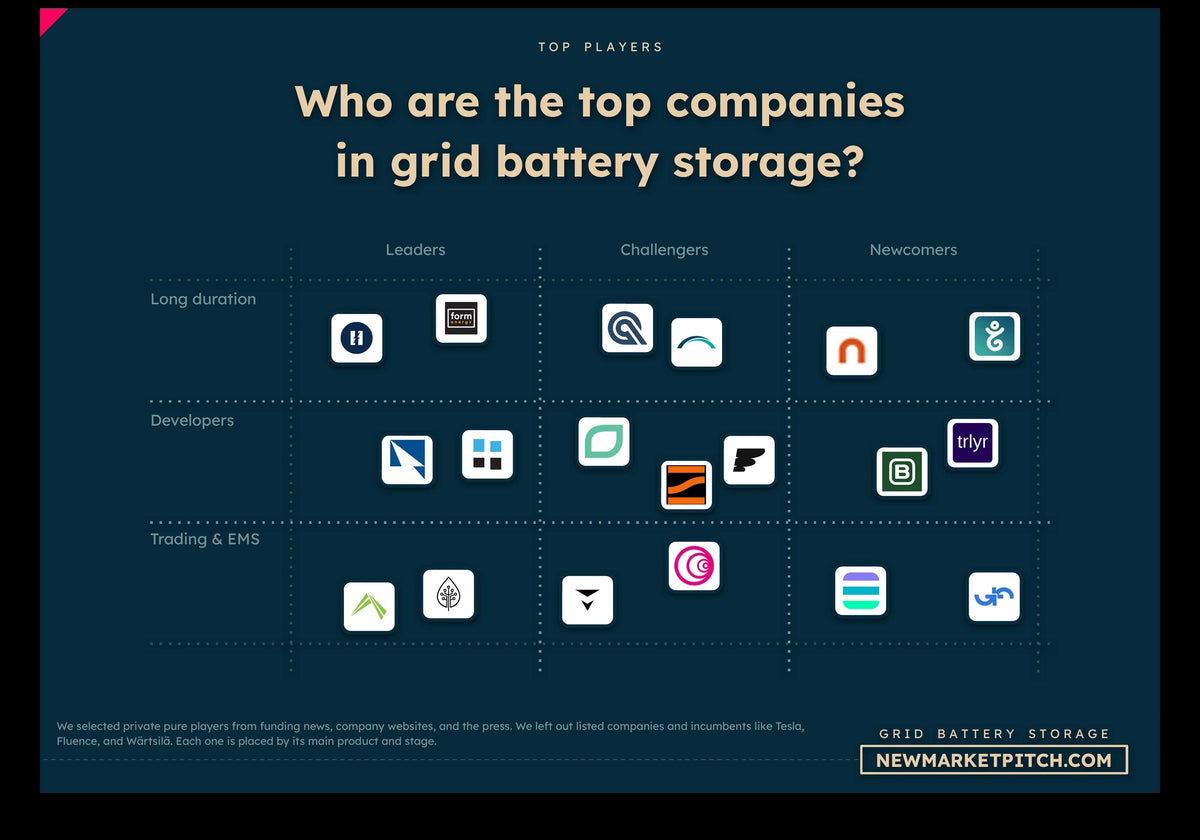
In our report covering the grid-scale battery storage market, we turn what is vague and complex into simple, useful visuals. Market maps like this one show you at a glance where every startup stands.
The ranking of top startups in the grid-scale battery storage market by revenue
Below is a table ranking the startups of this market by their current revenue scale. You can find our methodology at the end of this page.
If you want a deeper understanding of the market and its current dynamics, get our report on the grid-scale battery storage market.
| Ranking | Company | Latest Metric | Metric Type | Freshness | Disclosed When | Source Quality | Confidence | Segment | Why This Ranking | Local Metric | Country |
|---|---|---|---|---|---|---|---|---|---|---|---|
| 1 | CALB Group | ~$1.96B | Segment Revenue | Fresh · 10mo | Mar 31, 2026 | Credible Reported | Medium | Battery Cells & Systems | Substantial recent storage-related revenue exceeds REPT, although the reported category includes other products and is less pure than REPT battery sales. | CNY 14.1B | cn |
| 2 | HyperStrong | ~$1.62B | Annual Revenue | Fresh · 10mo | Apr 28, 2026 | Filed / Audited | High | Battery Systems | Audited FY2025 $1.62B sales outrank Hithium older $1.79B annual turnover because the latter operating period is almost two years old and less comparable. | CNY 11.6B | cn |
| 3 | Hithium | ~$1.79B | Annual Revenue | Aging · 22mo | Dec 22, 2025 | Credible Reported | Medium | Battery Cells & Systems | The larger 2024 revenue trails HyperStrong because its audited FY2025 sales better indicate current commercial scale; subsequent shipment growth has not been converted to revenue. | CNY 12.9B | cn |
| 4 | RelyEZ Energy Storage | ~$260M | Annual Revenue | Fresh · 10mo | Aug 11, 2026 | Credible Reported | Medium | Battery Systems | Recent predominantly grid-scale system revenue exceeds Energy Vault, although the cited amount represents the whole company rather than only utility projects. | CNY 1.87B | cn |
| 5 | Energy Vault | $196M | Product Revenue | Fresh · 10mo | Mar 17, 2026 | Filed / Audited | Medium | Battery Systems | Audited storage product revenue edges Zenobē, but product reporting can cover more than grid batteries because the company has developed non-battery technology. | us | |
| 6 | Zenobē Energy | ~$195M | Annual Revenue | Fresh · 10mo | May 2026 | Company Disclosed | Medium | Storage Development & Operation | Reported turnover is nearly equal to Energy Vault product sales, but it includes electric bus fleet services and is not pure battery-project revenue. | £148M | gb |
| 7 | Flower | ~$41.5M | Annual Revenue | Fresh · 10mo | Oct 14, 2026 | Credible Reported | Medium | Storage Optimization | Company-wide sales are above Zenergy storage-only sales but combine broader energy trading and balancing services; storage-specific turnover is not isolated. | SEK 396M | se |
| 8 | GridBeyond | ~$49.2M | Annual Revenue | Fresh · 10mo | Third-Party Estimate | Low | Storage Optimization | Unverified modelled turnover is placed below direct company disclosures despite being numerically above Flower; it may include demand-response activity outside batteries. | ie | ||
| 9 | Jiangsu Zenergy Battery Technologies | ~$15.2M | Product Revenue | Fresh · 10mo | Mar 30, 2026 | Filed / Audited | High | Battery Cells & Systems | Narrow ESS revenue is used rather than EV-dominated total turnover. Its battery-grid business is much smaller than larger integrators despite a recent listing. | CNY 109M | cn |
| 10 | Envision Group | >100 GWh cumulative BESS cell shipments | Other Scale Signal | Undated | Company Disclosed | Low | Battery Systems | Very large cumulative battery shipments support industrial scale, but the period is undated and Envision also sells wind and other energy products; total group turnover is not treated as storage revenue. | cn | ||
| 11 | Cornex New Energy | >20 GWh shipped | Units Sold | Aging · 22mo | Mar 2025 | Company Disclosed | Low | Battery Cells & Systems | Substantial completed shipment volume supports mature commercial activity, but no revenue value or selling-price evidence is disclosed and the figure is older. | cn | |
| 12 | Rongke Power | >3.5 GWh deployed | Other Scale Signal | Fresh · 9mo | Jan 9, 2026 | Credible Reported | Low | Flow Batteries | Installed battery capacity is evidence of commercial delivery, but cumulative energy capacity cannot be compared with yearly revenue or new contracted sales. | cn | |
| 13 | FlexGen | >25 GWh contracted and completed | Other Scale Signal | Fresh · 8mo | Feb 2026 | Company Disclosed | Low | Battery Systems | Integrates substantial deployed work and signed contracts, ranking ahead of smaller counterparties in this non-revenue tier; much of the GWh is still future delivery. | us | |
| 14 | Jupiter Power | 19.7 GWh operating, building or committed | Other Scale Signal | Undated | Company Disclosed | Low | Storage Development & Operation | Large combined operating and committed battery fleet indicates scale, but the undated figure contains undeployed commitments, not annual turnover. | us | ||
| 15 | Eku Energy | 25.1 GWh active delivery | Other Scale Signal | Very Fresh · 2mo | Aug 31, 2026 | Credible Reported | Low | Storage Development & Operation | Project delivery pipeline exceeds many peers in MWh, but active delivery is not equal to commissioned batteries, signed revenue or annual receipts. | gb | |
| 16 | Form Energy | ~80 GWh under agreement | Other Scale Signal | Very Fresh · 2mo | Aug 2026 | Company Disclosed | Low | Long-Duration Batteries | Enormous contracted future energy volume demonstrates demand but manufacturing and recognition lag contracts; GWh cannot outrank verified financial disclosure. | us | |
| 17 | Entrix | 8.5 GWh contracted | Other Scale Signal | Fresh · 7mo | Mar 25, 2026 | Company Disclosed | Low | Storage Optimization | Contracted optimization portfolio indicates commercialization, but this is customer battery capacity rather than software revenue and is not comparable to installations owned. | de | |
| 18 | Aypa Power | ~6.5 GW portfolio | Other Scale Signal | Very Fresh · 3mo | Jul 22, 2026 | Company Disclosed | Low | Storage Development & Operation | A large battery project portfolio includes uncommissioned assets and is quoted in GW rather than GWh; it is owned by financial sponsors rather than an operating group. | us | |
| 19 | Peak Energy | >6 GWh customer commitments | Other Scale Signal | Very Fresh · 3mo | Jul 8, 2026 | Company Disclosed | Low | Long-Duration Batteries | Customer commitments are meaningful future demand for sodium-ion systems, but not deliveries or recognized sales. | us | |
| 20 | CMBlu Energy | >5 GWh framework volume | Other Scale Signal | Fresh · 8mo | Feb 3, 2026 | Company Disclosed | Low | Flow Batteries | Large multi-year framework supports commercial traction but is conditional and is not an executable revenue order or delivered system capacity. | de | |
| 21 | Alsym Energy | 8.5 GWh project agreement | Other Scale Signal | Very Fresh · 1mo | Sep 9, 2026 | Credible Reported | Low | Long-Duration Batteries | Large newly reported agreement establishes interest, not shipment, income or payment; exact contractual status is less clear than utility project announcements. | us | |
| 22 | HiNa Battery | 10 GWh supply agreement | Other Scale Signal | Very Fresh · 1mo | Sep 9, 2026 | Credible Reported | Low | Battery Cells & Systems | Planned future supply volume is large but not a measure of actual current output or revenue; it sits below companies with realized battery shipments. | cn | |
| 23 | esVolta | 2 GWh operating or building | Other Scale Signal | Undated | Company Disclosed | Low | Storage Development & Operation | Directly operating or building battery capacity is stronger commercial evidence than early development pipelines, although the portfolio figure is undated. | us | ||
| 24 | Ingrid Capacity | >950 MWh managed | Other Scale Signal | Very Fresh · 1mo | Sep 24, 2026 | Credible Reported | Low | Storage Development & Operation | Recent battery fleet figure is attributable to assets under management, but not entirely producing fees or operating; construction projects remain included. | se | |
| 25 | Harmony Energy | >700 MW delivered | Other Scale Signal | Very Fresh · 3mo | Jul 9, 2026 | Company Disclosed | Low | Storage Development & Operation | Cumulative grid projects delivered represent genuine development activity but many were sold or jointly owned; acquisition by Alpiq in 2026 is recent. | gb | |
| 26 | Akaysha Energy | 1.68 GWh operating | Other Scale Signal | Very Fresh · 0mo | Oct 9, 2026 | Company Disclosed | Low | Storage Development & Operation | Operational flagship provides realized grid capacity, but the cited site is only one project rather than the full company portfolio or revenue. | au | |
| 27 | GridStor | 1.3 GWh operating and building | Other Scale Signal | Very Fresh · 5mo | May 20, 2026 | Company Disclosed | Low | Storage Development & Operation | Owned battery projects show concrete implementation, yet capacity under construction is not identical to commercial energy dispatched or invoiced. | us | |
| 28 | Field | 1 GWh construction financed | Other Scale Signal | Very Fresh · 3mo | Jul 7, 2026 | Company Disclosed | Low | Storage Development & Operation | Financed construction is more meaningful than aspirational pipeline, but the figure measures a new project tranche rather than total company turnover. | gb | |
| 29 | Strata Clean Energy | 1.02 GWh battery project delivered | Other Scale Signal | Fresh · 7mo | Mar 4, 2026 | Company Disclosed | Low | Storage Development & Operation | A verified completed utility-scale project demonstrates delivery capability but is just one project; the group also builds solar assets. | us | |
| 30 | Capalo AI | >1 GW contracted BESS | Other Scale Signal | Very Fresh · 1mo | Sep 23, 2026 | Company Disclosed | Low | Storage Optimization | Substantial signed battery-trading contracts, with nearly 400 MW live in two countries, but this is customer capacity rather than subscription revenue. | fi | |
| 31 | Spearmint Energy | 700 MWh operating | Other Scale Signal | Undated | Company Disclosed | Low | Storage Development & Operation | Operational project capacity is concrete but incomplete as a company-scale measure because additional development and construction projects are excluded. | us | ||
| 32 | TagEnergy | 480 MWh operating | Other Scale Signal | Very Fresh · 0mo | Oct 7, 2026 | Credible Reported | Low | Storage Development & Operation | Completed French grid battery is a real asset, although the group also owns renewable generation projects and the amount is not company-wide. | pt | |
| 33 | Plus Power | 350 MWh operating | Other Scale Signal | Fresh · 8mo | Feb 11, 2026 | Company Disclosed | Low | Storage Development & Operation | Operating single-project capacity demonstrates executed assets but materially understates the developer portfolio; no full-company sales figure is given. | us | |
| 34 | terralayr | 238 MWh financed | Other Scale Signal | Fresh · 9mo | Jan 27, 2026 | Credible Reported | Low | Storage Development & Operation | A financed project fleet provides a measurable commercial threshold, but the debt amount is not revenue and the batteries are not all operating. | de | |
| 35 | NineDot Energy | 34 MW operating | Other Scale Signal | Very Fresh · 0mo | Oct 8, 2026 | Third-Party Estimate | Low | Storage Development & Operation | Verified operating-power figures from third-party coverage are a capacity signal only and may miss additional small distributed installations. | us | |
| 36 | Peregrine Energy Solutions | 9.6 GW project pipeline | Other Scale Signal | Undated | Company Disclosed | Low | Storage Development & Operation | A very large early-stage project pipeline is less monetized than operating capacity; the figure does not distinguish completed projects or contracted receipts. | us | ||
| 37 | Delta Capacity | ~800 MWh under construction | Other Scale Signal | Undated | Company Disclosed | Low | Storage Development & Operation | Construction capacity is evidence of project implementation, but the statement is undated and there is no company turnover disclosed. | ch | ||
| NR | Our Next Energy | Not disclosed | Other Scale Signal | Undated | Company Disclosed | Low | Battery Cells & Systems | A defined utility-scale battery product line establishes relevance, but publicly comparable grid-system revenue, sales volume and commissioned projects are not disclosed. | us |

Our research about grid batteries gets updated several times a month, so you always get the latest view of where things stand.
Which grid battery startups make the most revenue today?
CALB Group ranks first among grid battery startups, with CNY 14.1B in FY2025 storage and other product sales, followed by HyperStrong with CNY 11.6B in FY2025 revenue and Hithium with CNY 12.9B in 2024 revenue. These three companies form a clear billion-dollar group, although their figures cover slightly different business activities and reporting periods.
RelyEZ Energy Storage occupies fourth place with CNY 1.87B in FY2025 revenue. Energy Vault and Zenobē Energy follow with $196M and £148M respectively. The remaining companies with monetary figures are considerably smaller, with Flower, GridBeyond and Jiangsu Zenergy Battery Technologies completing the nine revenue-based positions.
Beyond those nine companies, the market contains a much larger group of commercially active startups. Their scale is demonstrated through battery shipments, installed capacity, contracted projects and development portfolios. We retain these companies in their existing positions, while keeping their operational figures separate from recognized revenue.
| Rank | Company | Revenue or commercial-scale figure | Period |
|---|---|---|---|
| 1 | CALB Group | CNY 14.1B | FY2025 |
| 2 | HyperStrong | CNY 11.6B | FY2025 |
| 3 | Hithium | CNY 12.9B | 2024 |
| 4 | RelyEZ Energy Storage | CNY 1.87B | FY2025 |
| 5 | Energy Vault | $196M | FY2025 |
| 6 | Zenobē Energy | £148M | FY2025 |
| 7 | Flower | SEK 396M | FY2025 |
| 8 | GridBeyond | ~$49.2M | 2025 |
| 9 | Jiangsu Zenergy Battery Technologies | CNY 109M | FY2025 |
| 10 | Envision Group | >100 GWh cumulative BESS cell shipments | Undated |
| 11 | Cornex New Energy | >20 GWh shipped | 2024 |
| 12 | Rongke Power | >3.5 GWh deployed | As of Jan 2026 |
| 13 | FlexGen | >25 GWh completed and contracted | As of Feb 2026 |
| 14 | Jupiter Power | 19.7 GWh operating, building or committed | Undated |
| 15 | Eku Energy | 25.1 GWh active delivery | As of Aug 2026 |
| 16 | Form Energy | ~80 GWh under agreement | As of Aug 2026 |
| 17 | Entrix | 8.5 GWh contracted | As of Mar 2026 |
| 18 | Aypa Power | ~6.5 GW portfolio | As of Jul 2026 |
| 19 | Peak Energy | >6 GWh customer commitments | As of Jul 2026 |
| 20 | CMBlu Energy | >5 GWh framework volume | As of Feb 2026 |
| 21 | Alsym Energy | 8.5 GWh project agreement | As of Sep 2026 |
| 22 | HiNa Battery | 10 GWh supply agreement | As of Sep 2026 |
| 23 | esVolta | 2 GWh operating or building | Undated |
| 24 | Ingrid Capacity | >950 MWh managed | As of Sep 2026 |
| 25 | Harmony Energy | >700 MW delivered | As of Jul 2026 |
| 26 | Akaysha Energy | 1.68 GWh operating | As of Oct 2026 |
| 27 | GridStor | 1.3 GWh operating and building | As of May 2026 |
| 28 | Field | 1 GWh construction financed | As of Jul 2026 |
| 29 | Strata Clean Energy | 1.02 GWh battery project delivered | As of Mar 2026 |
| 30 | Capalo AI | >1 GW contracted BESS | As of Sep 2026 |
| 31 | Spearmint Energy | 700 MWh operating | Undated |
| 32 | TagEnergy | 480 MWh operating | As of Oct 2026 |
| 33 | Plus Power | 350 MWh operating | As of Feb 2026 |
| 34 | terralayr | 238 MWh financed | As of Jan 2026 |
| 35 | NineDot Energy | 34 MW operating | As of Oct 2026 |
| 36 | Peregrine Energy Solutions | 9.6 GW project pipeline | Undated |
| 37 | Delta Capacity | ~800 MWh under construction | Undated |
| Unranked | Our Next Energy | Grid battery revenue not disclosed | - |
Why is the grid battery market growing so fast?
Grid battery storage is growing exceptionally quickly because electricity networks need more flexibility, and batteries have become increasingly affordable to install.
According to the International Energy Agency's Global Energy Review 2026, worldwide battery storage additions reached 108 GW in 2025, approximately 40% more than in 2024. Annual additions were eleven times higher than in 2021. Around 80% of new installations in 2025 were utility-scale systems.
China accounted for approximately 60% of global additions, followed by the United States and Europe. Australia and parts of the Middle East are also becoming important markets.
The demand comes from several directions. Solar and wind generation create periods when electricity production exceeds immediate consumption, while evening demand and changing weather conditions can create shortages. Batteries allow electricity to be stored during cheaper periods and released when the grid needs it.
Data centres and industrial electrification are adding another source of demand. Electricity networks need more dispatchable flexibility as consumption increases and new generation connects to the grid.
This growth creates opportunities across the entire supply chain. CALB Group, HyperStrong and Hithium sell batteries and storage systems. RelyEZ provides integrated storage solutions. Companies such as Jupiter Power and Eku Energy develop and operate battery assets, while Flower, GridBeyond and Entrix manage the electricity-market activities that make those assets more valuable.
The industry is growing quickly, but different businesses capture different parts of the money being spent.

In our market report about grid batteries, we look at what the winners do differently, so you can learn from the best instead of guessing.
How much revenue does CALB Group make from energy storage?
CALB Group generates CNY 14.1B in FY2025 revenue from energy-storage products and other related products, making it the first-ranked company in our grid battery startup ranking.
Its FY2025 annual results show that total company revenue reached CNY 44.4B, up 60% year over year. Energy-storage products and other related activities contributed CNY 14.1B, representing 31.8% of consolidated revenue and an increase of 71.9%.
The selected figure is approximately $1.96B using the ranking's historical currency conversion.
There is an important qualification: CALB's reported category includes other related products alongside energy-storage products. We therefore use the exact reported category rather than describing the entire CNY 14.1B as pure utility-scale battery revenue.
Even with that qualification, the growth is substantial. The company's energy-storage category expanded faster than its overall revenue, increasing from CNY 8.2B in 2024 to CNY 14.1B in 2025.
CALB also has a large electric-vehicle battery business, which explains why consolidated revenue alone would give a misleading picture of its grid-storage activity.
Is HyperStrong ahead of Hithium in grid battery revenue?
HyperStrong ranks ahead of Hithium because its CNY 11.6B FY2025 revenue provides a more recent picture of commercial scale than Hithium's CNY 12.9B revenue for 2024.
The difference is worth examining. Hithium's historical figure is approximately 11% higher in yuan terms, but it comes from an earlier reporting period. HyperStrong's FY2025 financial statements report revenue of CNY 11.61B, an increase of 40.4% from CNY 8.27B in 2024.
Hithium's 2024 figure is supported by its official financial and sustainability disclosures. The company reported operating revenue of approximately CNY 12.92B for that year.
Both businesses focus heavily on stationary energy storage. HyperStrong develops integrated battery systems, while Hithium is particularly well known for its energy-storage battery cells.
HyperStrong's more recent results make it the stronger current revenue observation in our ranking. But we cannot say HyperStrong definitively outsells Hithium today. A comparable FY2025 figure for Hithium would be needed to establish that.

In our document detailing everything you need to know about grid-scale battery storage, you will always find fresh funding data, taken straight from our own verified funding database.
How big is RelyEZ Energy Storage compared with the largest battery startups?
RelyEZ Energy Storage generates CNY 1.87B in FY2025 revenue, placing it fourth among grid battery startups, substantially behind the three companies at the top.
Its FY2025 revenue reached CNY 1,867.6M, representing 63.2% growth over 2024, according to the company's Hong Kong IPO prospectus. Net profit reached CNY 153.6M.
The company's business is particularly relevant to grid storage. RelyEZ develops and sells large-scale and commercial and industrial energy-storage solutions, alongside hardware, software, operation and maintenance services and electricity-trading services.
The revenue composition is also revealing. Large-scale storage solutions represented approximately 89.4% of its FY2025 revenue, according to the prospectus.
That gives RelyEZ a relatively direct connection to the utility-scale storage market compared with manufacturers whose reporting combines EV batteries and other products.
The gap with the top three remains considerable. CALB Group's selected revenue category is roughly 7.5 times larger, while HyperStrong's company revenue is approximately 6.2 times RelyEZ's.
RelyEZ has already reached meaningful industrial scale, but it remains in a different financial tier from the three companies above it.
How much revenue do Energy Vault and Zenobē Energy make?
Energy Vault reports $196M in FY2025 energy-storage product revenue, while Zenobē Energy reports £148M in FY2025 company turnover, placing the two companies fifth and sixth respectively.
Energy Vault's 2025 Form 10-K provides a particularly useful breakdown. Total company revenue reached $203.7M, including $196.2M from energy-storage product sales. The remaining revenue came from tolling and power-purchase agreements, operations and maintenance, software licensing and intellectual-property licensing.
The increase was dramatic: total revenue rose from $46.2M in 2024 to $203.7M in 2025. Gross profit reached $48M, compared with $5.9M in the preceding year.
Zenobē operates across battery storage and electric-vehicle fleet electrification. Its 2025 impact report provides the context for its broader business, including battery infrastructure, heavy electric vehicles and portable power.
The two selected revenue figures are almost identical in approximate dollar terms. However, Energy Vault's figure is specifically storage product revenue, while Zenobē's turnover includes several business activities.
Energy Vault's reported product sales therefore provide a more direct measure of battery-related equipment revenue. Zenobē's figure demonstrates the scale of a broader infrastructure and operating business.

Learning from others' mistakes is the cheapest lesson there is. In our report covering the grid-scale battery storage market, we look at what broke startups before you, so you don't repeat it.
How much money do Flower, GridBeyond and Jiangsu Zenergy make?
Flower reports SEK 396M in FY2025 revenue, GridBeyond has an estimated ~$49.2M in 2025 revenue, and Jiangsu Zenergy reports CNY 109M in FY2025 energy-storage-system product sales.
These three companies illustrate how different grid battery businesses can generate money without sharing the same business model.
Flower's FY2025 turnover reached SEK 395.5M, according to an interview with its CFO published by Energy Loop. Revenue increased from SEK 160.3M in 2024, approximately 147% growth. Its activities include energy trading and balancing services, so the figure cannot be treated as storage-only revenue.
GridBeyond's approximately $49.2M figure comes from an external revenue estimate by Latka. It is less reliable than Flower's CFO-confirmed turnover and may include demand-response services beyond battery optimization.
Jiangsu Zenergy offers a different picture. Its FY2025 financial statements report CNY 109.31M in energy-storage-system revenue against CNY 8.10B in total company revenue. That makes storage approximately 1.3% of its consolidated turnover.
The comparison shows why the business category matters as much as the headline number. Flower earns money through broader energy-market activities, GridBeyond provides flexibility services, and Jiangsu Zenergy sells battery products within a much larger EV-oriented business.
Are Chinese grid battery startups dominating grid battery revenue?
Chinese startups occupy five of the nine monetary-revenue positions in our ranking, including all four highest positions.
CALB Group, HyperStrong, Hithium and RelyEZ Energy Storage rank first through fourth. Jiangsu Zenergy Battery Technologies appears ninth, with its narrower energy-storage-system revenue figure.
The concentration reflects China's manufacturing base and the size of its domestic storage market. The IEA estimates that China accounted for around 60% of global battery-storage capacity additions in 2025.
The Chinese companies also cover different parts of the supply chain. CALB and Hithium are closely associated with battery manufacturing, while HyperStrong and RelyEZ have substantial system-integration activities.
Outside China, Energy Vault, Zenobē, Flower and GridBeyond show that the market has meaningful commercial businesses in the United States and Europe.
Established manufacturers such as CATL, Sungrow and EVE Energy have much larger storage businesses, but they are outside our startup ranking.
China has a clear advantage in the financial scale of the eligible startups. Europe and North America remain important markets for developers, operators and software businesses, even though their revenue disclosures are generally smaller.

Your time is limited. In our research about grid batteries, we put numbers on each part of the market, so you can see where it makes sense to focus.
Are battery manufacturers making more money than storage developers?
Among the nine grid battery startups with monetary figures, manufacturers and integrated system suppliers occupy most of the highest revenue positions, while developers and optimization businesses appear further down the ranking.
CALB Group, HyperStrong, Hithium, RelyEZ Energy Storage, Energy Vault and Jiangsu Zenergy Battery Technologies all earn revenue through battery products, systems or storage-related technology. Zenobē Energy combines storage infrastructure with fleet electrification, while Flower and GridBeyond monetize electricity-market flexibility.
The difference comes partly from how these businesses recognize revenue. Manufacturers can book substantial sales when equipment is delivered. Developers often spend years securing sites, grid connections and financing before projects begin generating operating income.
There is also a difference between revenue and capital employed. A developer may own a battery portfolio worth hundreds of millions of dollars while reporting comparatively modest annual turnover. A manufacturer can report substantial equipment sales without owning the assets after delivery.
The available figures therefore support a clear conclusion about disclosed revenue scale, but they do not establish that manufacturers earn better returns on invested capital.
Owning batteries can create recurring income through electricity trading and grid services. Selling systems provides larger upfront transactions. To determine which model is more profitable, we would need comparable margins, debt, maintenance costs and cash-flow disclosures across the companies.
Are LFP batteries still winning the grid storage market?
Lithium iron phosphate batteries remain the dominant chemistry for grid storage, accounting for around 90% of global battery-storage deployments in 2025, according to the IEA.
That is a major change from five years earlier, when LFP represented considerably less than half of deployments.
The reason is straightforward: stationary batteries prioritize cost, safety, lifetime and repeated cycling more than the energy density required by passenger vehicles.
LFP technology has benefited from enormous manufacturing investment and a mature supply chain. Companies such as CALB Group, HyperStrong and Hithium can draw on this industrial base to produce and integrate systems at scale.
Battery prices have also fallen substantially, making conventional lithium-ion systems increasingly difficult to beat on upfront project costs.
Alternative chemistries still have opportunities. Sodium-ion batteries may reduce exposure to lithium prices, while iron-air and flow batteries target longer discharge durations and different operating requirements.
However, a promising chemistry must demonstrate commercial manufacturing, reliable operation and competitive lifetime costs. LFP currently has a considerable advantage on all three fronts.

In our market report about grid batteries, we always try to gather several sources and make estimates that make sense, so you can work with solid numbers.
Can long-duration battery startups challenge lithium-ion companies?
Long-duration battery startups are attracting serious customer interest, particularly in projects where conventional lithium-ion systems may be less economical over longer discharge periods.
Form Energy, Peak Energy, CMBlu Energy, Alsym Energy and HiNa Battery all have substantial commercial commitments or agreements recorded in our ranking.
Form Energy reports approximately 80 GWh under agreement for its iron-air technology. Peak Energy has more than 6 GWh in sodium-ion customer commitments, while CMBlu Energy has a framework agreement with Uniper covering more than 5 GWh of SolidFlow systems.
Alsym Energy reports an 8.5 GWh project agreement, and HiNa Battery reports a 10 GWh supply agreement.
These companies are pursuing different technical approaches. Form Energy targets very long-duration storage, Peak Energy is developing sodium-ion systems, CMBlu uses organic flow technology combined with solid-state materials, and HiNa is focused on sodium-ion batteries.
The commercial challenge is substantial. LFP systems are already available at industrial scale, and manufacturers continue to improve their cost and performance.
Long-duration technologies can win projects where duration, safety, material availability or lifetime economics justify the additional cost. Their ability to secure contracts is encouraging, but manufacturing output and completed installations will determine how quickly those agreements turn into revenue.
Is Form Energy's 80 GWh agreement already a major commercial business?
Form Energy has secured approximately 80 GWh of projects under agreement, making it one of the most commercially ambitious long-duration battery startups, although the figure represents future project activity rather than recognized revenue.
The company develops iron-air batteries designed to store electricity for up to 100 hours. That is considerably longer than the two-to-four-hour systems commonly deployed in today's grid-storage market.
Its commercial pipeline includes a 300 MW / 30 GWh project with Xcel Energy in Minnesota, intended to support electricity supply for a Google data centre. Form Energy has also announced a 10 MW / 1,000 MWh project in Ireland with FutureEnergy Ireland.
The company has raised substantial capital to support its manufacturing expansion, including a $750M Series G financing round.
These developments show that Form Energy has moved beyond laboratory work and attracted major industrial customers.
Still, the 80 GWh figure combines projects at different stages. Agreements must pass technical, financing, construction and delivery milestones before the associated equipment sales can be recognized.
Form Energy is a major commercial contender in long-duration storage. Its actual revenue scale will become clearer as its large projects move from agreements to completed deliveries.

If you build or invest in the grid-scale battery storage market, you need to know which business models pay off now and which ones are fading. That's why our report covering it has a whole section on it.
Which grid battery startups have the largest project portfolios?
Several grid battery startups now report portfolios exceeding 10 GWh, but the figures combine operating projects, construction, contracted deliveries and future development.
Jupiter Power reports 19.7 GWh operating, under construction or committed, with another 110 GWh in its development pipeline. Eku Energy reports 25.1 GWh in active delivery, while FlexGen reports more than 25 GWh completed or under contract.
Envision Group reports more than 100 GWh in cumulative BESS cell shipments, and Cornex New Energy reported more than 20 GWh shipped in 2024. These are physical manufacturing figures, rather than portfolios of owned projects.
Form Energy's approximately 80 GWh under agreement is another substantial number, although much of its activity remains tied to future project execution.
| Company | Reported scale | What the figure measures |
|---|---|---|
| Envision Group | >100 GWh | Cumulative BESS cell shipments |
| Cornex New Energy | >20 GWh | Battery shipments in 2024 |
| FlexGen | >25 GWh | Completed and contracted projects |
| Jupiter Power | 19.7 GWh | Operating, building or committed assets |
| Eku Energy | 25.1 GWh | Active delivery portfolio |
| Form Energy | ~80 GWh | Projects under agreement |
| Entrix | 8.5 GWh | Contracted battery optimization capacity |
| Aypa Power | ~6.5 GW | Operating, construction and contracted portfolio |
| Peak Energy | >6 GWh | Customer commitments |
| CMBlu Energy | >5 GWh | Conditional framework agreement |
| Alsym Energy | 8.5 GWh | Project agreement |
| HiNa Battery | 10 GWh | Supply agreement |
| Rongke Power | >3.5 GWh | Cumulative deployed flow-battery systems |
| esVolta | 2 GWh | Operating or building projects |
| Ingrid Capacity | >950 MWh | Operating and managed portfolio |
The figures cannot be sorted into a meaningful revenue hierarchy. For example, 100 GWh of cumulative shipments represents a different commercial achievement from 80 GWh under agreement or 19.7 GWh of operating and committed projects.
A growing number of startups have moved beyond isolated demonstration projects. Several now have industrial-scale customer portfolios, manufacturing deliveries or operational fleets.
Can battery optimization startups make money without manufacturing batteries?
Battery optimization startups can build substantial businesses without manufacturing cells or owning storage assets, because they earn money by improving how batteries participate in electricity markets.
Flower and GridBeyond are the clearest monetary examples in our ranking. Flower reported SEK 396M in FY2025 revenue, while GridBeyond has an estimated ~$49.2M in 2025 revenue.
Other companies demonstrate the physical scale behind this business model. Entrix reports 8.5 GWh of contracted battery optimization capacity, while Capalo AI has exceeded 1 GW of contracted BESS capacity across the Baltic states.
Capalo AI's September 2026 announcement also reported close to 400 MW of batteries and close to 400 MWp of solar under live optimization in Lithuania and Latvia.
These companies manage charging, discharging, forecasting and electricity-market participation. Their software helps asset owners capture value from differences in wholesale electricity prices and ancillary-service markets.
The attraction is clear: an optimization provider can expand its managed portfolio without financing every battery installation itself.
There are limits, however. Battery owners can switch providers, market opportunities change as more storage enters the grid, and software providers must consistently demonstrate better performance than competing traders.
The strongest businesses will combine reliable forecasting, access to multiple electricity markets and a growing base of long-term customers.

In our report covering the grid-scale battery storage market, we don't want to repeat what boring consulting reports say. Instead, we show you the real and latest market signals that matter.
Are grid battery revenues falling as more batteries are installed?
Battery deployment is increasing, but revenue per installed megawatt has fallen sharply in some electricity markets as more batteries compete for the same trading opportunities.
Australia provides a particularly clear example. Energy Synapse reported that median battery revenues across its National Electricity Market sample fell by more than 60% in the twelve months to August 2026 compared with the preceding twelve months.
In Queensland, median revenue declined from $195,000 to $63,400 per MW. South Australia fell from $172,000 to $57,700, while New South Wales declined from $135,000 to $52,100.
The decline followed a rapid expansion of the Australian battery fleet. More than 10 GW of utility-scale batteries were registered to participate in the market by the end of August 2026, over six times the capacity recorded in 2023.
Ancillary services have also become more competitive as additional batteries offer similar flexibility.
This creates a difficult environment for companies that own and operate storage assets. New installations can increase total market capacity while reducing the average revenue available to each battery.
The figures concern asset-level electricity-market revenues rather than the annual turnover of the startups in our ranking. Still, they show why deployment growth alone cannot guarantee improved project economics.
Does owning grid batteries make more money than selling them?
Owning grid batteries offers recurring revenue opportunities, while selling battery systems can generate much larger upfront sales, but the available startup financial disclosures do not prove that either business model produces better returns.
CALB Group, HyperStrong and Hithium earn substantial revenue from manufacturing and selling battery-related products. Energy Vault also generates a large share of its selected revenue through storage product sales.
On the ownership and development side, Jupiter Power, Aypa Power, Eku Energy, esVolta and GridStor build or operate storage portfolios. Zenobē combines asset ownership with other infrastructure services.
The difference becomes clear over a project's lifetime. A manufacturer can recognize revenue when equipment is delivered, while an asset owner may earn money through electricity arbitrage, capacity payments and grid services over many years.
The owner also has to finance the battery, maintain it, manage degradation and absorb electricity-market risks. A manufacturer faces different challenges, including factory utilization, warranty obligations, customer concentration and falling equipment prices.
The Australian revenue declines discussed above make the ownership model particularly interesting. A large operating portfolio can still generate disappointing returns if market competition compresses the income available per megawatt.
We cannot identify a universal winner from the available data. The strongest evidence would require comparable EBITDA, operating cash flow, debt and return-on-capital figures across both business models.

In our research about grid batteries, we like to show you the big picture. We know your time is precious, so we make every page quick to read and packed with as much learning as possible per minute.
Are acquisitions changing the grid battery startup market?
Acquisitions are bringing grid battery developers into larger infrastructure groups, while leaving their existing projects and commercial achievements relevant to the startup ranking.
Harmony Energy is a clear example. In July 2026, Alpiq announced the acquisition of a 90% stake in the company. Harmony had delivered 18 grid-scale battery projects with a combined capacity exceeding 700 MW.
The company continues operating under its own brand, with its existing team and management structure. Its twenty-fifth position in the ranking is therefore retained.
Aypa Power is another important transaction. In July 2026, Brookfield agreed to acquire Aypa from Blackstone. The announced portfolio included approximately 6.5 GW of operating, under-construction and contracted capacity, alongside a development pipeline exceeding 20 GW.
These deals show that battery developers can become attractive acquisition targets once they have secured projects, grid connections, operating teams and long-term customer contracts.
For large infrastructure investors, acquiring an existing development platform can be faster than building one from scratch.
The financial value of an acquisition should, of course, never be confused with the acquired company's revenue. The commercial scale of Harmony and Aypa comes from their battery projects and portfolios, not from the announced transaction values.
Can smaller grid battery startups compete with billion-dollar manufacturers?
Smaller grid battery startups can compete by focusing on specialized technologies, local electricity markets and software, although matching the manufacturing scale of CALB Group, HyperStrong or Hithium would be extremely difficult.
The leading manufacturers benefit from industrial supply chains, established customer relationships and large production facilities. A new entrant attempting to sell conventional LFP batteries faces strong price competition and significant capital requirements.
Companies such as Rongke Power and CMBlu Energy take a different route through flow-battery technology. Form Energy focuses on iron-air batteries, while Peak Energy and HiNa Battery are developing sodium-ion systems.
These technologies target particular requirements, including longer discharge periods, different material costs and alternative supply chains.
There are also opportunities outside manufacturing. Entrix and Capalo AI focus on optimizing batteries already owned by other companies, while developers such as NineDot Energy and Field concentrate on building projects in specific electricity markets.
A smaller company has a better chance of becoming a meaningful competitor by solving a problem that large manufacturers do not address particularly well than by attempting to reproduce their entire industrial model.

When you build or invest in the grid-scale battery storage market, you need clarity, not confusion. In our market report about grid batteries, we always try to put numbers on and quantify whatever is usually vague and confusing.
Will grid battery startup revenue keep growing over the next few years?
Grid battery startup revenue should continue growing as installed capacity expands, although falling equipment prices and increasingly competitive electricity markets will determine which companies actually benefit.
The IEA's Global Energy Review 2026 recorded 108 GW of new battery capacity in 2025, up 40% year over year. Its analysis also points to increasing deployment of longer-duration systems and a wider geographical spread of battery projects.
The demand outlook remains strong. Renewable generation continues to expand, electricity consumption is rising in several markets, and utilities need more flexibility to manage periods of high and low production.
However, the companies in our ranking face different economic pressures.
CALB Group, HyperStrong and Hithium can benefit from higher equipment volumes, but falling battery prices may reduce revenue per unit sold. Developers such as Jupiter Power and Eku Energy depend on project financing, grid connections and electricity-market returns. Optimization companies need to keep delivering better trading performance as competition increases.
Long-duration battery startups have another challenge: converting large agreements into reliable deliveries at competitive costs.
We expect the market's physical capacity to grow substantially. The financial winners will depend on manufacturing costs, successful project execution and the ability to earn attractive returns from installed batteries.
Who is actually winning the grid battery startup revenue race?
CALB Group is first in our grid battery startup revenue ranking, followed by HyperStrong and Hithium. The three companies have selected financial figures in the billion-dollar range, although their revenue categories and reporting periods differ.
RelyEZ Energy Storage is the next major business, with CNY 1.87B in FY2025 revenue. Energy Vault and Zenobē Energy follow with $196M and £148M respectively, while Flower, GridBeyond and Jiangsu Zenergy occupy the remaining monetary-revenue positions.
The wider market tells a second story. Envision Group, Cornex New Energy, FlexGen, Jupiter Power, Eku Energy and Form Energy demonstrate substantial physical or contractual commercial scale, even though their published capacity figures cannot be compared directly with annual revenue.
We also see a growing divide between companies selling battery hardware and those developing, owning or optimizing the resulting assets. Manufacturing currently accounts for most of the disclosed monetary scale, while electricity-market services and long-duration technologies are building their own commercial positions.
Chinese manufacturers and system providers dominate the top of the startup revenue ranking, while American and European businesses have developed important positions in project ownership, technology innovation and battery optimization.
CALB Group takes first place, HyperStrong is second and Hithium is third under our evidence-weighted approach. Those positions reflect the available financial disclosures, with the important caveat that Hithium's older revenue figure exceeds HyperStrong's newer one. The next phase of competition will depend on which companies turn rapidly expanding battery deployment into sustained revenue and profitable operations.

A good product starts with a real problem. In our document detailing everything you need to know about grid-scale battery storage, we show you the ones customers still live with.
Our methodology
This analysis ranks grid battery startups using the strongest available evidence of revenue and commercial scale as of November 2026. We cover battery-cell manufacturers, storage-system integrators, project developers and operators, long-duration battery companies, and businesses that optimize battery participation in electricity markets.
We use a consistent eligibility rule: companies must have been founded in 2000 or later, have never been publicly listed or have first listed within the previous five years, and remain independent rather than operating as established corporate divisions. Companies acquired within the previous three years remain eligible, with their ownership changes identified where relevant.
We prioritize annual revenue, fiscal-year revenue and directly attributable storage-segment revenue, followed by credible revenue estimates where official figures are unavailable. For CALB Group and Jiangsu Zenergy, we use the reported storage-related business categories rather than total consolidated sales. For HyperStrong, Hithium, RelyEZ and other companies, we retain the scope and period of their selected disclosures.
Ranking positions reflect the quality, relevance and freshness of the financial evidence, rather than a mechanical comparison of amounts from different years. This is particularly important for HyperStrong and Hithium: Hithium's CNY 12.9B figure covers 2024, while HyperStrong's CNY 11.6B covers 2025. We preserve that distinction instead of presenting them as directly comparable sales for the same year.
For companies without attributable revenue figures, we use measurable commercial milestones such as battery shipments, deployed capacity, operating portfolios, contracted projects and signed supply agreements. These entries are ranked separately from the revenue-backed group. A GWh shipment, a contracted GWh project and an operating GWh asset represent different levels of commercial maturity, and we do not convert them into estimated sales.
We also distinguish manufacturing and equipment revenue from electricity-market turnover, asset ownership and software-based optimization. A large development portfolio does not necessarily produce large current revenue, while a signed agreement does not become recognized revenue until the relevant delivery or accounting requirements have been met. Historical currency conversions are approximate and do not change the original reported amounts.
Our primary financial sources include CALB Group's Hong Kong financial disclosures, HyperStrong's FY2025 financial report, Hithium's 2024 sustainability disclosures, RelyEZ Energy Storage's Hong Kong IPO prospectus, Energy Vault's FY2025 Form 10-K, Zenobē's 2025 impact report, Energy Loop's interview with Flower's CFO, and Jiangsu Zenergy's financial filing. GridBeyond's revenue figure is an external estimate from Latka and is treated with lower confidence than company-confirmed financial results.
For market growth, technology adoption and project economics, we use the International Energy Agency's Global Energy Review 2026, its analysis of battery-storage deployment, and Energy Synapse's analysis of Australian battery revenues. These sources help distinguish rapid capacity growth from the changing economics of operating battery assets.
Important commercial-scale sources include Envision Group's energy-storage disclosures, Cornex New Energy's shipment announcement, FlexGen's project information, Form Energy's company and project disclosures, Jupiter Power's portfolio information, CMBlu Energy's Uniper framework agreement, Capalo AI's contracted-capacity announcement, and the disclosure covering Rongke Power's flow-battery deployment.
We also account for changes in company ownership using Alpiq's announcement concerning Harmony Energy and the Brookfield–Aypa Power transaction announcement. For recent operating milestones, we use disclosures such as Akaysha Energy's Waratah Super Battery update. Acquisition values, project pipelines and financing commitments are kept separate from annual company revenue throughout the ranking.

In our report covering the grid-scale battery storage market, we try to remove everything that could confuse you, especially if you're investing or building in this market.
Written by the New Market Pitch teamWe track new markets so founders and investors can move faster. About us