Medical billing: which AI startup is ahead?
Whether you're building or investing in the AI revenue cycle management market, our report covers everything you need to know: the players, the money, and what's coming next.
Summary
AKASA is still ahead in medical billing AI, and its lead now rests on published volume data as well as hospital trust. The lead is real but not wide.
In October 2026, AKASA said its health-system customers represent more than $180 billion in net patient revenue and that those customers account for roughly one in ten US inpatient discharges. The same month it unveiled autonomous inpatient coding and clinical documentation integrity, the hardest coding work in a hospital.
The market still has no runaway winner. CodaMetrix leads enterprise autonomous coding reach, Candid leads modern billing infrastructure and now has the most capital behind it, Adonis leads denial recovery, and Fathom has the strongest customer-validated coding performance.
Funding no longer separates AKASA from the pack. Candid raised a $120 million Series D in July 2026, taking it past $219 million in total, close to AKASA’s roughly $250 million.
Candid moves up to third place. Its annual recurring revenue grew 190% year over year and its net revenue retention is close to 200%, the best expansion figure any company in this race has published.
Adonis drops to fourth, not because it slowed, but because it has shown no new hospital proof since its March 2026 Series C. Its fourfold revenue growth in 2025 is still the fastest disclosed growth rate in the field.
Large hospitals remain the hardest test. AKASA and CodaMetrix have the best evidence inside complex health systems, and AKASA’s inpatient push now puts the two in more direct competition.
Fathom currently has the best measured mix of coding automation, accuracy, and customer satisfaction, but published percentages are not directly comparable across specialties.
The clearest financial leader changes with the revenue leak. Adonis stands out for denials and underpayments, Fathom and CodaMetrix for coding labor savings, and Collectly or Inbox Health for unpaid patient balances. We look at which of these revenue leaks hospitals and practices would pay most to fix in our AI revenue cycle management market report.
Our ranking is AKASA first, CodaMetrix second, Candid third, Adonis fourth, and Fathom fifth. AKASA stays ahead for now, but a slow rollout of its inpatient product or a large hospital win for Candid or Adonis could change the order quickly.

Written by the New Market Pitch teamWe track new markets so founders and investors can move faster. About us

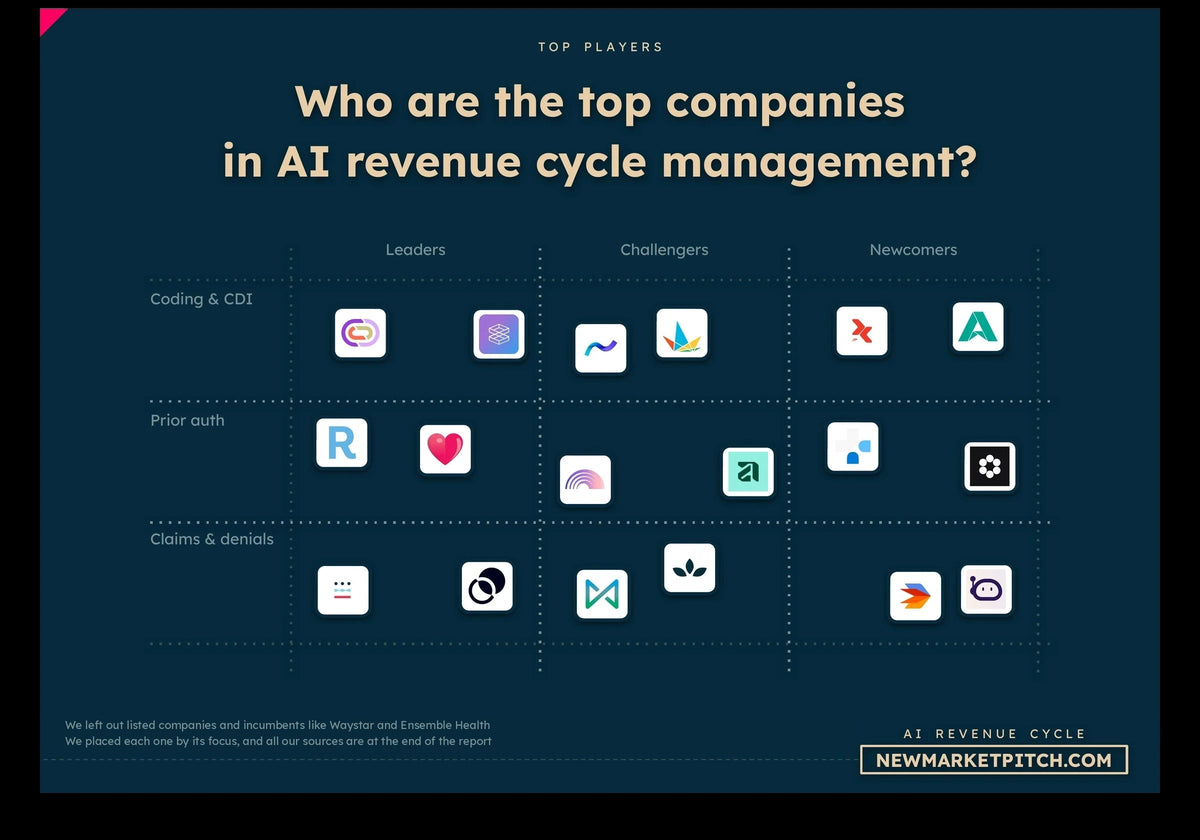
In our report covering the AI revenue cycle management market, we turn what is vague and complex into simple, useful visuals. Market maps like this one show you at a glance where every startup stands.
Which AI medical billing startups are we actually comparing?
The serious AI medical billing field currently contains about ten independent startups with enough funding, customer adoption, or production evidence to deserve comparison.
We include companies whose main product automates provider billing work: medical coding, claim preparation, denial prevention, payer follow-up, underpayment detection, billing infrastructure, or patient collections.
The money flowing into this work is growing fast. Capstone Partners reported in September 2026 that health-system spending on AI for coding and billing rose from about $200 million in 2024 to about $450 million in 2025. That is real budget, but still small next to the cost of manual billing work, so the race is far from settled. How much hospitals can spend on coding and billing AI feeds the market size we estimate from the ground up in our report on AI revenue cycle management.
We exclude established vendors such as Waystar, R1 RCM, Optum, Experian Health, Ensemble, and Infinx. Abridge and Ambience Healthcare also stay outside the ranking because clinical documentation remains their main business, even though both increasingly influence coding.
Smarter Technologies is excluded as well. New Mountain Capital formed the company by combining SmarterDx, Thoughtful.ai, and Access Healthcare. Much of its scale comes from Access Healthcare’s established services operation rather than a standalone AI startup. Smaller newcomers such as Procode AI, which raised a $10 million Series A in July 2026 for surgical coding, are too early to rank.
| Startup | Main position in AI medical billing | Disclosed funding | Recent proof of traction |
|---|---|---|---|
| AKASA | Hospital coding, documentation, prior authorization, and mid-cycle automation | About $250M | Customers with more than $180B in net patient revenue and about 1 in 10 US inpatient discharges (company-stated, October 2026) |
| Candid Health | Full billing infrastructure for provider organizations | More than $219M | $120M Series D in July 2026; ARR up 190% year over year; net revenue retention near 200% |
| CodaMetrix | Autonomous coding for health systems | About $95M | More than 30 health systems representing about $191B in net patient revenue (June 2026) |
| Adonis | Payer intelligence and AI agents across the revenue cycle | About $95M | Revenue grew more than 4x in 2025; $40M Series C in March 2026 |
| Nym | Explainable autonomous medical coding | About $92M | Millions of charts a year across more than 300 facilities (February 2026) |
| Fathom | High-automation autonomous medical coding | At least $61M | Strong KLAS results and investment from CVS Health Ventures in May 2026 |
| Inbox Health | Patient billing, support, and payments | About $55M | Used by more than 3,500 practices |
| Anomaly | Claim prediction and payer-contract intelligence | About $34M | Raised another $17M in May 2026 to expand its platform |
| Collectly | Patient billing and collection automation | About $34M | More than 3,000 facilities and $1B in patient payments processed |
| RapidClaims | Coding, claim validation, denial prevention, and recovery | About $11M | Added to KLAS comparisons and recognized by Black Book |
Is one AI medical billing startup clearly ahead today?
AKASA is still ahead overall in AI medical billing, but it leads a close group rather than dominating the market.
AKASA combines a broad hospital product with several demanding customers. Cleveland Clinic first deployed AKASA for coding and later expanded the relationship into clinical documentation integrity. That expansion carries more weight than a pilot announcement: Cleveland Clinic trusted AKASA with another important workflow after seeing the first product operate. Fierce Healthcare reported in October 2026 that Cleveland Clinic plans to deploy AKASA’s new autonomous mid-cycle tools as well.
AKASA also now publishes scale. The company said in October 2026 that the inpatient volume it processes grew almost sixfold in a year and that its customers account for roughly one in ten US inpatient discharges. These are company-stated figures, and the discharge share describes customers, not charts AKASA codes on its own, but they answer the biggest gap in its earlier case.
Funding no longer flatters AKASA. Candid’s $120 million Series D in July 2026 took it past $219 million raised, close to AKASA’s roughly $250 million. AKASA’s edge now rests on what it does inside hospitals, not on the size of its bank account.
The result is one broad leader followed by four credible challengers. AKASA leads the whole category, while CodaMetrix, Candid, Adonis, and Fathom each lead an important part of it.

Our research about AI tools for medical billing gets updated several times a month, so you always get the latest view of where things stand.
Who has turned AI medical billing into the most real-world usage?
AKASA and CodaMetrix now have the largest disclosed hospital footprints, roughly level with each other, while Candid shows the strongest growth in billing activity.
CodaMetrix works with more than 30 health systems across 27 states. In June 2026 it said those partners represent about $191 billion in net patient revenue, 30 million patients, and 120,000 physicians. AKASA said in October 2026 that its customers represent more than $180 billion in net patient revenue. In both cases the money belongs to the customers, not the startup, but it shows how deeply each product has entered large hospital organizations.
The two numbers are close, so neither company clearly wins on reach. AKASA’s one-in-ten discharge figure also describes its customers’ share of US hospital stays, not work AKASA processes, so it does not settle the question either. Its clearer usage signal is the almost sixfold rise in inpatient volume processed over a year.
Candid has not published a new customer count or claim volume. What it has disclosed is money: annual recurring revenue up 190% year over year and net revenue retention close to 200%, according to its July 2026 funding announcement. Customers using Candid roughly doubled their spending in a year.
Nym has also reached meaningful production scale. In February 2026 the company said it processes millions of charts a year for more than 300 facilities. A higher figure of more than 400 facilities has also circulated, but Nym’s own site does not confirm it, so we use the lower number.
Inbox Health reaches more individual provider organizations than any company in the ranking, serving more than 3,500 practices and 2.8 million patients each year. Most of those customers are much smaller than the hospitals using CodaMetrix or AKASA, so the figures describe a different kind of scale.
Is Candid Health or Adonis growing faster in AI medical billing?
Adonis posted the faster growth rate, but Candid now has the stronger and more recent evidence of momentum.
Adonis reported more than fourfold revenue growth during 2025 and net revenue retention above 130%. It then raised a $40 million Series C in March 2026, led by Quadrille Capital, taking total funding to about $95 million. The capital arrived after commercial growth rather than before it. Whether investors fund healthcare AI startups before or after commercial traction is something we follow closely in our market report about AI revenue cycle management.
Candid’s figures are more recent. In July 2026, Sixth Street Growth led a $120 million Series D. Candid said its annual recurring revenue grew 190% year over year, and Fortune reported net revenue retention close to 200%. The company said the round tripled its valuation from its February 2025 Series C, without giving a dollar figure.
The two numbers point in different directions. Adonis grew faster in 2025. Candid’s growth is slowing from a high base: Fortune reported sixfold and then fivefold growth in earlier years, against 190% in the latest year. But retention near 200% means Candid’s existing customers alone almost double its revenue, which is rare in software of any kind.
Sixth Street also said it interviewed nearly 40 Candid customers before investing. That is a form of outside diligence that Adonis has not matched in public.
Collectly remains the less obvious third name. The company acquired Pledge Health, reached more than 3,000 facilities, passed $1 billion in patient payments processed, and launched an Epic-connected billing product.
Our judgment: Candid has the better momentum case today, Adonis the better growth rate. Adonis needs fresh evidence, ideally a major hospital system, to stay ahead of Candid in the ranking.

In our market report about AI tools for medical billing, we look at what the winners do differently, so you can learn from the best instead of guessing.
Can AKASA's autonomous inpatient coding work in large health systems?
AKASA and CodaMetrix still have the strongest evidence inside complex health systems, and AKASA is now trying to automate the hardest part: inpatient coding.
Cleveland Clinic rolled AKASA’s coding technology across its US locations in four months and processed tens of thousands of encounters before expanding into clinical documentation integrity. A typical inpatient stay contains about 60 documents, or around 50,000 words, according to AKASA, so the system has to handle long and fragmented records.
In October 2026, AKASA unveiled autonomous inpatient coding and documentation review. The company says it codes an inpatient stay in about 90 seconds after discharge, against 30 to 60 minutes for a human coder, that the product can address 65% to 85% of inpatient volume, and that in blinded third-party tests it matched or beat expert coders on DRG assignment and principal diagnosis. Those are company-reported results, and the 65% to 85% is a scope estimate, not a live automation rate.
Sources disagree on timing. HIT Consultant described a commercial launch, while Fierce Healthcare reported that the autonomous inpatient product is due for release in the next several months, after an alpha test with one health system. Until named hospitals run it live, it is a strong claim rather than proven usage.
CodaMetrix has the broader institutional footprint today. More than 30 health systems use the platform, and several have invested in the company. At UMass Memorial, CodaMetrix reported an 86% automation rate and lower backlogs and overtime. It also covers radiology, pathology, surgery, endoscopy, and evaluation and management.
Fathom and Nym have mature coding products, but their public evidence remains narrower than AKASA’s cross-workflow deployment. KLAS found that customers generally liked both products, while also reporting gaps in specialty coverage and functionality.
Candid is clearly mature among digital-health companies and multisite provider groups. The missing proof is still a comparable deployment running a large academic hospital’s billing operation.
Is AKASA now a threat to CodaMetrix in autonomous coding?
CodaMetrix still leads autonomous medical coding by enterprise reach, but AKASA’s inpatient launch makes it the most serious new threat.
CodaMetrix has built the widest disclosed health-system network for autonomous coding. The platform operates across more than 30 health systems, covers several specialties, and is available through Epic’s marketplace, so hospitals on Epic can add it with less friction.
Most autonomous coding vendors, CodaMetrix included, built their strongest results on outpatient and professional coding. Inpatient coding is harder and pays more per chart, because the diagnosis group drives the hospital’s payment. If AKASA proves its inpatient product at scale, it would own a part of coding that most rivals have not yet won.
Outside validation is split. In KLAS research, Fathom received the highest customer performance score among the autonomous coding companies studied, although KLAS described the sample as limited. CodaMetrix, for its part, said in February 2026 that it ranked No. 1 in KLAS’s first Best in KLAS segment for autonomous coding. CVS Health Ventures invested in Fathom in May 2026.
Nym makes its coding decisions easier to inspect. The software links each assigned code to the clinical language and coding rules behind it, which helps during audits and payer disputes.
CodaMetrix wins the segment today because more large health systems trust it across more specialties. AKASA could take the lead in inpatient coding within a year if its rollout matches its test results.

In our document detailing everything you need to know about AI revenue cycle management, you will always find fresh funding data, taken straight from our own verified funding database.
Which medical coding AI performs best?
Fathom currently has the strongest measured mix of automation, accuracy, and customer satisfaction, although no common benchmark lets us compare every vendor fairly.
At Your Health, Fathom reported 95.5% automation and 98.3% accuracy across all service lines in March 2026. KLAS separately gave the company a 95.5 out of 100 performance score, with customers confirming automation above 90%. We sort which coding and billing tools already work in live hospitals, and which are still being tested, in our report covering the AI revenue cycle management market.
CodaMetrix has reported average automation above 96%, coding-cost reductions of as much as 60%, denial reductions of up to 70%, and faster cash collection. Those aggregate figures come from company material and do not reveal the specialty mix behind every measure.
Individual deployments give a more realistic view. CodaMetrix reached 86% automation at UMass Memorial, while other customers have reported different results. Radiology, surgery, pathology, and inpatient coding are not equally difficult.
Nym reports accuracy above 95% on charts it codes without human review. AKASA reports that its inpatient system matched or beat expert coders in blinded tests, but has not published an automation rate.
Independent research puts those numbers in context. A recent model tested across 1.8 million patients achieved a 71.8% micro-F1 score, with specialty-level results ranging from 53% to 91%. Commercial systems reach higher published figures because they use specialized data, coding rules, confidence thresholds, and human review for uncertain cases.
A vendor automating 95% of repetitive radiology charts may be solving an easier problem than one automating 75% of inpatient records. No startup publishes enough standardized detail to settle that comparison.
Which AI medical billing startup produces the clearest financial return?
Adonis has the strongest direct evidence on denial recovery, while Fathom and CodaMetrix offer more predictable savings through lower coding costs.
ApolloMD used Adonis to identify $46.6 million in potential revenue opportunities, reduce one category of Veterans Affairs denials by 67%, and save more than 2,000 staff hours. The $46.6 million is identified opportunity, not cash collected, so the denial reduction and labor savings are the more reliable measures.
Fox Valley Orthopedics reported 25% fewer denials and a 5.7-times return on investment after adopting Adonis, and recovered nearly $200,000 in denied revenue, according to the published customer case.
Adonis produces the largest upside when a provider has serious payer problems. The software finds underpayments, recurring denial patterns, missing follow-up, and contract issues that basic billing reports overlook.
Candid’s customers describe a different kind of return. Talkiatry said it cut manual billing work by 40% and collects 98.3% of what payers owe, and Nourish said it automatically processes 96.7% of its claims, according to Fortune.
Fathom offers a simpler cost-saving argument. When most eligible charts move through coding without manual work, a provider can process more volume without hiring coders at the same rate. CodaMetrix advertises coding at up to 30% lower cost, while some older customer results showed savings as high as 60%.
Patient billing creates another type of return. Collectly says it has processed more than $1 billion in patient payments, and one customer reported a 180% increase in collections within six months. Inbox Health says billing teams collect 60% faster during their first 60 days on the platform.
The leader changes with the leak. Adonis is strongest for insurer denials and underpayments. Fathom and CodaMetrix are better suited to coding labor. Collectly and Inbox Health focus on unpaid patient balances.

Learning from others' mistakes is the cheapest lesson there is. In our report covering the AI revenue cycle management market, we look at what broke startups before you, so you don't repeat it.
Which startup covers the largest part of the medical billing workflow?
AKASA covers the broadest set of difficult hospital billing workflows, while Candid offers the most complete billing platform for newer provider organizations.
AKASA connects medical coding, clinical documentation integrity, prior authorization, and other mid-cycle work. Its October 2026 inpatient product pushes further into the same zone, where incomplete documentation can cut reimbursement before a claim is even sent. AKASA says outpatient facility coding will follow, without a date.
Adonis reaches further into payer operations. Its platform coordinates eligibility checks, claim submission, denial work, payment posting, and follow-up across the provider’s existing systems.
Candid takes a more unified infrastructure approach. Provider organizations use one system to submit claims, apply billing rules, track payments, and automate follow-up. Candid says it now connects to more than 1,000 payers, and its new capital is meant to extend that platform.
CodaMetrix, Fathom, and Nym go deeper into coding but leave most other billing functions to partners or the customer’s existing technology. Inbox Health and Collectly concentrate on patient balances after insurance has processed the claim.
AKASA remains the broadest hospital-focused company. Candid is the more complete choice for a provider building its billing operation from scratch.
Which AI medical billing advantages will be hardest to copy?
CodaMetrix’s health-system data, AKASA’s workflow integrations, and Adonis’s knowledge of payer behavior still look like the strongest long-term advantages.
CodaMetrix has spent years learning how coding changes across hospitals, specialties, physicians, and documentation styles. A new competitor can access a strong language model, but it cannot instantly recreate the edge cases collected across dozens of health systems. What healthcare AI leaders consistently do differently, and which of their habits rivals struggle to copy, is studied in our AI revenue cycle management market report.
AKASA becomes harder to replace when one customer uses it across coding, documentation, and authorization. Each health system also gets models tuned to its own records, so switching means rebuilding integrations, validation processes, staff routines, and governance controls.
Adonis and Anomaly learn from how payers deny, delay, edit, and underpay claims. Those patterns differ by contract, specialty, geography, and procedure. Anomaly raised another $17 million in May 2026 to build on that data.
Candid’s advantage is different: once a provider runs all its claims through Candid, moving away means rebuilding the whole billing operation. Retention near 200% suggests customers are going deeper, not leaving.
Established companies remain the main threat. Epic already offers generative AI for coding and denial appeal letters, and Waystar, Oracle Health, Optum, R1, and large service providers control important customer relationships. The startups need to embed themselves deeply before incumbents bundle similar features into existing contracts.

Your time is limited. In our research about AI tools for medical billing, we put numbers on each part of the market, so you can see where it makes sense to focus.
Which startup leads each part of AI medical billing?
No company leads every part of AI medical billing today, because each subsegment rewards a different kind of product and customer relationship.
A hospital looking for coding automation will reach a different conclusion from a physician group fighting payer denials or a digital-health company building a billing operation from scratch.
| Medical billing segment | Current leader | Closest challenger | Why the leader is ahead |
|---|---|---|---|
| Broad hospital revenue-cycle AI | AKASA | CodaMetrix | Coding, CDI, and authorization at top-tier hospitals; customers with about 1 in 10 US inpatient discharges (company-stated) |
| Modern billing infrastructure | Candid Health | Adonis | ARR up 190%, retention near 200%, and a $120M Series D |
| Enterprise autonomous coding | CodaMetrix | AKASA | Largest disclosed health-system footprint across many specialties |
| Coding performance validation | Fathom | CodaMetrix | Highest KLAS customer performance score and customer-confirmed automation |
| Explainable medical coding | Nym | CodaMetrix | Clear audit trails linking codes to clinical evidence |
| Denial and underpayment prevention | Adonis | Anomaly | Better named customer outcomes and fast 2025 growth |
| Payer intelligence | Anomaly | Adonis | Focused platform for claim behavior and contract analysis, with fresh capital |
| Patient billing reach | Inbox Health | Collectly | Larger disclosed practice footprint |
| Patient-finance momentum | Collectly | Inbox Health | Acquisition, Epic integration, and more than $1B in payments processed |
| Emerging coding and claims automation | RapidClaims | Fathom | Strong third-party recognition from a small funding base |
How reliable is the evidence behind the AI medical billing ranking?
The available evidence is strong enough to identify the leading group, but too uneven to calculate exact market shares or revenue rankings.
Named deployments carry the most weight when the customer confirms them. Cleveland Clinic’s expansion with AKASA is stronger evidence than any product launch, including AKASA’s own inpatient announcement.
Customer case studies sit in the middle. The results may be real, but vendors choose their best implementations. Repeated results across several customers deserve more confidence than one exceptional case.
KLAS provides the best outside comparison for autonomous coding because it interviews provider customers directly. Its samples remain small. Its April 2026 look at AKASA’s mid-cycle suite covered a single early adopter, and KLAS warned that scores may shift as more clients go live.
Revenue is still the biggest blind spot. Adonis and Candid disclose growth rates and retention but not absolute revenue. AKASA, CodaMetrix, Fathom, and Nym provide no recent comparable revenue number. Candid’s valuation tripled, by its own account, but the dollar figure is not disclosed.
We can therefore rank customer quality, product maturity, enterprise reach, performance evidence, and momentum with reasonable confidence. The exact financial distance between the companies remains unknown.

In our market report about AI tools for medical billing, we always try to gather several sources and make estimates that make sense, so you can work with solid numbers.
Which AI medical billing startups are actually ahead?
AKASA is still ahead overall, CodaMetrix is the closest scaled challenger, and Candid has moved past Adonis into third place.
AKASA ranks first because hospital medical billing rewards trust and breadth. The company has won several elite health systems, expanded across connected workflows, and now says its customers account for about one in ten US inpatient discharges. Its inpatient autonomous coding product could widen the lead, but it still has to prove itself in live use.
CodaMetrix ranks second because it has the largest disclosed institutional footprint in autonomous coding. Its customer base is about the same size as AKASA’s by net patient revenue. The risk is that AKASA now competes directly for its hospital coding budget.
Candid takes third place. A $120 million Series D, revenue growth of 190%, and retention near 200% make it the best-funded challenger with the strongest expansion inside existing accounts. Large traditional hospitals remain its missing proof point.
Adonis ranks fourth. Its 2025 growth was the fastest in the field and its denial results are the most convincing, but beyond a June 2026 listing on Epic’s Connection Hub it has added no new public evidence since March 2026. A major hospital win would put it back in contention for third.
Fathom ranks fifth and would place higher in a coding-only comparison. Its customer scores and high automation make it a serious competitor, and CVS Health Ventures’ backing helps, but CodaMetrix still has broader health-system reach.
Nym follows with a substantial production footprint and the clearest explainable-coding product. Inbox Health and Collectly lead the patient-pay side, while Anomaly and RapidClaims remain earlier but differentiated challengers.
| Rank | Startup | Why it ranks here now |
|---|---|---|
| 1 | AKASA | Best mix of hospital trust, workflow breadth, and disclosed inpatient growth; new autonomous inpatient product still to prove |
| 2 | CodaMetrix | Strongest enterprise coding reach and largest disclosed institutional footprint |
| 3 | Candid Health | Most recent capital, ARR up 190%, retention near 200%, and the strongest modern billing-infrastructure position |
| 4 | Adonis | Fastest 2025 growth and most convincing denial and underpayment results, but no new hospital proof |
| 5 | Fathom | Highest KLAS performance score in autonomous coding, with less enterprise reach than CodaMetrix |
| 6 | Nym | Large production base and clearest explainable-coding proposition |
| 7 | Inbox Health | Largest disclosed patient-billing practice network |
| 8 | Collectly | Strengthening patient-finance platform with distribution and Epic integration gains |
| 9 | Anomaly | Promising payer-intelligence specialist with new capital but limited public deployment data |
| 10 | RapidClaims | Strong early third-party recognition, although commercial scale remains difficult to measure |
Our methodology
The answer to which AI medical billing startup is ahead is unclear because the companies compete across different parts of the revenue cycle and rarely disclose directly comparable results.
We broke the comparison into real-world usage, recent growth, enterprise maturity, coding performance, financial impact, product breadth, and defensibility. This separates a strong coding vendor from a broad billing platform or a fast-growing payer-intelligence company.
For each dimension, we used the most recent relevant public evidence and compared what it actually demonstrated. We gave the most weight to production deployments, customer-confirmed outcomes, expanding customer relationships, independent evaluations, and repeated operating results.
Funding helped us judge financial capacity, but it did not determine the ranking. Named production use carried more weight than partnership announcements or product launches, and customer-confirmed results carried more weight than broad vendor claims.
Published automation and accuracy figures were read alongside specialty mix, acceptance thresholds, customer setting, and whether human review remained in the workflow. We used KLAS as the clearest outside comparison for autonomous coding because it interviews provider customers directly.
The final ranking aggregates the conclusions from every dimension. No single metric settled the answer, and we did not treat customer revenue represented, identified revenue opportunities, processed charges, or patient payments as startup revenue.
Key sources include: Fierce Healthcare on AKASA’s autonomous inpatient platform, HIT Consultant on AKASA’s volume and customer figures, AKASA and Cleveland Clinic on their expanded partnership, CodaMetrix on its Best in KLAS ranking, CodaMetrix on its health-system footprint, Fortune on Candid Health’s Series D, growth, and retention, TechTarget on Adonis’s Series C and growth, Capstone Partners on AI coding and billing spend, KLAS on autonomous coding, Fathom’s Your Health results, and Nym on its production footprint.

If you build or invest in the AI revenue cycle management market, you need to know which business models pay off now and which ones are fading. That's why our report covering it has a whole section on it.
Written by the New Market Pitch teamWe track new markets so founders and investors can move faster. About us