Can industrial robot makers make money against China?
Whether you're building or investing in the industrial robotics market, our report covers everything you need to know: the players, the money, and what's coming next.
Summary
Industrial robot makers can still make good money against China, but their profitability increasingly depends on selling reliability, engineering, software and service rather than competing on robot-arm prices alone. Chinese manufacturers have captured most of the growth in the world's largest robotics market, yet their own profit margins show that winning volume is not the same as building a lucrative business.
China installed 354,000 industrial robots in 2025, representing 59% of global demand. Chinese manufacturers supplied 55% of those machines, compared with just 30% in 2020. The country has become both the largest buyer and the dominant domestic supplier of industrial robots.
Chinese manufacturers captured nearly 80% of the increase in China's annual robot installations between 2020 and 2025. Their domestic sales rose from approximately 53,000 to 195,000 units, while foreign suppliers increased from about 123,000 to 159,000. Most of the market's expansion has gone to local companies.
Foreign manufacturers are not disappearing, though. Their Chinese installations rebounded by roughly 27% in 2025, and domestic suppliers' market share slipped from 57% to 55%. China's competitive advantage is substantial, but its international rivals still have a meaningful business there.
The competitive divide is clearest by application. Chinese suppliers accounted for approximately 90% of installations in China's metal and machinery industry in 2024, but only 31% in automotive. Factories are much more willing to pay for established robot platforms when downtime, precision and production-line integration carry serious financial consequences.
Profitability varies enormously. ABB Robotics achieved a 12.1% operational EBITA margin in 2024, while KUKA Group reported a 1.5% EBIT margin in 2025. These are different accounting measures and business mixes, but they demonstrate how widely financial performance can diverge among established manufacturers.
Chinese suppliers face the same economic challenge. Estun increased revenue by nearly 22% in 2025 and returned to profitability, yet its net margin was only 0.85%. Engineering, selling expenses and financing costs absorbed almost all the profit generated from its expanding business.
The strongest defense against cheaper robots is total ownership cost. A machine that prevents expensive production interruptions can justify a substantial premium, while standardized applications such as palletizing increasingly give customers little reason to pay more for an established international brand.
Software and maintenance offer another route to profitability. With approximately five million industrial robots operating worldwide at the end of 2025, established suppliers have a large base of equipment requiring programming, upgrades, spare parts and technical support. The opportunity is real, although installed hardware does not automatically translate into high-margin recurring revenue.
SoftBank's $5.375 billion agreement to acquire ABB Robotics shows that investors still place considerable value on industrial robotics, including its potential in physical AI. But international expansion by Chinese competitors and easier AI-driven programming could weaken incumbent advantages. The companies best positioned to remain profitable are those whose technology improves factory economics in ways cheaper alternatives cannot easily reproduce.

Written by the New Market Pitch teamWe track new markets so founders and investors can move faster. About us
Has China already won the industrial robot market?
China now dominates industrial robot installations, but foreign manufacturers are still selling more robots in China than they did five years ago. Chinese suppliers have taken control of their home market without pushing international competitors out of it.
According to the International Federation of Robotics (IFR), China installed 354,000 industrial robots in 2025, accounting for 59% of global installations. Chinese manufacturers supplied 55% of those robots, compared with 57% in 2024 and just 30% in 2020. Their share actually slipped slightly in the latest year, although their installation volume continued growing.
China's scale is extraordinary. Its factories installed approximately 54,000 industrial robots in 2014 and 354,000 in 2025. More than two million industrial robots were already operating in the country by the end of 2024, according to the IFR.
Foreign suppliers have nevertheless retained substantial business. Their installations in China increased from approximately 123,000 units in 2020 to 159,000 in 2025, based on the IFR's rounded market-share figures. The latest year alone brought an estimated 27% increase in foreign-supplied installations.
The question now is whether international robot manufacturers can keep making good margins as Chinese competitors take most of the market's long-term growth. For companies such as FANUC, Yaskawa and ABB Robotics, winning fewer orders proportionally does not necessarily mean losing money. But Chinese suppliers are making it harder to charge a premium for machines that customers increasingly see as interchangeable.
How much industrial robot business have Chinese manufacturers taken from foreign rivals?
Chinese industrial robot manufacturers have captured most of the growth in China's market since 2020. Their annual installations increased by approximately 268% over five years, compared with just 29% for foreign suppliers.
The IFR's historical data shows how quickly this happened. In 2020, Chinese manufacturers supplied approximately 53,000 industrial robots domestically. By 2023, the figure had reached 131,000, and by 2025 it was 195,000.
Foreign manufacturers followed a very different path. Their installations peaked at approximately 186,000 in 2021, fell to around 125,000 in 2024 and recovered to roughly 159,000 in 2025.
That recovery deserves attention. Foreign suppliers gained an estimated 34,000 installations in a single year, partly reversing several years of declining volume. Their share was still around 25 percentage points lower in 2025 than in 2020 because Chinese producers had expanded so much faster.
We can also calculate how much of China's additional demand each group captured. Total annual installations increased by approximately 178,000 units between 2020 and 2025. Chinese manufacturers accounted for roughly 142,000 of that increase, or nearly 80%.
International brands still sell plenty of robots in China, but Chinese manufacturers have become the main beneficiaries of the country's automation boom. That's a substantial shift in competitive power.
| Year | China installations | Chinese supplier share | Chinese supplier units | Foreign supplier units |
|---|---|---|---|---|
| 2020 | 176,000 | 30% | 53,000 | 123,000 |
| 2021 | 275,000 | 32% | 89,000 | 186,000 |
| 2022 | 290,000 | 37% | 106,000 | 184,000 |
| 2023 | 276,000 | 47% | 131,000 | 146,000 |
| 2024 | 295,000 | 57% | 170,000 | 125,000 |
| 2025 | 354,000 | 55% | 195,000 | 159,000 |
| 2020–2025 change | +101% | +25 pp | +268% | +29% |

A good product starts with a real problem. In our report covering the industrial robotics market, we show you the ones customers still live with.
Are Chinese industrial robots as good as FANUC, ABB and Yaskawa robots?
Chinese industrial robots are already good enough to replace foreign machines in many factory applications. Their biggest remaining weakness is in demanding industrial tasks where accuracy, reliability and integration can matter more than purchase price.
The differences become obvious when we compare customer industries. IFR figures for 2024 showed Chinese suppliers accounting for approximately 90% of robot installations in China's metal and machinery industry, 80% in food and beverage, and 59% in electrical and electronics manufacturing.
Automotive manufacturing looked completely different. Chinese brands accounted for only 31% of installations, leaving foreign suppliers with 69%.
That's a big gap. Automotive factories use robots for complex welding, painting, assembly and other operations where production interruptions are expensive. A robot that costs less upfront may offer little advantage if it creates additional downtime or requires costly changes to existing production systems.
But Chinese suppliers are improving within a massive industrial market. Companies such as Estun, Siasun and Inovance work with manufacturers across metalworking, electronics, automotive and other sectors. They can develop products around customer requirements and gain experience through repeated deployments.
The situation is also changing at the industry level. In 2025, automotive robot installations in China increased by 38% to 78,900 units, while metal and machinery installations rose by 44% to 78,700. These IFR figures show that China is still adding robots rapidly in both demanding and more standardized applications, although they do not establish how much of the latest automotive growth Chinese suppliers captured.
Chinese robots are not universally equivalent to FANUC, ABB or Yaskawa. But the idea that Chinese manufacturers only produce cheap, low-end equipment is already outdated.
If you want more recent data on this point, please see our latest industrial robotics market report.
Are foreign industrial robot makers still profitable?
Yes, established industrial robot manufacturers can still earn attractive profits, although the gap between the strongest and weakest businesses is substantial. ABB Robotics generated a 12.1% operational EBITA margin in 2024, while KUKA Group reported just a 1.5% EBIT margin in 2025.
ABB Robotics generated approximately $2.28 billion in revenue and $277 million in operational EBITA in 2024. Its margin had been 14.2% in 2023, so profitability weakened but remained comfortably positive.
KUKA's results have been much less encouraging. According to its 2025 annual report, group EBIT declined from €158.2 million in 2023 to €76.5 million in 2024 and €58.7 million in 2025. Its EBIT margin dropped from 3.9% to 2.0% and eventually 1.5%.
KUKA's latest result included €75.1 million in restructuring expenses and additional losses from project revaluations. Those costs explain part of the weak reported margin, but they also show how expensive it can be to adapt a large industrial business when its markets change.
These figures are not perfectly comparable. ABB reports operational EBITA, which excludes certain costs, while KUKA's group results include systems integration and other activities beyond robot hardware.
Even with that distinction, the difference is revealing. ABB demonstrated that an established robot manufacturer could operate with double-digit margins despite Chinese competition. KUKA demonstrated how quickly those profits could disappear when restructuring, customer investment cycles and project execution become unfavorable.
China has clearly made industrial robotics more competitive. It has not made the entire industry unprofitable.

If you build or invest in the industrial robotics market, you need to know which business models pay off now and which ones are fading. That's why our report covering it has a whole section on it.
Are Chinese industrial robot manufacturers making money themselves?
Chinese industrial robot manufacturers are getting much bigger, but strong sales growth has not consistently translated into strong net profits. Estun Automation, one of China's leading domestic suppliers, reported a net profit margin of just 0.85% in 2025 despite revenue increasing by nearly 22%.
Estun's annual report provides a detailed example. Revenue reached RMB4.89 billion, compared with RMB4.01 billion in 2024. Its industrial robotics and intelligent manufacturing systems business grew by approximately 32%, reaching RMB4.00 billion.
The company also achieved a substantial financial recovery. It moved from an RMB817.7 million net loss in 2024 to RMB41.7 million in net profit in 2025. Operating cash flow improved from negative RMB104.0 million to positive RMB505.2 million.
That's encouraging, especially the recovery in cash generation. Yet Estun's RMB41.7 million profit on almost RMB4.9 billion in sales remains extremely thin.
Its income statement helps explain why. The company generated RMB1.42 billion in gross profit, but selling expenses reached RMB449 million, administrative expenses RMB427 million and research and development expenses RMB419 million. Financing costs further reduced earnings.
There is another interesting comparison in Estun's accounts. Mainland Chinese revenue increased by almost 30% in 2025, while overseas revenue grew by approximately 6.8%. The company generated 70% of its sales domestically, where its growth was strongest.
Even after a major turnaround, Estun still earned less than one yuan of net profit for every RMB100 in revenue. The company has gained scale, expanded sales and improved cash generation without yet demonstrating particularly attractive net margins.
One company's accounts cannot represent every Chinese manufacturer. But Estun's combination of rapid expansion, heavy engineering spending and modest net income illustrates a problem that extends well beyond China: making robots at scale can be much easier than making good money from them.
If you want more recent data on this point, please see our latest industrial robotics market report.
Is China's advantage in industrial robots really about cheaper prices?
China's industrial robot advantage goes well beyond price. Chinese suppliers benefit from massive domestic demand, nearby component manufacturers and customers that are continually expanding their automated production lines.
The scale alone changes the economics. China's 354,000 annual installations in 2025 exceeded the combined installations of every other country. That creates opportunities for manufacturers to produce at volume, test new equipment and spread engineering costs across large customer bases.
Companies such as Inovance participate in industrial automation, servo systems and motion control as well as robotics-related markets. Estun also produces automation components alongside complete robot systems. This overlap helps Chinese manufacturers build around a local network of suppliers and customers.
China's automotive, battery and electronics industries add another advantage. Manufacturers operating in those sectors often have demanding automation requirements and large production footprints. Robot suppliers can work closely with customers on specialized applications rather than developing products without access to real factories.
The relationship between China and established international manufacturers is also more complicated than it appears. KUKA, one of Germany's best-known industrial robotics companies, has been owned by China's Midea since 2017. Foreign manufacturers also operate factories and engineering centers within China.
Precise price comparisons remain difficult. Publicly advertised robot-arm prices often exclude controllers, integration, software, installation and maintenance. Comparing two robots without matching payload, reach, precision, cycle time and service coverage tells us little about their actual economics.
Still, the market-share numbers speak for themselves. Chinese suppliers have become the preferred option across large parts of their domestic market. Their products are sufficiently capable, available and economical for a growing range of industrial buyers. Cheap hardware alone would not have produced that result.

Learning from others' mistakes is the cheapest lesson there is. In our market report about industrial robots, we look at what broke startups before you, so you don't repeat it.
Why would a factory pay more for FANUC, ABB or Yaskawa robots?
Factories can still justify paying more for FANUC, ABB or Yaskawa robots when better reliability, precision or integration reduces production costs. The price premium becomes harder to defend when a Chinese robot can perform the same task with comparable results.
Imagine a factory that operates a production line for 6,000 hours annually. If a more reliable robot prevents 20 hours of downtime and each lost hour costs $5,000, the factory saves $100,000 a year.
That's an illustrative calculation rather than a measured difference between two robot brands. But it explains why acquisition price is not always the deciding factor.
Automotive manufacturers provide a useful example. A large welding or painting installation must operate within carefully controlled production cycles. Replacing an established robot platform may require changes to programming, tooling, controls and maintenance procedures.
This helps explain why foreign suppliers still accounted for approximately 69% of China's automotive robot installations in 2024. Their position was much weaker in standardized applications such as metalworking, where domestic suppliers already held roughly 90%.
The economics change considerably for simpler tasks. A factory purchasing a palletizing robot may care mainly about payload, speed, uptime and total installed cost. If several manufacturers meet those requirements, paying substantially more for one brand becomes difficult to defend.
Established manufacturers can maintain profitable positions in high-value applications, particularly where downtime and integration costs are large. But the burden of proof is shifting. Customers have more alternatives, and a familiar brand is no longer enough to justify the higher invoice.
If you want more recent data on this point, please see our latest industrial robotics market report.
Which industrial robot makers are most exposed to Chinese competition?
Industrial robot makers selling standardized equipment into China's metalworking, machinery and other cost-sensitive industries face the greatest pressure. Foreign suppliers remain much stronger in automotive production, although that business comes with its own investment cycles.
The IFR's 2024 industry figures allow us to estimate how many robots Chinese and foreign manufacturers supplied across several major sectors.
The difference is striking. Foreign manufacturers supplied approximately 39,500 robots to China's automotive industry, versus only 5,500 in metal and machinery. Automotive represented about 28% of installations in these four listed industries but almost half their foreign-supplied robots.
This concentration creates a risk of its own. A foreign manufacturer heavily dependent on automotive applications may avoid the worst price competition while becoming more exposed to factory investment decisions by major carmakers.
KUKA offers an example of how that can affect profitability. Its customers include large automotive and industrial manufacturers whose automation projects often require substantial integration work. Project delays, restructuring costs and investment cycles can weaken earnings even when the company's robots remain technically competitive.
In lower-cost applications, the challenge is different. Chinese manufacturers already control most of the addressable domestic volume, leaving foreign suppliers with fewer opportunities to recover market share through price alone.
| Chinese customer industry | 2024 installations | Chinese supplier share | Estimated foreign units |
|---|---|---|---|
| Metal and machinery | 54,600 | 90% | 5,460 |
| Food and beverage | 8,900 | 80% | 1,780 |
| Electrical and electronics | 83,000 | 59% | 34,030 |
| Automotive | 57,200 | 31% | 39,468 |
| Four industries combined | 203,700 | ~60% | 80,738 |
| Other industries combined | ~91,300 | ~50% | ~44,300 |
| China total | ~295,000 | 57% | ~125,000 |

When you build or invest in the industrial robotics market, you need clarity, not confusion. In our document detailing everything you need to know about industrial robotics, we always try to put numbers on and quantify whatever is usually vague and confusing.
Can software and maintenance keep industrial robot makers profitable?
Software, maintenance and spare parts give established industrial robot manufacturers ways to earn money long after the original sale. But those revenues are only valuable if customers keep using the supplier's technology and the services generate attractive margins.
There is already a very large market to serve. The IFR reported that approximately five million industrial robots were operating worldwide at the end of 2025, up 9% from the previous year.
Every operating robot creates potential demand for maintenance, replacement components, programming changes and production-line upgrades. The installed fleet provides established manufacturers with customer relationships that new hardware competitors cannot immediately replicate.
FANUC offers ROBOGUIDE for robot simulation and offline programming. ABB's RobotStudio serves similar functions for automation design and programming. Yaskawa provides robot controllers, programming tools and application support around its Motoman robots.
These tools can become part of a factory's operating practices. Once engineers have developed production programs, integrations and maintenance procedures around a particular platform, switching suppliers may involve more work than changing the robot arm.
However, a large installed fleet does not guarantee recurring profits. Independent integrators can provide services, factories can maintain equipment internally, and customers may eventually move to other software platforms.
The commercial opportunity is strongest when manufacturers can charge for capabilities that customers use repeatedly: programming tools, performance improvements, predictive maintenance, upgrades and specialized technical support.
A robotics company with proven service margins and software retention deserves more credit than one simply claiming that its installed robots represent future recurring revenue. The distinction becomes particularly important as hardware prices come under pressure.
Does SoftBank's $5.4 billion ABB Robotics deal mean industrial robots are still valuable?
SoftBank's $5.375 billion agreement to acquire ABB Robotics shows that established industrial robot manufacturers can command substantial valuations despite Chinese competition. The price also reflects expectations for physical AI, so it cannot be treated as a valuation of conventional robot manufacturing alone.
ABB announced the transaction in October 2025, choosing to sell its robotics division rather than proceed with a planned stock-market separation. The agreement valued the business at approximately 2.4 times its 2024 revenue.
Using ABB Robotics' $277 million in 2024 operational EBITA, we calculate an enterprise-value multiple of roughly 19.4 times operational EBITA. That is a meaningful valuation for a capital-intensive industrial business facing growing competition from Chinese suppliers.
SoftBank's strategic explanation focused heavily on combining ABB's engineering expertise with AI and next-generation computing. It wants to participate in a future where industrial robots become more adaptable and capable of completing tasks that traditionally require extensive programming.
ABB's decision to sell reveals another side of the economics. The company explained that robotics had limited business and technological synergies with its remaining operations. It preferred to focus capital on other activities despite the division's positive margins.
The same transaction therefore tells us two things. SoftBank sees enough potential in ABB's robotics technology and customer relationships to commit billions of dollars. ABB, meanwhile, decided those assets were no longer its preferred use of capital.
The acquisition price is evidence that industrial robotics still has considerable strategic appeal. Whether SoftBank earns an attractive return will depend on future profits and AI-related growth that have yet to be demonstrated.
If you want more recent data on this point, please see our latest industrial robotics market report.

In our report covering the industrial robotics market, we look at what the winners do differently, so you can learn from the best instead of guessing.
Can Chinese industrial robot manufacturers take over markets outside China?
Chinese industrial robot manufacturers have enough scale to become major international competitors, but winning profitable business outside China is proving harder than dominating their domestic market. Estun's overseas revenue growth of just 6.8% in 2025, compared with almost 30% in mainland China, illustrates that difference.
China installed 354,000 industrial robots in 2025, representing 59% of global demand. The rest of the world installed roughly 246,000.
Chinese suppliers installed approximately 195,000 robots in their home market alone. That volume was equivalent to nearly 80% of all installations outside China, giving Chinese manufacturers a considerable scale advantage before counting any exports.
International expansion still requires more than competitive factory prices. Customers need local spare parts, technical support, integration partners and confidence that suppliers can support equipment over many years.
Japan, Germany, the United States and South Korea also have deeply established industrial automation ecosystems. FANUC, Yaskawa, ABB and KUKA have spent decades developing relationships with automotive, electronics and machinery manufacturers.
Trade policy adds another complication. Tariffs and domestic manufacturing preferences can make Chinese imports less attractive in particular markets, although they may also increase automation costs for local factories.
Midea's acquisition of KUKA shows that Chinese industrial groups have another way to expand internationally: acquiring established brands, technology and customer relationships.
The size of the opportunity is clear. Chinese suppliers can manufacture and deploy robots at enormous scale. What they have not yet demonstrated across major international markets is the ability to reproduce their domestic market share while earning consistently attractive margins. That's a tougher expansion strategy than simply exporting cheaper machines.
Will AI help FANUC, ABB and Yaskawa compete with Chinese robot makers?
AI could help established industrial robot manufacturers earn more from software and advanced automation, but it could also make cheaper Chinese robots more competitive. There is still little evidence that AI will improve industry-wide operating margins.
Traditional industrial robots work especially well when tasks are predictable and movements can be programmed repeatedly. Introducing more capable perception, planning and adaptive control could make robots useful for tasks that currently require significant human intervention.
ABB, FANUC and Yaskawa already possess extensive experience in robot control, industrial software and integration. These capabilities provide a foundation for adding more advanced AI functions to existing products.
The business opportunity becomes interesting when software reduces a factory's engineering work or improves output enough for customers to pay extra. Easier robot programming, for example, could make automation economical for manufacturers producing smaller batches of products.
There is a potential downside for incumbents. If AI makes robots easier to program and integrate, customers may become less dependent on the specialized engineering capabilities of established manufacturers. Chinese suppliers could benefit just as much from lower software and integration barriers.
China is also investing directly in AI-enabled robotics. Its 2026–2030 industrial strategy places greater emphasis on combining artificial intelligence with physical systems, while its enormous manufacturing sector provides a large testing environment.
SoftBank's planned acquisition of ABB Robotics shows how seriously investors are taking this opportunity. But the deal remains a bet on what AI-enabled robots could become rather than proof of a new, highly profitable business model.
We suspect the economic outcome will depend less on which manufacturer announces the most AI features and more on which can charge for measurable improvements in factory output. If similar capabilities become available across competing robots, customers may keep most of the financial benefit.

In our research about industrial robots, we always try to gather several sources and make estimates that make sense, so you can work with solid numbers.
Can industrial robot makers make money against China?
Yes. Industrial robot manufacturers can still make good money against China, but the business is becoming much less forgiving for companies that rely on standardized hardware and premium pricing. The strongest opportunities are increasingly in applications where reliability, precision, integration and software produce measurable value for customers.
Chinese manufacturers have become the dominant suppliers in the world's largest industrial robot market. Their domestic installations increased from approximately 53,000 in 2020 to 195,000 in 2025, capturing nearly 80% of China's additional annual installation volume over that period.
That growth has not yet produced universally attractive profits. Estun earned a net margin below 1% in 2025 despite substantial revenue growth, while KUKA's group EBIT margin was only 1.5%. Making robots at scale can still be a difficult business.
ABB Robotics offers stronger evidence that the industry can generate good earnings. Its 12.1% operational EBITA margin in 2024 showed that differentiated industrial automation remained profitable even as Chinese suppliers expanded. SoftBank's $5.375 billion acquisition agreement reinforces the value investors still place on established robotics technology and customer relationships.
But the competitive pressure will intensify if Chinese manufacturers expand internationally and improve their performance in more demanding industrial applications. Foreign suppliers may find it increasingly difficult to recover weaker pricing through additional sales volume.
The decisive factor is what customers are paying for. A factory purchasing a standardized robot has more credible alternatives today than it did five years ago. A factory requiring extremely reliable automation for complex, expensive production processes still has reasons to pay more for established technology.
We expect profitability to become increasingly uneven across industrial robotics. Manufacturers with strong software, engineering, service businesses and specialized applications have room to maintain healthy margins. Those competing mainly on robot-arm specifications and price will struggle more.
China has already won much of the volume battle. The profitability battle remains open, although manufacturers will need a much stronger reason than brand reputation to keep charging a premium.
If you want more recent data on this point, please see our latest industrial robotics market report.
Sources and methodology
This analysis examines whether industrial robot manufacturers can sustain attractive profitability as Chinese suppliers gain market share. We compare China's installation growth, domestic and foreign supplier penetration, application-level competition, manufacturers' financial performance, international expansion and the potential economics of robotics software, maintenance and AI.
For each dimension, we identified recent industry and company evidence, aggregated the relevant figures, assessed what they demonstrated and combined the findings into a broader judgment. The analysis separates growth in robot installations from profitability, market share from technical performance, and acquisition valuations from demonstrated financial returns.
Market estimates are based primarily on International Federation of Robotics publications, including World Robotics 2026 and global operating robot statistics, its September 2025 China industrial robotics report, the World Robotics 2024 press conference data, its 2024 China market release and the World Robotics statistical framework.
We reconstructed approximate Chinese and foreign supplier installation volumes by applying reported market shares to annual installations, then calculated growth rates and each group's share of additional demand. The industry-level exposure table applies IFR's reported 2024 supplier shares to installation volumes. Because published shares and installation counts are rounded, reconstructed figures are estimates rather than exact manufacturer shipment totals. The 2020–2025 comparison measures changes in annual installations, not cumulative robot sales over the period.
For profitability, we examined ABB's 2024 financial results, its 2024 annual reporting suite, KUKA's 2025 annual report and Estun Automation's 2025 financial disclosures. We evaluated revenue, operating profitability, net income, cash flow and expense structures. ABB's operational EBITA, KUKA's group EBIT and Estun's net profit are different financial measures covering different business mixes; they are used to illustrate economic outcomes, not as directly equivalent robot-hardware margins.
The valuation analysis uses ABB's announcement of its robotics divestment, SoftBank's acquisition announcement and ABB's third-quarter 2025 reporting. We calculated transaction value relative to 2024 divisional revenue and operational EBITA, while distinguishing the agreed purchase price from a realized investor return. KUKA's 2017 annual report provides historical context for Midea's ownership.
For technological differentiation and software-related opportunities, we reviewed manufacturers' own product documentation, including FANUC ROBOGUIDE, ABB RobotStudio, Yaskawa Motoman's developer resources and RobotStudio Cloud. These materials establish available capabilities and integration tools, while our financial conclusions rely on disclosed corporate performance rather than product claims.
Our central assessment combines the competitive and financial evidence. Chinese suppliers have captured most of China's incremental installation demand, established international manufacturers remain profitable to very different degrees, and domestic Chinese growth has not automatically translated into strong net margins. Software, service and AI are evaluated as potential sources of differentiation and earnings, with greater weight assigned to demonstrated profitability than to expected future revenues.

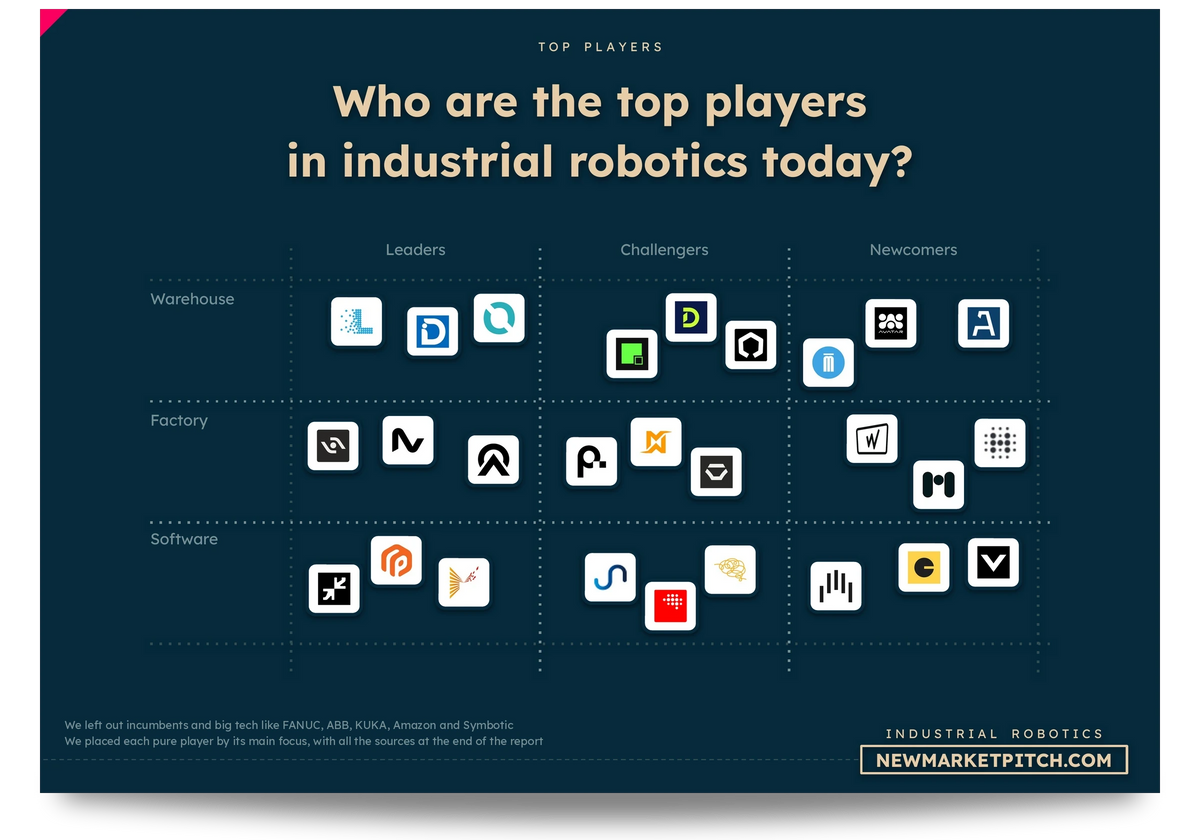
In our market report about industrial robots, we turn what is vague and complex into simple, useful visuals. Market maps like this one show you at a glance where every startup stands.
Written by the New Market Pitch teamWe track new markets so founders and investors can move faster. About us