Can top industrial robotics startups beat Fanuc and ABB?
Whether you're building or investing in the industrial robotics market, our report covers everything you need to know: the players, the money, and what's coming next.
Summary
Industrial robotics startups can beat Fanuc and ABB in specific factory applications, but none has yet demonstrated the manufacturing scale, customer reach, or service infrastructure to challenge their global leadership. Agile Robots and RobCo stand out for commercial traction, while NEURA Robotics, Standard Bots, and Figure AI are pursuing more ambitious changes to factory automation.
The biggest competitive shift is already happening in China. Domestic manufacturers supplied 55% of the country's industrial robot installations in 2025, compared with roughly 28% a decade earlier. Yet most of those gains belong to established Chinese manufacturers, not the latest AI robotics startups.
China's domestic supplier share actually declined from 57% in 2024 to 55% in 2025. But because total Chinese installations reached 354,000, local manufacturers still increased their absolute deliveries by approximately 15%. Market-share percentages alone can hide substantial growth.
Fanuc's one million cumulative robot shipments and ABB Robotics' $2.3 billion in 2024 revenue illustrate the scale newcomers face. A startup can outperform an incumbent at programming flexibility without having anything close to its manufacturing capacity or global customer support.
Agile Robots has some of the strongest operating evidence among newer entrants, reporting more than 20,000 installed robotic solutions and approximately €200 million in 2024 revenue. RobCo has sold more than 1,000 robots and is targeting smaller manufacturers that need automation without complicated integration projects.
Funding and valuations tell a more speculative story. NEURA Robotics announced financing of up to $1.4 billion, Standard Bots raised $200 million, and RobCo reached a valuation above $1 billion. Those milestones demonstrate investor demand, but none is equivalent to verified annual robot deliveries or recurring customer revenue.
Figure AI has supplied unusually concrete evidence for industrial humanoids: more than 90,000 sheet-metal parts handled during approximately 1,250 operating hours at BMW. That is serious factory experience, although it does not establish that humanoids are economically competitive with fixed industrial arms.
Collaborative robots are opening manufacturing applications that once required too much engineering effort. Still, they represented only 11% of global industrial robot installations in 2025, and Fanuc and ABB sell cobots themselves. Growth in this category does not automatically translate into startup market share.
The strongest opening for newcomers is in smaller factories and frequently changing production environments. Reducing programming, integration, and changeover costs may create more customer value than offering a cheaper robot arm. Reliable servicing remains the difficult part.
ABB's planned $5.375 billion sale of its robotics business to SoftBank could also change the competition by connecting an established industrial platform with newer AI technologies. For now, the likely outcome is not startups replacing Fanuc and ABB worldwide, but a more fragmented market where specialists win valuable applications that traditional automation has served poorly.

Written by the New Market Pitch teamWe track new markets so founders and investors can move faster. About us

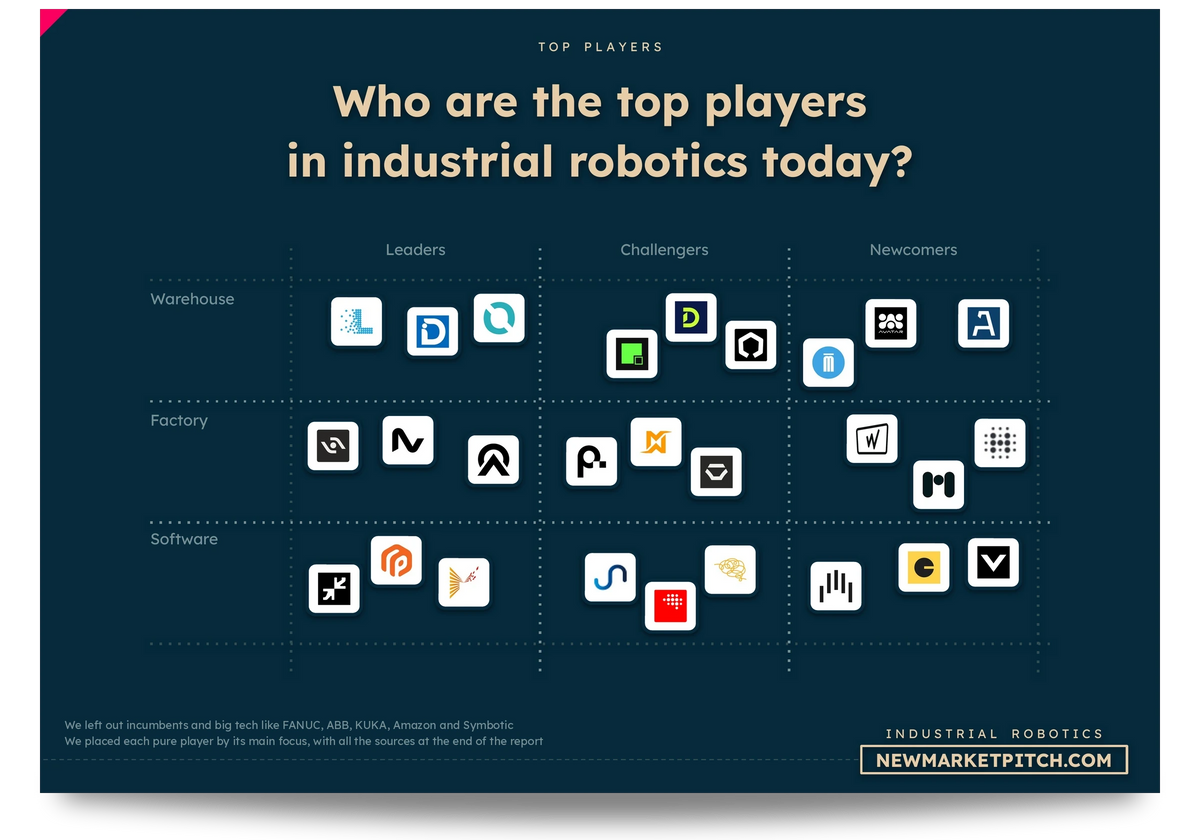
In our report covering the industrial robotics market, we turn what is vague and complex into simple, useful visuals. Market maps like this one show you at a glance where every startup stands.
Are industrial robotics startups finally becoming a threat to Fanuc and ABB?
Industrial robotics startups are now taking business away from established manufacturers, particularly in China, although Fanuc and ABB still have a huge advantage in factory installations worldwide.
The latest figures from the International Federation of Robotics (IFR) show that factories installed 603,000 industrial robots in 2025, up 11% from the previous year. That was the first time annual installations exceeded 600,000, following several years when demand stayed close to 540,000 units. The number of industrial robots operating worldwide reached 5.08 million, more than double the figure seven years earlier.
The interesting part is who supplied the new machines. Chinese manufacturers captured 55% of robot installations in China, the world's largest industrial robotics market. A decade earlier, foreign manufacturers supplied roughly 72% of the country's industrial robots.
Startups are also making progress outside China. Agile Robots has installed more than 20,000 robotic solutions worldwide, RobCo has sold more than 1,000 robots, and Figure AI has put humanoid robots to work at BMW's Spartanburg factory.
There is another reason to watch the industry closely. In October 2025, ABB agreed to sell its robotics division to SoftBank for $5.375 billion. The deal was designed to combine established industrial robotics with AI technology, showing that companies with major positions in factory automation are also looking for ways to adapt.
The pressure on Fanuc and ABB is becoming harder to ignore. So far, though, the clearest losses of market share have come from established Chinese competitors rather than the new generation of AI robotics startups.
What would it take for a robotics startup to beat Fanuc or ABB?
A robotics startup could beat Fanuc or ABB in a particular factory task long before it becomes a serious competitor to either company worldwide.
For example, a startup could develop a robot that is easier to program, handles unfamiliar objects better, or costs less to install in a small factory. If manufacturers consistently choose that system over an equivalent Fanuc or ABB product, the startup has already won something meaningful.
Becoming one of the world's biggest industrial robot manufacturers is a much harder target.
Fanuc reached one million cumulative industrial robot shipments in August 2023. Universal Robots, one of the most successful robotics startups of the past two decades, reached 100,000 cumulative cobot sales in 2025. The difference is approximately tenfold, even though Universal Robots had already spent nearly 20 years building its business.
New technology alone won't close that gap. Industrial customers expect robots to operate for years, often across several shifts, with access to replacement parts, maintenance, and technical support.
For this article, we consider a startup a serious challenger when it can repeatedly win paying industrial customers, demonstrate dependable production performance, and expand beyond isolated installations.
By that definition, several startups are already competing. None, however, has publicly demonstrated the annual shipment volumes needed to challenge Fanuc's overall position.
If you want more recent data on this point, please see our latest industrial robotics market report.

Our research about industrial robots gets updated several times a month, so you always get the latest view of where things stand.
How much bigger are Fanuc and ABB than industrial robotics startups?
Fanuc and ABB are still operating on a completely different scale from most robotics startups, and the gap is especially large in manufacturing experience and customer support.
Fanuc started producing industrial robots in 1977 and reached 500,000 cumulative shipments in 2017. Just six years later, it reached one million. The company therefore delivered its second half-million robots much faster than its first.
ABB Robotics generated approximately $2.3 billion in revenue in 2024, with about 7,000 employees and an operational EBITA margin of 12.1%. That represents roughly $278 million in operational earnings before interest, taxes, and amortization adjustments.
Now compare those figures with the emerging companies.
Agile Robots has reported more than 20,000 installed robotic solutions. This covers automation solutions rather than a directly comparable count of industrial robot arms. RobCo has sold more than 1,000 robots, while NEURA Robotics disclosed a €1 billion order book in January 2025.
These figures show real progress, but they measure different things. Installed solutions, delivered robot arms, customer orders, and annual revenue cannot be treated as equivalent measures of market share.
| Company | Reported commercial scale | What it tells us |
|---|---|---|
| Fanuc | 1M cumulative robots shipped by 2023 | Global manufacturing scale |
| ABB Robotics | $2.3B revenue in 2024 | Large operating business |
| Universal Robots | 100,000+ cobots sold by 2025 | Proven collaborative robot adoption |
| Agile Robots | 20,000+ robotic solutions installed | Broad industrial deployment experience |
| RobCo | 1,000+ robots sold | Early commercial scale |
| NEURA Robotics | €1B reported order book in 2025 | Large future delivery pipeline |
| Figure AI | 90,000+ parts handled at BMW | Demonstrated factory operation |
The best-established challengers are selling real products, but their public reporting is still far less complete than that of major manufacturers.
Until startups consistently disclose annual shipments, revenue, repeat orders, and operating performance, claims that they are catching Fanuc or ABB will remain difficult to prove.
Which industrial robotics startups are actually worth watching?
Agile Robots and RobCo have some of the strongest commercial credentials among newer industrial robotics companies, while NEURA Robotics, Standard Bots, and Figure AI are pursuing technologies that could change what factory robots can do.
Agile Robots is particularly interesting because it combines industrial deployments with AI development. Founded in Munich in 2018, the company has built a business spanning robot hardware, automation systems, and software. It reports more than 20,000 installed robotic solutions, especially in automotive and electronics.
Its April 2026 partnership with Google DeepMind added another dimension. The companies are working to bring Gemini Robotics models into real industrial environments. Agile Robots can contribute operating experience from factories, while DeepMind brings advanced robotic AI models.
The company has also expanded through industrial acquisitions and partnerships, including its investment in India's XNG Automation. This gives Agile Robots access to additional integration expertise and customers, rather than forcing it to build every part of its business from scratch.
RobCo is following a different strategy. Founded in 2020, the German company focuses on making industrial robots easier to deploy and operate. It has sold more than 1,000 robots and counts BMW among its customers. In October 2026, RobCo announced that an employee secondary share transaction valued the business above $1 billion, approximately double its valuation nine months earlier.
NEURA Robotics is pursuing cognitive robots, collaborative arms, and humanoids. Its June 2026 financing announcement described a Series C round of up to $1.4 billion, backed by investors including Tether and several major technology and industrial groups.
Standard Bots focuses on industrial robot arms with simpler programming and AI capabilities. It announced a $200 million Series C in June 2026 at a reported valuation of $1 billion.
Figure AI is the most distinct company in this group because its industrial approach centers on humanoids. It has already demonstrated extended factory operation at BMW, although its deployed fleet remains much smaller than that of conventional robot manufacturers.
| Startup | Main focus | Most useful evidence |
|---|---|---|
| Agile Robots | AI-powered factory automation | 20,000+ installed solutions |
| RobCo | Flexible industrial automation | 1,000+ robots sold |
| NEURA Robotics | Cognitive and humanoid robots | €1B reported order book |
| Standard Bots | Accessible AI-enabled robot arms | $200M Series C |
| Figure AI | Humanoid industrial work | Extended BMW factory deployment |
| JAKA Robotics | Collaborative industrial robots | Established commercial product range |
| Dobot | Affordable cobots and robot arms | Broad commercial product range |
| Rethink Robotics | Collaborative automation | Relaunched industrial robot portfolio |
We would put Agile Robots ahead on demonstrated industrial deployment breadth, with RobCo particularly interesting for flexible automation. NEURA Robotics and Figure AI offer potentially greater technological upside, but their ultimate manufacturing scale is harder to judge.
There is no reliable public dataset that allows us to rank all these private companies by comparable annual robot shipments or audited robotics revenue.
If you want more recent data on this point, please see our latest industrial robotics market report.

In our market report about industrial robots, we look at what the winners do differently, so you can learn from the best instead of guessing.
Have Chinese industrial robot manufacturers already beaten foreign competitors?
Chinese robot manufacturers have already overtaken foreign suppliers collectively in China, and the latest installation figures show that this shift is holding even as the market grows rapidly.
According to IFR, Chinese manufacturers supplied 55% of industrial robots installed in China in 2025, compared with 57% in 2024 and 47% in 2023.
The two-percentage-point decline in 2025 might initially look like a reversal. But China installed 354,000 industrial robots that year, 20% more than in 2024. Domestic manufacturers supplied approximately 195,000 of those machines, up 15% in absolute terms.
Local manufacturers sold more robots even though foreign suppliers grew slightly faster within China. That's a useful distinction, and one easily missed when looking only at market share.
We calculate that robots supplied by Chinese manufacturers to Chinese factories represented approximately 32% of all new industrial robot installations worldwide in 2025. This excludes exports, so it understates their total contribution to global supply.
Companies such as Estun and Siasun compete in traditional industrial automation, while JAKA and Dobot are active in collaborative and increasingly flexible robotics. These companies differ in age and corporate structure, and several are established manufacturers rather than startups.
China's competitive advantage is also reinforced by its huge domestic customer base. Electronics manufacturers installed 96,400 industrial robots in 2025, automotive companies installed 78,900, and the metal and machinery industry installed 78,700. Together, these three sectors accounted for almost 72% of Chinese installations.
International robot manufacturers have lost majority share in the world's largest market. That part of the competitive shift has already happened.
Whether Chinese suppliers can reproduce that success in Europe, Japan, and North America remains less certain. Distribution, industrial standards, service infrastructure, and customer relationships can all slow expansion outside their domestic market.
Are collaborative robots replacing traditional factory robots?
Collaborative robots are becoming more common, but conventional industrial robots still account for nearly nine out of ten new installations worldwide.
IFR recorded approximately 66,000 collaborative robot installations in 2025, representing 11% of the global industrial robot market by units.
That leaves around 537,000 installations in other industrial robot categories. Conventional systems therefore remain far more common, particularly in applications such as automotive welding, heavy material handling, and high-speed assembly.
Universal Robots shows how far collaborative automation can go. Founded in Denmark in 2005, the company introduced its first commercially viable cobot in 2008 and reached 100,000 cumulative sales in 2025.
Its success came partly from making automation accessible to manufacturers without the engineering resources of major automotive groups. Easier programming, smaller installations, and the ability to change tasks all made industrial robots useful in more factories.
But even the market leader faces difficult periods. Teradyne's Robotics segment, which includes Universal Robots and Mobile Industrial Robots, generated $375.2 million in 2023 and $364.8 million in 2024. Revenue declined by roughly 2.8%, despite the long-term growth opportunity.
Fanuc and ABB also sell collaborative robots, so growth in cobot installations doesn't automatically favor startups.
Collaborative robotics should keep opening doors for newer manufacturers. Its 11% market share, however, shows how much of factory automation still depends on conventional systems.

In our document detailing everything you need to know about industrial robotics, you will always find fresh funding data, taken straight from our own verified funding database.
Can robotics startups make factory automation much cheaper?
Robotics startups can make automation cheaper for smaller manufacturers by reducing programming and installation costs, although there is little independent evidence that their robots cost less over an entire operating lifetime.
A robot arm is only one part of a factory automation project.
Manufacturers may also need grippers, cameras, safety equipment, conveyors, software integration, employee training, and ongoing maintenance. These expenses can substantially exceed the cost of basic hardware.
An industry pricing analysis published by Standard Bots in January 2026 placed entry-level collaborative robots around $25,000, while advanced complete industrial automation systems can cost $500,000 or more. These are broad price ranges across different applications, rather than a direct comparison between competing robot models.
The opportunity for companies such as RobCo and Standard Bots comes from reducing the work required to get a robot running.
Consider a machining company producing different components in small batches. A robot that employees can reprogram quickly could be more useful than a faster industrial arm that requires specialist engineers whenever production changes.
The calculation changes in a large automotive factory. A production line running thousands of repeated operations values predictable cycle times, high uptime, and reliable servicing. Saving money on the original robot purchase becomes less attractive if it increases the risk of downtime.
There is no independently verified, apples-to-apples study establishing that the leading startups consistently outperform Fanuc or ABB on total lifetime cost.
For smaller installations and frequently changing tasks, startups have a convincing opening. For large, heavily optimized production lines, traditional suppliers remain very difficult to undercut.
If you want more recent data on this point, please see our latest industrial robotics market report.
Can AI-powered robots really outperform Fanuc and ABB?
AI-powered industrial robots have a real advantage in tasks involving unpredictable objects or frequent changes, but they have yet to demonstrate better performance than Fanuc and ABB across standard factory operations.
The difference comes down to how much a robot needs to adapt.
Traditional industrial arms are excellent at repeating precisely defined movements. A welding robot can execute the same programmed path thousands of times under controlled conditions.
Handling objects that arrive in different positions, identifying unfamiliar components, or adapting to changes in a workspace requires more perception and decision-making.
One of the clearest demonstrations comes from Figure AI's work with BMW.
In November 2025, Figure reported that its Figure 02 humanoids had loaded more than 90,000 sheet-metal parts during approximately 1,250 operating hours at BMW's Spartanburg plant. The deployment contributed to the production of more than 30,000 BMW X3 vehicles.
Those figures come from an extended factory deployment, which provides stronger evidence than a short demonstration. However, Figure's robots performed a specific component-loading task, while conventional industrial automation continued to handle the downstream welding.
The April 2026 partnership between Agile Robots and Google DeepMind shows another direction. Rather than developing only new robot hardware, the companies aim to use advanced AI models in existing industrial automation systems.
This approach may be easier to scale because it builds on equipment already designed for factory use.
The real commercial test is whether AI can reduce the cost and time needed to automate unfamiliar tasks. Repeatedly achieving that while maintaining acceptable uptime would allow startups to win applications that traditional robot suppliers have struggled to automate economically.
For repetitive, high-speed work, Fanuc and ABB remain formidable competitors.

Learning from others' mistakes is the cheapest lesson there is. In our report covering the industrial robotics market, we look at what broke startups before you, so you don't repeat it.
Are humanoid robots ready to replace industrial robot arms?
Humanoid robots can already perform useful factory tasks, but Figure AI's BMW deployment shows how far they still have to go before competing directly with high-speed industrial arms.
Figure's November 2025 report described an 11-month development and deployment period, including regular work on an active production line at BMW.
The reported 90,000-plus parts handled over 1,250-plus hours imply an average of roughly 72 parts per operating hour, or one part every 50 seconds. This is a simple calculation using the reported totals, rather than a certified cycle-time benchmark.
The hours may include different operating conditions and task interruptions. We cannot use the average to claim that Figure is faster or slower than a particular Fanuc or ABB arm performing the same job.
The achievement is still substantial. Figure demonstrated that a humanoid could perform repeated manufacturing work over an extended period without requiring a completely separate industrial process.
BMW has continued exploring humanoid robotics with other suppliers. In September 2026, the company announced work involving Hexagon's AEON humanoid at its Leipzig plant, targeting applications including high-voltage battery assembly and component handling.
These experiments reveal where automakers see an opportunity: tasks that remain difficult to automate with fixed equipment, especially when workstations were originally designed for humans.
Humanoids bring disadvantages as well. Walking, balancing, and manipulating objects through a human-like body introduce mechanical complexity that a fixed industrial arm can avoid.
For welding, high-speed picking, and repetitive component assembly, specialized machines can often perform the job with fewer moving parts and greater predictability.
Humanoids have earned a place in serious industrial experiments. Large-scale displacement of traditional robot arms is still unsupported by production data.
Can Fanuc keep its lead as industrial robots become smarter?
Fanuc is well positioned to remain one of the world's largest industrial robot manufacturers, although its historical scale alone won't guarantee leadership in more flexible and AI-driven automation.
Its product range is an important advantage. Fanuc supplies robots for welding, palletizing, assembly, material handling, and machine tending, with hundreds of model variations for different payloads and applications.
That breadth gives manufacturers a single supplier for many production requirements. It also creates opportunities for existing customers to standardize equipment, programming tools, maintenance practices, and spare parts.
Fanuc has spent decades building relationships with industrial integrators and customers. A factory already using its robots may prefer to buy additional compatible machines rather than introduce another supplier and support system.
However, the experience of Chinese manufacturers shows that purchasing habits can change. Domestic suppliers managed to take majority share in China despite facing established international competitors with extensive product catalogs and industrial experience.
Fanuc's challenge is therefore concentrated in new installations. Its existing robots can remain useful for many years, while new competitors target additional production lines or tasks that have not previously been automated.
The company also sells collaborative robots and continues developing automation software, reducing the chances that startups can win simply by introducing easier programming or additional sensors.
Fanuc is unlikely to lose its place as a major industrial supplier anytime soon. But it could still lose meaningful business in flexible automation while retaining a huge installed base. How much of that next generation it captures is the more interesting question.
If you want more recent data on this point, please see our latest industrial robotics market report.

In our research about industrial robots, we always try to gather several sources and make estimates that make sense, so you can work with solid numbers.
Could SoftBank turn ABB Robotics into a much stronger competitor?
SoftBank's planned acquisition of ABB Robotics could make the business a more aggressive competitor in AI-powered industrial automation, provided the new owner can turn its technology investments into better commercial products.
The October 2025 agreement valued ABB's robotics business at $5.375 billion.
Compared with the division's $2.3 billion revenue in 2024, that represents approximately 2.3 times annual sales. Its 12.1% operational EBITA margin also shows that the business had established profitable operations.
SoftBank is buying access to industrial customers, manufacturing expertise, hardware, software, and servicing capabilities that startups typically spend years trying to build.
The strategic rationale goes beyond robot sales. SoftBank has invested heavily in AI and robotics, including companies working on intelligent manipulation and robot foundation models.
ABB brings an established industrial platform to that portfolio. Connecting newer AI technologies with factory equipment could offer a faster route to deployment than building an entirely new robot manufacturer.
We should still distinguish the planned strategy from demonstrated results. The transaction was announced with an expected closing in mid-to-late 2026, subject to regulatory approvals and other conditions. Its operating benefits cannot be established from the purchase agreement alone.
If SoftBank succeeds, ABB Robotics could combine the commercial strengths of an incumbent with some of the technology advantages pursued by startups.
That could make life harder for new entrants. They may soon be competing against traditional industrial suppliers that are investing seriously in the same AI capabilities.
Are investors valuing industrial robotics startups ahead of their real sales?
Investors are putting enormous amounts of money into industrial robotics startups, but the public evidence of robot deliveries and revenue remains much smaller than some of the valuations might suggest.
RobCo is a good example. The company disclosed a valuation above $1 billion in October 2026, following a transaction that allowed some employees to sell shares to investors.
The valuation had roughly doubled in nine months. RobCo also reported selling more than 1,000 robots, establishing that it has commercial customers rather than only a research platform.
Yet a secondary share transaction is different from a large primary financing round. Some of the money goes to existing shareholders, so the transaction should not be treated as new capital entirely available for factory expansion.
NEURA Robotics announced a Series C round of up to $1.4 billion in June 2026. The funding announcement involved investors including Tether, Qualcomm, Amazon, NVIDIA, Bosch, and Schaeffler.
The company has also described plans to manufacture millions of robots by 2030. That is an ambitious production target, although public disclosures do not yet establish that NEURA can deliver robots at anything approaching that volume.
Standard Bots' $200 million Series C provides another example of capital arriving ahead of fully transparent shipment figures.
There is an important contrast with Agile Robots, which has reported around €200 million of revenue for 2024 and more than 20,000 installed robotic solutions. That gives investors additional operating evidence beyond financing announcements.
As seen above, Universal Robots took roughly two decades to reach 100,000 cumulative cobot sales. Scaling robot manufacturing and supporting customers worldwide can be a long process, even for a successful company.
We would give much more weight to repeat customer orders, delivered robots, revenue, and uptime than to investment valuations when deciding which startups are becoming serious competitors.
The financing boom gives these companies a chance to grow quickly. Whether their future sales justify the prices investors are paying is another question.

If you build or invest in the industrial robotics market, you need to know which business models pay off now and which ones are fading. That's why our report covering it has a whole section on it.
Can industrial robotics startups win smaller factories before Fanuc and ABB?
Smaller factories are among the best opportunities for robotics startups because many still struggle with the cost and complexity of industrial automation.
Large automotive and electronics manufacturers have used industrial robots for decades. They can employ dedicated engineers to plan installations, program equipment, and maintain production systems.
Smaller manufacturers often have different needs. They may produce shorter runs, switch between different components, or operate with limited engineering support.
RobCo and Standard Bots have built their products around making these kinds of installations easier. A factory that can teach a robot new tasks without a major integration project has a stronger reason to automate work that previously remained manual.
The wider market is also growing beyond the largest automotive applications.
IFR reported that industrial robot installations in the metal and machinery sector increased 22% worldwide in 2025, twice the 11% growth rate of total installations. That does not tell us exactly how many robots went to smaller businesses, but it shows increasing demand in a sector that includes a wide range of manufacturers.
Universal Robots provides a useful historical comparison. Its collaborative robots reached customers in industries including metalworking, electronics, food production, and packaging, proving that factory automation can spread beyond the largest industrial buyers.
The difficult part for a startup is servicing these customers. Smaller factories may have little internal robotics expertise, so a cheap or easy-to-program machine still needs reliable support when something goes wrong.
This is where newer companies have one of their best chances of winning lasting market share. A simpler installation process, reasonable pricing, and dependable local support could make them attractive to factories that have never bought a robot before.
Can industrial robotics startups actually beat Fanuc and ABB?
Yes, industrial robotics startups can beat Fanuc and ABB in specific factory applications, but none has yet shown that it can replace either company as a global industrial robotics leader.
The strongest evidence of competitive change comes from China's domestic suppliers, which already account for the majority of new robot installations in the world's largest national market. Their success shows that foreign incumbents can lose substantial market share, even in an industry built around long equipment lifetimes and established customer relationships.
Among the newer companies, we currently see Agile Robots as one of the strongest commercial challengers. Its installed solutions, reported revenue, industrial acquisitions, and AI partnership with Google DeepMind give it a broader foundation than companies still depending primarily on prototypes and planned production.
RobCo is particularly interesting for flexible industrial automation. Its robot sales and customer relationships show genuine traction, while the latest valuation increase suggests investors expect much more growth.
NEURA Robotics and Standard Bots have attracted major financing to build new industrial platforms. Figure AI has supplied some of the strongest evidence of humanoid robots doing sustained work inside a car factory. But the publicly available figures do not yet establish that these businesses can manufacture, deploy, and support robots at the scale of the leading incumbents.
Fanuc remains especially difficult to challenge in conventional industrial robotics, supported by decades of manufacturing experience and a huge installed base. ABB Robotics could become even more competitive in AI-enabled systems if its planned integration with SoftBank produces tangible improvements.
The next major change in industrial robotics will probably come from more factories adopting robots that are easier to teach, cheaper to integrate, and better at handling variable tasks. Startups have a credible opportunity to lead parts of that transition.
The companies most likely to succeed are those that combine new capabilities with reliable manufacturing and customer support. For now, Agile Robots and RobCo offer particularly strong evidence of commercial progress, while NEURA Robotics and Figure AI are among the more ambitious technology bets.
Fanuc and ABB still lead the established industrial robot business. The new generation of competitors has a genuine chance to take valuable parts of that market, especially where traditional automation remains too expensive or inflexible. A startup overtaking the incumbents worldwide is a much bigger claim, and the evidence isn't there yet.
If you want more recent data on this point, please see our latest industrial robotics market report.

In our document detailing everything you need to know about industrial robotics, we don't want to repeat what boring consulting reports say. Instead, we show you the real and latest market signals that matter.
Sources and methodology
This analysis examines whether industrial robotics startups can challenge Fanuc and ABB through commercial deployments, manufacturing scale, technological capabilities, automation economics, and changing supplier market shares. We distinguish startups winning individual factory applications from companies capable of competing with established industrial robot manufacturers worldwide.
For each dimension, we collected recent evidence from industry statistics, corporate financial reports, company disclosures, financing announcements, and documented factory deployments. We then aggregated those findings, assessed their commercial significance, and compared them across competitors to identify where competitive advantages are emerging and where the incumbents remain stronger.
We use the International Federation of Robotics' installation statistics to assess overall market growth, Chinese and foreign supplier shares, industry-level demand, and collaborative robot adoption. We distinguish annual installations from cumulative robot shipments and the operating installed base. Our calculation of Chinese manufacturers' contribution to global installations uses reported domestic supplier share multiplied by Chinese installations, divided by global installations.
Commercial scale is assessed through reported robot deliveries, installed solutions, customer deployments, revenue, and sustained factory operation. These measures are not interchangeable. Agile Robots' installed automation solutions, RobCo's robots sold, NEURA Robotics' order book, and Figure AI's documented BMW operations represent different kinds of evidence, so we compare their significance rather than combining them into a single shipment ranking.
We give particular weight to factory deployments involving identifiable industrial customers, meaningful operating periods, and measurable work completed. Figure AI's BMW deployment is evaluated using reported parts handled and operating hours, while recognizing that a calculated average is not a certified cycle-time comparison against conventional industrial arms.
For automation economics, we examine hardware costs alongside programming, integration, safety equipment, maintenance, and production flexibility. The comparison separates smaller factories with frequently changing tasks from large production lines where uptime, speed, and established support networks carry greater weight. We do not treat advertised robot prices as comprehensive lifetime cost estimates.
Financing announcements, company valuations, secondary transactions, order books, and future production targets are assessed separately from verified commercial activity. We also consider incumbent responses, including Fanuc's established product portfolio and ABB's announced sale to SoftBank, to evaluate how changes in ownership and AI investment could affect future competition.
Key industry and incumbent sources include the International Federation of Robotics' World Robotics 2026 findings, IFR's industrial robotics market updates, IFR's China market report, Fanuc's one-million-robot shipment announcement, ABB's SoftBank divestment announcement, Teradyne's 2024 annual report, and Universal Robots' 100,000-cobot milestone.
Key startup and deployment sources include Agile Robots' Google DeepMind partnership announcement, Agile Robots' industrial acquisition announcement, RobCo's valuation and secondary transaction disclosure, NEURA Robotics' Series C announcement, Figure AI's BMW production report, Figure AI's subsequent BMW deployment update, BMW's Leipzig humanoid robotics announcement, BMW's Physical AI deployment information, and Standard Bots' 2026 industrial robot cost analysis.
The resulting assessment gives greater weight to repeat customer adoption, demonstrated industrial work, manufacturing capabilities, and service infrastructure than to fundraising, valuations, or projected production volumes. Comparing these dimensions together allows us to identify credible near-term competitors without treating technological promise as proof of global industrial leadership.

In our report covering the industrial robotics market, we like to show you the big picture. We know your time is precious, so we make every page quick to read and packed with as much learning as possible per minute.
Written by the New Market Pitch teamWe track new markets so founders and investors can move faster. About us