Does RaaS work as a warehouse robotics business model?
Whether you're building or investing in the warehouse robotics market, our report covers everything you need to know: the players, the money, and what's coming next.
Summary
Yes. Robotics-as-a-Service works as a warehouse robotics business model, with thousands of robots deployed under recurring contracts. The unresolved question is how much profit suppliers can retain after financing, maintaining and replacing those machines.
Locus Robotics demonstrates the commercial scale already achieved. With more than 22,000 robots across over 360 sites and 8 billion completed picks, warehouse RaaS has moved far beyond experimental deployments. But a large installed fleet doesn't automatically translate into strong cash flow.
The customer economics can be compelling. A DHL Makro deployment increased picking productivity by 120%, while a RAMS pharmaceutical-distribution case reported approximately $454,000 in annual savings after paying for robotic services. Warehouses have a concrete financial reason to subscribe.
Pricing varies substantially with the work performed. Brightpick advertises roughly $1,900 to $2,200 per robot per month, while a specialized pallet-handling deployment costs approximately $3,537 per robot monthly. Comparing those prices without comparing the labor replaced tells us very little.
The biggest distinction between RaaS contracts is who carries the risk. Fixed subscriptions protect suppliers against temporary drops in customer activity, while usage-based contracts tie revenue more closely to warehouse throughput. Provider-financed fleets also require considerably more capital than arrangements backed by leasing partners or equipment buyers.
Robot acquisition costs can make or break the model. In our illustrative five-year contract charging $2,500 monthly, a $60,000 deployment leaves $48,000 after direct operating expenses and equipment costs, but before financing, overhead and taxes. The headline contract value is $150,000, which tells a much more flattering story.
Capital recovery is especially sensitive to hardware costs. At $1,800 in monthly contribution, a $30,000 robot pays back in about 17 months, while a $100,000 installation takes roughly 56 months. Both generate identical subscription revenue, yet their investment economics are radically different.
Seasonal flexibility creates a second financial test. DHL Makro supplements 95 permanent robots with 28 seasonal units, giving it approximately 29% additional capacity during peak demand. That's attractive for the warehouse, but the supplier needs to redeploy those machines or recover their costs from a relatively short operating season.
Repeated customer adoption is stronger evidence than one-off pilot announcements. DHL expanded its relationship with Locus over several years, reaching 500 million assisted picks by June 2024. Even so, Locus's private financial disclosures are insufficient to establish consistent supplier profitability.
The alternatives deserve attention. Shopify's roughly $450 million acquisition of 6 River Systems in 2019 was followed by Ocado's $12.7 million purchase in 2023, illustrating how deployed fleets can coexist with disappointing investment outcomes. Meanwhile, AutoStore's 72.4% gross margin and Symbotic's substantial backlog show that selling automation systems outright can remain highly attractive.
Warehouse RaaS is best positioned where robots are relatively affordable, deployments are repeatable, customer contracts are durable and equipment can be reused across sites. The eventual winners won't necessarily operate the largest fleets. They'll be the suppliers that can keep expanding without continually needing enormous amounts of fresh capital.

Written by the New Market Pitch teamWe track new markets so founders and investors can move faster. About us

A good product starts with a real problem. In our report covering the warehouse robotics market, we show you the ones customers still live with.
Why are more warehouses choosing Robotics-as-a-Service?
Robotics-as-a-Service (RaaS) is now a proven way to sell warehouse automation, with thousands of robots working under recurring service contracts. What remains much harder to establish is whether the companies providing those robots make attractive profits.
Locus Robotics shows how far the model has come. The company currently reports more than 22,000 robots deployed across over 360 sites, with more than 8 billion warehouse picks completed. Its customers pay for access to robotic automation, software and ongoing services rather than necessarily purchasing the machines outright.
The commercial appeal is straightforward. Warehouses can automate operations without making a large initial investment, while suppliers earn recurring revenue over several years. Companies such as Brightpick and inVia Robotics have built similar offerings around monthly subscriptions or productivity-based payments.
However, there is an expensive difference between selling software subscriptions and renting physical robots. Every new warehouse deployment requires equipment, installation, maintenance and often substantial financing.
That creates the central question: can robotics providers earn enough from their subscriptions to recover those costs, finance expansion and still make money?
What are warehouses actually paying for with RaaS?
Warehouse RaaS usually combines robots, software and maintenance into one recurring payment, but the financial arrangement can vary considerably between providers.
Locus Robotics offers flexible access to autonomous mobile robots and its warehouse orchestration platform. Brightpick includes installation, servicing, software and performance guarantees in its subscriptions. inVia Robotics has developed a pay-per-productivity approach that links automation spending to fulfillment activity.
These arrangements carry different risks. A fixed monthly fee gives the supplier more predictable revenue, even if warehouse activity falls. Usage-based pricing can increase revenue when customers process more orders, but leaves the supplier more exposed during slow periods.
Equipment ownership also varies. In a fully provider-financed model, the robotics company pays for the fleet and recovers its investment through subscriptions. Other arrangements use leasing or third-party financing.
For investors, these differences can matter more than the technology itself. Two companies might report identical recurring revenue while requiring completely different amounts of capital to generate it.

If you build or invest in the warehouse robotics market, you need to know which business models pay off now and which ones are fading. That's why our report covering it has a whole section on it.
Are warehouse robots saving customers enough money to justify RaaS?
Warehouse RaaS can produce substantial savings, and several real deployments show productivity improvements large enough to justify recurring payments.
DHL Makro's Madrid operation offers a useful example. According to a case study published by Locus Robotics, the warehouse deployed 123 Locus Origin robots and increased productivity from 50 to 110 lines processed per hour, an improvement of 120%.
The robots transport goods through a complicated wholesale distribution operation serving 27 stores and thousands of daily outbound routes. By reducing manual movement and sorting, the system allows employees to process considerably more orders.
A different example comes from RAMS and VisionNav Robotics. Their published pharmaceutical-distribution case describes 23 autonomous vehicles replacing repetitive pallet-handling work associated with a $1.43 million annual labor burden.
The reported subscription costs $81,342 per month, or approximately $976,100 annually, leaving around $453,900 in annual savings. The customer therefore retains roughly 32% of the original labor expense after paying for the robotic service.
These are supplier-reported case studies rather than independently audited financial results. Still, the numbers show why warehouses are interested. Where labor costs are high and workflows repetitive, companies can justify sizeable monthly payments while reducing operating expenses.
How much does warehouse robotics-as-a-Service actually cost?
Warehouse RaaS pricing already ranges from roughly $2,000 per robot per month for some picking applications to substantially higher amounts for more specialized industrial equipment.
Brightpick published indicative RaaS pricing in June 2025 of $1,900 to $2,200 per robot per month, depending on installation size and contract duration. The fee includes equipment, software, remote support, on-site servicing and preventive maintenance.
At those prices, a warehouse operating 50 robots would pay approximately $1.14 million to $1.32 million over a year. Across a five-year contract, payments would reach $5.7 million to $6.6 million before any contractual changes.
The RAMS pharmaceutical example works out to approximately $3,537 per robot per month. Its higher cost reflects a different application involving autonomous pallet-handling vehicles and a bundled service agreement.
These examples show why comparisons based only on robot count are misleading. A small picking robot and an autonomous forklift perform different jobs, replace different labor activities and carry different equipment costs.
The more useful question is how much money the customer saves after paying the subscription. We can illustrate that using a hypothetical deployment that eliminates $10,000 in monthly operating costs before its RaaS fee.
| Monthly RaaS fee | Monthly savings after fee | Annual savings | Savings retained by customer |
|---|---|---|---|
| $2,000 | $8,000 | $96,000 | 80% |
| $3,000 | $7,000 | $84,000 | 70% |
| $4,000 | $6,000 | $72,000 | 60% |
| $5,000 | $5,000 | $60,000 | 50% |
| $6,000 | $4,000 | $48,000 | 40% |
| $7,000 | $3,000 | $36,000 | 30% |
| $8,000 | $2,000 | $24,000 | 20% |

Learning from others' mistakes is the cheapest lesson there is. In our market report about warehouse robots, we look at what broke startups before you, so you don't repeat it.
Is renting warehouse robots cheaper than buying them?
Renting warehouse robots is often easier to finance than buying them, but long-term RaaS contracts can end up costing customers more than equipment ownership.
A warehouse purchasing robots outright must pay for the machines, installation and integration before realizing most of the savings. RaaS replaces much of that upfront spending with predictable payments spread over several years.
For companies facing uncertain order volumes or limited capital budgets, this can make automation possible sooner. It also reduces the burden of maintaining specialized equipment and managing technical failures.
However, subscriptions accumulate. A warehouse paying $100,000 annually spends $500,000 over five years. Purchasing an equivalent system could prove cheaper if the equipment lasts longer than expected and maintenance costs remain manageable.
The comparison changes again when software licenses, financing, repairs and replacement parts are included. Brightpick's published pricing, for example, already bundles several services that equipment buyers would otherwise need to purchase separately.
RaaS is particularly attractive when companies value flexibility or want the supplier to handle technical risks. Warehouses planning to operate the same automation system for ten years may find ownership more economical.
If you want more recent data on this point, please see our latest warehouse robotics market report.
Can RaaS companies actually make money on their robot subscriptions?
Warehouse RaaS can generate attractive returns, but subscription revenue alone tells us very little about supplier profitability. The decisive variable is how much each deployed robot costs to build, operate and finance.
Consider a hypothetical provider spending $60,000 to manufacture and deploy a robot. If the company charges $2,500 per month over five years, the contract generates $150,000 in revenue.
Assume maintenance, support, connectivity and other direct operating costs total $700 per month. Across the contract, those expenses reach $42,000, leaving $108,000 before recovering the original equipment investment.
After subtracting the $60,000 deployment cost, the provider retains $48,000 before financing expenses, corporate overhead, sales costs and taxes.
That could be a viable business, but it's much less attractive than the headline $150,000 contract value suggests.
The example is illustrative rather than based on a particular company's disclosed margins. Private warehouse robotics suppliers rarely publish the detailed cost and cash-flow information required to verify these calculations.
We have convincing evidence that RaaS customers receive useful automation. The public evidence is much thinner when it comes to how much profit robotics suppliers retain from each installation.

When you build or invest in the warehouse robotics market, you need clarity, not confusion. In our document detailing everything you need to know about warehouse robotics, we always try to put numbers on and quantify whatever is usually vague and confusing.
How quickly does a RaaS provider need to recover the cost of a robot?
A warehouse RaaS provider should ideally recover its equipment investment well before the customer contract expires. Otherwise, even modest financing costs or equipment failures can consume much of the expected profit.
We can test this using a hypothetical five-year contract generating $2,500 in monthly revenue and $1,800 in monthly contribution after direct operating expenses.
At a $30,000 deployment cost, the company recovers its initial investment in roughly 17 months. At $60,000, that increases to 33 months. At $100,000, the investment takes almost the full five-year contract to recover.
The table shows how dramatically the economics change even though the customer's subscription payment remains identical.
| Initial investment | Monthly contribution | Simple payback | Five-year surplus before overhead |
|---|---|---|---|
| $20,000 | $1,800 | 11 months | $88,000 |
| $30,000 | $1,800 | 17 months | $78,000 |
| $40,000 | $1,800 | 22 months | $68,000 |
| $50,000 | $1,800 | 28 months | $58,000 |
| $60,000 | $1,800 | 33 months | $48,000 |
| $80,000 | $1,800 | 44 months | $28,000 |
| $100,000 | $1,800 | 56 months | $8,000 |
If you want more recent data on this point, please see our latest warehouse robotics market report.
Does warehouse RaaS only work when robots stay busy all day?
Warehouse RaaS becomes much more attractive when robots work across multiple shifts, although the effect depends on whether suppliers charge fixed subscriptions or bill customers according to usage.
A warehouse running robots for 16 hours daily can extract considerably more value from the same equipment than one using them for four hours. That gives high-throughput distribution centers a natural advantage when calculating automation savings.
For providers charging fixed monthly fees, low utilization may not immediately reduce revenue. But customers are unlikely to renew expensive subscriptions for machines they barely use.
Usage-based models face the problem more directly. Imagine a supplier charging $0.12 per completed task over 300 operating days.
At 500 tasks per day, the robot generates $18,000 annually. At 1,000 tasks, revenue reaches $36,000. At 1,500 tasks, it rises to $54,000, assuming the equipment can handle the additional workload.
Better fleet orchestration can therefore increase revenue potential without requiring the provider to manufacture another robot.
The most attractive warehouses are those with consistent demand, repetitive tasks and enough volume to keep equipment productive throughout the working day.

In our report covering the warehouse robotics market, we look at what the winners do differently, so you can learn from the best instead of guessing.
Can warehouse RaaS really handle seasonal demand?
Seasonal flexibility is one of the clearest advantages of warehouse RaaS, particularly for retailers and logistics companies whose order volumes change dramatically during the year.
DHL Makro's Madrid operation provides unusually specific evidence. Its fleet contains 95 permanent Locus robots and another 28 seasonal robots, according to the supplier's published case study.
The seasonal machines represent approximately 23% of the 123-robot peak fleet. Compared with its permanent configuration, the warehouse can access roughly 29% more robotic capacity when demand increases.
That flexibility reduces the need to purchase enough equipment to handle the busiest weeks of the year.
There's a catch for suppliers, though. Robots removed after a seasonal peak still need to earn enough revenue across the rest of the year to justify their acquisition cost.
Providers can deal with that through minimum contract commitments, seasonal price premiums or redeployment between customers with different demand cycles.
The DHL example shows how valuable flexibility can be for customers. For the supplier, the important question is how quickly temporarily idle robots can start earning money somewhere else.
Are big logistics companies actually expanding their warehouse robot fleets?
Large logistics operators have moved well beyond warehouse robot pilots, with DHL providing one of the clearest examples of repeated deployment and growing usage.
DHL began working with Locus Robotics in 2017. In May 2023, the companies announced an expansion agreement covering 5,000 autonomous mobile robots.
By June 2024, DHL reported reaching 500 million assisted picks across more than 35 facilities. The first 10 million picks had taken approximately two and a half years, while the most recent 100 million required only 154 days.
That last period works out to roughly 649,000 picks per day across the participating network. It demonstrates substantial operating activity, although it cannot tell us the productivity or profitability of an individual robot.
The history is more convincing than a single large purchase announcement. DHL repeatedly increased its use of automation across different warehouses and continued working with the same supplier over several years.
For warehouse RaaS, repeat adoption by large customers is particularly valuable because those customers already understand the integration costs, staff training requirements and operational limitations.
DHL's experience supports the commercial case for the model. Reliable deployments can lead to broader contracts without providers having to acquire entirely new customer relationships for every robot.

Your time is limited. In our research about warehouse robots, we put numbers on each part of the market, so you can see where it makes sense to focus.
Has Locus Robotics proved that warehouse RaaS can scale profitably?
Locus Robotics has proved that warehouse RaaS can operate at considerable scale, but the company has not publicly demonstrated consistent profitability through detailed financial disclosures.
Its current published footprint exceeds 22,000 robots and 360 sites. Dividing those figures gives a rough average of 61 deployed robots per site, although the actual distribution varies and both published totals are rounded.
The company also reports more than 8 billion completed picks. That scale makes Locus one of the strongest commercial examples of robotics delivered through recurring service contracts.
There is evidence of continued product development, too. Locus has expanded from collaborative mobile robots toward more autonomous fulfillment through Locus Array and its work with Nexera Robotics.
Yet Locus remains privately held. Public materials do not provide enough information to calculate its consolidated gross margin, customer acquisition costs, fleet depreciation, financing burden or free cash flow.
A robotics company can grow its installed fleet and recurring revenue while consuming cash to purchase additional equipment. Those numbers can look excellent from the outside right up until financing becomes difficult.
Locus is a commercially established RaaS provider. Calling it a proven highly profitable business would require financial data that is not publicly available.
If you want more recent data on this point, please see our latest warehouse robotics market report.
Can smaller warehouse robotics companies compete with Locus?
Smaller warehouse robotics suppliers can compete with Locus by focusing on specific jobs and pricing their services around the value delivered, rather than trying to match its entire installed fleet.
inVia Robotics concentrates on goods-to-person fulfillment and has promoted productivity improvements of up to five times in selected applications. Its approach emphasizes warehouse throughput and automation delivered as an ongoing service.
Brightpick focuses more heavily on automated picking and storage workflows. Its subscription bundles robots, integration and support, making the offering relatively straightforward for customers comparing automation with existing labor expenses.
6 River Systems provides another useful comparison. When Ocado announced its acquisition in May 2023, the company's Chuck robots were operating in more than 100 warehouses serving over 70 customers.
Across these examples, suppliers tackle different levels of warehouse automation. Some primarily reduce walking and transport time, while others automate picking or pallet movement.
Specialization can help a smaller company win contracts when its system handles a particular workflow better or at a lower total cost.
The challenge comes after deployment. Every additional warehouse needs integration, customer support, spare parts and reliable servicing. Smaller providers must spread those costs across enough installations to preserve margins.

In our market report about warehouse robots, we always try to gather several sources and make estimates that make sense, so you can work with solid numbers.
What does the collapse in 6 River Systems' sale price tell us about warehouse robotics?
The 6 River Systems acquisition history is a warning that commercially deployed warehouse robots do not guarantee attractive investment returns.
Shopify acquired the company in 2019 through a transaction valued at approximately $450 million. Its Chuck robots were expected to support Shopify's growing fulfillment network, and Shopify anticipated around $30 million in annual billings from 6 River Systems in 2020.
Four years later, Shopify sold the business to Ocado. Ocado's financial disclosures confirm that the acquisition closed in June 2023 for $12.7 million in cash.
The later purchase consideration was approximately 97% below the original headline transaction value. These figures are not directly equivalent enterprise valuations, particularly because the first deal included stock and employee compensation arrangements. Nevertheless, the size of the difference is striking.
At the time of the Ocado transaction, 6 River Systems still had more than 70 customers and deployments in over 100 warehouses.
Shopify's broader decision to retreat from operating its own logistics network played an important role in the sale. We cannot attribute the valuation difference solely to weaknesses in robotics subscriptions.
But investors should pay attention to the outcome. Deployed fleets, functioning technology and recurring customer relationships can coexist with deeply disappointing financial returns.
If you want more recent data on this point, please see our latest warehouse robotics market report.
Why are AutoStore and Symbotic selling warehouse systems instead of relying on RaaS?
AutoStore and Symbotic show why large warehouse automation companies often prefer selling systems upfront and earning additional revenue from software and services.
AutoStore reported $538.6 million in revenue and other operating income for 2025, down 10.4% from the previous year. Its gross margin was 72.4%, according to its annual report.
Most of that revenue came from system sales rather than subscriptions for fleets owned by AutoStore. Customers and integration partners finance much of the installed infrastructure.
Symbotic follows a different but similarly capital-conscious approach. The company sells large automation systems while generating additional revenue from software and operational services.
In its fiscal third quarter of 2026, Symbotic reported $721 million in revenue, up 22% year over year, and $55 million in net income. It also had approximately $22.5 billion in backlog, with 56 operational systems and 77 systems in deployment.
Equipment sales offer a financial advantage: suppliers can receive substantial payments for the machines and installation rather than financing every deployment through years of subscriptions.
These companies still face manufacturing costs, integration risk and delayed payments. Symbotic's backlog, for example, represents work that must be delivered over time.
But their published financial results provide a level of visibility that is largely missing from private RaaS specialists.

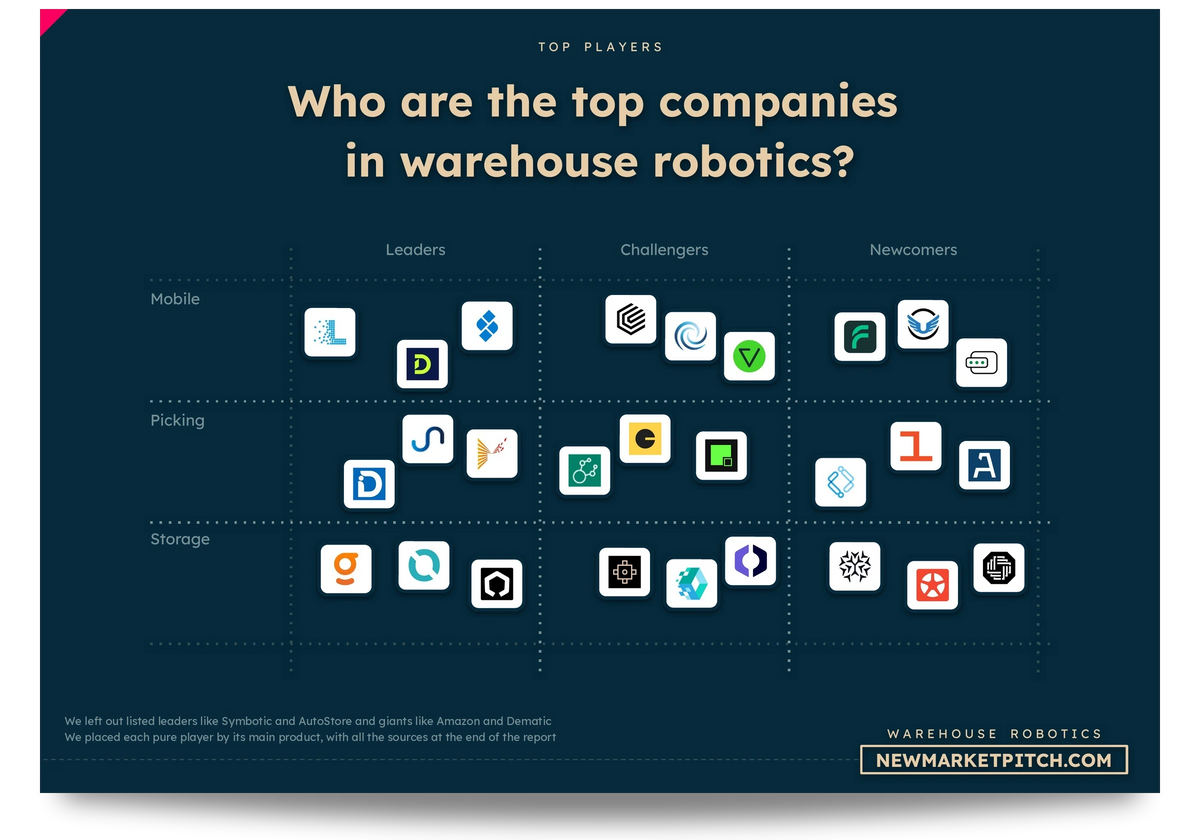
In our document detailing everything you need to know about warehouse robotics, we turn what is vague and complex into simple, useful visuals. Market maps like this one show you at a glance where every startup stands.
Could warehouse RaaS companies run out of money while growing?
Warehouse RaaS companies can face financing problems even when demand is growing, because every additional customer may require another investment in physical equipment.
Suppose a provider deploys 1,000 robots annually at an average equipment and installation cost of $40,000 each. That represents $40 million in upfront capital.
Increasing annual deployments to 5,000 robots raises the requirement to $200 million, before considering central engineering, software development, sales and other company expenses.
The equipment may eventually generate excellent returns. However, the supplier needs financing while customer payments arrive over several years.
This becomes especially risky when the robots cannot easily be reused. A supplier might spend heavily customizing equipment for one warehouse, only to discover that the system requires substantial modifications before serving another customer.
Long-term agreements with reliable customers can make fleet financing easier. Specialized lenders or leasing partners may also help suppliers expand without funding every machine through new equity investments.
We would be much more confident in a RaaS provider that recovers its deployed capital within two years than one requiring most of a five-year contract to do so.
Fast deployment growth is attractive only when the unit economics make that growth worth financing.
Will fully autonomous picking robots improve the RaaS business model?
Fully autonomous warehouse picking could make RaaS substantially more valuable by replacing more manual work per installation, although current evidence is still too limited to establish the financial returns at scale.
Collaborative mobile robots typically reduce walking and transport activities while employees continue handling goods. Automated picking systems attempt to remove additional human tasks by combining robotics, perception and gripping technology.
Locus introduced Locus Array in April 2026 as part of its move toward more autonomous fulfillment. Its published materials describe the potential to reduce manual labor requirements by up to 90% in targeted workflows.
That would represent a considerable improvement over systems focused mainly on moving goods between locations. But the figure is a supplier claim, and early deployments do not yet establish typical productivity across a broad installed base.
Adding robotic arms, cameras, grippers and more sophisticated control systems also increases equipment complexity. Higher service revenue will have to cover those additional costs, along with repairs and equipment depreciation.
The strongest opportunities are likely to be warehouses handling large volumes of relatively predictable products. Operations dealing with fragile, irregular or frequently changing inventory may require more human intervention.
For now, the financial promise of fully autonomous RaaS is stronger than the available evidence of repeatable supplier profits.

Our report covering the warehouse robotics market gets updated several times a month, so you always get the latest view of where things stand.
Does RaaS work as a warehouse robotics business model?
Yes. Warehouse robotics-as-a-Service is already a commercially proven business model, especially for modular automation that improves productivity without requiring customers to purchase equipment upfront. Whether it creates highly profitable robotics companies is a separate question that public financial disclosures have not fully answered.
The adoption evidence is convincing. Locus has built an installed fleet exceeding 22,000 robots, DHL has expanded deployments over multiple years, and published warehouse case studies show major productivity improvements alongside measurable labor savings.
There is a clear economic reason customers subscribe. RaaS allows warehouses to automate sooner, adjust fleet capacity and transfer many servicing responsibilities to specialist suppliers.
The provider economics are less forgiving. A robotics company must recover its equipment costs, maintain the installed fleet and finance new deployments while collecting payments over several years. Poor utilization or expensive hardware can quickly turn an attractive subscription into a disappointing investment.
Equipment sales remain a strong alternative. AutoStore's 72.4% gross margin in 2025 and Symbotic's large system backlog demonstrate that robotics businesses can build valuable recurring service relationships without carrying the financing burden of every deployed machine.
The most likely winners in warehouse RaaS are providers with affordable, reusable robots, standardized deployments, strong customer retention and contracts long enough to recover capital comfortably. High-volume warehouses with expensive labor offer the clearest opportunities.
RaaS should continue winning customers where flexibility matters more than owning equipment. Larger, permanent automation systems are likely to remain attractive candidates for outright sales or hybrid contracts.
Our conclusion is that RaaS works particularly well as a way to sell and deploy warehouse robotics. The businesses that ultimately make the most money will be those that can turn growing robot fleets into consistently positive cash flow without needing ever-larger amounts of capital to support them.
If you want more recent data on this point, please see our latest warehouse robotics market report.
Our methodology
This analysis examines whether Robotics-as-a-Service works as a warehouse robotics business model by assessing three separate outcomes: commercial adoption, customer savings and supplier profitability. We study the contractual arrangements, operating performance and financial requirements that determine whether recurring robotics revenue can translate into sustainable returns.
For commercial adoption, we gathered recent deployment figures, customer expansion announcements and operational milestones from warehouse robotics suppliers and logistics operators. We then compared installed fleet sizes, customer site counts, repeated deployments and reported warehouse activity. We placed greater weight on sustained operating relationships, such as DHL's expansion with Locus Robotics, than on isolated pilot announcements.
For customer economics, we used supplier and customer case studies to examine productivity improvements, labor savings and recurring service payments. The DHL Makro deployment provides evidence of throughput improvements, while the RAMS pharmaceutical-distribution case supplies a more direct comparison between annual labor costs and RaaS subscription spending. These company-reported operational results were treated as deployment-specific observations rather than universal performance assumptions.
For pricing and contract structures, we examined published Brightpick subscription prices, inVia Robotics' productivity-based approach and the financing and service arrangements described by RAMS and Locus Robotics. We separated fixed monthly subscriptions from usage-based contracts, and provider-financed fleets from arrangements that may involve equipment leasing or external financing. Those differences determine how revenue risk and capital obligations are distributed between customers and suppliers.
To assess supplier economics, we built illustrative cash-flow scenarios using explicit assumptions for robot acquisition and deployment costs, monthly subscription revenue, direct operating expenses and five-year contract duration. We calculated simple investment payback and cumulative surplus before financing, corporate overhead and taxes. These scenarios are analytical illustrations, not estimates of any specific company's actual profitability. They show how changes in equipment costs and capital recovery periods affect the economic attractiveness of a contract.
We also examined utilization and seasonal demand separately. Fixed-fee and usage-based contracts respond differently to changes in robot activity, while temporary fleet expansions create additional requirements for redeployment and equipment financing. The DHL Makro permanent and seasonal robot counts provide a concrete example of the operational flexibility customers receive and the fleet-management challenge that suppliers must solve.
For broader financial comparisons, we reviewed official acquisition announcements, transaction disclosures, investor reports and operating results. Shopify's acquisition of 6 River Systems and its subsequent sale to Ocado provide a documented investment outcome, while AutoStore and Symbotic offer publicly reported financial benchmarks for automation businesses that rely heavily on system sales. We preserved the distinction between acquisition consideration, operating revenue, gross margin, backlog and supplier cash flow rather than treating these measures as interchangeable.
Finally, we assessed developments in more autonomous picking through Locus Array's product announcement and technical documentation. We considered the potential reduction in manual work alongside the increased complexity and cost of advanced robotics hardware. Taken together, these dimensions allow us to distinguish established customer demand from the financial conditions required for providers to scale profitably.
Key sources for commercial adoption and pricing include Locus Robotics' company and deployment overview, Brightpick's RaaS pricing and service explanation, inVia Robotics' RaaS model, and RAMS' robotics service and financing model.
Operational evidence comes from the Locus Robotics DHL Makro case study, RAMS' deployment case studies, DHL's account of its robotics partnership, DHL Group's 500 million assisted picks announcement, and DHL's account of the milestone and operating history.
Financial and transaction evidence includes Shopify's original 6 River Systems acquisition announcement, Ocado Group's acquisition announcement, Ocado Group's 2023 financial disclosures, AutoStore's 2025 annual report, Symbotic's fiscal third-quarter 2026 results, and Symbotic's fiscal 2025 Form 10-K.
For autonomous picking technology, we also reviewed Locus Robotics' April 2026 Locus Array announcement and the Locus Array technical datasheet. These materials help establish the direction of product development and supplier-reported capabilities, while the financial conclusions remain grounded in reported deployments, documented transactions and explicitly stated economic assumptions.

In our research about warehouse robots, we don't want to repeat what boring consulting reports say. Instead, we show you the real and latest market signals that matter.
Written by the New Market Pitch teamWe track new markets so founders and investors can move faster. About us