How big is the warehouse robotics market beyond Amazon?
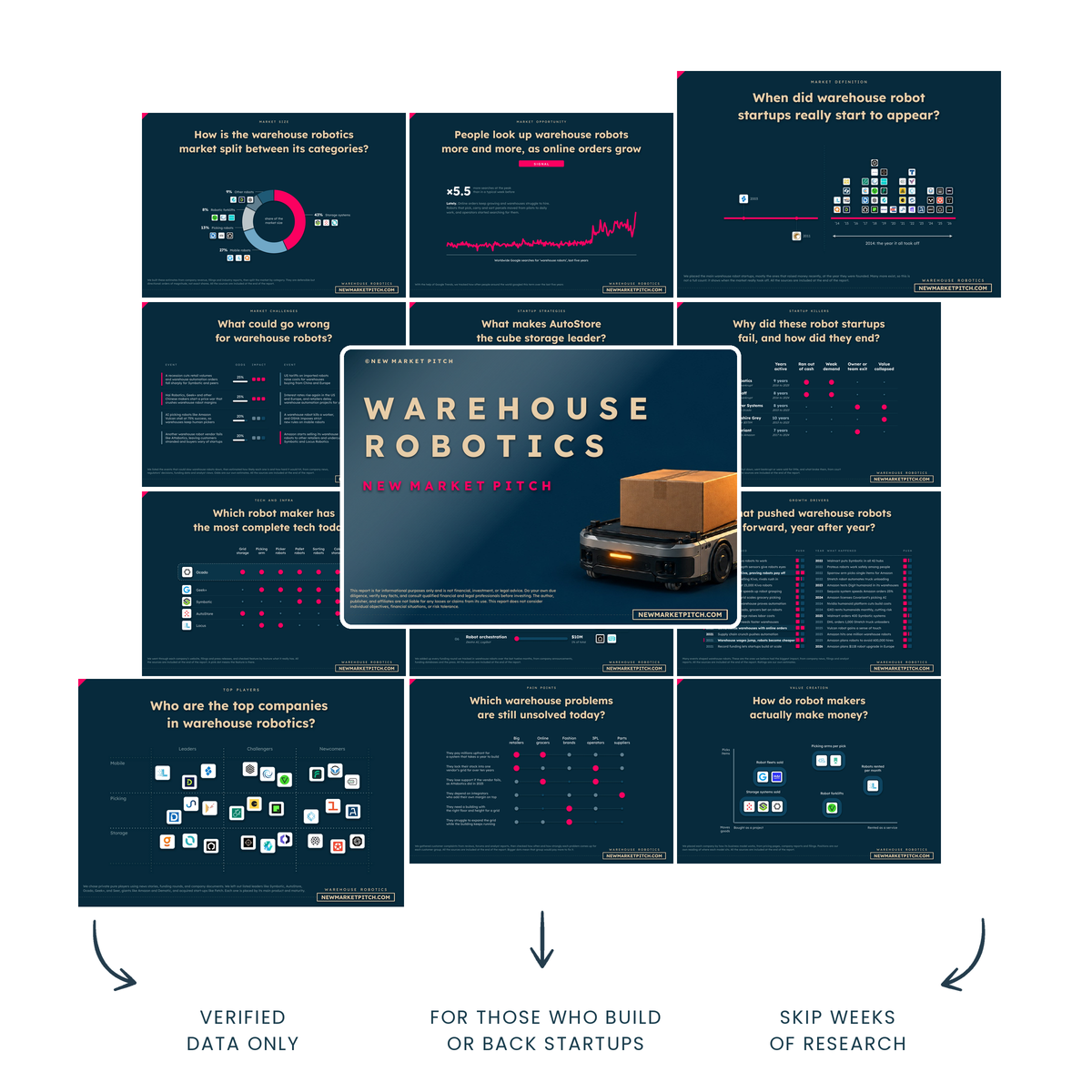
Whether you're building or investing in the warehouse robotics market, our report covers everything you need to know: the players, the money, and what's coming next.
Summary
Warehouse robotics beyond Amazon is already a multibillion-dollar commercial market. The broader warehouse automation industry generates approximately $25 billion to $30 billion annually, although robotics-specific spending cannot yet be isolated reliably from equipment, software and integration services.
Independent suppliers have proved that the opportunity is substantial. Symbotic generated $2.247 billion in fiscal 2025 revenue, AutoStore reported $538.6 million, and Ocado Technology Solutions generated £561.2 million. Together, these businesses produced more than $3.5 billion in revenue, even though their sales include more than robots alone.
Amazon's million-robot fleet makes the industry look more mature than the independent market actually is. Those machines were deployed over more than a decade inside one company's operations, whereas the International Federation of Robotics recorded 117,500 transportation and logistics robots sold worldwide in 2025.
Robot adoption is accelerating faster than the wider automation market. Transportation and logistics robot shipments grew 21% in 2025, while warehouse automation order intake increased only 7%, partly because higher equipment costs inflated project prices. More robots are being sold without a comparable surge in overall warehouse investment. More robots sold without a matching rise in spending is the kind of signal we track every quarter in our warehouse robotics market report.
The biggest independent suppliers are also heavily exposed to a few customers. Symbotic reported $22.3 billion in remaining performance obligations, nearly ten times its annual revenue, but much of that future business depends on Walmart and Exol. Large contracts establish commercial demand without proving that the customer base is broadly diversified.
Growth is surprisingly uneven. Symbotic's revenue increased 26% in fiscal 2025, Ocado Technology Solutions grew 13%, and AutoStore's revenue declined 10.4%. Warehouse robotics is already too diverse for a single adoption trend to explain every supplier's performance.
Walmart's automation difficulties expose the gap between buying robots and making them productive. Packaging variations, equipment reliability and integration costs can undermine ambitious deployment plans, even for a retailer with enormous financial resources. Amazon's advantage includes years of operational learning, not simply its robot count.
The market is expanding beyond American retail giants. GXO Logistics expects to operate nearly 20,000 robots by the end of 2026, while suppliers including Geek+, Hai Robotics, Exotec and AutoStore are serving international logistics operators. The harder challenge is reaching ordinary mid-sized warehouses profitably.
Economics and technological limits still determine adoption. Robots become more attractive when warehouses operate multiple shifts, while picking unusual or fragile items remains difficult. AutoStore's 72.4% gross margin and Symbotic's 6.5% adjusted EBITDA margin also show how differently suppliers can monetize automation.
A $50 billion broad warehouse automation market is credible over the next decade, but reaching it within five years from a $28 billion baseline would require approximately 12.3% annual growth, compared with Interact Analysis's 6% forecast. The real upside for independent robotics suppliers lies in making automation economical across thousands of smaller facilities, rather than replicating Amazon's extraordinary deployment scale.

Written by the New Market Pitch teamWe track new markets so founders and investors can move faster. About us
Is warehouse robotics already a big market without Amazon?
Warehouse robotics beyond Amazon is already a multibillion-dollar business, with several suppliers generating hundreds of millions or even billions in annual revenue.
The broader warehouse automation market generates roughly $24 billion to $32 billion a year, based on published 2025 estimates. That includes conveyors, sorting equipment, automated storage systems, software and integration services. Robots account for part of that spending, although public market data does not establish their exact share. That is why our warehouse robotics market report starts by drawing the boundaries of the market before putting any number on it.
The clearest evidence comes from companies selling automation to external customers. Symbotic generated $2.247 billion in fiscal 2025 revenue, AutoStore reported $538.6 million, and Ocado's Technology Solutions business generated £561.2 million. Together, these three suppliers reported more than $3.5 billion in revenue when converted into US dollars at approximate 2025 exchange rates. Their businesses overlap with warehouse robotics to different degrees, so this combined figure should not be treated as robot sales alone.
Amazon operates on another scale. The company announced its one-millionth deployed robot in June 2025, having spent more than a decade developing and installing automation across its fulfillment network.
Amazon builds much of its robotics infrastructure for its own warehouses, while independent suppliers need paying customers. Companies such as Symbotic, AutoStore and Ocado have already demonstrated that external customers will spend substantial amounts on these systems.
Does Amazon's million-robot fleet make the warehouse robotics market look bigger than it is?
Amazon's million-robot milestone makes warehouse robotics look more mature than the independent market actually is, because those robots were accumulated over many years inside one company's operations.
Amazon crossed one million deployed robots in June 2025, thirteen years after acquiring Kiva Systems for approximately $775 million. Its fleet includes several generations of mobile robots and other warehouse automation equipment developed for different tasks.
The International Federation of Robotics, meanwhile, recorded approximately 117,500 transportation and logistics service robots sold worldwide in 2025, up 21% from 2024. This category includes applications beyond warehouses and covers reporting suppliers rather than every manufacturer worldwide.
Even with those limitations, the comparison is useful. Amazon's cumulative robot fleet is more than eight times the annual worldwide sales volume reported for the broader transportation and logistics service robot category.
Amazon's million robots also have no publicly disclosed equivalent sales value. Counting them as commercial market demand would require estimating internal production costs, software development, integration and deployment spending.
For an independent robotics supplier, a more meaningful number is the money external customers pay for installed systems each year. Amazon's fleet demonstrates what warehouse automation can achieve at enormous scale, but it tells us little about the annual revenue available to outside vendors.

Your time is limited. In our report covering the warehouse robotics market, we put numbers on each part of the market, so you can see where it makes sense to focus.
How much is the global warehouse robotics market worth today?
The global warehouse automation market is worth approximately $25 billion to $30 billion annually, although the narrower market for robotic equipment and systems remains difficult to isolate.
The Business Research Company estimated the broader warehouse automation market at $23.92 billion in 2025. Fortune Business Insights placed it at $31.21 billion, while another warehouse automation systems study from The Business Research Company estimated $31.71 billion.
That leaves a difference of almost $8 billion between widely published estimates for essentially the same industry. The discrepancy comes largely from how research firms define warehouse automation and which equipment, software and services they include.
Taking roughly $28 billion as a working midpoint gives us a useful reference for the overall industry. But we cannot assign that entire figure to robotics. Conventional conveyors, fixed sorting systems and other nonrobotic equipment still account for substantial warehouse investment.
A robotic installation also includes far more than the robots. Customers may pay for storage infrastructure, software, integration, maintenance and engineering. Excluding those components would understate what robotics suppliers actually sell.
We use the $25 billion to $30 billion range for broad warehouse automation, while comparing actual supplier revenue and robot shipments to understand the robotics-specific business.
| Market or company | Published 2025 value | What the figure includes |
|---|---|---|
| Warehouse automation, TBRC | $23.92B | Equipment, software and services |
| Warehouse automation, Fortune Business Insights | $31.21B | Broad automation systems |
| Warehouse automation systems, TBRC | $31.71B | Automated systems and related components |
| Working broad-market midpoint | ~$28B | Our reference estimate |
| Symbotic revenue | $2.247B | Integrated warehouse automation |
| AutoStore revenue | $538.6M | Robotic storage systems |
| Ocado Technology Solutions revenue | £561.2M | Automation technology and services |
Are warehouse robots selling faster than before?
Warehouse robot sales are growing quickly in unit terms, but overall spending on warehouse automation is increasing much more slowly.
According to the International Federation of Robotics, worldwide sales of transportation and logistics service robots reached 117,500 units in 2025, an increase of 21% from 2024.
At the same time, Interact Analysis reported that global warehouse automation order intake grew just 7% during 2025. Part of that increase came from higher steel and labor costs, which pushed up the prices of automation projects.
These two datasets cover different markets, so we cannot subtract their growth rates to calculate a shift toward robotics. Still, the contrast is revealing.
Companies are buying more logistics robots, but the overall value of new warehouse automation orders is growing at a modest pace. Modular mobile robots can be deployed without the same upfront investment as a large automated distribution center, making them attractive when customers are cautious about capital spending.
The customer base also remains concentrated. Interact Analysis identified Amazon, Walmart, Tesco, Marks & Spencer and Ahold Delhaize among the large retailers supporting industry demand in 2025.
A few large warehouse projects can significantly influence annual order growth, even if adoption among smaller businesses changes very little.
The next test is whether smaller logistics companies start buying robots in much larger numbers. Interact Analysis expects demand to broaden toward mid-sized operators, but the latest available order data does not yet prove that this shift has happened at scale.

In our research about warehouse robots, we always try to gather several sources and make estimates that make sense, so you can work with solid numbers.
How big has Symbotic become in warehouse robotics?
Symbotic has become one of the largest independent warehouse automation suppliers, generating more than $2.2 billion in annual revenue, although a huge portion of its business depends on a few major customers.
The company reported fiscal 2025 revenue of $2.247 billion, up 26% from approximately $1.78 billion in fiscal 2024. Adjusted EBITDA reached $147 million, while its annual net loss was $91 million. Which business models keep their margins once the robots are installed is one of the questions our report on warehouse robots digs into.
Symbotic sells large automated warehouse systems combining autonomous robots, computer vision, storage infrastructure and software. Its technology is designed primarily for major distribution centers handling cases and pallets, rather than small warehouses looking to automate a few picking stations.
Walmart provides the clearest example of Symbotic's commercial scale. Their agreement covers automation across Walmart's 42 regional distribution centers, with additional arrangements involving other facilities and applications.
Symbotic reported $22.3 billion in remaining performance obligations in its filing for the quarter ended December 27, 2025. That is almost ten times the company's fiscal 2025 revenue. The amount represents future contractual obligations to be fulfilled over multiple years, rather than revenue already earned.
The size of that backlog is remarkable for a warehouse robotics company. It also exposes Symbotic's dependence on a limited number of major relationships, particularly Walmart and Exol.
Symbotic has clearly proved that customers will sign multibillion-dollar contracts for warehouse robotics. We have much less evidence that dozens of unrelated customers are ready to make commitments of comparable size.
Are AutoStore and Ocado growing as fast as Symbotic?
AutoStore and Ocado are substantial warehouse robotics businesses, but their recent financial results show just how differently suppliers are performing.
AutoStore reported $538.6 million in revenue and other operating income for 2025, down 10.4% from $601.4 million in 2024. Its robotic storage systems are used to retrieve products from compact grid-based storage installations. Despite the revenue decline, the company maintained a gross margin of 72.4%.
Ocado's Technology Solutions business moved in the opposite direction. It generated £561.2 million in pro forma revenue in fiscal 2025, up 13% from £496.5 million. Ocado supplies technology and services for automated grocery fulfillment, where systems must handle large assortments of products and demanding delivery schedules.
Symbotic's 26% revenue growth was therefore substantially stronger than either competitor's.
These differences also reflect the products being sold. Symbotic specializes in large distribution-center installations, AutoStore focuses on dense robotic storage, and Ocado concentrates on grocery fulfillment technology.
A slowdown in one category does not necessarily indicate weaker demand across warehouse robotics. AutoStore's declining revenue, for instance, coincided with growing sales at Symbotic and Ocado.
Still, the results challenge the idea that all warehouse robotics suppliers automatically benefit when automation adoption increases. Customer spending is selective, project schedules can change, and different warehouse activities have very different economics.

In our market report about warehouse robots, we don't want to repeat what boring consulting reports say. Instead, we show you the real and latest market signals that matter.
Can Walmart really catch up with Amazon in warehouse robotics?
Walmart is making enormous investments in warehouse robotics, but the operational challenges reported in its automation program show how difficult it is to match Amazon's deployment experience.
Walmart's agreement with Symbotic covers its 42 regional distribution centers, and the retailer has pursued additional automation projects across grocery distribution and fulfillment.
There is an important difference between the two companies' networks. Amazon primarily uses its fulfillment infrastructure to handle huge volumes of individual e-commerce orders. Walmart must also move cases and pallets efficiently from distribution centers into physical stores.
Symbotic's technology addresses that problem by automating how cases are stored, retrieved and organized into pallets for store replenishment. It can reduce manual handling and produce more efficient outbound loads.
However, a Wall Street Journal investigation published in October 2026 described implementation difficulties across Walmart's automation program. Reported problems included packaging compatibility, unusual product dimensions, robot reliability and operating costs.
Those challenges are especially revealing because Walmart has the financing, warehouse volume and technical partnerships that smaller retailers generally lack.
Amazon's robotics advantage reflects more than the number of robots it owns. The company has accumulated years of experience designing fulfillment processes around automation, refining its software and adjusting warehouse operations.
Walmart is building substantial automated capacity, but matching Amazon's robot count would not automatically deliver the same productivity.
Which companies are leading warehouse robotics beyond Amazon?
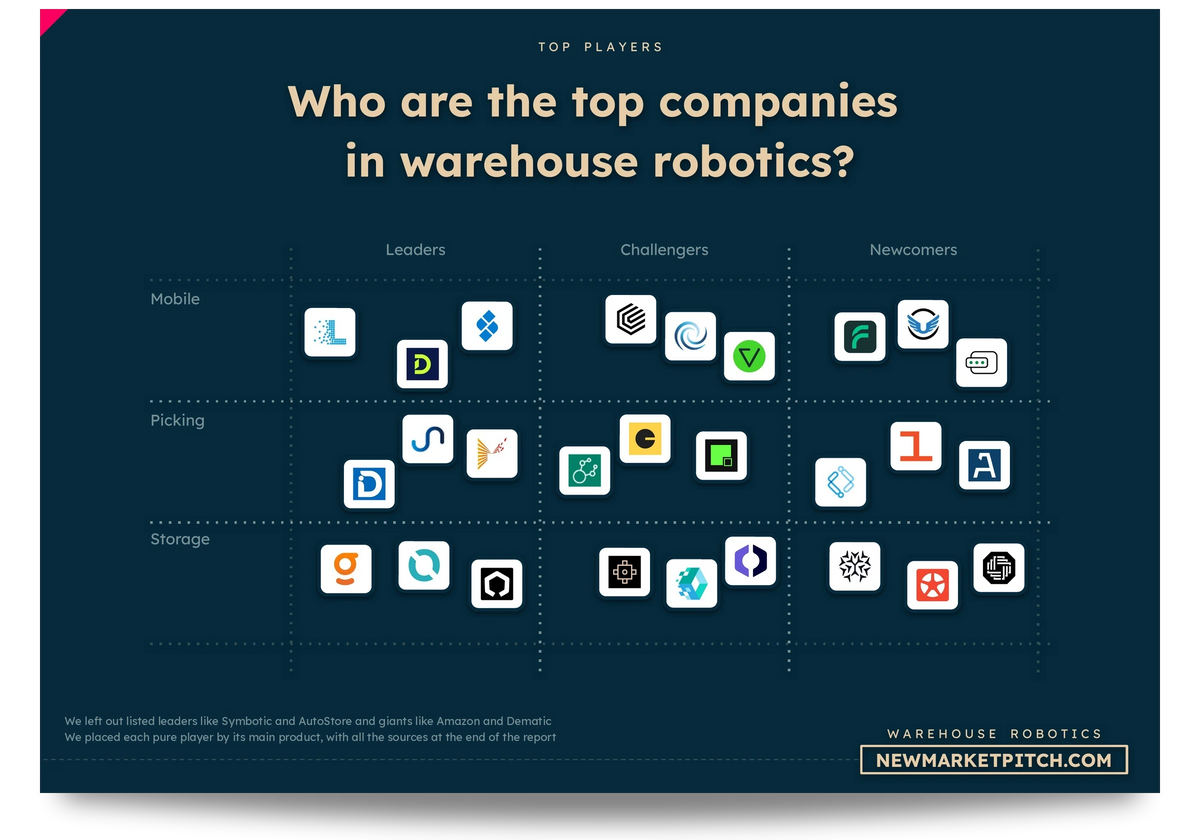
Symbotic, AutoStore, Ocado, Exotec, Geek+, Hai Robotics and several established automation integrators are among the most important commercial suppliers competing beyond Amazon.
There is no reliable single ranking because these companies sell different technologies and disclose different metrics.
Symbotic focuses on large distribution centers. AutoStore and Exotec compete in robotic storage and goods-to-person fulfillment. Geek+ and Hai Robotics supply mobile robotic systems, while Ocado specializes in automated grocery operations.
Traditional warehouse automation companies also have substantial positions in the market. Dematic, KNAPP, Swisslog, Vanderlande and SSI Schaefer combine robotic equipment with storage infrastructure, conveyor systems, software and systems integration.
The diversity reflects how warehouses actually operate. A grocery warehouse has different needs from a pharmaceutical distribution center or an apparel fulfillment operation.
Robot counts alone would make a poor ranking. A supplier installing thousands of relatively inexpensive mobile robots might generate less revenue than another delivering several complex automated storage projects.
| Company | Main specialization | What customers buy |
|---|---|---|
| Symbotic | Large distribution centers | Case and pallet automation |
| AutoStore | Compact robotic storage | Grid-based storage and retrieval |
| Ocado | Grocery fulfillment | Automated fulfillment platforms |
| Exotec | Order fulfillment | Skypod robotic storage |
| Geek+ | Mobile warehouse robots | Picking, sorting and transport |
| Hai Robotics | Goods-to-person automation | Autonomous case-handling systems |
| Dematic | Large automation projects | Integrated warehouse systems |
| KNAPP | Distribution and fulfillment | Shuttle systems and robotic picking |
| Swisslog | Storage and fulfillment | Robotics and warehouse integration |
| Vanderlande | Logistics and parcel operations | Automated handling and sorting |

In our document detailing everything you need to know about warehouse robotics, we like to show you the big picture. We know your time is precious, so we make every page quick to read and packed with as much learning as possible per minute.
Are warehouse robots spreading beyond big American retailers?
Warehouse robotics is increasingly used by third-party logistics companies and international operators, with GXO Logistics providing one of the clearest examples outside Amazon and Walmart.
GXO expects to operate nearly 20,000 robots by the end of 2026, according to its shareholder communications. The company manages warehouses for external customers across several industries, making its robot fleet particularly interesting. How fleets like this one grow from a pilot to dozens of sites is one of the winning patterns we study in our market report about warehouse robots.
Unlike a retailer automating its own operations, GXO can deploy robotics across warehouses serving different brands. Its installations include mobile robots, collaborative systems and goods-to-person equipment.
The company's 2025 annual report describes robotics as a tool for improving warehouse productivity, picking efficiency and workplace safety. GXO also reported more than $1 billion in new business wins for the third consecutive year, although that figure covers logistics contracts broadly and should not be interpreted as robotics revenue.
Compared with Amazon's million-robot milestone, GXO's targeted fleet remains roughly 50 times smaller. The comparison involves different reporting dates and operating models, but it illustrates the extraordinary scale Amazon has already reached.
The opportunity extends well beyond the United States. Geek+ and Hai Robotics compete internationally from China, AutoStore originates from Norway, KNAPP from Austria, and Swisslog from Switzerland.
Regional demand is uneven, however. Interact Analysis expects average annual warehouse automation growth of approximately 7% in Europe, the Middle East and Africa between 2025 and 2030, compared with 6% in the Americas and 5% in Asia-Pacific.
Its research also estimated that Asia-Pacific warehouse automation revenue declined 8% in 2025, partly because of weak conditions in China.
There is already a large international supplier ecosystem and a growing number of commercial deployments, even though different regions are moving at very different speeds.
Are warehouse robots actually cheaper than warehouse workers?
Warehouse robots can be cheaper than manual operations when they run frequently enough, but installation costs and ongoing maintenance can quickly destroy an attractive payback calculation.
Consider a hypothetical $10 million automation project. Recovering that investment through operating savings over five years would require $2 million in annual net savings, ignoring financing costs and residual value.
At a fully loaded employment cost of $50,000 per warehouse worker, that equals the annual cost of 40 employees.
However, an installation rarely eliminates labor costs dollar for dollar. The customer may need new maintenance staff, software subscriptions, electricity, spare parts and specialized technical support. Productivity can also fall temporarily while workers adjust to the new equipment.
The economics become more attractive when robots operate across several shifts. A large distribution center running close to 24 hours per day can spread equipment costs across far more productive hours than a warehouse operating one daytime shift.
Labor savings are also only part of the calculation. Faster order processing, lower error rates and better storage density can generate meaningful benefits.
Symbotic's customer contracts demonstrate that major retailers see enough potential savings to justify large investments. Walmart's reported deployment difficulties show why those savings should be measured after the systems reach stable operation.
For customers, the decisive figures are cost per order, cost per case, throughput and reliability. A fast robot is only valuable when the full installation makes the warehouse cheaper or more productive.

In our report covering the warehouse robotics market, we turn what is vague and complex into simple, useful visuals. Market maps like this one show you at a glance where every startup stands.
Why aren't smaller warehouses buying robots everywhere?
Smaller warehouses are adopting robotics more slowly because many installations still require substantial upfront spending, operational changes and technical support.
A large retailer can spread engineering and maintenance expenses across multiple sites. A small logistics company operating one or two warehouses has less room for costly mistakes. Which warehouse jobs buyers will pay to automate first, and which still need people, is mapped in our warehouse robotics report.
The economics also depend on workload. A facility running one shift per day may struggle to recover the cost of a complex automated system, especially when order volumes fluctuate significantly throughout the year.
This has created an opening for modular robotic systems. Companies such as Locus Robotics, Geek+, Hai Robotics and Exotec offer different approaches to automating warehouse activities without necessarily replacing the entire operating infrastructure.
Some systems can be introduced gradually, allowing customers to automate transport, retrieval or picking before committing to larger changes.
Financing models are evolving too. The International Federation of Robotics reported that robot-as-a-service arrangements grew 42% in transportation and logistics applications during 2024. These contracts can reduce initial capital requirements by allowing customers to pay over time.
Subscriptions still need to generate enough savings to justify their costs, and integration remains necessary. But for smaller warehouses, being able to introduce automation without financing a complete facility redesign makes a considerable difference.
The size of this customer segment is important. Warehouse robotics suppliers will have a much broader market if they can profitably serve ordinary logistics facilities, rather than depending mainly on giant retailers.
Are warehouse robotics companies actually profitable?
Some warehouse robotics suppliers are profitable on selected operating measures, but the financial results of AutoStore, Symbotic and Ocado show that attractive technology does not automatically produce attractive net margins.
AutoStore reported a 72.4% gross margin in 2025, unusually high for a business associated with physical automation equipment. However, gross profit excludes research, sales, administrative expenses and other costs.
Symbotic generated $147 million in adjusted EBITDA on $2.247 billion of revenue, an adjusted EBITDA margin of approximately 6.5%. The company still reported a $91 million annual net loss.
Ocado Technology Solutions recorded £140.3 million in pro forma adjusted EBITDA on £561.2 million in revenue, equivalent to roughly 25%. That measure excludes certain expenses and cannot be directly compared with another supplier's net profit.
These companies have different financial structures. Symbotic delivers complex large-scale installations, AutoStore sells proprietary robotic storage technology, and Ocado combines technology with ongoing services.
Recurring software and maintenance revenue can make the business more predictable after installation. Still, public disclosures do not establish how much of the industry's profit comes from these recurring contracts.
The hardware, software and integration mix can have a major influence on profitability. We have strong evidence that warehouse robotics can generate substantial sales, but much less evidence that suppliers consistently earn high net margins.

Our research about warehouse robots gets updated several times a month, so you always get the latest view of where things stand.
Can AI make warehouse robots do much more than move boxes?
AI is helping warehouse robots handle more complex tasks, but reliable picking and manipulation remain far harder than moving standardized containers or pallets.
Amazon provides an interesting comparison within its own operations. The company has deployed more than one million robots, many of which handle structured material movement. Its newer Blue Jay system is being developed to tackle more complicated manipulation tasks.
Amazon said in 2025 that Blue Jay was being tested in South Carolina and could handle approximately 75% of the different item types stored at its sites during testing.
That is a promising result, although it measures item compatibility in a specific setting. It does not mean Blue Jay completes 75% of warehouse work without human assistance.
Robotic picking becomes difficult when products have unpredictable dimensions, flexible packaging, reflective surfaces or fragile contents. Objects can also be stacked awkwardly or arrive damaged.
The reported difficulties in Walmart's automation program underline the same problem. Unusual packaging and product dimensions can interfere with equipment designed around predictable handling conditions.
Robotic transport and automated storage are therefore much more established commercially than general-purpose robotic picking.
AI could expand the warehouse robotics market by allowing suppliers to automate a greater share of picking, unloading, packing and exception handling. Today, though, most proven systems still perform relatively structured and repetitive work.
Replacing warehouse workers entirely would require robots to handle these less predictable activities at a competitive cost. The available deployment evidence supports gradual task automation much more strongly than near-term fully autonomous warehouses.
Could warehouse robotics become a $50 billion market?
A $50 billion global warehouse automation market is credible over the coming decade, but reaching that level quickly would require faster growth than some of the latest industry forecasts suggest.
Using our approximate $28 billion starting point for broad warehouse automation, we can calculate what different growth rates would produce. Our own estimate of the market, with every assumption visible, is in our warehouse robotics market report.
Interact Analysis forecasts approximately 6% annual global warehouse automation growth between 2025 and 2030. At that pace, a $28 billion market would reach approximately $37.5 billion after five years.
That represents nearly $10 billion in additional annual revenue, which would be a substantial expansion for the industry.
Reaching $50 billion over the same five-year period would require annual growth of about 12.3%, more than twice that assumed in the Interact Analysis projection.
Fortune Business Insights is considerably more optimistic over the longer term. It forecasts the warehouse automation market growing from $31.21 billion in 2025 to $119.86 billion by 2034.
The gap between these forecasts is substantial. Differences in market definitions and growth assumptions make direct comparisons imperfect, but the contrast shows how much uncertainty remains around future spending.
There is also a distinction between the wider automation industry reaching $50 billion and warehouse robotics alone generating that amount. Robots would need to capture a much larger share of overall automation spending for the narrower market to approach that level.
The biggest opportunities involve expanding adoption among medium-sized warehouses and making robotic picking, unloading and other labor-intensive tasks commercially reliable.
For now, the strongest near-term evidence supports more moderate growth than the most aggressive forecasts. A much larger industry is plausible, but getting there will take more than another wave of giant distribution-center projects.

In our market report about warehouse robots, you will always find fresh funding data, taken straight from our own verified funding database.
How big is the warehouse robotics market beyond Amazon, really?
Warehouse robotics beyond Amazon is already a major commercial industry, supported by multibillion-dollar suppliers, growing robot shipments and substantial investment from retailers and logistics operators worldwide.
The broader warehouse automation market generates approximately $25 billion to $30 billion annually. Robotics represents an important part of that spending, although existing public data does not allow us to calculate a trustworthy standalone total for robotic systems.
The clearest evidence of scale comes from independent suppliers. Symbotic generated $2.247 billion in fiscal 2025 revenue, AutoStore reported $538.6 million, and Ocado Technology Solutions generated £561.2 million. Meanwhile, the International Federation of Robotics recorded 117,500 transportation and logistics service robots sold worldwide in 2025, up 21% from the previous year.
Demand remains uneven. Interact Analysis reported only 7% growth in warehouse automation order intake during 2025, partly supported by higher project prices and spending from a handful of major customers. AutoStore's revenue declined, while Symbotic expanded rapidly. Walmart's installation difficulties also show how demanding large automation projects can become.
Warehouse robotics is finding customers beyond Amazon and Walmart. GXO expects its robot fleet to approach 20,000 units, and suppliers such as Geek+, Exotec, Hai Robotics and AutoStore are selling systems across different industries and regions.
Warehouse robotics is now a real industrial market with substantial customer spending. What remains unproven is whether adoption can spread fast enough among smaller warehouses to match the scale of Amazon's deployment.
That is where the next major expansion would come from. Amazon has already demonstrated what robots can do inside an exceptionally large fulfillment network. The commercial opportunity for independent suppliers is to make those economics work for the much wider warehouse industry.
Our methodology
This analysis examines how large the warehouse robotics market has become beyond Amazon's internal deployments. We assessed commercial supplier revenue, published market estimates, robot shipments, warehouse automation orders, customer contracts, operating economics and technological capabilities. The goal was to measure the independent market through observable business activity rather than extrapolate from Amazon's cumulative robot fleet.
We used seven analytical dimensions: market boundaries and commercial activity; market sizing and supplier financials; adoption and demand momentum; competitive structure and customer diversification; profitability and contractual commitments; deployment economics and technological maturity; and long-term growth potential. For each dimension, we identified recent evidence, aggregated the relevant figures, checked what they actually measured and assessed whether the combined findings supported a stronger conclusion.
For market sizing, we compared published estimates from The Business Research Company, its separate warehouse automation systems study, and Fortune Business Insights. Their figures establish a broad industry range but include equipment, conventional automation, software and related services. Our approximately $28 billion midpoint is a working reference, not an independently measured robotics-only market value.
For adoption momentum, we used the International Federation of Robotics' World Robotics 2026 Service Robots findings, including 117,500 transportation and logistics robots sold in 2025, and Interact Analysis's 2025 warehouse automation order-intake research. We also examined its analysis of concentrated supplier and customer growth. Robot units, automation order values and installed fleets were kept separate because they cover different populations, time periods and types of activity.
For financial evidence, we prioritized Symbotic's fiscal 2025 results, its February 2026 Form 10-Q, AutoStore's 2025 Annual Report, and Ocado Group's full-year 2025 results. We distinguished reported revenue from adjusted EBITDA, net income and future performance obligations. The supplier revenue comparison demonstrates commercial scale, but does not represent an additive estimate of the entire robotics market.
For customer diversification and deployment maturity, we examined Amazon's million-robot milestone, its Blue Jay announcement, Symbotic's Walmart distribution-center partnership, and its expanded fulfillment automation agreement. We also used GXO Logistics' 2025 full-year earnings materials to assess robotics adoption across third-party logistics operations.
We incorporated operational evidence from The Wall Street Journal's investigation into Walmart's warehouse automation challenges to assess reliability, packaging compatibility and implementation costs. For financing models, we used the International Federation of Robotics' World Robotics 2025 service robotics findings, including growth in robot-as-a-service arrangements. These sources helped test whether the economic and technical assumptions behind faster automation adoption were supported by deployment experience.
Finally, we assessed long-term potential by applying published growth expectations to the approximately $28 billion broad-market reference. The 6% growth scenario follows Interact Analysis's 2025–2030 outlook, while the faster expansion case is compared with Fortune Business Insights' projections. Calculated scenarios are identified separately from published estimates. Across the analysis, we favored company filings, official disclosures, robotics industry statistics, specialist market research and reporting with direct operational evidence, assessing how those observations reinforced or challenged one another before drawing conclusions.

In our document detailing everything you need to know about warehouse robotics, we look at what the winners do differently, so you can learn from the best instead of guessing.
Written by the New Market Pitch teamWe track new markets so founders and investors can move faster. About us