What are the top industrial robotics startups by revenue?
Whether you're building or investing in the industrial robotics market, our report covers everything you need to know: the players, the money, and what's coming next.
Summary
Exotec is the number-one industrial robotics startup by revenue, with ~$378M of fiscal-year revenue for 2025. Agile Robots follows with ~$330M of annual revenue for 2025, while Hai Robotics recorded ~$282M of fiscal-year revenue for 2025.
That is a different picture from the robot arms many people associate with factory automation. Warehouse operators already spend large sums on storage, picking and software, and young robotics companies can win those budgets.
Exotec installs Skypod storage systems, Agile Robots automates factory production, and Hai Robotics builds robotic storage. Their customers already need these jobs done. Each supplier sells a way to do them faster or with fewer manual steps.
Humanoids are harder to judge. AgiBot has disclosed substantial annual sales, though it also sells outside industrial work and carries no rank here, while several highly publicized American humanoid makers still offer no comparable revenue figure.
Figure AI's deployment at BMW demonstrates real factory work, not its annual sales. Agility Robotics has disclosed revenue, yet the gap between customer orders, field deployments and recognized sales remains an important part of its story.
Outside humanoids, NEURA Robotics reports a large backlog, Path Robotics reports bookings, and Pickle Robot has a reported contract value. Those figures show demand, but the work has not necessarily been delivered and recorded as sales.
China has plenty of companies selling robotic arms, mobile factory robots, welding systems and robot-control software. Several publish audited figures, giving us a much firmer view of sales than their robot videos do.
Europe has serious sellers too. Exotec and Agile Robots have become sizable businesses, while Dexory and Solent Automation sell more specialized tools to warehouses and factories.
American startups have big-name customers and working machines. Yet some publish robot activity or let outside analysts estimate their revenue, leaving us less certain about their sales than about their deployments.
For now, warehouse systems and established factory work bring the clearest documented sales. A famous robot or a huge order book can point to future revenue, but it cannot replace money already earned.

Written by the New Market Pitch teamWe track new markets so founders and investors can move faster. About us

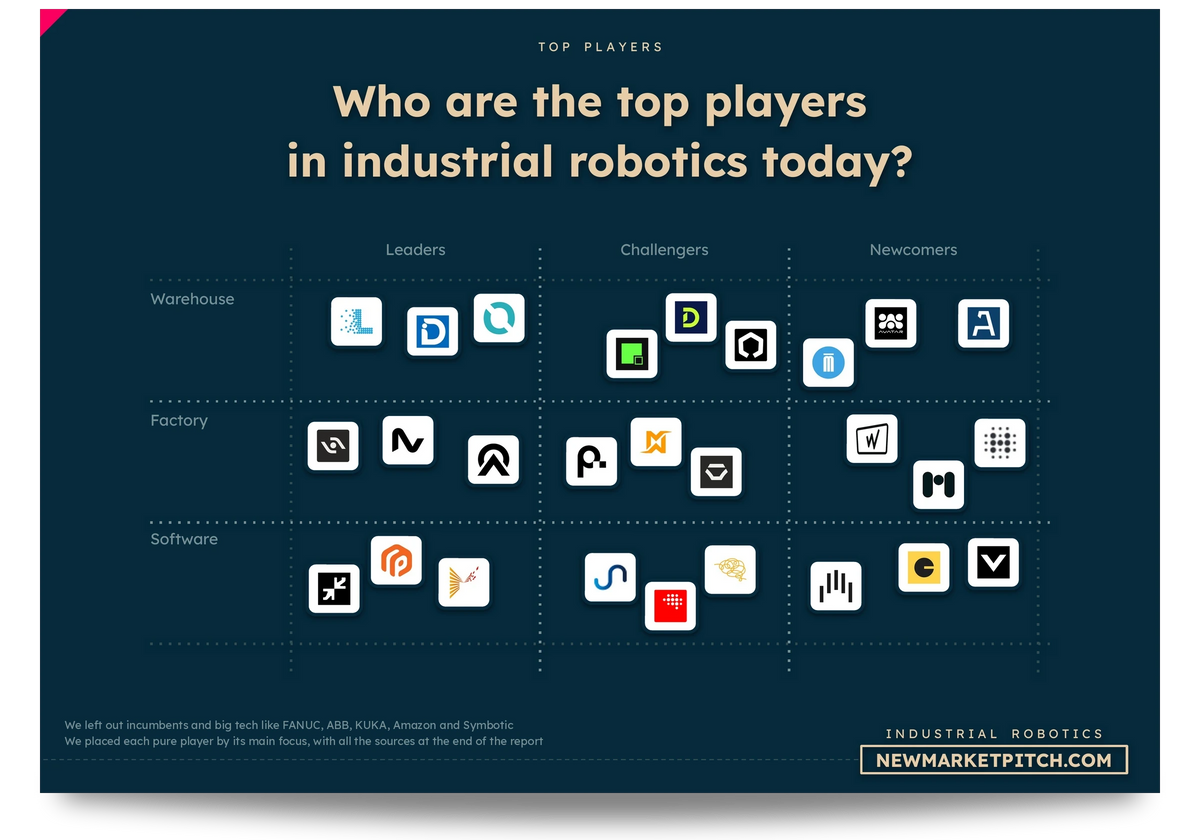
In our report covering the industrial robotics market, we turn what is vague and complex into simple, useful visuals. Market maps like this one show you at a glance where every startup stands.
The ranking of top startups in the industrial robotics market by revenue
Below is a table ranking the startups of this market by their current revenue scale. You can find our methodology at the end of this page.
If you want a deeper understanding of the market and its current dynamics, get our report on the industrial robotics market.
| Ranking | Company | Latest Metric | Metric Type | Freshness | Disclosed When | Source Quality | Confidence | Segment | Why This Ranking | Local Metric | Country |
|---|---|---|---|---|---|---|---|---|---|---|---|
| 1 | Exotec | ~$378M | Fiscal-Year Revenue | Fresh · 11mo | 2026 | Filed / Audited | High | Warehouse, Intralogistics & Industrial Inspection Robots | A regulatory filing records ~$378M of fiscal-year revenue through December 2025. It is a recent full-year figure for the warehouse automation business, not an annualized sales pace. | EUR 343M | fr |
| 2 | Agile Robots | ~$330M | Annual Revenue | Fresh · 11mo | Aug 3, 2026 | Company Disclosed | High | Industrial Robot Hardware & Cobots | The company disclosed ~$330M of annual revenue for 2025, reported by the Wall Street Journal in August 2026. It reflects an established automation business, not the following year's sales target. | EUR 300M | de |
| 3 | Hai Robotics | ~$282M | Fiscal-Year Revenue | Fresh · 11mo | Sep 17, 2026 | Filed / Audited | High | Warehouse, Intralogistics & Industrial Inspection Robots | A regulatory filing records ~$282M of fiscal-year revenue through December 2025. The recent figure measures completed warehouse automation sales rather than installations announced for later delivery. | CNY 2.02B | cn |
| 4 | ROKAE | ~$73M | Fiscal-Year Revenue | Fresh · 11mo | Jun 30, 2026 | Filed / Audited | High | Industrial Robot Hardware & Cobots | A regulatory filing records ~$73M of fiscal-year revenue through December 2025. The filed result is close to Dobot Robotics' ~$68.9M for the same period. | CNY 522M | cn |
| 5 | Dobot Robotics | ~$68.9M | Fiscal-Year Revenue | Fresh · 11mo | Mar 30, 2026 | Filed / Audited | High | Industrial Robot Hardware & Cobots | Its annual filing reports ~$68.9M of fiscal-year revenue through December 2025, compared with ROKAE's ~$73M. The result covers actual product sales, not only the newer humanoid range. | CNY 492M | cn |
| 6 | SEER Robotics | ~$61.9M | Fiscal-Year Revenue | Fresh · 11mo | Jun 15, 2026 | Filed / Audited | High | Factory Material Handling & Intralogistics | Audited financial statements record ~$61.9M of fiscal-year revenue through December 2025. The reported business includes industrial robots and robot controllers. | CNY 442M | cn |
| 7 | Mech-Mind Robotics | ~$54.4M | Fiscal-Year Revenue | Fresh · 11mo | Aug 24, 2026 | Filed / Audited | High | Industrial Robotic Software & Integration | A regulatory filing records ~$54.4M of fiscal-year revenue through December 2025. The figure captures commercial robot vision and integration sales, not an AI model valuation. | CNY 389M | cn |
| 8 | YOUIBOT | ~$47.6M | Fiscal-Year Revenue | Fresh · 11mo | Mar 31, 2026 | Filed / Audited | High | Factory Material Handling & Intralogistics | A regulatory filing records ~$47.6M of fiscal-year revenue through December 2025, close to DEEP Robotics' ~$47.2M. Its manufacturing mobile robots are a documented sales business. | CNY 340M | cn |
| 9 | DEEP Robotics | ~$47.2M | Fiscal-Year Revenue | Fresh · 11mo | May 18, 2026 | Filed / Audited | High | Industrial Robot Hardware & Cobots | A regulatory filing records ~$47.2M of fiscal-year revenue through December 2025, alongside YOUIBOT's ~$47.6M. This measures actual robot sales, not inspection mileage or robot demonstrations. It ranks ahead of Mujin, whose figure covers only one segment. | CNY 337M | cn |
| 10 | Mujin | ~$24.5M | Segment Revenue | Aging · 23mo | 2025 | Company Disclosed | Medium | Industrial Robotic Software & Integration | A Japanese company declaration reports ~$24.5M of segment revenue for fiscal 2024. It is an aging partial-business measure and is treated as a minimum rather than total company sales. | JPY 3.6B | jp |
| 11 | Boqing Technology | ~$22.1M | Fiscal-Year Revenue | Fresh · 11mo | Nov 10, 2026 | Filed / Audited | High | Welding, Cutting & Surface Processing | A regulatory filing records ~$22.1M of fiscal-year revenue through December 2025. That completed-year welding business is close to DUCO Robotics' ~$21.5M. | CNY 158M | cn |
| 12 | DUCO Robotics | ~$21.5M | Fiscal-Year Revenue | Fresh · 11mo | Apr 24, 2026 | Filed / Audited | High | Industrial Robot Hardware & Cobots | A regulatory filing records ~$21.5M of fiscal-year revenue through December 2025, beside Boqing Technology's ~$22.1M. Its figure covers completed sales, unlike AI² Robotics' half-year figure. | CNY 154M | cn |
| 13 | AI² Robotics | $15M | Half-Year Revenue | Fresh · 17mo | Sep 11, 2025 | Company Disclosed | Medium | Industrial Robot Hardware & Cobots | The company disclosed $15M of half-year revenue for the six months through June 2025, reported by Reuters. This is not a full-year total and is treated as a minimum. | cn | |
| 14 | Rapyuta Robotics | ~$12.9M | Fiscal-Year Revenue | Aging · 23mo | Company Disclosed | Medium | Warehouse, Intralogistics & Industrial Inspection Robots | A Japanese company declaration reports ~$12.9M of fiscal-year revenue through December 2024. The older full-year figure is similar in scale to Gather AI's ~$10–15M current run-rate, but the measures differ. | JPY 1.9B | jp | |
| 15 | Gather AI | ~$10–15M | Revenue Run-Rate | Very Fresh · 5mo | Jun 17, 2026 | Company Disclosed | Medium | Warehouse, Intralogistics & Industrial Inspection Robots | The company disclosed a ~$10–15M annualized revenue run-rate as of June 2026 in a CEO interview. It is a current sales pace, not full-year recognized revenue. A range is placed at its midpoint, which sits just below Rapyuta Robotics' ~$12.9M. | us | |
| 16 | ESTUN Codroid | ~$7.02M | Fiscal-Year Revenue | Fresh · 11mo | Aug 4, 2026 | Filed / Audited | High | Industrial Robot Hardware & Cobots | A regulatory filing records ~$7.02M of fiscal-year revenue through December 2025. ESTUN Automation acquired the business in September 2026, after the reported sales period. | CNY 50.2M | cn |
| 17 | Dexory | ~$4.1M | Fiscal-Year Revenue | Aging · 20mo | Apr 1, 2026 | Filed / Audited | Medium | Warehouse, Intralogistics & Industrial Inspection Robots | Filed accounts record ~$4.1M of fiscal-year revenue for the year ended March 2025. The accounting period is older than most calendar-year results in the ranking. | GBP 3.2M | gb |
| 18 | Twinny | ~$3.7M | Annual Revenue | Fresh · 11mo | Sep 15, 2026 | Company Disclosed | High | Warehouse, Intralogistics & Industrial Inspection Robots | The company disclosed ~$3.7M of annual revenue for 2025, reported by the Korean press in September 2026. This is a completed-year warehouse robotics figure. | KRW 5B | kr |
| 19 | Solent Automation | ~$2.84M | Annual Revenue | Fresh · 11mo | Sep 17, 2026 | Company Disclosed | High | Assembly, Machine Tending & Packaging | Republic Europe materials disclose ~$2.84M of annual revenue for 2025. The company reports actual factory automation sales rather than the value of its future project pipeline. | GBP 2.22M | gb |
| 20 | Agility Robotics | $1.78M | Fiscal-Year Revenue | Fresh · 11mo | Sep 4, 2026 | Filed / Audited | High | Industrial Robot Hardware & Cobots | Regulatory filings record $1.78M of fiscal-year revenue through December 2025. This is recognized humanoid robot business revenue, not the value of later Digit orders. | us | |
| 21 | Unbox Robotics | ~$1.71M | Fiscal-Year Revenue | Aging · 20mo | Apr 8, 2026 | Third-Party Estimate | Low | Warehouse, Intralogistics & Industrial Inspection Robots | CRISIL estimated ~$1.71M of fiscal-year revenue for the year ended March 2025. It is less certain than Agility Robotics' $1.78M filed result and is not a company disclosure. | INR 142M | in |
| 22 | Nomagic | ~$1.38M | Segment Revenue | Aging · 23mo | Filed / Audited | Medium | Warehouse, Intralogistics & Industrial Inspection Robots | Polish filings record ~$1.38M of segment revenue for fiscal 2024. This is an aging, partial-business minimum rather than the company's full current sales. It sits below Unbox Robotics, whose larger figure is an estimate. | PLN 5.3M | pl | |
| NR | GreyOrange | $200M | Annual Revenue | Aging · 23mo | Third-Party Estimate | Low | Warehouse, Intralogistics & Industrial Inspection Robots | An automated company-data source estimates $200M of annual revenue for 2024. No second independent estimate confirms it, so the figure remains unranked. | us | ||
| NR | Locus Robotics | $180M | ARR | Very Fresh · 5mo | Jul 6, 2026 | Third-Party Estimate | Low | Warehouse, Intralogistics & Industrial Inspection Robots | Sacra estimates $180M of ARR as of June 2026. ARR is annualized recurring sales, not completed-year revenue, and the unconfirmed single analyst estimate remains unranked. | us | |
| NR | ANYbotics | $176M | Annual Revenue | Undated | Third-Party Estimate | Low | Warehouse, Intralogistics & Industrial Inspection Robots | An automated company-data website lists $176M of annual revenue without a period. Its age and accuracy are unverified, so it receives no rank. | ch | ||
| NR | AgiBot | ~$147M | Annual Revenue | Fresh · 11mo | Apr 20, 2026 | Company Disclosed | Medium | Industrial Robot Hardware & Cobots | The company disclosed ~$147M of annual revenue for 2025, reported by Yicai in April 2026. AgiBot also sells robots outside industrial work and does not publish its industrial share, so the figure stays unranked. | CNY 1.1B (~$147M per Yicai) | cn |
| NR | Mind Robotics | $41M | Annual Revenue | Period not stated · collected 8mo ago | Period not stated | Third-Party Estimate | Low | Robot Workcells & Production Automation | An automated company-data website lists $41M of annual revenue, collected in March 2026 without a stated sales period. One unconfirmed estimate is insufficient for a rank. | us | |
| NR | Leju Robotics | ~$36.1M | Fiscal-Year Revenue | Fresh · 11mo | May 19, 2026 | Filed / Audited | Medium | Industrial Robot Hardware & Cobots | A regulatory filing records ~$36.1M of fiscal-year revenue through December 2025. Leju also sells robots outside industrial work and does not publish its industrial share, so the figure stays unranked. | CNY 258M | cn |
| NR | Outrider | $35.7M | Annual Revenue | Undated | Third-Party Estimate | Low | An automated company-data source suggests $35.7M of annual revenue but does not state the period. There is no independent company confirmation, so it remains unranked. | us | |||
| NR | Gecko Robotics | $34.5M | Annual Revenue | Historical · 35mo | Third-Party Estimate | Low | Warehouse, Intralogistics & Industrial Inspection Robots | A company-data website estimates $34.5M of annual revenue for 2023. The historical estimate has no independent confirmation and cannot support a revenue rank. | us | ||
| NR | Standard Bots | $24M | Revenue Run-Rate | Fresh · 11mo | 2026 | Third-Party Estimate | Low | Industrial Robot Hardware & Cobots | Sacra estimates a $24M annualized revenue run-rate as of December 2025. It is not a full-year result or a company disclosure, so the single estimate stays unranked. | us | |
| NR | DiFACTO Robotics and Automation | ~$23.5M | Fiscal-Year Revenue | Aging · 20mo | Dec 21, 2025 | Third-Party Estimate | Low | Welding, Cutting & Surface Processing | An automated company-data website estimates ~$23.5M of fiscal-year revenue through March 2025. Without a second independent source, the estimate is unranked. | INR 1.96B | in |
| NR | Ambi Robotics | $13.6M | Annual Revenue | Undated | Third-Party Estimate | Low | Warehouse, Intralogistics & Industrial Inspection Robots | An automated company-data website estimates $13.6M of annual revenue without stating the period. An undated single-source estimate does not qualify for a rank. | us | ||
| NR | RobCo | ~$10M | Annual Revenue | Period not stated · collected 33mo ago | Period not stated | Credible Reported | Medium | Robot Workcells & Production Automation | Forbes reported ~$10M of annual revenue in February 2024 without identifying its reporting period. The old, undated measure stays unranked rather than being presented as current sales. | de | |
| NR | Multiply Labs | $7.1M | Annual Revenue | Aging · 23mo | Aug 10, 2026 | Third-Party Estimate | Low | Robot Workcells & Production Automation | An automated company-data website estimates $7.1M of annual revenue for 2024. No second independent source confirms the estimate, so it is unranked. | us | |
| NR | Sereact | $6.4M | Annual Revenue | Fresh · 14mo | Sep 18, 2025 | Third-Party Estimate | Low | Warehouse, Intralogistics & Industrial Inspection Robots | An automated company-data website estimates $6.4M of annual revenue for a 2025 period. The single unconfirmed estimate is displayed without a rank. | de | |
| NR | THEKER | ~$34K | Fiscal-Year Revenue | Aging · 23mo | Jun 11, 2026 | Credible Reported | Medium | Industrial Robot Hardware & Cobots | Spanish press reported ~$34K of fiscal-year revenue through December 2024 from registry records. The below-$1M figure is not ranked. | EUR 31K | es |
| NR | Control One AI | ~$33K | Fiscal-Year Revenue | Aging · 20mo | Nov 2026 | Third-Party Estimate | Low | Factory Material Handling & Intralogistics | An automated company-data source estimates ~$33K of fiscal-year revenue through March 2025. This below-$1M, unconfirmed estimate receives no rank. | INR 2.75M | in |
| NR | Figure AI | >30K BMW vehicles supported | Other Scale Signal | Fresh · 12mo | Nov 19, 2025 | Company Disclosed | Medium | Humanoid Robotics | The company said its robots supported >30K BMW vehicles in 2025. That production-activity signal does not disclose customer revenue, so Figure AI is unranked. | us | |
| NR | RobotEra | >$70M (bookings, not revenue) | Bookings | Fresh · 8mo | Mar 23, 2026 | Company Disclosed | Medium | Industrial Robot Hardware & Cobots | The company disclosed >$70M (bookings, not revenue) through March 2026. Orders do not establish recognized sales, so there is no revenue rank. | CNY 500M | cn |
| NR | Bright Machines | >10K compute nodes assembled | Other Scale Signal | Very Fresh · 5mo | Jun 2026 | Credible Reported | Medium | Robotic Manufacturing Cells | The press reported >10K compute nodes assembled as of June 2026 using the company's manufacturing systems. Production output is not the robotics supplier's revenue. | us | |
| NR | Fabric | >$200M (GMV, not revenue) | GMV | Undated | Company Disclosed | Medium | Warehouse, Intralogistics & Industrial Inspection Robots | The company reported >$200M (GMV, not revenue) without a stated period. Goods processed through fulfillment cannot be counted as the robotics provider's sales. | us | ||
| NR | Quicktron Robotics | >45K robots deployed | Other Scale Signal | Very Fresh · 1mo | Company Disclosed | Medium | Mobile Warehouse Robots | The company described >45K robots deployed as of October 2026. Installed-unit counts say nothing precise about recognized annual revenue, so it remains unranked. | cn | ||
| NR | Covariant | $380M (contract value, not revenue) | Contract Value | Aging · 27mo | Jan 18, 2025 | Credible Reported | Medium | Industrial Robotic Software & Integration | The Washington Post reported $380M (contract value, not revenue) for an August 2024 agreement. Contract consideration is not recognized annual sales. | us | |
| NR | NEURA Robotics | >$1.1B (backlog, not revenue) | Backlog | Very Fresh · 1mo | Oct 19, 2026 | Company Disclosed | Medium | Industrial Robot Hardware & Cobots | The company disclosed >$1.1B (backlog, not revenue) as of October 2026, reported by Forbes. Future work in the order book is not completed sales. | de | |
| NR | Mytra | 2 pilot systems shipped | Other Scale Signal | Fresh · 11mo | Jan 15, 2026 | Company Disclosed | Medium | Robotic Storage Systems | The company reported 2 pilot systems shipped during 2025. Pilot shipments establish deployment progress but not a revenue figure that can be ranked. | us | |
| NR | Pickle Robot | $120M (contract value, not revenue) | Contract Value | Fresh · 11mo | Dec 15, 2025 | Credible Reported | Medium | Warehouse, Intralogistics & Industrial Inspection Robots | Bloomberg reported $120M (contract value, not revenue) for a December 2025 warehouse-robot order. The contract amount is not recognized annual sales. | us | |
| NR | SENAD | >$14M (bookings, not revenue) | Bookings | Fresh · 11mo | Jun 25, 2026 | Credible Reported | Medium | Warehouse, Intralogistics & Industrial Inspection Robots | Chinese financial press reported >$14M (bookings, not revenue) for 2025. Order intake is not a completed-year sales result. | CNY 100M | cn |
| NR | Path Robotics | >$100M (bookings, not revenue) | Bookings | Fresh · 11mo | Jan 6, 2026 | Company Disclosed | Medium | Welding, Cutting & Surface Processing | The company reported >$100M (bookings, not revenue) for 2025. Welding automation orders may convert into sales later, but they are not current recognized revenue. | us | |
| NR | Plus One Robotics | >1B parcels handled | Other Scale Signal | Aging · 23mo | 2024 | Company Disclosed | Medium | Warehouse, Intralogistics & Industrial Inspection Robots | The company reported >1B parcels handled through December 2024 as a lifetime operating signal. Parcels handled are not the robotics provider's reported revenue. | us | |
| NR | Seegrid | >20M autonomous miles | Other Scale Signal | Very Fresh · 6mo | May 6, 2026 | Company Disclosed | Medium | Industrial Mobile Robots | The company reported >20M autonomous miles cumulatively through May 2026. Robot travel distance reflects deployment scale, not annual revenue. | us |

Our research about industrial robots gets updated several times a month, so you always get the latest view of where things stand.
Are warehouse robot startups making more money than factory robot startups?
Warehouse robotics startups currently hold the top reported industrial robotics revenue spot, with Exotec ahead of factory automation maker Agile Robots.
Exotec and Hai Robotics automate warehouse storage and picking; Agile Robots builds factory automation. These are all physical industrial tasks. We count robotic equipment that stores, moves, sorts, inspects or assembles goods, including dedicated software that makes those machines run. We leave out consumer and agricultural robots, generic AI models and cameras that do not control physical robots.
The International Federation of Robotics reported more than 600,000 new industrial robot installations worldwide in 2025 and 5 million factory robots in operation. Its separate professional-service-robot reports cover transport and logistics. A buyer might see all of these systems as automation, even when industry statistics divide them into separate categories.
A factory robot moving parts and a warehouse robot retrieving goods solve similar problems: both spare workers repetitive trips. Looking only at robotic arms would miss a large part of what industrial customers pay to automate.
Why does Exotec make so much money from warehouse robots?
Exotec brings in more documented annual revenue than any other industrial robotics startup by selling complete warehouse storage and picking systems.
Exotec's fiscal-year 2025 accounts put it first. Its Skypod machines travel vertically through storage racks, while workstations, conveyors and Deepsky software form the rest of the installation. Customers get more storage, faster picking and a system designed to run throughout the working day.
In October 2025, Exotec said Skypod was deployed at more than 200 customer sites worldwide. Subsequent customer projects make the economics more concrete. In June 2026, DSV described a Dutch logistics center using approximately one hundred Skypod robots and managing approximately ninety thousand bins and trays. In October, Exotec said its installation for First Supply had improved picking speed tenfold and left room to quadruple capacity within the existing footprint.
These productivity gains come from Exotec and its customers, not independent testing. Still, the projects have something important in common: real warehouses, measurable bottlenecks and robots already on site. After installation, customers may also pay for support or expansion.

In our market report about industrial robots, we look at what the winners do differently, so you can learn from the best instead of guessing.
Has Agile Robots caught Exotec in industrial robotics revenue?
No. Industrial automation startup Agile Robots reported ~$330M of annual revenue for 2025, below Exotec for the same year.
The Wall Street Journal reported in August 2026 that Agile Robots' chief executive expected the business to double sales during the year. That is a forecast, so the completed annual sales figure still stands. Agile Robots has also bought numerous industrial automation businesses, acquiring engineering teams and established factory relationships rather than building every customer channel from scratch.
The German company's business mixes robotic hardware, factory automation systems and integration work. A large factory customer may buy a production line, a customized robotic cell or ongoing automation engineering; this is different from selling one general-purpose machine. The company's March 2026 partnership with Google DeepMind aims to add Gemini Robotics models to a platform already used in industrial applications.
Agile Robots can test new AI features with factories it already serves. Newer robot startups must often find customers and prove that the machine works at the same time. The sales forecast remains unproven, although Agile Robots starts from an existing business rather than a lab demo.
Is Hai Robotics already selling warehouse robots at serious scale?
Yes. Hai Robotics recorded ~$282M of fiscal-year revenue for 2025 by selling industrial warehouse storage systems.
The company's HaiPick technology addresses a specific problem: how to retrieve inventory from dense racks without forcing workers to walk long distances or rebuilding every warehouse around traditional conveyors. Hai Robotics also handles storage layout and the links to a customer's existing warehouse systems.
A September 2026 company announcement described an expansion by a European fashion retailer involving more than 1,500 HaiPick Climb robots. Hai Robotics said it would be the largest deployment of rack-climbing warehouse robots. The retailer is planning a large repeat installation, but the robot count tells us nothing about annual sales.
Like Exotec, Hai Robotics sells a system that a warehouse depends on every day. Getting the first installation working is difficult; winning the next site from the same customer is where this kind of business can grow. The European retailer expansion is a useful example of that repeat purchase.
Which warehouse robotics startups actually make money?
Exotec and Hai Robotics have sizeable documented warehouse robotics sales, while smaller startups such as Dexory and Nomagic have much narrower reported businesses.
Exotec and Hai Robotics have filing-backed full-year figures. Rapyuta Robotics disclosed a figure for fiscal 2024, while Gather AI gave a more recent annualized run-rate, not a completed year of revenue. Dexory and Twinny report smaller annual sales, whereas Unbox Robotics rests on an outside estimate and Nomagic has a narrower segment figure.
These startups sell quite different things. A robotic storage system can require a big installation contract; drones that count inventory and robots that pick individual items often begin at one site. Nomagic, for instance, announced an expanded Zalando rollout in October 2025. That customer relationship is real, even though its reported figure covers only one segment of an earlier year.
The table below shows selected warehouse robotics startups and the figures they have reported.
| Startup | Reported scale | Measure | Period |
|---|---|---|---|
| Exotec | ~$378M | Fiscal-year revenue | FY2025 |
| Hai Robotics | ~$282M | Fiscal-year revenue | FY2025 |
| Rapyuta Robotics | ~$12.9M | Fiscal-year revenue | FY2024 |
| Gather AI | ~$10–15M | Revenue run-rate | Jun 2026 |
| Dexory | ~$4.1M | Fiscal-year revenue | Mar 2025 |
| Twinny | ~$3.7M | Annual revenue | 2025 |
| Unbox Robotics | ~$1.71M | Fiscal-year revenue | Mar 2025 |
| Nomagic | ~$1.38M | Segment revenue | FY2024 |

In our document detailing everything you need to know about industrial robotics, you will always find fresh funding data, taken straight from our own verified funding database.
Are Chinese industrial robotics startups already selling at scale?
Chinese industrial robotics startups already sell at scale. ROKAE, Dobot Robotics and SEER Robotics have published annual sales in regulatory filings, and AgiBot has disclosed its 2025 revenue.
The sales come from several jobs. ROKAE and Dobot Robotics build collaborative arms, SEER Robotics sells mobile machines and controllers, Mech-Mind Robotics helps robots see and handle objects, and YOUIBOT moves materials through factories. DEEP Robotics sells inspection quadrupeds and humanoid systems. Factory buyers already have budgets for much of this work.
The International Federation of Robotics reported that Chinese factories installed 354,000 industrial robots in 2025, with domestic manufacturers selling more units than foreign suppliers in China. That national installation figure does not measure the revenue of the startups below, but it explains why local suppliers can test products in a large home market and build distribution around existing factory demand.
The filings show something that robot launch videos cannot: customers are paying for arms, controllers, mobile machines and industrial vision today. AgiBot and Leju Robotics also sell robots outside industrial work and do not publish their industrial share, so they appear in the table without a revenue rank. China has a deep group of sellers, even though the highest reported startup figure still belongs to France's Exotec.
The table below shows reported annual sales for selected Chinese industrial robotics startups.
| Startup | Reported scale | Measure | Period |
|---|---|---|---|
| AgiBot | ~$147M | Annual revenue | 2025 |
| ROKAE | ~$73M | Fiscal-year revenue | FY2025 |
| Dobot Robotics | ~$68.9M | Fiscal-year revenue | FY2025 |
| SEER Robotics | ~$61.9M | Fiscal-year revenue | FY2025 |
| Mech-Mind Robotics | ~$54.4M | Fiscal-year revenue | FY2025 |
| YOUIBOT | ~$47.6M | Fiscal-year revenue | FY2025 |
| DEEP Robotics | ~$47.2M | Fiscal-year revenue | FY2025 |
| Leju Robotics | ~$36.1M | Fiscal-year revenue | FY2025 |
Is AgiBot already making real money from humanoid robots?
AgiBot is already selling humanoid and embodied robots at scale, with ~$147M of annual revenue disclosed for 2025, though profitability remains unproven.
At an April 2026 partner event, founder Deng Taihua said AgiBot was still focused on growing rather than turning a profit. Yicai Global reported the annual sales figure and his much larger target for a future year. The target says nothing about revenue already earned.
What are those customers buying? AgiBot sells robots for several settings, including industrial work, and builds them using an established Chinese manufacturing supply chain. A company selling humanoid robots may not yet earn all of its sales from manufacturing tasks.
We know AgiBot sells robots, but the company-wide number cannot tell us how much revenue comes specifically from factories or whether each machine makes money. The annual sales number still tells us more than a booking announcement. Without a factory-only sales breakdown, AgiBot stays unranked in our revenue list.

Learning from others' mistakes is the cheapest lesson there is. In our report covering the industrial robotics market, we look at what broke startups before you, so you don't repeat it.
How much money does Figure AI actually make from industrial robots?
Figure AI has not disclosed a verified annual revenue figure for its industrial humanoid robots, so its sales cannot be compared reliably with AgiBot's.
Figure AI disclosed >30K BMW vehicles supported during its 2025 deployment in Spartanburg, in a November company update. The company reported parts handling and robot operating time. BMW independently described the work as a successful factory pilot and has subsequently discussed tests involving a newer Figure robot.
The BMW work proves Figure AI robots can handle factory tasks. It tells us nothing precise about what BMW paid, whether the machines made a profit or how much Figure recorded as sales. New hardware and fresh funding do not answer those questions either.
AgiBot has published company-wide annual revenue, even if it has not broken out factory-only sales. Figure AI is doing real industrial work, but assigning it a revenue position today would mean guessing.
Is Agility Robotics making serious money from Digit yet?
Not yet. Agility Robotics reported $1.78M of fiscal-year revenue for 2025 from its humanoid robotics business, despite commercial Digit deployments.
In October 2026, Agility and logistics operator GXO announced plans to extend their robot partnership to facilities in North Carolina and Tennessee. The company also works with manufacturers such as Toyota Motor Manufacturing Canada. Then on November 5, 2026, Agility began Nasdaq trading under AGLT after a merger, making it a newly listed company that remains within our recent-listing startup definition.
Agility's announcement described substantial multi-year Digit 5 orders and many hours of robot operation. Both matter for future business, but they answer different questions from its historical income statement. Orders depend on delivery milestones and performance requirements; actual revenue depends on completed obligations under customer contracts. A successful pilot can bring in little revenue until the customer pays for a wider rollout.
Agility has customers and a growing deployment plan. What it still needs is to turn those contracts into larger reported sales. The Nasdaq listing does not change what the 2025 accounts recorded.

In our research about industrial robots, we always try to gather several sources and make estimates that make sense, so you can work with solid numbers.
Are factory cobots still selling while humanoids get the headlines?
Yes. Factory cobots already bring in documented revenue, while humanoids still account for a much smaller share of sales at companies such as Dobot Robotics.
ROKAE disclosed ~$73M of fiscal-year revenue for 2025, and Dobot Robotics disclosed ~$68.9M for the same year. These close figures are more useful side by side than as proof of a decisive competitive advantage. Both companies sell robotic arms that fit defined factory tasks, including assembly, handling and machine tending.
Dobot's March 2026 annual report shows how the economics differ from humanoid headlines. Six-axis collaborative robots accounted for 61.4% of its 2025 revenue, while embodied-AI robots represented 4.1%. The report also showed an operating business with expanding product sales but an annual net loss. So people are buying the machines, even though the business has not yet turned a profit.
Factories can choose a cobot by how far it reaches, how much it lifts, how safely it runs and what it costs. Humanoids must prove that their extra flexibility is worth the price. Right now, a dependable arm can be the better purchase for a repetitive job.
Do factories actually pay for robot control software?
Robot control software and vision systems already earn real money in factories by helping machines work together and handle parts.
SEER Robotics reported ~$61.9M of fiscal-year revenue for 2025 from its industrial mobile robot and controller business. Mech-Mind Robotics reported ~$54.4M for the same period in industrial robot vision and intelligence. Japan's Mujin disclosed ~$24.5M of segment revenue for fiscal 2024; that is a segment measure, not a complete estimate of every sale it made.
Controllers tell machines where to move and how to avoid obstacles. Vision-guided software helps a robot pick irregular objects or adjust when a part moves. These tools are useful when factories have machines from different suppliers and cannot rebuild a production line whenever they add another robot.
SEER's Hong Kong filing breaks out robots, controllers, software and accessories. That mix is common in factory automation: a buyer wants the machine, the program that runs it and someone who can make it work at the site.
Are factory mobile robots selling, or just doing demos?
Factory mobile robots already have paying customers: YOUIBOT and SEER Robotics sell machines that move materials through production sites.
YOUIBOT reported ~$47.6M of fiscal-year revenue for 2025 from its autonomous mobile robot business. SEER Robotics also sells industrial mobile robots alongside their controllers. These machines move components, bins and materials between production steps, reducing manual transport and linking otherwise separate stations.
The International Federation of Robotics reported that installations in factories worldwide grew in 2025, with China a particularly large buyer of automation. Those figures cover factory robots broadly, not mobile robots alone. The value proposition also becomes clearer when a factory changes its product mix: a navigable mobile robot may be easier to redeploy than a fixed conveyor.
The harder part is keeping a full fleet moving safely around people and existing equipment. Factories that can do that may buy again. A flashy trade-show demo offers no comparable proof of paid demand.

If you build or invest in the industrial robotics market, you need to know which business models pay off now and which ones are fading. That's why our report covering it has a whole section on it.
Are industrial robot dogs actually making money?
Industrial robot dogs already generate sales, including at DEEP Robotics, though most companies do not reveal what individual plants pay.
DEEP Robotics reported ~$47.2M of fiscal-year revenue for 2025. Its rugged quadrupeds and related robots inspect places that are difficult or dangerous for workers to enter. This is equipment for plant operators, rather than a consumer novelty.
Other familiar inspection names are harder to compare. The $176M annual-revenue figure attributed to ANYbotics is an undated automated estimate from a company-data website, not a company filing. Gecko Robotics has a $34.5M 2023 annual-revenue estimate from a single outside database. Neither figure is a company-confirmed result that should be placed beside the filed industrial robotics sales figures.
Plant operators care whether a robot can inspect a hazardous area repeatedly and capture useful data. That could support paid maintenance and software work. But a robot filmed at a refinery tells us very little about the supplier's annual sales, especially when the only published revenue number is an outside estimate.
Do autonomous welding robots have customers who actually pay?
Welding robots already generate documented factory sales, although new orders count as revenue only when the work is delivered.
Boqing Technology reported ~$22.1M of fiscal-year revenue for 2025 from autonomous welding robotics for heavy industry. DUCO Robotics reported ~$21.5M of fiscal-year revenue for 2025 from collaborative industrial robots, including equipment that can serve production processes. The two annual figures are very close.
American welding specialist Path Robotics reported >$100M in bookings during 2025 in its January 2026 year-in-review. It described its Obsidian system as adjusting welding paths to changing seams and highlighted a project with LAD Services involving barge manufacturing. Those details show demand for flexible heavy-industry automation, where the parts are too varied for traditional rigid programming.
Path Robotics' >$100M in bookings covers orders, not completed fiscal-year sales. Building, installing and signing off a welding system takes time. We cannot put the company ahead of firms that have actually reported revenue on the strength of its order book.

In our document detailing everything you need to know about industrial robotics, we don't want to repeat what boring consulting reports say. Instead, we show you the real and latest market signals that matter.
Does a billion-dollar robotics order book mean a billion dollars in sales?
No. A billion-dollar industrial robotics backlog tells us how much work customers have ordered, not how much revenue the supplier has earned.
NEURA Robotics disclosed >$1.1B of backlog as of October 2026, according to Forbes, while also declining to disclose its actual revenue. The same report described most of its existing revenue as coming from conventional cobots rather than its envisioned large-scale humanoid business. That makes the backlog commercially interesting but insufficient for a revenue ranking.
Other cases repeat the difference at different scales. RobotEra reported >$70M in bookings through March 2026. Pickle Robot was associated with a $120M contract value for warehouse unloading robots in a December 2025 Bloomberg report. Fabric describes >$200M in gross merchandise value, the value of goods handled through its retail fulfillment activity, not the automation supplier's own sales.
A contract might be delayed, delivered in stages or canceled. A retailer's GMV is different again because most of the money belongs to the merchandise being sold. We show these numbers without revenue ranks rather than pretend that future work is already finished.
How much revenue does Locus Robotics actually make?
Locus Robotics has not confirmed its annual warehouse robotics revenue; Sacra estimates $180M of ARR as of June 2026.
Sacra publishes that estimate. Locus itself documents customers, deployed machines and throughput, and in April 2026 launched Locus Array, which combines mobile robotics, picking arms and perception in a more autonomous warehouse workflow. Its Robots-as-a-Service subscriptions are an understandable business model, but the company has not confirmed the same ARR number in a source strong enough for a rank here.
GreyOrange presents a similar issue: its $200M of 2024 annual revenue is an automated database estimate, not a company statement. Standard Bots has a $24M estimated annualized run-rate as of December 2025, also from a single analyst. We cannot treat either estimate like a company filing.
All three companies sell real products, and the estimates may eventually prove accurate. For now, none of the three estimates has the confirmation needed for a fair comparison with filed annual accounts. That is why Locus has no revenue rank, rather than an assumed position based on a single estimate.

In our report covering the industrial robotics market, we like to show you the big picture. We know your time is precious, so we make every page quick to read and packed with as much learning as possible per minute.
Are American industrial robotics startups falling behind on revenue?
We cannot say American industrial robotics startups are losing the revenue race: several of their best-known companies do not publish comparable sales figures.
Agility Robotics' Digit operates in commercial warehouses and factories, but its recorded sales are still small relative to the industrial deployment plans announced by customers. Gather AI, which uses drones to scan warehouse stock, disclosed a ~$10–15M annualized revenue run-rate as of June 2026. That range measures current sales pace, not a full completed fiscal year.
Meanwhile, Figure AI publishes meaningful operating evidence from BMW, Locus Robotics details warehouse scale, and Seegrid reports >20M cumulative autonomous miles through May 2026. All are signs that robots are being used, not statements of annual sales. A comparison using robot miles or funding would give a very different answer from a comparison using sales.
The International Federation of Robotics recorded about 38,000 new factory robot installations in the United States during 2025. American factories clearly buy automation. What we lack for several famous American startups is a verified revenue number, so a confident country-by-country sales verdict would go too far.
Can European industrial robotics startups really compete with China?
Yes. European industrial robotics startups compete at serious scale: France's Exotec and Germany's Agile Robots occupy the top two reported revenue positions.
France's Exotec has expanded across Asia, Europe and the United States with a modular warehouse product. Germany's Agile Robots combines robot hardware with industrial automation engineering and acquired factory relationships. Both compete for budgets that factories and warehouse operators already spend.
The smaller European names show the breadth of the market. Dexory recorded ~$4.1M of fiscal-year revenue for the year ended March 2025 from its warehouse-scanning robot business. Britain's Solent Automation reported ~$2.84M of annual revenue in 2025, according to its Republic Europe fundraising materials, which also described end-of-line systems and customers including Premier Foods. Poland's Nomagic has a smaller reported segment figure but a publicly described Zalando rollout.
Europe has big industrial robotics sellers and many small specialists, just as China does.
Are Japanese industrial robotics startups making serious money?
Japanese industrial robotics startups such as Mujin and Rapyuta Robotics already make sales, but their latest published figures cover an earlier year than many Chinese rivals.
Mujin develops robot controllers and automation systems that coordinate industrial machines. Its company declaration in Japan's SME growth program supports ~$24.5M of fiscal 2024 segment revenue, a minimum for the reported segment rather than a full business total. Rapyuta Robotics, known for cloud-connected warehouse robots, disclosed ~$12.9M of fiscal-year revenue for 2024 through the same Japanese growth-declaration program.
Japan also has FANUC and other longstanding industrial robot manufacturers. They sell at a very different scale, but they are established groups, not startups. Mixing them with young robotics companies would answer a different question.
Mujin and Rapyuta show there is a paying market for new Japanese factory and warehouse technology. Both figures, however, cover 2024, whereas many Chinese filings cover 2025. We should not turn a difference in reporting dates into a verdict on Japanese engineering.

When you build or invest in the industrial robotics market, you need clarity, not confusion. In our research about industrial robots, we always try to put numbers on and quantify whatever is usually vague and confusing.
Are robot subscriptions replacing traditional factory automation sales?
Only partly. Industrial robotics subscriptions are spreading, but factories and warehouses still buy complete systems and custom automation projects.
Locus Robotics offers Robots-as-a-Service, charging customers for access to machines, software, maintenance and support. Agility Robotics also offers deployment arrangements for Digit, with customer contracts that can lead to recurring payments over time. These models can make deployment easier for operators unwilling to purchase an entire robotic fleet upfront.
At the other end, Exotec sells major warehouse systems around storage, workstations and orchestration software, while Agile Robots can deliver factory automation lines and engineering. Solent Automation builds production-end equipment suited to particular manufacturing operations. Customers may pay for support later, but the original installation can still be a large one-time project.
An annualized subscription pace still differs from sales recorded across a completed financial year. Industrial buyers have more ways to pay, and companies still sell large systems outright.
So, which industrial robotics startups make the most money today?
Exotec makes the most documented revenue among industrial robotics startups, followed by Agile Robots and Hai Robotics. None of the bigger order books changes that result.
The International Federation of Robotics recorded 5 million factory robots in operation in 2025, but those machines were sold by established manufacturers as well as startups. Among younger companies, warehouse installations and factory automation are already producing published sales. AgiBot shows that humanoids can sell too, although a pilot or an order announcement usually comes long before full-year revenue catches up.
China has many filing-backed robot makers, especially in factory arms, mobile robots and control software. Europe has strong warehouse and factory automation sellers. American startups have recognizable deployments, particularly in humanoids, but some still keep their annual sales private. The region that gets the most robot publicity is not necessarily the one with the clearest revenue numbers.
The numbers also describe different things: a completed year of sales, an annualized pace, one business segment, an outside estimate or an order for future work. Repeat customers and audited annual sales are the strongest proof that a robotics business is growing. Exotec holds the top spot on the figures we can verify today.
The table below shows what we found.
| Question | Answer |
|---|---|
| Can warehouse systems outsell factory arms? | Yes, integrated warehouses generate substantial recognized commercial revenue. Exotec had more than 200 installed customer sites by 2025. Customer installations underpin that result more than robot publicity. |
| Has the German challenger already taken first place? | No, Agile Robots remains behind Exotec on reported annual sales. Its ~$330M figure covers the completed 2025 calendar year. Expected future growth cannot rewrite a completed revenue period. |
| Are Chinese storage robots a commercial force? | Absolutely, Hai Robotics sells large warehouse automation installations. Its planned European customer project involves more than 1,500 robots. Repeat retailer deployments demonstrate demand beyond experimental warehouse pilots. |
| Can humanoid robot makers record substantial sales? | Yes, AgiBot has published meaningful company-wide annual revenue. It disclosed ~$147M of annual revenue for 2025. The industrial share and profitability remain separate unanswered questions. |
| Do collaborative robot arms have paying buyers? | They do, with mature factory tasks supporting sales. ROKAE reported ~$73M of fiscal-year revenue in 2025. Buyers pay for reliable handling and assembly performance. |
| Can factory robot control software earn revenue? | Yes, controllers coordinate real robots in paid operations. SEER Robotics reported ~$61.9M of fiscal-year revenue in 2025. Hardware integration makes that control software commercially useful. |
| Are mobile manufacturing robots selling already? | Yes, autonomous factory transport has documented customer revenue. YOUIBOT disclosed ~$47.6M of fiscal-year revenue for 2025. Moving components is a defined industrial purchasing decision. |
| Has American humanoid adoption translated into sales? | Not at comparable scale for Agility Robotics yet. It reported $1.78M of fiscal-year revenue in 2025. Commercial orders must still become delivered and recognized sales. |
| Are big welding orders the same as revenue? | No, booked projects do not represent completed sales. Path Robotics reported >$100M in bookings during 2025. Installation and customer acceptance determine when sales are recognized. |
| Does a giant humanoid backlog prove commercial success? | Not on a revenue basis for NEURA Robotics. Its disclosed backlog was >$1.1B as of October 2026. The company has not published comparable annual revenue. |
| Can small warehouse startups already serve big brands? | Yes, early deployments can precede large recognized sales. Nomagic reported ~$1.38M of fiscal 2024 segment revenue. Its Zalando rollout illustrates the time between adoption and scale. |

A good product starts with a real problem. In our market report about industrial robots, we show you the ones customers still live with.
Our methodology
Our data runs through November 14, 2026. We then reviewed this article and updated its answers on November 13, 2026, the date shown under the title. We define industrial robotics as programmable physical machines and dedicated control systems used in manufacturing, factory-floor handling, warehouses, industrial inspection and closely related industrial logistics. We include credible businesses near the warehouse and manufacturing boundary rather than exclude them arbitrarily. Every ranked company meets our fixed startup definition: founded in 2000 or later, built to scale around new technology, backed by entrepreneurial capital or its founders, and never listed or listed within the past five years; recent acquisitions remain eligible. Established manufacturers are excluded even when they earn much more.
We reviewed company announcements, audited accounts, regulatory filings, investor materials and reputable reporting over the companies' histories, including the last ten years. Businesses report revenue as full-year sales, ARR, annualized run-rates, partial periods or product and segment sales. We preserve those labels and never turn one metric into another. Bookings, contracts, backlog, GMV, forecasts, customer counts, robots installed and goods handled are not revenue; we never manufacture a sales figure from users or prices.
We selected one figure per company, preferring a measure no more than 18 months old, then the strongest evidence: regulatory filings or direct company disclosures, followed by credible reporting, independent analysts and automated company-data estimates. Where evidence is otherwise comparable, we prefer full-year revenue to ARR or run-rate, and both to partial-period or individual-segment revenue. We order companies by the retained figure. A range is placed at its proportional midpoint, using the geometric mean so a very high upper end does not distort its place; a minimum is ordered at its lower bound. Figures older than 36 months or not representing revenue remain unranked.
Freshness describes months since the reported period ended: Very Fresh, Fresh, Aging or Historical. Confidence is High for a recent, exact full-year result from a filing or company; Medium for run-rates, ARR, partial figures, minimums, press figures or reports aged 18 to 30 months; and Low for estimates, wide ranges or older measures. We show source confidence plainly. We convert foreign currencies into US dollars using fixed exchange rates and retain the original amounts. A single analyst or automated revenue estimate stays unranked; two independent agreeing estimates can rank at Low confidence, while conflicting estimates remain an unranked range. A company sales figure with an unspecified period may rank at Low confidence, but an undated estimate does not. Broad corporate revenue without a disclosed industrial robotics segment, and any forecast, stays unranked.
The obvious objection is that a famous company with major customers can be left without a rank while a much smaller business with filed revenue earns one. That is deliberate. Our question is what businesses demonstrably sell today, not which company might eventually sell more. The same principle explains why an annualized run-rate or partial-year figure is labeled rather than silently multiplied, and why a newer press estimate never replaces the selected figure automatically. The ranking is a disciplined comparison of disclosed financial scale, not a claim that every metric has identical accounting treatment.
These company rankings span each eligible startup's available operating history, unlike deal trackers that focus on transactions since January 2024. We retain the period attached to each number and disclose acquisitions or recent listings when relevant, so readers can distinguish an established result from a later corporate event.
Key sources include International Federation of Robotics factory installations and robot stock in 2025, Exotec installed Skypod sites and business model, Exotec and DSV warehouse deployment in the Netherlands, First Supply's reported picking and capacity gains from Exotec, Agile Robots management's 2025 sales and 2026 guidance, Agile Robots and Google DeepMind industrial robotics partnership, Hai Robotics major rack-climbing robot deployment, AgiBot annual revenue and management growth ambitions, Dobot audited 2025 revenue and product revenue mix, SEER Robotics audited 2025 sales of robots, controllers and software, Figure AI's BMW deployment and production participation, Agility Robotics listing, orders and commercial customers, GXO and Agility expanded warehouse robot deployment, Locus Array and warehouse Robots-as-a-Service operations, Path Robotics welding bookings and commercial work, NEURA Robotics disclosed order backlog and revenue disclosure limitations, Nomagic and Zalando robot deployments, Solent Automation disclosed sales and factory customers, Mujin Japanese SME growth declaration, Rapyuta Robotics Japanese SME growth declaration, RobotEra order bookings, distinct from revenue, and Pickle Robot contract value, distinct from revenue.

In our document detailing everything you need to know about industrial robotics, we try to remove everything that could confuse you, especially if you're investing or building in this market.
Written by the New Market Pitch teamWe track new markets so founders and investors can move faster. About us