What are the top warehouse robotics startups by revenue?
Whether you're building or investing in the warehouse robotics market, our report covers everything you need to know: the players, the money, and what's coming next.
Summary
Symbotic is the number one warehouse robotics startup by revenue, with $2.25B of fiscal-year revenue for FY2025. Geek+ follows with ~$444M of FY2025 revenue, while Exotec reports ~$378M for the same fiscal year. These are sales figures, not the value of robots ordered or the money investors put into the companies.
Symbotic earned that position by installing complex systems in huge warehouses. Walmart has spent years rolling out its automation technology, and a further multiyear commercial agreement in October 2026 shows why large distribution-center installations can produce revenue on a different scale from individual mobile robots.
Chinese and European suppliers have also built serious businesses. Geek+ sells autonomous mobile robot systems globally, Exotec supplies dense robotic storage, and Hai Robotics reports ~$282M of FY2025 revenue from its warehouse automation business.
The products earning serious money already do unglamorous work: storing cases, retrieving bins, moving goods to workers and sorting shipments. A system that replaces several connected warehouse processes can sell on a much larger contract than a robot performing one isolated task.
After those large installations, the numbers get smaller. Mujin has a published warehouse-related segment figure of ~$24.5M for FY2024, while Rapyuta Robotics reported ~$12.9M of FY2024 fiscal-year revenue. Both have installed systems, but their figures describe an earlier period than those of the biggest companies.
Gather AI shows that an inventory product can also generate commercial demand. Its founder described a ~$10–15M annualized revenue run-rate in June 2026, which is a current sales pace rather than full-year recognized revenue.
Some famous warehouse robotics companies still do not publish comparable sales figures. Locus Robotics has a $180M ARR estimate from Sacra for June 2026, but it remains unranked because that single analyst estimate is not independently substantiated by a comparable company disclosure.
Other headline numbers measure something entirely different. Quicktron Robotics reports >45K robots deployed, Fabric cites >$200M (GMV, not revenue), and Pickle Robot's $120M (contract value, not revenue) relates to a contract rather than earned revenue.
Humanoid robotics also remains commercially young. Agility Robotics filed $1.78M of FY2025 revenue even as it expanded its warehouse deployments and completed a stock-market transaction in November 2026. The filings show the difference between a technology being used and a business earning large amounts from it.
The biggest reported warehouse robotics sales already come from companies installing full systems in working distribution centers. Robot counts, venture valuations, customer pilots and future orders reveal momentum, but they cannot replace recognized revenue when identifying who makes the most money.

Written by the New Market Pitch teamWe track new markets so founders and investors can move faster. About us

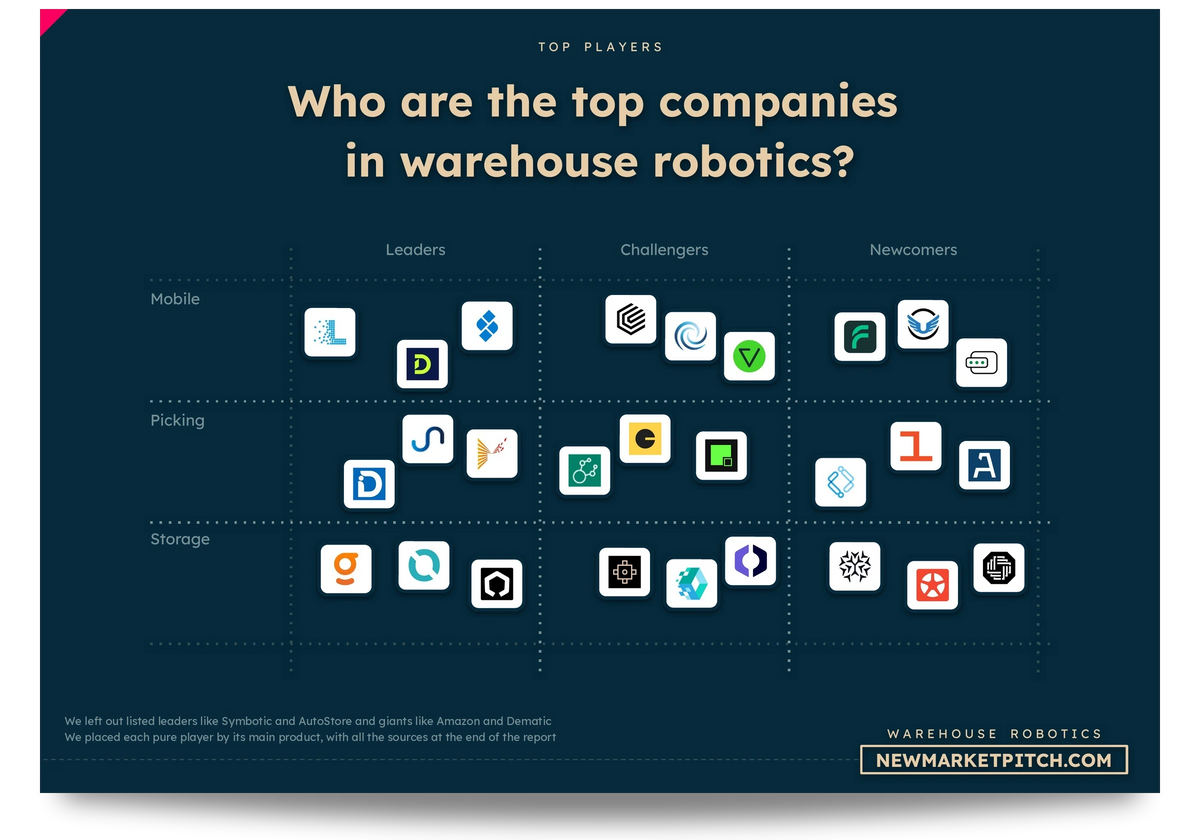
In our report covering the warehouse robotics market, we turn what is vague and complex into simple, useful visuals. Market maps like this one show you at a glance where every startup stands.
The ranking of top startups in the warehouse robotics market by revenue
Below is a table ranking the startups of this market by their current revenue scale. You can find our methodology at the end of this page.
If you want a deeper understanding of the market and its current dynamics, get our report on the warehouse robotics market.
| Ranking | Company | Latest Metric | Metric Type | Freshness | Disclosed When | Source Quality | Confidence | Segment | Why This Ranking | Local Metric | Country |
|---|---|---|---|---|---|---|---|---|---|---|---|
| 1 | Symbotic | $2.25B | Fiscal-Year Revenue | Fresh · 14mo | Nov 24, 2025 | Company Disclosed | High | Automated Storage & Retrieval Systems | Symbotic disclosed $2.25B of FY2025 fiscal-year revenue in November 2025. The fresh full-year sales figure is not a customer order or forecast. | us | |
| 2 | Geek+ | ~$444M | Fiscal-Year Revenue | Fresh · 11mo | Mar 30, 2026 | Filed / Audited | High | Autonomous Mobile Robots | The March 2026 annual filing reported ~$444M of FY2025 fiscal-year revenue. The audited completed-year result supports High confidence. | CNY 3.17B | cn |
| 3 | Exotec | ~$378M | Fiscal-Year Revenue | Fresh · 11mo | 2026 | Filed / Audited | High | Automated Storage & Retrieval Systems | French filed accounts report ~$378M of FY2025 fiscal-year revenue. It measures an entire completed year of warehouse automation sales. | EUR 343M | fr |
| 4 | Hai Robotics | ~$282M | Fiscal-Year Revenue | Fresh · 11mo | Sep 17, 2026 | Filed / Audited | High | Automated Storage & Retrieval Systems | A 2026 listing application reports ~$282M of FY2025 fiscal-year revenue, equivalent to CNY 2.02B. The filed amount is recent, not a robot-order total. | CNY 2.02B | cn |
| 5 | Mujin | ~$24.5M | Segment Revenue | Aging · 23mo | 2025 | Company Disclosed | Medium | Warehouse Robot Orchestration | Mujin disclosed ~$24.5M of FY2024 segment revenue in 2025. The older figure covers a limited business scope and is ranked as a minimum. | JPY 3.6B | jp |
| 6 | Rapyuta Robotics | ~$12.9M | Fiscal-Year Revenue | Aging · 23mo | Company Disclosed | Medium | Warehouse Robot Orchestration | The company disclosed ~$12.9M of FY2024 fiscal-year revenue. It is a completed-year figure but an aging one, rather than a current run-rate. | JPY 1.9B | jp | |
| 7 | Gather AI | ~$10–15M | Revenue Run-Rate | Very Fresh · 5mo | Jun 17, 2026 | Company Disclosed | Medium | Autonomous Mobile Robots | The company described a ~$10–15M annualized revenue run-rate in June 2026. Ranked on the midpoint of its range, which sits just below Rapyuta Robotics' ~$12.9M fiscal-year figure. | us | |
| 8 | Dexory | ~$4.1M | Fiscal-Year Revenue | Aging · 20mo | Apr 1, 2026 | Filed / Audited | Medium | Autonomous Mobile Robots | Filed accounts show ~$4.1M of fiscal-year revenue for the year ended March 2025. The amount is documented but already aging. | GBP 3.2M | gb |
| 9 | Twinny | ~$3.7M | Annual Revenue | Fresh · 11mo | Sep 15, 2026 | Company Disclosed | High | Autonomous Mobile Robots | The company disclosed ~$3.7M of 2025 annual revenue in September 2026. Its completed-year figure is more direct than a robot deployment count. | KRW 5B | kr |
| 10 | Agility Robotics | $1.78M | Fiscal-Year Revenue | Fresh · 11mo | Sep 4, 2026 | Filed / Audited | High | Robotic Picking Systems | A regulatory filing reports $1.78M of FY2025 fiscal-year revenue. It is close to Unbox Robotics' ~$1.71M figure, but comes from stronger filed evidence. | us | |
| 11 | Unbox Robotics | ~$1.71M | Fiscal-Year Revenue | Aging · 20mo | Apr 8, 2026 | Third-Party Estimate | Low | Robotic Sorting Systems | CRISIL's credit assessment records ~$1.71M of fiscal-year revenue for the year ended March 2025. Its analyst evidence is Low confidence beside Agility Robotics' filed $1.78M. | INR 142M | in |
| 12 | Nomagic | ~$1.38M | Segment Revenue | Aging · 23mo | Filed / Audited | Medium | Robotic Picking Systems | Polish accounts report ~$1.38M of FY2024 segment revenue. This older, narrower amount is a minimum, even though it is better documented than Unbox Robotics' estimate. | PLN 5.3M | pl | |
| NR | GreyOrange | $200M | Annual Revenue | Aging · 23mo | Third-Party Estimate | Low | Warehouse Robot Orchestration | The $200M figure is an automated estimate of 2024 annual revenue from Apps Run The World. Without independent confirmation, it has no rank. | us | ||
| NR | Locus Robotics | $180M | ARR | Very Fresh · 5mo | Jul 6, 2026 | Third-Party Estimate | Low | Autonomous Mobile Robots | Sacra estimated $180M of ARR as of June 2026. It annualizes recurring sales but is one analyst estimate, not a company-disclosed revenue result. | us | |
| NR | Ambi Robotics | $13.6M | Annual Revenue | Undated | Third-Party Estimate | Low | Robotic Sorting Systems | Growjo's $13.6M annual revenue figure has no stated period. It is an automated estimate with unknown age and no rank. | us | ||
| NR | Sereact | $6.4M | Annual Revenue | Fresh · 14mo | Sep 18, 2025 | Third-Party Estimate | Low | Robotic Picking Systems | GetLatka lists $6.4M of estimated 2025 annual revenue. An uncorroborated automated figure is not enough to establish a revenue position. | de | |
| NR | Attabotics | $6.3M | Annual Revenue | Fresh · 11mo | Aug 10, 2026 | Third-Party Estimate | Low | Automated Storage & Retrieval Systems | The $6.3M CY2025 annual revenue figure is a GetLatka automated estimate, not a company filing. It remains unranked. The original company went through insolvency in 2025 before LaFayette Systems took over its technology in February 2026. | ca | |
| NR | Fabric | >$200M (GMV, not revenue) | GMV | Undated | Company Disclosed | Medium | Automated Storage & Retrieval Systems | Fabric disclosed >$200M (GMV, not revenue) in merchandise transactions processed by its facilities. Transaction value cannot establish the company's annual sales. | us | ||
| NR | Quicktron Robotics | >45K robots deployed | Other Scale Signal | Very Fresh · 1mo | Company Disclosed | Medium | Mobile Warehouse Robots | Quicktron reported >45K robots deployed as of October 2026. This fresh installed-base figure is operational scale, not annual revenue. | cn | ||
| NR | Covariant | $380M (contract value, not revenue) | Contract Value | Aging · 27mo | Jan 18, 2025 | Credible Reported | Medium | Robotic Picking Systems | The press reported $380M (contract value, not revenue) for an August 2024 technology agreement. A contract's headline value is not earned annual sales. | us | |
| NR | Mytra | 2 pilot systems shipped | Other Scale Signal | Fresh · 11mo | Jan 15, 2026 | Company Disclosed | Medium | Robotic Storage Systems | Mytra disclosed 2 pilot systems shipped during 2025. Pilot shipments show adoption progress, but no recognized annual revenue figure. | us | |
| NR | Pickle Robot | $120M (contract value, not revenue) | Contract Value | Fresh · 11mo | Dec 15, 2025 | Credible Reported | Medium | Robotic Picking Systems | Bloomberg reported $120M (contract value, not revenue) for a December 2025 unloading agreement. Future contracted work is not a completed year's sales. | us | |
| NR | SENAD | >$14M (bookings, not revenue) | Bookings | Fresh · 11mo | Jun 25, 2026 | Credible Reported | Medium | Robotic Sorting Systems | The press reported >$14M (bookings, not revenue) for FY2025. Customer orders have not been converted into a comparable revenue disclosure. | CNY 100M | cn |
| NR | Plus One Robotics | >1B parcels handled | Other Scale Signal | Aging · 23mo | 2024 | Company Disclosed | Medium | Robotic Sorting | The company disclosed >1B parcels handled through December 2024. The cumulative handling figure does not measure money earned by the vendor. | us | |
| NR | Seegrid | >20M autonomous miles | Other Scale Signal | Very Fresh · 6mo | May 6, 2026 | Company Disclosed | Medium | Industrial Mobile Robots | Seegrid reported >20M autonomous miles through May 2026. Distance traveled in customer operations does not disclose annual revenue. | us | |
| NR | ForwardX Robotics | >3,000 robots deployed | Other Scale Signal | Historical · 47mo | Company Disclosed | Medium | Mobile Warehouse Robots | ForwardX Robotics disclosed >3,000 robots deployed through 2022. This historical fleet milestone is neither current nor revenue. | cn |

Our research about warehouse robots gets updated several times a month, so you always get the latest view of where things stand.
Are warehouse robotics startups making real money yet?
Yes, warehouse robotics startups already sell substantial automation systems to paying customers, but only a few have published large annual sales.
Symbotic, Geek+ and Exotec have each disclosed completed-year revenue from large-scale warehouse automation. These companies solve recurring operational problems for large warehouse networks. Their customers pay for systems that move inventory through real facilities, not simply for the right to experiment with a new robot. Symbotic's work with Walmart spans regional distribution centers, while Exotec's March 2026 agreement with Decathlon covers seven warehouse sites in five European countries.
Smaller vendors show just how uneven the market still is. Mujin disclosed segment revenue rather than its complete business revenue. Gather AI reported an annualized run-rate in a June 2026 founder interview, while Agility Robotics published a completed-year figure from a humanoid business still moving beyond early deployments.
Warehouse operators pay first to store more goods, sort faster and reduce repetitive picking work. The best-established sellers can repeat installations across sites. A pilot robot or signed order tells us far less about how much a startup earns.
Is Symbotic still the biggest warehouse robotics startup by revenue?
Symbotic still leads warehouse robotics revenue with $2.25B of FY2025 fiscal-year revenue, largely from large distribution-center automation projects.
Symbotic's November 2025 annual results described revenue growth of 26% from the previous fiscal year. Its systems combine robotic handling, dense storage and software that coordinates the movement of cases through distribution facilities. Customers buy hardware, installation, software and support together. That creates a much larger sale than supplying a few mobile robots.
Walmart's rollout is the clearest example. The retailer expanded its initial deployment plan to all 42 US regional distribution centers in 2022. Symbotic has also worked with Walmex in Mexico and pursued store-focused fulfillment technology. These relationships gave it a route to repeating a complex installation across multiple sites instead of finding a new customer for every individual system.
Symbotic has traded on the stock market since 2022, so its financial statements are public. It still qualifies as a recently listed startup under our definition. Competitors will need customers prepared to roll out similarly large systems to challenge its sales lead.

In our market report about warehouse robots, we look at what the winners do differently, so you can learn from the best instead of guessing.
Is Symbotic too dependent on Walmart for warehouse sales?
Walmart accounts for much of Symbotic’s success in warehouse robotics, but depending on one huge customer makes future sales vulnerable.
Walmart and Symbotic began working together in 2015, well before the recent enthusiasm for physical AI, and a 2022 agreement extended automation to all 42 Walmart regional distribution centers in the United States. In January 2025, Symbotic acquired Walmart's Advanced Systems and Robotics business to develop smaller automated fulfillment systems for online pickup and delivery. Each new distribution center built on a system Walmart had already tested in another one.
The commercial relationship deepened again in October 2026. Walmart committed approximately $6 billion of additional spending over several years under a new automation agreement covering work across multiple facilities. That commitment covers future work; it is not annual revenue already earned.
Walmart gives Symbotic repeat installations and years of experience on live systems. It can also slow Symbotic's growth if construction slips or the retailer changes its plans. Symbotic flags customer concentration as a risk in its filings. We can be confident about the sales already reported without assuming Walmart will keep spending at the same pace.
Is Geek+ catching Symbotic in warehouse robotics revenue?
Geek+ has not caught Symbotic in warehouse robotics revenue: Geek+ disclosed ~$444M of FY2025 fiscal-year sales, while Symbotic remains ahead.
The strongest evidence of Geek+'s sales growth comes from its audited 2025 results, published in March 2026. The company said revenue increased 31.6% year over year and its gross margin reached 35.5%. It also reported positive adjusted net profit and operating cash flow for the year. Those results show customers are buying systems that Geek+ can deliver profitably, a stronger test than a new robot launch.
Geek+ sells autonomous mobile robots that support goods-to-person picking, sorting and material transport. These systems can be deployed modularly, giving retailers and logistics groups a different buying path from Symbotic's deeply integrated distribution-center projects. That suits operators who want to improve one part of their warehouse without rebuilding the whole building.
In its 2026 interim results, Geek+ said newly signed orders rose 35.5% year over year in the first half. That is the same number as its 2025 gross margin, but a different measure. We do not treat those orders as revenue, because timing, acceptance and installation still matter. Geek+ is also listed in Hong Kong, another reminder that a newly public robotics company can remain an emerging player while reporting mature financial statements. Geek+ is growing, but those orders cannot be used to close the gap in reported annual sales.

In our document detailing everything you need to know about warehouse robotics, you will always find fresh funding data, taken straight from our own verified funding database.
How much revenue does warehouse robot maker Exotec generate?
French warehouse robotics company Exotec reported ~$378M of FY2025 fiscal-year revenue, putting it among the largest sellers of automated storage systems.
Exotec's approach differs from companies that move racks horizontally across a warehouse floor. Skypod robots travel vertically inside storage racks, bringing goods to picking stations. The customer buys denser storage and a coordinated flow of merchandise, a combination that can justify a large installation rather than a small robot trial.
In March 2026, Decathlon chose Exotec for a multisite program across France, the UK, Portugal, Italy and Germany. That covers seven facilities, meaning one customer decision can lead to several installations. Each site can also use the same equipment and support model.
Skypod will not fit every warehouse. A building's layout, products and existing equipment still decide whether an installation pays off. But Exotec has already done the difficult part that most young robotics companies face: selling and supporting complex systems across more than one customer site.
How much money does Chinese warehouse robot maker Hai Robotics make?
Hai Robotics recorded ~$282M of FY2025 fiscal-year revenue, according to figures in its Hong Kong listing application.
Hai Robotics concentrates on autonomous case-handling systems and rack-climbing robots. The robots retrieve containers from tall racks, so customers store more goods while workers walk less. A GIGABYTE fulfillment project in Los Angeles, for example, combines case-handling and companion mobile robots; other Hai projects operate in apparel, healthcare and retail logistics.
In August 2026, Hai Robotics said customers had contracted more than 10,000 HaiPick Climb robots worldwide. Since its 2025 launch, customers in 12 countries had chosen the system. Those contracted units show demand beyond early trials, although they are not recognized revenue.
Hai Robotics also said more than 80% of its orders in the first half of 2026 came from existing customers, whether through expansions or new projects. Repeat orders matter because customers can test the robots in a live warehouse before rolling them out elsewhere. The remaining question is how quickly the newly contracted units turn into delivered systems and recognized sales.

Learning from others' mistakes is the cheapest lesson there is. In our report covering the warehouse robotics market, we look at what broke startups before you, so you don't repeat it.
Have warehouse robotics startups broken the $100M revenue barrier?
Yes, warehouse robotics has several startups with more than $100M of reported annual revenue, led by suppliers of complete automation systems.
Symbotic is the clearest proof of the industry's upper end. Geek+, Exotec and Hai Robotics are the next established examples, all publishing FY2025 fiscal-year revenue above the threshold. All four sell systems that warehouses already have a reason to buy: faster sorting, storage, picking and goods movement.
But a long client list does not prove that another startup has also crossed the threshold. GreyOrange is associated with a $200M automated estimate of 2024 annual revenue, but the figure is not a company filing or independently confirmed disclosure. Locus Robotics has a $180M analyst estimate of June 2026 ARR, which annualizes recurring contracted sales and is not the same metric as a completed fiscal year. Neither is treated as an independently verified ranked company result.
We would only say a startup has crossed the revenue threshold when the sales figure itself supports that claim. Customer activity, analyst estimates and future orders may suggest a bigger business, but they cannot settle the question.
Do mobile warehouse robots make more money than storage systems?
Neither type of warehouse robot wins everywhere: big storage installations show the largest reported sales, while mobile robots can also support sizable businesses.
Symbotic's automated case-handling and storage platform sits at the top of the disclosed revenue evidence. Geek+ demonstrates that mobile robots can also become a substantial business through repeat installations. Exotec and Hai Robotics illustrate the alternative route: warehouses buy storage systems that retrieve goods without sending workers down long aisles. All four publish completed-year figures, although their product and installation models differ.
Robot counts miss most of the bill. Exotec's systems include racks and picking stations. Geek+ connects mobile fleets to a warehouse's workflow software. Symbotic supplies substantial physical infrastructure as well as ongoing services. A smaller fleet can be much easier to deploy when the warehouse cannot afford a full redesign.
We cannot declare every storage robot more lucrative than every mobile one. The companies mix hardware, software and installation work, and smaller vendors often report different accounting periods. Mujin reports segment revenue; Gather AI describes a current revenue run-rate; Dexory publishes historical fiscal-year sales. A comparison based only on robot type would miss that.
The table below shows how warehouse robotics vendors report sales across different products and accounting periods.
| Company | Focus | Measure | Period |
|---|---|---|---|
| Symbotic | Storage | Fiscal-Year Revenue | FY2025 |
| Geek+ | Mobile | Fiscal-Year Revenue | FY2025 |
| Exotec | Storage | Fiscal-Year Revenue | FY2025 |
| Hai Robotics | Storage | Fiscal-Year Revenue | FY2025 |
| Mujin | Orchestration | Segment Revenue | FY2024 |
| Rapyuta Robotics | Orchestration | Fiscal-Year Revenue | FY2024 |
| Gather AI | Inventory drones | Revenue Run-Rate | Jun 2026 |
| Dexory | Inventory robots | Fiscal-Year Revenue | FY2025 |

Your time is limited. In our research about warehouse robots, we put numbers on each part of the market, so you can see where it makes sense to focus.
Do warehouse robotics companies earn money from robots or subscriptions?
Warehouse robotics companies earn money from both equipment and subscriptions, with hardware installations, software and support recorded under different contract terms.
A large storage project starts with design and equipment, then moves through installation and testing. The supplier records sales according to when those goods and services are delivered. Symbotic's Walmart agreements illustrate the complexity: system installation comes with separate commitments for maintenance, spare parts and sometimes ongoing operation. Walmart's multiyear spending commitment still needs to turn into completed work before it becomes sales.
Mobile robotics is often sold with a service layer. A customer can pay for a robot fleet, a software license and continuing support, or subscribe to a robots-as-a-service arrangement. Geek+ has emphasized subscription-based services in its 2026 interim communication. Rapyuta Robotics' Japanese customer cases involve software integration and recurring operational adjustments, not simply equipment deliveries.
Gather AI makes the distinction especially clear. Its founder described subscriptions that can expand from an initial cluster of facilities across a customer's wider network. The company reported a ~$10–15M annualized revenue run-rate in June 2026. That measures the current sales pace, not a completed fiscal year.
Customers care about cost per pick, per stored item and per inventory check. We also need to know whether a number describes booked sales, completed-year revenue or an annualized subscription pace. Otherwise two figures that look similar can mean very different things.
How much money does Locus Robotics actually make?
Locus Robotics has not confirmed its full-year warehouse robotics revenue; Sacra estimated $180M of ARR as of June 2026.
That uncertainty should not obscure how widely Locus robots are used. Locus supplies collaborative mobile robots to warehouse operators, and its customers have used those systems at enormous volumes. In October 2025 the company said its robots had passed six billion picks worldwide. DHL Supply Chain separately reported reaching one billion picks with Locus technology in February 2026. Both milestones show sustained warehouse use, but neither tells us what Locus billed.
Each pick counts an item moved, not money paid to Locus. The customer's contract might cover robot rental, software, maintenance, deployment and usage-related fees. Without contract terms, attaching a made-up price to billions of picks would tell us nothing reliable about sales.
Locus is clearly active in large warehouses. But its sales are still an estimate from one analyst, so we leave it without a revenue rank rather than pass that estimate off as a company result.

In our market report about warehouse robots, we always try to gather several sources and make estimates that make sense, so you can work with solid numbers.
Has GreyOrange passed $100M in warehouse robotics sales?
GreyOrange may have passed $100M in annual warehouse automation sales, but its $200M estimate for 2024 is not verified company revenue.
GreyOrange sells autonomous robots and software that coordinate warehouse execution. Retailers use its products to coordinate robots, employees and warehouse software. Once the system works in one building, the customer can add more robots or roll it out to other facilities.
The $200M annual revenue estimate comes from the company-information service Apps Run The World, and GreyOrange has not published audited accounts. We do not have a second independent estimate that establishes comparable sales or a company filing that verifies the amount. We cannot give a profile-page estimate the same weight as annual accounts.
A warehouse software company may get a subscription while an equipment partner books the robot sale. Without financial statements, we cannot tell how much of a large customer project belongs to GreyOrange itself. GreyOrange has customers, but its sales figure remains unverified.
How much does Quicktron actually earn from warehouse robots?
Quicktron Robotics has deployed >45K warehouse robots, but the company has not published a comparable annual revenue figure.
Quicktron's company materials cite 1,000+ clients and deployments in multiple countries. The product range includes goods-to-person picking robots and machines for moving materials. The company also describes partnerships with established logistics and equipment groups. Those customers show that Quicktron sells beyond small trials.
The number of installed robots leaves out what customers paid. Some customers purchase robots; others pay for software, systems or services. Robots can also be installed through integrators, and the original hardware sale might have occurred in a different financial period. A robot installed years ago still appears in the deployment total today.
Seegrid's >20M autonomous miles through May 2026 and ForwardX Robotics' >3,000 deployed robots through 2022 tell a similar story: these machines are working, but their makers' annual sales remain unclear. Quicktron is a substantial robot supplier. We still cannot name its revenue without a financial disclosure.
Are Japanese and Korean warehouse robot startups making real sales?
Warehouse robotics startups in Japan and South Korea have published real sales figures, although their disclosed periods and products differ.
Japan's Mujin reported ~$24.5M of FY2024 segment revenue. It sells robotic picking, pallet handling and software that orchestrates industrial robots. Its published customer cases include LOGISTEED, ASKUL and PALTAC, where robots handle specific picking or palletizing tasks inside complex logistics operations. The figure covers a segment rather than a full company-wide warehouse business, so it should be read as a minimum for that scope, not as a complete picture of everything Mujin sells.
Rapyuta Robotics reported ~$12.9M of FY2024 fiscal-year revenue. Its Japanese implementations show a different route to sales: pick-assist mobile robots and automated storage systems that can be added to existing facilities. In a case published in November 2026, Rapyuta described a DHL Supply Chain Japan operation serving ACTUS where picking productivity rose from 46 to 115 lines per worker-hour following installation and continued optimization.
South Korea's Twinny reported ~$3.7M of 2025 annual revenue. Its Nargo transport robots move goods through warehouses without relying on fixed routes. That is a different purchase from Mujin's integrated picking and Rapyuta's mobile picking support. The sales are real, but they cover different products and accounting periods. DHL's productivity results show why customers buy these products; they do not give us a newer revenue figure.

If you build or invest in the warehouse robotics market, you need to know which business models pay off now and which ones are fading. That's why our report covering it has a whole section on it.
Can warehouse inventory drones become a real revenue business?
Gather AI shows warehouse inventory drones can attract paying customers, with a ~$10–15M revenue run-rate reported in June 2026. Gather AI ranks just below Rapyuta Robotics' ~$12.9M because a range is ranked on its midpoint, which sits a little under that figure.
Gather AI uses drones and camera systems to help warehouses locate inventory and identify mismatches between the physical floor and the records inside management software. The founder discussed customers expanding deployments from a small group of sites to a wider network once the product reduced inventory errors. Misplaced products waste picking time and create errors even in warehouses full of advanced equipment.
Gather AI later said bookings grew 250% over the previous year, and listed customers including GEODIS, Barrett Distribution Centers, NFI Industries and dnata. Those new bookings are orders, not completed-year sales. An inventory drone never needs to lift a box to be useful. Workers can find missing stock faster once the system shows what is really on each rack.
Dexory approaches the same inventory problem with ground-based robots that build high-resolution digital representations of warehouses. It reported ~$4.1M of fiscal-year revenue for the year ended March 2025. Its October 2026 product update described a move from inventory visibility toward operational recommendations and orchestration. Both sell tools that help warehouses know what is on their shelves. One gives us an annualized pace; the other gives us a completed-year figure from an earlier period.
Is Exotec the only European warehouse robot startup selling at scale?
No, Exotec is not the only European warehouse robot startup earning sales: Dexory and Nomagic also have filed revenue and paying customers.
Exotec is the main European example, with substantial FY2025 fiscal-year revenue from its Skypod storage systems. Its Decathlon multisite program shows how a European customer relationship can expand across borders once the technology has proved its usefulness. It sells completed warehouse installations and helps customers run them.
Smaller European companies solve narrower warehouse problems. Britain's Dexory reported ~$4.1M of fiscal-year revenue for the year ended March 2025, built around inventory scanning and digital warehouse mapping. Poland's Nomagic has ~$1.38M of FY2024 segment revenue in its filed accounts, and builds robotic picking systems for e-commerce fulfillment. In September 2026, Nomagic also announced a planned picking and induction deployment with BESTSECRET in Poland.
A full storage installation costs a customer far more than a robot that scans shelves, while AI picking systems have their own delivery and support costs. Dexory and Nomagic have real customers, but their figures are smaller and older. Exotec has the more established European sales business today.

In our report covering the warehouse robotics market, we don't want to repeat what boring consulting reports say. Instead, we show you the real and latest market signals that matter.
Are humanoid warehouse robots making much money yet?
Agility Robotics is still early in warehouse humanoid sales, with $1.78M of FY2025 fiscal-year revenue despite paying deployments.
Agility's Digit robot is designed to move totes and perform repetitive material-handling tasks. GXO began testing Digit in a live Georgia warehouse in late 2023 and signed a multiyear robots-as-a-service agreement in June 2024. In October 2026, GXO and Agility announced planned expansions to two more US facilities, with deployments expected to begin in early 2027. The companies said Digit had already moved more than 100,000 totes at the original site.
Moving totes in a live warehouse is a meaningful test. But a functioning deployment does not tell us whether subscriptions and robot sales cover Agility's costs.
Agility closed its public-market business combination in November 2026, making its accounts more visible. The filing separates completed sales from future Digit orders that depend on milestones. Investors may be buying the prospect of much larger deployments, but those orders are not FY2025 sales. For now, there is plenty of warehouse humanoid work left to sell.
Can AI-powered warehouse picking robots turn pilots into sales?
AI warehouse picking robots already have paying customers, but sales figures are modest and most announced expansions still begin with pilots.
Poland's Nomagic reported ~$1.38M of FY2024 segment revenue in its filed accounts. It builds systems that recognize and pick individual items for fulfillment operations. Picking individual products is harder than moving a standard bin. Boxes, bottles and soft packages all require different grips, while the rest of the warehouse keeps moving.
Nomagic has moved into real customer environments. In September 2026, it announced work with fashion retailer BESTSECRET, beginning with a pilot and potentially expanding to additional robotic induction stations. That expansion has to be delivered before it can count as completed sales.
Germany's Sereact works on AI-based robotic picking software, but the $6.4M annual revenue figure associated with 2025 comes from a single automated company-data estimate rather than a verified financial report. That estimate does not establish a comparable revenue rank. Picking robots clearly have buyers. The harder test is whether they keep working as product assortments change, without expensive field support. Nomagic has filed sales, while Sereact's figure remains an unverified estimate.

In our research about warehouse robots, we like to show you the big picture. We know your time is precious, so we make every page quick to read and packed with as much learning as possible per minute.
Are parcel-sorting warehouse robots already making sales?
Parcel-sorting warehouse robot makers do earn revenue, but publicly discussed figures often mix sales estimates, contracts and parcel volumes.
Unbox Robotics has ~$1.71M of estimated fiscal-year revenue for the year ended March 2025, based on a CRISIL Ratings credit assessment. Its small sorting robots carry packages to the right destinations inside compact warehouse systems. CRISIL's credit report points to a business selling real systems, though the figure is an analyst estimate rather than a directly filed company result.
Unbox is worth comparing with Agility Robotics, which has more direct FY2025 fiscal-year evidence. The displayed amounts are close, but their evidence differs: a rating-agency assessment for Unbox and audited accounts for Agility. We would not interpret that small difference as proof that one company has a stronger business.
Other parcel companies generate bigger publicity signals without publishing revenue on the same basis. Plus One Robotics said its systems had handled more than 1 billion parcels through 2024. Pickle Robot's reported UPS agreement carried $120M (contract value, not revenue), with delivery and recognition spread over future work. Sorting robots are clearly being used. What remains hard to establish for many suppliers is how much of that activity has become recognized annual revenue.
Do big warehouse robot contracts mean big sales right away?
No, a warehouse robotics contract can cover years of future deliveries, so its headline value tells us little about revenue earned today.
A retailer might sign for a warehouse system that takes years to install. The supplier records revenue as it delivers equipment and services, following the contract's accounting terms. Symbotic's expanded Walmart agreement in October 2026 illustrates the difference: the companies described approximately $6 billion of multiyear spending, rather than a one-year revenue result. Pickle Robot's UPS arrangement, reported by Bloomberg in December 2025, similarly concerns future contractual value.
Technology licensing creates another trap for readers. In August 2024, Amazon announced a nonexclusive license for Covariant's robot foundation models and hired several of its founders. The press later reported a $380M contract value for the agreement. That reported contract value does not tell us Covariant's annual sales. Meanwhile, Fabric's statement that its facilities have processed >$200M (GMV, not revenue) describes value moving through fulfillment operations rather than the platform's own sales.
We leave these companies unranked on revenue because the figures describe orders, contracts or goods handled. None reveals what the company earned in a completed year.
The table below shows examples of warehouse robotics scale signals that are not recognized revenue.
| Company | Signal | Type | Period |
|---|---|---|---|
| Fabric | >$200M (GMV, not revenue) | GMV | Not stated |
| Quicktron Robotics | >45K robots deployed | Other Scale Signal | Oct 2026 |
| Covariant | $380M (contract value, not revenue) | Contract Value | Aug 2024 |
| Mytra | 2 pilot systems shipped | Other Scale Signal | 2025 |
| Pickle Robot | $120M (contract value, not revenue) | Contract Value | Dec 2025 |
| SENAD | >$14M (bookings, not revenue) | Bookings | FY2025 |
| Plus One Robotics | >1B parcels handled | Other Scale Signal | Dec 2024 |
| Seegrid | >20M autonomous miles | Other Scale Signal | May 2026 |
| ForwardX Robotics | >3,000 robots deployed | Other Scale Signal | 2022 |

When you build or invest in the warehouse robotics market, you need clarity, not confusion. In our market report about warehouse robots, we always try to put numbers on and quantify whatever is usually vague and confusing.
Has Mytra started selling warehouse robots beyond pilots?
Mytra has moved warehouse robots into customer facilities, but its latest disclosed milestone is 2 pilot systems shipped during 2025, not annual revenue.
Mytra is a useful test case. In January 2026 it said it had shipped two pilot systems during 2025, gone live at a new customer site and signed a deployment substantially larger than earlier installations. Its robotic material-handling approach aims to make storage and movement programmable, rather than leaving customers to design fixed routes around every new warehouse task. The progress is real, although those shipments do not establish a yearly sales figure.
The distinction also applies to other platforms. Attabotics, whose original business went into insolvency in 2025 before LaFayette Systems restarted its technology in February 2026, has a $6.3M automated estimate of CY2025 annual revenue from GetLatka, but no sufficiently corroborated disclosure supporting a rank. Sereact's $6.4M automated estimate of 2025 annual revenue faces the same limitation. Both amounts remain uncorroborated estimates, so neither company receives a revenue rank.
Warehouses cannot stop shipping orders while a robot team fixes problems. That makes uptime, safety and support costs decisive. Mytra's next commercial test is whether early sites lead to repeat orders like those announced by mature suppliers, and whether the company publishes actual sales.
So, which warehouse robotics startups make the most money today?
Symbotic is the number one warehouse robotics startup by revenue today, with Geek+, Exotec and Hai Robotics behind it on disclosed fiscal-year sales.
The leading companies all have finished installations and financial results, rather than just robot demonstrations or large funding announcements. Their systems tackle storage, retrieval, sorting and material movement at a scale that customers can repeatedly deploy. The evidence is much thinner for companies whose headline achievements are robot counts, pilot shipments, software licenses or a third party's modeled annual income.
Smaller companies are selling different things at earlier stages. Gather AI demonstrates that inventory intelligence can support subscriptions. Nomagic and Unbox Robotics have meaningful picking and sorting use cases. Agility Robotics has brought humanoid robots into live warehouse work, even if recognized sales remain early. A startup with a successful warehouse pilot should not be compared as though it had already delivered a national rollout.
Full-year sales, segment revenue, run-rates and estimates still measure different things. Keeping those labels attached to each figure lets us make a direct call about the leaders without overstating the smaller companies. The table below shows what we found.
| Question | Answer |
|---|---|
| Can integrated warehouse systems still win on sales? | Yes, Symbotic leads the warehouse robotics business on recognized sales. Its FY2025 fiscal-year revenue reached $2.25B through substantial system work. A concentrated customer base remains its main commercial vulnerability. |
| Has China's mobile robotics business reached large sales? | Geek+ already sells warehouse automation far beyond the prototype stage. Its FY2025 fiscal-year revenue stood at ~$444M from installed systems. Continued orders support growth but do not close the existing gap. |
| Is European warehouse automation already a substantial business? | Exotec has a commercial storage systems business with multinational customers. Its FY2025 fiscal-year revenue amounted to ~$378M in company accounts. The Decathlon agreement demonstrates why repeatable multisite deployments matter so much. |
| Do case-handling robots attract repeat buyers now? | Hai Robotics sells automated storage rather than merely testing it. Its FY2025 fiscal-year revenue reached ~$282M in listing materials. Repeat customer orders strengthen the case for lasting demand. |
| Can warehouse inventory tools sell without moving products? | Gather AI shows inventory intelligence can become a subscription business. The company reported bookings growth of 250% over the prior year. Its current sales pace still differs from completed-year recognized revenue. |
| Does a large installed fleet guarantee impressive sales? | No, installed robots cannot reveal annual financial performance by themselves. Quicktron Robotics reports 1,000+ clients across customer markets. Contract mix and recognition periods still determine what becomes revenue. |
| Have warehouse humanoids moved beyond publicity stunts? | Yes, Agility Robotics has operated Digit in genuine logistics workflows. GXO says Digit moved more than 100,000 totes in Georgia. Customer deployment is established even while recognized sales remain modest. |
| Are Japan's warehouse robotics specialists selling real systems? | Mujin and Rapyuta Robotics supply working logistics automation products today. Mujin disclosed ~$24.5M of FY2024 segment revenue from its business. That narrower figure cannot be treated as complete company sales. |
| Are parcel robots already a proven subscription business? | Parcel automation has customers, but contract structures differ considerably today. Unbox Robotics has ~$1.71M of estimated FY2025 fiscal-year revenue. A credit assessment is weaker evidence than audited company statements. |
| Can an Amazon robotics deal be annual sales? | No, technology licensing payments and annual warehouse revenue mean different things. Covariant's $380M was reported as contract value from an Amazon agreement. It cannot establish Covariant's current annual warehouse robotics sales. |
| Will the next generation replace established suppliers soon? | New warehouse robotics platforms have begun operating in customer facilities. Mytra disclosed 2 pilot systems shipped during its 2025 expansion. Pilots must become repeated paid deployments before sales leadership changes. |

A good product starts with a real problem. In our document detailing everything you need to know about warehouse robotics, we show you the ones customers still live with.
Our methodology
Our data runs through November 14, 2026. We then reviewed this article and updated its answers on November 13, 2026, the date shown under the title. We define warehouse robotics as robotic systems automating activity inside warehouses and fulfillment centers: mobile robots, picking, sorting, storage, robotic inventory scanning, truck loading and the software dedicated to these systems. We also include robot-powered microfulfillment and adjacent products when warehouse deployment is a principal marketed use, rather than forcing borderline companies out. Every ranked company meets our consistent startup definition: founded in 2000 or later, built for fast growth around a new product or technology, financed by founders or outside backers, and either private or listed within the past five years. Established groups are excluded even when their automation revenues are larger.
We reviewed company announcements, annual and interim reports, regulatory filings, investor materials, interviews and reputable media covering the companies' histories over the previous ten years. Companies disclose different measures of commercial scale, and we retain those distinctions. Full-year revenue remains full-year revenue; ARR and revenue run-rates remain annualized sales measures. We do not convert bookings, contracts, gross merchandise value, robot deployments, item counts or forecasts into revenue, and we do not infer sales by multiplying customers by prices.
For each company, we select one figure, prioritizing a figure from the most recent 18 months, then its source strength, and then the completeness of the measure. Regulatory filings and company disclosures take priority over press reports, followed by analyst work and automated company-data estimates. Full-year revenue takes priority over ARR or run-rate, which take priority over a partial period or a published warehouse segment. Companies are ordered on that chosen figure; for ranges, we use the midpoint in proportional terms, so an unusually high upper bound cannot determine the order, and minimums are evaluated at their lower bounds. Figures older than three years, forecasts and non-revenue activity are displayed without a rank.
We label recency as Very Fresh, Fresh, Aging or Historical according to months since the reported period ended. Confidence is High for a recent, exact full-year company or filed figure; Medium for annualized sales, partial periods, press disclosures, minimums or figures 18 to 30 months old; and Low for estimates, wide ranges or figures older than 30 months. Non-dollar figures are converted at consistent fixed exchange rates while preserving the amounts in their original currencies. The confidence label is written in words alongside the source so the strength of each row is visible.
A single automated company-data estimate or independently modeled analyst ARR figure is not treated as sufficient for a normal revenue rank. Two independent estimates that agree can be ranked at Low confidence; conflicting estimates remain an unranked range. A company-disclosed revenue figure without a stated period can be ranked at Low confidence, but an estimate without a period cannot. Where a company's published sales combine warehouse robotics with a broader business and no warehouse segment is available, the whole-company figure is unranked. CRISIL's completed-year operating-income assessment of Unbox Robotics is a narrower exception to the rule against lone modeled estimates: we retain its stated fiscal-year figure at Low confidence because the credit assessment draws on company financial information rather than a generic automated revenue model.
The most natural objection is that some recognizable, heavily deployed companies appear without a revenue rank while a less famous company with a smaller disclosed figure gets one. That is a deliberate distinction between operational activity and verifiable recognized sales, not a judgment on product quality. We also keep ARR, run-rates and limited segment figures visible because suppressing them would hide real commercial progress. Their labels, periods and confidence levels are part of the conclusion, not fine print. A newer deal announcement does not replace an earlier completed-year revenue figure merely because its headline is larger.
Key sources include Symbotic FY2025 revenue and year-over-year growth, October 2026 Walmart multiyear automation commitment, Geek+ audited 2025 results and profitability, Exotec and Decathlon multisite deployment agreement, Hai Robotics contracted robot and country milestones, Mujin warehouse picking and palletizing customers, Rapyuta Robotics picking-productivity results at DHL, Gather AI CEO interview on annualized sales and pricing, Gather AI bookings growth and customers, Dexory product direction and warehouse mapping, Agility Robotics filed sales and detailed financial statements, Agility Robotics November 2026 business-combination closing, GXO Digit commercial expansion and tote handling, Nomagic planned picking and induction systems, CRISIL analysis of Unbox Robotics fiscal-year sales, Locus Robotics warehouse picking milestone, Fabric facility transaction value versus company revenue, Quicktron Robotics deployments and customer footprint, Mytra pilot shipments and customer deployments, Seegrid autonomous miles in customer facilities, Amazon's Covariant technology license and employee transfers, Pickle Robot contract reported by Bloomberg, and Geek+ 2026 interim orders and subscription services.

It's easy to get lost in the details. In our report covering the warehouse robotics market, we give you some perspective first, so you see the whole market before you make a move.
Written by the New Market Pitch teamWe track new markets so founders and investors can move faster. About us