Who are the top warehouse robotics startups beyond Amazon?
Whether you're building or investing in the warehouse robotics market, our report covers everything you need to know: the players, the money, and what's coming next.
Summary
Geek+, Locus Robotics, Exotec and Hai Robotics are the top warehouse robotics startups beyond Amazon, while Symbotic leads on disclosed revenue and Brightpick and Nomagic stand out in autonomous picking. Each has built a credible business around a different part of warehouse operations.
Amazon's million-robot fleet remains unmatched, but most of those machines operate inside its own logistics network. Independent suppliers have an enormous market to serve without having to replicate Amazon's entire automation ecosystem.
Robot counts are a misleading way to rank these companies. Geek+ reports more than 81,000 deployed robots and Locus more than 22,000, while Symbotic has 56 operational systems. A single Symbotic installation can represent a major distribution-center project, making direct comparisons almost meaningless.
Symbotic is the financial heavyweight, generating $721 million in quarterly revenue and carrying approximately $22.5 billion in backlog. Its biggest advantage is also a vulnerability: a relatively small number of enormous customer relationships, particularly Walmart, account for much of its business.
Geek+'s order growth is running ahead of revenue growth, with first-half 2026 orders up 35.5% against revenue growth of 25.3%. That points to continued customer demand, although the company still has work to do on profitability.
Locus has demonstrated something that hardware announcements rarely prove: sustained usage. Its robots have completed more than eight billion picks across over 360 sites. The company succeeds by making warehouse employees more productive, while newer competitors are trying to remove human involvement from the picking task itself.
Automated storage has produced two particularly strong private challengers. Exotec has passed 200 customer sites, while Hai Robotics reports more than 10,000 deployed System 3 robots and another 10,000-plus HaiPick Climb robots under contract. The distinction between installed equipment and future deliveries is essential.
Brightpick offers one of the clearest demonstrations of where the technology is heading. At Superior Communications, its robots autonomously complete approximately 73% of picks. Nomagic has achieved impressive handling coverage for specialized products, but its reported 98% shoebox-SKU compatibility should not be confused with a 98% autonomous order-completion rate.
The sector's next opportunities extend beyond transporting and picking goods. GreyOrange is building a large robotics orchestration business, while Dexory and Gather AI are automating inventory monitoring. These technologies can coexist in the same warehouse rather than competing for one winner-takes-all contract.
Humanoids face a demanding commercial benchmark. Specialized warehouse robots already have large installed bases, measurable throughput and years of operating experience. General-purpose machines are more likely to enter through difficult tasks that existing systems cannot automate economically than to replace proven warehouse automation.

Written by the New Market Pitch teamWe track new markets so founders and investors can move faster. About us

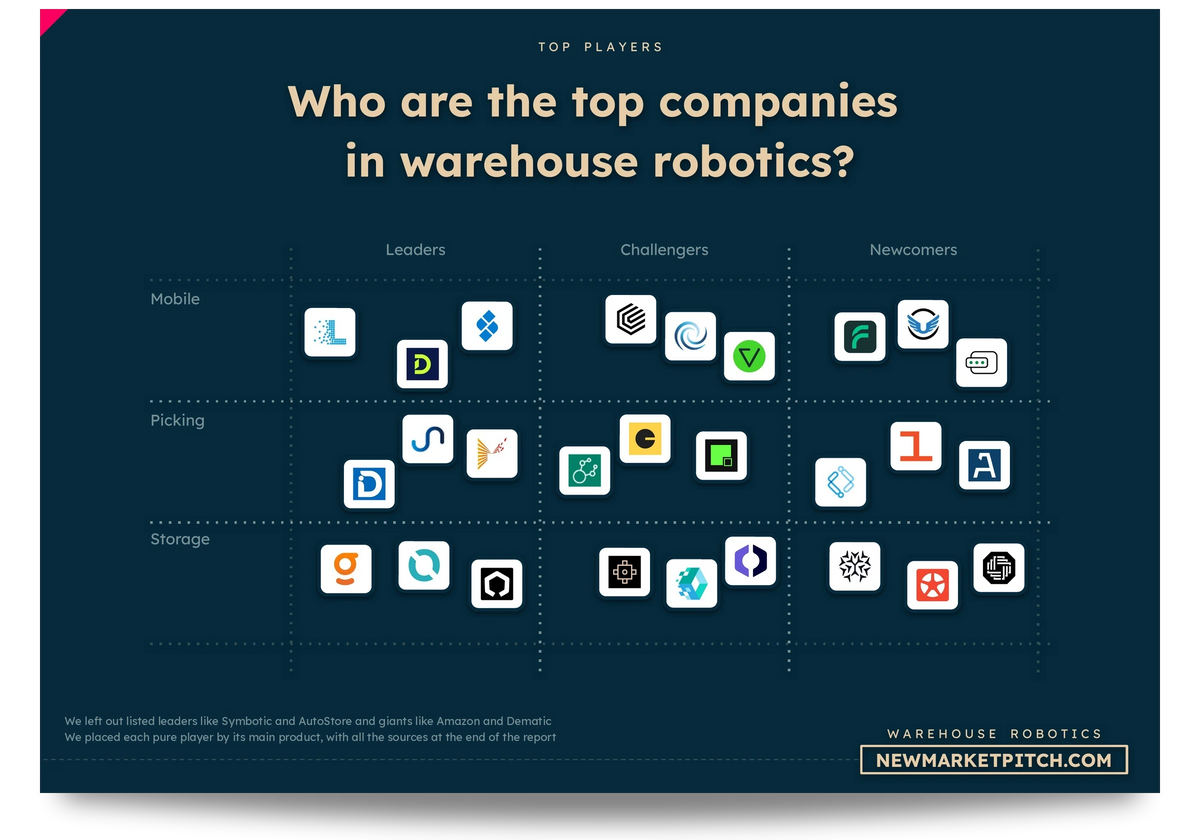
In our report covering the warehouse robotics market, we turn what is vague and complex into simple, useful visuals. Market maps like this one show you at a glance where every startup stands.
Why are warehouse robotics startups becoming serious alternatives to Amazon?
Warehouse robotics companies such as Geek+, Locus Robotics, Exotec and Hai Robotics have already built large commercial businesses outside Amazon's logistics network. They operate across hundreds of customer facilities, and the biggest specialists now have thousands or tens of thousands of robots deployed. The competition has moved well beyond experimental installations.
Amazon remains the reference point for warehouse robotics at scale. In June 2025, the company announced the deployment of its one-millionth robot across its operations. Its technology covers inventory movement, sorting, robotic manipulation and software coordinating entire fulfillment centers. However, Amazon primarily develops these systems for its own network, leaving an enormous market of retailers, manufacturers and logistics operators that need automation from independent suppliers.
The strongest challengers are taking different approaches. Geek+ has built one of the world's largest mobile warehouse robot fleets. Locus Robotics focuses on improving picking productivity with collaborative robots. Exotec and Hai Robotics specialize in high-density automated storage, while Symbotic is winning large distribution-center automation projects.
Several leaders have already emerged. The harder question is which companies have the strongest commercial positions, rather than simply the most impressive robots or fundraising announcements.
Who are the biggest warehouse robotics companies outside Amazon?
Geek+, Symbotic, Locus Robotics, AutoStore and Exotec are among the largest independent warehouse automation specialists, although their businesses are too different for a simple ranking by robot count. Geek+ leads in reported mobile robot fleet scale, Symbotic has much larger disclosed quarterly revenue, and AutoStore provides one of the clearest examples of profitable warehouse automation.
Geek+ reported more than 81,000 deployed robots worldwide, while Locus Robotics reports more than 22,000. Exotec reached 200 customer sites using its Skypod system in 2025. Symbotic, meanwhile, disclosed 56 operational systems and another 77 systems in deployment in its fiscal third quarter of 2026.
Those Symbotic installations are large, complex warehouse automation projects. Counting them alongside individual mobile robots would give a distorted picture.
The financial figures reveal another difference. Symbotic generated $721 million in quarterly revenue, while AutoStore reported $192 million in its second quarter of 2026 and an adjusted EBITDA margin of approximately 45%. Geek+ generated RMB1.284 billion in first-half revenue, up 25.3% year over year.
We include publicly traded companies in this comparison because excluding them would remove some of the most successful businesses that emerged from the warehouse robotics startup ecosystem. Among companies that remain private, Locus Robotics, Exotec and Hai Robotics have especially strong claims.
| Company | Main specialization | Reported commercial scale | Position |
|---|---|---|---|
| Geek+ | Autonomous mobile robots | 81,000+ deployed robots | Leading mobile robotics supplier |
| Symbotic | Large distribution-center automation | 56 operational systems; $721M quarterly revenue | Major enterprise automation supplier |
| Locus Robotics | Collaborative fulfillment robots | 22,000+ deployed robots; 360+ sites | Leading independent picking specialist |
| AutoStore | Robotic storage and retrieval | $192M quarterly revenue | Established, profitable public benchmark |
| Exotec | Robotic goods-to-person storage | 200+ customer sites | Major private automation supplier |
| Hai Robotics | Case and tote handling | 10,000+ System 3 robots reported deployed | Major storage automation challenger |
| GreyOrange | Robotics and inventory orchestration | 130,000 reported hardware/software agents | Large software-led automation platform |

Our research about warehouse robots gets updated several times a month, so you always get the latest view of where things stand.
Is Geek+ the biggest independent warehouse robotics company?
Geek+ has one of the strongest claims to leadership in autonomous mobile warehouse robots, backed by more than 81,000 deployed machines, roughly 1,000 end customers and growing sales. Its latest financial results also show that demand is still increasing, although profitability remains unfinished business.
According to its first-half 2026 results, Geek+ secured RMB2.385 billion in new orders, up 35.5% from the comparable period. Revenue increased 25.3% to RMB1.284 billion, while gross margin reached 35.8%.
The difference between order growth and revenue growth is worth examining. New orders grew roughly ten percentage points faster than sales, suggesting that customers are adding projects faster than Geek+ is currently recognizing revenue. Delivery schedules will determine how much of that demand eventually converts into sales.
The company is also moving beyond one-off robot installations. Orders for subscription-based services increased more than 75% to RMB156 million. They still represented only about 6.5% of new orders, but that is encouraging for a business historically built around equipment and automation projects.
Geek+'s market position is more specific than its global footprint might suggest. Its investor materials, drawing on CIC research, put its share of the global warehouse fulfillment autonomous mobile robot market at approximately 9% in 2024. Its share of the much broader warehouse automation market was only around 1%.
Profitability is the main remaining weakness. Adjusted net loss narrowed 32.1% in the first half of 2026, but Geek+ has yet to establish the consistently strong margins achieved by mature automation suppliers such as AutoStore.
For mobile warehouse robotics, Geek+ belongs at the very top of the independent supplier market.
If you want more recent data on this point, please see our latest warehouse robotics market report.
Can Locus Robotics catch up with Geek+?
Locus Robotics is already a major competitor to Geek+ in warehouse fulfillment, with more than 22,000 deployed robots and over eight billion completed picks. Its advantage is especially clear in facilities where customers want to increase picking productivity without rebuilding the warehouse around fixed automation.
Locus has expanded to more than 360 sites across over 20 countries. Its cumulative picking volume shows that customers are using the machines extensively, rather than simply installing them.
In October 2025, Locus passed six billion cumulative picks, with the sixth billion completed in 24 weeks. That works out to approximately 42 million picks per week during that interval. Since then, the reported total has climbed beyond eight billion, extending a track record of repeated warehouse use.
The customer results are also concrete. Staples Canada reached one million picks 70 days after launching its Locus system. UPS Healthcare reported a 54% throughput improvement in a cold-storage operation, while Ulta Beauty reported a 25% increase in units picked per hour and doubled its robot fleet to handle peak demand.
These examples help explain why logistics providers choose Locus. Its collaborative robots reduce walking and coordinate picking tasks while allowing warehouses to keep much of their existing infrastructure.
Geek+ has a considerably larger reported robot fleet, but the two companies' systems do not always address identical needs.
Locus is also pushing toward fuller automation. Its work with Nexera Robotics brings robotic manipulation into a platform historically focused on helping people pick faster. Whether customers adopt those capabilities widely will be important to its next stage of growth.

In our market report about warehouse robots, we look at what the winners do differently, so you can learn from the best instead of guessing.
Has Exotec become Europe's leading warehouse robotics startup?
Exotec is one of Europe's strongest warehouse robotics startups, with more than 200 customer sites and a system that has gained traction far beyond France. Its Skypod technology has established the company as a serious alternative to conventional automated storage systems.
Founded in France in 2015, Exotec developed autonomous robots that travel horizontally and climb storage racks to retrieve inventory. Warehouses can store products densely while moving requested bins to picking stations, reducing the time employees spend traveling between storage locations.
The company has gradually expanded from the Skypod robots into a more complete warehouse automation offering, including Skypath conveyors and Deepsky execution software. This allows Exotec to participate in larger projects where customers want one supplier to coordinate several warehouse operations.
Its international customer base is the strongest evidence of commercial maturity. Exotec passed 200 Skypod customer sites in 2025 and announced six additional projects in Spain that year, including an installation for pharmaceutical distributor Alliance Healthcare.
The comparison with AutoStore is particularly interesting. Both systems compete for automated storage projects, but AutoStore uses robots moving across the top of a storage grid, while Exotec's machines move through and climb rack structures. The better option depends on facility layout, throughput requirements, expansion plans and integration costs.
Exotec has less public financial transparency than AutoStore, making it difficult to compare profitability or revenue directly. Still, its installed base and international expansion put it among the most established private warehouse robotics businesses.
If you want more recent data on this point, please see our latest warehouse robotics market report.
Is Hai Robotics catching up with Exotec and Geek+?
Hai Robotics has become a major competitor in robotic storage, and its latest orders suggest that existing customers are increasingly expanding their installations. The Chinese company is particularly strong in automated case and tote handling, where high storage density and flexible robot movement are valuable.
Hai Robotics reported more than 10,000 deployed robots across over 100 projects using its HaiPick System 3 architecture. In August 2026, it separately announced contracts covering more than 10,000 HaiPick Climb robots worldwide.
Those figures need to stay separate. The first concerns deployed machines from an established system generation, while the second concerns contracted units for a newer product family. Treating every contracted robot as already operational would exaggerate the installed base.
HaiPick Climb has nevertheless attracted customers in 12 countries. In September 2026, the company announced a European fashion retail project involving more than 1,500 rack-climbing robots for a customer already using its technology.
One of the most interesting details in Hai Robotics' disclosures is customer behavior. More than 80% of its first-half 2026 orders reportedly came from existing customers, including expansions and additional projects.
That proportion suggests customers are returning after their initial purchases, which is encouraging in a market where automation projects can involve expensive installation work and operational disruption. However, without the absolute value of those orders, we cannot determine how quickly repeat business is growing.
Hai Robotics now belongs in the same broad group as Exotec among major private automated storage suppliers. Its next test is converting that rapidly growing contracted fleet into an equally impressive operational footprint.

In our document detailing everything you need to know about warehouse robotics, you will always find fresh funding data, taken straight from our own verified funding database.
Is Symbotic already bigger than most warehouse robotics startups?
Symbotic is already much bigger than most warehouse robotics startups by disclosed revenue, generating $721 million in its fiscal third quarter of 2026. Its business centers on large distribution-center automation projects, putting it in a different commercial category from suppliers of smaller mobile robots.
Revenue grew 22% year over year, while quarterly net income reached $55 million, compared with a $21 million loss a year earlier. Adjusted EBITDA more than doubled from $45 million to $95 million.
The company also reported 56 fully operational systems and 77 additional systems in deployment. During the quarter, 11 new system deployments began and four existing projects became operational.
These figures show how much implementation work sits behind Symbotic's sales. Systems revenue accounted for $671 million of quarterly revenue, while software and operational services contributed $13 million and $37 million respectively. The installed base is expanding, but building new systems still generates the overwhelming majority of sales.
Symbotic's approximately $22.5 billion backlog is another indication of its commercial reach. It represents many years of revenue at the current quarterly run rate, although the value will be recognized over extended delivery periods and depends on projects proceeding as contracted.
Walmart has been central to Symbotic's expansion. Its extensive automation program helped Symbotic reach a financial scale that most independent robotics suppliers have not approached.
That relationship also creates customer concentration and execution risk. Reports of commissioning difficulties and reliability challenges in Walmart-related automation programs illustrate how demanding these deployments can become, especially when older distribution centers need major modifications.
Symbotic has the revenue, backlog and enterprise relationships that many robotics startups dream of. But its exposure to a few enormous projects makes execution mistakes especially expensive.
Can Brightpick really automate warehouse picking without humans?
Brightpick is among the most convincing emerging warehouse robotics companies for autonomous item picking, with real customer deployments where robots already handle most picks without human assistance. At Superior Communications in Tennessee, its robots complete approximately 73% of picks autonomously.
The deployment uses 50 Autopicker robots and achieves up to 3,500 picks per hour, according to a May 2026 customer case study. Superior initially launched 25 robots in July 2025 before expanding the fleet to 50 in early 2026.
The warehouse uses two additional workflows for the remaining picking activity. Around 10% of picks go through a goods-to-person station, while 17% involve an operator handling fast-moving products from pallets. The site operates with two to three pickers per shift, alongside additional employees responsible for replenishment and packing.
So Brightpick has demonstrated substantial picking automation, but the facility still needs employees. That is a more useful result than another promise of a completely autonomous warehouse.
Brightpick has other sizeable installations. In January 2026, it announced that 103 Autopicker robots were handling approximately 70,000 items per day for sports nutrition retailer The Feed. Across its customer operations, the company reported 16 million picks during 2025.
The comparison with Locus Robotics is revealing. Locus has a much larger installed fleet and far greater cumulative picking volume, but its established model has focused mainly on helping warehouse employees pick faster. Brightpick is trying to automate a larger share of the actual item-handling work.
Brightpick remains smaller, yet its deployments make it one of the most interesting companies in mobile manipulation. If it can reproduce those autonomous picking rates across more product categories and customer facilities, it could challenge the economics of conventional collaborative picking.
If you want more recent data on this point, please see our latest warehouse robotics market report.

Learning from others' mistakes is the cheapest lesson there is. In our report covering the warehouse robotics market, we look at what broke startups before you, so you don't repeat it.
Could Nomagic become a leader in AI-powered warehouse picking?
Nomagic is one of the more credible AI warehouse picking startups, with deployed systems at major retailers and logistics operators, although it remains much smaller than the established robot fleet suppliers. Its particular strength is handling individual products that conventional warehouse robots often cannot manipulate reliably.
The Polish company has worked with customers including Cdiscount, ASOS, Arvato, Fiege and Brack.Alltron. These relationships cover picking, packing, sorting and induction tasks across different types of products and fulfillment environments.
In January 2026, Nomagic announced a $10 million extension to its Series B financing, taking total funding above $84 million. In May, the company expanded its partnership with Brack.Alltron to introduce vision-language-action technology into live warehouse operations.
Its Shoebox Picker provides an unusually clear example of a specialized application. The system, which received a 2026 IFOY innovation award, can reportedly automate handling for up to 98% of shoebox SKUs and has been deployed in a customer warehouse.
The 98% figure describes the range of product types the system can handle, rather than the percentage of orders completed automatically. That distinction is important when assessing how much labor the installation can actually save.
Nomagic and Brightpick could eventually compete for some of the same customers, although their designs differ. Nomagic emphasizes robotic manipulation integrated into warehouse workflows, while Brightpick combines picking and transportation in mobile machines.
Nomagic is a promising specialist with strong technology and customer references. It has more to prove on deployment volume, revenue and repeat installations before joining the industry's largest companies.
Is GreyOrange a major warehouse robotics company or mostly a software business?
GreyOrange has become a major warehouse and retail orchestration platform, with a reported 130,000 hardware- and software-based agents across its operations. Its scale is impressive, but the agent count includes software entities and cannot be compared directly with the physical robot fleets reported by Geek+ or Locus Robotics.
In September 2026, GreyOrange announced that its technology was operating in more than 3,800 retail stores worldwide. It had added approximately 100,000 agents over the previous two years, increasing its reported footprint from roughly 30,000 to 130,000.
That represents more than a fourfold expansion in the agent count, although the company does not break out how much of the increase came from physical machines versus software.
GreyOrange has also built long-running customer relationships. H&M Group first implemented its GreyMatter warehouse orchestration software in a U.S. distribution center in 2021 and subsequently expanded the partnership across additional facilities and hundreds of retail stores.
The company's technology coordinates different robotic systems and inventory workflows. Its growth into retail software means it can serve customers even when it does not manufacture the underlying machines.
Businesses running robots from several manufacturers still need to coordinate their equipment, inventory and operational decisions. GreyOrange can participate in that spending without having to win every hardware contract.
GreyOrange is therefore a major automation software competitor, and its growing retail footprint makes it increasingly different from a traditional warehouse robotics manufacturer.

Your time is limited. In our research about warehouse robots, we put numbers on each part of the market, so you can see where it makes sense to focus.
Can inventory robots become as important as picking robots?
Dexory and Gather AI are building serious warehouse robotics businesses around inventory monitoring, an expensive operational problem that many picking and storage systems do not completely solve. Their robots and drones help operators locate stock, identify discrepancies and track warehouse conditions without relying entirely on manual inspections.
Dexory uses autonomous mobile robots equipped with sensors to create detailed digital representations of warehouses. Gather AI approaches the problem with autonomous drones and computer vision.
The financing figures show substantial investor interest. Dexory announced $165 million in financing in October 2025, including a $100 million Series C equity round and an expanded debt facility. Gather AI raised a $40 million Series B in February 2026.
Gather AI has named logistics customers including NFI, GEODIS, DSV and Barrett Distribution. The company has reported inventory scanning speeds up to 15 times faster than conventional methods, while NFI described a fivefold productivity increase from using one drone.
These results address a different cost problem from order picking. An automated picking system improves how quickly products move through a warehouse, while inventory monitoring helps ensure that the right products are in the correct locations.
A large distribution center could use Symbotic for material handling, Locus for fulfillment and Gather AI for inventory checks. The technologies are complementary, and customers do not have to choose between them.
Dexory and Gather AI are still smaller than the warehouse automation giants, but their specialized applications provide a credible route to building meaningful businesses without trying to automate every warehouse task.
If you want more recent data on this point, please see our latest warehouse robotics market report.
Are warehouse robotics startups actually replacing warehouse workers?
Warehouse robotics companies are already reducing labor requirements for picking, transport and inventory checking, but fully autonomous warehouses remain uncommon. The strongest evidence comes from operational installations where companies can measure throughput and staffing, rather than from predictions about how many jobs robots might eventually replace.
Brightpick's Superior Communications project is particularly informative. The robots complete nearly three-quarters of picking tasks independently, yet human employees still handle the remaining picks, inventory replenishment and packing.
Locus Robotics follows a different approach. Its collaborative robots reduce travel time and help employees process more orders during a shift. The company's customer examples, including Ulta Beauty and UPS Healthcare, demonstrate substantial productivity improvements, but they do not establish that entire facilities can run without staff.
The economics also depend on the warehouse. A large retailer handling predictable product categories may justify extensive fixed automation. A smaller warehouse with frequent changes in product mix might prefer mobile robots that can be moved or reconfigured.
That is one reason several types of robotics suppliers continue to grow simultaneously.
Warehouse robots are eliminating many individual manual tasks and reducing the staffing needed for certain workflows. Industry-wide job replacement is harder to measure because automation also changes operating capacity, warehouse design, maintenance requirements and the division of work between people and machines.
The most useful commercial measure is labor hours required per order or item processed, together with equipment costs, reliability and actual throughput. A robot that reduces walking time is valuable. One that reliably completes the pick itself could change staffing requirements much more dramatically.

In our market report about warehouse robots, we always try to gather several sources and make estimates that make sense, so you can work with solid numbers.
Will humanoid robots replace warehouse robotics startups?
Humanoid robots are unlikely to displace established warehouse robotics suppliers in the near term because specialized machines already perform repetitive logistics tasks at a scale that general-purpose humanoids have yet to demonstrate. The more immediate opportunity for humanoids lies in difficult tasks that existing warehouse automation cannot handle cheaply.
Moving standardized totes through fixed routes is a good example. Geek+, Locus Robotics and Hai Robotics have developed machines specifically for these operations, with established software, charging systems and maintenance processes.
A humanoid would need to beat those systems on cost, reliability or flexibility. Its ability to walk and use two arms offers little advantage in jobs that simpler robots already perform efficiently.
Irregular product handling, trailer unloading, pallet preparation and workstations designed for humans may provide better opportunities. These tasks often involve changing objects, constrained spaces and decisions that conventional robotics struggle to handle.
Even here, specialist AI-powered machines have a head start. Brightpick is already automating item picking inside commercial warehouses, while Nomagic has deployed robotic manipulation for particular product categories.
Ambi Robotics offers another useful benchmark. The company has reported more than 150 million parcels handled and over 250,000 operational hours across more than 100 deployed robots. That level of cumulative operating experience is exactly what newer humanoid platforms need to establish.
Humanoids will probably compete first for warehouse tasks that are still performed manually. Replacing mature, purpose-built automation systems is a much tougher proposition.
So, who are the top warehouse robotics startups beyond Amazon?
Geek+, Locus Robotics, Exotec and Hai Robotics are the strongest independent warehouse robotics specialists today, while Symbotic stands out for its much larger disclosed revenue and major distribution-center contracts. Brightpick and Nomagic are among the most interesting emerging challengers because they are taking automation deeper into the physical picking process.
Our ranking depends on what each company has actually achieved.
Geek+ has the clearest advantage in reported mobile robot fleet scale among the companies reviewed. Locus Robotics has a particularly strong record in collaborative fulfillment, demonstrated through extensive deployment and billions of completed picks.
Exotec and Hai Robotics are leading challengers in automated storage, where installations require deeper integration into warehouse infrastructure. Symbotic has reached a financial scale few robotics companies can match, although its large projects and customer concentration create different risks.
Brightpick looks especially interesting among smaller emerging suppliers. Its installations offer concrete evidence that mobile robots can handle a substantial majority of individual picking tasks. Nomagic is also making meaningful progress in specialized manipulation, but its commercial scale is less transparent.
GreyOrange deserves recognition for robotics orchestration software, while Dexory and Gather AI show that warehouse inventory monitoring can support its own category of robotics businesses.
These companies have established several successful commercial models. Warehouse transport, storage, manipulation, orchestration and inventory intelligence involve different tasks and often different purchasing decisions.
Amazon remains far ahead in the scale of robotics deployed inside its own operations. Outside that network, independent warehouse robotics suppliers have become established industrial businesses. Geek+, Locus Robotics, Exotec and Hai Robotics lead the private-and-former-startup specialist group, while the next generation of competition will increasingly depend on how much physical warehouse work companies such as Brightpick and Nomagic can automate reliably and at a competitive cost.
If you want more recent data on this point, please see our latest warehouse robotics market report.

If you build or invest in the warehouse robotics market, you need to know which business models pay off now and which ones are fading. That's why our report covering it has a whole section on it.
Our methodology
This analysis identifies the leading warehouse robotics startups beyond Amazon by examining commercial traction, deployment scale, financial strength, operational performance and technological differentiation. We include established private companies, emerging challengers and publicly traded businesses that originated in the warehouse robotics ecosystem. Amazon serves as the reference point for scale, rather than as a directly comparable independent supplier.
We approached each dimension through a structured aggregation of recent evidence. First, we collected company disclosures, investor reports, customer deployment announcements, operational case studies and industry evaluations. We then compared the available observations within relevant technology categories before assessing which companies had demonstrated the strongest commercial positions. Greater weight was given to installed systems, recurring customer activity, disclosed financial performance and documented operating results than to fundraising or announced future capacity.
Deployment figures were interpreted according to what companies actually count. Individual mobile robots, large integrated warehouse automation systems, customer sites and software agents are different measurements. We therefore distinguish Geek+'s and Locus Robotics' deployed robot fleets from Symbotic's operational systems, Exotec's customer sites and GreyOrange's combined hardware and software agents. For Hai Robotics, we also separate deployed System 3 robots from contracted HaiPick Climb units.
Financial comparisons rely on disclosed results rather than estimated private-company revenues. We use Geek+'s first-half 2026 orders, revenue, margins and losses alongside Symbotic's fiscal third-quarter 2026 performance and AutoStore's second-quarter 2026 results. Orders and backlog are evaluated as indicators of future contracted business, with delivery and implementation risks kept separate from revenue already recognized.
Operational performance is assessed through published customer examples and measured activity. Locus Robotics' cumulative picks and customer throughput improvements provide evidence of sustained collaborative fulfillment, while Brightpick's deployments illustrate the proportion of individual picks completed autonomously. We distinguish Nomagic's reported shoebox-SKU handling coverage from actual autonomous picking rates. These figures are useful for understanding each technology's capabilities, although customer case studies are not standardized cross-company benchmarks.
For emerging specialists, we also consider the relevance of customer relationships, repeat installations and independent technical evaluations. Dexory and Gather AI are assessed within inventory monitoring rather than compared directly with picking robot fleets. We keep equity financing separate from debt when discussing Dexory's October 2025 funding package, and assess Ambi Robotics' cumulative operating experience as a benchmark for newer robotic manipulation and humanoid systems.
Key sources for commercial scale and financial performance include Amazon's one-million-robot milestone, Geek+'s 2026 interim financial results, Symbotic's fiscal Q3 2026 results, AutoStore's Q2 2026 results, and Locus Robotics' deployment statistics.
Sources for established storage systems and operating performance include Exotec's ten-year commercial milestone, Hai Robotics' HaiPick Climb contract milestone, Hai Robotics' European deployment announcement, Locus Robotics' UPS Healthcare case study, Brightpick's Superior Communications deployment, and Brightpick's The Feed installation.
For robotic manipulation and emerging applications, we consulted Nomagic's Shoebox Picker announcement, the IFOY Awards technical evaluation, Nomagic's Brack.Alltron partnership update, Dexory's October 2025 financing announcement, Gather AI's February 2026 Series B announcement, and Ambi Robotics' production deployment figures.
The final assessment draws conclusions across these dimensions without forcing companies into a single numerical ranking. This recognizes the strongest suppliers within their respective warehouse functions, distinguishes demonstrated operating achievements from future commitments and identifies where newer technologies are beginning to challenge established approaches.

In our report covering the warehouse robotics market, we don't want to repeat what boring consulting reports say. Instead, we show you the real and latest market signals that matter.
Written by the New Market Pitch teamWe track new markets so founders and investors can move faster. About us