Is the medical imaging AI market as big as FDA lists imply?
Whether you're building or investing in the medical imaging AI market, our report covers everything you need to know: the players, the money, and what's coming next.
Summary
No. The medical imaging AI market is substantially smaller than the FDA's enormous list of authorized devices might suggest. Commercial adoption is growing, but regulatory clearances are accumulating much faster than hospitals are purchasing and routinely using independent AI software.
More than 1,600 AI-enabled medical devices had been authorized in the United States by September 2026, with radiology representing roughly three-quarters of the cumulative list. The count includes standalone algorithms, AI-equipped scanners, reconstruction software and successive product versions. These are very different businesses.
Hospital adoption reveals a much narrower market. KLAS research found that approximately half of surveyed healthcare organizations were using imaging AI, but international respondents averaged only 2.2 active use cases. Hospitals are adopting the technology selectively rather than purchasing dozens of algorithms.
Demand is clustering around a few recognizable applications. Stroke detection, breast imaging and chest X-ray analysis consistently appear among the most widely used categories. High examination volumes, clinical urgency and identifiable workflow benefits are proving more commercially useful than simply having another cleared algorithm.
The financial evidence confirms that meaningful software businesses are emerging. RadNet's DeepHealth division generated $92.7 million in 2025 revenue and reached $105.5 million in annual recurring revenue by June 2026. But those figures also include enterprise imaging and operational software, illustrating how difficult it is to isolate diagnostic AI revenue.
A multibillion-dollar standalone software market is possible, but not established by current public disclosures. An illustrative model with 15,000 paying organizations spending $100,000 annually produces $1.5 billion in revenue. Reaching $4.2 billion would require 21,000 buyers spending $200,000 each, or another combination delivering equivalent spending.
Reimbursement could change the economics of specific applications. Coronary CT plaque analysis now has a dedicated 2026 CPT code, with published Medicare payment amounts around $950 to $1,017 for qualifying services and settings. Those payments go toward the clinical service, however, not automatically to the AI developer.
Distribution is becoming a bigger competitive advantage. Companies that already supply imaging equipment, enterprise software or multiple clinical algorithms can sell additional AI capabilities through existing hospital relationships. A startup offering one narrowly defined algorithm faces a much harder integration and purchasing process, even with FDA authorization.
Platform adoption could concentrate revenue further. Hospitals want fewer integrations and simpler oversight, while providers such as Sectra, Philips, DeepHealth and other enterprise imaging vendors can distribute multiple algorithms through existing infrastructure. Counting platform revenue and underlying algorithm sales separately can overstate total spending.
The market is international, and the FDA list misses commercial activity outside the United States. Yet the same constraint appears across regions: regulatory availability does not guarantee clinical deployment, and deployment does not guarantee substantial recurring revenue. The strongest opportunities are tied to workflows hospitals already perform at scale.
Our conclusion is that the FDA list substantially exaggerates the size and maturity of the realized standalone medical imaging AI software market. The industry has moved beyond pilots, and some vendors are growing quickly, but the next decisive measure of market expansion will be paid, routine clinical usage rather than the number of newly authorized devices.

Written by the New Market Pitch teamWe track new markets so founders and investors can move faster. About us

Your time is limited. In our report covering the medical imaging AI market, we put numbers on each part of the market, so you can see where it makes sense to focus.
Why are there so many FDA-cleared medical imaging AI products now?
The FDA's medical imaging AI list has become enormous, but the number of authorized devices is growing much faster than the number of AI products hospitals routinely use.
According to the FDA, more than 1,600 AI-enabled medical devices had been authorized for marketing in the United States by September 2026. Radiology accounts for roughly three-quarters of the cumulative list, making medical imaging by far the biggest category. The database covers everything from stroke detection and mammography analysis to MRI reconstruction, ultrasound enhancement and automated measurements.
The list has also become more crowded with established manufacturers. Philips, Siemens Healthineers, GE HealthCare and Canon appear alongside specialized companies such as Aidoc, Lunit, RapidAI and ScreenPoint Medical. Some sell independent diagnostic software. Others add AI capabilities to equipment hospitals were already buying.
A new FDA clearance might represent a completely new clinical application, an updated algorithm or another version of an existing scanner. All count toward the regulatory total, even though their commercial value can differ enormously.
The FDA list shows how widely AI has spread across medical imaging technology. Whether that translates into a similarly large software market depends on what hospitals are actually purchasing.
Does FDA clearance mean a medical imaging AI product is being sold?
An FDA clearance tells us that a medical imaging AI device has met the applicable regulatory requirements, but it tells us almost nothing about how much money the product makes.
The FDA reviews a device's safety and effectiveness for its intended use. Manufacturers do not need to prove that hundreds of hospitals will purchase their software, that physicians will use it regularly or that the product can generate profitable recurring revenue.
The database also contains repeated submissions from individual manufacturers. In 2026, Lunit received authorizations for different versions of its INSIGHT breast-imaging products. Philips registered multiple configurations of ultrasound systems, while GE HealthCare and Siemens appeared with successive imaging systems and software capabilities.
These are legitimate regulatory authorizations. Yet counting them as separate commercial businesses would produce a misleading picture of the market.
Another complication is that a clearance remains part of the FDA's cumulative record regardless of whether the corresponding version later becomes obsolete, is replaced or fails commercially.
We can establish how many regulatory authorizations have been granted. Determining how many products are actively sold, how many hospitals pay for them and how much revenue they generate requires different evidence.

In our research about AI for medical imaging, we always try to gather several sources and make estimates that make sense, so you can work with solid numbers.
How much of the FDA's medical imaging AI list is actually software?
The independent medical imaging AI software market is considerably smaller than the FDA's radiology device category because many listed products are complete imaging systems with AI built into them.
Consider three examples. Aidoc's BriefCase-Triage software identifies potentially urgent findings in imaging studies. Lunit INSIGHT MMG assists radiologists interpreting mammograms. GE HealthCare's AIR Recon DL uses deep learning to reconstruct MRI images.
All three involve medical imaging AI, but their business models are different.
Aidoc and Lunit can sell identifiable software capabilities to healthcare organizations. GE HealthCare can use AI reconstruction as part of a broader MRI offering. In the latter case, the equipment manufacturer may earn revenue from an expensive scanner without separately reporting what customers paid for the AI functionality.
The same problem appears with ultrasound systems, CT scanners and enterprise imaging software. An AI-enabled machine can be commercially successful without creating a separately measurable AI software market.
For market sizing, we therefore distinguish spending on diagnostic algorithms, imaging workflow software, enterprise AI platforms and AI functionality embedded in medical equipment.
| Medical imaging AI category | Examples | How revenue is generated |
|---|---|---|
| Emergency imaging AI | Aidoc, RapidAI, Viz.ai | Software and platform contracts |
| Breast imaging AI | Lunit, ScreenPoint, DeepHealth | Licensing, subscriptions and screening-related fees |
| Chest imaging AI | Gleamer, annalise.ai | Software licenses and enterprise contracts |
| Quantitative cardiac AI | Cleerly, HeartFlow | Analysis services and software-related fees |
| Radiology workflow AI | Rad AI, DeepHealth | Enterprise software subscriptions |
| MRI reconstruction AI | GE HealthCare, Canon Medical | Software licensing or equipment-related sales |
| Ultrasound AI | Philips, Siemens, GE HealthCare | Embedded capabilities or software licenses |
| Imaging AI platforms | Sectra, AGFA HealthCare, Philips | Enterprise software and integration contracts |
The categories also overlap. A hospital may buy a platform containing several third-party algorithms, so adding the full platform contract to the full underlying software sales would risk counting the same spending twice.
If you want more recent data on this point, please see our latest medical imaging AI market report.
Are hospitals actually using medical imaging AI at scale?
Medical imaging AI has reached a meaningful share of hospitals, but most adopters still use only a small number of applications.
KLAS Research's November 2024 study interviewed 206 US healthcare organizations and found that just over half were beginning to use AI algorithms for at least one imaging application. That compares with 17% of interviewed organizations piloting or actively using imaging AI in 2018.
The international picture is similar. In September 2025, KLAS published research covering 369 organizations across Europe, Canada, Asia/Oceania, Latin America and the Middle East/Africa. Nearly half reported using at least one imaging AI solution.
The more revealing finding concerns how much AI these organizations actually use. According to a detailed review of the KLAS international results published in HealthManagement, respondents reported an average of 2.2 active imaging AI use cases. Most were using just one or two.
Approximately half of surveyed organizations have adopted some imaging AI, while the typical adopter is still working with a fairly limited collection of tools.
That helps explain the gap between regulatory supply and commercial demand. The FDA has authorized an enormous range of applications, but hospitals are concentrating their spending on a small part of that range.
The KLAS surveys cover selected organizations rather than every hospital worldwide. Their percentages should therefore be read as adoption indicators, not exact global penetration rates.

In our market report about AI for medical imaging, we don't want to repeat what boring consulting reports say. Instead, we show you the real and latest market signals that matter.
Which medical imaging AI applications are hospitals buying the most?
Stroke detection, breast imaging and chest X-ray analysis currently stand out as the clearest areas of medical imaging AI adoption.
KLAS's 2025 international research identified these three categories as the most common diagnostic imaging AI applications. RapidAI, Gleamer and annalise.ai were the most frequently used image-analysis vendors among respondents, followed by Lunit and ScreenPoint Medical.
The earlier US study found RapidAI and Viz.ai leading reported adoption, followed by Aidoc and Rad AI.
There is a practical explanation for the overlap. Stroke software helps identify potentially urgent cases and coordinate care when treatment delays can have serious consequences. Mammography AI supports recurring screening examinations. Chest X-ray algorithms address a widely used imaging modality with frequent, recognizable abnormalities.
Other applications also have identifiable markets. Fracture detection helps emergency clinicians assess common injuries, while coronary CT analysis can provide measurements relevant to treatment decisions.
But a narrowly targeted algorithm for a rare finding may struggle to attract buyers even when its technical performance is impressive.
The recurring appearance of the same clinical categories across US and international surveys suggests that demand is concentrating around established, high-volume workflows. Hospitals are choosing particular problems to solve rather than buying AI for every type of scan.
Why aren't hospitals using more medical imaging AI algorithms?
Hospitals are holding back on broader medical imaging AI deployment because every additional algorithm creates costs and operational work, even after regulatory clearance.
A hospital buying AI software must connect it to imaging archives, reporting systems and clinical workflows. It must also check that the algorithm performs adequately on its own patient population, establish oversight procedures and handle cybersecurity, updates and staff training.
These requirements become harder when hospitals deploy products from several independent vendors. One algorithm may prioritize stroke cases, another may flag chest abnormalities and a third may produce automated measurements. Each can create its own alerts, interfaces and integration requirements.
The KLAS research makes the consequences visible. Despite reporting 108 different imaging AI vendors across its international survey, the average organization was using only a small number of applications.
The problem is especially relevant for products whose benefits are difficult to measure. A stroke notification that changes the order in which urgent cases receive attention has an identifiable operational purpose. An algorithm that slightly improves a measurement but adds another verification step has a harder commercial argument.
KLAS also found that larger imaging organizations were more likely to use AI, consistent with the idea that high examination volumes make the implementation effort easier to justify.
There is genuine demand here. But hospitals aren't going to buy every algorithm that receives clearance, and the purchasing process is much slower than the regulatory numbers might suggest.
If you want more recent data on this point, please see our latest medical imaging AI market report.

In our document detailing everything you need to know about medical imaging AI, we like to show you the big picture. We know your time is precious, so we make every page quick to read and packed with as much learning as possible per minute.
How much revenue are medical imaging AI companies making?
The most transparent medical imaging AI businesses currently generate tens or hundreds of millions of dollars in annual imaging-related software revenue, with major differences between companies and product categories.
RadNet provides one of the strongest financial examples. Its Digital Health division, DeepHealth, generated $92.7 million in 2025 revenue, up from $65.7 million in 2024. Annual recurring revenue reached $105.5 million by June 2026, an increase of 97.2% over the previous year.
The growth is substantial. DeepHealth added approximately $27 million in annual segment revenue in 2025, and its recurring-revenue base expanded by almost $52 million between June 2025 and June 2026.
There is one qualification: DeepHealth combines clinical AI, enterprise imaging and imaging operations software. The $105.5 million recurring-revenue figure covers that wider business rather than diagnostic algorithms alone.
South Korea's Lunit provides another important example through its breast and chest imaging products. Its financial disclosures also include Lunit SCOPE oncology technology and the acquired Volpara business, which means consolidated company revenue cannot be treated as pure diagnostic imaging AI sales.
Meanwhile, companies such as Aidoc, Viz.ai, RapidAI and ScreenPoint Medical have established commercial deployments, but they do not all publish directly comparable audited revenue figures.
The available accounts confirm that medical imaging AI has produced meaningful recurring businesses. They do not yet give us a complete revenue census of the global standalone algorithm market.
Is medical imaging AI already a multibillion-dollar market?
Medical imaging AI can reasonably be described as a multibillion-dollar industry under broad definitions, but the evidence for several billion dollars in independently purchased diagnostic AI software remains much weaker.
Many market estimates include some combination of AI-enabled imaging equipment, reconstruction software, clinical applications and enterprise imaging platforms. That produces a much larger number than measuring what hospitals pay specifically for standalone algorithms.
We can test the size of the narrower software market through a spending model.
Suppose there were 30,000 potential hospital and imaging-organization buyers worldwide. This is an illustrative assumption rather than a verified global customer count.
If 30% purchased imaging AI software and spent an average of $50,000 annually, the market would generate $450 million. With 50% penetration and $100,000 average spending, it would generate $1.5 billion. At 70% penetration and $200,000 spending, revenue would reach $4.2 billion.
These scenarios show the scale of purchasing required to support different market estimates.
| Scenario | Paying organizations | Annual spending per buyer | Annual software market |
|---|---|---|---|
| Limited adoption | 3,000 | $30,000 | $90M |
| Small commercial market | 6,000 | $50,000 | $300M |
| Moderate adoption | 9,000 | $50,000 | $450M |
| Broad adoption | 12,000 | $75,000 | $900M |
| Strong enterprise adoption | 15,000 | $100,000 | $1.50B |
| High penetration | 18,000 | $150,000 | $2.70B |
| Large enterprise market | 21,000 | $200,000 | $4.20B |
These are modeled outcomes, not observed revenue or a forecast. They exclude equipment and clinical-service revenue.
A $4 billion standalone software market would require a fairly wide customer base, large average contracts or both. Current public disclosures do not establish those conditions across the industry.
If you want more recent data on this point, please see our latest medical imaging AI market report.

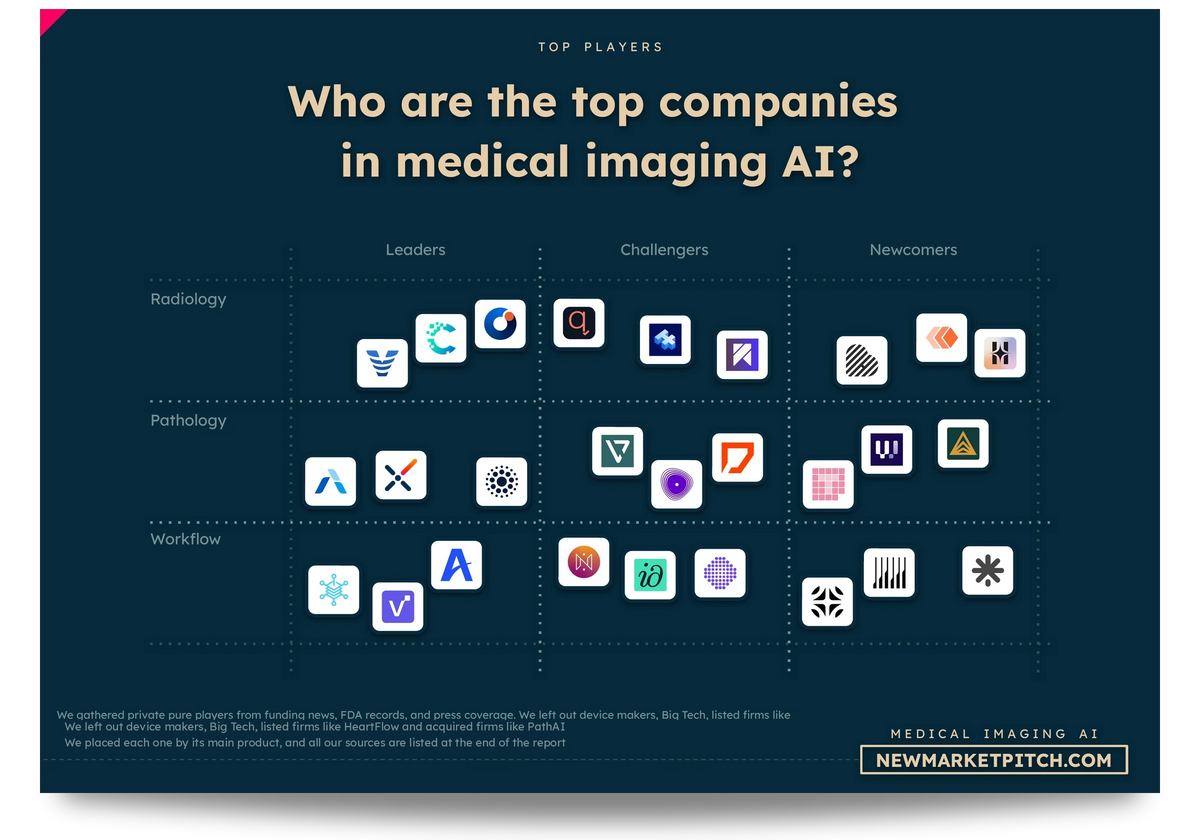
In our report covering the medical imaging AI market, we turn what is vague and complex into simple, useful visuals. Market maps like this one show you at a glance where every startup stands.
Does FDA clearance make hospitals willing to pay for medical imaging AI?
FDA clearance helps medical imaging AI companies enter the US market, but hospitals still need a convincing financial or clinical reason to purchase their products.
The regulatory review deals with safety and effectiveness for a particular intended use. Hospital purchasing teams must answer different questions.
Will the software reduce reporting delays? Can radiologists handle more examinations? Does it improve clinical decisions? Will the benefits justify the subscription and integration costs?
The answer varies enormously by application.
Stroke-triage software can help direct attention toward potentially urgent CT studies. Mammography AI can support reading and screening workflows. Radiology reporting software can reduce documentation work. These are relatively straightforward uses to evaluate, although proving financial returns still requires clinical and operational data.
Other products face a harder test. Detecting an additional imaging feature may be technically impressive without changing clinical decisions enough to justify a recurring contract.
The American College of Radiology's decision to establish an Artificial Intelligence Economics Committee, announced in July 2025, is particularly revealing. The committee focuses on reimbursement, purchasing and financially responsible deployment.
Medical imaging AI has progressed far enough that economic questions now deserve their own professional infrastructure. Regulatory clearance alone has not resolved them.
Could Medicare reimbursement make medical imaging AI much bigger?
Reimbursement could significantly increase spending on selected medical imaging AI applications, and coronary CT plaque analysis currently provides one of the clearest examples.
Starting in 2026, CPT code 75577 covers qualifying coronary plaque quantification and characterization derived from CT angiography, with professional interpretation.
Cleerly's published 2026 billing guidance lists Medicare physician-fee-schedule payments of approximately $1,012 to $1,017 for the complete service in a qualifying office setting. Its hospital outpatient guidance lists a $950.50 payment under the relevant payment system.
These amounts are considerably more concrete than a general claim that AI improves radiologist productivity. A healthcare provider can evaluate potential clinical-service revenue alongside costs and coverage requirements.
However, the reimbursement is paid for the covered clinical service, including technical and professional work. The software developer receives only the portion established by its commercial arrangement with the provider.
Coverage is also limited to qualifying circumstances. Cleerly's published guidance describes restrictions relating to patient symptoms, coronary disease findings and medical necessity.
Reimbursement could be a powerful growth driver for particular applications, but it won't solve the economics of the entire industry. A reimbursable coronary-analysis service has a different commercial structure from a stroke alert or a generic image-enhancement algorithm.

Our research about AI for medical imaging gets updated several times a month, so you always get the latest view of where things stand.
Are the biggest medical imaging AI companies winning because they have more FDA clearances?
The leading medical imaging AI companies appear to be winning customers through distribution and integration as much as through their regulatory portfolios.
DeepHealth is a useful example. Its software business combines clinical AI with enterprise imaging and operational products, giving hospitals several reasons to enter a commercial relationship. In the second quarter of 2026, the company signed approximately $21 million in new total contract value, bringing first-half new business to roughly $37 million.
That figure is different from recognized revenue, but it provides evidence of additional contracted business. The company also reported that external customers accounted for approximately 63% of Digital Health revenue.
The enterprise approach gives DeepHealth opportunities to sell more than a single algorithm.
Aidoc similarly offers several clinical AI applications and deployment infrastructure. Viz.ai combines imaging-derived findings with care coordination. Lunit has built relationships with imaging providers and distribution partners across international markets.
Compare these businesses with an independent developer selling one narrowly defined algorithm. Even with a successful FDA clearance, the smaller company must still find buyers, complete integrations, support clinicians and justify an additional contract.
The commercial advantage of an established vendor is partly cumulative: existing customer relationships make additional product sales easier.
We cannot prove from public information that distribution matters more than algorithm quality in every purchasing decision. But recurring enterprise contracts, platform investment and concentrated vendor adoption make one point difficult to ignore: counting FDA clearances is a poor way to rank commercial leaders.
If you want more recent data on this point, please see our latest medical imaging AI market report.
Will hospitals buy imaging AI platforms instead of individual algorithms?
Imaging AI platforms are likely to capture more spending as hospitals try to manage multiple algorithms through fewer software providers.
In its 2024 US study, KLAS found that 47% of responding organizations were considering an AI platform. The international 2025 study identified Sectra, AGFA HealthCare and Philips among the vendors frequently considered for imaging AI platforms.
Current platform usage was still relatively limited, generally around 10–20% across the surveyed international organizations, according to the detailed KLAS findings. Interest was much broader than deployment.
The appeal is straightforward. Hospitals already rely on imaging archives, reporting software and enterprise IT systems. Adding algorithms through those existing environments can simplify integration and governance.
Established manufacturers are also getting involved. Philips, GE HealthCare and Siemens can combine scanner capabilities, enterprise imaging software and AI tools in existing commercial relationships.
Independent algorithm companies face a choice. They can build their own enterprise sales and deployment infrastructure or work through partners that already control hospital software environments.
Both approaches can succeed, but the revenue ends up in different places. A platform vendor might collect the main software contract and share part of it with algorithm developers. In other cases, the hospital may license the algorithms separately.
Gross platform sales and individual algorithm revenue cannot simply be added together when estimating the market.

In our market report about AI for medical imaging, you will always find fresh funding data, taken straight from our own verified funding database.
Is breast imaging AI a bigger business than stroke detection AI?
Breast imaging AI probably has the broader recurring screening opportunity, while stroke AI benefits from a particularly urgent clinical need. Public revenue data are insufficient to establish which category is currently larger.
Breast imaging products from Lunit, ScreenPoint and DeepHealth address examinations performed repeatedly across screening programs. That creates opportunities to charge for software used routinely by imaging centers and hospitals.
Stroke AI has a different commercial appeal. RapidAI and Viz.ai focus on time-sensitive cases where faster identification and coordination can affect treatment decisions. Hospitals may value those capabilities highly even though stroke examinations represent a smaller subset of overall imaging volume.
Both categories ranked prominently in KLAS adoption research, and their vendors repeatedly appeared among the most widely deployed products.
The difference becomes important when comparing possible revenue models. Breast imaging can benefit from broad examination volume, while stroke detection can justify specialized enterprise contracts linked to emergency and neurological care.
Without comparable figures for paid examinations, contract values and software revenue, declaring either category the larger market would be guesswork.
For now, these two areas demonstrate different ways medical imaging AI can become commercially useful: frequent routine screening and high-consequence clinical decisions.
Is medical imaging AI growing as fast as FDA approvals suggest?
Medical imaging AI spending is growing quickly at several established companies, although there is no reliable evidence that total industry revenue is increasing at the same pace as FDA authorizations.
RadNet's Digital Health revenue increased 41.1% in 2025. Its annual recurring revenue then nearly doubled year over year by June 2026.
That performance shows growth in contracted software relationships rather than relying on new regulatory submissions. At the same time, the Digital Health division's adjusted EBITDA increased only 1.9% in 2025, from approximately $15.2 million to $15.5 million. Revenue expanded much faster than divisional profitability.
Rapid sales growth can coexist with significant spending on product development, acquisitions, implementation and customer support.
The longer adoption trend is encouraging. KLAS's US research showed a substantial increase in the share of interviewed organizations using or piloting imaging AI between 2018 and 2024. Its subsequent international findings confirmed that the technology had also reached healthcare providers across multiple regions.
But those surveys do not measure total worldwide spending, and the FDA's cumulative database cannot supply an industry revenue growth rate.
The market has moved well beyond pilots, and some vendors are converting adoption into fast-growing software revenue. The economic progress is real. Still, every new authorization shouldn't be treated as an equivalent increment of commercial demand.

In our document detailing everything you need to know about medical imaging AI, we look at what the winners do differently, so you can learn from the best instead of guessing.
Can medical imaging AI become a big market without replacing radiologists?
Medical imaging AI can generate substantial revenue without replacing radiologists because many of its most useful applications help clinicians handle existing work more efficiently.
Hospitals perform large numbers of CT, MRI, ultrasound, mammography and X-ray examinations. Even modest improvements in acquisition time, reporting workflow or urgent-case prioritization can have value when repeated across high examination volumes.
RadNet illustrates the scale of the underlying activity. In 2025, the company generated approximately $2.04 billion in total revenue from its wider operations, compared with $92.7 million in its Digital Health division.
Those figures are not a direct measure of AI productivity, but the gap shows how large the clinical imaging business remains relative to identifiable software revenue.
AI applications can capture some of that spending by making scanners more efficient, supporting radiologists or helping imaging providers manage patient flow.
There are limits. A hospital might purchase one tool to prioritize urgent studies and another to improve MRI reconstruction, but it will not necessarily buy dozens of narrowly differentiated algorithms.
Generic functions can also become standard features in equipment and imaging software. That may spread AI adoption while reducing the price customers are willing to pay for independent products.
The long-term opportunity is tied to how much useful work AI performs across imaging departments and how much of that value vendors can charge for.
Is medical imaging AI mostly a US market?
Medical imaging AI is already an international business, and the FDA's US-focused list misses important parts of its commercial activity.
KLAS's 2025 international research covered 369 organizations across five broad regions outside the United States. Europe led reported adoption, followed by Asia/Oceania and Canada, while Latin America and the Middle East/Africa were generally earlier in deployment.
The vendor landscape also demonstrates the market's international reach. Lunit is headquartered in South Korea, Gleamer in France, ScreenPoint Medical in the Netherlands and annalise.ai in Australia.
These companies have achieved recognition among healthcare organizations outside their domestic markets. The KLAS study identified Lunit and annalise.ai prominently in Asia/Oceania, while European respondents frequently reported products from Gleamer, annalise.ai, DeepHealth, RapidAI and Brainomix.
Regulation complicates direct comparisons. A European deployment does not necessarily require an FDA authorization, while receiving FDA clearance does not automatically permit commercialization in Europe or Asia.
The FDA database is therefore an incomplete measure of worldwide product availability, even though it is one of the most visible inventories of medical AI devices.
The global opportunity is wider than the US regulatory record, but international purchasing still depends on local budgets, reimbursement, regulatory approval and healthcare infrastructure.

If you build or invest in the medical imaging AI market, you need to know which business models pay off now and which ones are fading. That's why our report covering it has a whole section on it.
Is the medical imaging AI market as big as FDA lists imply?
No. The medical imaging AI market is growing into a substantial software business, but the FDA's enormous list of authorized devices makes the commercial market look much bigger and more mature than it is today.
There are three important findings from our research.
First, the regulatory total combines products with very different economics. Standalone diagnostic software, scanner reconstruction technology, enterprise imaging platforms and updated equipment configurations can all appear in the same broad category. A clearance offers little information about annual revenue.
Second, actual hospital usage remains relatively concentrated. KLAS found that roughly half of surveyed healthcare organizations were using imaging AI, yet the average international respondent reported only about 2.2 active use cases. Stroke, breast imaging and chest X-ray analysis accounted for much of the recurring clinical interest.
Third, the financial results of established vendors confirm meaningful revenue growth without supporting the idea that every cleared product represents a large independent business. DeepHealth's $105.5 million annual recurring revenue shows that enterprise imaging software can reach considerable scale, although the figure includes more than diagnostic AI algorithms.
We cannot establish a precise global standalone imaging AI revenue total from the available public data. Our spending scenarios show that a market worth several billion dollars annually is plausible under broad adoption and higher contract values, but those assumptions should not be confused with verified sales.
The most promising commercial opportunities are increasingly clear. Hospitals are paying for tools that improve high-volume screening, help manage urgent cases, reduce operational work or support reimbursable services. Enterprise platforms can spread these applications across more clinical environments.
The FDA has demonstrated that medical imaging AI technology is becoming widespread. Companies still have to demonstrate that customers will repeatedly pay for it.
Our judgment is that the regulatory list greatly overstates today's realized standalone software opportunity, while the underlying market has genuine room to grow. The next meaningful measure of progress will be revenue from routine clinical use, rather than another large increase in the number of FDA clearances.
If you want more recent data on this point, please see our latest medical imaging AI market report.
Sources and methodology
This analysis examines whether the medical imaging AI market is as commercially substantial as the FDA's expanding list of authorized devices might suggest. We assess the industry's actual economic scale by comparing regulatory authorizations, product commercialization, hospital adoption, clinical utilization, purchasing economics, reported company revenue, reimbursement and distribution models.
Our starting point is a structured aggregation of recent, verifiable evidence rather than a single industry forecast. For each analytical dimension, we identified relevant disclosures and observations, compared them across sources, organizations and reporting periods, and assessed what they reveal about commercial activity. We then combined those findings to distinguish established businesses from potential markets that remain largely unproven.
For regulatory activity, we used the FDA's cumulative AI-enabled medical device database, including its radiology classifications, manufacturer records and individual device authorizations. We distinguish the total number of authorizations from the number of commercially distinct products because the same manufacturer can receive several authorizations covering different versions, configurations or applications. The FDA AI-enabled medical device list, the FDA's accompanying regulatory information and Lunit's 2026 clearance record provide the principal regulatory evidence.
We classify medical imaging AI according to how customers purchase and use it: standalone clinical algorithms, workflow applications, enterprise imaging platforms, image reconstruction software and AI capabilities embedded in medical equipment. This distinction prevents the regulatory count from being mistaken for the size of the independently purchased software market. We also avoid adding full platform contract values to underlying algorithm revenue when those amounts represent overlapping transactions.
To assess hospital adoption, we prioritized KLAS Research's 2024 US Imaging AI study, covering 206 healthcare organizations, and its 2025 Global Imaging AI study, covering 369 organizations outside the United States. These studies support our comparisons of adoption, clinical applications, vendor usage, platform interest and geographical differences. We interpret their findings as evidence from surveyed organizations, not as a census of all hospitals or an exact measure of worldwide penetration.
We also distinguish organizations using at least one AI application from the number of applications actively deployed. This allows us to compare the breadth of adoption with the intensity of utilization. The international average of 2.2 active use cases is particularly relevant because it provides a different measure of commercial maturity from the cumulative FDA total.
Company revenue was examined using original financial disclosures, with particular attention to the difference between total corporate revenue, imaging software revenue, annual recurring revenue and contracted business. RadNet's full-year 2025 financial results, its second-quarter 2026 disclosure and the corresponding SEC filing provide the financial basis for our DeepHealth analysis. Its Digital Health revenue and recurring-revenue figures are treated as measures of the broader segment, including enterprise imaging and operational software.
For reimbursement, we examined Cleerly's 2026 coronary analysis billing guidelines alongside the CMS 2026 Hospital Outpatient Prospective Payment final rule. We distinguish reimbursement for an eligible clinical service from the amount earned by the software manufacturer. The published payment figures are used to understand potential provider economics, not as direct estimates of developer revenue. The American College of Radiology's July 2025 announcement of its AI Economics Committee provides additional context for purchasing and reimbursement discussions.
Our competitive analysis combines adoption patterns with direct manufacturer and platform documentation, including GE HealthCare's AIR Recon DL, Lunit's medical AI portfolio, its INSIGHT regulatory disclosures, Sectra's integrated radiology AI offering and Viz.ai's clinical coordination platform. These sources help distinguish standalone diagnostic products from equipment-integrated capabilities and enterprise distribution models.
For market sizing, we constructed illustrative spending scenarios using a hypothetical base of 30,000 potential hospital and imaging-organization buyers, different adoption levels and annual spending per customer. The calculations are bottom-up sensitivity tests, not measured industry revenue or forecasts. Their purpose is to show the customer penetration and contract economics necessary to support annual standalone software markets ranging from tens of millions to several billion dollars.
Our final assessment gives greater weight to commercially observable evidence: organizations deploying applications, recurring software contracts, disclosed revenue, reimbursable services and purchasing behavior. FDA authorizations demonstrate product availability, while company accounts and adoption research provide a closer view of realized demand. Comparing these dimensions shows where regulatory growth is already becoming meaningful commercial activity and where the market remains smaller than headline device counts imply.

When you build or invest in the medical imaging AI market, you need clarity, not confusion. In our research about AI for medical imaging, we always try to put numbers on and quantify whatever is usually vague and confusing.
Written by the New Market Pitch teamWe track new markets so founders and investors can move faster. About us