Which top medical imaging AI startups actually get paid?
Whether you're building or investing in the medical imaging AI market, our report covers everything you need to know: the players, the money, and what's coming next.
Summary
Heartflow, Gleamer, Aidoc and Viz.ai are among the top medical imaging AI companies actually getting paid by hospitals, with Heartflow showing the strongest disclosed revenue, Gleamer demonstrating a successful subscription-based exit, and Aidoc and Viz.ai leading in private enterprise adoption.
Heartflow generated $176 million in 2025 revenue, up roughly 40% from 2024, and guided toward $246 million–$250 million for 2026. Its usage-based cardiac analysis business provides unusually clear evidence that physicians are repeatedly ordering and paying for AI-assisted services, although the company remains unprofitable.
Gleamer built more than 700 customer contracts across 44 countries before RadNet acquired it for up to €230 million in March 2026. Its recurring revenue grew at a compound annual rate exceeding 90% between 2022 and 2025, with projected 2026 ARR of approximately $30 million.
Aidoc and Viz.ai may be among the largest independent imaging AI businesses, but neither discloses comparable revenue. Aidoc reports deployment across more than 1,600 hospitals, while Viz.ai reaches approximately 2,000 hospitals and says its healthcare business achieved profitability in 2025.
DeepHealth reached $105.5 million in annual recurring revenue by June 2026, making it a substantial imaging software platform. However, acquisitions including Gleamer complicate any attempt to measure how much growth came from existing customers buying more AI.
Lunit reported ₩45.8 billion in first-half 2026 revenue, but its acquisition of Volpara brought an established breast-imaging software business into the group. Consolidated sales demonstrate commercial scale without isolating demand for Lunit's original AI algorithms.
Deployment numbers can be misleading. Harrison.ai reports more than 1,000 sites and Qure.ai more than 5,500, but screening programs, hospital licenses and access through larger networks can have radically different economics. Neither company publishes enough financial information for a reliable revenue ranking.
Reimbursement is a particularly powerful monetization advantage. Heartflow has already built a nine-figure revenue business around physician-requested cardiac analyses, while Cleerly has a published Medicare billing pathway for coronary plaque assessment. The reimbursement allowance is not necessarily the amount received by the software vendor.
Hospital purchasing is also shifting toward broader platforms. Aidoc, Viz.ai and DeepHealth can support multiple algorithms or clinical pathways through existing relationships, potentially giving them stronger distribution and expansion economics than vendors selling a single diagnostic tool.
The most convincing evidence combines actual revenue, recurring contracts, repeated clinical use and financial sustainability. Heartflow leads on transparent monetization, Gleamer proves the value of radiology subscriptions, and Viz.ai has made a notable profitability claim. The biggest unanswered question is how much revenue private hospital-platform leaders such as Aidoc and Viz.ai actually generate.

Written by the New Market Pitch teamWe track new markets so founders and investors can move faster. About us

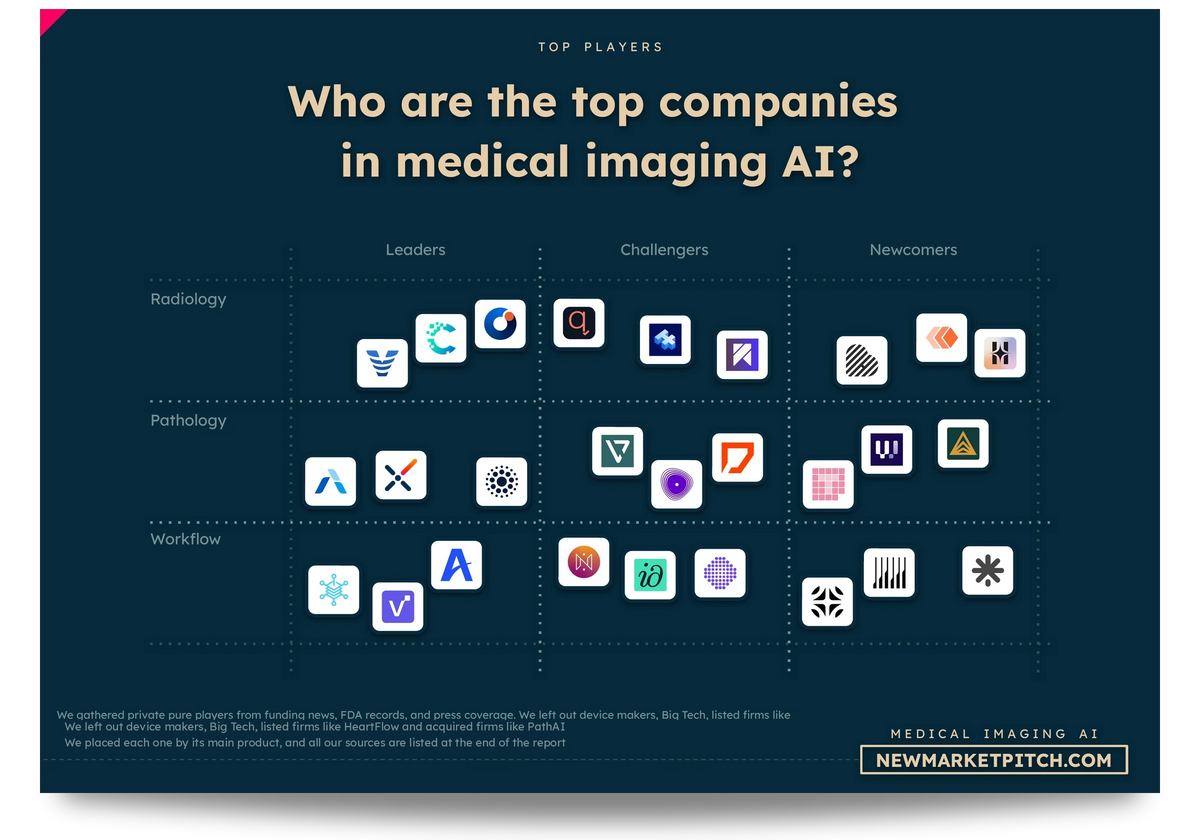
In our report covering the medical imaging AI market, we turn what is vague and complex into simple, useful visuals. Market maps like this one show you at a glance where every startup stands.
Are hospitals really paying for medical imaging AI?
Yes, hospitals are spending real money on medical imaging AI, and a handful of companies have already built businesses generating tens or even hundreds of millions of dollars a year.
Heartflow reported $176 million in 2025 revenue, up from $125.8 million in 2024. RadNet's DeepHealth division reached $105.5 million in annual recurring revenue by June 2026, nearly double its level a year earlier. Gleamer, acquired by RadNet in March 2026, had signed more than 700 customer contracts, with recurring revenue growing at an annual compound rate above 90% between 2022 and 2025.
These figures tell us considerably more than the number of AI algorithms approved by regulators. Heartflow earns fees when physicians request cardiac analysis. Gleamer built a subscription business around routine radiology examinations. DeepHealth sells imaging software and services to healthcare organizations.
There is a catch, though. Some medical imaging AI companies count hospitals where their technology is available, others report the number of images analyzed, and a few disclose actual revenue. A hospital installation can mean a paid subscription, a trial or access through a larger software provider. Those figures are rarely comparable.
We therefore give the greatest weight to recognized revenue, recurring software contracts and repeated clinical purchases. Large deployments are useful evidence, particularly when hospitals expand existing agreements, but they cannot tell us how much money a vendor makes.
The market has clearly moved beyond experimentation. What remains surprisingly difficult is identifying which companies are capturing most of the spending.
Is Heartflow the medical imaging AI company making the most money?
Heartflow is currently the clearest example of a specialist medical imaging AI business generating substantial revenue, although it is now publicly traded rather than a private startup.
The company reported $87.2 million in revenue in 2023, $125.8 million in 2024 and $176 million in 2025. That amounts to approximately 102% growth over two years. Annual growth remained close to 40% in 2025, even after Heartflow had passed $100 million in sales.
Its second-quarter 2026 revenue reached $64.1 million, up 48% from the equivalent quarter a year earlier. Management subsequently raised full-year guidance to $246 million–$250 million, suggesting another year of roughly 40%–42% growth.
Heartflow analyzes coronary CT angiography scans to help physicians assess coronary artery disease. Its FFRCT Analysis evaluates whether narrowing in a coronary artery is likely to restrict blood flow, while Plaque Analysis helps assess plaque characteristics.
The business benefits from an unusually clear payment mechanism. According to its SEC filings, substantially all Heartflow revenue comes from usage-based fees recognized when physicians receive requested analyses.
Its U.S. installed base reached 1,465 accounts in 2025. Gross margin was 76.8%, showing that analysis services can generate attractive margins once the technology and delivery network are established.
Heartflow is still losing money, however. Its 2025 GAAP net loss reached $116.8 million, so strong revenue growth has yet to translate into profitability.
Even with that limitation, Heartflow sets the financial benchmark for medical imaging AI. Few competitors disclose a comparable multiyear revenue history, and its sales are closely tied to actual clinical usage.
If you want more recent data on this point, please see our latest medical imaging AI market report.

Our research about AI for medical imaging gets updated several times a month, so you always get the latest view of where things stand.
Is Gleamer one of the most successful radiology AI startups?
Gleamer has one of the strongest commercial track records among radiology AI startups, with hundreds of customer contracts and rapid recurring-revenue growth before its acquisition.
When RadNet announced its purchase in March 2026, Gleamer had more than 700 customer contracts across 44 countries. Its technology covered several common imaging applications, including musculoskeletal X-rays, mammography, lung imaging and neurological assessment.
RadNet disclosed that Gleamer's annual recurring revenue had grown at a compound rate exceeding 90% between 2022 and 2025. It expected the company to reach approximately $30 million in ARR during 2026.
That growth is particularly interesting because Gleamer built much of its business around everyday radiology work. Hospitals perform large numbers of routine X-rays, and software that helps radiologists read them more efficiently can become part of their daily workflow.
Gleamer also reported analyzing more than 30 million examinations across over 2,250 locations. Those locations should not be confused with its 700-plus customer contracts, since a single health system or imaging provider may operate many facilities.
The acquisition confirms the commercial appeal of this model. RadNet, already a major imaging operator, bought Gleamer to strengthen its DeepHealth software portfolio.
Gleamer's projected $30 million ARR was a forecast rather than audited full-year revenue. Still, its combination of recurring contracts, international customers and a completed acquisition makes it one of the clearest startup success stories in medical imaging AI.
Is Aidoc actually making money from its huge hospital network?
Aidoc has built one of the largest commercial medical imaging AI networks, but its revenue is still private, making it impossible to rank the company confidently by sales.
The company's published platform figures indicate deployment across more than 150 health systems and 1,600 hospitals, with over 230 enterprise deployments.
Aidoc began with AI tools that identify urgent findings in medical images and alert clinical teams. Its aiOS platform has since expanded to support multiple algorithms, clinical workflows and third-party applications.
Some customer implementations show how deeply Aidoc is getting into hospital operations. Hartford HealthCare deployed 17 FDA-cleared algorithms alongside care-coordination tools. Mercy implemented 12 use cases across its network within three months, according to Aidoc's published case studies.
These are substantial implementations involving hospital technology teams, clinical departments and ongoing support. They also suggest that customers increasingly want a shared AI platform instead of buying each algorithm separately.
Aidoc reports that 69% of its customers use partner-developed or internally developed algorithms through its platform. That is an important commercial advantage because the company can remain involved even when customers adopt algorithms built by other developers.
The missing information is financial. Aidoc does not publicly disclose annual revenue, average contract value, recurring-revenue growth or profitability.
We can confidently place Aidoc among the leading private imaging AI vendors for enterprise adoption. But we cannot establish whether it generates more revenue than Gleamer did before its acquisition, or how much each hospital contributes to its business.

In our market report about AI for medical imaging, we look at what the winners do differently, so you can learn from the best instead of guessing.
Has Viz.ai built a profitable medical imaging AI business?
Viz.ai has gone beyond selling stroke-detection software and reported that its healthcare business reached profitability in 2025, making it one of the strongest private commercial players.
The company initially became known for software that identifies suspected large-vessel occlusion strokes and alerts specialist teams so patients can receive faster treatment.
Viz.ai reported approximately 1,700 hospital customers in early 2025. By July 2026, its footprint had reached around 2,000 hospitals, covering an estimated population of 230 million people and supporting more than 50 AI-enabled care pathways.
That represents roughly 300 additional hospitals, or 18% growth, over approximately 18 months.
The expansion into cardiology, oncology and other clinical areas helps explain why Viz.ai now looks more like a hospital software platform than a single-purpose imaging algorithm company.
Its most revealing financial announcement came in January 2026, when management stated that the healthcare business had achieved profitability during 2025. Viz.ai also reported that its life sciences business had doubled over the previous 18 months, supported by additional pharmaceutical partnerships.
We should be precise about the claim: profitability in the healthcare business does not establish that the entire company is profitable. Viz.ai has not released detailed consolidated revenue, costs or net income.
Still, profitability is a meaningful step beyond accumulating hospital contracts. Viz.ai has a large installed base, continued hospital growth and a healthcare operation that management says can cover its costs.
Among private medical imaging AI startups, that puts Viz.ai in a particularly strong position.
If you want more recent data on this point, please see our latest medical imaging AI market report.
Which medical imaging AI companies have the strongest proof of revenue?
Heartflow, DeepHealth, Gleamer and Lunit provide the strongest publicly available financial evidence, while Aidoc and Viz.ai have impressive enterprise adoption without comparable revenue disclosure.
Revenue, ARR, deployment counts and profitability claims measure different things. A company with 2,000 hospitals may generate less revenue than a specialist charging for high-value procedures at a smaller number of locations.
We also need to separate independent startups from public companies, acquired businesses and subsidiaries. Several of the most successful imaging AI companies have already changed ownership.
| Company | Reported commercial scale | Best evidence | Main limitation |
|---|---|---|---|
| Heartflow | $176M revenue in 2025 | Recognized analysis revenue | Public; loss-making |
| DeepHealth | $105.5M ARR, June 2026 | Recurring software contracts | Includes acquired businesses |
| Gleamer | ~$30M projected 2026 ARR | 700+ customer contracts | Acquired by RadNet |
| Lunit | ₩45.8B H1 2026 revenue | Consolidated financial reports | Includes Volpara |
| Viz.ai | ~2,000 hospitals | Healthcare profitability reported | Revenue undisclosed |
| Aidoc | 1,600+ hospitals | 230+ enterprise deployments | Revenue undisclosed |
| Harrison.ai | 1,000+ sites | Large clinical installations | Revenue undisclosed |
| Qure.ai | 5,500+ sites | Screening program adoption | Revenue undisclosed |
| RapidAI | Multihospital networks | Named customer expansions | Revenue undisclosed |
| Cleerly | Reimbursable cardiac services | Published billing pathway | Revenue undisclosed |
| Nanox.AI | $1.0M Q2 2026 AI/software revenue | Reported segment sales | Includes acquired operations |
Among the companies with disclosed revenue, Heartflow currently gives us the clearest picture of a specialist AI business earning money directly from its clinical technology.
DeepHealth and Lunit have substantial sales, but acquisitions make their original AI products harder to isolate.
Aidoc and Viz.ai could be generating significant revenue, yet their private financial reporting leaves us without a defensible dollar-for-dollar comparison.

In our document detailing everything you need to know about medical imaging AI, you will always find fresh funding data, taken straight from our own verified funding database.
Is Lunit's medical imaging AI revenue as impressive as it looks?
Lunit is generating substantial medical imaging AI and software revenue, but its acquisition of Volpara accounts for an important part of the consolidated business.
The South Korean company reported ₩45.8 billion in first-half 2026 revenue, approximately 23% higher than a year earlier. Overseas sales contributed ₩43.4 billion, or around 95% of the total.
That international exposure is impressive for a company originally built around AI software for cancer screening and diagnostic imaging.
However, Lunit acquired New Zealand-based breast-imaging software company Volpara in 2024. The acquisition brought an established customer base, existing software subscriptions and a strong position in breast screening.
According to Lunit's Korean regulatory filings, Volpara generated ₩50.1 billion in revenue during 2025. That explains why comparing Lunit's revenue before and after the acquisition can be misleading.
Lunit now has an opportunity to sell its INSIGHT AI products through Volpara's existing relationships with imaging providers, particularly in North America. The installed software network is a useful distribution advantage, although consolidated revenue does not tell us exactly how quickly those additional AI sales are growing.
The company also remains unprofitable. Its first-half 2026 operating loss was approximately ₩29 billion, despite narrowing by around 31% compared with the previous year.
Lunit belongs among the industry's larger commercial businesses. But we would need separate organic revenue figures for its original AI products to compare its performance fairly with Heartflow or Gleamer.
Are Harrison.ai and Qure.ai making real money from medical imaging AI?
Harrison.ai and Qure.ai have built substantial international medical imaging AI operations, although neither has disclosed enough financial information to establish how much revenue its deployments generate.
Harrison.ai, which brought its Annalise.ai branding under the Harrison.ai name in 2025, reported deployment across more than 1,000 sites in over 40 countries.
Its technology had supported almost 7 million patient cases and was used by more than 3,400 clinicians.
The company also established a presence in more than 40 NHS trusts in the United Kingdom and public emergency departments in Hong Kong. These are meaningful institutional relationships, especially given the clinical testing, procurement and integration involved.
Qure.ai has followed a different route. Its technology focuses on identifying abnormalities in chest X-rays, CT scans and other medical images, with extensive use in tuberculosis screening, lung cancer detection and public health programs.
Qure.ai reports more than 5,500 deployment sites in over 105 countries and says its technology has affected more than 45 million lives.
Those figures make Qure.ai one of the most widely distributed imaging AI companies, but the type of customer matters. A screening program funded by a government or international health organization may operate with a very different budget from a commercial radiology department.
Neither company provides the public revenue, recurring-contract data or profitability figures necessary for a reliable financial ranking.
Both have achieved meaningful clinical distribution. Their business economics are much harder to assess, especially for Qure.ai, where deployments cover many different countries and healthcare funding models.

Learning from others' mistakes is the cheapest lesson there is. In our report covering the medical imaging AI market, we look at what broke startups before you, so you don't repeat it.
Are RapidAI and Viz.ai still getting paid for stroke AI?
RapidAI and Viz.ai remain important commercial stroke AI providers, with recent health-system expansions showing that hospitals continue to invest in software for stroke detection and care coordination.
Both companies helped establish a market for tools that analyze emergency imaging, flag suspected stroke-related abnormalities and connect the clinical teams responsible for treatment.
RapidAI's ongoing commercial presence is visible through named institutional customers. In October 2025, Baptist Health in Arkansas described its established use of RapidAI across a statewide stroke network.
In August 2026, OSF HealthCare announced that it was expanding RapidAI across all its hospitals.
These announcements are more persuasive than isolated pilots because the customers already operate healthcare networks and are extending the technology into additional facilities.
Viz.ai has pursued a broader strategy. Its products now support more than 50 care pathways, and its reported hospital footprint has continued expanding beyond stroke-specific use cases.
The difference between the companies is clearest in the available financial evidence. Viz.ai has stated that its healthcare business reached profitability. RapidAI has not published comparable revenue or profitability figures.
We therefore cannot determine which company earns more specifically from stroke-related applications.
Hospital demand has continued beyond the first wave of stroke AI adoption, while both vendors are trying to make their software useful across more of the clinical workflow.
Does reimbursement make Heartflow and Cleerly easier to monetize than other medical imaging AI startups?
Reimbursement gives Heartflow and Cleerly a major commercial advantage because eligible cardiac imaging services can generate payment through established healthcare billing channels.
Many medical imaging AI startups must persuade hospitals to add a separate software subscription to their budgets. Heartflow operates in a different environment: physicians can request an analysis connected to a reimbursable cardiac imaging service.
Heartflow's financial results show how powerful that arrangement can become. Revenue comes primarily from delivered analyses, creating a direct relationship between clinical usage and sales.
Cleerly is pursuing a related opportunity in coronary plaque analysis. Its published 2026 Medicare billing guidance identifies CPT code 75577 for coronary plaque quantification and characterization.
The guidance lists non-facility Medicare payment amounts of approximately $1,012–$1,017 for the global service, depending on applicable adjustments.
That is the payment allowance for an eligible billed procedure, rather than the fee necessarily received by Cleerly. Actual company revenue depends on agreements with providers, billing arrangements and the costs of delivering the service.
The opportunity is nevertheless clear. A physician who can order an analysis supported by reimbursement faces a different economic decision from a radiology department purchasing an AI algorithm entirely from its operating budget.
Heartflow has already demonstrated substantial revenue under this general model. Cleerly has a promising payment pathway, although its actual revenue remains undisclosed.
For now, reimbursement is one of the clearest ways a focused imaging AI product can build a large business without becoming a broad hospital software platform.
If you want more recent data on this point, please see our latest medical imaging AI market report.

Your time is limited. In our research about AI for medical imaging, we put numbers on each part of the market, so you can see where it makes sense to focus.
Are hospitals buying individual medical imaging AI algorithms or entire platforms?
Large health systems are increasingly buying medical imaging AI through broader platforms, particularly when they want several algorithms working inside the same clinical workflow.
Aidoc offers a useful example. Its aiOS platform can run the company's own algorithms alongside third-party and internally developed applications. According to Aidoc, 69% of customers use those additional algorithms through its infrastructure.
Viz.ai has moved in a similar direction, expanding from stroke alerts into more than 50 clinical pathways. A hospital already using Viz.ai for emergency care may find it easier to add another application through an existing relationship.
DeepHealth approaches the market from the radiology software side. RadNet has expanded its capabilities through acquisitions including Gleamer and iCAD, combining imaging AI tools with broader software used by radiology organizations.
The financial growth is substantial. DeepHealth's ARR increased from $53.5 million in June 2025 to $105.5 million in June 2026. RadNet also reported approximately $37 million in total contract value from new business signed during the first half of 2026.
However, DeepHealth's expansion includes acquired revenue. We cannot treat the entire increase as evidence that existing hospital customers suddenly doubled their software spending.
Hospital procurement involves integration costs, cybersecurity reviews, clinical validation and ongoing technical support. Once an AI platform is installed, expanding the relationship can be easier than introducing another independent vendor.
That creates an advantage for companies controlling the software infrastructure. Smaller algorithm developers may increasingly need partnerships with those platforms to reach customers efficiently.
Is medical imaging AI revenue really growing, or are companies just buying competitors?
Medical imaging AI revenue is genuinely growing, but acquisitions explain a meaningful part of the reported expansion at Lunit and DeepHealth.
Heartflow provides a relatively clear example of growth tied to clinical usage. Its SEC filings attribute revenue increases mainly to a larger account base and more analyses performed at existing accounts.
The company more than doubled revenue between 2023 and 2025 without relying on the consolidation of a large acquired breast-imaging software provider or radiology platform.
DeepHealth's trajectory is harder to separate. Its recurring revenue nearly doubled over one year, but RadNet was actively acquiring imaging software businesses, including Gleamer.
Lunit presents the same comparison problem. Volpara brought an existing subscription business into its consolidated financial statements, making group revenue growth different from growth in Lunit's original AI products.
Another revealing point comes from RadNet's own reporting. The company indicated that sales to its imaging-center operations represented about 45% of Digital Health revenue in 2025, with the proportion expected to fall toward 33% in 2026 as external business increased.
In its second-quarter 2026 results, RadNet said external customers accounted for approximately 63% of Digital Health revenue.
That shift deserves attention because independent customer sales provide stronger evidence of wider market demand than revenue generated inside the same corporate group.
There is also a smaller cautionary example in Nanox.AI. In the second quarter of 2026, Nanox reported about $1 million in AI and software revenue, including approximately $0.9 million associated with the acquisition of Nanox Health IT. Original imaging AI sales alone therefore accounted for only a small part of the reported segment.
Consolidated revenue can grow through customer adoption, acquisitions or both. Heartflow currently offers the clearest evidence of substantial growth linked directly to repeated AI-assisted clinical services.
If you want more recent data on this point, please see our latest medical imaging AI market report.

In our market report about AI for medical imaging, we always try to gather several sources and make estimates that make sense, so you can work with solid numbers.
How much can a successful medical imaging AI startup sell for?
Gleamer's acquisition for up to €230 million shows that a radiology AI startup with a strong subscription business can become a valuable acquisition target.
RadNet agreed to pay €215 million upfront, with up to €15 million more tied to performance milestones.
Its subsequent SEC reporting recorded approximately $264.1 million in acquisition consideration at the transaction date, including the estimated fair value of contingent payments.
Against Gleamer's projected $30 million in 2026 ARR, the maximum announced purchase price represents roughly eight to nine times projected recurring revenue, depending on the exchange rate.
That comparison is indicative because the denominator is forecast ARR rather than audited historical revenue.
The acquisition also reveals what attracted the buyer. RadNet's purchase-price allocation assigned substantial value to Gleamer's customer relationships and developed technology.
More than 700 customer contracts gave Gleamer an established route into hospitals and imaging centers. Its AI applications covered several common radiology tasks, making the software useful across a broader range of examinations.
Other companies are following different paths. Heartflow reached the public market with nine-figure annual revenue. Aidoc and Viz.ai remain independent private businesses pursuing large healthcare enterprise contracts.
Gleamer provides one of the most concrete acquisition benchmarks in medical imaging AI. Its outcome suggests that a strong recurring customer base can be extremely valuable even before an AI company reaches $100 million in annual sales.
Which medical imaging AI business models are getting customers to pay?
The medical imaging AI companies with the strongest commercial evidence currently make money through three main routes: reimbursable clinical services, recurring radiology software and enterprise hospital platforms.
Heartflow illustrates the reimbursable-service model. Physicians order analyses linked to clinical care, and the company earns fees based on completed work.
Gleamer built its business around routine radiology software subscriptions. The product can be used repeatedly in high-volume imaging departments, creating an opportunity to make AI part of an everyday workflow.
Aidoc and Viz.ai sell broader clinical software that can be deployed across hospitals. Once integrated into existing systems, their technology can support additional algorithms, departments and care pathways.
Lunit and DeepHealth add a fourth commercial route: acquiring established imaging software businesses and selling more AI capabilities through their existing distribution networks.
Public health screening offers another model, particularly for Qure.ai. Governments, healthcare providers and screening-program funders may support deployments that cover very large patient populations.
The differences become clearer when we compare who pays and what the company has actually demonstrated.
| Company | Main commercial model | Customer or payer | Evidence of payment |
|---|---|---|---|
| Heartflow | Per-analysis cardiac service | Healthcare providers; eligible payer reimbursement | $176M 2025 revenue |
| Gleamer | Radiology software subscriptions | Hospitals and imaging centers | 700+ customer contracts |
| Aidoc | Enterprise AI platform | Hospital systems | 230+ enterprise deployments |
| Viz.ai | Clinical AI and care coordination | Health systems and life sciences partners | Healthcare profitability reported |
| Lunit / Volpara | Breast-imaging software and AI | Breast-imaging providers | Consolidated reported sales |
| DeepHealth | Imaging informatics and AI subscriptions | Imaging groups and health systems | $105.5M ARR |
| Qure.ai | Screening and diagnostic AI | Healthcare and screening-program funders | 5,500+ deployment sites |
| RapidAI | Stroke imaging and care coordination | Hospitals and stroke networks | Multihospital expansions |
| Cleerly | Coronary plaque analysis | Clinical providers; applicable reimbursement | Published Medicare billing guidance |
There is no single winning payment model. Heartflow has shown how large usage-based revenue can become, while Gleamer demonstrated that routine subscriptions can attract a major buyer.
Aidoc and Viz.ai have compelling enterprise businesses, but until their revenue becomes public, we cannot compare their commercial efficiency with the same precision.

If you build or invest in the medical imaging AI market, you need to know which business models pay off now and which ones are fading. That's why our report covering it has a whole section on it.
So which top medical imaging AI startups actually get paid?
Heartflow, Gleamer, Aidoc, Viz.ai and Lunit stand out as the strongest commercial names in medical imaging AI, although the evidence behind each company is very different.
Heartflow is the clearest financial leader among the specialist businesses we examined. With $176 million in 2025 revenue and continuing strong growth in 2026, it has demonstrated demand at a scale most imaging AI developers have yet to reach. Its main weakness is profitability, and it is now a public company rather than a startup.
Gleamer is arguably the strongest example of a successful independent radiology AI startup reaching a meaningful commercial exit. Its recurring contracts, rapid revenue growth and acquisition by RadNet establish that hospitals and imaging centers were willing to pay for its products.
Aidoc and Viz.ai are the leading private enterprise-platform candidates. Aidoc has an exceptionally broad hospital network and significant multispecialty deployments. Viz.ai has a similarly large customer footprint and has reported profitability in its healthcare business. Their actual revenue rankings remain unknown.
Lunit is generating substantial consolidated sales, although its acquired Volpara business accounts for a meaningful part of the financial picture. DeepHealth has become a major competitor with more than $100 million in ARR, but it is a consolidated imaging software platform rather than an independent startup.
Harrison.ai, Qure.ai and RapidAI also have strong evidence of clinical adoption. Cleerly deserves attention for its cardiac reimbursement model. However, their limited public financial disclosure makes it premature to rank them alongside companies with verified revenue.
There is a recurring difference between impressive deployment figures and measurable sales. Some companies report thousands of hospitals or screening sites without revealing what those customers pay. Others have disclosed actual revenue, recurring contracts or profitable operations.
For a reader trying to identify the commercial winners today, Heartflow has the strongest documented revenue record, Gleamer has demonstrated a successful subscription-based exit, and Aidoc and Viz.ai are the private companies with the most convincing enterprise-scale adoption.
Those are the names with the clearest evidence behind them. The rest of the field still has more to prove about how much money its technology actually makes.
If you want more recent data on this point, please see our latest medical imaging AI market report.
Sources and methodology
This analysis examines which medical imaging AI startups actually generate revenue from hospitals, imaging centers and other healthcare customers. We assess six dimensions of commercial success: recognized revenue, recurring monetization, enterprise purchasing, clinical usage, financial sustainability and commercial outcomes such as acquisitions.
For each dimension, we collected recent evidence from regulatory filings, company financial results, acquisition announcements, healthcare-provider deployments and reimbursement documentation. We aggregated the findings across companies and reporting periods, compared the underlying commercial activity, and assessed which businesses had accumulated the strongest proof of sustained customer spending.
We give the greatest weight to recognized revenue and documented recurring software contracts. Annual recurring revenue represents a subscription run rate rather than necessarily the revenue recognized during the same period. We treat hospital counts, algorithm installations, examinations processed and geographic coverage as evidence of distribution, but do not translate them into estimated revenue without disclosed contract economics.
The analysis distinguishes independent private startups, publicly traded specialists, acquired companies and consolidated software divisions. It also separates organic growth from acquisition-driven expansion. This is especially important for DeepHealth, which has expanded through acquisitions including Gleamer, and Lunit, whose acquisition of Volpara added a substantial existing software business.
Profitability claims are assessed at the level actually disclosed. Viz.ai's reported healthcare-business profitability is not treated as consolidated company profitability. Likewise, reimbursement allowances are distinguished from vendor revenue: Cleerly's published Medicare billing amounts describe potential payments for eligible procedures, not necessarily fees paid directly to Cleerly.
We also examined how individual observations reinforce one another. Heartflow's revenue growth was compared with its usage-based billing model and expanding installed base. Gleamer's recurring contracts were assessed alongside its acquisition valuation. Aidoc and Viz.ai were compared through their hospital deployments, platform breadth and available financial disclosures. Repeated health-system expansions provided additional evidence that customers continued using imaging AI beyond initial implementations.
Key financial sources include Heartflow's full-year 2025 results, its 2025 SEC Form 10-K and second-quarter 2026 Form 10-Q; RadNet's second-quarter 2026 financial results and Form 10-Q; and Nanox's second-quarter 2026 results. Lunit's consolidated figures and Volpara subsidiary performance are considered using its reported financial disclosures.
For acquisitions and recurring software economics, we used RadNet's Gleamer acquisition announcement, its first-quarter 2026 Form 10-Q, Lunit's Volpara acquisition disclosure, and Volpara's subsequent commercial update. These documents help distinguish contract growth, purchase consideration and acquired business scale.
Enterprise adoption was assessed using Aidoc's aiOS platform disclosures, Viz.ai's 2025 commercial performance announcement, its July 2026 network update, Harrison.ai's global deployment information and Qure.ai's published clinical reach. Named customer evidence includes Baptist Health's RapidAI deployment and OSF HealthCare's hospital-wide expansion. For cardiac payment economics, we consulted Cleerly's 2026 reimbursement guidance.
The resulting comparison identifies commercial leaders according to the evidence they have actually disclosed. Recognized sales provide the strongest revenue ranking, while recurring contracts, hospital expansions, profitable operations and completed acquisitions offer additional evidence where detailed financial statements are unavailable. Conclusions are strongest when several independent commercial observations point in the same direction.

In our report covering the medical imaging AI market, we don't want to repeat what boring consulting reports say. Instead, we show you the real and latest market signals that matter.
Written by the New Market Pitch teamWe track new markets so founders and investors can move faster. About us