Can medical imaging AI make money without reimbursement?
Whether you're building or investing in the medical imaging AI market, our report covers everything you need to know: the players, the money, and what's coming next.
Summary
Yes. Medical imaging AI can make money without dedicated reimbursement, and some businesses are already generating substantial revenue this way. The strongest models save hospitals measurable operating costs, increase imaging capacity, collect optional patient payments, or bundle AI into larger software contracts.
The market has moved well ahead of reimbursement policy. A review identified 723 FDA-authorized radiology AI devices, while a 2025 KLAS survey found that nearly half of 369 healthcare organizations surveyed outside the United States were already using imaging AI. Regulatory authorization and hospital adoption, however, reveal little about which vendors are profitable.
RadNet provides the clearest disclosed financial evidence. Its Digital Health business reached $105.5 million in annual recurring revenue in June 2026, almost doubling year over year, and generated positive adjusted EBITDA. But those results combine diagnostic AI with enterprise imaging software, informatics, and acquired businesses.
Direct patient payments are a particularly interesting alternative. RadNet charges $40 for optional AI-enhanced breast screening, and nearly 45% of eligible screening patients were choosing the service in its second-quarter 2025 results. That creates revenue without waiting for insurers to recognize a separate AI procedure.
The strongest productivity evidence comes from mammography. The randomized MASAI trial found that AI-supported screening reduced reading workload by 44.2% while detecting more cancers. For a sufficiently large imaging operation, the labor capacity released could justify a substantial annual software contract.
Imaging AI does not need spectacular savings per examination to work commercially. At 100,000 annual examinations, an application generating $2 of genuine economic benefit per scan creates $200,000 of annual value. The harder part is proving that the benefit becomes actual savings, higher throughput, or additional revenue rather than simply a theoretical efficiency gain.
Emergency imaging AI faces a different problem. Faster stroke or pulmonary embolism detection may improve care considerably, but the financial benefit often lands outside the radiology department purchasing the software. That makes these applications harder to sell through ordinary departmental budgets, even when their clinical case is strong.
Reimbursement can change the equation, but it is not equivalent to vendor revenue. Viz.ai, Aidoc, and Heartflow illustrate different payment pathways, from temporary Medicare inpatient add-ons to outpatient diagnostic billing. The payment generally goes to the healthcare provider, and the vendor still has to negotiate how much value it captures.
The market is moving toward enterprise platforms partly because individual algorithms are expensive to integrate and support. Vendors that can deploy multiple applications through one hospital relationship can spread integration costs across more revenue, while standalone products increasingly compete with AI features bundled by established imaging suppliers.
The commercial opportunity is real, but company-level profitability remains largely unproven for independent diagnostic-AI specialists. RadNet's diversified software business and the MASAI trial support the economics of selected models, while widespread adoption alone does not establish sustainable margins. Our conclusion is that reimbursement-independent imaging AI can scale, but the winning products will be those whose financial value reaches the customer actually paying for them.

Written by the New Market Pitch teamWe track new markets so founders and investors can move faster. About us
Why are hospitals buying medical imaging AI when insurers often won't pay for it?
Medical imaging AI is already making money without dedicated insurance reimbursement, mainly because hospitals are willing to pay for software that saves time, increases capacity, or makes existing imaging services more efficient.
The number of available products has grown much faster than the number of reimbursement pathways. A review published in JAMA Network Open examined 950 FDA-authorized AI and machine-learning medical devices, including 723 radiology devices, representing 76% of the total. Yet FDA clearance does not create a reimbursement code or guarantee that insurers will pay for the technology.
Hospital adoption has moved ahead anyway. In its 2025 Global Imaging AI report, KLAS Research interviewed 369 healthcare organizations outside the United States and found that nearly half were already using at least one imaging AI solution. Those organizations reported products from 108 different vendors.
This creates an unusual market: hundreds of medical imaging AI products are available, hospitals are increasingly buying them, and dedicated reimbursement remains limited. The question is how much money vendors can make when their customers must cover the software costs themselves.
What does making money without reimbursement actually mean for medical imaging AI?
Medical imaging AI can generate revenue without dedicated reimbursement whenever hospitals, imaging centers, or patients pay for the technology directly. Whether those sales produce a profitable business is another question.
In the United States, hospitals already receive payments for covered imaging examinations. An AI application can be included in the cost of performing those examinations without creating an additional insurance claim. A chest CT interpreted with AI can receive the same underlying reimbursement as one interpreted without it.
That leaves several ways to charge customers. Hospitals can purchase annual software licenses, pay per examination, include AI in broader imaging software contracts, or fund it through departmental budgets. Some imaging companies also sell optional AI-enhanced services directly to patients.
The economics vary considerably. A hospital buying stroke-triage software for $100,000 annually needs to justify that expense through its existing clinical or operational budget. An imaging center collecting $40 from patients for enhanced mammography screening has a direct revenue stream attached to the service.
For AI vendors, the calculation includes deployment, cloud processing, regulatory compliance, customer support, research, and sales expenses. Even a company with hundreds of hospital customers can lose money if those costs rise almost as quickly as revenue.

A good product starts with a real problem. In our report covering the medical imaging AI market, we show you the ones customers still live with.
Has anyone built a big medical imaging AI business without relying entirely on reimbursement?
Yes. RadNet's DeepHealth business shows that medical imaging AI can contribute to a business generating more than $100 million in recurring revenue without depending entirely on dedicated reimbursement.
RadNet reported Digital Health annual recurring revenue of $105.5 million at June 30, 2026, compared with $53.5 million one year earlier. That is approximately 97% growth. Second-quarter revenue increased from $20.7 million to $32.4 million, while adjusted EBITDA remained positive at $2.5 million.
There is an important distinction behind those figures. DeepHealth combines clinical AI with enterprise imaging software, informatics, and workflow tools. Its revenue cannot be treated as pure diagnostic-AI revenue, and acquisitions contributed to growth.
Still, approximately 63% of Digital Health revenue came from external customers rather than RadNet's own imaging operations. The business has therefore moved well beyond selling software internally to its parent company's imaging centers.
Other vendors have reached considerable deployment scale. Viz.ai reported a network of 2,000 hospitals in July 2026, while Aidoc has expanded through enterprise contracts with major health systems. Both also have reimbursement exposure in specific applications, and neither provides public financial statements detailed enough to isolate the profitability of non-reimbursed products.
RadNet offers the strongest publicly disclosed financial evidence here, although its diversified product portfolio makes it difficult to measure how much profit comes specifically from diagnostic AI.
If you want more recent data on this point, please see our latest medical imaging AI market report.
Will patients really pay extra for AI mammograms?
Yes. RadNet has shown that a surprisingly large share of patients will pay directly for AI-enhanced breast cancer screening.
Its Enhanced Breast Cancer Detection program charges patients $40 out of pocket for an optional service built around AI-assisted mammography review. In its second-quarter 2025 results, RadNet reported that almost 45% of eligible screening mammography patients were choosing the service.
That participation rate is impressive for an optional healthcare purchase. For every 100 eligible patients offered the program, approximately 45 purchases generate $1,800 in gross receipts. At 100,000 eligible examinations, the same participation rate would generate $1.8 million before clinical, technology, and operating expenses.
RadNet had previously reported participation above 40% on the East Coast and above 28% on the West Coast, where the program had been available for less time. The progression toward approximately 45% across its eligible screening population suggests that demand extended beyond the earliest customers.
The company also reported a 21% improvement in cancer detection in an observational evaluation involving more than 575,000 patients. That figure describes the combined enhanced screening workflow rather than the isolated performance of one algorithm.
Breast cancer screening has a particular advantage for direct payments: patients understand the concern and can easily grasp the potential value of an additional review. We have much less evidence that patients would pay similar amounts for routine chest X-rays, orthopedic imaging, or other AI-assisted examinations.

If you build or invest in the medical imaging AI market, you need to know which business models pay off now and which ones are fading. That's why our report covering it has a whole section on it.
Can medical imaging AI save enough radiologist time to pay for itself?
Yes. AI-assisted mammography provides particularly strong evidence that medical imaging AI can reduce reading workloads enough to justify substantial software spending.
The Swedish MASAI trial offers a useful benchmark. In an analysis published in The Lancet Digital Health, researchers compared AI-supported mammography screening with standard double reading across more than 105,000 women.
The AI-supported group required 61,248 screen readings, compared with 109,692 in the control group. That represents a 44.2% reduction in reading workload. The AI-supported group also detected 338 cancers compared with 262 in the control group, 29% more, without a significant increase in false-positive rates.
Those results are unusually convincing because the productivity gain was measured in a randomized study alongside clinical outcomes.
We can estimate what this might mean financially. Consider a screening operation processing 200,000 examinations per year, with an existing double-reading labor cost of $8 per examination. Its annual reading expense would be $1.6 million. Applying the trial's 44.2% reduction to comparable reading work produces approximately $707,000 in potential annual labor capacity.
That is an illustrative calculation, rather than an observed financial result from the trial. Hospitals would only realize equivalent cash savings if they reduced labor expenditure, avoided additional hiring, or used the available time for other productive work.
Even with that limitation, the order of magnitude is significant. A hospital saving several hundred thousand dollars in reading capacity could reasonably justify a six-figure annual AI contract without receiving any additional payment from insurers.
If you want more recent data on this point, please see our latest medical imaging AI market report.
Does faster medical imaging AI actually increase hospital revenue?
Faster medical imaging AI can increase revenue, especially in busy imaging centers, but hospitals do not automatically earn more money simply because a diagnosis arrives sooner.
An MRI center with a waiting list can benefit if AI-assisted reconstruction reduces scan duration enough to complete additional examinations. The financial gain depends on whether the center has enough patient demand, staffing, and reimbursement capacity to fill those extra appointments.
Emergency imaging is more complicated. AI that prioritizes suspected stroke, intracranial hemorrhage, or pulmonary embolism may help clinicians act faster, but the hospital generally does not receive another payment simply for identifying the condition earlier.
Viz.ai presented evidence at the 2025 International Stroke Conference showing a 44.13% reduction in a measured stroke workflow interval involving diagnosis and contact with an endovascular specialist. Its economic analysis also modeled the potential financial effects of avoiding unnecessary patient transfers.
That research supports a credible financial case for better coordination, although it does not establish identical savings across hospitals.
The distinction becomes clearer when we compare two providers. An imaging center completing 1,000 extra examinations may collect additional revenue directly. A hospital diagnosing 1,000 emergency patients faster still has to demonstrate how that improvement reduces costs, changes patient flow, or improves reimbursed care.
For vendors selling productivity software, the first situation is generally easier to turn into a convincing purchase.

Learning from others' mistakes is the cheapest lesson there is. In our market report about AI for medical imaging, we look at what broke startups before you, so you don't repeat it.
Which medical imaging AI applications can make money without reimbursement?
Mammography, MRI reconstruction, radiotherapy planning, and enterprise imaging software currently have some of the clearest routes to revenue without dedicated reimbursement. The common advantage is that customers can identify a financial benefit within their existing operations.
The situation is harder for algorithms that primarily improve the detection of rare conditions or produce benefits outside the department purchasing the software.
| Imaging AI application | Main financial benefit | Need for dedicated reimbursement |
|---|---|---|
| Mammography screening AI | Reduced reading workload and improved detection | Moderate; can be funded through operating budgets |
| Optional enhanced breast screening | Direct patient payments | Low where patient-pay services are permitted |
| MRI reconstruction AI | Faster scans and potentially greater scanner capacity | Low when utilization gains are measurable |
| Automated radiotherapy contouring | Reduced treatment-planning labor | Low to moderate |
| Stroke and emergency CT triage | Faster intervention and care coordination | Moderate to high unless savings are demonstrated |
| Chest X-ray detection AI | Triage, quality assurance, reporting support | Moderate; per-case economics can be difficult |
| Incidental finding detection | Follow-up identification and care coordination | Moderate to high; benefits may accrue outside radiology |
| Enterprise imaging AI platforms | Shared integration, workflow efficiency, software consolidation | Lower than fragmented standalone applications |
A busy MRI center can potentially recover its investment by completing more scans with the same equipment. A mammography provider may save substantial reading time or sell an optional enhanced screening service.
An algorithm identifying rare incidental abnormalities faces a tougher commercial equation. It might improve clinical care considerably while creating little direct financial benefit for the radiology department paying for it.
This difference helps explain why clinical accuracy alone has proven insufficient to determine which imaging AI products attract significant recurring spending.
Can medical imaging AI make money at just a few dollars per scan?
Yes, but medical imaging AI priced at $1 to $5 per examination generally needs substantial volume to become an attractive business.
A hospital processing 200,000 eligible examinations annually would generate $200,000 of software revenue at $1 per scan, $400,000 at $2, or $1 million at $5.
Those amounts can support a meaningful contract. However, vendors must still integrate with picture archiving and communication systems, configure imaging workflows, complete security reviews, monitor performance, and provide technical support.
Volume makes an enormous difference. A hospital paying $100,000 annually for software covering 10,000 relevant examinations is effectively spending $10 per examination. At 100,000 examinations, that cost falls to $1.
This favors AI applications used frequently across large hospital networks. Vendors that can install one platform and activate several algorithms without rebuilding the integration each time also have an advantage.
Smaller applications are not automatically unviable. A rare-disease algorithm could justify a relatively high price if detecting a missed case produces substantial clinical or financial value. But the vendor must demonstrate that value convincingly enough to overcome the low examination volume.
If you want more recent data on this point, please see our latest medical imaging AI market report.

When you build or invest in the medical imaging AI market, you need clarity, not confusion. In our document detailing everything you need to know about medical imaging AI, we always try to put numbers on and quantify whatever is usually vague and confusing.
Are hospitals actually using medical imaging AI, or mostly running pilots?
Medical imaging AI has moved well beyond isolated pilots, although we still lack reliable industry-wide data on how many deployments turn into lasting paid contracts.
KLAS Research found that nearly half of the 369 organizations surveyed internationally in 2025 were using imaging AI. That is a substantial share of the surveyed organizations, although it should not be interpreted as the adoption rate across every hospital worldwide.
Large health systems are also expanding initial deployments. Advocate Health announced an Aidoc expansion following a pilot, with approximately 63,000 patients annually expected to benefit. Viz.ai's reported 2,000-hospital network points to widespread adoption of imaging-related AI in clinical workflows.
Procurement has also moved toward broader hospital contracts. Rather than selecting one algorithm for a research project, organizations are increasingly purchasing platforms that support multiple applications across departments.
However, reported hospital installations can include different levels of utilization and different commercial arrangements. They tell us little about contract values, renewal rates, or how many customers are generating profits for vendors.
The evidence for adoption is considerably stronger than the evidence for sector-wide profitability. Public financial reporting remains too limited to measure how much installed imaging AI is commercially successful.
Does reimbursement make a big difference for medical imaging AI companies?
Absolutely. Dedicated reimbursement can make medical imaging AI much easier to sell because customers have an external source of funding rather than covering the entire expense themselves.
Viz.ai received a Medicare New Technology Add-on Payment for its large-vessel-occlusion stroke software beginning in 2020, with the initial payment opportunity reaching up to $1,040 per eligible patient.
Aidoc obtained a New Technology Add-on Payment for its CARE Body CT Multi-Triage solution, effective October 1, 2026, for qualifying Medicare fee-for-service inpatient cases. The product received FDA clearance earlier that year.
Heartflow operates under a different payment structure. Its coronary plaque analysis moved to Category I CPT code 75577 in 2026. Heartflow's published reimbursement materials list a $950 Medicare hospital outpatient payment for the associated plaque analysis service, subject to applicable coverage and medical-necessity rules.
These are three different reimbursement arrangements. Viz.ai and Aidoc have benefited from temporary inpatient add-on payment pathways, while Heartflow has established outpatient billing mechanisms for specific diagnostic services.
The figures also need to be interpreted correctly. A Medicare payment to a hospital is not automatically revenue collected by the software vendor. Contracts determine how much of that payment ultimately supports the technology provider.
Still, a hospital facing a six-figure annual AI expense will find the purchase easier to justify when eligible clinical use can generate additional reimbursement. That advantage can be decisive for applications whose direct operational savings are relatively small.
If you want more recent data on this point, please see our latest medical imaging AI market report.

In our report covering the medical imaging AI market, we look at what the winners do differently, so you can learn from the best instead of guessing.
How much money must medical imaging AI save to justify a hospital contract?
For medical imaging AI sold through hospital budgets, the key question is whether the software produces enough annual savings or additional revenue to cover its cost. A difference of just a few dollars per examination can completely change the answer.
We can test this with a hypothetical imaging department processing 100,000 eligible examinations annually and paying $100,000 for AI software.
| Annual scenario | Gross benefit or receipts | Annual AI cost | Net financial impact |
|---|---|---|---|
| Save $0.50 per scan | $50,000 | $100,000 | -$50,000 |
| Save $1 per scan | $100,000 | $100,000 | $0 |
| Save $2 per scan | $200,000 | $100,000 | +$100,000 |
| Save $3 per scan | $300,000 | $100,000 | +$200,000 |
| Save $5 per scan | $500,000 | $100,000 | +$400,000 |
| Add 1,000 scans at $100 contribution each | $100,000 | $100,000 | $0 |
| Add 3,000 scans at $100 contribution each | $300,000 | $100,000 | +$200,000 |
| Collect $40 from 40% of 20,000 eligible patients | $320,000 | $100,000 | +$220,000 |
Can governments pay for medical imaging AI without reimbursing every scan?
Yes. Governments are already funding medical imaging AI through centralized purchasing and deployment programs, sometimes covering entire hospital networks rather than individual examinations.
England offers a concrete example. In July 2025, the UK government reported that its £21 million AI Diagnostic Fund was supporting deployment across 12 imaging networks covering 67 of England's 137 acute and specialist NHS trusts.
The program focused on high-demand imaging applications, including chest X-rays and CT scans intended to support faster lung cancer diagnosis.
Separately, the government reported £113 million allocated through its AI in Health and Care Award to test and evaluate technologies across healthcare, including imaging and diagnostics.
Thailand provides another example of adoption without additional per-scan reimbursement. A 2025 analysis published in the Korean Journal of Radiology reported that approximately 68% of Thai hospitals used some form of AI, particularly for chest radiography, without patients generally facing additional AI charges or hospitals receiving separate AI-specific reimbursement.
These examples show that public healthcare systems can support large deployments without creating new insurance payments for every algorithm.
There is one commercial weakness, though. A government-funded rollout can create considerable initial demand while leaving vendors dependent on future procurement decisions. Long-term revenue becomes more predictable when hospitals continue paying for the technology after the original funding program ends.

Your time is limited. In our research about AI for medical imaging, we put numbers on each part of the market, so you can see where it makes sense to focus.
Is FDA clearance enough to help medical imaging AI startups make money?
No. FDA clearance allows medical imaging AI companies to market authorized products for their intended uses, but it gives little assurance that hospitals will buy them.
The JAMA Network Open review identified 723 authorized radiology AI devices among 950 AI-enabled devices in its study population. Of the radiology devices with available submission documentation, only 33, approximately 5%, involved prospective testing, while 208, approximately 29%, incorporated clinical testing as classified by the researchers.
Those findings should not be interpreted as evidence that the other devices were unsafe. Regulatory requirements vary by intended use and submission pathway. But they reveal how little regulatory authorization tells us about financial performance inside a hospital.
Competition also makes commercialization harder. GE HealthCare, Siemens Healthineers, Philips, Fujifilm, and other established imaging technology companies can include AI features in systems hospitals already use.
Independent startups must therefore persuade customers to add another vendor, another integration, and another software expense. A clinically useful algorithm may struggle if an existing imaging supplier offers comparable functionality within a broader contract.
This is why FDA clearance is increasingly a starting point for commercialization. The startups most likely to command substantial prices are those that can prove a financial benefit, deliver clearly superior performance, or offer functionality hospitals cannot easily obtain from existing suppliers.
Are hospitals going to buy one imaging AI platform instead of dozens of separate tools?
Large hospitals are increasingly being offered integrated imaging AI platforms, and that model looks economically stronger than managing dozens of unrelated applications. Specialized products can still win, but their advantages need to justify the extra complexity.
DeepHealth combines clinical AI with imaging management, informatics, and workflow products. RadNet's acquisition of iCAD in 2025 expanded its breast imaging AI portfolio, while other acquisitions strengthened its broader technology offering.
Viz.ai has evolved from stroke-focused detection toward a care-coordination platform. In July 2026, the company reported more than 50 AI care pathways spanning neurology, radiology, cardiology, oncology, pulmonology, and other areas.
Aidoc has also emphasized enterprise deployment through its aiOS platform. In August 2026, it announced a Diagnostic AI Consortium involving 12 U.S. health systems collectively caring for nearly 20 million patients annually.
All three companies are pursuing larger contracts, broader coverage, and less reliance on selling one algorithm at a time.
For hospitals, buying through an existing platform can simplify implementation and reduce the burden of managing separate vendors. For software companies, it creates opportunities to sell additional applications without repeating every part of the original deployment.
The approach is especially attractive for non-reimbursed AI because the cost of integration can be spread across many clinical uses. But broader product portfolios also require more engineering, regulatory work, and support. The financial advantage only appears when revenue grows faster than those expenses.

In our market report about AI for medical imaging, we always try to gather several sources and make estimates that make sense, so you can work with solid numbers.
Can medical imaging AI startups become profitable before reimbursement becomes widespread?
Yes, although the publicly available financial evidence currently supports profitability in certain business models much more strongly than across medical imaging AI startups as a whole.
RadNet's Digital Health results illustrate both the potential and the limits. During the second quarter of 2026, the business generated $32.4 million in revenue and $2.5 million in adjusted EBITDA, representing an adjusted EBITDA margin of approximately 7.7%.
Revenue increased 56.5% year over year, yet adjusted EBITDA declined from $3.4 million in the comparable quarter. Growth in software sales therefore did not translate into higher adjusted operating earnings during that period.
The segment also includes enterprise imaging software and informatics, which prevents us from treating those financial results as a clean measurement of standalone diagnostic AI profitability.
Private vendors provide even less financial detail. Aidoc and Viz.ai have reported large hospital deployments, but they do not publicly disclose enough revenue, gross-margin, operating-expense, and cash-flow information to establish whether their businesses are profitable.
The cost of supporting hospitals is a particular concern. Vendors need clinical validation, system integration, security controls, ongoing algorithm monitoring, and technical support. Large hospital networks can produce attractive recurring contracts, but they can also demand extensive customization.
That makes customer concentration and product integration important. A company selling several AI applications to one hospital network may achieve better economics than a company deploying one specialized algorithm separately at dozens of hospitals.
For now, profitability remains easier to demonstrate in diversified imaging software businesses than in independent diagnostic-AI specialists.
If you want more recent data on this point, please see our latest medical imaging AI market report.
Will more medical imaging AI companies need reimbursement as their products become more advanced?
Reimbursement is likely to become increasingly important for medical imaging AI that provides a distinct diagnostic service or changes treatment decisions, while simpler workflow applications can continue selling through hospital budgets.
Heartflow illustrates why. Its cardiac CT analysis products have established billing pathways for services including fractional flow reserve derived from CT and coronary plaque analysis. In 2026, its published Medicare hospital outpatient payment figures included $877 for FFRCT analysis and $950 for plaque analysis, subject to the relevant coverage rules.
These services produce diagnostic information that can influence how physicians evaluate coronary artery disease and make treatment decisions. Dedicated reimbursement creates a clearer commercial pathway than asking a hospital to absorb every analysis as an additional software expense.
Aidoc's CARE Body CT Multi-Triage reimbursement milestone reflects another way payment policy can support newer diagnostic applications, although its inpatient add-on payment is temporary and applies only to eligible cases.
The distinction becomes more important as algorithms move beyond highlighting suspicious images. Advanced characterization, risk assessment, and treatment guidance can require more clinical evidence, greater regulatory investment, and closer integration with medical decision-making.
Vendors developing those products have a strong incentive to pursue reimbursement, particularly when their clinical benefits are substantial but difficult for hospital departments to translate into immediate cost savings.

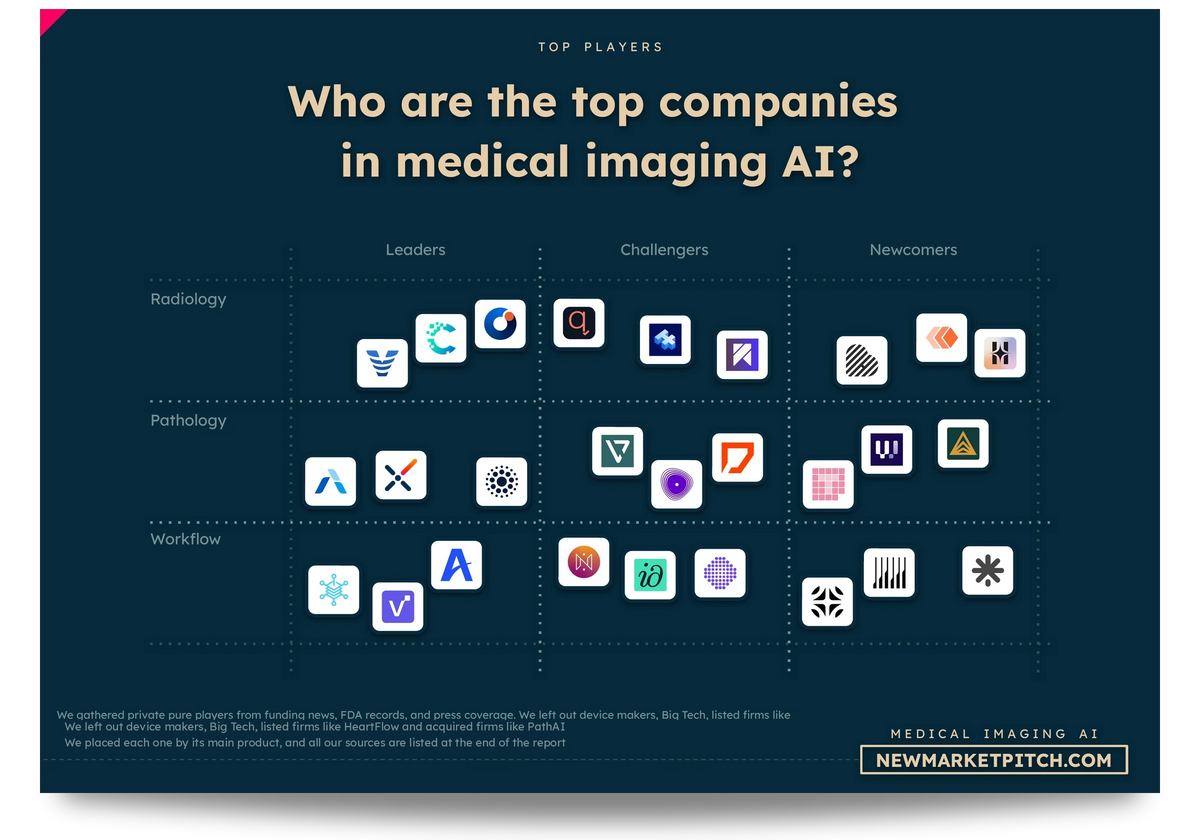
In our document detailing everything you need to know about medical imaging AI, we turn what is vague and complex into simple, useful visuals. Market maps like this one show you at a glance where every startup stands.
Can medical imaging AI make money without reimbursement?
Yes. Medical imaging AI can build substantial revenue without dedicated reimbursement, and several business models already have strong evidence behind them. But the economics favor products that save measurable labor, increase imaging capacity, support larger enterprise software contracts, or attract direct patient payments.
RadNet demonstrates that AI-enabled imaging services can contribute to a business generating more than $100 million in recurring revenue, with positive adjusted EBITDA and significant sales to external customers. Its enhanced breast screening program also shows that patients will pay directly for certain AI-supported services.
The MASAI trial provides independent evidence of a major productivity benefit, with a 44.2% reduction in mammography reading workload. Large hospital deployments reported by KLAS, Aidoc, and Viz.ai further confirm that adoption has progressed beyond the experimental stage.
We should be more cautious about company-level profitability. RadNet's results cover a diversified Digital Health business, while most standalone medical imaging AI vendors still disclose too little financial information to establish their margins or cash generation.
Reimbursement makes commercial adoption easier, particularly for specialized diagnostic services whose financial benefits are difficult for hospitals to capture. Yet it is clearly possible to sell imaging AI without it, and in some applications there is already a strong reason for customers to pay.
Our judgment is that medical imaging AI has a viable reimbursement-independent business model, but only part of the market can scale profitably through that route. Vendors that reliably turn clinical improvements into direct financial benefits have the strongest prospects. Companies whose products improve diagnosis without helping the buyer recover the cost will remain far more dependent on reimbursement, government funding, or larger platform partners.
Sources and methodology
This analysis examines whether medical imaging AI companies can generate substantial revenue and sustainable profits without dedicated reimbursement for each AI-assisted examination. We separate the economics of hospital purchasing, patient-paid services, software vendors, and reimbursed diagnostic procedures because each represents a different commercial model.
We structured the research around commercial traction, hospital operating economics, clinical productivity, patient willingness to pay, software scalability, regulatory conditions, reimbursement pathways, and profitability. For each dimension, we collected recent evidence from company financial disclosures, original clinical research, healthcare organization announcements, industry adoption studies, regulatory records, and public funding decisions. We aggregated those findings, assessed their economic implications, and then compared the conclusions across business models.
Financial analysis relies principally on RadNet's reported Digital Health revenue, annual recurring revenue, external-customer activity, and adjusted EBITDA. We treat that segment as a diversified imaging software and AI business, rather than attributing its entire performance to diagnostic algorithms. Private-company deployment figures from Aidoc and Viz.ai are used to assess commercial reach, not to estimate undisclosed profitability or margins.
Clinical productivity is assessed through the randomized MASAI mammography trial, while patient willingness to pay is evaluated using RadNet's reported enhanced breast screening participation. Illustrative financial calculations translate reading workload reductions, per-examination savings, patient payments, and additional scan volumes into possible annual economic benefits. These calculations are scenarios, not documented hospital profit improvements; actual returns depend on staffing costs, utilization, implementation expenses, payer arrangements, and whether released capacity produces cash savings or additional billable activity.
For reimbursement, we distinguish FDA authorization from insurance coverage, and temporary Medicare New Technology Add-on Payments from outpatient diagnostic billing. We also separate reimbursement received by healthcare providers from revenue ultimately captured by AI vendors. The comparison covers Viz.ai's stroke-related payment pathway, Aidoc's CARE Body CT Multi-Triage eligibility, and Heartflow's published 2026 reimbursement arrangements.
Hospital adoption is informed by KLAS Research's international survey and disclosed health-system deployments. These figures describe reported adoption within specific surveyed or customer populations, rather than a comprehensive global market penetration rate. Public funding evidence from England and research concerning Thailand provide additional examples of deployment models that do not depend on separate reimbursement for every AI-assisted scan.
We prioritized original research, regulatory sources, company financial filings, and attributable first-hand announcements. We gave greater weight to measured clinical outcomes and disclosed financial performance than to projected efficiency gains or deployment claims alone. The final assessment considers which applications deliver value that the paying customer can capture, and where commercial adoption remains dependent on separate reimbursement or external funding.
Key financial and commercial sources include RadNet's second-quarter 2026 results, RadNet's SEC-filed financial disclosures, RadNet's 2025 enhanced screening participation figures, RadNet's breast cancer detection presentation, and DeepHealth's iCAD acquisition announcement.
Clinical and adoption sources include The Lancet Digital Health's MASAI trial analysis, KLAS Research's Global Imaging AI 2025 report, Advocate Health's Aidoc deployment announcement, Viz.ai's reported hospital and care-pathway reach, Aidoc's Diagnostic AI Consortium announcement, and Viz.ai's published stroke workflow research.
Regulatory and reimbursement sources include JAMA Network Open's FDA-authorized AI device review, the FDA's AI-enabled medical device list, the FDA's AI medical-device regulatory guidance, Viz.ai's Medicare NTAP announcement, Aidoc's Medicare NTAP eligibility announcement, and Heartflow's 2026 reimbursement resources.
Public funding and international payment evidence comes from the UK Parliament's response on AI diagnostic funding and the Korean Journal of Radiology's analysis of AI access and reimbursement in Thailand.

Our report covering the medical imaging AI market gets updated several times a month, so you always get the latest view of where things stand.
Written by the New Market Pitch teamWe track new markets so founders and investors can move faster. About us