Medical imaging: which AI startup is ahead?
Whether you're building or investing in the medical imaging AI market, our report covers everything you need to know: the players, the money, and what's coming next.
Summary
Aidoc is the medical imaging AI startup ahead overall, but Viz.ai is close enough that the lead could still change.
Aidoc has the strongest mix of regulatory breadth, enterprise adoption, product depth and recent momentum. In 2026 alone it won FDA clearance for a foundation-model product covering 11 acute indications, raised a $150 million Series E led by Goldman Sachs Alternatives and received a Breakthrough Device Designation for AI report drafting.
Viz.ai has the better commercial proof. In July 2026, as it marked ten years, it said its platform is embedded in 2,000 hospitals. In January 2026 it reported that its healthcare business turned profitable in 2025.
This is not one leaderboard. Aidoc leads as a broad radiology platform, RapidAI stays strongest in specialist stroke imaging, Viz.ai owns deeply embedded care-coordination workflows and Qure.ai has the widest public-health reach.
Qure.ai’s network of more than 5,500 sites is the largest reported footprint, but not every site is a deep hospital deployment. A screening van or a small clinic is not the same as an enterprise contract that links imaging, alerts, specialists and treatment.
Aidoc holds the largest proprietary FDA portfolio among the broad platforms, with 31 company-stated clearances. Qure.ai is the closest challenger: six new chest X-ray indications in February 2026 took it to 26, and in September 2026 the FDA cleared its qCT Lung software.
Profitability is still the most valuable business datapoint in this race. A private valuation shows investor belief. Profit shows that hospitals pay enough to carry the business.
RapidAI remains hard to beat on clinical maturity, with more than 2,500 hospital deployments and a research base tied to established stroke treatment.
The market around these startups is consolidating. RadNet bought Gleamer for up to about $270 million and Sectra agreed in March 2026 to acquire Oxipit. Buyers are paying for deployed products, which raises the value of the independents that already have hospital scale. Where the money goes in healthcare AI, what investors back and what they now avoid, is covered in our report on medical imaging AI.
Our ranking is Aidoc first, Viz.ai second, Qure.ai third and RapidAI fourth. Aidoc leads today. Sustained profitable growth at Viz.ai or deeper U.S. contracts for Qure.ai could tighten the race quickly.

Written by the New Market Pitch teamWe track new markets so founders and investors can move faster. About us
Medical imaging AI is no longer a market of small hospital pilots. Several private companies now run across thousands of sites, hold large FDA portfolios and sit directly inside radiology and treatment workflows.
We compared the independent startups that analyze medical images and sell software in clinical use. We looked at hospital adoption, regulatory progress, clinical evidence, commercial traction, workflow depth, international reach and recent momentum. Funding counted only when it had clearly produced better products, wider deployments or stronger customer access.

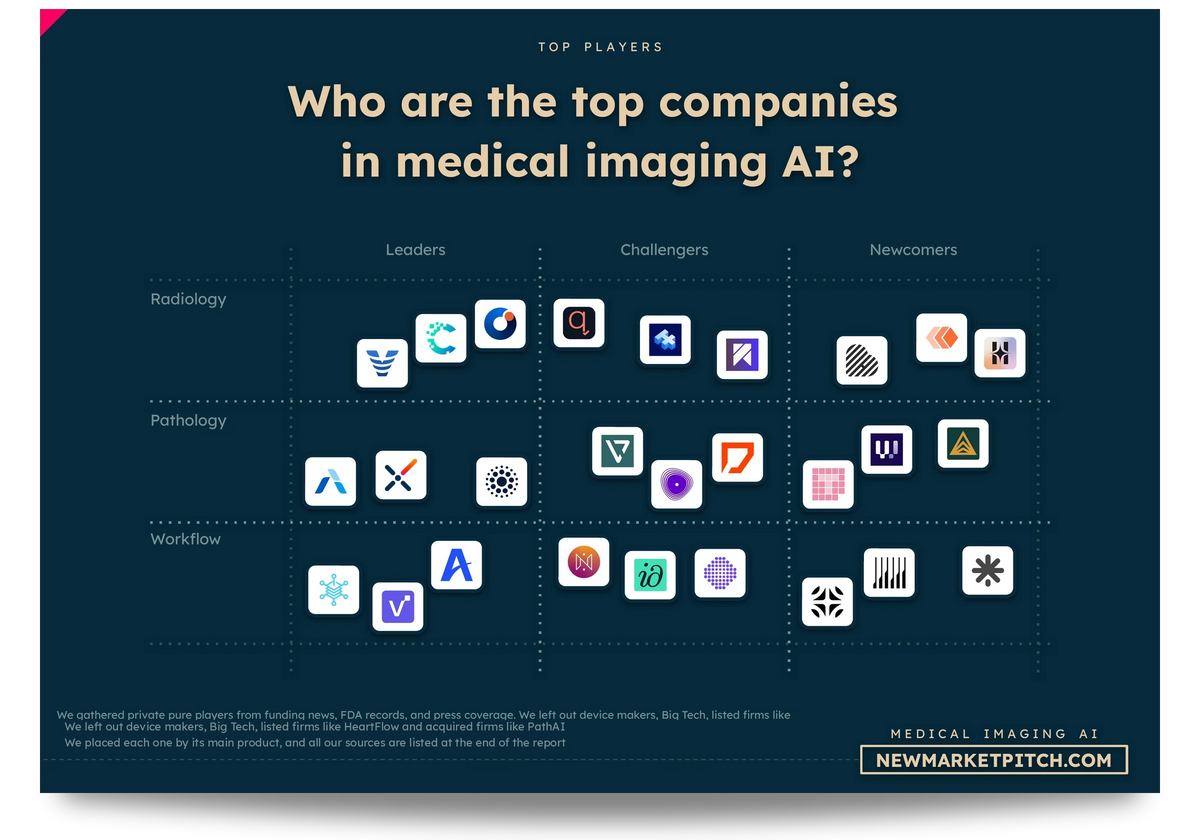
In our report covering the medical imaging AI market, we turn what is vague and complex into simple, useful visuals. Market maps like this one show you at a glance where every startup stands.
Which medical imaging AI startups are we actually comparing?
Seven private medical imaging AI startups belong in the main comparison: Aidoc, Viz.ai, Qure.ai, RapidAI, Harrison.ai, AZmed and Avicenna.AI.
Each one analyzes scans directly and sells software that is in clinical use. Aidoc, Qure.ai and Harrison.ai are building broad radiology systems. Viz.ai and RapidAI started with time-critical diseases such as stroke and are widening into other care pathways. AZmed focuses on high-volume X-rays. Avicenna.AI focuses on urgent and incidental CT findings.
We leave out companies that would distort the picture. Lunit is publicly listed. Gleamer now belongs to RadNet’s DeepHealth after an acquisition worth up to about $270 million. Oxipit, the Lithuanian autonomous chest X-ray company, agreed in March 2026 to be bought by Sectra. Deepc mainly runs the platform through which hospitals deploy other vendors’ algorithms. Rad AI is mostly a reporting and follow-up company. Pathology, retinal and specialist cardiac-imaging startups also sit outside this radiology field. Which neighboring fields sit inside healthcare AI and which sit outside is decided by the market definition in our market report about medical imaging AI.
Funding totals are approximate because private-company databases treat debt, grants and secondary sales differently. The gaps are still large enough to show who has serious financial firepower.
| Startup | Main medical imaging focus | Approximate cumulative funding | Why it belongs |
|---|---|---|---|
| Aidoc | Broad CT and X-ray analysis, triage, care coordination and report drafting | More than $500 million, including a $150 million Series E in April 2026 | The broadest private enterprise radiology AI platform |
| Viz.ai | Disease detection and coordination across imaging and clinical data | About $252 million | One of the largest hospital networks and the clearest profitability evidence |
| Harrison.ai | Comprehensive chest X-ray and CT interpretation | About $240 million | Broad second-reader technology with major NHS and Asia-Pacific deployments |
| Qure.ai | Chest X-ray, lung cancer, tuberculosis and neurocritical imaging | About $123 million | The widest international deployment network among the startups |
| RapidAI | Stroke, neurocritical, vascular and pulmonary imaging | About $100 million | The deepest specialist clinical evidence and a large hospital base |
| AZmed | Fracture, chest, bone-age and measurement tools for X-rays | About $22 million | An unusually capital-efficient X-ray specialist |
| Avicenna.AI | Emergency, vascular, trauma, spine and incidental CT findings | About $11 million | A small company with a large regulatory footprint |
Is Aidoc already the clear leader in medical imaging AI?
Aidoc leads medical imaging AI overall, but Viz.ai is close enough that this is not yet a one-company race.
Aidoc combines 31 company-stated FDA clearances, deployments in nearly 2,000 hospitals and more than $500 million in funding. What matters most is the shift in its technology. In January 2026, the FDA cleared its foundation-model product for 11 acute triage indications at once, which moves Aidoc away from a catalog of single-disease tools. In April 2026, it raised a $150 million Series E led by Goldman Sachs Alternatives, with NVIDIA and SoftBank also taking part. In June 2026, its First Read product, which reads chest X-rays and drafts preliminary report text for a radiologist to check, received a Breakthrough Device Designation. That designation speeds up the FDA review. It is not a clearance.
Viz.ai has a similar hospital footprint and better financial evidence. In July 2026, the company said its platform runs in 2,000 hospitals. In January 2026, it said its healthcare business had turned profitable during 2025. Its Agent Studio lets health systems build their own AI care pathways instead of buying only fixed workflows designed by Viz.ai.
Qure.ai is closing in on the top two. It reports more than 5,500 sites across over 105 countries, 45 million lives reached and 26 FDA-cleared indications, and it added an FDA clearance for CT lung-nodule software in September 2026. RapidAI is stronger in stroke evidence and reports more than 2,500 hospital deployments, but its growth and finances are less visible.
The result is one leader, one very close challenger and two strong companies right behind. On our rough editorial index where Aidoc equals 100, Viz.ai sits around 91, Qure.ai around 84 and RapidAI around 81. The gaps widen sharply after the top four.

Our research about AI for medical imaging gets updated several times a month, so you always get the latest view of where things stand.
Which startup has the strongest FDA portfolio in medical imaging AI?
Aidoc has the strongest proprietary FDA portfolio among the broad medical imaging AI startups.
The company reports 31 FDA clearances across acute, vascular, abdominal, pulmonary, neurological and incidental findings. The most important is the January 2026 clearance of its comprehensive product, which covers 11 acute indications from one foundation model. Aidoc says the system produces about ten times fewer false alerts than leading single-condition tools. That is a company claim, and independent studies have not yet confirmed the size of the gain.
Qure.ai is the closest regulatory challenger. In February 2026, the FDA cleared six new indications for its chest X-ray product, taking the company to 26 cleared indications. It had 19 a few months earlier, a fast climb by any standard in this field. In September 2026, the FDA also cleared qCT Lung, its CT software that flags lesions suspicious for cancer.
Harrison.ai holds nine FDA clearances covering 13 radiological findings. Its international products read far more findings, but only a small part of that range has U.S. authorization.
Viz.ai says its platform runs more than 50 AI care pathways. Treat that figure with care. A pathway count can include several modalities and partner products, so it does not equal the number of regulatory submissions the company owns.
Aidoc stays first on regulatory breadth. Qure.ai is closing the gap faster than anyone else.
Which medical imaging AI startup has the biggest and deepest deployment network?
Qure.ai has the widest reported site network. RapidAI, Aidoc and Viz.ai are stronger inside large hospital systems.
Qure.ai reports more than 5,500 sites across over 105 countries. It reported more than 4,500 facilities in its 2024–25 financial year and around 4,800 later in 2025. That is roughly 1,000 new locations in a little over a year.
Those locations include hospitals, screening programs, mobile units and small clinics. A Qure.ai screening site can be a much lighter deployment than an enterprise contract that links imaging, alerts, specialists and treatment.
RapidAI reports more than 2,500 hospitals in over 100 countries. Viz.ai and Aidoc each sit at roughly 2,000 hospitals, by their own counts from mid-2026. Aidoc also works with more than 150 health systems, and Viz.ai says it reaches a majority of the 50 largest U.S. health systems.
Depth changes the ranking. Aidoc runs several clinical applications through one technical layer. Viz.ai ties radiology findings to specialist alerts, transfers and treatment. RapidAI pairs imaging analysis with stroke and vascular workflows that hospitals have used for years.
Harrison.ai has moved into national-scale deployment. Its software runs across more than 58 NHS trusts and health boards covering over 150 hospitals. AZmed reports more than 2,500 healthcare facilities, mostly lighter X-ray deployments.
Qure.ai leads on physical reach. RapidAI has the largest clearly hospital-based count. Aidoc and Viz.ai look strongest once the test becomes large, deeply integrated enterprise networks.
| Startup | Latest reported scale | What the figure mainly represents | Current position |
|---|---|---|---|
| Qure.ai | 5,500+ sites in 105+ countries (company-stated) | Hospitals, clinics, screening sites and public-health programs | Widest physical and geographic reach |
| RapidAI | 2,500+ hospitals in 100+ countries (company-stated) | Acute-care and specialist hospital workflows | Largest clearly hospital-based footprint |
| AZmed | 2,500+ healthcare facilities in 55+ countries (company-stated) | Mostly radiology and X-ray locations | Exceptional scale for its funding |
| Viz.ai | About 2,000 hospitals, 50+ care pathways (company-stated, July 2026) | Disease detection and care coordination | One of the deepest U.S. hospital networks |
| Aidoc | Nearly 2,000 hospitals, 150+ health systems (company-stated) | Enterprise radiology and clinical AI deployments | Strongest broad health-system presence |
| Harrison.ai | 1,000+ customer sites (company-stated) | Hospitals, imaging networks and public systems | Major UK and Asia-Pacific position |
| Avicenna.AI | Regulatory access in 50+ countries | Current deployment count not disclosed | Broad authorization, smaller visible adoption |

In our market report about AI for medical imaging, we look at what the winners do differently, so you can learn from the best instead of guessing.
Which medical imaging AI startup has turned its technology into the strongest business?
Viz.ai has the clearest commercial lead because it pairs a network of about 2,000 hospitals with disclosed profitability.
In January 2026, Viz.ai said its healthcare business became profitable during 2025. Its life-sciences arm, which works with drug makers to find eligible patients, also kept growing and doubled its partnerships over 18 months. Profit is stronger evidence than a valuation. It shows that customers pay enough to carry the operating business. Viz.ai has not published revenue figures, so the size of that profit is not disclosed. Profit shows a business model works, and we look at which healthcare AI models make money and keep their margins in our report covering the medical imaging AI market.
Aidoc may already earn more, but it does not publish revenue or profit. Two $150 million rounds less than a year apart, a large hospital base and big health systems as customers point to strong demand. We still cannot tell how much recurring revenue each hospital brings or how close Aidoc is to profit.
Qure.ai gives more operating evidence than most private rivals. In its 2024–25 financial year, its software reached more than 32 million people across 4,500 facilities. Its tuberculosis product screened more than seven million people that year and flagged about 650,000 as at risk. It has since passed 5,500 sites, and its chief executive has publicly set a goal of an IPO within about two years.
Capital efficiency tells a different story. RapidAI built a 2,500-hospital footprint on about $100 million raised. AZmed passed 2,500 facilities on about $22 million. Avicenna.AI reached regulatory access in more than 50 countries with only about $11 million in reported equity funding.
Harrison.ai is the hardest business to judge. It has raised about $240 million, including a $112 million Series C, runs at more than 1,000 sites and is becoming part of NHS infrastructure. It says little about software revenue or profit.
Viz.ai leads commercially because it has scale and profit together. Aidoc probably operates at a larger financial scale but shows too little to prove it.
Is Aidoc or Qure.ai growing faster in medical imaging AI?
Aidoc has the strongest all-round momentum. Qure.ai is growing faster on the two numbers that can be measured: sites and FDA indications.
Aidoc’s 2026 is the most complete run of progress in the field. The foundation-model clearance came in January, the $150 million Series E in April and the Breakthrough Device Designation for report drafting in June. Capital, product scope and regulation are moving together, which makes this more than a string of unrelated announcements.
Qure.ai has the cleanest growth curve. Its footprint rose from more than 4,500 facilities to more than 5,500, and its FDA-cleared indications rose from 19 to 26. In November 2025, it partnered with Microsoft to bring its lung cancer detection suite to the Precision Imaging Network in the United States. It also has Gates Foundation support to develop point-of-care ultrasound AI for tuberculosis and childhood pneumonia. In September 2026, it said its Aira clinical decision-support system won an EU MDR Class IIb certificate; that is a clinical software certificate, not an imaging clearance.
Viz.ai is growing in a more disciplined way. It reached profit in healthcare, reached 2,000 hospitals and more than 50 care pathways by July 2026, and launched Agent Studio. A pulmonary suite also takes it beyond the stroke and vascular work that built the company.
RapidAI added five FDA-cleared imaging modules in a single release, covering medium-vessel occlusions, midline shift, hyperdensities and aortic measurements. It also had 28 abstracts accepted at the International Stroke Conference.
Harrison.ai could become the fastest-moving challenger. Harrison.Rad 1.5 uses images, clinical context and prior exams to draft reports, and the company’s technical report says it was the only model tested to pass a simulated radiology board exam. That is a research result, not proof of routine clinical use.
Aidoc holds the momentum lead because more things are moving at once. Qure.ai wins on pure measured growth, from a smaller base.

In our document detailing everything you need to know about medical imaging AI, you will always find fresh funding data, taken straight from our own verified funding database.
Which startup has the most mature medical imaging AI product?
RapidAI has the most mature specialist product. Aidoc has the most mature broad radiology platform.
RapidAI has spent years building software around acute stroke decisions. Its products analyze non-contrast CT, CT angiography and perfusion imaging, and its workflow tools help specialists review cases and coordinate treatment. The company reports more than 700 clinical studies and over 2,500 hospital deployments.
Aidoc is more mature across many clinical areas. Its software runs continuously over hospital imaging, flags urgent exams and connects findings to care teams. The January 2026 foundation-model clearance lets a hospital cover 11 acute conditions through one system.
Viz.ai has the most mature workflow after a finding is made. Its software alerts specialists, shares scans, organizes transfers and tracks cases through treatment.
Qure.ai is most mature in public health and low-resource settings. Its tuberculosis program alone handled more than seven million screenings in one financial year.
A stroke center could fairly put RapidAI first. A health system that wants one broad imaging AI platform would probably pick Aidoc.
Which medical imaging AI startup has the strongest clinical evidence?
RapidAI still has the deepest clinical evidence. Qure.ai leads in large public-health programs, and AZmed has become a serious evidence-based challenger in X-ray.
RapidAI reports more than 700 clinical studies, including research tied to the expansion of stroke treatment guidelines. It also presented 28 abstracts at the International Stroke Conference. Some papers use RapidAI as a measuring or patient-selection tool rather than testing the full commercial product, but its research base is still far deeper than most rivals’.
Qure.ai has built a broad evidence library across tuberculosis, lung cancer, stroke and chest imaging. Its 2024–25 impact report describes more than seven million tuberculosis screenings and more than five million people screened for lung cancer across 20 countries. The value of this evidence is that it comes from national programs and hard real-world settings, not only controlled hospital datasets. Real-world evidence counts for more than demos, so we separate healthcare AI that works today from what is still being tested in our medical imaging AI market report.
Aidoc has credible workflow and diagnostic studies, though its public research count is smaller than RapidAI’s. A randomized intracranial-hemorrhage study found that AI prioritization cut average reporting time from 132 minutes to 73. A quality-assurance study found fewer missed hemorrhages when radiologists received Aidoc alerts.
AZmed has strengthened its position. One large international evaluation covered more than 258,000 X-rays from 100 clinical centers in 26 countries. Another validation study covered 18 chest and musculoskeletal conditions using more than 21,000 exams from 52 centers in 20 countries.
Harrison.ai’s foundation-model research is ambitious, but much of it still rests on company-led benchmarks and simulated exams. Viz.ai has useful studies on shorter treatment delays and better coordination.
RapidAI stays first on clinical evidence because its research has built up over many years and links directly to established stroke care.

Learning from others' mistakes is the cheapest lesson there is. In our report covering the medical imaging AI market, we look at what broke startups before you, so you don't repeat it.
Can any medical imaging AI startup prove that its algorithms are the most accurate?
No. No medical imaging AI startup can credibly claim the best accuracy across every scan type and disease.
The companies solve different problems. Finding a brain bleed on CT, a fracture on X-ray and tuberculosis on a chest film need different datasets, thresholds and clinical trade-offs. Lining up their published sensitivity figures side by side would produce a false ranking.
Even for one disease, performance shifts with the patient population, the scanner, image quality and the chosen threshold. Older patients, prior disease and unusual imaging protocols can all weaken results.
Independent head-to-head tests are the fairest evidence. One comparison of five commercial tuberculosis systems found that Qure.ai’s qXR had the highest area under the curve, at about 90.8%. The lead over the next product was small, and every product did worse in some patient groups.
AZmed’s study across 258,000 X-rays is useful because it spans 100 centers and 26 countries. That size makes it less likely that the results reflect one hospital’s scanners or patients. It still does not show how the product changes everyday decisions; that needs prospective studies.
Aidoc’s foundation-model product could make future comparisons easier, because one system can be tested across 11 acute findings at once. Its claim of far fewer false alerts than single-condition tools still needs independent confirmation.
Qure.ai has the cleanest independent win in a narrow head-to-head study. RapidAI, Aidoc and Viz.ai have stronger evidence that their products improve complex clinical workflows.
Which medical imaging AI startup offers hospitals the best economics?
Viz.ai has the strongest proven economic case in large U.S. hospitals. Qure.ai and AZmed look better suited to high-volume, low-cost imaging.
Viz.ai built its business around diseases where minutes decide treatment. Faster stroke alerts can help hospitals move more patients to thrombectomy, avoid needless transfers and save specialist time. It also won one of the first dedicated Medicare add-on payments for medical AI.
Aidoc’s case rests on spreading integration, security and monitoring costs across many applications on one platform. That gets more attractive as hospitals move from one or two algorithms to larger AI portfolios, and the 11-indication foundation-model clearance strengthens it. Aidoc does not publish enough pricing data to work out a clear payback period.
Qure.ai can screen large populations on equipment that already exists, then send costlier tests to higher-risk patients. AZmed applies the same high-volume logic to routine X-ray departments.
Prices stay private across most of the industry. Viz.ai has the best-documented case for complex hospital care. Qure.ai and AZmed probably offer better economics for mass screening and routine radiography.

Your time is limited. In our research about AI for medical imaging, we put numbers on each part of the market, so you can see where it makes sense to focus.
Which medical imaging AI startup has the hardest advantage to copy?
Viz.ai has the stickiest workflow advantage. Aidoc may be building the stronger long-term platform.
Viz.ai’s software links radiology, emergency teams, specialists, transfers and treatment. Ripping it out can disrupt several departments at once, which creates real switching costs. Making software painful to replace is one of the moves we study when we ask what leaders consistently do differently in our report on medical imaging AI.
Aidoc’s edge comes from breadth, data and deployment experience. Nearly 2,000 hospitals expose it to many scanners, workflows and clinical settings. Its foundation-model approach, now cleared by the FDA for 11 indications, should let it add new applications faster than rivals that build one model per disease.
Qure.ai owns a different moat. Its ties with health ministries, public-health programs, nonprofit funders and clinics in more than 105 countries took years to build.
RapidAI benefits from deep clinical trust in stroke, where hospitals are slow to replace proven tools without strong evidence.
Viz.ai has the higher switching costs today. Aidoc has the clearer path to a broad technology platform.
Which startup leads each part of the medical imaging AI market?
Medical imaging AI has several specialist leaders, even though Aidoc holds the strongest overall position.
RapidAI is the benchmark for deep stroke imaging. Viz.ai is best at moving patients and information through a treatment pathway. Qure.ai leads global tuberculosis and public-health imaging. Harrison.ai is furthest ahead in comprehensive second reading of chest X-rays and CT. AZmed has built a strong position in routine radiography and fracture detection.
These lines are blurring. Aidoc is moving into report drafting. Harrison.ai is building foundation models. Qure.ai is pushing further into the United States and ultrasound. RapidAI and Viz.ai are adding diseases beyond stroke.
| Medical imaging AI segment | Current leader | Why it leads today | Closest challenger |
|---|---|---|---|
| Broad enterprise radiology AI | Aidoc | Best mix of regulatory breadth, hospital depth and a cleared foundation-model platform | Viz.ai |
| Stroke image analysis | RapidAI | Deepest clinical evidence and full neurovascular imaging workflow | Viz.ai |
| Stroke and acute-care coordination | Viz.ai | Strongest specialist alerts, transfers and treatment orchestration | RapidAI |
| Global tuberculosis and public-health imaging | Qure.ai | Largest geographic footprint and millions of annual screenings | No close broad-platform rival |
| Comprehensive chest X-ray and CT second reading | Harrison.ai | Broad multi-finding products and advanced reporting research | Aidoc |
| Routine X-ray and fracture detection | AZmed | More than 2,500 facilities and growing independent validation | Harrison.ai |
| Emergency and incidental CT findings | Aidoc | Wider product breadth and much greater enterprise scale | Avicenna.AI |
| Configurable care pathways across specialties | Viz.ai | Hospitals can build workflows through Agent Studio | Aidoc |

In our market report about AI for medical imaging, we always try to gather several sources and make estimates that make sense, so you can work with solid numbers.
Could Viz.ai or Qure.ai overtake Aidoc in medical imaging AI?
They could, but neither has done it yet. Viz.ai and Qure.ai have the clearest paths to challenge Aidoc, and Harrison.ai has the most upside from a lower starting point.
Viz.ai could move first if it stays profitable while Agent Studio spreads across several specialties. Its next proof point would be a revenue figure, which it has not disclosed.
Qure.ai could reach the top two by turning its 5,500-site footprint into deeper recurring revenue and larger U.S. health-system contracts. Its stated IPO goal would force it to publish audited numbers, which would settle the question either way.
RapidAI could rise by showing that its push beyond stroke brings real enterprise adoption.
Harrison.ai could jump several places if its report-drafting model wins regulatory approval and works reliably in hospitals.
Consolidation is the wild card. RadNet paid up to about $270 million for Gleamer and has committed over $340 million to acquisitions in 2026. Sectra moved on Oxipit. A large buyer taking over one of the top four would change the field overnight.
Aidoc’s main test is economic. More than $500 million in funding raises the bar. Further clearances will matter less than repeat usage, customer expansion and a credible path to profit.
Which medical imaging AI startups are actually ahead?
Aidoc is the strongest medical imaging AI startup overall, followed closely by Viz.ai, with Qure.ai ahead of RapidAI for third place.
Aidoc wins on the most complete mix of regulatory breadth, enterprise deployment, technical ambition, strategic customers and momentum. Its 11-indication foundation-model clearance in January 2026 and its Breakthrough Device Designation for report drafting in June 2026 give it a credible route beyond single-condition triage.
Viz.ai remains a serious threat. It has a hospital network of similar size, a profitable healthcare business and a deeply embedded coordination layer. Aidoc covers more of the radiology stack. Viz.ai has shown more clearly that its core business pays for itself.
Qure.ai holds third because its evidence has strengthened fast. It reports more than 5,500 sites, 45 million lives reached and 26 FDA-cleared indications. Its reach is wider than RapidAI’s, and its 2026 regulatory gains have narrowed the gap with the leading U.S. platforms.
RapidAI remains very strong and could fairly rank third for a hospital focused on stroke and neurovascular disease. It ranks fourth overall because the market is moving toward multi-disease platforms, comprehensive image reading and configurable enterprise workflows.
Harrison.ai holds fifth place. Its NHS expansion and foundation-model research give it more upside than AZmed or Avicenna.AI, but its U.S. approvals and visible commercial scale trail the top four.
The gap between the top two is small. Aidoc leads today, but profitable growth at Viz.ai could reverse the order. Qure.ai and RapidAI form the next tier, with Qure.ai carrying more momentum and RapidAI keeping deeper specialist strength.
| Rank | Startup | Why it holds this position |
|---|---|---|
| 1 | Aidoc | The strongest overall mix of regulatory breadth, enterprise adoption, a cleared foundation-model platform, funding and 2026 momentum |
| 2 | Viz.ai | The best commercial evidence, with profitability, about 2,000 hospitals and deeply embedded care-coordination workflows |
| 3 | Qure.ai | More than 5,500 sites, 26 FDA-cleared indications plus a September 2026 lung CT clearance, fast expansion and unmatched global public-health reach |
| 4 | RapidAI | The deepest clinical evidence and specialist maturity, especially in stroke, but slower visible expansion into a broad imaging platform |
| 5 | Harrison.ai | Major NHS adoption and leading foundation-model research, with commercialization and U.S. regulatory breadth still catching up |
| 6 | AZmed | More than 2,500 facilities, growing clinical evidence and exceptional capital efficiency in routine X-ray imaging |
| 7 | Avicenna.AI | Strong regulatory reach and focused CT products, offset by a smaller visible deployment and commercial footprint |
Our methodology
Which medical imaging AI startup is ahead cannot be answered with a single statistic. Funding, FDA clearances, hospital deployments, published studies and commercial results each capture only one part of the picture.
We split the comparison into the dimensions that most directly show leadership: regulatory progress, clinical adoption, commercial traction, product maturity, clinical evidence, workflow integration, international reach and recent momentum.
We looked for several recent, independent indicators pointing the same way rather than letting one funding round, regulatory milestone or headline deployment figure decide the ranking.
We also separated metrics that look alike but prove different things. We distinguished deployment breadth from deployment depth, specialist leadership from overall platform leadership, and recent acceleration from long-term position.
Company-reported site counts were read according to what those sites are. A screening site, mobile unit or small imaging center was not treated as equal to a deeply integrated hospital deployment linking radiology, specialist alerts, transfers and treatment.
Regulatory comparisons focused on each company’s own products and cleared indications where possible. Platform-wide algorithm counts were treated separately because they may include several applications, modalities or third-party products. A Breakthrough Device Designation was counted as a regulatory signal, not as a clearance.
Clinical evidence was weighted by independence, sample size, number of centers and link to real clinical decisions. Large multicenter studies and evidence tied to established care pathways counted more than company-led benchmarks or simulated exams.
Commercial traction weighed more when companies disclosed operating evidence such as profitability, recurring adoption, customer expansion or measurable program activity. Funding counted mainly when it had clearly turned into better products, wider deployments or stronger customer access. Key figures such as funding rounds, clearances and profitability were checked against a second, independent source where one existed.
The final ranking is an editorial synthesis, not a mechanical scorecard. It combines the strongest recent evidence across these dimensions and gives more confidence to conclusions backed by several kinds of proof.
Key sources used for the analysis include the U.S. Food and Drug Administration’s device-clearance resources, the FDA 510(k) database, the FDA Breakthrough Devices Program, the FDA list of AI-enabled medical devices, Aidoc’s June 2026 First Read announcement, Viz.ai’s July 2026 ten-year milestone release, ClinicalTrials.gov, PubMed, the American Heart Association’s journals, the Radiological Society of North America, the American College of Radiology, the World Health Organization, the CDC’s tuberculosis resources, the Gates Foundation, the Centers for Medicare & Medicaid Services, EUDAMED and the NHS.
We also used current product, regulatory, deployment and company disclosures from Aidoc, Viz.ai, Qure.ai, RapidAI, Harrison.ai, AZmed and Avicenna.AI.

If you build or invest in the medical imaging AI market, you need to know which business models pay off now and which ones are fading. That's why our report covering it has a whole section on it.
Written by the New Market Pitch teamWe track new markets so founders and investors can move faster. About us